


Report Overview
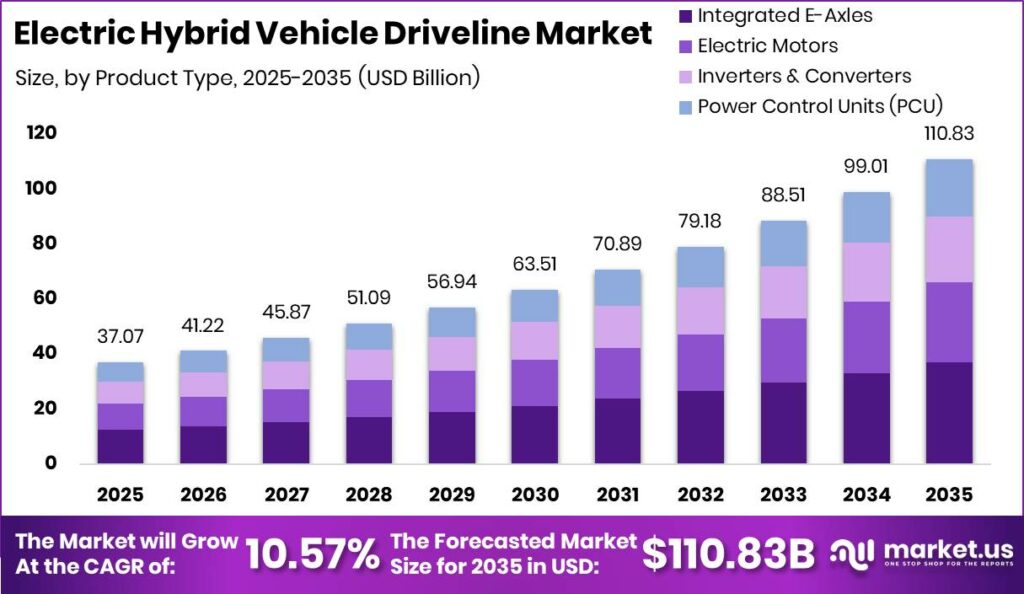
Global Electric Hybrid Vehicle Driveline Market size is expected to be worth around USD 110.83 Billion by 2035 from USD 37.07 Billion in 2025, growing at a CAGR of 10.57% during the forecast period 2026 to 2035. Hybrid driveline demand tracks automaker compliance planning rather than consumer novelty. Suppliers with hybrid-ready transmission lines therefore win multi-year platform contracts instead of single-model orders.
The electric hybrid vehicle driveline covers the components that move electric and engine power to the wheels. Integrated e-axles, electric motors, inverters and converters, and power control units form the core hardware set. Automakers buy these parts as bundled systems, not loose components. This means Tier-1 suppliers who own motor, inverter, and transmission engineering together capture far more value per vehicle than single-part vendors.
Key Takeaways
- Market size reached USD 37.07 Billion in 2025 and will hit USD 110.83 Billion by 2035 at a CAGR of 10.57%.
- Integrated E-Axles led the component group with a 33.50% share.
- Parallel Configuration held 48.00% of the architecture type group.
- Electronic Continuously Variable Transmission captured 41.00% of transmission demand.
- Battery Electric Vehicles accounted for 57.00% of the vehicle type group.
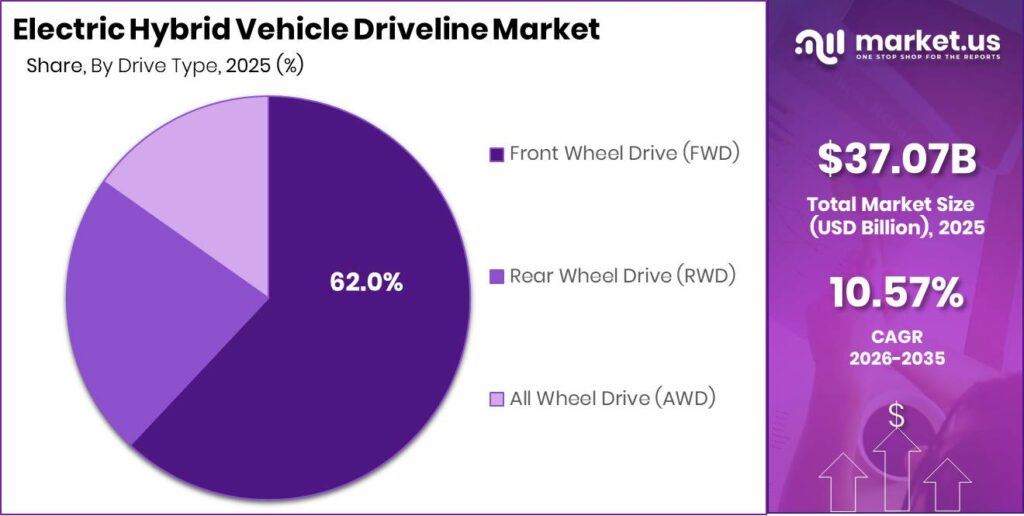
- Front Wheel Drive commanded 62.00% of the drive type group.
- The 45 to 100 kW band held 51.00% of motor power output demand.
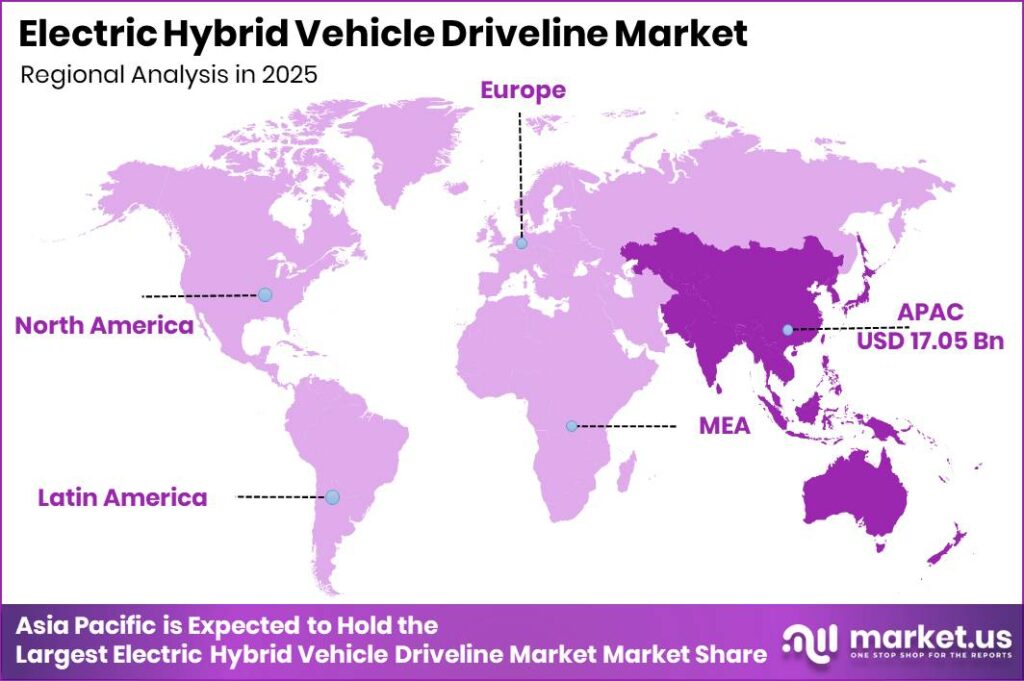
- Asia Pacific Dominates the Electric Hybrid Vehicle Driveline Market with a Market Share of 42.30%, Valued at USD 17.05 Billion
Government emission rules now set the pace of driveline investment. Under the European Commission CO2 standards, automakers pay €95 per gram of CO2 per km above their fleet limit. This penalty makes hybrid drivelines the cheapest compliance tool available. As a result, powertrain budgets shift toward electrified transmissions instead of new combustion programs, and suppliers with certified hybrid systems gain pricing leverage on long-term supply deals.
Real-world efficiency data supports that spend. A 2025 peer-reviewed study found hybrid electric vehicles cut average fuel-consumption factors by 39.3% on freeways and expressways against combustion vehicles. Fleet buyers translate that saving into lower running costs per vehicle. Consequently, commercial and taxi operators upgrade earlier than private buyers, giving suppliers a predictable replacement cycle in the automotive powertrain space.
Adoption is broadening across mainstream showrooms. The U.S. Energy Information Administration reported about 22% of new U.S. light-duty vehicles in 2025 were hybrids, plug-in hybrids, or battery-electric models, up from 20% in 2024. This growth pulls driveline demand into high-volume segments. Therefore component makers must cut unit cost fast, because mass-market platforms reward scale far more than premium engineering.
Component Analysis
Integrated E-Axles dominates with 33.50% due to compact packaging cutting assembly line cost.
In 2025, Integrated E-Axles held a dominant market position in the By Component segment of Electric Hybrid Vehicle Driveline Market, with a 33.50% share. Trade data from UN Comtrade shows single-phase AC motor trade under HS 850140 reached USD 6.03 Billion in 2024, rising 6.2% year on year. This means e-axle builders can source motor inputs from a deep global base, protecting delivery schedules during demand spikes.
Electric motors carry the torque duty in every hybrid driveline and set the ceiling on vehicle performance. UN Comtrade records show the same motor trade code moved across 171 countries through 5,411 bilateral corridors in 2024. Such spread signals commoditised supply at the low end. Therefore motor makers must compete on thermal management and control software, not raw output, to defend margin against low-cost entrants.
Inverters and converters govern how efficiently stored energy reaches the motor. Renault reports its new 160 hp full-hybrid E-Tech driveline consumes 4.3 L per 100 km, saving up to 40% of fuel versus an equivalent petrol powertrain. Power electronics deliver much of that gain. As a result, buyers pay premiums for higher-switching-frequency units, rewarding suppliers who invest in advanced electric vehicle components early.
Power Control Units act as the decision layer, choosing between engine and battery power each second. Toyota states its Land Cruiser Hybrid 48V system adds 12 kW and 65 Nm during initial acceleration when the battery is fully charged. Control calibration unlocks that boost. This creates recurring software revenue for suppliers, since automakers keep tuning drivability long after the hardware contract closes.
Architecture Type Analysis
Parallel Configuration dominates with 48.00% due to direct engine coupling lowering system complexity.
In 2025, Parallel Configuration held a dominant market position in the By Architecture Type segment of Electric Hybrid Vehicle Driveline Market, with a 48.00% share. ACEA reported hybrid-electric cars took 34.4% of new registrations across the EU, EFTA, and UK in 2025, ahead of petrol at 26.1%. Parallel layouts serve most of those vehicles. This means volume tooling already exists, keeping entry costs low for suppliers.
Power-Split Systems rank as the fastest growing architecture because they blend engine and motor torque continuously for city driving. ACEA data shows EU plug-in and hybrid demand grew strongly in Spain, where hybrid-electric registrations rose 23.1% in 2025. Southern European traffic favours split operation. Therefore suppliers targeting these markets should prioritise planetary gearset capacity over conventional gearbox lines.
Series Configuration keeps the engine as a generator only, which simplifies drivability tuning for buyers new to electrification. ZF introduced its upgraded 8HP evo hybrid transmission concept in June 2025, adding electric range extender technology for extended-range architectures. Range extenders sit squarely in series territory. This signals that series demand will follow supplier readiness rather than consumer pull, favouring firms with existing generator-set expertise.
Plug-in Hybrid architectures let drivers cover daily trips on electricity alone. ACEA figures show plug-in-hybrid registrations reached 1,015,887 units in the EU during 2025, lifting share to 9.4% from 7.2% a year earlier. That jump increases demand for larger batteries and onboard chargers. Consequently driveline suppliers must qualify higher-voltage components or lose plug-in programs entirely.
Transmission Type Analysis
Electronic Continuously Variable Transmission dominates with 41.00% due to smooth ratio control saving fuel.
In 2025, Electronic Continuously Variable Transmission held a dominant market position in the By Transmission Type segment of Electric Hybrid Vehicle Driveline Market, with a 41.00% share. ACEA recorded 3,733,325 new hybrid-electric car registrations in the EU during 2025. Most of these use dedicated hybrid transmissions. This means eCVT capacity utilisation stays high, letting incumbent suppliers spread fixed tooling cost across large volumes.
Dual Clutch Transmission is the fastest growing type because it preserves sporty shift feel while accepting an electric motor between clutches. Porsche states its 2025 Panamera 4S E-Hybrid develops 400 kW of system power and reaches 60 mph in 3.5 seconds. Performance brands need that response. Therefore DCT suppliers can charge premium prices in a niche where efficiency is not the only buying trigger.
Automatic Transmission remains the default for larger vehicles where towing and load capacity matter more than packaging. ZF expanded production capability for its fourth-generation 8HP transmission family in March 2025, covering mild-hybrid and plug-in hybrid variants. Modular platforms let one housing serve many programs. As a result, automakers can electrify existing models without new assembly lines, protecting near-term automatic transmission volumes.
Vehicle Type Analysis
Battery Electric Vehicle dominates with 57.00% due to full electric drivelines needing no engine.
In 2025, Battery Electric Vehicle held a dominant market position in the By Vehicle Type segment of Electric Hybrid Vehicle Driveline Market, with a 57.00% share. ACEA reported 1,880,370 new battery-electric registrations in the EU in 2025, taking 17.4% share against 13.6% one year earlier. This means driveline suppliers face rising volume with fewer parts per vehicle, so content per unit must come from integration, not part count.
Plug-in Hybrid Electric Vehicles grow fastest because they answer range anxiety without full charging dependence. Opel states its 2025 Grandland plug-in hybrid travels up to 87 km on electricity and offers up to 897 km of combined range. Buyers value that flexibility. Therefore suppliers who can deliver both a motor and an engine interface in one unit hold the strongest bid position.
Hybrid Electric Vehicles serve buyers who want lower fuel bills without changing charging habits. ACEA reported hybrid-electric models took 34.4% of new registrations across Europe in 2025, well ahead of petrol at 26.1%. This scale keeps engine-plus-motor driveline volumes secure through the forecast window. Therefore suppliers should protect combustion interface engineering rather than retire it early, because mainstream demand still funds that capability.
Drive Type Analysis
Front Wheel Drive dominates with 62.00% due to compact layouts fitting mass-market platforms.
In 2025, Front Wheel Drive held a dominant market position in the By Drive Type segment of Electric Hybrid Vehicle Driveline Market, with a 62.00% share. UNCTAD reported global goods trade rose 12.5% to USD 13.7 Trillion in the first half of 2026, with East Asia growing fastest. East Asian plants build most front-drive hybrid platforms. This means component sourcing stays concentrated, so buyers must plan dual sourcing to limit single-region exposure.
All Wheel Drive grows fastest because a rear e-motor adds traction without a mechanical driveshaft. Automakers achieve four-wheel drive by bolting on a second axle unit. This creates a clean upsell path for e-axle suppliers, since one extra module lifts content per vehicle sharply while reusing existing front-axle validation work.
Rear Wheel Drive serves performance and premium vehicles where weight balance and towing matter. The WTO tariff database records a simple average MFN applied US tariff of 3.4% in 2025, with an effective applied rate of 10.5% as of 24 July 2026. Imported premium rear-drive models absorb that cost. Consequently automakers shift rear-drive hybrid assembly closer to end markets to protect margin.
Motor Power Output Analysis
45 to 100 kW dominates with 51.00% due to matching mainstream passenger car needs.
In 2025, the 45 to 100 kW band held a dominant market position in the By Motor Power Output segment of Electric Hybrid Vehicle Driveline Market, with a 51.00% share. IEA analysis shows plug-in hybrid vehicles rose from roughly 15% of electric car sales in 2020 to nearly 30% in 2024. Most of these use mid-power motors. This means volume economics favour suppliers who standardise one motor family across many nameplates.
The above 250 kW band grows fastest as performance hybrids and large SUVs electrify. High-output units demand liquid cooling, thicker busbars, and silicon carbide inverters. These requirements raise the engineering barrier. Therefore only suppliers with in-house power electronics can bid credibly, which keeps competition thin and pricing firmer than in mainstream power classes.
Motors below 45 kW support mild-hybrid systems that recover braking energy and restart the engine smoothly. Automakers add them to existing platforms at low cost. This creates the cheapest compliance route for legacy model lines, so demand persists wherever fleet rules tighten faster than consumers accept full electrification.
The 101 to 250 kW band bridges family vehicles and light commercial applications. Buyers in this class weigh payload capability against efficiency targets. Consequently suppliers who offer scalable stator lengths within one housing win multiple programs from a single tooling investment, spreading capital cost across more units.
Key Market Segments
By Component
- Integrated E-Axles
- Electric Motors
- Inverters & Converters
- Power Control Units (PCU)
By Architecture Type
- Parallel Configuration
- Power-Split Systems
- Series Configuration
- Plug-in Hybrid
By Transmission Type
- Automatic Transmission (AT)
- Dual Clutch Transmission (DCT)
- Electronic Continuously Variable Transmission (E-CVT)
By Vehicle Type
- Hybrid Electric Vehicle (HEV)
- Plug-in Hybrid Electric Vehicle (PHEV)
- Battery Electric Vehicle (BEV)/Electric Vehicle (EV)
By Drive Type
- Front Wheel Drive (FWD)
- Rear Wheel Drive (RWD)
- All Wheel Drive (AWD)
By Motor Power Output
- Less than 45 kW
- 45 to 100 kW
- 101 to 250 kW
- > 250 kW
Regional Analysis
Asia Pacific Dominates the Electric Hybrid Vehicle Driveline Market with a Market Share of 42.30%, Valued at USD 17.05 Billion
Asia Pacific anchors global driveline output because China, Japan, and South Korea host both automakers and component makers. Regional plants supply motors, inverters, and transmissions to export markets at scale. This concentration lowers unit cost but raises tariff and logistics risk for buyers outside the region. Therefore importers increasingly negotiate local assembly clauses instead of pure supply contracts.
Europe grows fastest as fleet CO2 rules force rapid electrification across mainstream brands. ACEA reported EU plug-in-hybrid share climbed to 9.8% in the first half of 2026, up from 8.5% a year earlier, while overall registrations rose 5.7%. This means European driveline demand rises even in a flat total car market, rewarding suppliers with local certification and nearby capacity.
North America follows a slower but steadier path built on hybrid pickups and SUVs. The region favours higher-output motors and all-wheel-drive layouts over compact front-drive systems. As a result, suppliers selling into North America need different validation targets, including towing durability and cold-weather performance, which raises development cost per program.
Key Regions and Countries
North America
- US
- Canada
Europe
- Germany
- France
- The UK
- Spain
- Italy
- Rest of Europe
Asia Pacific
- China
- Japan
- South Korea
- India
- Australia
- Rest of APAC
Latin America
- Brazil
- Mexico
- Rest of Latin America
Middle East and Africa
- GCC
- South Africa
- Rest of MEA
Market Dynamics
Market Opportunity Analysis - Underserved power classes, drive layouts, and regional platforms offer entry points for new suppliers
The above 250 kW motor class remains thinly served because few suppliers hold in-house power electronics capability. High-output units need liquid cooling and advanced inverters that mainstream vendors avoid. This creates a protected niche where pricing holds firm. Therefore new entrants with silicon carbide expertise can win premium programs without competing against high-volume incumbents on cost.
All Wheel Drive represents a second underexploited path within the drive type group, where Front Wheel Drive still holds 62.00%. Adding a rear e-axle lifts content per vehicle without redesigning the front driveline. This means suppliers already qualified on front axles can double their per-vehicle revenue with modest incremental validation spending.
Series Configuration stays underexploited inside the architecture group led by Parallel Configuration at 48.00%. Range extender demand depends on supplier readiness rather than buyer pull. Consequently firms with generator-set and engine-control experience face limited competition when automakers finally commit to extended-range programs.
North America offers regional upside because its hybrid mix favours larger vehicles rather than compact front-drive platforms. Towing durability and cold-weather validation raise entry barriers for Asia-based suppliers. As a result, investors backing local validation capacity gain access to programs that lower-cost exporters cannot easily contest.
Technology and Innovation Landscape - Integration, power electronics, and control software redefine competitive edges
Integrated e-axles combine motor, inverter, and reduction gearing into one housing, which cuts assembly steps on the vehicle line. This packaging holds 33.50% of component demand. Automakers value fewer interfaces and shorter installation time. This means suppliers who master mechanical and electronic integration together displace vendors selling loose components.
Electronic continuously variable transmissions use planetary gearsets and motor control instead of fixed gear steps, delivering smoother ratio changes and better fuel economy. Renault’s 160 hp E-Tech driveline reaches 4.3 L per 100 km through this approach. Efficiency gains of this scale justify premium pricing, rewarding suppliers with mature planetary gear engineering.
Forty-eight volt mild-hybrid architecture adds electric assist at low system cost. Toyota’s Land Cruiser Hybrid system contributes 12 kW and 65 Nm during initial acceleration. Automakers apply this to existing platforms without full redesign. Therefore mild-hybrid hardware remains the fastest route to compliance revenue for suppliers serving legacy model lines.
Plug-in hybrid range engineering now pushes electric-only capability far higher. Opel’s Grandland delivers up to 87 km on electricity and up to 897 km combined. Longer electric range demands higher-voltage components and stronger thermal management. Consequently suppliers must upgrade insulation and cooling designs or forfeit plug-in program awards entirely.
Drivers
According to the European Commission CO2 standards for cars and vans, manufacturers exceeding fleet targets pay €95 per gram of CO2 per km above the limit. Multiplied across annual registrations, one gram of overshoot creates eight-figure liabilities for high-volume automakers. Hybridised drivelines remain the cheapest way to avoid those penalties. This means suppliers holding certified hybrid transmission capacity win platform awards that combustion-only vendors cannot contest.
The December 2025 Automotive Package preserved a continued role for mild hybrids and combustion-linked drivelines. That certainty keeps automakers investing in electrified transmissions instead of pivoting fully to battery-electric platforms. ICCT fleet-registration tracking shows compliance-cost avoidance per hybrid unit exceeds the incremental driveline bill of materials, protecting component-level powertrain margins of roughly 8% to 12%. Therefore investors backing hybrid driveline capacity face lower obsolescence risk than expected.
| Driver | + Impact on CAGR Forecast | Geographic Relevance | Impact Timeline |
|---|---|---|---|
| Tightening fleet-wide CO2 compliance targets | +2.8% | EU, China, Japan | Short term (2 years or less) |
| Hybrid as bridge amid BEV affordability gap | +2.1% | North America, India, ASEAN | Short term (2 years or less) |
| Shift to dedicated hybrid transmissions (eCVT/DHT) | +1.6% | Global | Medium term (2 to 4 years) |
| Rising fuel prices & TCO advantage of hybrid | +1.3% | Europe, Emerging Asia | Short term (2 years or less) |
| OEM platform consolidation onto hybrid-ready architectures | +1.0% | Global | Medium term (2 to 4 years) |
| Expanding hybrid model availability in mass segment | +0.8% | North America, India | Short term (2 years or less) |
Restraints
Beijing tightened rare-earth export licensing on 4 April 2025, and the Chinese Ministry of Commerce framework placed NdFeB magnets plus dysprosium and terbium inputs under case-by-case approval. Shipments into automotive markets slipped immediately. Permanent-magnet synchronous motors remain the default in hybrid drivelines, so this bottleneck is structural rather than cyclical. As a result, motor sub-assembly lines stop rather than slow, freezing addressable driveline sales at the source.
India’s Press Information Bureau reported affected automakers risked exhausting magnet inventory within roughly 1 month during mid-2025. National customs data show magnet consumption of 1,700 tonnes in 2022 rising nearly tenfold to 15,400 tonnes by 2032. The Union Cabinet approved a Rs. 7,280 crore sintered-magnet scheme on 26 November 2025 targeting 6,000 MTPA. Consequently resupply takes years, leaving buyers exposed to stranded tooling cost.
| Restraint | – Impact on CAGR Forecast | Geographic Relevance | Impact Timeline |
|---|---|---|---|
| Rare-earth magnet export curbs freezing motor output | -2.6% | Global (China-sourced) | Short term (2 years or less) |
| Withdrawal of hybrid tax exemptions & incentives | -1.9% | US, France, EU | Short term (2 years or less) |
| Elevated interest rates suppressing vehicle financing | -1.4% | North America, Europe | Short term (2 years or less) |
| Revised PHEV utility-factor de-rating of tax benefits | -1.1% | EU company-car fleets | Medium term (2 to 4 years) |
| Capital scarcity for dual-powertrain tooling | -0.9% | Global | Medium term (2 to 4 years) |
Challenges
Hybrid drivelines demand engineers fluent in e-motor control, power electronics, and combined mechanical and electrical calibration. Figures from U.S. manufacturing workforce studies show over 1.9 million manufacturing roles could go unfilled by 2033 as the skills gap widens. Reporting on India’s auto supply chain confirms a parallel crunch. This creates a paid services market in contract calibration and validation engineering for firms that build the capability now.
The deficit shows up as longer validation cycles and higher warranty-reserve provisioning. Each unfilled senior calibration role stretches program timelines and cuts research throughput. OECD labour-market indicators show structural tightness in advanced-manufacturing wages across affected economies. Automakers respond with in-house academies and community-college partnerships flagged across 2025 workforce analyses. Therefore training providers and engineering service bureaus capture recurring revenue, since mitigation extends beyond 4 years.
| Challenge | – CAGR Friction / Drag | Geographic Relevance | Mitigation Horizon |
|---|---|---|---|
| Powertrain engineering talent deficit | -1.7% | North America, Europe, India | Long term (4 years or more) |
| Dual-architecture manufacturing complexity | -1.3% | Global | Medium term (2 to 4 years) |
| Thermal & NVH integration of e-drive units | -1.0% | Global | Medium term (2 to 4 years) |
| Power-electronics semiconductor sourcing drag | -0.8% | Global | Medium term (2 to 4 years) |
| Aftermarket & servicing skills gap | -0.6% | Emerging markets | Long term (4 years or more) |
Opportunities
Rare-earth-free traction motors using externally induced-field, ferrite, or synchronous-reluctance designs remain white space. Deployment today sits in pilot programs, not volume driveline platforms. Based on U.S. Department of Energy powertrain research, removing heavy rare-earth dependence strips 10% to 20% out of motor material cost. This means driveline gross margins can widen by several hundred basis points while insulating suppliers from export-licensing volatility.
IEA critical-minerals analysis identifies magnet-material exposure as one of the sharpest concentration risks in electrified drivetrain supply. General Motors signed a multi-year U.S. magnet-sourcing agreement in 2025 and invested in rare-earth-free motor developers. Early movers therefore capture unmet demand before rivals finish validation. However the research and re-tooling required pushes the realistic execution window beyond 4 years, so capital must be patient.
| Opportunity | + Potential CAGR Upside | Geographic Relevance | Execution Window |
|---|---|---|---|
| Rare-earth-free / reduced-magnet motor architecture | +2.3% | Global | Long term (4 years or more) |
| Hybrid driveline localization in emerging Asia | +1.7% | India, ASEAN, Africa | Medium term (2 to 4 years) |
| Commercial & LCV hybrid driveline penetration | +1.4% | North America, Europe | Medium term (2 to 4 years) |
| Magnet recycling & closed-loop material recovery | +1.1% | Global | Long term (4 years or more) |
| Software-defined driveline calibration monetization | +0.9% | Global | Medium term (2 to 4 years) |
| Tier-1 M&A roll-up of hybrid transmission specialists | +0.7% | Europe, North America | Medium term (2 to 4 years) |
Key Company Insights
BorgWarner Inc. concentrates on integrated propulsion hardware spanning motors, inverters, and e-axle assemblies for hybrid and electric platforms. This breadth lets the company bid complete systems instead of single parts, raising content per vehicle and locking in longer program cycles. However heavy exposure to electrified propulsion leaves the company vulnerable if automakers delay hybrid program launches, since capacity commitments cannot flex quickly.
ZF Friedrichshafen AG builds its position around transmission engineering, with the 8HP family scaled across mild-hybrid and plug-in hybrid variants. In March 2025 the company expanded production capability for its fourth-generation 8HP platform, and in June 2025 it presented an upgraded hybrid transmission concept with range extender technology. This modular approach lets automakers electrify existing models without new assembly lines, protecting near-term volumes.
Key Players
- BorgWarner Inc.
- ZF Friedrichshafen AG
- Continental AG
- Robert Bosch GmbH
- GKN Automotive Limited
- Aisin Seiki Co., Ltd.
- AVL List GmbH
- Dana Incorporated
- DENSO Corporation
- Hitachi Automotive Systems
- JTEKT Corporation
- Magna International Inc.
- Mahle GmbH
- Marelli Holdings Co., Ltd.
- Nidec Corporation
- NIO Inc.
- Schaeffler Technologies AG & Co. KG
- SK Innovation
- Valeo Inc.
- XPeng Inc.
- Tesla Inc.
- Toyota Motor Corporation
- Ford Motor Company
- General Motors Company
- Volkswagen AG
- BMW Group
- Nissan Motor Co., Ltd.
- Honda Motor Co., Ltd.
- Hyundai Motor Company
- BYD Company Limited
Recent Developments
- June 2025: ZF Friedrichshafen presented an upgraded 8HP evo hybrid transmission concept incorporating electric range extender technology for extended-range architectures.
- March 2025: ZF Friedrichshafen expanded production capability for its fourth-generation 8HP transmission family covering mild-hybrid and plug-in hybrid variants.
- 2025: Toyota confirmed its Land Cruiser Hybrid 48V system delivers an additional 12 kW and 65 Nm during initial acceleration at full battery charge.
- 2025: Renault detailed a 160 hp full-hybrid E-Tech driveline achieving 4.3 L per 100 km, saving up to 40% of fuel versus petrol equivalents.
- 2025: Opel launched the Grandland plug-in hybrid offering up to 87 km electric range and up to 897 km combined range.
- 2025: Porsche introduced the Panamera 4S E-Hybrid with 400 kW system power and a 3.5 second time to 60 mph.
Geopolitical Impact Analysis
Tariff escalation reshapes driveline sourcing decisions directly. According to WTO Tariff and Trade Data, the United States applied a simple average MFN tariff of 3.4% in 2025, while its effective applied rate reached 10.5% by 24 July 2026. Motors, inverters, and axle assemblies crossing that border absorb the difference. Therefore suppliers relocate final assembly into North America to protect program margins.
Shipping route disruption still inflates component logistics cost. Figures from UNCTAD show Red Sea and Suez disruptions contributed 148 percentage points to a cumulative 120% rise in the China Containerized Freight Index between October 2023 and June 2024. Cape of Good Hope rerouting adds roughly 10 days on Asia to Northwest Europe lanes. Consequently buyers hold larger safety stock of motors and power electronics.
Report Scope
| Report Features | Description |
|---|---|
| Market Value (2025) | USD 37.07 Billion |
| Forecast Revenue (2035) | USD 110.83 Billion |
| CAGR (2026-2035) | 10.57% |
| Base Year for Estimation | 2025 |
| Historic Period | 2020-2024 |
| Forecast Period | 2026-2035 |
| Report Coverage | Revenue Forecast, Market Dynamics, Market Opportunity Analysis, Technology and Innovation Landscape, Competitive Landscape, Recent Developments |
| Segments Covered | By Component (Integrated E-Axles, Electric Motors, Inverters & Converters, Power Control Units (PCU)), By Architecture Type (Parallel Configuration, Power-Split Systems, Series Configuration, Plug-in Hybrid), By Transmission Type (Automatic Transmission (AT), Dual Clutch Transmission (DCT), Electronic Continuously Variable Transmission (E-CVT)), By Vehicle Type (Hybrid Electric Vehicle (HEV), Plug-in Hybrid Electric Vehicle (PHEV), Battery Electric Vehicle (BEV)/Electric Vehicle (EV)), By Drive Type (Front Wheel Drive (FWD), Rear Wheel Drive (RWD), All Wheel Drive (AWD)), By Motor Power Output (Less than 45 kW, 45 to 100 kW, 101 to 250 kW, > 250 kW) |
| Regional Analysis | North America (US and Canada), Europe (Germany, France, The UK, Spain, Italy, and Rest of Europe), Asia Pacific (China, Japan, South Korea, India, Australia, and Rest of APAC), Latin America (Brazil, Mexico, and Rest of Latin America), Middle East and Africa (GCC, South Africa, and Rest of MEA) |
| Competitive Landscape | BorgWarner Inc., ZF Friedrichshafen AG, Continental AG, Robert Bosch GmbH, GKN Automotive Limited, Aisin Seiki Co., Ltd., AVL List GmbH, Dana Incorporated, DENSO Corporation, Hitachi Automotive Systems, JTEKT Corporation, Magna International Inc., Mahle GmbH, Marelli Holdings Co., Ltd., Nidec Corporation, NIO Inc., Schaeffler Technologies AG & Co. KG, SK Innovation, Valeo Inc., XPeng Inc., Tesla Inc., Toyota Motor Corporation, Ford Motor Company, General Motors Company, Volkswagen AG, BMW Group, Nissan Motor Co., Ltd., Honda Motor Co., Ltd., Hyundai Motor Company, BYD Company Limited |
| Customization Scope | Customization for segments, region / country-level will be provided. Additional customization can be done based on requirements. |
| Purchase Options | We have three licenses to opt for: Single User License | Multi-User License (Up to 5 Users) | Corporate Use License (Unlimited User and Printable PDF) |





































