


Overview
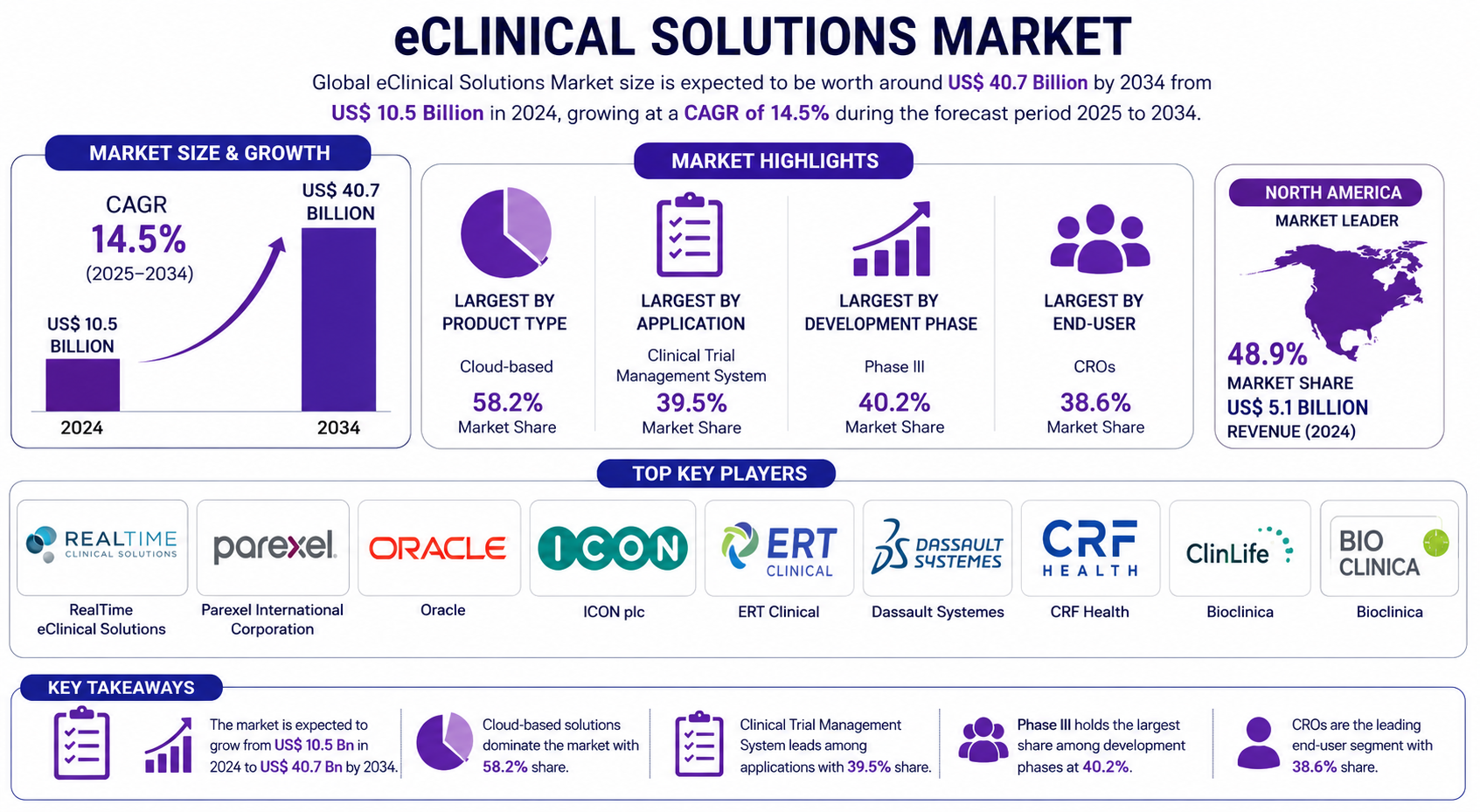
Global eClinical Solutions Market size is expected to be worth around US$ 40.7 Billion by 2034 from US$ 10.5 Billion in 2024, growing at a CAGR of 14.5% during the forecast period 2025 to 2034. North America led the market, achieving over 48.9% share with a revenue of US$ 5.1 Billion.
The global eClinical Solutions market is expanding as pharmaceutical companies, biotechnology firms, and contract research organizations increasingly adopt digital technologies to improve the efficiency, quality, and regulatory compliance of clinical trials. eClinical platforms integrate electronic data capture (EDC), clinical trial management systems (CTMS), electronic clinical outcome assessments (eCOA), randomization, and trial analytics into a unified environment, helping reduce manual processes and accelerate study timelines.
Growing clinical trial complexity, decentralized trial models, and the increasing use of electronic health records are further supporting demand for advanced digital trial management solutions. The U.S. Food and Drug Administration (FDA) continues to encourage the use of secure electronic systems, electronic records, and electronic signatures in clinical investigations to improve data reliability, traceability, and regulatory compliance. FDA guidance also promotes interoperable electronic source data and electronic health record integration for more efficient research workflows.
The importance of digital clinical research infrastructure is increasing as global clinical research activity continues to grow. According to the U.S. National Library of Medicine’s ClinicalTrials.gov database, more than 540,000 clinical studies have been registered across more than 220 countries and territories, highlighting the need for scalable eClinical technologies to manage large volumes of research data efficiently.
Additionally, FDA regulations under 21 CFR Part 11 establish requirements for trustworthy electronic records and electronic signatures, reinforcing industry adoption of validated digital platforms for regulatory submissions and trial oversight. These developments are expected to strengthen investments in cloud-based, AI-enabled, and interoperable eClinical solutions over the coming years.
Key Takeaways
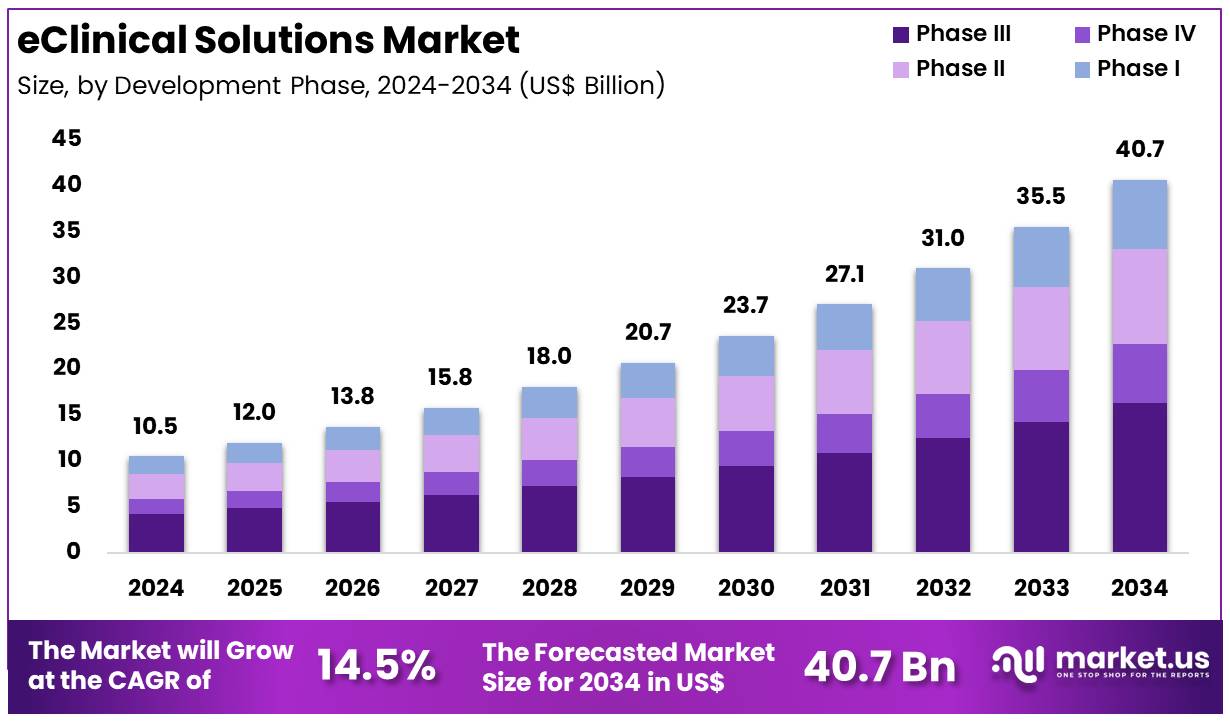
- The global eClinical Solutions market was valued at US$ 10.5 billion in 2024 and is projected to reach US$ 40.7 billion by 2034, expanding at a CAGR of 14.5% during the forecast period.
- Among product types, the cloud-based segment dominated the market, accounting for 58.2% of the total share due to its scalability and ease of deployment.
- By application, the Clinical Trial Management System (CTMS) segment held the largest share at 39.5%, supported by increasing adoption for efficient trial planning and monitoring.
- Based on development phase, Phase III emerged as the leading segment, capturing 40.2% of the market as a result of the high volume of late-stage clinical trials.
- Among end users, Contract Research Organizations (CROs) led the market with a 38.6% revenue share, driven by the growing trend of outsourcing clinical research activities.
- North America remained the leading regional market, securing a 48.9% share, supported by strong clinical research infrastructure and widespread adoption of digital trial technologies.
Statistical Information
- ClinicalTrials.gov currently lists 593,857 registered clinical studies conducted across 226 countries and territories, demonstrating the expanding global need for digital platforms to manage trial operations and clinical data.
- Of all studies registered on ClinicalTrials.gov, 453,135 (76%) are interventional studies, highlighting the significant demand for electronic data capture, clinical trial management, and regulatory-compliant eClinical systems.
- As of July 2026, 65,004 clinical studies were actively recruiting participants, with 66% conducted outside the U.S., reflecting the increasing complexity of multinational clinical trials that rely on centralized digital trial management.
- ClinicalTrials.gov receives approximately 133,000 visitors every day and around 3.2 million unique monthly visitors, indicating strong global engagement with digital clinical research infrastructure.
- ClinicalTrials.gov reports 79,150 studies with posted results, including 74,477 interventional trials, underscoring the growing importance of electronic systems for regulatory reporting and transparent data sharing.
- The FDA’s 2024 guidance on decentralized clinical trials formally supports the use of telehealth visits, home healthcare visits, and remote trial activities, accelerating adoption of cloud-based eClinical technologies for modern study execution.
- The FDA recommends that sponsors, investigators, CROs, and institutional review boards use electronic health record (EHR) data in FDA-regulated clinical investigations where appropriate, encouraging greater interoperability between healthcare IT and eClinical platforms.
Market Segmentation Analysis
Product Type Analysis
The cloud-based segment accounted for 58.2% of the eClinical Solutions market, driven by its ability to provide secure, scalable, and cost-effective clinical trial management. Cloud platforms support remote collaboration, real-time data access, and seamless integration with electronic health records (EHRs) and other clinical systems. Regulatory agencies such as the FDA encourage the use of validated electronic systems and reliable electronic records, supporting wider adoption of cloud-based technologies across global clinical research.
Application Analysis
The Clinical Trial Management System (CTMS) segment held a 39.5% market share due to its central role in planning, monitoring, and managing clinical studies. CTMS helps sponsors and contract research organizations improve trial oversight, regulatory compliance, and resource utilization. Increasing adoption of decentralized and digital clinical trials is strengthening demand for integrated CTMS platforms that work alongside electronic data capture and other eClinical applications.
Development Phase Analysis
Phase III represented 40.2% of the market as these large-scale studies require extensive patient monitoring, regulatory documentation, and high-quality data management. eClinical platforms improve operational efficiency by supporting secure electronic records, centralized data collection, and real-time trial oversight. FDA guidance emphasizes the importance of trustworthy electronic systems, making advanced digital solutions increasingly valuable during late-stage clinical development and regulatory submissions.
End-User Analysis
Contract Research Organizations (CROs) led the market with a 38.6% share, reflecting growing outsourcing by pharmaceutical and biotechnology companies. CROs depend on eClinical platforms to coordinate multicenter studies, manage electronic records, maintain regulatory compliance, and improve trial efficiency. FDA guidance supports the use of validated computerized systems by sponsors and CROs, encouraging continued investment in integrated digital clinical research technologies.
Regional Analysis
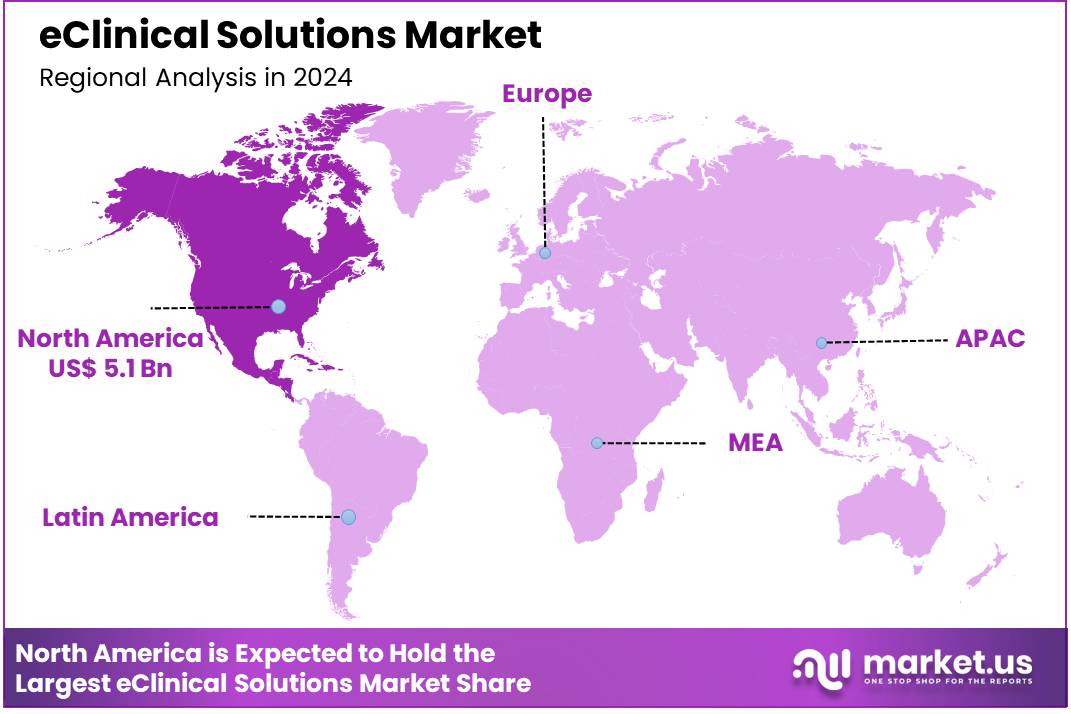
North America dominated the eClinical Solutions market with a 48.9% revenue share, supported by its advanced clinical research ecosystem, high pharmaceutical R&D spending, and widespread adoption of digital trial technologies. The region continues to benefit from strong regulatory support for electronic clinical systems and data integrity.
According to the U.S. Food and Drug Administration (FDA), 50 novel drugs were approved in 2024, highlighting sustained clinical development activity and the need for robust eClinical platforms to manage increasingly complex trials. The growing adoption of cloud-based clinical trial management, electronic data capture, and decentralized trial technologies further strengthens the region’s market leadership.
Asia Pacific is projected to register the fastest growth during the forecast period due to expanding pharmaceutical and biotechnology industries, rising clinical trial activity, and supportive government initiatives that encourage research innovation. Countries such as China, India, Japan, and South Korea are becoming preferred destinations for global clinical studies because of their large patient populations and improving regulatory environments.
Increasing investments in digital health infrastructure and greater adoption of electronic clinical trial technologies are expected to accelerate demand for eClinical solutions across the region.
Business Opportunities
The eClinical Solutions market offers significant business opportunities as pharmaceutical companies, biotechnology firms, and contract research organizations accelerate digital transformation across clinical research. The growing adoption of decentralized and hybrid clinical trials is creating demand for cloud-based platforms that support remote patient monitoring, electronic consent, telehealth, and real-time data collection.
The U.S. FDA has issued guidance encouraging decentralized clinical trials and the use of digital health technologies, creating opportunities for vendors offering integrated eClinical platforms, AI-powered analytics, and secure data management solutions.
Another major opportunity lies in the integration of artificial intelligence with electronic health records to automate data capture, improve patient recruitment, and enhance trial efficiency. Companies developing interoperable solutions that comply with regulatory requirements for electronic records and data integrity are well positioned for growth.
Expanding clinical research activity in emerging markets across Asia-Pacific, increasing adoption of Software-as-a-Service (SaaS) delivery models, and rising investments in precision medicine and digital biomarkers are expected to create new revenue streams. Organizations that provide scalable, cybersecurity-enabled, and regulatory-compliant eClinical platforms are likely to benefit from the ongoing modernization of global clinical trial operations.
Emerging Trends
- Decentralized clinical trials are becoming mainstream, with the FDA encouraging remote visits, telehealth, home healthcare services, and local laboratories. These approaches improve participant recruitment, retention, and access while increasing demand for integrated eClinical platforms that securely manage distributed trial data.
- Digital Health Technologies (DHTs) are being integrated into clinical research for remote data acquisition. The FDA issued final guidance supporting validated digital tools, creating new opportunities for eClinical vendors to integrate wearable devices, mobile applications, and connected sensors into clinical trial workflows.
- Hybrid clinical trial models are expanding rapidly as sponsors combine traditional research sites with remote patient participation. Research published by the U.S. National Library of Medicine identified 4,874 decentralized clinical trials, with annual growth accelerating after 2020, demonstrating increasing digitalization of clinical research.
- Patient diversity and accessibility are becoming strategic priorities. FDA guidance highlights that decentralized trial elements can improve enrollment of people with rare diseases, mobility limitations, and geographically dispersed populations, encouraging greater investment in cloud-enabled participant management and electronic consent platforms.
- Regulatory focus on secure digital clinical systems continues to strengthen. In 2026, the FDA expanded digital health guidance with new recommendations covering AI-enabled software and digital technologies, encouraging developers to build compliant, interoperable eClinical ecosystems for modern clinical research.
Use Cases
- Cloud-based clinical trial management enables sponsors and CROs to coordinate global multicenter studies through centralized dashboards, allowing real-time monitoring, regulatory documentation, and collaboration across multiple research sites while reducing administrative burden.
- Remote patient monitoring is increasingly used in clinical trials through wearable devices and connected health technologies that automatically capture study data from participants’ homes, improving data continuity while reducing unnecessary site visits.
- Electronic informed consent (eConsent) platforms simplify participant enrollment by allowing secure digital consent and documentation before trial participation. FDA guidance recognizes electronic processes as important components of decentralized clinical trials, improving convenience and compliance.
- Telehealth-supported follow-up visits enable investigators to conduct virtual assessments, review adverse events, and maintain participant engagement without requiring frequent travel. This approach improves trial continuity while expanding access to patients in remote locations.
- Electronic health record (EHR) integration supports automated clinical data collection and reduces duplicate manual entry. Standardized eSource approaches have demonstrated improved completeness of electronic clinical forms, helping research organizations enhance data quality and operational efficiency.
Recent Developments
- In March 2026, Parexel received the 2026 NEXT Award for Patient Leadership from Medidata Solutions. The award recognized Parexel’s use of patient-focused technology and patient insights to improve the clinical trial experience and reduce participant burden across global clinical studies.
- In January 2026, Oracle Health announced that Baystate Health (U.S.) expanded its strategic relationship with Oracle to deploy additional Oracle Health technologies across its network, supporting digital transformation and improving clinical and operational workflows.
- In May 2025, Dassault Systèmes‘ Medidata launched Protocol Optimization, an AI-powered solution introduced at ASCO to improve clinical trial protocol design, reduce patient and site burden, accelerate recruitment, and increase study efficiency across clinical development.
Conclusion
The global eClinical Solutions market is poised for strong growth as digital transformation reshapes clinical research worldwide. Rising adoption of cloud-based platforms, decentralized clinical trials, artificial intelligence, and integrated data management solutions is improving trial efficiency, regulatory compliance, and patient engagement. Pharmaceutical companies, biotechnology firms, and contract research organizations are increasingly investing in interoperable technologies to streamline complex clinical workflows and accelerate drug development.
Supportive regulatory guidance from agencies such as the U.S. FDA and growing clinical research activity across developed and emerging markets will continue to drive innovation. As demand for secure, scalable, and data-driven trial management expands, the eClinical Solutions market is expected to witness sustained long-term growth.




















