


Introduction
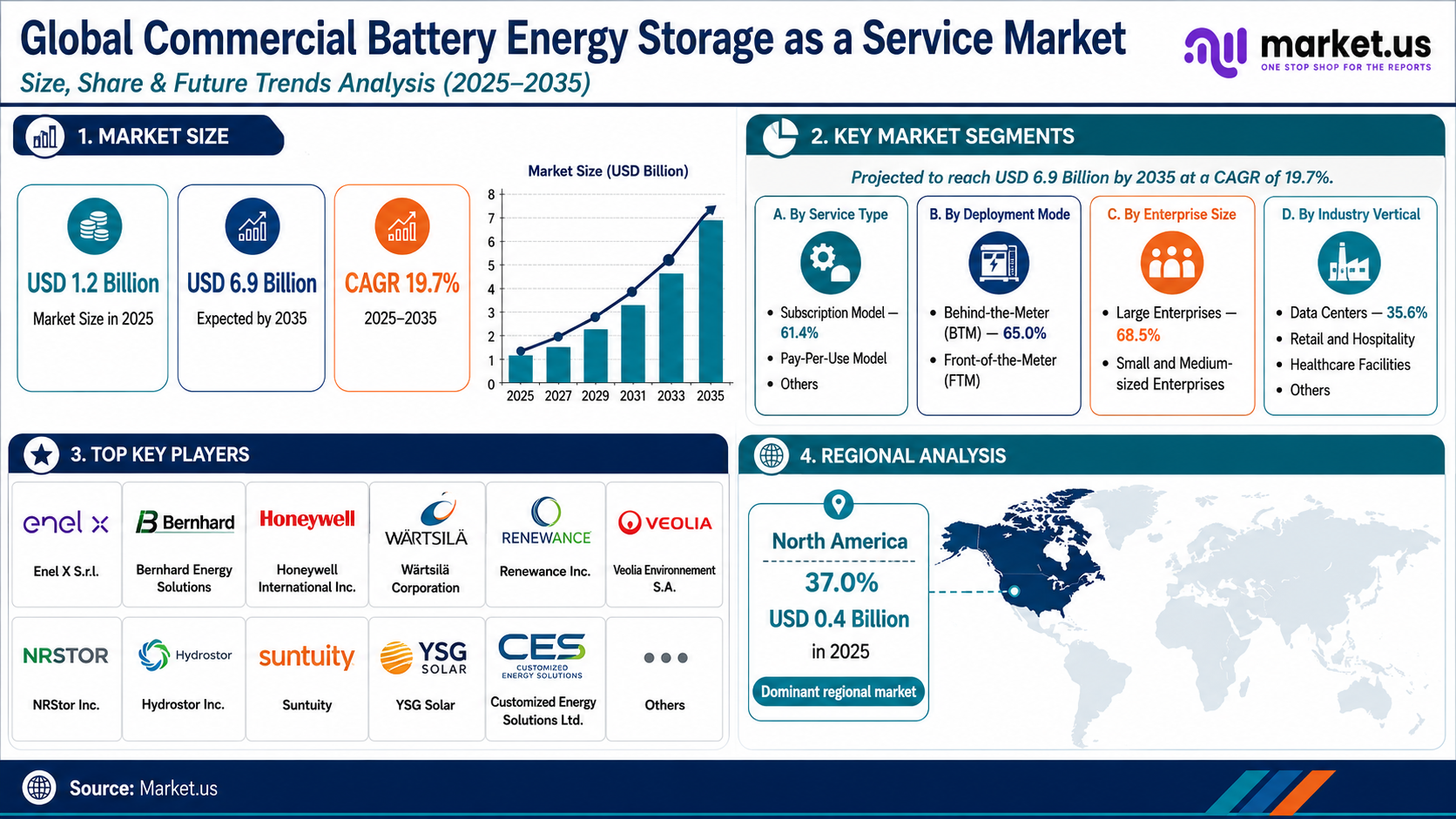
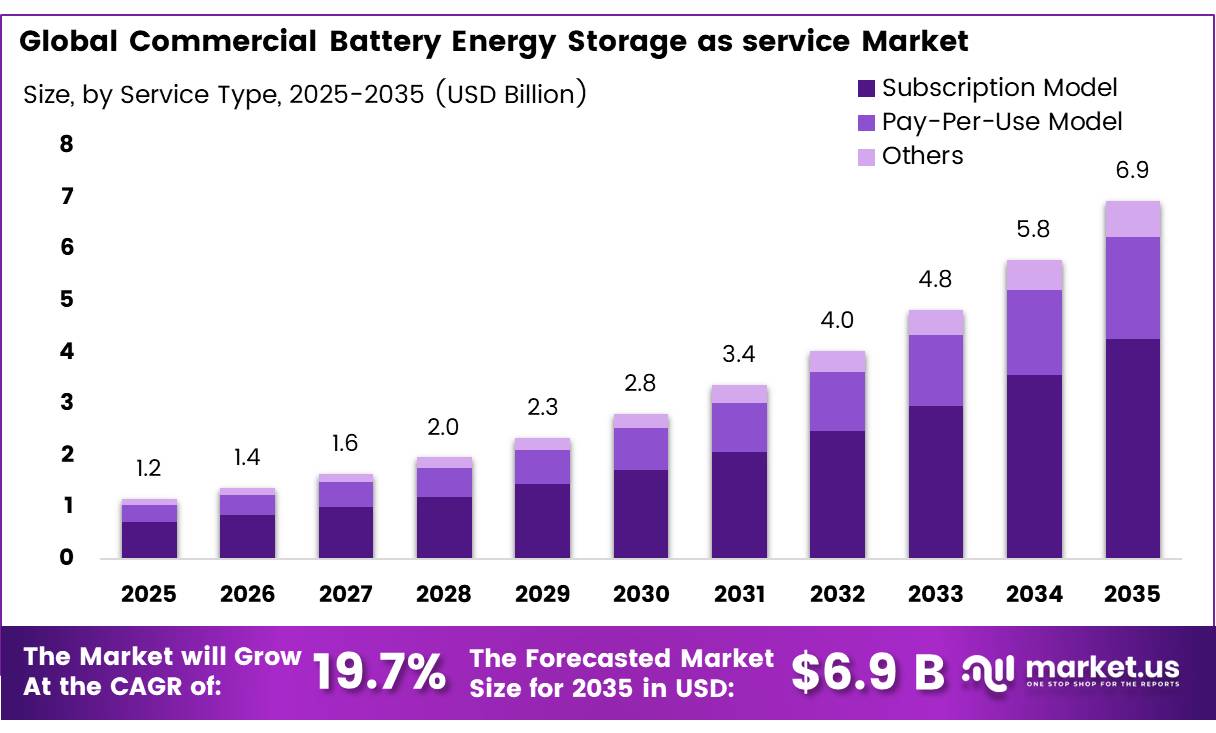
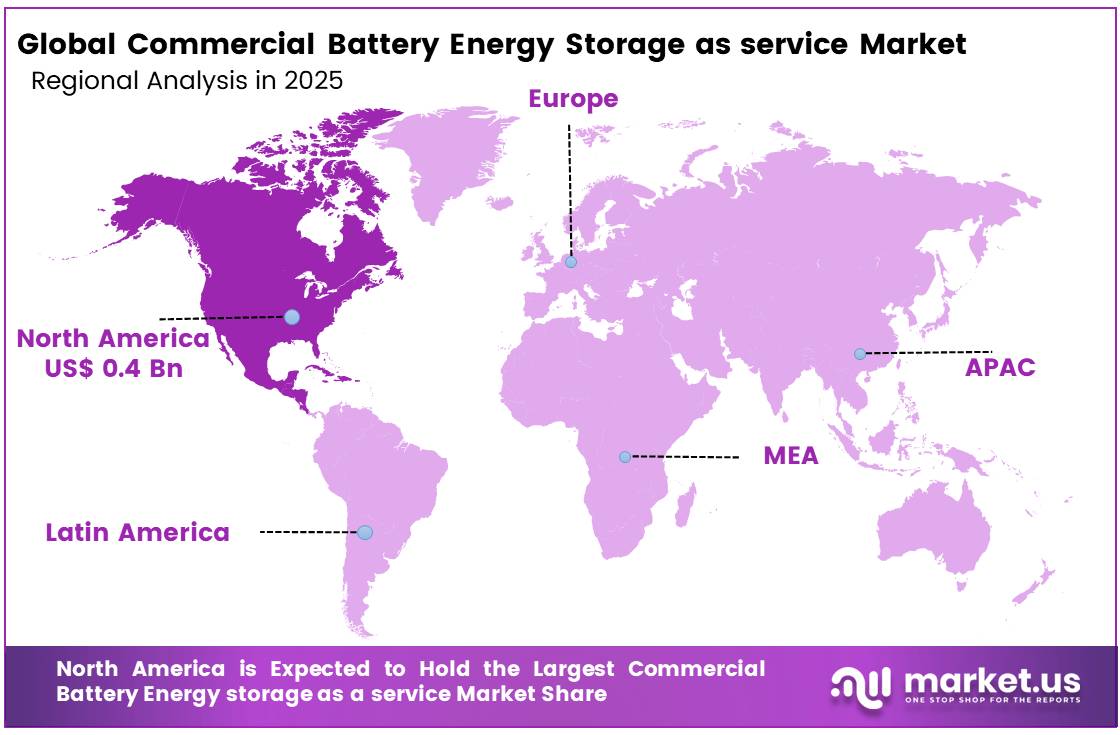
The global Commercial Battery Energy Storage as a Service Market was valued at USD 1.2 billion in 2025 and is projected to reach USD 6.9 billion by 2035. During 2025 to 2035, the market is expected to expand at a CAGR of 19.7%. In 2025, North America held more than a 37.0% share, generating approximately USD 0.4 billion in revenue.
Commercial Battery Energy Storage as a Service, or BESSaaS, is a subscription- or contract-based business model. It allows commercial and industrial users to access battery storage hardware, energy management software, maintenance, and operational services without purchasing the entire system. The model is becoming increasingly attractive as global battery storage deployment continues to rise.
- In April 2026, the International Energy Agency reported that 108 GW of new battery storage capacity was installed worldwide during 2025. This represented a 40% increase over 2024, while total installed capacity became 11 times higher than in 2021. High installation costs and the need for technical operating expertise are encouraging businesses to select service-based storage models instead of direct ownership.
Key Takeaways
- The global Commercial Battery Energy Storage as a Service market was valued at USD 1.2 billion in 2025.
- The global market is projected to grow at a CAGR of 19.7% and is estimated to reach USD 6.9 billion by 2035.
- On the basis of By Service Type, Subscription Model dominated the market, constituting 61.4% of the total market share.
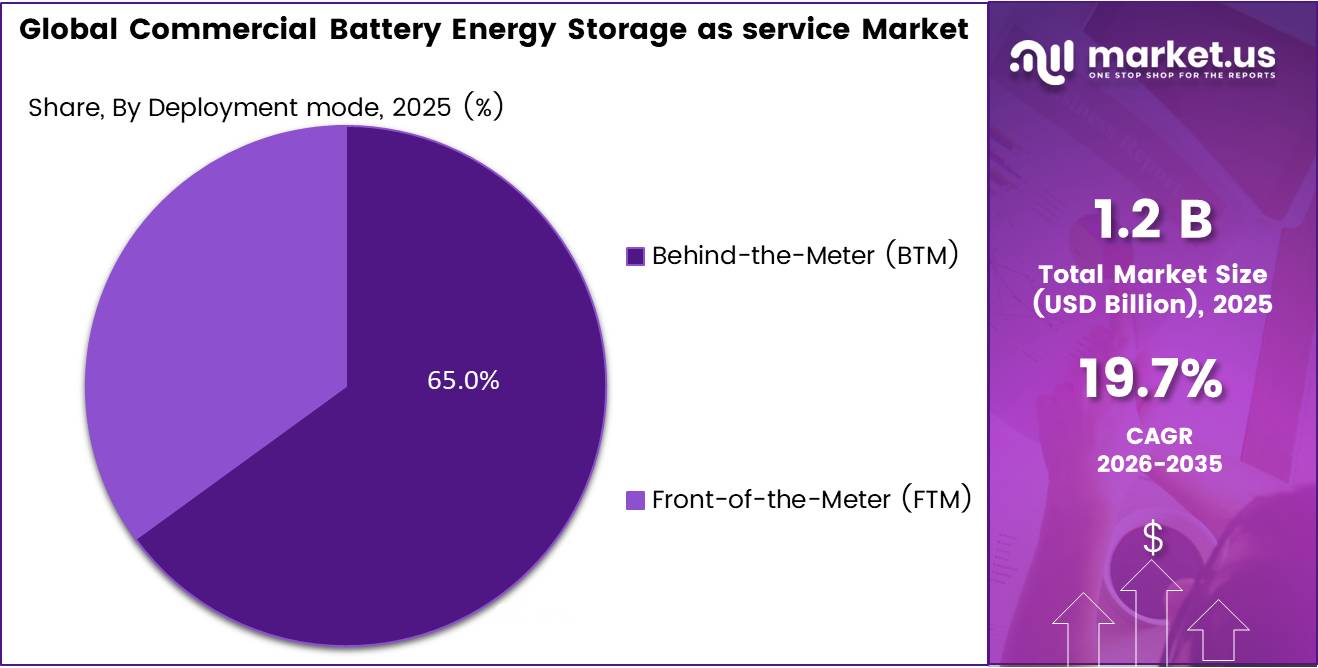
- Based on the Deployment Mode, the Behind-the-Meter (BTM) dominated the Commercial Battery Energy Storage as a Service market, with a substantial market share of around 65.0%.
- Based on the By Enterprise Size, Large Enterprises led the market, comprising 68.5% of the total market.
- Among the By Industry Vertical, the Data Centers held a major share in the Commercial Battery Energy Storage as a Service market,35. 6% of the market share.
- In 2025, the North America was the most dominant region in the Commercial Battery Energy Storage as a Service market, accounting for 34.0% of the total global consumption.
The industry is also benefiting from the rapid expansion of renewable energy, increasing grid reliability requirements, and falling battery prices. In 2024, the IEA reported that lithium-ion battery prices declined from USD 1,400 per kilowatt-hour in 2010 to less than USD 140 per kilowatt-hour in 2023. This was among the fastest cost reductions recorded for an energy technology.
In March 2025, the U.S. Energy Information Administration stated that cumulative utility-scale battery storage capacity in the United States exceeded 26 GW in 2024. Operators also planned to install an additional 19.6 GW of capacity in 2025, strengthening the demand for professional storage management and service-based solutions.
- Government policies and decarbonization targets are major market growth drivers. In 2024, the IEA estimated that global energy storage capacity must increase sixfold to 1,500 GW by 2030 to support the planned tripling of renewable energy capacity. Batteries are expected to represent 90% of the additional storage growth, with capacity increasing 14-fold to 1,200 GW under the Net Zero Emissions by 2050 Scenario.
In 2024, the European Union’s Net-Zero Industry Act entered into force and identified batteries as a strategic net-zero technology. The regulation is designed to simplify permitting processes and support large-scale energy storage projects across EU member states.
The U.S. Department of Energy’s Loan Programs Office estimated in 2024 that the national electricity grid could require between 225 GW and 460 GW of long-duration energy storage by 2050. Meeting this requirement may involve nearly USD 330 billion in capital investment, creating strong opportunities for BESSaaS providers that can finance, install, operate, and maintain storage assets for commercial customers.
Market Segmentation Overview
Service Type Analysis
Subscription Model Leads with a 61.4% Share
The Subscription Model held the dominant position in the Commercial Battery Energy Storage as a Service market, accounting for a 61.4% share. Its leadership is supported by the preference of commercial and industrial users for predictable operating expenses, lower upfront investment, and efficient energy management. Subscription-based services generally include continuous system monitoring, maintenance, software upgrades, and performance optimization, making them suitable for businesses seeking reliable and cost-efficient battery storage solutions.
Deployment Mode Analysis
Behind-the-Meter Deployment Dominates with a 65.0% Share
The Behind-the-Meter segment emerged as the leading deployment mode, capturing a 65.0% market share. Its strong position is driven by the growing installation of on-site battery storage systems across commercial and industrial facilities. These systems help businesses reduce electricity expenses, manage peak demand charges, and improve overall energy efficiency. Behind-the-Meter deployment also provides users with greater control over energy consumption, making it an effective option for companies focused on operational optimization.
Enterprise Size Analysis
Large Enterprises Account for a 68.5% Share
The Large Enterprises segment dominated the market with a 68.5% share. Large companies have stronger financial resources to adopt advanced battery storage technologies and pursue long-term sustainability targets. Organizations operating in data centers, manufacturing, retail, and commercial real estate increasingly use energy storage as a service to lower electricity costs, manage energy consumption, improve power reliability, and support grid stability.
The Small and Medium-sized Enterprises segment is also gaining momentum as energy storage providers introduce more flexible subscription and pay-per-use models. These service arrangements reduce the need for high capital investment and make battery storage solutions more accessible to smaller businesses.
Industry Vertical Analysis
Data Centers Lead with a 35.6% Share
The Data Centers segment held the leading position in the market, securing a 35.6% share. Its dominance is linked to the growing need for reliable power supply and low-latency backup systems for cloud computing, artificial intelligence workloads, and hyperscale digital infrastructure. Battery energy storage services help data centers reduce energy expenses, manage peak electricity demand, and maintain uninterrupted operations during grid disturbances or power outages.
The Retail and Hospitality segment also represents an important part of the market. Shopping malls, hotels, retail outlets, and commercial buildings are increasingly adopting battery storage services to optimize electricity costs, control peak loads, improve energy efficiency, and maintain backup power during supply interruptions.
Drivers
Rapid Renewable Expansion Accelerates Commercial Demand for BESSaaS
The rapid expansion of renewable power is becoming a growth driver for the Commercial Battery Energy Storage as a Service market. Solar and wind generation change with weather conditions, creating a need for storage that can balance electricity supply, control peak demand, and protect business operations from grid interruptions. BESSaaS allows commercial users to gain these benefits through service contracts instead of making an upfront investment in battery assets.
In April 2026, the International Energy Agency reported that the world added 108 GW of battery storage capacity during 2025, representing a 40% increase from 2024. Global installed battery storage capacity was eleven times higher than in 2021. Around 80% of the new capacity was utility-scale, while the remaining share came from behind-the-meter systems installed by commercial and residential consumers. These figures show that storage is becoming a central part of electricity systems.
The renewable transition will require much greater storage deployment. The IEA estimates that global energy storage capacity must rise sixfold to 1,500 GW by 2030 to support the tripling of renewable power capacity. Batteries are expected to deliver 90% of this growth, reaching 1,200 GW by 2030. This requirement creates an opening for providers that finance, install, monitor, and maintain battery systems under subscription or long-term service agreements.
The United States reflects the same pattern. In March 2025, the U.S. Energy Information Administration reported that utility-scale battery storage capacity exceeded 26 GW in 2024 after increasing by 66%. Operators also planned to add 19.6 GW during 2025. Separately, the U.S. Department of Energy estimated that the grid could require 225 GW to 460 GW of long-duration storage by 2050, involving about USD 330 billion in capital. Such investment requirements strengthen the appeal of BESSaaS by shifting ownership costs and technical responsibilities from commercial customers to specialist service providers.
Business Opportunities
Virtual Power Plants Unlock New Commercial Revenue Streams
Virtual power plant participation creates a growth opportunity for Commercial Battery Energy Storage as a Service providers. Under this model, batteries installed at offices, factories, warehouses, data centers, and retail sites can be digitally combined and operated as one flexible power resource. Providers can then earn income from peak reduction, demand response, capacity, energy trading, and ancillary grid services, while customers continue paying through subscription or performance-based contracts.
The opportunity is becoming substantial in North America. The U.S. Department of Energy reported that virtual power plant capacity reached 33 GW across North America. It estimates that deployment could expand to 80–160 GW by 2030, enough to meet 10–20% of U.S. peak electricity demand and reduce annual grid costs by about USD 10 billion. The department also noted that several utilities launched basic programs in less than six months with under USD 1 million in upfront investment and delivered more than 100 MW of peak-demand reduction.
A growing battery base strengthens this opportunity. The U.S. Energy Information Administration reported that utility-scale battery capacity exceeded 26 GW in 2024 after increasing 66% during the year. Operators planned another 19.6 GW of additions in 2025. As storage spreads across the electricity system, BESSaaS companies can move beyond equipment access and offer aggregation, automated dispatch, market bidding, and revenue-sharing services. This approach can lower customer energy bills while creating recurring income for providers.
Emerging Trends
AI Data Centers Accelerate Managed Battery Storage Adoption
The rapid growth of artificial intelligence infrastructure is encouraging data centers to adopt managed battery storage. These facilities require continuous electricity, fast backup response, and protection against grid congestion. Under a BESSaaS arrangement, a specialist provider can finance, operate, monitor, and optimize the battery while the data center pays through a subscription or service contract. This approach reduces the need to own storage equipment and supports peak shaving, renewable energy use, and emergency power.
In April 2025, the International Energy Agency reported that data centers consumed around 415 TWh of electricity in 2024, equal to about 1.5% of worldwide electricity demand. Consumption is projected to reach nearly 945 TWh by 2030, with demand increasing by around 15% annually between 2024 and 2030. Electricity use from AI-optimized data centers is expected to more than quadruple by 2030. This sharp rise is pushing operators to combine battery systems with intelligent energy controls that can schedule charging, reduce demand during expensive periods, and respond quickly when grid power becomes unstable.
Government-supported projects are also moving this model forward. In April 2026, the U.S. Department of Energy approved project work involving microgrids at two major data center sites in Virginia and South Carolina, including added onsite generation and battery storage. DOE also showed that a microgrid could support a 5 MW data center without a major transmission upgrade. These developments indicate that BESSaaS is evolving into an intelligent power-management service for energy-intensive commercial facilities.
Use Cases
1. Peak Demand Reduction and Electricity Bill Management: Commercial BESSaaS is widely used to reduce peak electricity demand in factories, offices, shopping centres, hotels, warehouses, and other commercial facilities. The battery charges when electricity use is low and discharges when building demand reaches its highest level. This helps lower demand charges without requiring the customer to purchase and maintain the battery system. A U.S. National Renewable Energy Laboratory analysis covering more than 10,000 utility tariffs across 48 states found that nearly 5 million commercial customers had access to tariffs with demand charges exceeding USD 15 per kW. Demand charges can represent around 30% to 70% of a commercial electricity bill.
2. Electricity Price Arbitrage and Tariff Optimization: BESSaaS providers can automatically charge commercial batteries when electricity prices are low and discharge them when market prices are high. This use case is suitable for companies operating under time-of-use rates or in areas with volatile wholesale electricity prices. In September 2025, the U.S. Energy Information Administration reported that 66% of U.S. utility-scale battery capacity used price arbitrage, while 41% identified it as the primary use. At the end of 2024, California had 11.7 GW of battery capacity, with 43% mainly used for arbitrage. Texas had 8.1 GW, and approximately 50% was primarily used for the same purpose.
3. Backup Power for Data Centers: Data centres use managed battery storage to protect servers, networking equipment, and cooling systems from voltage changes and power interruptions. Under a service model, the provider continuously monitors battery health, maintains the equipment, and replaces components when needed. The IEA reported that data centres consumed approximately 415 TWh of electricity in 2024, equal to 1.5% of global electricity use. Consumption is projected to reach around 945 TWh by 2030, growing nearly 15% annually from 2024. Battery-based uninterruptible power supply additions increased 30% to 45 GW in 2025, mainly due to data-centre development.
4. On-Site Solar and Renewable Energy Integration: Commercial facilities with rooftop solar can use BESSaaS to store surplus electricity produced during daylight hours. The stored power can then be used in the evening, during cloudy conditions, or when grid prices rise. In 2025, approximately 108 GW of new battery storage capacity was installed worldwide, representing a 40% increase over 2024. Global installed capacity became 11 times higher than in 2021. Around 20% of new capacity was installed behind the meter by commercial and residential users. Most projects remain close to two hours in duration, although deployments of four hours or more are increasing.
5. Virtual Power Plants and Grid Services: BESSaaS companies can combine batteries installed across several commercial properties into a virtual power plant. The aggregated systems can support frequency control, demand response, capacity markets, and grid balancing while generating additional revenue for participating customers. The U.S. Department of Energy reported that virtual power plant capacity reached 33 GW across North America. Capacity could rise to 80–160 GW by 2030, covering 10–20% of U.S. peak demand and reducing grid costs by around USD 10 billion annually. Some utility programmes were launched in under six months, required less than USD 1 million, and delivered more than 100 MW of peak reduction.
Regional Analysis
North America led the Commercial Battery Energy Storage as a Service market with a share of more than 37.0%, generating approximately US$0.4 billion in revenue. Regional growth is supported by increasing renewable energy adoption, advanced grid networks, and strong demand from data centers and commercial facilities. The United States remains the main contributor due to government incentives, tax credits, clean energy investments, grid modernization projects, and ongoing efforts to reduce carbon emissions.
Asia Pacific is expected to emerge as the fastest-growing regional market. Growth is being driven by rapid industrial development, rising electricity consumption, and expanding investment in renewable energy across China, India, Japan, and South Korea. Supportive government policies and the continued development of smart grid infrastructure are also encouraging commercial users to adopt battery energy storage as a service solutions.
Recent Developments
In December 2025, Bernhard Energy Solutions signed a 30-year, USD 54.2 million partnership with Beacon Health System. The agreement is expected to deliver USD 191 million in utility savings, reduce annual utility costs by 35.5%, and lower carbon emissions by 26.2%. In April 2026, ENFRA entered a separate 30-year partnership with Memorial Health covering four hospital campuses, with projected savings of USD 115.3 million, including nearly USD 2 million in the first year after construction.
In May 2026, Enel X secured a further 32 MW virtual power plant award in New South Wales, taking its Roadmap-supported portfolio beyond 95 MW and contributing to around 300 MW of flexible capacity across the state. The company also won 480 MW in Great Britain’s 2026 T-4 Capacity Market auction, allowing participating commercial battery and flexible-load customers to earn about GBP 54,000 per MW annually for four years. By June 2026, Enel X managed 10 GW of flexible capacity across 14 countries, more than 100 programs, 8,000 customers, and 16,000 sites.
Conclusion
This outlook is supported by the wider growth of battery storage infrastructure. The International Energy Agency reported that 108 GW of new battery storage capacity was deployed worldwide in 2025, representing a 40% increase over 2024, while total installed capacity became 11 times higher than in 2021.
Around 20% of new capacity was installed behind the meter by commercial and residential users, highlighting the growing role of customer-located systems. In the United States, utility-scale battery capacity exceeded 26 GW in 2024, and operators planned to add another 19.6 GW in 2025. Overall, subscription, leasing, and performance-based service models are expected to make battery storage more accessible to commercial facilities while creating recurring revenue opportunities for service providers.
Looking for data tailored to your specific market, region, or business need? Request a custom report or consultation — write to us at [email protected]




















