


Introduction
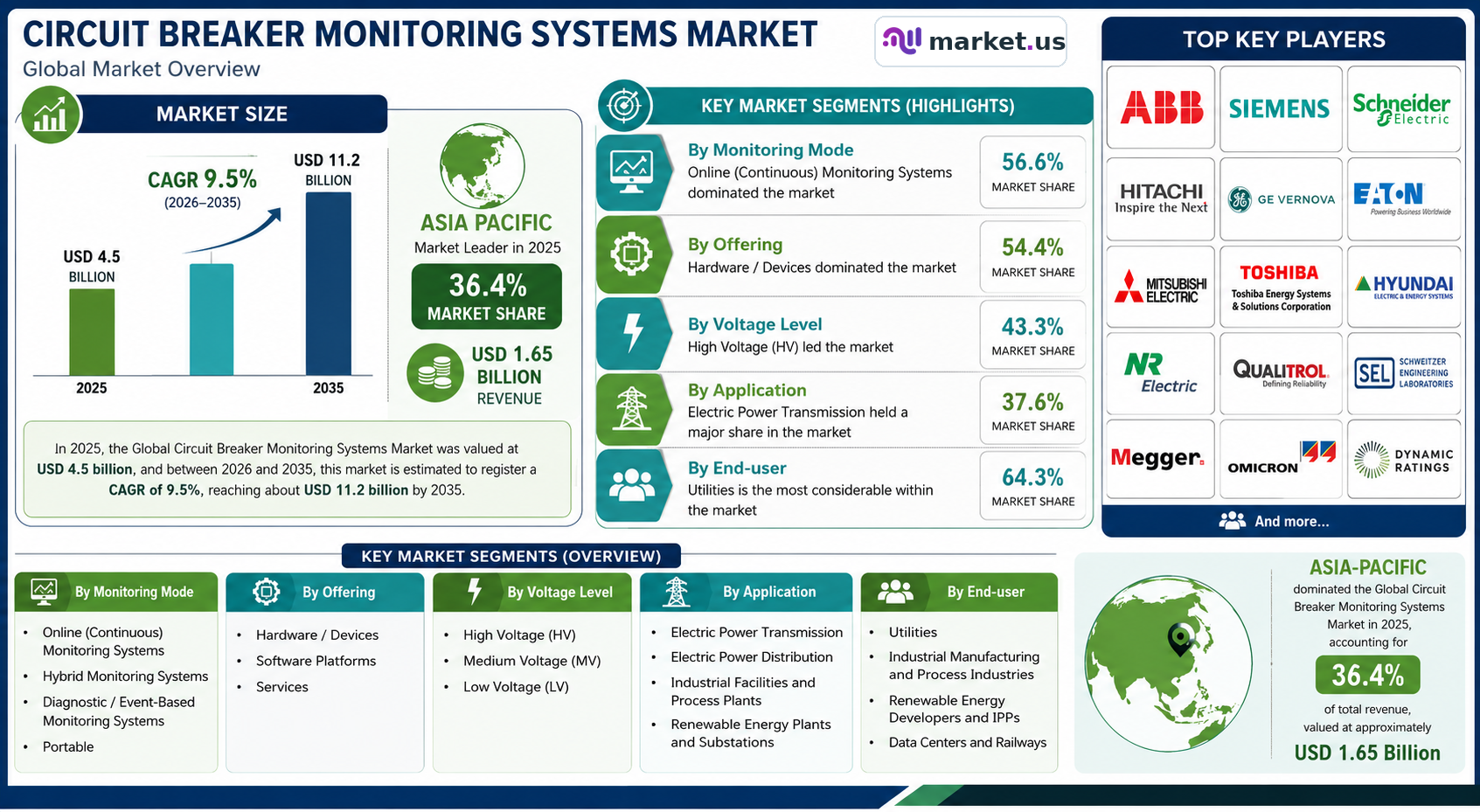
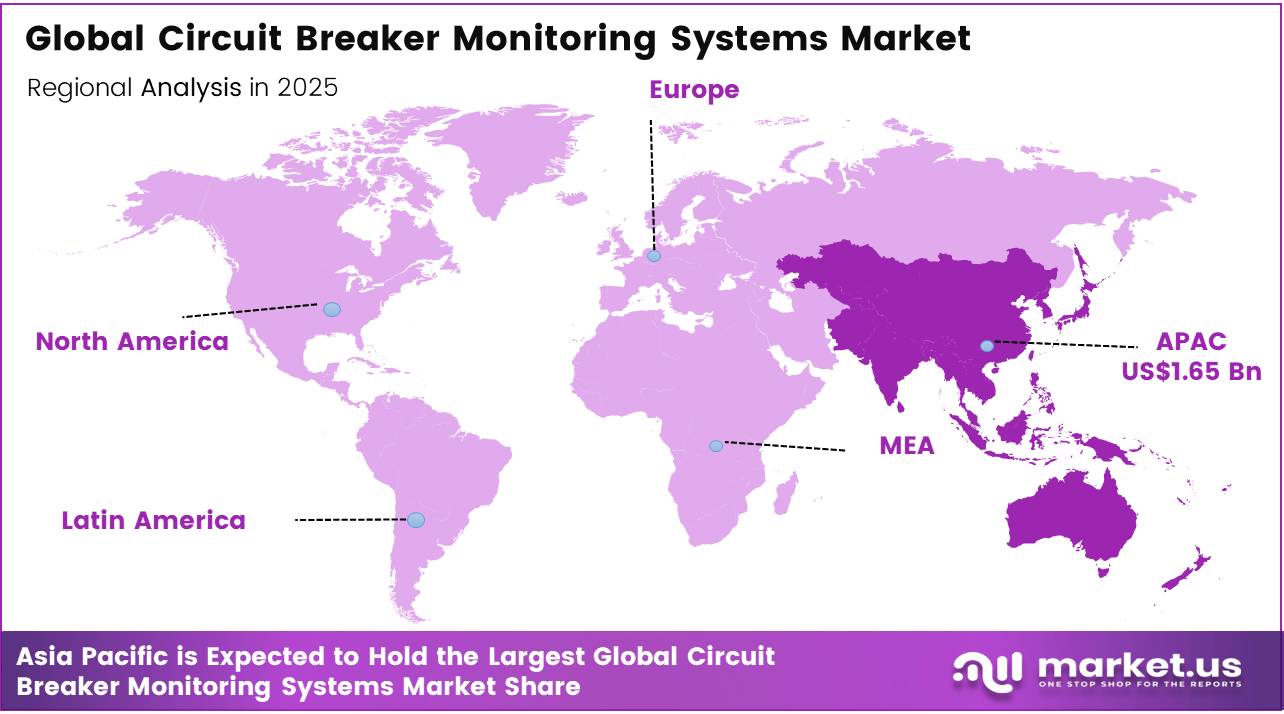
In 2025, the Global Circuit Breaker Monitoring Systems Market was valued at US$4.5 billion, and between 2026 and 2035, this market is estimated to register a CAGR of 9.5%, reaching about US$11.2 billion by 2035. In 2025, Asia Pacific held a dominant market position, capturing more than a 36.4% share, holding USD 1.65 Billion revenue.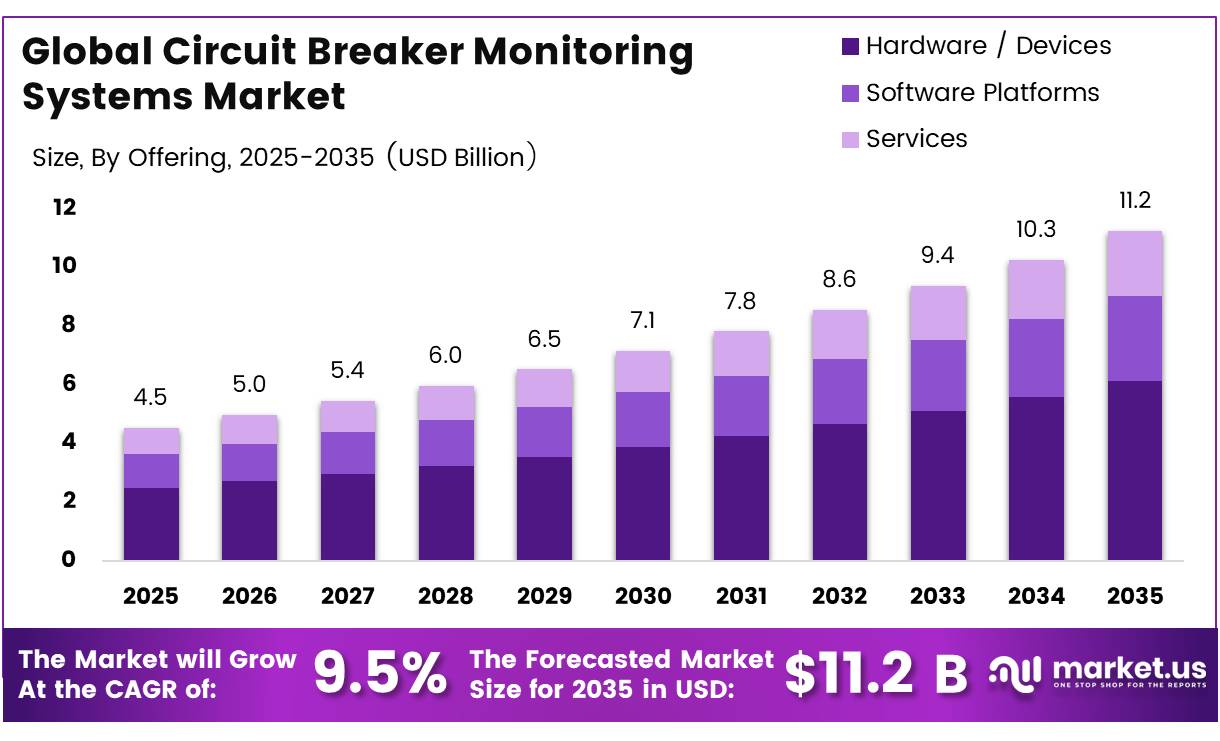
Circuit breaker monitoring systems are becoming an essential part of digital substations by tracking contact wear, operating time, coil current, gas pressure, temperature, and mechanical condition. The industrial environment is strengthening as utilities modernize aging networks and integrate renewable generation.
- The International Energy Agency reported that global grid spending reached approximately USD 400 billion in 2025, while electricity-sector investment approached USD 1.5 trillion, creating a strong foundation for equipment upgrades. Demand is also supported by outage exposure and aging switching assets.
- In 2024, U.S. customers experienced an average of 662.6 interruption minutes, 1.531 interruptions, and 432.7 minutes per interruption when major events were included. Continuous monitoring enables utilities to identify slow operation, contact wear, coil abnormalities, and insulation deterioration before failures occur.
Renewable energy expansion is further increasing the need for greater visibility across breakers, substations, and feeder networks. IRENA reported that global renewable capacity reached 4,448 GW in 2024 after adding 585 GW, representing 92.5% of worldwide power-capacity expansion. Higher variable generation increases switching frequency and strengthens demand for reliable monitoring systems.
Future opportunities are expected to emerge through retrofit sensors, digital twins, predictive analytics, and remote maintenance. More than 2,500 GW of generation, storage, and large-load projects remain in global grid queues, while Europe requires EUR 730 billion for distribution networks and EUR 477 billion for transmission infrastructure by 2040.
Key Takeaways
- The global Circuit Breaker Monitoring Systems market was valued at US$4.5 billion in 2025.
- The market is expected to expand at a CAGR of 9.5%, reaching approximately US$11.2 billion by 2035.
- By monitoring mode, Online (Continuous) Monitoring Systems led the market, accounting for 56.6% of the total share.
- Based on offering, Hardware / Devices represented the leading segment, holding approximately 54.4% of the market.
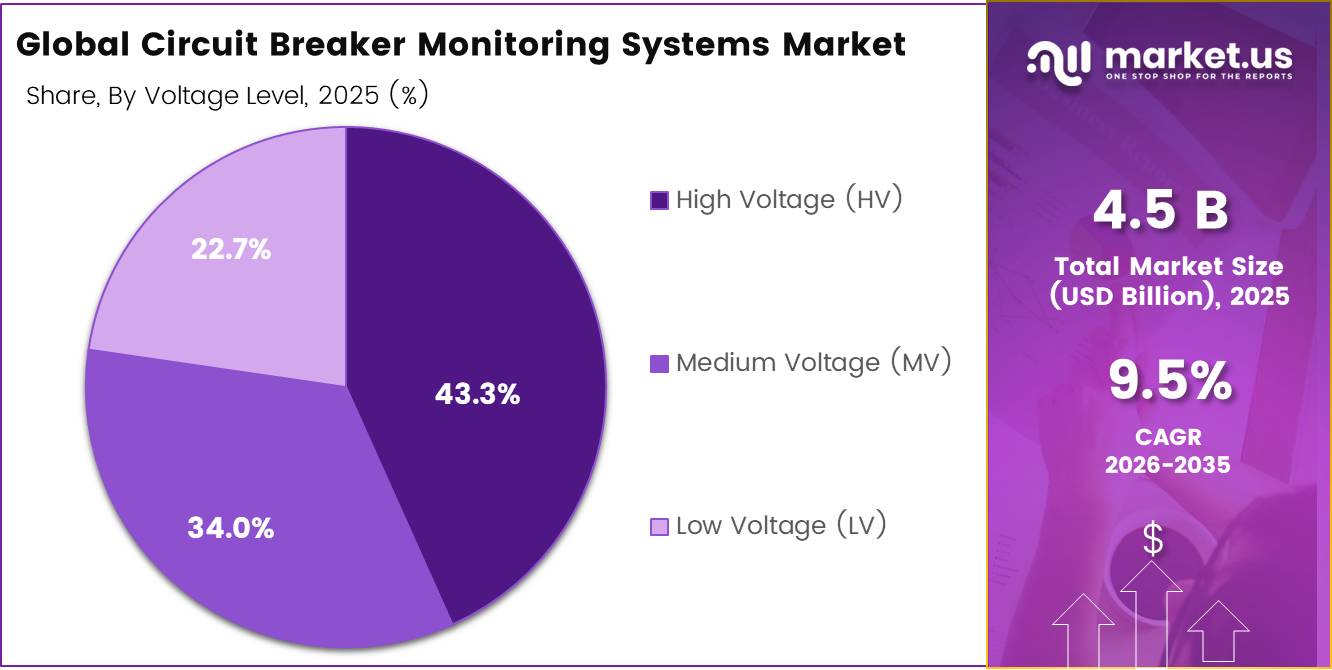
- By voltage level, the High Voltage (HV) segment maintained the largest position, capturing 43.3% of the total market.
- In terms of application, Electric Power Transmission accounted for a significant 37.6% share of the Circuit Breaker Monitoring Systems market.
- By end user, Utilities emerged as the leading category, contributing approximately 64.3% of total market revenue.
- Regionally, Asia Pacific dominated the Circuit Breaker Monitoring Systems market in 2025, representing 36.4% of total global consumption.
Market Segmentation Overview
Monitoring Mode Analysis
Online (Continuous) Monitoring Systems Lead the Market with a 56.6% Share
Online (Continuous) Monitoring Systems held the dominant position in the Circuit Breaker Monitoring Systems market, accounting for a 56.6% share. The segment’s leadership is driven by the growing need to continuously monitor breaker timing, coil current, contact condition, temperature, and insulation performance without disrupting the electricity supply. The U.S. Energy Information Administration reported that customers experienced an average of 11 hours of power interruptions, with major events contributing 80% of the total outage duration. Continuous monitoring allows utilities to identify emerging faults at an early stage, improve maintenance planning, and lower the risk of unexpected circuit breaker failures.
Offering Analysis
Hardware/Devices Lead the Market with a 54.4% Share
Hardware/Devices held the dominant position in the Circuit Breaker Monitoring Systems market, accounting for 54.4% of the total share. The segment’s leadership is supported by continued utility investment in sensors, communication modules, trip-coil monitors, temperature detectors, and intelligent electronic devices that deliver real-time information on circuit breaker condition. In March 2026, the U.S. Department of Energy announced approximately USD 1.9 billion for rapid transmission infrastructure and advanced technology upgrades, creating a favorable deployment environment for physical monitoring equipment across substations.
Voltage Level Analysis
High Voltage Monitoring Leads the Market with a 43.3% Share
High Voltage Monitoring Systems held the dominant position in the Circuit Breaker Monitoring Systems market, accounting for a 43.3% share. The segment’s leadership is supported by the need to continuously monitor breaker timing, contact wear, insulation condition, operating mechanisms, and control circuits across transmission substations. FERC states that the ERCOT network includes more than 46,000 miles of transmission lines connected to approximately 550 generating units, demonstrating the large volume of equipment requiring dependable protection and condition monitoring. High-voltage circuit breakers also involve greater operational risk, as a single failure can disrupt substantial power flows and affect several areas of the electricity network.
Application Analysis
Electric Power Transmission Leads the Market with a 37.6% Share
Electric Power Transmission held the dominant position in the Circuit Breaker Monitoring Systems market, accounting for a 37.6% share. The segment’s leadership is supported by the extensive use of high-voltage circuit breakers to isolate faults and protect transformers, transmission lines, and substations carrying large volumes of electricity. The U.S. Department of Energy plans to increase long-distance transmission capacity by 16% by 2030, including the development of 7,500 miles of new transmission lines. This planned expansion is expected to strengthen demand for continuous breaker-condition monitoring, temperature sensing, operating-time analysis, and remote fault detection across critical grid infrastructure.
End-User Analysis
Utilities Lead the Market with a 64.3% Share
Utilities held the dominant position in the Circuit Breaker Monitoring Systems market, accounting for a 64.3% share. The segment’s leadership is driven by the operation of extensive transmission and distribution networks, where circuit breaker failures can disrupt electricity supply for thousands of customers. The U.S. Energy Information Administration recorded approximately 164.5 million electricity customers and total power-sector generation of about 4,260 billion kilowatthours. This large operating scale encourages utilities to adopt continuous condition monitoring, remote alarms, predictive maintenance, and centralized asset-management systems to improve breaker availability and reduce unplanned field inspections.
Drivers
Grid Digitalization Mandates and IEC 61850 Based Substation Upgrades
Grid digitalization mandates and IEC 61850-based substation upgrades are key growth drivers for the Circuit Breaker Monitoring Systems market in 2026. Utilities are moving from isolated diagnostic tools to interoperable, substation-wide condition-monitoring platforms. In Europe, electricity demand is expected to rise by approximately 60% by 2030, supporting investment in intelligent primary equipment and real-time asset visibility. IEC 61850 enables multi-vendor integration, reduces customized engineering, and standardizes monitoring across bays, feeders, and retrofit projects.
These upgrades could add about +2.1% to market CAGR across North America, the EU, China, India, and GCC markets over 2–4 years. Renewable integration, congestion visibility, and curtailment reduction may contribute +1.8% within ≤2 years, while asset-life extension and outage-cost avoidance could add +1.6%. Cybersecure remote monitoring may provide +1.3%, SF6 phase-down and aging switchgear replacement +1.2%, and feeder-level distribution modernization +1.5% across India, Southeast Asia, the Middle East, Africa, Latin America, and mature utility markets over the next 2–4 years during ongoing network modernization programs worldwide.
Major Challenges
Utility capex crowd-out
Utility capital expenditure crowd-out remains a major restraint for the Circuit Breaker Monitoring Systems market. Although utilities support digital monitoring, much of their available spending in 2026 is being directed toward grid expansion, transformer replacement, interconnection upgrades, and resilience hardening before condition-monitoring systems receive funding. U.S. utility capital expenditure is projected to reach nearly $259.1 billion in 2026, compared with about $200 billion in 2025, representing an increase of approximately 29%.
Wildfire mitigation programs are also absorbing substantial budgets, while traditional system hardening can cost around $1.05 million per mile, covered conductor installation about $1.21 million per mile, and strategic undergrounding nearly $2.66 million per mile. This spending mix places breaker monitoring behind mandatory reliability and fire-risk projects in rate cases and internal investment rankings. As a result, monitoring systems are often postponed, limited to new construction, or removed from substation scopes, reducing near-term attachment rates and extending procurement timelines, despite their ability to improve maintenance planning and failure prevention.
Business Opportunities
Monitoring-as-a-service
Recurring monitoring services represent a major opportunity for the Circuit Breaker Monitoring Systems market because most current deployments still generate revenue through capital equipment sales and commissioning. The opportunity lies in converting installed diagnostics into subscription-based analytics, uptime guarantees, and outsourced fleet monitoring. As substation digitalization expands in 2026, many utilities still lack the data science capabilities and maintenance maturity needed to manage continuous breaker information across large fleets.
This creates space for vendors to move beyond one-time hardware margins of around 25%–35% toward blended software and service margins exceeding 55%–65% once deployments cover several thousand monitored bays. Monthly or annual service pricing could reduce upfront approval barriers by approximately 20%–40% compared with full capital expenditure requests. Recurring offerings can also improve revenue visibility and increase lifetime revenue per site by about 1.7x–2.4x through alarm management, condition scoring, digital twins, predictive analytics, and maintenance recommendations delivered across the utility asset base.
Use Cases
Predictive Maintenance and Breaker Health Assessment
Circuit breaker monitoring systems support predictive maintenance by continuously tracking travel curves, mechanism timing, contact speed, trip and close coil current, operation count, contact wear, and motor or pump runtime. This information helps utilities identify mechanical deterioration before a breaker fails. Hitachi Energy’s monitoring platform can connect up to 10 gas-monitoring modules in one stack, operate between -40°C and 70°C, and maintain module power consumption below 6 W. This use case helps utilities replace fixed maintenance schedules with condition-based servicing, improving asset availability and maintenance planning.
Regional Analysis
Asia Pacific Held the Largest Share of the Global Circuit Breaker Monitoring Systems Market.
Asia Pacific held the largest share of the global Circuit Breaker Monitoring Systems market, accounting for 36.4%. Strong renewable energy deployment, expanding transmission networks, and ongoing substation modernization are increasing the number of circuit breakers that require continuous condition monitoring. In 2025, China’s installed renewable power capacity surpassed 2,337 GW, while renewable sources represented 82.7% of the country’s newly added power capacity.
This rapid infrastructure expansion is strengthening demand for breaker-monitoring sensors, operating-time measurement, contact-wear assessment, insulation supervision, and remote maintenance systems. Utilities across the region are increasingly adopting these technologies to improve equipment reliability, identify developing faults, reduce unplanned outages, and manage larger electricity networks more efficiently.
Recent Developments
- In August 2025, Schneider Electric introduced FeederSeT, a digitally connected circuit-protection portfolio featuring asset-health monitoring. The launch was supported by a £42 million manufacturing facility in Scarborough and is designed to improve monitoring scalability and reliability across electrical distribution networks.
- In November 2025, ABB launched SACE Emax 3 in Canada, delivering fault detection in under 40 milliseconds, communication of more than 3,000 grid parameters, support for eight communication protocols, and continuous temperature monitoring to strengthen predictive circuit breaker maintenance.
Conclusion
The Circuit Breaker Monitoring Systems market is positioned for sustained growth as utilities increase spending on substations, distribution equipment, and intelligent grid infrastructure. The U.S. Energy Information Administration reported that utility investment in distribution infrastructure reached USD 50.9 billion in 2023, including USD 6.1 billion spent on distribution substation equipment, representing a 15% annual increase. Transmission-system spending also reached USD 27.7 billion, nearly 3 times its level in 2003.
These government figures indicate that grid operators are directing more capital toward replacing aging assets and improving network resilience. As utilities adopt digital substations and condition-based maintenance, circuit breaker monitoring systems will remain essential for detecting equipment deterioration, supporting faster maintenance decisions, extending asset life, and reducing the risk of unexpected power interruptions.




















