Overview
The Global AI in Ultrasound Imaging Market size is expected to be worth around USD 2261.8 Million by 2033, from USD 964.2 Million in 2023, growing at a CAGR of 8.9% during the forecast period from 2024 to 2033.
Artificial intelligence is reshaping ultrasound imaging by improving scan quality, reducing operator dependency, and helping clinicians interpret images with greater speed and consistency. As healthcare providers face increasing imaging workloads, AI-powered ultrasound solutions are becoming valuable tools for supporting early diagnosis, workflow automation, and better patient management across radiology, cardiology, obstetrics, and emergency medicine. These technologies are also expanding access to diagnostic imaging in rural and underserved regions through portable and handheld ultrasound systems.
Government and trusted healthcare organizations continue to support the safe adoption of AI-enabled medical imaging. The U.S. Food and Drug Administration (FDA) has authorized multiple AI-assisted ultrasound devices for clinical use, reflecting growing regulatory confidence in validated imaging software. According to published FDA-related research, 692 AI/ML-enabled medical devices had been authorized by October 2023, including 17 ultrasound AI devices designed for measurement, image analysis, workflow support, and diagnostic assistance.
Ultrasound remains one of the most widely used imaging technologies because it provides real-time imaging without exposing patients to ionizing radiation, making it suitable for applications such as pregnancy monitoring, cardiac assessment, abdominal examinations, vascular imaging, and image-guided procedures. The FDA also highlights ultrasound as an essential diagnostic tool across numerous medical specialties due to its safety profile and versatility.

Key Takeaways
- Based on component, the software segment accounted for the largest share of the AI in ultrasound imaging market, capturing 61.3% of the market in 2023 due to its growing role in image analysis, workflow automation, and diagnostic support.
- Based on technology, the deep learning segment emerged as the leading category, holding a significant 60.8% market share in 2023, driven by its advanced capabilities in image recognition, pattern detection, and diagnostic accuracy across ultrasound applications.
- Based on application, the neurology segment secured a substantial 39.5% market share in 2023, supported by the increasing adoption of AI-powered imaging solutions for the early detection, diagnosis, and monitoring of neurological disorders.
- Based on end user, the hospitals segment dominated the market with a 74.8% share in 2023, fueled by rising patient volumes and the growing integration of AI-enabled ultrasound systems to improve diagnostic efficiency and clinical outcomes.
- North America led the global AI in ultrasound imaging market in 2023, accounting for a 32.1% market share, supported by advanced healthcare infrastructure, strong adoption of AI technologies, and increasing investments in medical imaging innovation.
Statistical Information
- 65,000+ Butterfly iQ+ handheld ultrasound systems have been distributed globally, according to the WHO Compendium of Innovative Health Technologies 2024.
- The WHO lists the Butterfly iQ+ handheld ultrasound at a commercial price of USD 2,699, making AI-assisted portable ultrasound more accessible than traditional cart-based systems.
- Butterfly Network’s AI gestational age model was trained using more than 21 million ultrasound images from diverse patient populations.
- The AI tool estimates fetal gestational age in less than 2 minutes, reducing the need for manual fetal biometric measurements.
- The FDA-authorized AI model is validated for pregnancies between 16 and 37 weeks of gestation.
- Validation of Siemens Healthineers’ AI Measure for the ACUSON Sequoia ultrasound system showed an overall automated measurement success rate of 89.6%.
- The same Siemens validation study evaluated the AI algorithm using 1,354 ultrasound image samples collected across multiple imaging modes.
- The Siemens clinical validation dataset included ultrasound images from 32 patients across 5 healthcare institutions, demonstrating multi-center evaluation before FDA clearance.
Regional Analysis
North America dominated the AI in ultrasound imaging market in 2023, accounting for 32.1% of the global market. The region benefits from advanced healthcare infrastructure, widespread adoption of artificial intelligence in medical imaging, and strong investments in digital health technologies. The United States continues to lead innovation through the growing use of AI-assisted diagnostic systems and supportive regulatory pathways for medical devices.
The U.S. Food and Drug Administration (FDA) has authorized an increasing number of AI-enabled imaging solutions, while ultrasound remains one of the safest and most commonly used imaging modalities because it provides real-time visualization without ionizing radiation. Additionally, the aging population and rising burden of chronic diseases are increasing the demand for faster and more accurate diagnostic imaging across hospitals and outpatient centers.
Asia-Pacific is projected to register the fastest growth during the forecast period, driven by expanding healthcare infrastructure, rising healthcare expenditure, and improving access to diagnostic imaging services. Rapid population aging, increasing chronic disease prevalence, and greater awareness of maternal and fetal healthcare are accelerating demand for AI-enabled ultrasound systems. Governments across the region are also investing in healthcare digitalization and AI adoption, creating favorable conditions for advanced imaging technologies to support earlier diagnosis and improved clinical outcomes.
Emerging Trends
- AI-powered handheld ultrasound is becoming mainstream: Healthcare providers are increasingly adopting AI-enabled portable ultrasound systems that guide users during image acquisition and automatically improve image quality. In 2026, the FDA introduced a new product classification for prescription home-use ultrasound imaging systems with software guidance, highlighting the growing shift toward AI-assisted portable imaging beyond hospitals.
- AI foundation models are emerging as the next generation of ultrasound imaging: A key market trend is the development of universal AI foundation models that can support multiple ultrasound applications instead of being trained for a single disease. In 2025, researchers introduced the Ultrasound Representation Foundation Model (URFM), pre-trained on over 1 million ultrasound images from 15 anatomical organs, improving performance across diverse diagnostic tasks while reducing dependence on large labeled datasets.
- Regulatory oversight for AI ultrasound is becoming stronger: Government agencies are placing greater emphasis on AI safety, transparency, and lifecycle monitoring. The FDA continues expanding its database of AI-enabled medical devices, including several ultrasound systems cleared during 2025–2026, encouraging manufacturers to maintain performance after commercialization through continuous quality management.
- Portable ultrasound is supporting global maternal healthcare: The World Health Organization’s 2025 Target Product Profile highlights portable and handheld ultrasound technologies as key tools for improving maternal care. AI-assisted imaging is expected to help expand access to quality obstetric examinations, particularly in low-resource healthcare settings where skilled sonographers remain limited.
- AI is improving workflow efficiency in routine ultrasound exams: Healthcare facilities are increasingly using AI to automate measurements, reduce operator variability, and standardize image acquisition across different clinical departments. These capabilities help clinicians complete examinations more efficiently while maintaining consistent diagnostic quality across abdominal, cardiac, vascular, and obstetric imaging.
Use Cases
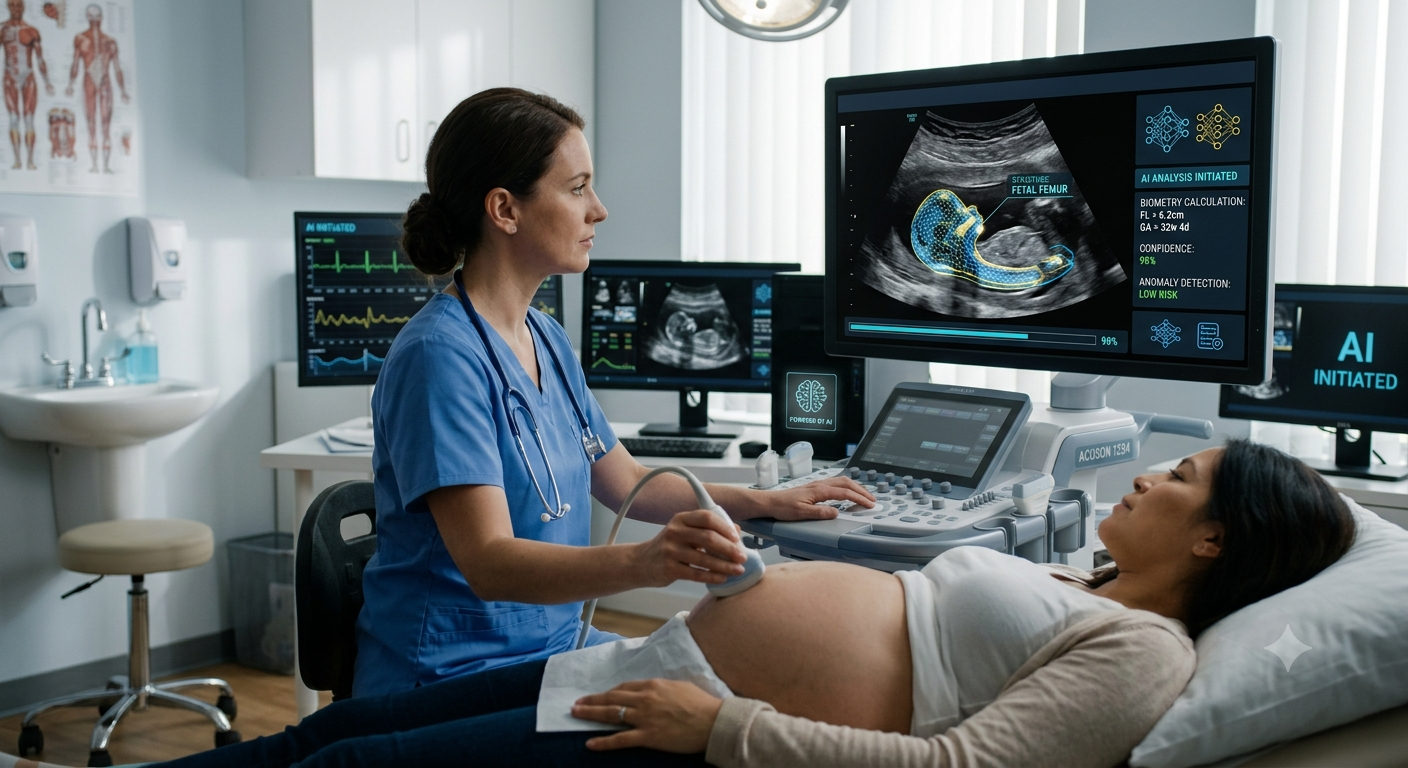
- Automated fetal growth and pregnancy assessment: AI assists clinicians by automatically identifying fetal anatomy, calculating gestational age, and measuring fetal growth parameters. These tools reduce manual measurements, improve consistency, and support faster prenatal assessments, particularly in primary care clinics and rural healthcare facilities with limited imaging specialists.
- AI-guided scanning for inexperienced users: Modern ultrasound systems provide real-time guidance that helps less-experienced healthcare workers position the ultrasound probe correctly and capture diagnostic-quality images. This capability expands ultrasound access in community hospitals, emergency departments, and remote healthcare locations where expert sonographers are unavailable.
- Automatic organ segmentation and measurement: AI automatically identifies organs and anatomical structures, calculates dimensions, and generates standardized measurements during ultrasound examinations. This reduces examination time, minimizes inter-operator variation, and improves reporting consistency across abdominal, pelvic, vascular, and cardiac imaging applications.
- Decision support for disease detection: AI analyzes ultrasound images to highlight suspicious regions that may require further clinical review. It acts as a decision-support tool for radiologists by improving diagnostic confidence while reducing the likelihood of overlooked abnormalities during routine imaging examinations.
- Remote and home-based ultrasound imaging: AI-assisted home ultrasound systems enable patients or caregivers to acquire images with software guidance while qualified healthcare professionals interpret them remotely. This use case supports telehealth services, chronic disease monitoring, pregnancy follow-up, and healthcare delivery in geographically isolated communities.
Frequently Asked Questions About AI in Ultrasound Imaging
- How does AI improve the accuracy of ultrasound imaging?
AI helps identify anatomical structures, reduces image noise, automates repetitive measurements, and highlights suspicious findings for clinician review. These capabilities minimize operator variability, improve consistency between examinations, and enhance diagnostic confidence across multiple ultrasound applications. - Which medical specialties use AI-powered ultrasound the most?
AI-enabled ultrasound is widely used in obstetrics, cardiology, radiology, emergency medicine, vascular imaging, musculoskeletal care, and abdominal imaging. Hospitals and diagnostic centers increasingly rely on AI to streamline workflows and improve imaging quality across these specialties. - What is driving growth in the AI in ultrasound imaging market?
Growing demand for early disease detection, rising adoption of portable ultrasound devices, expanding point-of-care imaging, healthcare workforce shortages, and continuous regulatory approvals for AI-enabled medical devices are major factors accelerating market growth across developed and emerging healthcare systems. - Can AI replace sonographers or radiologists?
No. AI is designed as a clinical decision-support technology rather than a replacement for healthcare professionals. It assists with image acquisition, measurements, and workflow efficiency, while qualified clinicians remain responsible for image interpretation, diagnosis, and patient management. - What are the major benefits of AI in ultrasound imaging?
AI offers faster examinations, standardized measurements, improved image consistency, reduced operator dependency, and better workflow efficiency. These advantages help healthcare providers manage increasing imaging volumes while maintaining high-quality diagnostic performance and supporting better patient outcomes. - How is AI supporting point-of-care and home ultrasound imaging?
AI provides real-time scanning guidance that helps users capture clinically useful images even outside traditional imaging departments. The FDA has introduced a device classification for prescription home-use ultrasound systems with software guidance, supporting remote care and telehealth applications. - What opportunities are emerging in the AI in ultrasound imaging market?
Opportunities include AI-guided handheld ultrasound, cloud-based image analysis, tele-ultrasound services, automated prenatal assessments, and expanded use in rural healthcare. These innovations can improve access to diagnostic imaging where experienced sonographers and radiologists are limited. - What is the future outlook for the AI in ultrasound imaging market?
The market is expected to grow as healthcare providers increasingly adopt AI-enabled portable imaging, automated clinical workflows, and remote diagnostic services. Ongoing regulatory support and advances in foundation AI models are expected to expand ultrasound applications across multiple medical specialties.
Conclusion
The AI in ultrasound imaging market is advancing steadily as healthcare providers seek faster, more accurate, and more accessible diagnostic solutions. AI is improving image quality, automating measurements, reducing operator dependency, and supporting clinical decision-making across multiple specialties. Increasing adoption of handheld ultrasound devices, stronger regulatory support from the FDA, and continuous innovation in deep learning and foundation AI models are creating new opportunities for market growth.
Expanding use in telehealth, maternal care, emergency medicine, and rural healthcare further strengthens demand. As AI technologies mature and integrate into routine clinical workflows, the market is expected to play an increasingly important role in delivering efficient, standardized, and patient-centered diagnostic imaging worldwide.