


Introduction
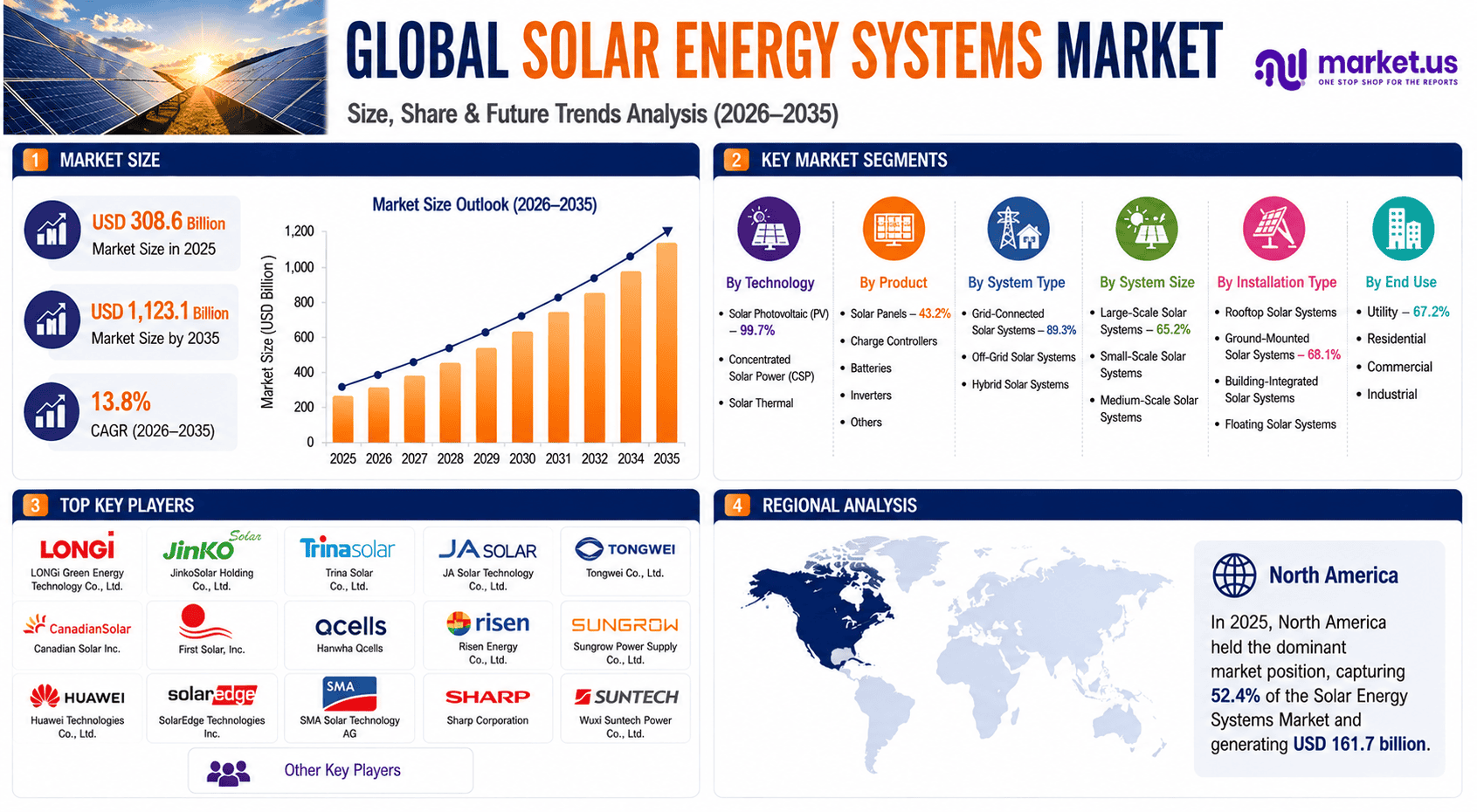
In 2025, the Global Solar Energy Systems Market was valued at USD 308.6 billion. Between 2026 and 2035, the market is projected to grow at a CAGR of 13.8%, reaching approximately USD 1,123.1 billion by 2035. North America dominated the market in 2025, accounting for over 52.4% of global revenue, equivalent to USD 161.7 billion.
Solar energy systems have become a key part of global electricity generation, covering utility-scale and rooftop photovoltaic systems, solar thermal technologies, inverters, trackers, monitoring software, and battery-integrated solutions. In 2025, global solar PV additions exceeded 600 GW, bringing cumulative installed capacity to nearly 2,800 GW, while solar accounted for more than 75% of newly added renewable capacity.
Falling costs continue to drive adoption. According to IRENA, the global weighted-average cost of electricity from newly commissioned utility-scale solar PV fell to USD 0.043/kWh in 2024, with average installed costs declining to USD 691/kW. These improvements are encouraging wider deployment by utilities, businesses, and households seeking lower energy costs and reduced carbon emissions.
Government support through auctions, tax incentives, rooftop solar programs, and grid modernization is further accelerating market growth. Emerging opportunities in solar-plus-storage, floating solar, agrivoltaics, building-integrated PV, and green hydrogen are expected to create additional demand, while digital energy management and grid flexibility solutions will support long-term market expansion.
Key Takeaways
- The Global Solar Energy Systems Market was valued at USD 308.6 billion in 2025.
- The market is projected to grow at a CAGR of 13.8% and is estimated to reach USD 1,123.1 billion by 2035.
- On the basis of technology, Solar Photovoltaic (PV) dominated the market, constituting 99.7% of the total market share.
- Based on the product, Solar Panels dominated the market, with a substantial market share of around 43.2%.
- Based on the system type, Grid-Connected Solar Systems led the market, comprising 89.3% of the total market.
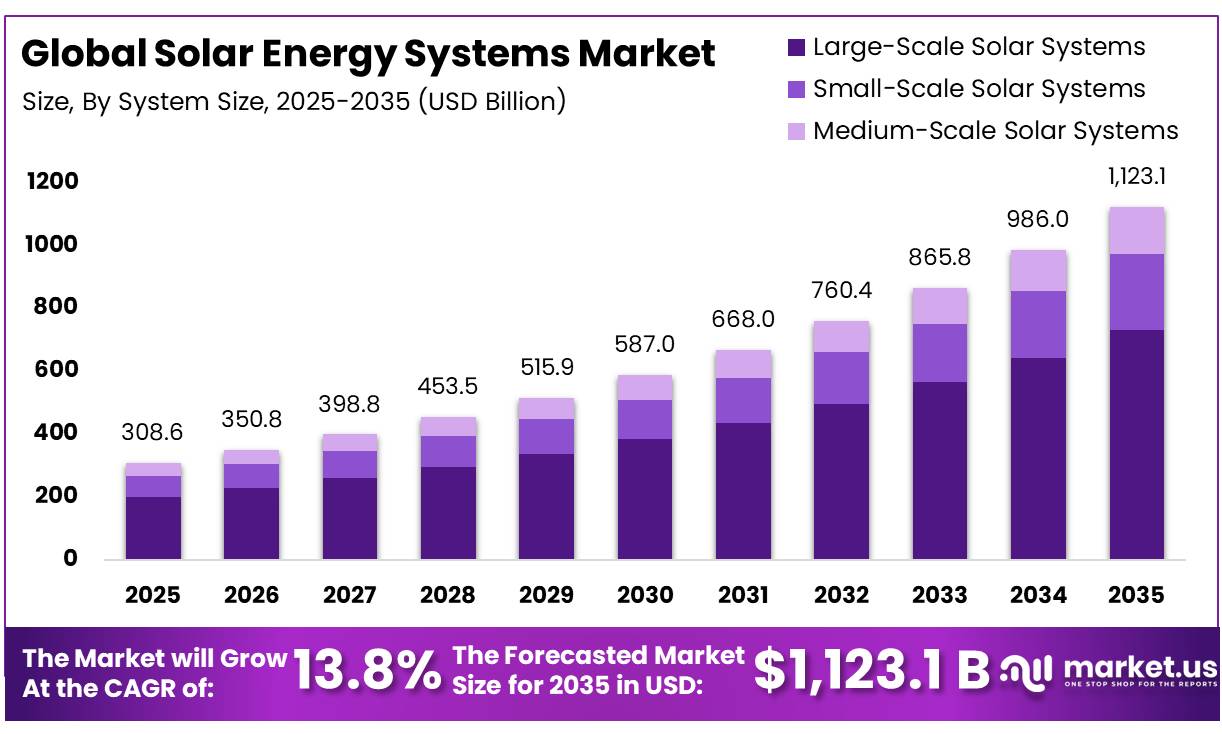
- On the basis of system size, Large-Scale Solar Systems dominated the market, constituting 65.2% of the total market share.
- Based on the installation type, Ground-Mounted Solar Systems dominated the market, with a substantial market share of around 68.1%.
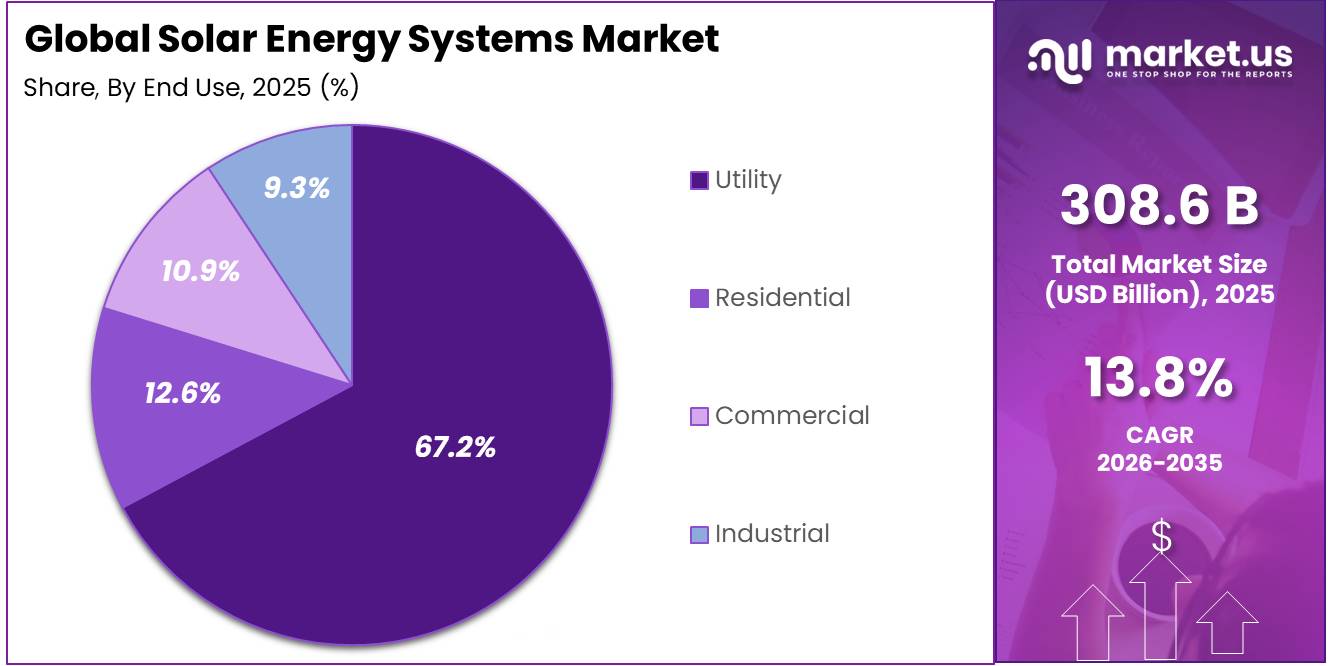
- Based on the end use, Utility led the market, comprising 67.2% of the total market.
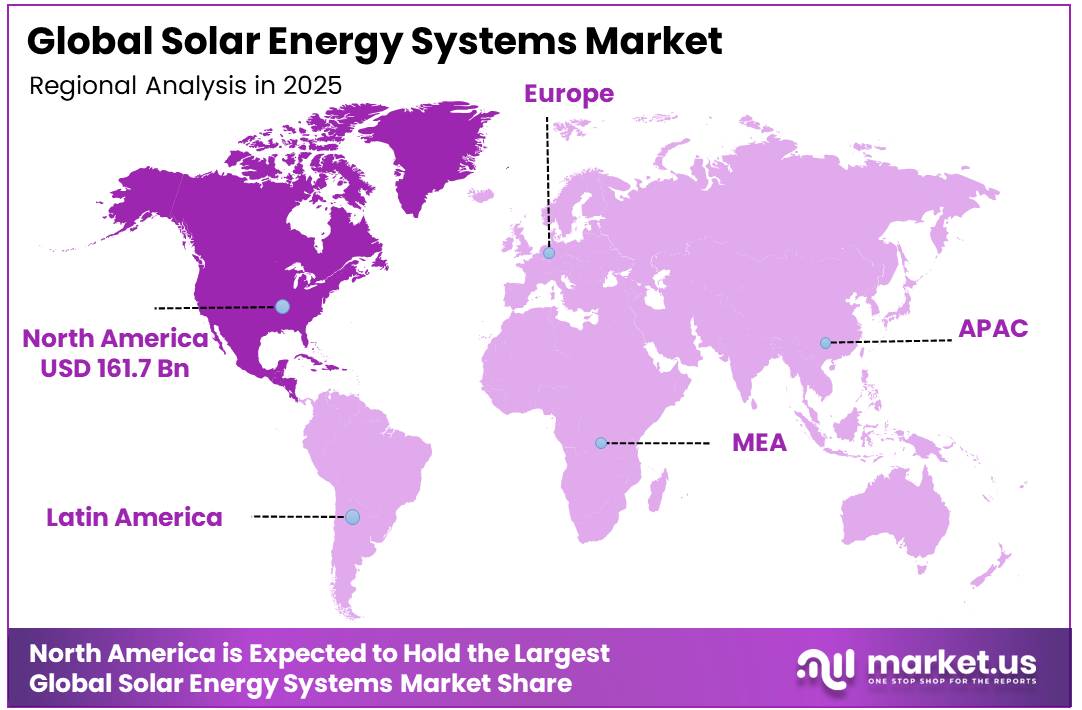
- In 2025, North America was the most dominant region in the market, accounting for 52.4% of the total global consumption.
Market Segmentation Overview
Technology Analysis
Solar Photovoltaic dominates the market with a 99.7% share due to its extensive adoption across residential, commercial, and utility-scale applications
In 2025, Solar Photovoltaic (PV) held a dominant market position, capturing more than a 99.7% share. Its leading position was driven by its modular design, ease of installation, and ability to serve residential, commercial, and utility-scale power generation projects. According to the U.S. Energy Information Administration, estimated small-scale solar PV capacity reached 59,505.5 MW in 2025, while residential small-scale PV systems generated 63,274 thousand MWh of electricity during the year. These figures highlight the widespread deployment of PV technology and its continued role as the primary method for converting solar energy into electricity.
Product Analysis
Solar Panels dominate the product segment with a 43.2% share
In 2025, Solar Panels held a dominant market position, accounting for more than 43.2% of the market. Their dominance was supported by their essential role in converting sunlight into electricity across residential, commercial, and utility-scale solar installations. In January 2025, the U.S. Department of Energy reported that the Orion I, Orion II, and Orion III solar projects in Texas utilized 1.3 million solar panels manufactured in Ohio, supporting a combined electricity generation capacity of 875 MW. The large number of modules required for utility-scale projects continues to strengthen the demand for solar panels.
System Type Analysis
Grid-Connected Solar Systems dominate with an 89.3% share, supported by expanding utility-scale installations
In 2025, Grid-Connected Solar Systems held a dominant market position, capturing more than 89.3% share. Their leadership was driven by direct integration with utility networks, the expansion of large solar parks, net-metering programs, and ongoing investments in transmission infrastructure. During 2025, U.S. developers added 27.2 GW of utility-scale solar capacity to the electricity grid, reinforcing the widespread deployment of grid-connected systems designed to deliver power through interconnected transmission and distribution networks.
System Size Analysis
Large-Scale Solar Systems dominate with a 65.2% share as utility-scale projects continue to expand
In 2025, Large-Scale Solar Systems held a dominant market position, capturing more than 65.2% share. Their market leadership was supported by increasing investments in utility-scale solar farms, centralized electricity generation, and large grid-connected projects. Long-term power purchase agreements, government-backed renewable energy initiatives, and continuous improvements in transmission infrastructure further encouraged the development of large-scale solar facilities worldwide.
Installation Type Analysis
Ground-Mounted Solar Systems lead with a 68.1% share, supported by utility-scale solar developments
In 2025, Ground-Mounted Solar Systems held a dominant market position, capturing more than 68.1% share. Their strong market presence was supported by large utility-scale projects capable of accommodating extensive panel arrays, solar tracking systems, central inverters, and battery storage facilities. According to the U.S. Department of Energy, the panel-covered footprint of a ground-mounted photovoltaic array typically requires 3 to 4 acres per MWdc of installed capacity. When space for fencing, equipment, access roads, and unusable land is included, the total site requirement generally increases to 5 to 6 acres per MWdc.
End Use Analysis
Utility end use dominates the Solar Energy Systems Market with a 67.2% share
In 2025, Utility held a dominant market position, capturing more than 67.2% share. Large-scale solar installations remained the preferred choice for generating electricity at scale and supplying power directly to centralized grids. Utility projects also supported bulk electricity procurement, grid modernization, and long-term renewable energy targets. According to the U.S. Energy Information Administration, developers planned to add 43.4 GW of new utility-scale solar capacity in 2026, increasing demand for solar panels, inverters, tracking systems, transformers, energy storage systems, and grid management equipment.
Drivers
Record Solar Deployment Accelerates Energy System Adoption Worldwide
Rapid solar deployment is a major driver for the Solar Energy Systems Market as utilities, businesses, and households increase investment in clean electricity infrastructure. According to the International Energy Agency, global renewable capacity additions reached 800 GW in 2025, while solar PV represented more than three-quarters of new renewable installations. Solar PV additions alone exceeded 600 GW, showing that solar has become the preferred technology for expanding electricity supply because of its scalability, improving economics, and shorter project development cycles.
Government-backed technology development is also supporting wider adoption. Global solar PV generation increased by about 600 TWh in 2025 and reached nearly 2,700 TWh. In the United States, the Department of Energy’s Solar Energy Technologies Office Lab Call FY2025-27 provides USD 217 million for research covering photovoltaics, system integration, manufacturing, and other solar technologies. These programs help improve efficiency, grid compatibility, manufacturing capabilities, and long-term system reliability, encouraging further investment across residential, commercial, and utility-scale solar energy systems.
Major Challenges
Grid Bottlenecks Restrict Faster Solar Energy System Expansion
Limited grid capacity is becoming a major challenge for the Solar Energy Systems Market as solar projects are being developed faster than transmission networks can connect them. The International Energy Agency reported that more than 2,500 GW of renewable, storage, and large-load projects remain stalled in grid connection queues worldwide. This backlog delays solar commissioning, increases project costs, and weakens developer returns when electricity cannot reach consumers efficiently.
The pressure is growing because annual grid investment remains around USD 400 billion, far behind the pace of investment in new electricity generation. The IEA estimates that grid spending must increase by roughly 50% by 2030 to meet electricity demand. Slow permitting, transformer shortages, congestion, and limited network flexibility can also force solar power to be curtailed during high-production periods. Governments are responding through grid reforms, storage policies, and faster connection procedures, but infrastructure development still takes longer than solar project construction.
Business Opportunities
Solar Plus Storage Creates Major Grid Expansion Opportunities
Growing demand for battery storage creates a strong business opportunity for the Solar Energy Systems Market. In 2025, around 108 GW of new battery storage capacity was installed worldwide, representing an increase of about 40% from the previous year. The International Energy Agency also reported that installed battery capacity is now 11 times higher than in 2021. This rapid expansion gives solar developers an opportunity to combine photovoltaic systems with batteries, allowing excess daytime electricity to be stored and supplied when demand rises.
Government financing is also improving the commercial potential of integrated projects. In January 2025, the U.S. Department of Energy closed a USD 584.5 million loan guarantee for solar PV and battery projects in Puerto Rico, including USD 559.4 million in principal financing and USD 25.1 million in capitalized interest. Such programs can create additional opportunities for solar equipment suppliers, storage providers, EPC companies, and grid-integration businesses.
Use Cases
Utility-Scale Solar Supports Large Electricity Networks
Utility-scale solar energy systems are increasingly used by power companies to supply electricity directly to national and regional grids. In 2025, global solar PV capacity additions increased by around 12% and exceeded 600 GW for the first time. This pushed cumulative installed solar PV capacity to approximately 2,800 GW worldwide. Solar generation also increased by about 600 TWh during the year, reaching nearly 2,700 TWh and contributing more than 8% of global electricity generation. These figures show the growing role of large solar farms in meeting rising power demand and replacing part of conventional electricity generation. Utilities are also combining solar plants with transmission infrastructure and storage to improve grid reliability.
Rooftop Solar Reduces Commercial Electricity Dependence
Residential, commercial, and industrial buildings increasingly use rooftop solar systems to generate electricity close to where it is consumed. The IEA expects distributed solar applications, including residential, commercial, industrial, and off-grid installations, to represent around 42% of global solar PV expansion between 2025 and 2030. Solar PV overall is projected to account for almost 80% of worldwide renewable capacity growth during this period. Higher retail electricity prices and supportive government policies are encouraging homes and businesses to install systems that lower purchased electricity requirements. The application is particularly attractive for factories, warehouses, offices, retail facilities, schools, and residential buildings with available roof space and regular daytime electricity consumption.
Solar-Plus-Storage Provides Reliable Flexible Power Supply
Solar energy systems combined with batteries are becoming an important application where customers require electricity after sunset or during grid interruptions. Global battery storage additions reached 108 GW in 2025, increasing approximately 40% from 2024. Utility-scale installations accounted for around 87 GW, or roughly four-fifths of total additions, while approximately 24 GW of new utility-scale batteries were directly co-located with renewable energy projects. Battery storage enables solar electricity produced during high-generation hours to be shifted to periods of stronger demand. This creates growing applications across utility projects, commercial properties, industrial facilities, microgrids, and locations with unstable electricity networks. It also allows solar operators to improve system flexibility and reduce renewable energy curtailment.
Regional Analysis
North America Dominates the Solar Energy Systems Market with a 52.4% Share
In 2025, North America held the leading position in the Solar Energy Systems Market, accounting for 52.4% of the global market and generating USD 161.7 billion in revenue. According to the International Renewable Energy Agency (IRENA), the region had 230,471 MW of installed solar capacity at the end of 2025. Market leadership was driven by the expansion of utility-scale solar projects, increasing adoption of distributed solar generation, rising corporate renewable energy procurement, growing integration of battery storage systems, and well-established financing mechanisms.
The United States remained the primary market for solar deployment, while Canada and Mexico continued to support regional growth through utility-scale developments and commercial solar installations. Although grid interconnection delays continue to present challenges, North America maintained its strong position in the global solar energy systems market.
Recent Developments
- In June 2025, LONGi Green Energy Technology introduced its HIBC technology along with a standard-size solar module capable of delivering more than 700 W of power, 25.9% module efficiency, and a power density exceeding 259 W/m², reinforcing its focus on improving energy generation and maximizing output from limited installation space.
- In March 2025, JinkoSolar Holding Co., Ltd. entered into a partnership with Germany-based AIS GmbH to deploy a 66.5 MWh solar-plus-storage project, integrating its SunTera energy storage system with Tiger Neo solar modules to enhance renewable energy generation and storage capabilities.
Conclusion
The Solar Energy Systems Market is expected to remain an important part of the global shift toward cleaner and more secure electricity. According to the International Energy Agency, global solar PV capacity additions surpassed 600 GW in 2025, taking cumulative installed solar PV capacity to around 2,800 GW. Solar electricity generation also reached nearly 2,700 TWh, reflecting the technology’s growing role across utility-scale plants, commercial facilities, homes, and distributed energy systems.
Falling technology costs, supportive government policies, expanding electricity demand, and growing integration with battery storage are strengthening the long-term outlook for solar energy systems. At the same time, grid congestion, permitting delays, and transmission limitations will require continued infrastructure investment. Overall, strong deployment momentum and wider use of solar across different applications are expected to create sustained opportunities for manufacturers, developers, utilities, EPC providers, and energy-storage companies.




















