


Overview
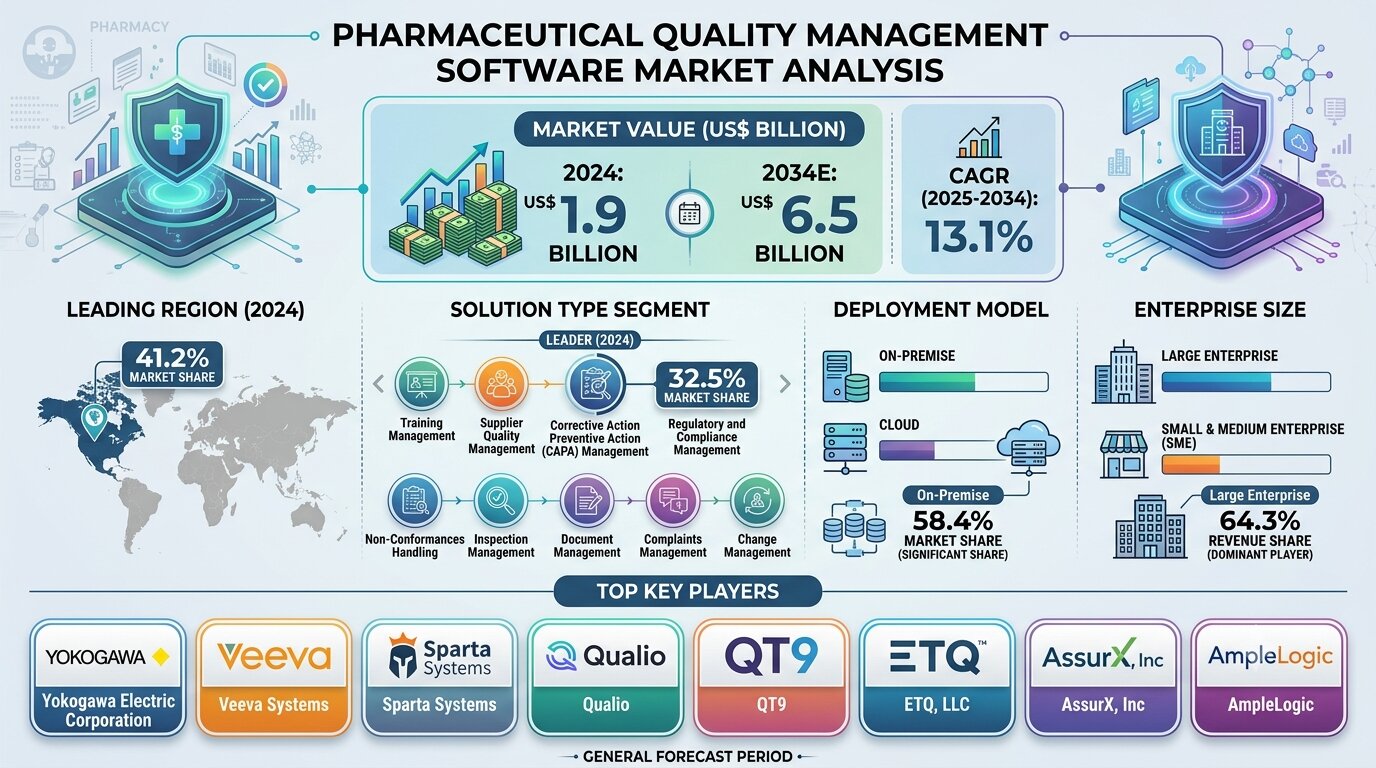
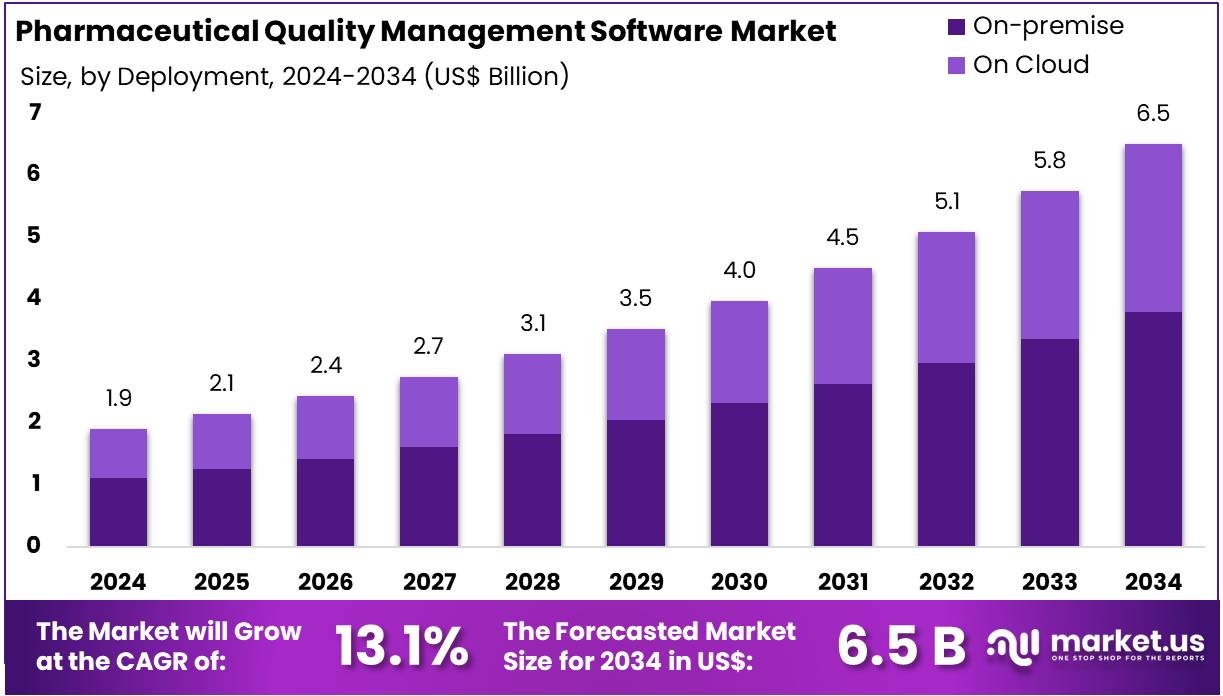
The Pharmaceutical Quality Management Software Market size is expected to be worth around US$ 6.5 billion by 2034 from US$ 1.9 billion in 2024, growing at a CAGR of 13.1% during the forecast period 2025 to 2034.
The pharmaceutical manufacturing industry is increasingly adopting digital quality management solutions as companies seek stronger compliance, improved operational visibility, and more consistent control across complex manufacturing networks. Pharmaceutical quality management software supports critical activities including deviation management, corrective and preventive actions (CAPA), change control, audits, document management, training, complaints, risk management, and quality reporting.
The scale of pharmaceutical manufacturing oversight highlights the need for effective quality systems. According to the U.S. Food and Drug Administration’s FY2025 Report on the State of Pharmaceutical Quality, the agency’s CDER Site Catalog contained 5,953 manufacturing sites globally at the end of fiscal year 2025, with 57% located in the United States. During FY2025, FDA conducted 1,248 drug quality assurance inspections, compared with 972 inspections in FY2024.
Regulatory expectations are also encouraging manufacturers to move beyond basic compliance. FDA’s Quality Management Maturity program promotes practices that exceed baseline current good manufacturing practice requirements and emphasizes continuous improvement, supply reliability, and proactive quality management. Manufacturing quality remains particularly important for pharmaceutical availability.
FDA identifies manufacturing quality issues as the most common reason for drug shortages, increasing the importance of early detection, root-cause analysis, corrective action, and continuous monitoring.
Key Takeaways
- In 2024, the pharmaceutical quality management software market generated US$ 1.9 billion in revenue, growing at a 13.1% CAGR. The market is projected to reach US$ 6.5 billion by 2034.
- CAPA management dominated the solution type segment in 2024, accounting for a 32.5% market share. The segment includes CAPA, training, supplier quality, compliance, inspection, document, complaints, and change management.
- On-premise deployment held the leading position in 2024 with a 58.4% market share. The deployment segment also includes cloud-based pharmaceutical quality management software.
- Large enterprises dominated the enterprise-size segment in 2024, capturing a 64.3% revenue share. The segment is divided into large enterprises and small and medium enterprises (SMEs).
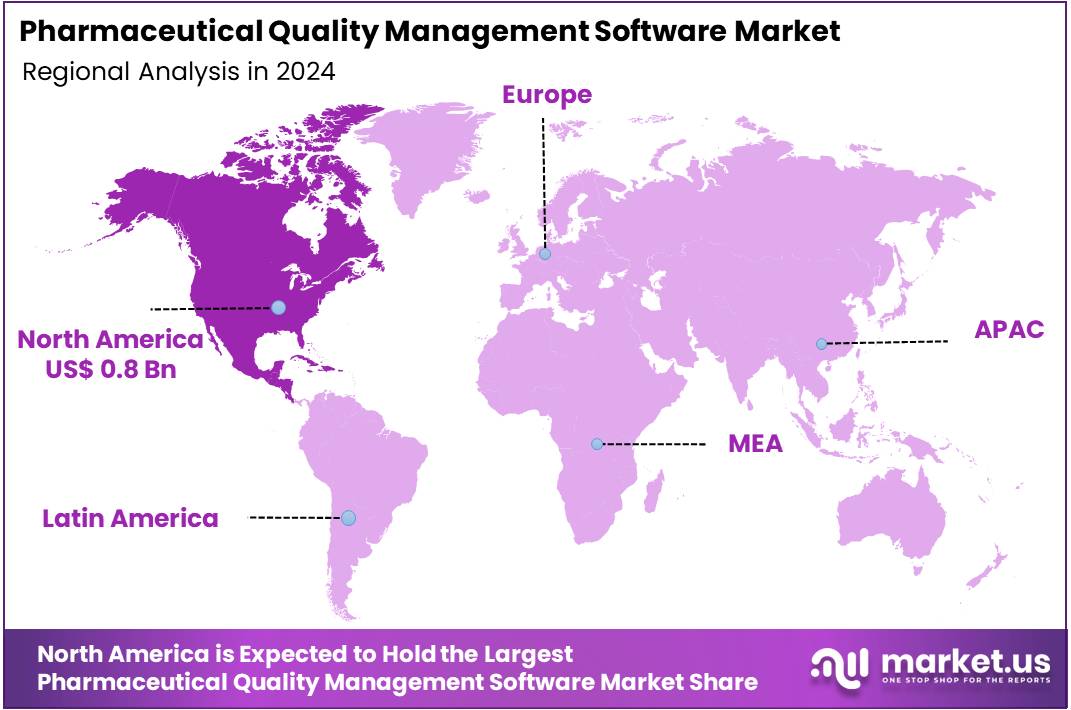
- North America led the global pharmaceutical quality management software market in 2024 with a 41.2% market share. Its leadership reflects strong adoption of digital quality and compliance management solutions.
Statistical Information
- 64% of drug-launch delays analyzed by Accenture across FDA Complete Response Letters from 2019–2024 were attributed to chemistry, manufacturing and controls (CMC) issues, highlighting the importance of stronger manufacturing-quality systems.
- A 2025 Deloitte survey of 103 biopharma executives found that 50% reported fewer errors and deviations after quality-control laboratory modernization initiatives.
- 45% of the 103 surveyed biopharma executives reported improved compliance following QC laboratory modernization, supporting investment in digital quality-management technologies.
- 43% of surveyed biopharma executives reported shorter testing timelines following QC laboratory modernization, demonstrating the operational benefits associated with digital quality processes.
- In FY2025, FDA received 4,059 initial Field Alert Reports (FARs) concerning significant quality-related incidents involving marketed drugs, providing evidence of the continuing need for effective quality-event monitoring and management.
- 35% of FDA-reported drug-quality defects in FY2025 involved packaging issues, making packaging the largest reported defect category and reinforcing the importance of quality controls, documentation, investigations, and corrective actions.
- 17% of FY2025 FDA-reported drug-quality defects involved out-of-specification or stability-testing issues, while another 13% involved contamination and sterility issues, highlighting the need for robust quality monitoring and preventive controls.
- FDA reported 321 drug recall events involving 755 recalled products in 2025. The agency also reported that more than 17,000 drug products had been recalled between 2012 and 2025, underscoring the continuing importance of preventive quality controls and effective CAPA processes.
Market Segmentation Analysis
Solution Type Analysis
The Corrective Action Preventive Action (CAPA) Management segment dominated the pharmaceutical quality management software market, accounting for 32.5% of the market share. Growing regulatory scrutiny and the need for rapid resolution of quality issues are increasing demand for effective CAPA solutions across pharmaceutical manufacturing operations. These platforms help organizations identify root causes, implement corrective measures, track preventive actions, and reduce the risk of recurring quality failures.
Integration with document control, supplier quality, and compliance functions further strengthens CAPA capabilities. In addition, automation and data analytics enable companies to monitor quality events more efficiently and identify potential risks earlier. The increasing focus on continuous improvement, regulatory compliance, and product safety is expected to support continued adoption of CAPA management solutions.
Deployment Analysis
The On-Premise deployment segment accounted for a leading 58.4% market share in the pharmaceutical quality management software market. Pharmaceutical companies continue to favor on-premise solutions because they provide greater control over sensitive quality, manufacturing, and compliance-related data.
Strict regulatory requirements and internal data-security policies further encourage organizations to maintain software infrastructure within their own environments. Existing investments in enterprise IT infrastructure and legacy systems also make on-premise platforms easier to integrate into established workflows.
Furthermore, pharmaceutical manufacturers often require extensive customization and direct control over system configurations, updates, and access permissions. Although cloud-based deployment is gaining traction, on-premise solutions remain important for organizations operating complex and highly regulated manufacturing environments.
Enterprise Size Analysis
The Large Enterprise segment represented the largest share of the pharmaceutical quality management software market, accounting for 64.3% in 2024. Large pharmaceutical organizations manage complex manufacturing networks, extensive regulatory requirements, and quality operations across multiple facilities, creating strong demand for scalable quality management platforms. These companies require integrated solutions capable of managing CAPA, audits, documentation, supplier quality, compliance, and change management across geographically distributed operations.
Advanced capabilities such as real-time analytics, automated workflows, and integration with manufacturing systems further support adoption among large enterprises. Their comparatively higher technology budgets also enable investment in sophisticated quality management infrastructure. As pharmaceutical companies increasingly prioritize operational efficiency, risk reduction, and consistent product quality, large enterprises are expected to remain a major contributor to market demand.
Regional Analysis
North America led the pharmaceutical quality management software market with a 41.2% share in 2024, supported by stringent pharmaceutical quality and compliance requirements. The FDA’s CGMP framework requires manufacturers to establish robust quality systems, investigate deviations, and maintain effective production controls.
The FDA is also advancing its Quality Management Maturity (QMM) program to encourage manufacturers to adopt practices beyond baseline CGMP requirements, strengthening demand for digital tools that support continuous improvement, risk management, and quality oversight.
Asia Pacific is projected to register the fastest CAGR during the forecast period, driven by expanding pharmaceutical production and increasing emphasis on quality assurance. WHO identifies GMP as an essential component of pharmaceutical quality management, covering production, processing, packaging, and quality controls. India’s pharmaceutical sector is particularly significant, with 60% of medicines prequalified by WHO for global use originating from India, highlighting the region’s importance in global pharmaceutical supply.
Business Opportunities
The pharmaceutical quality management software market presents significant business opportunities as manufacturers increasingly digitize quality, compliance, and risk-management processes. Software providers can capitalize on demand for CAPA, document control, audit management, supplier quality, deviation management, and change-control solutions, particularly among organizations managing complex manufacturing networks.
Integration with enterprise systems, manufacturing execution systems, laboratory information systems, and electronic document management platforms can create additional revenue opportunities through modular solutions and recurring subscriptions.
Artificial intelligence and advanced analytics represent another growth area, enabling companies to identify recurring quality issues, prioritize risks, automate investigations, and support predictive quality management. Cloud-based platforms also offer opportunities to serve small and mid-sized pharmaceutical manufacturers that require scalable systems without extensive infrastructure investments.
Regional expansion provides further potential, particularly across Asia Pacific, where pharmaceutical manufacturing capacity and international regulatory requirements are increasing. Vendors can develop localized compliance capabilities and multilingual platforms for these markets.
Partnerships with pharmaceutical manufacturers, contract development and manufacturing organizations (CDMOs), and regulatory consulting firms can further expand distribution channels. Providers that combine automation, interoperability, data security, and regulatory adaptability are well positioned to capture emerging demand.
Emerging Trends
- AI for Quality Decisions: AI is becoming a major trend in pharmaceutical quality software. It helps teams find unusual quality events, review deviations, and suggest root causes. Deloitte found that 38% of biopharma executives expect to automate many QC processes using AI and machine learning.
- Connected Quality Systems: Companies are replacing separate quality applications with connected platforms. These systems link documents, deviations, CAPA, laboratories, and manufacturing. Deloitte reported that 40% of QC executives still work with disconnected systems, showing why integrated quality software is becoming increasingly important.
- Cloud-Based Quality Platforms: Cloud technology is gaining adoption because it allows teams to access quality data across locations. Deloitte’s survey of 150 biopharma leaders found that 49% already use cloud computing in daily operations, supporting the shift toward centralized quality management systems.
- Continuous Manufacturing Monitoring: Regulators are encouraging advanced manufacturing methods that need continuous quality monitoring. FDA supports technologies such as continuous manufacturing and AI-enabled production, increasing demand for software that tracks process quality in real time instead of relying only on final product testing.
- Digital Traceability: Traceability is becoming more important for protecting pharmaceutical supply chains. WHO promotes digital systems that improve product tracking and faster reporting of quality problems. This trend is pushing companies to use software that records product movement and quality events throughout manufacturing.
Use Cases
- CAPA Management: Quality software is widely used to manage corrective and preventive actions. Teams record deviations, investigate root causes, assign actions, and track completion. This helps manufacturers reduce repeated quality problems and maintain clear records for inspections and regulatory reviews.
- Electronic Document Control: Manufacturers use quality software to store procedures, specifications, training records, and controlled documents. Digital approval workflows reduce paper records and make sure employees always use the latest approved version, improving consistency across manufacturing sites.
- Supplier Quality Management: Pharmaceutical companies use these platforms to qualify suppliers, track audits, manage supplier deviations, and monitor incoming materials. FDA quality guidance highlights supplier oversight as an important part of maintaining consistent product quality and reducing manufacturing risks.
- Audit and Inspection Management: Quality teams use software to prepare for regulatory inspections, schedule internal audits, record findings, and monitor corrective actions. Centralized records make it easier to show inspectors how issues were identified, investigated, and closed.
- Batch Review and Release: Manufacturers increasingly use digital systems to review production records before releasing medicines. Rockwell Automation reported a pharmaceutical implementation that reduced batch-product-review cycle time by 46% to 75%, showing the practical value of automated quality workflows.
Recent Developments
- In May 2026, QT9 Software officially released QT9 ERP 2026, adding new rework and contract-manufacturing modules, potency tracking, expanded ERP integrations, enhanced shop-floor material management, and an AI-driven Help Center for regulated manufacturers.
- In April 2026, Veeva Systems expanded its Vault AI strategy across life-sciences applications, with industry-specific AI agents planned for quality and other R&D functions, building on its Vault platform’s ability to connect data, content, and AI-driven workflows.
- In March 2026, QT9 Software published a QMS implementation case study showing how a customer that purchased QT9 in August 2025 used the system to establish a clean transition point for controlled documents and simplify audit preparation.
- In January 2026, AssurX expanded its partner program, inviting technology and service providers to collaborate with its quality-management platform. The partnership model focuses on combining capabilities to improve product quality, reduce costs, and support regulatory compliance.
- In November 2025, Veeva reported 115 customers live with Veeva AI, while confirming that its first AI agents for R&D and quality were planned for 2026, marking a significant move toward AI-enabled quality and life-sciences workflows.
- In June 2025, Yokogawa Electric Corporation signed a multi-faceted strategic partnership with Jinggong Group, covering mutual business development and collaboration. The agreement expands Yokogawa’s industrial digital-transformation activities relevant to regulated manufacturing environments.
Conclusion
The Pharmaceutical Quality Management Software Market is evolving as pharmaceutical manufacturers increasingly prioritize regulatory compliance, operational efficiency, data integrity, and continuous quality improvement. Growing adoption of CAPA, digital document control, supplier quality management, automated workflows, AI, cloud platforms, and connected quality systems is creating new opportunities for software providers. Strong regulatory oversight, increasing manufacturing complexity, and the need to minimize quality-related disruptions are further supporting demand.
North America remains a major market, while Asia Pacific offers significant expansion potential. Going forward, vendors that deliver scalable, secure, interoperable, and intelligent quality-management solutions will be well positioned to support pharmaceutical companies in achieving consistent product quality and stronger compliance.




















