


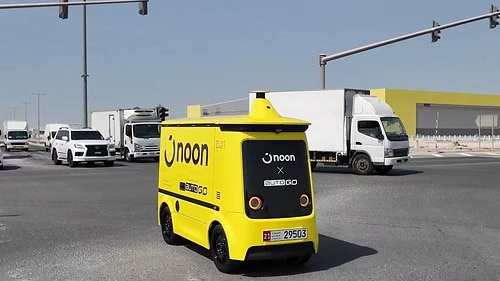
Neolix is expanding its autonomous logistics business in the Middle East, where several hundred of its self-driving delivery vehicles are operating around the clock. In a July 13, 2026 announcement, the company highlighted its international growth. It also discussed its approach to shared robotic delivery services.
According to Neolix, it has deployed more than 25,000 proprietary RoboVans across more than 300 cities in over 15 countries. Its vehicles have recorded approximately 200 million autonomous kilometers, and individual city fleets have grown to more than 2,000 vehicles.
The company shared its commercial experience at LEAP East 2026. This event was held at the Hong Kong Convention and Exhibition Centre from July 8 to 10.
Middle East Becomes a Key Market for Neolix
The Middle East plays an important role in Neolix’s international expansion. Specifically, the United Arab Emirates serves as a proving ground for autonomous logistics at commercial scale.
Will Zhao, Executive President of Neolix, said the UAE offers real-world applications in quick commerce and urban logistics. He identified Saudi Arabia as an important next step through local partnerships. The company is also expanding across Southeast Asia and Europe.
Zhao described the regional focus as a shift. It is now moving from demonstrating whether autonomous logistics can work to determining how quickly it can scale.
RoboVan Deployments Support Commercial Delivery
Neolix specializes in Level 4 autonomous logistics and uses mapless technology in its RoboVan operations. The company points to its deployment figures and accumulated autonomous mileage as evidence of its commercial progress.
According to Neolix, deployments involving global retailers have reduced fulfillment lead times from six hours to two hours. At the same time, they have significantly lowered delivery costs. These performance results are company-reported.
LEAP East Discussions Focus on Physical AI
At LEAP East 2026, Zhao participated in two sessions: “Autonomous Everything: The Dawn of Physical AI” and “Unmanned & Autonomous: The Emergence of Physical AI in Transportation.”
He argued that logistics offers a practical setting for Physical AI because goods move through frequent, measurable networks. In these settings, operators can assess efficiency, safety, and return on investment.
Compared with humanoid robots and robotaxis, Zhao said business-to-business logistics has clearly defined routes and measurable outcomes. In his view, these characteristics have helped autonomous delivery move beyond demonstrations and into commercial production.
Neolix’s Robotics-as-a-Service model allows multiple retailers and logistics operators to share an autonomous fleet across different routes and time windows. Zhao said this approach can improve vehicle utilization. Furthermore, it can make the technology accessible to mid-sized businesses as well as large organizations.
Rather than dedicating one RoboVan to one operator, the company envisions an intelligent fleet serving several shippers and retailers. Zhao described this as a move from per-vehicle costs toward per-parcel economics. In this model, the value of autonomous delivery is assessed through measurable business results.
International Cooperation Supports Logistics Infrastructure
LEAP East was organized by Tahaluf and jointly convened by Hong Kong’s Innovation, Technology and Industry Bureau and Saudi Arabia’s Ministry of Communications and Information Technology. The event connected technology and business communities across Asia and the Middle East.
Zhao highlighted Hong Kong’s position between the manufacturing and operational capabilities of China and Southeast Asia. He also noted investment and demand from the Gulf, as well as standards across broader consumer markets. He said international cooperation would be essential to developing infrastructure for the next generation of logistics.
About Neolix
Neolix develops Level 4 autonomous logistics technology and proprietary RoboVans for retail and logistics operations. Through its international deployments and shared-fleet model, the company aims to make autonomous delivery part of everyday logistics infrastructure.


