


Overview
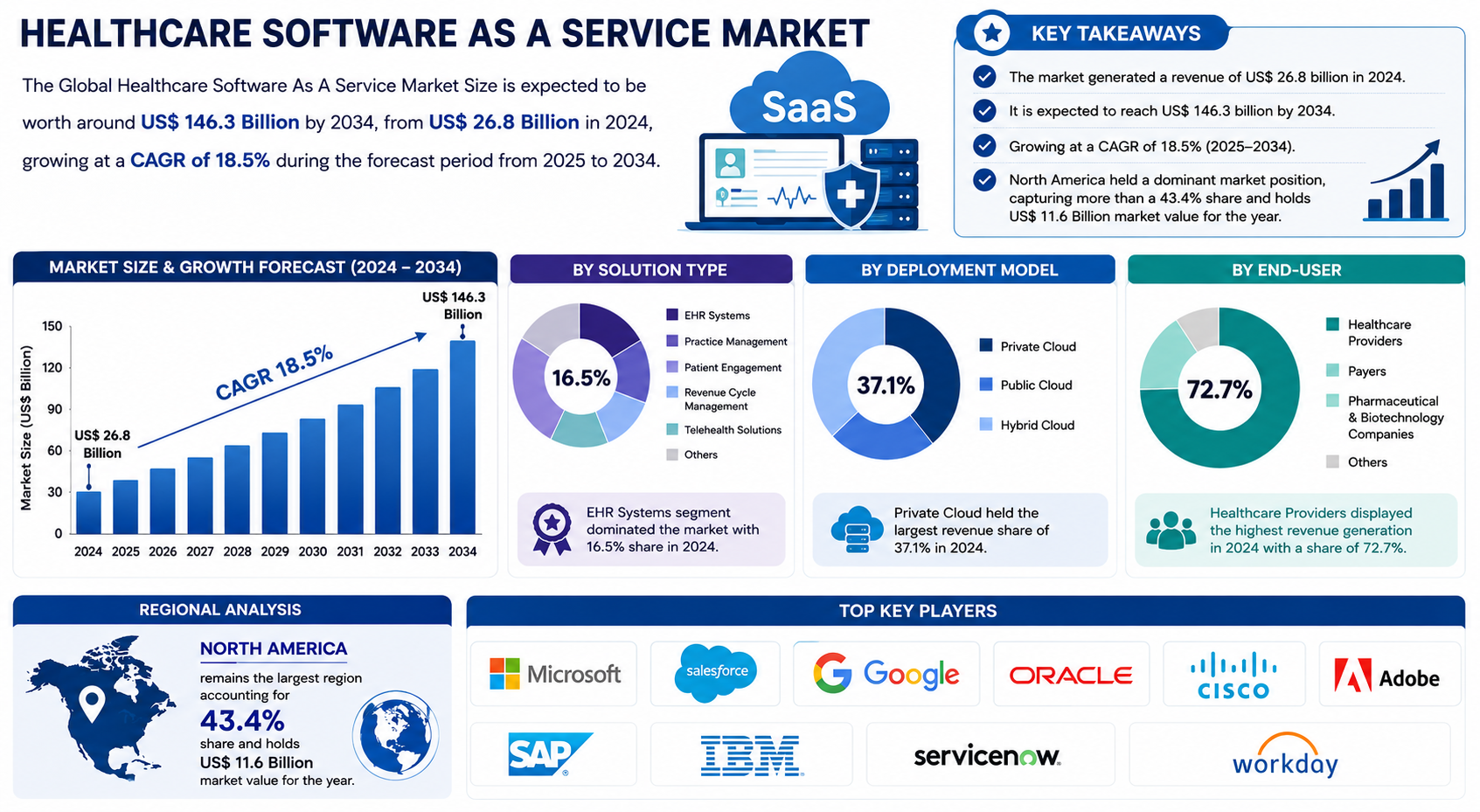
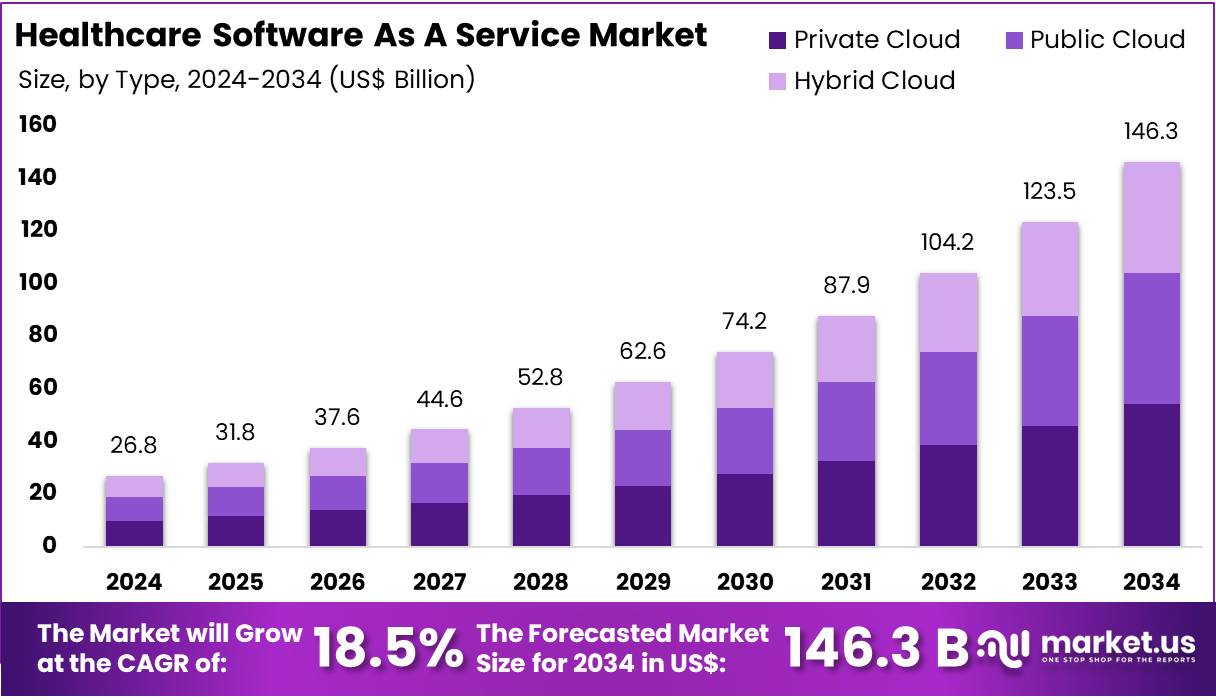
The Global Healthcare Software As A Service Market Size is expected to be worth around US$ 146.3 Billion by 2034, from US$ 26.8 Billion in 2024, growing at a CAGR of 18.5% during the forecast period from 2025 to 2034. North America held a dominant market position, capturing more than a 43.4% share and holds US$ 11.6 Billion market value for the year.
The growing adoption of digital healthcare technologies is transforming how hospitals, clinics, and healthcare organizations manage patient information, clinical workflows, and administrative operations. Healthcare Software as a Service (SaaS) platforms are increasingly being used for electronic health records (EHR), patient engagement, telehealth management, revenue cycle management, analytics, and healthcare data integration due to their scalability, lower infrastructure requirements, and remote accessibility.
Healthcare providers are shifting toward cloud-based software solutions to improve operational efficiency and support value-based care models. These platforms enable real-time access to medical information, automated workflows, and improved collaboration among healthcare professionals. The increasing focus on healthcare interoperability and secure data exchange is further encouraging organizations to adopt advanced software platforms.
The U.S. Food and Drug Administration (FDA) has also continued developing regulatory guidance for digital health software, including software functions, mobile medical applications, and artificial intelligence-enabled healthcare technologies, supporting safer adoption of digital solutions.
A 2025 healthcare cloud survey found that 15% of organizations had fully integrated cloud adoption into their business strategy, while 31% had established formal cloud strategies to support future digital transformation. Additionally, healthcare organizations are increasingly integrating artificial intelligence and analytics capabilities into SaaS platforms to improve clinical decision support and operational planning.
The FDA has issued guidance related to AI-enabled device software lifecycle management, reflecting the growing role of intelligent healthcare applications. These advancements are expected to strengthen demand for flexible, cloud-based healthcare software solutions worldwide.
Key Takeaways
- In 2024, the global Healthcare Software as a Service market was valued at US$ 26.8 billion and is projected to reach US$ 146.3 billion by 2034, expanding at a CAGR of 18.5% during the forecast period.
- The EHR Systems segment emerged as the leading solution type, accounting for 16.5% of the global market share in 2024.
- Among deployment models, the Private Cloud segment held the largest share, representing 37.1% of total market revenue in 2024.
- The Healthcare Providers segment led the market by end user, contributing 72.7% of the overall revenue in 2024.
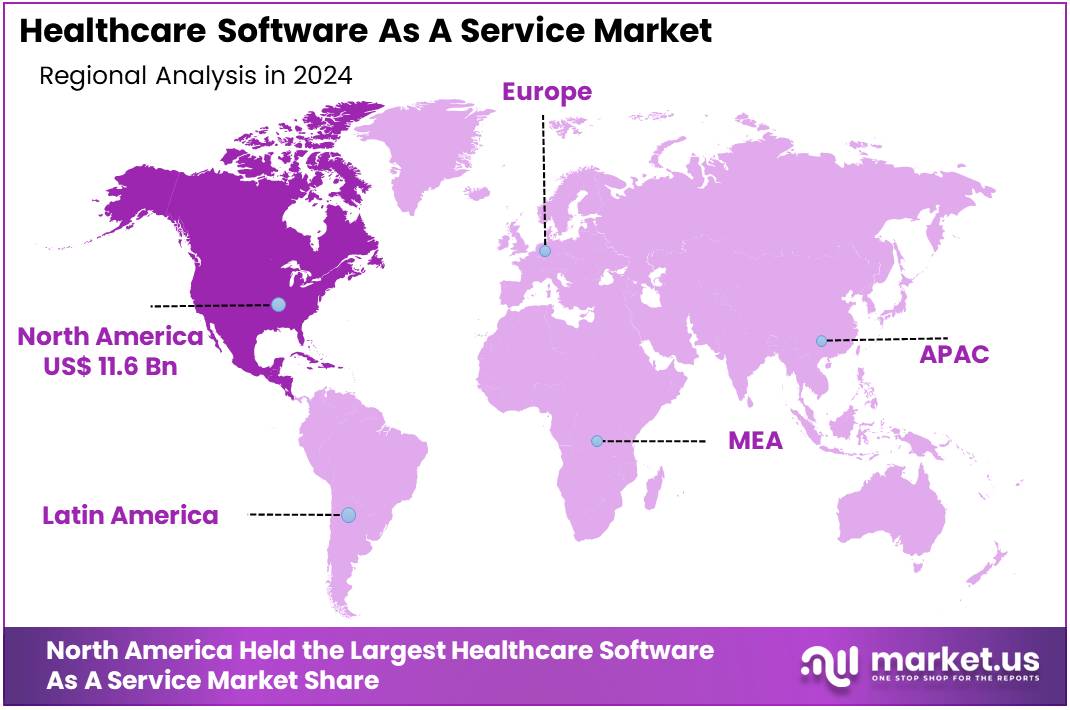
- North America dominated the global Healthcare Software as a Service market, capturing 43.4% of the total market share in 2024.
Statistical Information
- 95.0% of U.S. office-based physicians used an Electronic Health Record (EHR) system in 2024, reflecting the continued reliance on digital clinical software across healthcare practices.
- 175 different certified health IT developers were reported by clinicians participating in the 2024 Promoting Interoperability Program, demonstrating a broad and competitive healthcare software ecosystem.
- Epic Systems products were used by 62.8% of clinician participants in the 2024 Promoting Interoperability Program, making it the most widely reported certified health IT developer.
- Oracle Health products were reported by 10.5% of clinician participants in the same 2024 federal reporting program, highlighting Oracle’s growing presence in healthcare software.
- U.S. national health expenditure reached US$5.3 trillion in 2024, equal to US$15,474 per person, underscoring the scale of digital healthcare investment opportunities.
- Hospital expenditures increased 8.9% to US$1.635 trillion in 2024, driving demand for scalable SaaS platforms that improve hospital operations, clinical workflows, and financial management.
- Private health insurance spending grew 8.8% to US$1.645 trillion in 2024, increasing the need for cloud-based claims management, interoperability, and payer-provider software solutions.
- Medicare spending reached US$1.118 trillion in 2024, representing 21% of total U.S. healthcare expenditure, reinforcing the importance of SaaS platforms that support reimbursement, compliance, and care coordination.
Market Segmentation Analysis
Type Analysis
The Electronic Health Records (EHR) Systems segment led the Healthcare Software as a Service market with a 16.5% share in 2024, driven by the growing digitalization of healthcare services. Widespread EHR adoption has improved patient data management, care coordination, and clinical decision-making.
The expansion of cloud-based EHR platforms has further supported market growth by offering scalable and cost-effective solutions. Vendors are also integrating artificial intelligence into EHR systems to automate administrative workflows, enhance clinical efficiency, and improve patient care outcomes.
Deployment Model Analysis
The Private Cloud segment accounted for the largest 37.1% revenue share in 2024, supported by increasing demand for secure, compliant, and dedicated cloud infrastructure. Healthcare organizations favor private cloud environments to protect sensitive patient information, maintain regulatory compliance, and gain greater control over data storage and access.
The deployment model also enables seamless integration with electronic health records and other digital healthcare applications, making it a preferred choice for hospitals and large healthcare systems adopting cloud-based technologies.
End-User Analysis
The Healthcare Providers segment dominated the market with a 72.7% share in 2024, reflecting strong investment by hospitals, clinics, and physician practices in cloud-based healthcare software. SaaS solutions help providers improve workflow efficiency, streamline patient record management, and enhance care coordination while reducing IT infrastructure costs.
Growing adoption of cloud-based platforms, combined with AI-enabled administrative and clinical tools, continues to accelerate digital transformation across healthcare organizations, supporting better operational performance and improved patient outcomes.
Regional Analysis
North America dominated the global Healthcare Software as a Service (SaaS) market with a 43.4% share in 2024, supported by its advanced healthcare infrastructure, widespread adoption of cloud technologies, and strong regulatory environment. The United States continues to lead the region due to the extensive use of electronic health records (EHRs), telehealth platforms, and AI-enabled healthcare applications.
Healthcare providers are increasingly investing in cloud-based SaaS solutions to improve interoperability, streamline clinical workflows, strengthen cybersecurity, and reduce administrative costs. The region also benefits from ongoing federal initiatives that promote digital health and secure health information exchange.
Business Opportunities
The Healthcare Software as a Service (SaaS) market presents significant business opportunities as healthcare systems accelerate cloud adoption, interoperability, and AI integration. The U.S. Centers for Medicare & Medicaid Services (CMS) is advancing a national digital health ecosystem that encourages providers, electronic health record (EHR) vendors, payers, and technology companies to adopt interoperable, cloud-based solutions using FHIR standards and secure data exchange. This creates strong opportunities for SaaS vendors offering EHR platforms, API integration, identity management, and patient engagement applications.
Artificial intelligence represents another major growth area. CMS is promoting AI-powered healthcare applications that support symptom assessment, care navigation, clinical decision support, and administrative automation while maintaining privacy and HIPAA compliance. Companies developing AI-enabled SaaS platforms can capitalize on rising demand for workflow automation and personalized healthcare services.
Opportunities are also expanding in cybersecurity, cloud migration, revenue cycle management, and population health analytics as healthcare organizations modernize legacy IT systems.
In addition, CMS announced that more than 60 organizations committed to supporting its digital health ecosystem initiative, including 21 health data networks, 11 health systems, and 7 EHR vendors, highlighting growing collaboration between public agencies and private technology providers.
Emerging Trends
- Patient-controlled digital health ecosystems are becoming a priority. In 2025, more than 60 organizations joined the CMS Health Tech Ecosystem initiative to expand secure health data sharing, digital identity, and interoperable healthcare applications, accelerating demand for cloud-based SaaS platforms that improve patient access and provider collaboration.
- Nationwide interoperability standards are expanding rapidly. The U.S. Office of the National Coordinator (ONC) released Draft USCDI Version 6 in 2025, introducing additional standardized health data elements to improve electronic health information exchange, encouraging SaaS vendors to build more interoperable EHR, analytics, and clinical workflow solutions.
- Automated public health reporting is replacing manual processes. The CDC states that electronic case reporting (eCR) enables real-time transmission of reportable disease data from EHR systems to public health agencies, improving surveillance speed and reducing reporting burdens for healthcare providers through cloud-enabled SaaS platforms.
- FHIR-based cloud integration is becoming the industry standard. CDC and ONC are promoting nationwide adoption of FHIR®, USCDI, and TEFCA to simplify secure healthcare data exchange, creating new opportunities for SaaS providers offering API integration, interoperability services, and cloud-based health information exchange platforms.
- Healthcare software is shifting toward AI-enabled patient services. In 2025, CMS announced that technology partners would develop conversational AI applications for symptom assessment, appointment scheduling, and chronic disease management while enabling FHIR-based digital insurance cards for patients, expanding SaaS innovation across healthcare delivery.
Use Cases
- Cloud SaaS is improving provider identity and credential verification. CMS is developing a National Provider Directory that will enable healthcare organizations to verify provider identities through a centralized digital infrastructure, reducing administrative complexity and supporting secure cloud-based provider management systems.
- Digital patient access is replacing fragmented healthcare portals. CMS is expanding Blue Button 2.0 APIs and modern digital identity services so patients can securely retrieve and share health information without maintaining multiple healthcare website accounts, creating new opportunities for patient engagement SaaS platforms.
- Electronic prior authorization is becoming a major SaaS application. CMS has identified Electronic Prior Authorization as a dedicated Health Tech Ecosystem category, encouraging healthcare software providers to automate payer-provider communication, reduce delays, and improve reimbursement efficiency through interoperable cloud applications.
- Healthcare SaaS is increasingly supporting public health surveillance. CDC’s National Electronic Health Records Survey (NEHRS), active since 2008, tracks physician adoption of EHRs and interoperability, highlighting the growing use of cloud software to support health information exchange and national healthcare reporting initiatives.
- Healthcare organizations are leveraging large-scale clinical data for better decisions. The CDC reports that the rapid growth of electronic health records, laboratory systems, pharmacy transactions, and medical imaging data has accelerated demand for SaaS platforms capable of securely managing and analyzing large healthcare datasets for clinical and public health decision-making.
Recent Developments
- In January 2026, Innovaccer partnered with Coforge to establish the G-Forge Healthcare AI Center of Excellence, making Coforge the preferred implementation partner for the Gravity AI platform to accelerate enterprise healthcare AI deployments.
- In September 2025, Oracle expanded Oracle Health’s AI portfolio by introducing coordinated Clinical AI Agents capable of generating clinical summaries, assisting with prior authorization, creating prescriptions, and supporting laboratory orders directly within healthcare workflows.
- In February 2025, GE HealthCare introduced the Genesis portfolio, a cloud-native enterprise imaging Software-as-a-Service platform featuring cloud archive, vendor-neutral archive, edge technologies, and cloud migration tools to modernize imaging operations for healthcare providers.
- In January 2025, Innovaccer secured US$ 275 million in a Series F funding round to expand its Healthcare Intelligence Cloud, strengthen AI and cloud capabilities, and accelerate development of SaaS solutions for clinical decision support, utilization management, and care management.
Conclusion
The Healthcare Software as a Service (SaaS) market is experiencing strong momentum as healthcare organizations accelerate digital transformation through cloud-based technologies, artificial intelligence, and interoperable health information systems. Growing adoption of electronic health records, secure private cloud infrastructure, and AI-enabled clinical applications is improving operational efficiency, patient care, and data-driven decision-making.
Supportive government initiatives promoting interoperability, cybersecurity, and standardized data exchange are further strengthening market adoption. With continuous innovation from leading technology providers, expanding investment in digital healthcare infrastructure, and increasing demand for scalable software solutions, the Healthcare SaaS market is well positioned for sustained long-term growth across global healthcare ecosystems.




















