


Overview
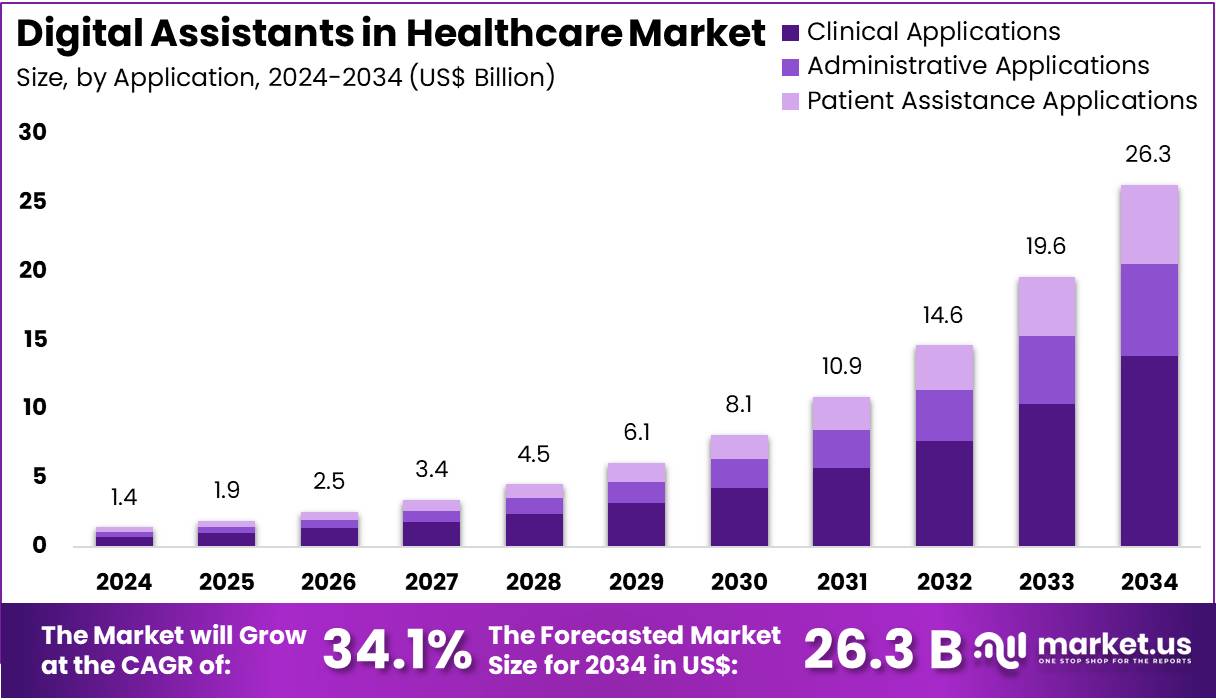
The Global Digital Assistants in Healthcare Market size is expected to be worth around US$ 26.3 Billion by 2034, from US$ 1.4 Billion in 2024, growing at a CAGR of 34.1% during the forecast period from 2025 to 2034. North America held a dominant market position, capturing more than a 42.2% share and holds US$ 0.6 Billion market value for the year.
The rapid adoption of artificial intelligence, conversational technologies, and digital health platforms is accelerating the use of digital assistants across healthcare. These tools are increasingly being deployed to support patient communication, care navigation, appointment coordination, symptom assessment, medication reminders, clinical documentation, and administrative workflows.
Healthcare organizations are also exploring conversational AI to improve access to information while reducing repetitive workloads for clinicians. According to the American Medical Association, 57% of physicians identified reducing administrative burdens through automation as the biggest opportunity for AI in healthcare. The same survey found that 72% considered AI useful for creating discharge instructions, care plans, or progress notes, highlighting the growing relevance of intelligent assistants in everyday clinical workflows.
Federal health IT data further indicates that digital patient engagement infrastructure is expanding. In 2024, 8 in 10 U.S. hospitals had adopted all foundational patient-engagement capabilities, including electronic access to health information and secure communication with providers.
Recent clinical research is also demonstrating practical applications. A 2026 study evaluating a conversational AI voice assistant for pre-procedural patient preparation reported an 87.9% call-completion rate during real-world implementation, supporting its potential to handle routine interactions while allowing nurses to focus on clinical responsibilities.
The U.S. Food and Drug Administration continues to advance responsible digital-health innovation through its Digital Health Center of Excellence and maintains an AI-enabled medical-device framework emphasizing safety, transparency, and regulatory oversight.
Key Takeaways
- In 2024, the Digital Assistants in Healthcare Market generated US$ 1.4 billion in revenue and is projected to reach US$ 26.3 billion by 2034, expanding at a 34.1% CAGR.
- The AI-based digital assistants segment dominated the product type category in 2024, accounting for a 61.3% market share.
- The clinical applications segment led the application category in 2024, capturing the largest revenue share of 52.7% in the Digital Assistants in Healthcare Market.
- The hospitals & healthcare providers segment dominated the end-user category in 2024, holding a 49.3% revenue share of the market.
- North America maintained its leading position in the Digital Assistants in Healthcare Market in 2024, securing a 42.2% market share.
Statistical Information
- 81% of physicians reported using AI in their professional work in 2026, more than double the 38% reported in 2023, demonstrating rapidly expanding adoption of AI-enabled healthcare tools.
- The average number of AI applications used by physicians increased from 1.1 in 2023 to 2.3 in 2026, indicating that healthcare professionals are adopting AI across multiple clinical and administrative workflows.
- 39% of physicians reported using AI to summarize medical research and standards of care in 2026, making information summarization one of the leading professional applications of healthcare AI.
- 30% of physicians reported using AI to create discharge instructions, care plans, or progress notes, demonstrating demand for digital assistants supporting clinical documentation and patient-care workflows.
- 28% of physicians reported using AI for documentation of billing codes, medical charts, or visit notes, highlighting an important opportunity for assistants focused on reducing administrative workloads.
- 19% of physicians reported using AI to generate draft responses to patient portal messages, demonstrating the growing role of AI assistants in patient communication and engagement.
- 63.9% of healthcare chatbot users expressed concerns about the privacy of information shared with chatbots in a 2025 study involving 617 respondents, emphasizing the importance of privacy, security, and trust in patient-facing assistants.
- At Intermountain Health, 2,285 clinicians using Microsoft Dragon Copilot experienced a 27% reduction in time spent on notes per appointment, providing real-world evidence of the productivity potential of AI-powered clinical assistants.
Market Segmentation Analysis
Product Type Analysis
The AI-based digital assistants segment dominated the Digital Assistants in Healthcare Market, accounting for 61.3% of the market in 2024. This leadership is supported by the growing adoption of artificial intelligence to enhance patient care, automate repetitive healthcare tasks, and improve operational efficiency.
AI-powered assistants can provide personalized interactions, support clinical workflows, analyze healthcare information, and assist with decision-making. Their integration with electronic health records (EHRs), patient management platforms, and digital health applications is further strengthening demand.
Healthcare providers are increasingly seeking intelligent solutions capable of delivering faster, data-driven insights while reducing administrative workloads. As AI technologies become more sophisticated, the AI-based segment is expected to maintain strong growth across healthcare settings.
Application Analysis
The clinical applications segment represented the largest share of the Digital Assistants in Healthcare Market, accounting for 52.7% in 2024. Its leading position reflects the increasing demand for digital tools that can support healthcare professionals in clinical decision-making and patient management.
Digital assistants can help providers access patient information, monitor treatment progress, support diagnostic workflows, and deliver relevant clinical insights. The growing emphasis on personalized and data-driven healthcare is further encouraging adoption across hospitals and other care settings.
In addition, advances in artificial intelligence and machine learning are improving the ability of digital assistants to process healthcare data and provide timely recommendations. As healthcare organizations prioritize efficiency, accuracy, and improved patient outcomes, clinical applications are expected to remain a major growth area.
End-User Analysis
The hospitals & healthcare providers segment held the leading position in the Digital Assistants in Healthcare Market, capturing 49.3% of the market in 2024. The segment’s dominance is attributed to the growing need for hospitals to improve patient engagement, optimize workflows, and manage increasingly complex healthcare operations.
Digital assistants can support appointment scheduling, patient communication, information retrieval, clinical documentation, and administrative activities, helping healthcare organizations improve efficiency. Their integration with electronic health records and hospital information systems is also creating opportunities for more connected digital workflows.
Furthermore, healthcare providers are increasingly investing in automation and AI-enabled technologies to reduce repetitive workloads and enhance service quality. As hospitals continue their digital transformation initiatives, demand for digital assistants is expected to expand significantly.
Regional Analysis
North America dominated the Digital Assistants in Healthcare Market, accounting for a 42.2% share in 2024. The region’s leadership is supported by the widespread adoption of digital healthcare technologies, advanced healthcare infrastructure, and increasing integration of artificial intelligence into clinical and administrative workflows.
Healthcare providers are increasingly adopting digital assistants to improve patient engagement, streamline communication, support clinical decision-making, and reduce repetitive administrative tasks. Strong digital health ecosystems and continued investment in AI-enabled healthcare solutions are expected to reinforce North America’s position in the market.
Asia Pacific is expected to register the highest CAGR during the forecast period. Growth is being supported by expanding digital health infrastructure, increasing adoption of AI technologies, and greater emphasis on improving healthcare accessibility and efficiency. WHO highlights the region’s ongoing efforts to strengthen digital health strategies, AI governance, interoperability, workforce capabilities, and responsible deployment of digital technologies. These developments are creating a favorable environment for digital assistants across healthcare systems, particularly in patient care, clinical support, and healthcare management.
Business Opportunities
The Digital Assistants in Healthcare Market presents significant opportunities for technology providers, healthcare organizations, and AI developers as demand grows for more efficient, patient-centered digital services. One major opportunity lies in AI-powered administrative automation, including appointment scheduling, patient communication, documentation, and workflow coordination. The American Medical Association identifies administrative burden as a leading opportunity for healthcare AI, supporting demand for solutions that can reduce repetitive work.
Another promising area is clinical support, where digital assistants can help healthcare professionals access patient information, support decision-making, and coordinate care. WHO specifically highlights digital assistants as tools that can help health workers and individuals navigate digital health services.
EHR integration and interoperability also offer strong opportunities, enabling assistants to securely retrieve and organize relevant patient information. Companies can further develop personalized patient-engagement platforms, multilingual assistants, remote-care support, and chronic-care management solutions.
Additionally, opportunities exist in AI governance, validation, cybersecurity, and compliance services, as healthcare organizations require trustworthy AI deployment and ongoing performance monitoring. FDA initiatives emphasizing safety, transparency, lifecycle management, and real-world evaluation further strengthen this opportunity area.
Emerging Trends
- Ambient AI assistants are moving into clinical workflows: Digital assistants are increasingly listening to clinician-patient conversations and converting them into structured notes. This trend is shifting assistants from basic voice or chat tools toward continuous workflow support, while keeping clinicians responsible for reviewing generated information.
- Multilingual healthcare assistance is expanding: New assistants are being designed to understand natural speech, multiple languages, and specialty-specific terminology. This supports more flexible communication between patients and providers and can help digital tools operate across diverse healthcare environments.
- AI assistants are becoming more specialized: Instead of one general-purpose assistant, healthcare technology is moving toward specialty-focused tools that can create customized clinical documentation and support specific workflows. Microsoft’s Dragon Copilot, for example, supports specialty-specific documentation and customizable templates.
- Regulatory oversight is becoming part of AI development: The FDA’s 2025 guidance places greater emphasis on transparency, bias, lifecycle management, documentation, and planned AI changes. This is encouraging developers to build healthcare assistants with stronger validation and governance from the beginning.
- Human review is becoming a core design principle: Healthcare AI is increasingly being developed as an assistive technology rather than a replacement for professionals. Current systems generate drafts, recommendations, or structured information for clinician review, supporting safer adoption in clinical environments.
Use Cases
- Emergency department documentation: Ambient assistants can capture emergency-room conversations and prepare clinical notes. A 2025 study of 8,740 encounters found that ambient-AI encounters had shorter documentation times, showing potential for faster emergency-care workflows.
- Psychiatric clinical documentation: AI voice assistants can convert conversations into psychiatric notes and letters. This application can help mental-health professionals spend less time organizing documentation and more time engaging directly with patients during consultations.
- Surgical outpatient support: Ambient assistants are being tested in surgical clinics to reduce mental workload and improve clinician attention. A 2025 pilot involving 79 providers found lower perceived mental demand and improved clinician attention during patient interactions.
- Inpatient discharge documentation: AI assistants can prepare discharge summaries from clinical information, helping physicians complete complex documentation more efficiently. Research found median discharge-summary creation time fell from 459 seconds to 114 seconds with ambient AI in a simulated inpatient setting.
- Clinical order and data preparation: New AI assistants can convert spoken clinical information into structured outputs, including potential orders, conditions, flowsheet information, and other clinical data. This creates an emerging use case for reducing manual data entry within healthcare workflows.
Recent Developments
- In June 2026, Apple introduced the next generation of Apple Intelligence and Siri AI, adding a more conversational assistant with personal-context understanding, onscreen awareness, and the ability to take actions across apps. Apple also introduced updated App Intents so developers can connect their apps directly with Siri AI capabilities.
- In March 2026, Google partnered with DocMorris to create a more personalized digital-health experience for millions of people in Europe. The agreement combines DocMorris’ healthcare expertise with Google AI, while DocMorris is migrating its infrastructure to Google Cloud to support the service.
- In March 2026, Microsoft expanded Dragon Copilot’s clinical-AI capabilities, presenting the assistant as a platform that brings together clinical intelligence, workflows, and partner AI. The development focuses on reducing clinician workload and scaling AI-supported care across healthcare organizations.
- In October 2025, Ada Health partnered with Fullspan Health to integrate Ada’s clinical AI into Fullspan’s healthcare platform. The partnership is designed to provide personalized guidance and care pathways, with the stated goal of helping millions of Americans reach appropriate treatment more efficiently.
- In April 2025, KPJ Healthcare partnered with IBM Malaysia to deploy IBM watsonx for personalized patient services. The resulting AI-powered chatbot was designed to provide 24/7 responses to routine patient questions, specialist information, and appointment scheduling across KPJ’s healthcare network in Malaysia.
Conclusion
The Digital Assistants in Healthcare Market is entering a high-growth phase as healthcare providers increasingly adopt AI, conversational technologies, and connected digital platforms. Expanding use across clinical workflows, patient engagement, documentation, and administrative operations is creating strong opportunities for technology developers and healthcare organizations.
AI-based assistants are gaining importance through improved personalization, interoperability, and workflow automation, while regulatory oversight and human review remain essential for responsible deployment. North America currently leads adoption, while Asia Pacific offers significant future growth potential. Continued investments in AI infrastructure, secure health-data exchange, and specialized healthcare solutions are expected to strengthen the market’s long-term development.




















