


Overview
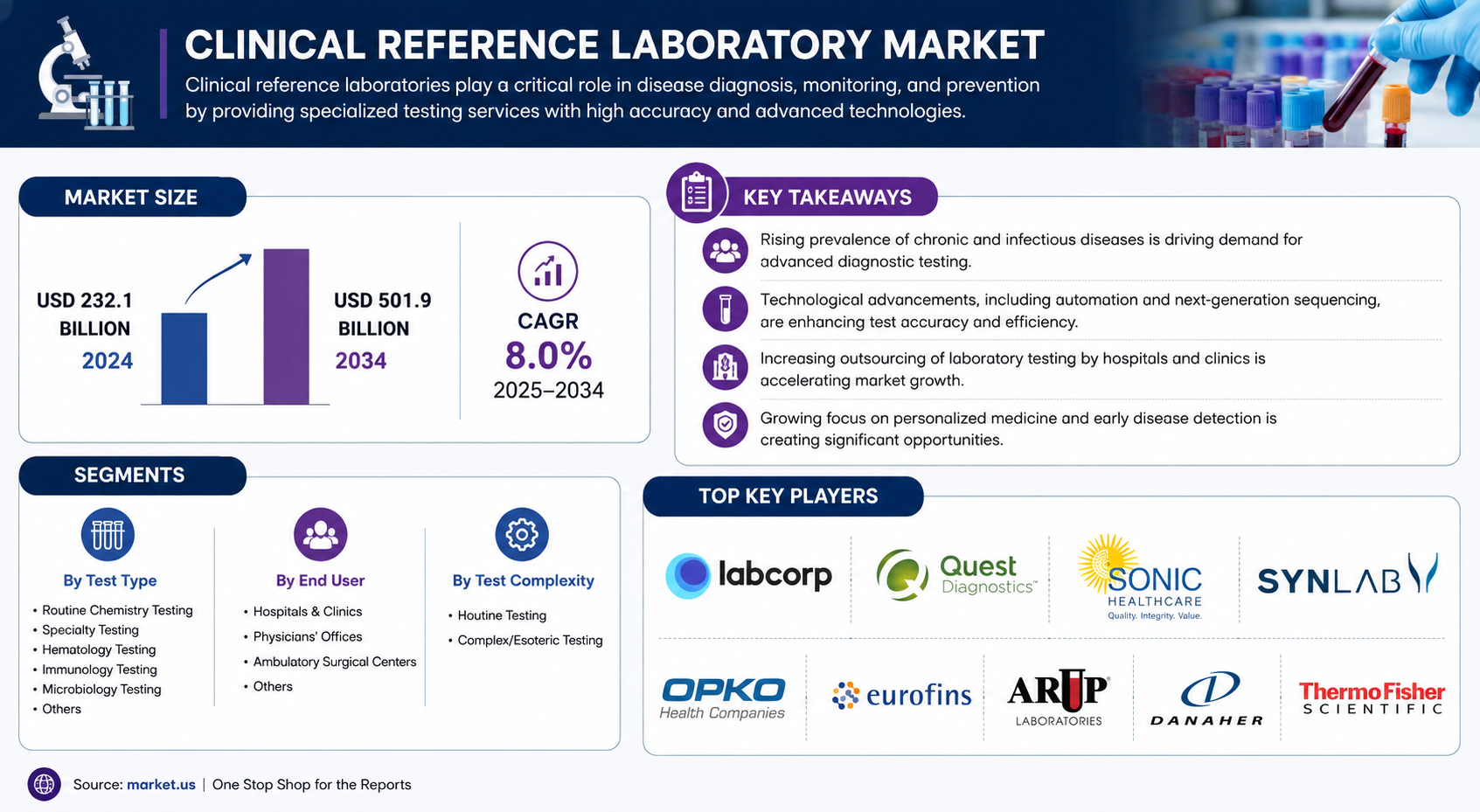
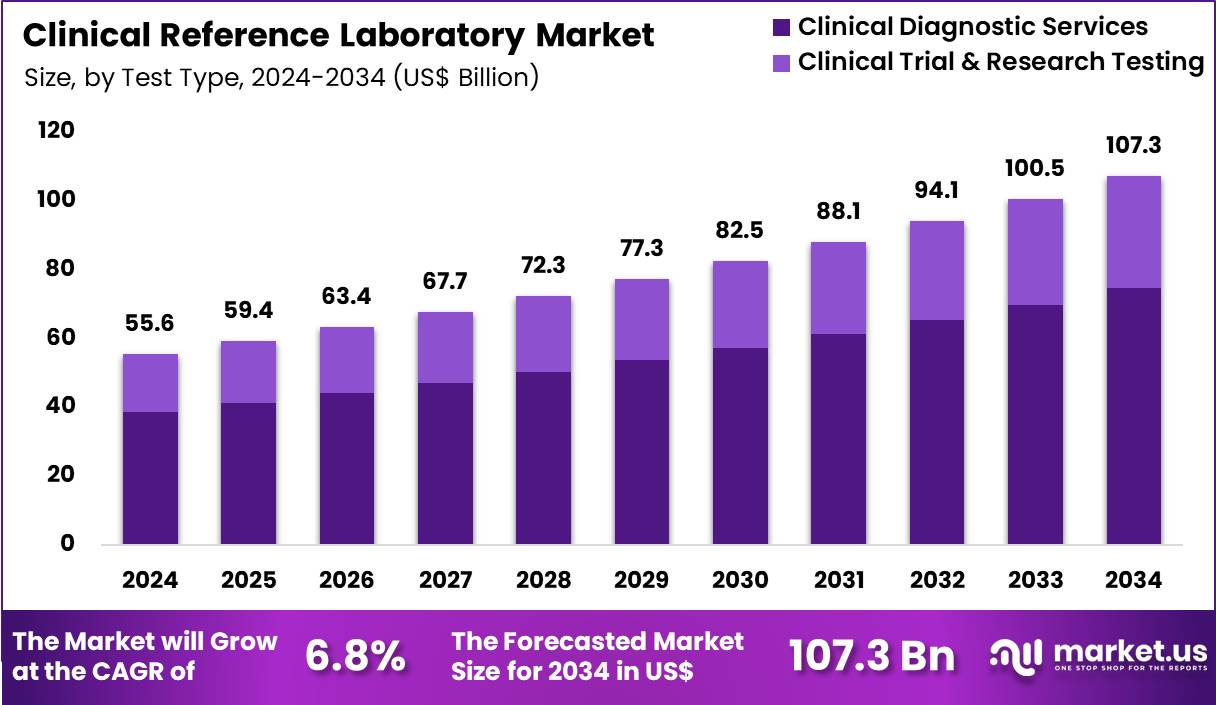
The Global Clinical Reference Laboratory Market size is expected to reach around US$ 107.3 Billion by 2034, up from US$ 55.6 Billion in 2024, growing at a CAGR of 6.8% during the forecast period 2025 to 2034. In 2024, North America led the market, achieving over 39.1% market share with revenue of US$ 21.7 Billion.
The Clinical Reference Laboratory Market is an integral part of the healthcare industry, offering specialized diagnostic testing services to hospitals, physician offices, outpatient clinics, pharmaceutical companies, and research organizations. These laboratories perform clinical chemistry, hematology, microbiology, immunology, pathology, molecular diagnostics, and genetic testing, enabling accurate disease diagnosis and effective treatment planning. Growing demand for early disease detection and preventive healthcare is increasing the need for advanced laboratory services across developed and emerging economies.
The rising prevalence of chronic diseases continues to boost testing volumes. According to the World Health Organization (WHO), noncommunicable diseases account for approximately 41 million deaths annually, representing nearly 74% of all global deaths. The U.S. Centers for Disease Control and Prevention (CDC) also reports that 6 in 10 adults have at least one chronic disease, while 4 in 10 adults live with two or more chronic conditions.
Cancer diagnostics and genetic testing are becoming increasingly important. The WHO estimated approximately 20 million new cancer cases and 9.7 million cancer deaths worldwide in 2022. Additionally, the U.S. National Institutes of Health (NIH) identifies more than 10,000 rare diseases, with nearly 80% linked to genetic causes, supporting demand for molecular diagnostics.
Advancements in laboratory automation, artificial intelligence (AI), digital pathology, robotics, and next-generation sequencing (NGS) are improving testing efficiency and accuracy. Clinical reference laboratories process millions of patient samples every day, supporting faster diagnoses and better clinical outcomes while driving long-term market growth.
Key Takeaways
- In 2024, the Clinical Reference Laboratory Market was valued at US$ 55.6 billion and is projected to reach US$ 107.3 billion by 2034, expanding at a CAGR of 6.8% during the forecast period.
- By test type, the market is segmented into clinical diagnostic services and clinical trial & research testing. Clinical diagnostic services dominated the market in 2024, accounting for a 69.5% share.
- Based on service provider type, the market is categorized into independent/standalone clinical reference laboratories, hospital-based reference laboratories, and public health reference laboratories. Among these, hospital-based reference laboratories held the largest market share of 47.1% in 2024.
- North America emerged as the leading regional market, capturing a 39.1% share of the global Clinical Reference Laboratory Market in 2024.
Market Segmentation Overview
- Test Type Analysis: The clinical diagnostic services segment dominated the Clinical Reference Laboratory Market with a 69.5% share in 2024. Growth is driven by increasing testing for chronic diseases affecting 6 in 10 U.S. adults, according to the CDC. Rising demand for hematology, immunology, molecular diagnostics, and preventive screenings, combined with laboratory automation and faster turnaround times, continues to strengthen this segment’s market leadership.
- Service Provider Type Analysis: The hospital-based reference laboratories segment accounted for the largest 47.1% market share in 2024. Hospitals perform high volumes of emergency, inpatient, and specialized diagnostic tests. Growing surgical procedures, rising hospital admissions, and investments in advanced laboratory automation enable these facilities to deliver faster, high-complexity testing, reinforcing their leading position in the global market.
Statistical Information
- Clinical Laboratory Testing Supports the Majority of Medical Decisions: Clinical laboratory testing is a cornerstone of modern healthcare. The U.S. CDC states that laboratory test results influence approximately 70% of all medical decisions, making reference laboratories essential for disease diagnosis, treatment monitoring, and preventive care. The United States performs an estimated 7–10 billion laboratory tests every year, reflecting the growing dependence on diagnostic services.
- Chronic Diseases Continue to Increase Diagnostic Testing Demand: The increasing burden of chronic diseases is driving higher laboratory testing volumes. According to the CDC, 6 in 10 U.S. adults have at least one chronic disease, while 4 in 10 adults have two or more chronic conditions. These patients require regular blood chemistry, lipid profile, HbA1c, kidney function, and other laboratory tests throughout treatment.
- Cancer Burden Expands Need for Specialized Laboratory Testing: Cancer diagnosis depends heavily on pathology, molecular diagnostics, and biomarker testing. According to the World Health Organization (WHO), there were approximately 20 million new cancer cases and 9.7 million cancer deaths worldwide in 2022. These figures continue to increase demand for advanced clinical reference laboratory services.
- Hospital Laboratories Perform the Largest Share of High-Complexity Testing: Hospital laboratories remain the backbone of complex diagnostic services. A CDC analysis of U.S. CLIA-certified laboratories found that although hospital and independent laboratories represented only 34% of laboratories, they performed 81% of all laboratory testing. Hospital laboratories also employed approximately 158,778 testing professionals, more than twice the workforce of independent laboratories (74,904).
- Physicians Frequently Order Laboratory Tests During Patient Care: A CDC-supported physician survey reported that physicians ordered diagnostic laboratory tests during an average of 31.4% of patient encounters. Physicians also reported uncertainty in selecting laboratory tests in 14.7% of diagnostic encounters and difficulty interpreting results in 8.3%, highlighting the growing importance of advanced reference laboratory support.
- Electronic Health Records Show Strong Demand for Preventive Laboratory Testing: A CDC PCORnet study analyzing healthcare records from more than 30.7 million patients between 2018 and 2022 found continued use of preventive laboratory testing, including HbA1c testing and lipid testing, while identifying millions of new chronic disease diagnoses through laboratory-supported screening.
- Rare Diseases Affect Around 30 Million Americans: According to the National Institutes of Health (NIH), approximately 30 million people in the United States are living with a rare disease. Nearly 80% of rare diseases have a genetic cause, increasing demand for molecular diagnostics, genomic sequencing, and specialized laboratory services.
- Sepsis Causes Nearly 270,000 Deaths Annually in the U.S.: The CDC estimates that at least 1.7 million adults in the United States develop sepsis each year, resulting in nearly 270,000 deaths. Rapid laboratory identification of bloodstream infections is essential for timely diagnosis and treatment.
- Diabetes Affects More Than 38 Million Americans: According to the CDC National Diabetes Statistics Report, approximately 38.4 million Americans have diabetes, representing 11.6% of the U.S. population. Routine laboratory tests such as HbA1c, fasting glucose, and kidney function tests are fundamental for disease management.
- CMS Clinical Laboratory Database Contains More Than 676,000 Laboratory Records: The CMS Clinical Laboratory Provider dataset contains 676,051 records and 103 data fields (Q1 2026). The database captures laboratory demographics, certification status, and testing capabilities, providing one of the largest official repositories of clinical laboratory information in the United States.
Regional Analysis
North America led the market by securing a market share of 39.1% in 2024.
North America dominated the Clinical Reference Laboratory Market in 2024, capturing 39.1% of the global market due to its advanced healthcare infrastructure, high diagnostic testing volumes, and strong regulatory framework. According to the Centers for Medicare & Medicaid Services (CMS), the Clinical Laboratory Improvement Amendments (CLIA) program oversees approximately 320,000 laboratory entities, ensuring standardized laboratory quality across the United States.
The Centers for Disease Control and Prevention (CDC) reports that 6 in 10 U.S. adults have at least one chronic disease and 4 in 10 have two or more chronic conditions, increasing demand for routine and specialized diagnostic testing. Growing adoption of molecular diagnostics, next-generation sequencing (NGS), digital pathology, and laboratory automation enhances testing efficiency and clinical accuracy.
Strong investments in precision medicine, oncology diagnostics, and genetic testing, combined with widespread electronic health record integration and favorable reimbursement systems, continue to strengthen North America’s leadership in the global Clinical Reference Laboratory Market.

Business Opportunities
The Clinical Reference Laboratory Market offers significant business opportunities driven by rising demand for specialized diagnostic testing and precision medicine. Expanding adoption of molecular diagnostics, next-generation sequencing (NGS), and companion diagnostics is creating new revenue streams for laboratories serving oncology, infectious diseases, and rare genetic disorders.
Increasing prevalence of chronic diseases and aging populations is boosting demand for routine laboratory monitoring and preventive health screening. Pharmaceutical and biotechnology companies are increasingly partnering with reference laboratories to support clinical trials, biomarker discovery, and personalized treatment development. Investments in laboratory automation, artificial intelligence (AI), robotics, and cloud-based laboratory information systems provide opportunities to improve operational efficiency and reduce turnaround times.
Growing demand for at-home sample collection, digital pathology, and telehealth-integrated diagnostic services is expanding access to laboratory testing. Emerging markets are also investing in laboratory infrastructure and public health programs, creating opportunities for international laboratory networks, equipment manufacturers, and diagnostic technology providers to expand their global presence.
Driver
The clinical reference laboratory market is primarily driven by the increasing prevalence of chronic diseases, infectious disorders, and genetic conditions that require accurate and timely diagnostic testing. Rising healthcare expenditure, expanding preventive healthcare programs, and growing awareness regarding early disease detection have significantly increased laboratory testing volumes.
The growing elderly population, which is more susceptible to complex medical conditions, further supports demand for specialized laboratory services. In addition, continuous advancements in molecular diagnostics, automation technologies, and high-throughput testing platforms have improved testing accuracy, efficiency, and turnaround times, encouraging greater adoption of clinical reference laboratory services worldwide.
Trend
A prominent trend in the clinical reference laboratory market is the growing adoption of advanced molecular diagnostics, next-generation sequencing, and artificial intelligence-enabled laboratory workflows. Laboratories are increasingly integrating digital pathology, cloud-based data management, and automated sample processing systems to improve operational efficiency and diagnostic precision.
Personalized medicine and companion diagnostics are also gaining momentum, creating demand for highly specialized laboratory testing services. Furthermore, increasing collaborations between healthcare providers, biotechnology companies, and laboratory networks are enhancing access to innovative diagnostic solutions while supporting faster clinical decision-making and improved patient outcomes across diverse therapeutic areas.
Challenges
The clinical reference laboratory market faces several challenges, including stringent regulatory requirements, quality assurance standards, and complex accreditation processes that increase operational costs. Maintaining data security and protecting sensitive patient information remain significant concerns as laboratories adopt digital platforms and cloud-based systems.
Additionally, shortages of skilled laboratory professionals and rising costs associated with advanced diagnostic technologies can limit service expansion. Reimbursement uncertainties in several healthcare systems and intense competition among independent laboratories, hospital-based laboratories, and diagnostic service providers further pressure profit margins while requiring continuous investments in technology and operational efficiency.
Emerging Trends
- AI and Digital Laboratory Workflows: Clinical laboratories are increasingly adopting artificial intelligence (AI) for test interpretation, workflow optimization, and report generation. In 2024, the WHO released more than 40 recommendations for the safe use of AI in healthcare, reflecting growing adoption of AI-enabled diagnostic services while emphasizing governance and patient safety.
- Expansion of Next-Generation Sequencing (NGS): Reference laboratories are expanding NGS for oncology, infectious disease surveillance, and rare disease diagnosis. The CDC’s NGS Quality Initiative provides more than 100 free quality guidance documents and SOPs to improve sequencing reliability across clinical and public health laboratories.
- Greater Standardization of Laboratory Testing: Standardized laboratory testing is becoming a priority to improve diagnostic consistency. According to the CDC, approximately 14 billion laboratory tests are performed annually in more than 266,000 CLIA-certified laboratories across the United States, highlighting the need for harmonized testing standards.
- Stronger Regulatory Oversight of Laboratory Tests: Clinical laboratories are adapting to increased regulatory requirements. In April 2024, the FDA issued a final rule to strengthen oversight of laboratory-developed tests (LDTs), improving the safety, effectiveness, and reliability of diagnostic testing used in patient care.
- Focus on Laboratory Quality and Diagnostic Excellence: Healthcare providers continue investing in quality management systems to reduce diagnostic errors. The CDC Division of Laboratory Systems promotes laboratory quality standards, workforce development, and diagnostic excellence programs to improve accurate and timely patient diagnoses across clinical laboratories.
Use Cases
- Chronic Disease Monitoring: Clinical reference laboratories support continuous monitoring of diabetes, kidney disease, cardiovascular disease, and thyroid disorders. The CDC notes that around 14 billion laboratory tests are performed annually in the U.S., with many supporting long-term management of chronic conditions.
- Precision Oncology and Genetic Testing: Reference laboratories use NGS and molecular diagnostics to identify cancer-related mutations and guide targeted therapies. The CDC NGS Quality Initiative offers 100+ standardized resources that help laboratories produce reliable genomic testing results for clinical decision-making.
- Hospital Diagnostic Decision Support: Laboratory testing plays a vital role in patient management. According to a joint FDA-CMS statement citing the CDC, approximately 70% of healthcare decisions rely on laboratory test results, making reference laboratories essential for accurate diagnosis and treatment selection.
- Public Health Surveillance: Clinical reference laboratories support surveillance of infectious diseases through molecular diagnostics and sequencing. The CDC collaborates with public health laboratories to improve NGS quality management, enabling faster outbreak detection and nationwide disease monitoring.
- Laboratory Automation for High Testing Volumes: Automation helps laboratories process increasing specimen volumes with greater efficiency. According to the CDC, more than 266,000 CLIA-certified laboratories contribute to approximately 14 billion laboratory tests annually, encouraging wider adoption of automated laboratory systems and digital workflows.
Recent Development
- In Q1 2026, Quest Diagnostics finalized its laboratory services joint venture with Corewell Health, managing 21 Michigan hospital-based laboratories and planning a new state-of-the-art reference laboratory in southeast Michigan featuring automated microbiology and high-throughput molecular testing, targeted to open in 2027.
- In April 2026, NeoGenomics integrated its oncology clinical reference laboratory testing portfolio into Epic Aura, enabling oncologists and health systems to order its full suite of oncology tests and receive results directly within Epic electronic health record workflows, lowering testing access barriers and targeting 20–30% increases in test adoption per site.
- In April 2026, Mayo Clinic Laboratories partnered with Karius to make Karius’s metagenomic next-generation sequencing infectious disease diagnostic tests including Karius Spectrum for broad pathogen detection from plasma and Karius Focus I BAL for lung infection diagnostics available to order through the Mayo Clinic Laboratories reference testing network with 24-hour turnaround.
- In March 2025, Eurofins Scientific completed its acquisition of SYNLAB’s clinical diagnostics operations across Spain, encompassing genetics and anatomical pathology services generating approximately €140 million in annual revenues, making Eurofins the leading clinical diagnostics operator in Spain with capacity to serve over 10 million patients and process more than 100 million laboratory tests annually.
- In 2025, Sonic Healthcare completed its acquisition of LADR, one of Germany’s top five medical laboratory groups, described as one of Sonic’s largest acquisitions, solidifying its market leadership position in Germany and expanding its European reference laboratory network across a medically led, pathologist-governed laboratory operating model.
- In January 2026, Quest Diagnostics completed its acquisition of select outreach laboratory assets from University Hospitals in Cleveland, Ohio, expanding its Midwest clinical reference laboratory network and increasing patient access to its advanced diagnostics and molecular testing menu across Ohio and Pennsylvania.
Conclusion
The Clinical Reference Laboratory Market is poised for sustained growth, supported by the rising prevalence of chronic diseases, increasing demand for early and accurate diagnosis, and continuous advancements in laboratory technologies. Expanding use of molecular diagnostics, next-generation sequencing, artificial intelligence, and laboratory automation is improving testing efficiency and clinical outcomes.
Growing adoption of precision medicine, preventive healthcare, and personalized treatment approaches is further strengthening market demand. North America continues to lead with advanced healthcare infrastructure, while Asia Pacific is expected to witness the fastest growth due to expanding healthcare investments. Ongoing innovation and strategic collaborations will continue to shape the market’s long-term development.




















