


Overview
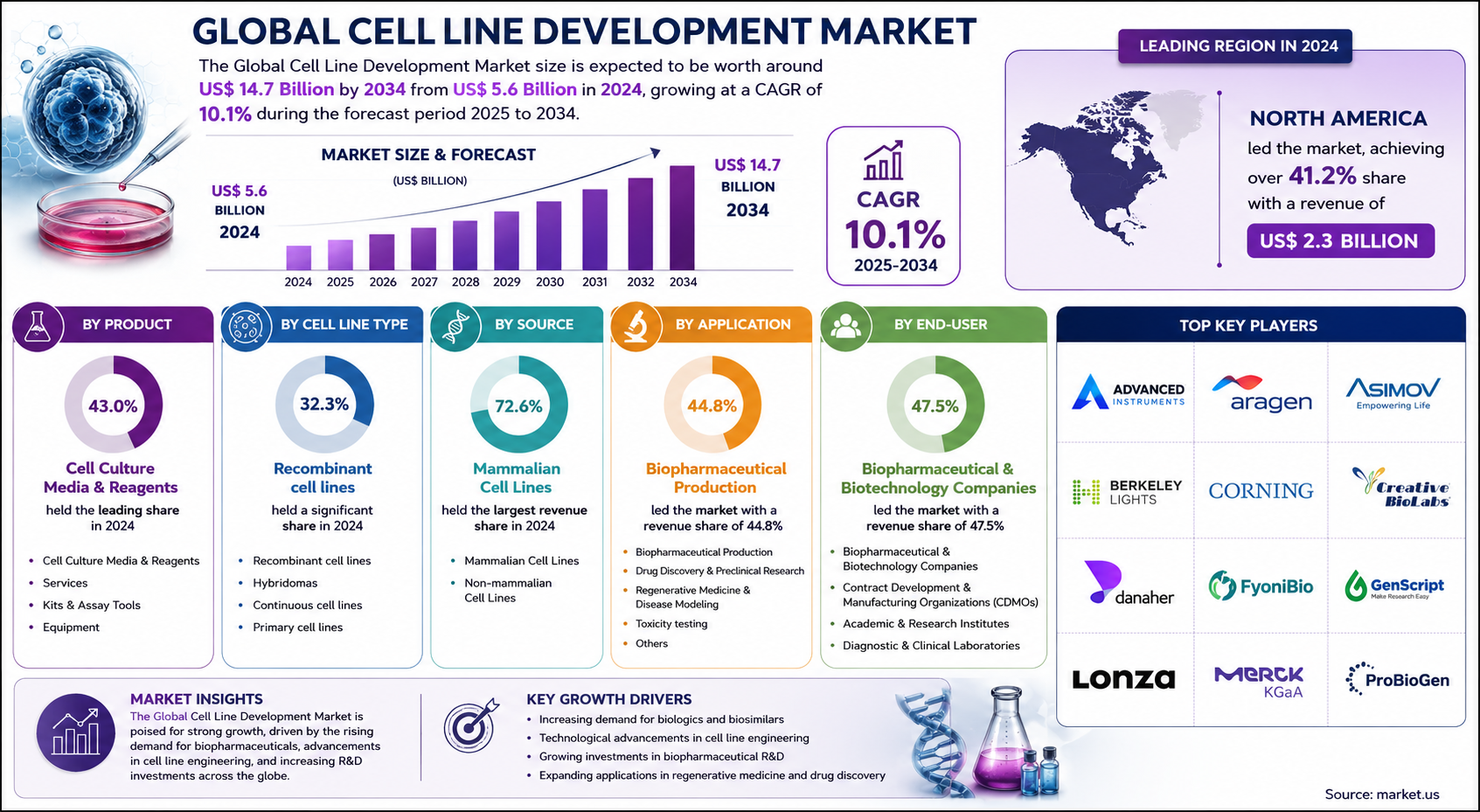
New York, NY – August 05, 2026 – The Global Cell Line Development Market size is expected to reach around US$ 14.7 Billion by 2034, up from US$ 5.6 Billion in 2024, growing at a CAGR of 10.1% during the forecast period 2025 to 2034. In 2024, North America led the market, achieving over 41.2% market share with revenue of US$2.3 billion.
Cell Line Development is a critical segment of the global biopharmaceutical industry, supporting the production of monoclonal antibodies, recombinant proteins, vaccines, biosimilars, and advanced cell and gene therapies. Cell line development involves engineering stable, high-yield cell lines that consistently produce therapeutic proteins at commercial scale. Chinese Hamster Ovary (CHO) cells remain the industry standard, accounting for more than 70% of all recombinant therapeutic protein manufacturing worldwide.
Growing demand for biologics, which now represent over 35% of the global pharmaceutical pipeline, continues to accelerate investments in advanced cell line technologies. The market is expanding rapidly due to increasing biologics approvals, rising R&D spending, and greater outsourcing to contract development and manufacturing organizations (CDMOs). According to the U.S. FDA, 65 novel drugs were approved in 2025, with biologics representing a significant portion requiring robust cell line development. The global biologics pipeline exceeds 10,000 drug candidates, while the number of clinical trials involving biologics and cell-based therapies has surpassed 8,000 globally.
Modern technologies such as CRISPR gene editing, automated clone screening, single-cell analysis, and AI-driven cell selection can reduce development timelines by 30–50% and improve production yields by 20–40%. Additionally, global pharmaceutical R&D expenditure now exceeds US$300 billion annually, supporting continuous innovation in cell line engineering. North America leads the market with the largest share, supported by strong biotechnology infrastructure and high research funding, while Asia-Pacific is witnessing the fastest growth due to expanding biomanufacturing facilities, increasing government investments, and rising demand for biosimilars and biologic therapeutics.
Key Takeaways
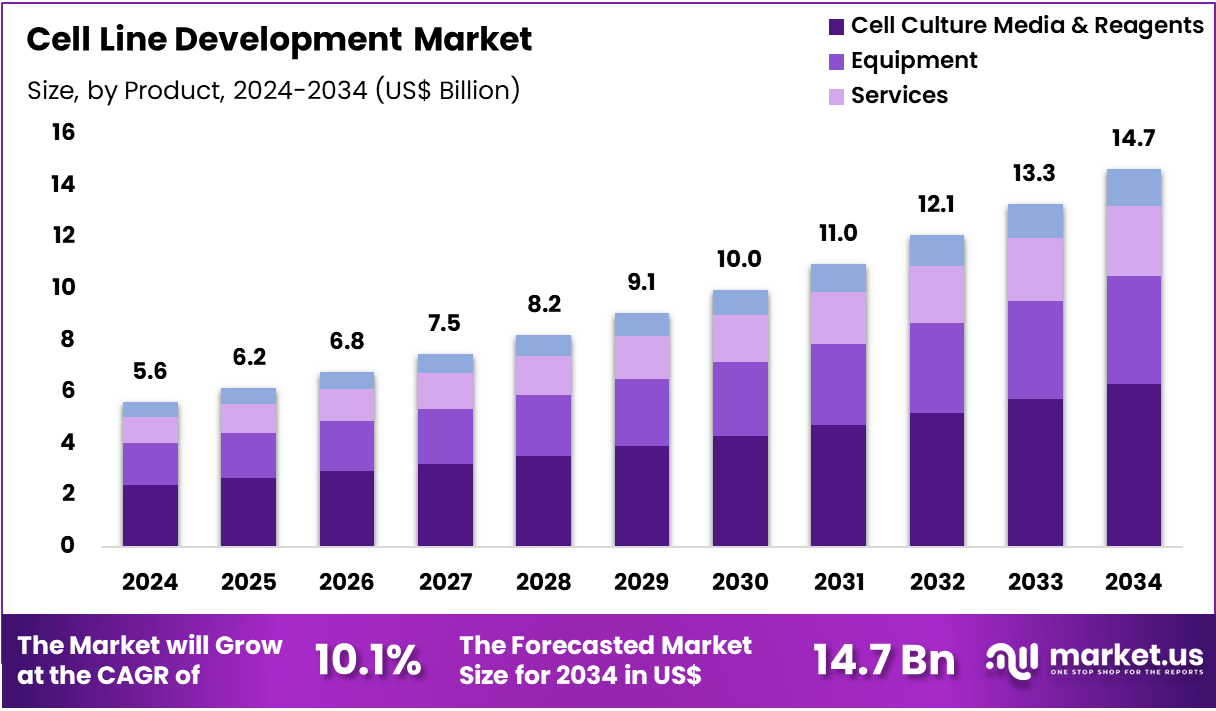
- The market was valued at US$ 5.6 billion in 2024 and is projected to reach US$ 14.7 billion by 2034, expanding at a CAGR of 10.1% during the forecast period.
- By product, the market is categorized into cell culture media & reagents, equipment, services, and kits & assay tools. Among these, cell culture media & reagents dominated the market in 2024, accounting for 43.0% of the total revenue.
- Based on cell line type, the market is segmented into recombinant cell lines, hybridomas, continuous cell lines, and primary cell lines. Recombinant cell lines emerged as the leading segment, capturing 32.3% of the market share in 2024.
- In terms of source, the market is divided into mammalian cell lines and non-mammalian cell lines. Mammalian cell lines held the dominant position, contributing 72.6% of the overall market revenue in 2024.
- By application, the market includes biopharmaceutical production, drug discovery & preclinical research, regenerative medicine & disease modeling, toxicity testing, and others. Biopharmaceutical production led the segment with a 44.8% revenue share in 2024.
- Based on end user, the market comprises biopharmaceutical & biotechnology companies, contract development & manufacturing organizations (CDMOs), academic & research institutes, and diagnostic & clinical laboratories. Biopharmaceutical & biotechnology companies held the largest share at 47.5% in 2024.
- North America dominated the global Cell Line Development Market in 2024, accounting for 41.2% of the total market revenue.
Market Segmentation Analysis
- Product Analysis: Cell culture media & reagents dominated the product segment with a 43.0% market share in 2024. Their leadership is driven by increasing demand for optimized media that improves cell growth, protein expression, and production efficiency. The expanding manufacturing of monoclonal antibodies, recombinant proteins, and vaccines, along with rising adoption of serum-free and chemically defined media, continues to support strong market growth.
- Cell Line Type Analysis: Recombinant cell lines accounted for 32.3% of the market in 2024 due to their ability to deliver stable, high-yield production of therapeutic proteins. Growing demand for biologics, biosimilars, and gene-based therapies, combined with advances in CRISPR gene editing and clone selection technologies, is accelerating the adoption of recombinant cell lines across biopharmaceutical manufacturing.
- Source Analysis: Mammalian cell lines held the largest 72.6% revenue share in 2024, supported by their ability to produce complex biologics with human-like post-translational modifications. Widely used CHO and HEK cell lines remain the preferred platforms for therapeutic antibody production, while continuous improvements in cell engineering further enhance productivity, quality, and regulatory compliance.
- Application Analysis: Biopharmaceutical production led the application segment with a 44.8% market share in 2024. Rising global demand for biologics, vaccines, and recombinant proteins is increasing the need for high-performance cell lines. Manufacturers continue investing in scalable production processes and optimized cell line development to improve yield, reduce costs, and ensure consistent commercial manufacturing.
- End-User Analysis: Biopharmaceutical & biotechnology companies accounted for 47.5% of the market in 2024, making them the largest end-user segment. Growing investments in biologics, oncology, immunology, and rare disease therapies are driving demand for advanced cell line development. These companies continue expanding in-house research capabilities to accelerate product development and maintain strong intellectual property protection.
Statistical Information
- CHO Cells Manufacture More Than 70% of Recombinant Therapeutic Proteins: Chinese Hamster Ovary (CHO) cells remain the dominant production platform for biologics. Scientific studies show that more than 70% of all approved recombinant therapeutic proteins are produced using CHO cells because they provide human-like glycosylation, high productivity, and scalable manufacturing. In addition, 95 of 107 mammalian-derived biopharmaceuticals (89%) approved in a major benchmark analysis were manufactured using CHO cells.
- FDA Approved 123 Biologics Between 2015 and 2023: FDA approval data show that 123 biologics were approved out of 415 total new drug approvals between 2015 and 2023, representing 29.6% of all approvals. In 2023, the FDA approved 17 biologics out of 55 new medicines (30.9%), demonstrating sustained demand for cell line development technologies.
- Global Biologics Sales Exceeded US$441 Billion: NIH researchers reported that global biologics sales reached approximately US$441–533 billion by the end of 2024 and are projected to grow to US$794–1,077 billion by 2030–2035, representing an estimated 8–10% CAGR. Increasing biologics production directly supports investments in advanced cell line development.
- Recombinant Protein CDMO Market Expected to Nearly Quadruple: According to a 2025 NIH review, the recombinant protein Contract Development and Manufacturing Organization (CDMO) sector is currently valued at US$20–21 billion and is expected to nearly quadruple by 2032–2034, reflecting increasing outsourcing of biologics manufacturing and cell line development services.
- Review Analyzed 164 Scientific Studies on CHO Cell Engineering: Researchers performed a systematic review of 164 peer-reviewed publications covering 2011–2024 to identify the most effective strategies for improving CHO cell productivity. The review was selected from an initial search of 3,373 publications, highlighting the extensive global research focused on cell line development technologies.
- CHO Cells Produce 89% of Mammalian-Derived Biopharmaceutical Products: A comprehensive scientific review reported that 89% of mammalian-derived therapeutic products and approximately 60% of all approved recombinant therapeutics are manufactured using CHO cell lines. This confirms the continued dominance of mammalian cell lines in commercial biologics production.
- FDA Has Approved More Than 316 Biotherapeutics Since 2002: Scientific analysis based on FDA approvals reported that more than 316 biotherapeutic products received approval from 2002 onward. Monoclonal antibodies represented approximately 22% of all FDA NDA/BLA approvals and nearly 30% of biosimilar approvals, increasing demand for recombinant cell line development.
- CHO Cells Manufacture Nearly All Commercial Monoclonal Antibodies: Scientific reviews report that CHO cells manufacture approximately 70% of recombinant biopharmaceutical proteins and virtually 100% of FDA-approved monoclonal antibodies introduced since 2016, demonstrating their critical role in biologics manufacturing.
- FDA biologics approvals as upstream demand indicator: In 2025, the FDA’s Center for Biologics Evaluation and Research (CBER) approved nine Biologics License Applications (BLAs), comparable to 13 approvals in 2021 and 12 in 2022, but below 22 approvals in 2023 and 24 in 2024. This steady flow of licensed biologics reflects sustained industrial demand for cell line development to support commercial‑scale biologics manufacturing.
- FDA novel drug mix shows biologics growth: CDER approved 46 novel drugs in 2025, of which 12 were biologics, meaning biologics accounted for roughly 26% of total novel approvals that year. During 2015–2024, biologics represented 29% of all approved drugs (102 of 352), underscoring a structural shift toward large molecules that require robust cell line development capabilities upstream.
Regional Analysis
North America led the market by securing a market share of 41.2% in 2024.
North America dominated the Cell Line Development Market, accounting for 41.2% of global revenue in 2024, driven by its advanced biopharmaceutical industry, strong biotechnology ecosystem, and supportive regulatory environment. The U.S. Food and Drug Administration (FDA) approved 50 novel drugs in 2024, including 16 biologics (32%) and 13 monoclonal antibodies, increasing demand for advanced CHO and other mammalian cell lines used in commercial biologics manufacturing.
The region also benefits from leading biotechnology companies, contract development and manufacturing organizations (CDMOs), and world-class research institutions that continuously invest in gene editing, clone selection, and automated cell line development technologies. Asia-Pacific is expected to register the fastest growth during the forecast period due to expanding biologics manufacturing and rising healthcare investments. According to the International Diabetes Federation, 537 million adults were living with diabetes in 2021, with the largest patient population in Asia-Pacific, driving demand for recombinant insulin, biosimilars, monoclonal antibodies, and other biologic therapies.

Business Opportunities
The Cell Line Development Market offers significant business opportunities as global demand for biologics, biosimilars, vaccines, and cell and gene therapies continues to rise. Increasing investments in monoclonal antibody production are creating demand for high-yield recombinant and mammalian cell lines. Growing outsourcing to Contract Development and Manufacturing Organizations (CDMOs) provides opportunities for specialized cell line development and analytical service providers.
The adoption of CRISPR gene editing, artificial intelligence, automated clone selection, and single-cell analysis enables faster development timelines and improved production efficiency, encouraging technology investments. Expanding use of serum-free and chemically defined media creates new opportunities for media and reagent manufacturers. Emerging economies across Asia-Pacific are investing in biopharmaceutical manufacturing infrastructure, attracting global biotechnology partnerships.
Additionally, increasing approvals of biosimilars and advanced therapies are driving demand for scalable, regulatory-compliant manufacturing platforms. Companies offering integrated cell engineering, process optimization, and bioprocess automation solutions are well positioned to capitalize on the market’s long-term growth potential.
Driving Factor
The increasing demand for biologics, biosimilars, monoclonal antibodies, vaccines, and cell and gene therapies is a major driver of the cell line development market. Pharmaceutical and biotechnology companies are investing significantly in advanced cell line development technologies to improve production efficiency, product quality, and regulatory compliance.
The growing prevalence of chronic diseases and cancer has accelerated the need for innovative biologic therapies, thereby increasing the requirement for stable, high-yield cell lines. In addition, rising research and development activities, expanding biopharmaceutical manufacturing capacity, and advancements in gene editing technologies such as CRISPR are supporting the adoption of efficient cell line development solutions across the healthcare industry.
Trending Factor
A key trend shaping the cell line development market is the increasing adoption of artificial intelligence, automation, and single-cell cloning technologies to enhance development efficiency and reduce timelines. Companies are integrating high-throughput screening, digital analytics, and machine learning algorithms to identify high-performing cell clones with greater accuracy.
The use of chemically defined media and serum-free culture systems is also gaining traction to improve reproducibility and meet regulatory standards. Furthermore, the growing emphasis on personalized medicine and advanced biologics is driving demand for customized cell lines, while strategic collaborations between biotechnology firms and contract development organizations continue to strengthen market innovation.
Challenges
The cell line development market faces several challenges, including the high cost associated with research, specialized equipment, and skilled personnel required for developing stable and productive cell lines. The complex and time-consuming nature of cell line selection, validation, and optimization often delays product development and commercialization.
Additionally, stringent regulatory requirements related to product quality, safety, and manufacturing consistency increase compliance costs for manufacturers. Risks of cell line contamination, genetic instability, and variability in production performance also remain significant concerns. These factors, combined with limited technical expertise in emerging markets, may restrict broader market expansion during the forecast period.
Emerging Trends
- CRISPR gene editing is improving cell line engineering: NIH-funded researchers developed a smaller CRISPR system that fits into adeno-associated virus (AAV) vectors, enabling more precise genome editing for therapeutic cell lines. This innovation supports faster development of advanced biologics and gene therapies with improved manufacturing efficiency.
- CHO cell lines continue to dominate biologics production: More than 70% of recombinant therapeutic proteins are manufactured using Chinese Hamster Ovary (CHO) cells because they provide high productivity, scalability, and human-like protein glycosylation. Companies continue investing in engineered CHO platforms to improve biologic yields and quality.
- Regulatory support is accelerating advanced therapy development: In 2026, the FDA reported approving nearly 50 cell and gene therapies over the past decade and introduced new manufacturing flexibility guidance to speed development while maintaining product quality and safety.
- Alternatives to embryonic stem cells are gaining momentum: In 2026, the NIH announced that 503 human embryonic stem cell lines are listed in its registry while encouraging greater use of induced pluripotent stem cells (iPSCs) and adult stem cells for future biomedical research.
- Automation and digital manufacturing are improving productivity: Biopharmaceutical companies are increasingly combining automated clone selection, high-throughput screening, and AI-assisted workflows to reduce development timelines, improve reproducibility, and accelerate commercial biologics manufacturing under evolving FDA guidance.
Use Cases
- Monoclonal antibody manufacturing: More than 150 monoclonal antibodies have been approved globally for diseases including cancer and autoimmune disorders. Stable mammalian cell lines, especially CHO cells, are essential for producing these therapies at commercial scale with consistent quality.
- Recombinant protein production: More than 600 recombinant protein therapeutics have been approved worldwide, including insulin, growth hormones, enzymes, and clotting factors. Cell line development ensures stable, high-yield production for large-scale biopharmaceutical manufacturing.
- Cell and gene therapy development: The FDA has approved close to 50 cell and gene therapies over the last decade. Robust cell line development supports viral vector production, genome editing, and manufacturing processes required for these advanced therapies.
- Vaccine manufacturing: Mammalian and other engineered cell lines are widely used to manufacture recombinant vaccines and viral vaccines. Advanced cell line development improves production consistency, scalability, and regulatory compliance while supporting rapid response to emerging infectious diseases.
- Drug discovery and toxicity testing: Pharmaceutical and biotechnology companies use engineered cell lines for disease modeling, drug screening, and safety assessment. These models reduce development time, improve prediction of drug responses, and support more efficient preclinical research before human clinical trials.
Recent Development
- In May 2026, Lonza launched its new Xcite AAV stable producer cell line (PCL) platform for adeno-associated virus gene therapy manufacturing, demonstrating a 10–15-fold increase in titer compared with traditional transient transfection methods, targeting gene therapy developers seeking improved scalability, reduced cost of goods, and greater process robustness as programs advance toward commercial manufacturing.
- In March 2026, Thermo Fisher Scientific launched advanced automated cell line development platforms targeting acceleration of monoclonal antibody production workflows, improving protein expression efficiency and reducing development timelines for biopharmaceutical company institutional clients requiring faster investigational new drug application filing.
- In February 2026, Danaher Corporation expanded its bioprocessing portfolio through its Cytiva subsidiary, enhancing cell line engineering solutions for biologics manufacturing, targeting pharmaceutical and biotechnology company clients seeking integrated upstream cell line development and bioprocessing workflow capabilities.
- In January 2026, Sartorius AG strengthened strategic partnerships with U.S. biotechnology firms to scale high-yield cell line development services, expanding its integrated bioprocess automation and single-use technology capabilities targeting biopharmaceutical manufacturers requiring improved cell line productivity and GMP-compliant manufacturing scalability.
- In December 2025, Merck KGaA (MilliporeSigma) introduced next-generation CHO cell line platforms designed to improve productivity and stability in biopharmaceutical production, targeting pharmaceutical and biotechnology company clients requiring high-performance host cell lines for monoclonal antibody, bispecific antibody, and fusion protein biologics manufacturing programs.
- In August 2025, WuXi Biologics launched WuXia293 Stable, a HEK293 stable cell line platform for the development and manufacturing of difficult-to-express molecules, featuring high titers, robust stability, and scalable manufacturing capabilities, targeting biopharmaceutical company clients seeking improved production solutions for complex biologic drug substance programs.
Conclusion
The Cell Line Development Market is positioned for sustained growth, supported by rising demand for biologics, biosimilars, monoclonal antibodies, vaccines, and cell and gene therapies. Advances in CRISPR gene editing, automation, artificial intelligence, and chemically defined media are improving productivity, reducing development timelines, and enhancing manufacturing quality.
Mammalian cell lines, particularly CHO cells, continue to dominate commercial biologics production, while biopharmaceutical companies and CDMOs expand manufacturing capabilities worldwide. North America remains the leading regional market, and Asia-Pacific is emerging as the fastest-growing hub. Continuous innovation, supportive regulations, and increasing healthcare investments will further strengthen long-term market opportunities.




















