Overview
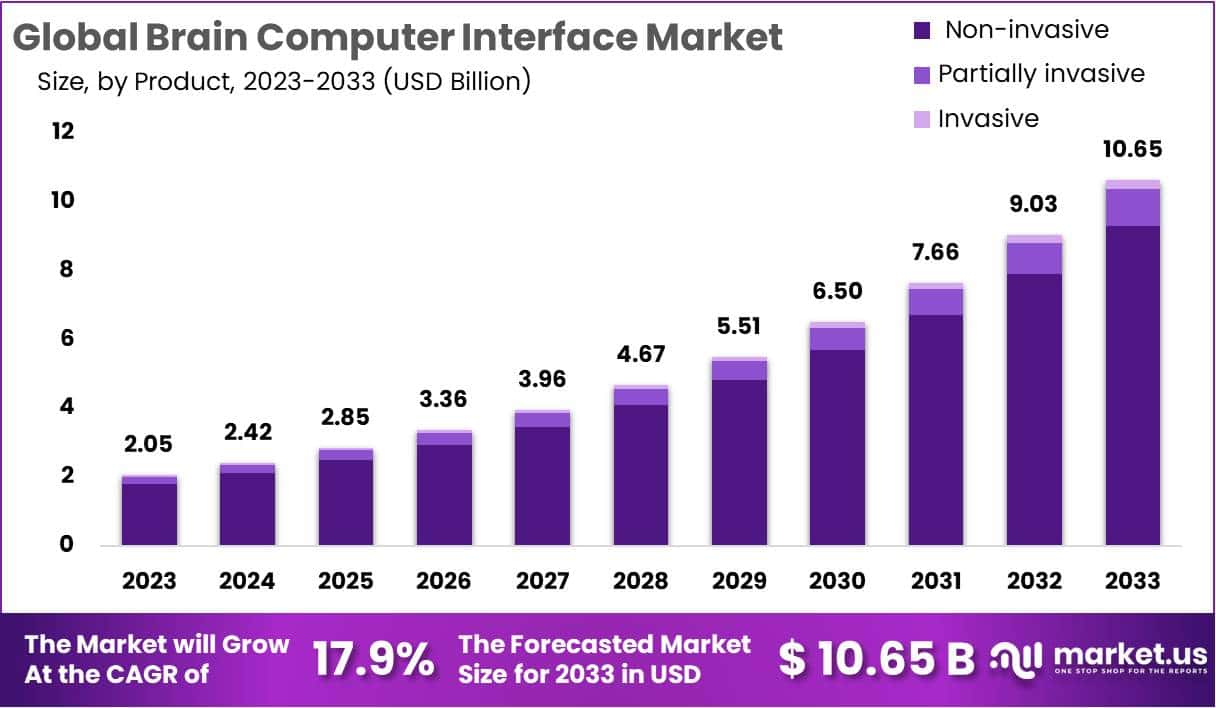
The Global Brain Computer Interface Market size is expected to be worth around USD 10.65 Billion by 2033, from USD 2.05 Billion in 2023, growing at a CAGR of 17.9% during the forecast period from 2024 to 2033.
Brain-computer interface (BCI) technology is becoming an important part of modern healthcare by creating a direct communication pathway between the brain and external devices. These systems are helping people with paralysis, spinal cord injuries, stroke, and neurodegenerative diseases communicate, control computers, and operate assistive devices using neural signals. Continuous advances in artificial intelligence, signal processing, and wearable neurotechnology are improving the speed and accuracy of BCI systems, encouraging broader clinical research and commercialization.
The market is also benefiting from growing investments in neuroscience research and supportive regulatory frameworks that promote the safe development of implantable and non-invasive neuro-technologies. The U.S. Food and Drug Administration (FDA) has issued dedicated guidance for implanted BCI devices, providing recommendations for clinical testing and safety evaluation, which supports innovation while maintaining patient protection.
Research activity is accelerating through government-backed initiatives. The U.S. National Institutes of Health (NIH) BRAIN Initiative received USD 402 million in appropriations for fiscal year 2024 to advance innovative neuro-technologies and brain research.
In another significant milestone, an NIH-supported study published in 2026 demonstrated that a person with amyotrophic lateral sclerosis (ALS) successfully used a brain-computer interface at home to generate speech, highlighting the growing real-world potential of BCI systems for restoring communication and improving quality of life for patients with severe neurological disabilities.
Key Takeaways
- The Global Brain Computer Interface Market was valued at USD 2.05 billion in 2023 and is projected to reach USD 10.65 billion by 2033, expanding at a CAGR of 17.9% during the forecast period.
- In 2023, the non-invasive BCI segment emerged as the leading product category, accounting for 87.5% of the global Brain Computer Interface market revenue.
- The healthcare segment dominated the market by application in 2023, representing 63.3% of the total market share.
- Based on end use, the medical segment held the largest share of the Brain Computer Interface market, capturing 47.0% of the revenue in 2023.
- North America maintained its leading position in the global Brain Computer Interface market in 2023, accounting for 40.8% of the overall market share.
Statistical Information
- The NIH BRAIN Initiative is managed by 10 NIH Institutes and Centers, creating one of the world’s largest coordinated neuroscience research programs focused on accelerating brain-computer interface and neural recording technologies.
- The 21st Century Cures Act continues to provide dedicated federal funding for neurotechnology research, enabling long-term investment in implantable neural devices, advanced electrodes, and brain signal decoding platforms used in BCI development.
- An NIH-funded clinical study enabled a 45-year-old ALS patient with implanted brain electrodes to convert attempted speech into text and synthesized voice, demonstrating the real-world potential of speech-based BCIs for restoring communication.
- In the NIH-supported speech BCI study, researchers implanted 4 microelectrode arrays containing 64 electrodes each into the participant’s brain, allowing real-time decoding of neural activity into spoken language.
- The speech restoration system was activated only 25 days after implantation, highlighting rapid post-surgical deployment of advanced brain-computer interface technology in a clinical setting.
- The NIH BRAIN Initiative was established in 2013 and has recorded more than 20 major scientific milestones, reflecting sustained government commitment to advancing neuroscience and neurotechnology research.
- Synchron, a U.S.-based neurotechnology company, reported interest from approximately 120 clinical trial centers for its large-scale brain implant study, indicating growing clinical adoption and healthcare provider engagement with BCI technologies.
- Synchron has already implanted its minimally invasive BCI device in six patients during early clinical studies while preparing for broader FDA-authorized clinical trials targeting individuals with ALS, stroke, and multiple sclerosis.
Regional Analysis
North America dominated the global Brain Computer Interface (BCI) market in 2023, accounting for 40.8% of total revenue. The region’s leadership is supported by strong federal investment in neuroscience research, advanced healthcare infrastructure, and a favorable regulatory environment for neurotechnology.
In addition, the U.S. Food and Drug Administration (FDA) has established dedicated guidance for implanted BCI devices, helping streamline clinical evaluation and encourage safe commercialization. These initiatives, combined with growing clinical research for neurological disorders and paralysis, continue to strengthen North America’s market position.
The Asia-Pacific region is projected to register the fastest growth during the forecast period, driven by expanding healthcare investments, rising neuroscience research, and supportive government initiatives. Countries such as China, Japan, South Korea, and India are increasing investments in neurotechnology, while improved healthcare access and growing awareness of neurological disorders are accelerating BCI adoption.
Government-backed research programs, expanding clinical collaborations, and the development of cost-effective manufacturing capabilities are expected to support rapid regional market growth over the coming years.
Emerging Trends
- AI-powered speech restoration is becoming a major breakthrough in the BCI market. In 2025, NIH-supported researchers developed a system that converts brain activity into audible speech with significantly lower delay, enabling more natural conversations for people affected by paralysis and stroke.
- Closed-loop brain interfaces are gaining momentum as next-generation neurotechnology. According to the NIH BRAIN 2025 Scientific Vision, these systems can monitor brain signals in real time and automatically adjust stimulation, improving treatment for neurological disorders while supporting future intelligent BCI platforms.
- Regulatory support is accelerating commercialization. The U.S. FDA has published dedicated guidance for implanted brain-computer interface devices, helping developers meet safety and clinical testing requirements while encouraging innovation in medical neurotechnology for patients with paralysis and limb loss.
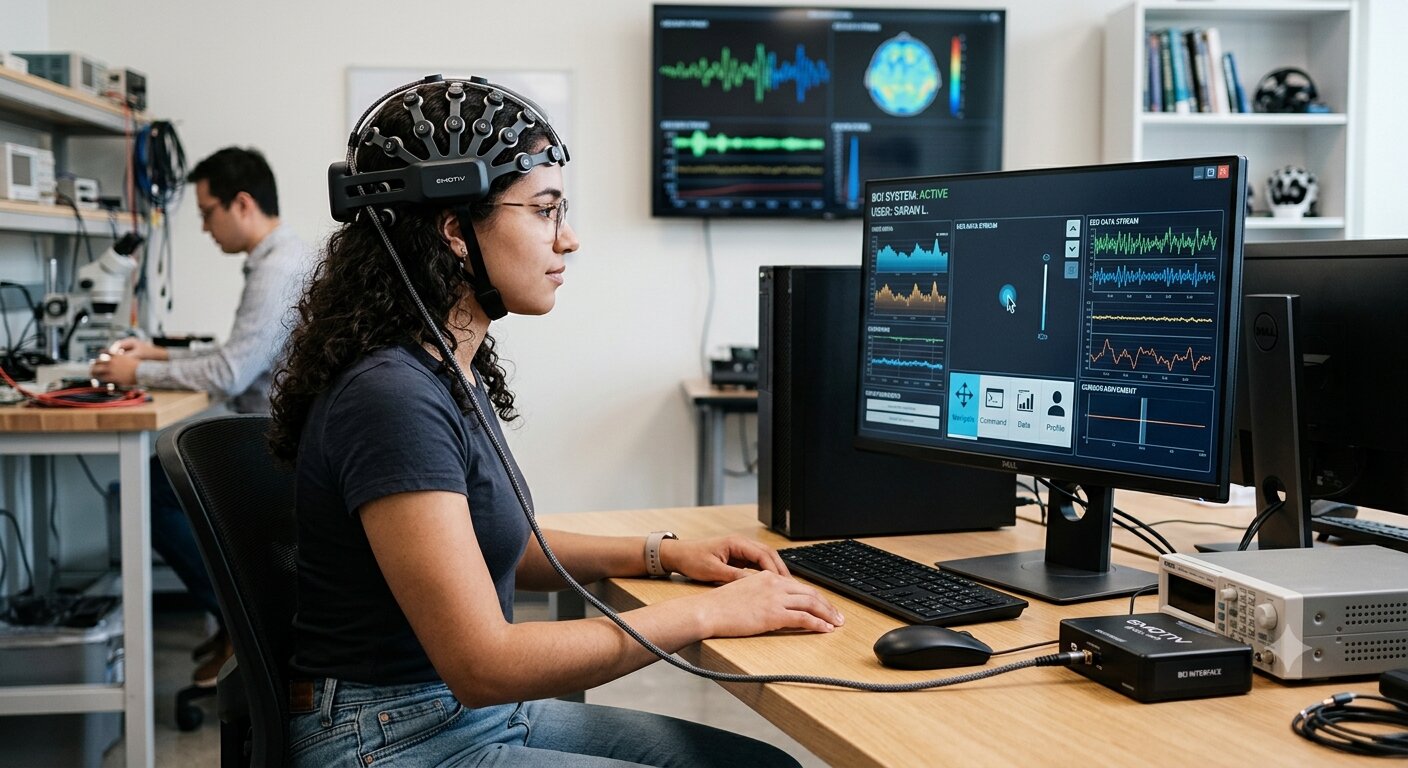
- Non-invasive BCIs continue to expand because they offer safer and more affordable access than implanted systems. Recent scientific reviews highlight rapid improvements in EEG-based signal decoding, robotic control, and machine learning, making wearable BCI systems increasingly practical for clinical and research applications.
- Brain interfaces are moving beyond laboratories into home environments. In 2026, an NIH-supported participant with ALS successfully operated a speech-generating BCI from home, demonstrating growing confidence in long-term real-world use and expanding opportunities for remote neurological care.
Use Cases
- Speech recovery for patients with paralysis is becoming one of the fastest-growing BCI applications. NIH-supported systems now translate neural activity directly into spoken words, allowing users who cannot speak naturally to communicate with family members and healthcare professionals more efficiently.
- Brain-controlled assistive devices are improving patient independence. The NIH reports that investigational BCIs allow people with paralysis to operate robotic arms, prosthetic devices, and computers using neural signals, supporting everyday activities without relying on muscle movement.
- Stroke rehabilitation is emerging as a high-potential application. Advanced BCIs are increasingly being integrated with rehabilitation technologies to restore movement and improve motor recovery through continuous brain-signal monitoring and personalized therapy approaches.
- Real-time decoding of inner speech is opening new possibilities for individuals unable to produce physical speech. In 2025, NIH-funded researchers demonstrated that imagined words could be decoded directly from brain activity, representing an important advancement for future communication devices.
- BCIs are increasingly supporting treatment of neurological disorders. FDA-recognized neurological technologies are being developed to help diagnose, monitor, and manage conditions including Parkinson’s disease, epilepsy, spinal cord injury, traumatic brain injury, and other serious neurological diseases through advanced brain-device interaction.
Frequently Asked Questions About Brain Computer Interface
- How does a Brain Computer Interface work?
A BCI records brain activity using implanted electrodes or non-invasive sensors, processes the neural signals with advanced algorithms, and translates them into commands that control external devices. This enables users to perform tasks such as typing, speaking, or operating assistive technologies without relying on muscle movement. - What factors are driving the Brain Computer Interface market?
The market is expanding due to rising investments in neuroscience research, increasing prevalence of neurological disorders, continuous improvements in artificial intelligence, and growing demand for assistive technologies. Government initiatives and supportive regulatory frameworks are also accelerating clinical development and commercialization of BCI technologies. - Which industries are adopting Brain Computer Interface technology?
Healthcare remains the primary adopter of BCI technology, particularly for neurorehabilitation, paralysis treatment, and communication restoration. Research institutions, defense organizations, academic laboratories, and emerging human-computer interaction applications are also increasing adoption as technology continues to mature. - Which region leads the Brain Computer Interface market?
North America leads the BCI market due to its strong healthcare infrastructure, significant government funding for neuroscience research, advanced clinical trial ecosystem, and supportive regulatory policies. The region also benefits from the presence of leading neurotechnology developers and major academic research institutions. - What challenges affect the Brain Computer Interface market?
Key challenges include high development costs, complex regulatory approval processes, long clinical validation timelines, concerns regarding long-term implant safety, and technical difficulties in achieving reliable neural signal decoding. Addressing these challenges remains essential for wider commercial adoption of BCI technologies. - What is the future outlook for the Brain Computer Interface market?
The future of the BCI market is expected to be shaped by advances in artificial intelligence, wireless neural interfaces, miniaturized implants, and real-time brain signal processing. Ongoing government-funded research and clinical innovations are likely to expand the technology’s use across healthcare and assistive communication applications.
Conclusion
The Brain Computer Interface (BCI) market is entering a transformative phase as advances in artificial intelligence, neuroscience, and neurotechnology accelerate the development of practical brain-controlled solutions. Increasing government funding, supportive regulatory frameworks, and expanding clinical research are driving innovation in communication, rehabilitation, and assistive healthcare technologies.
The growing adoption of non-invasive and implantable BCI systems is expected to improve the quality of life for patients with paralysis and neurological disorders while creating new opportunities in healthcare and beyond. As research continues to translate into commercial applications, the global BCI market is well positioned for sustained growth, technological advancement, and broader real-world adoption over the coming decade.