


Overview
New York, NY – Oct 15, 2026 – The biocontrol market is gaining attention as farmers and agricultural businesses look for effective ways to manage insects, plant diseases, and other crop pests while supporting more sustainable farming practices. Biocontrol uses living organisms, beneficial insects, microorganisms, and naturally derived substances to suppress harmful pests. These methods can be used alone or alongside conventional crop protection products as part of integrated pest management.
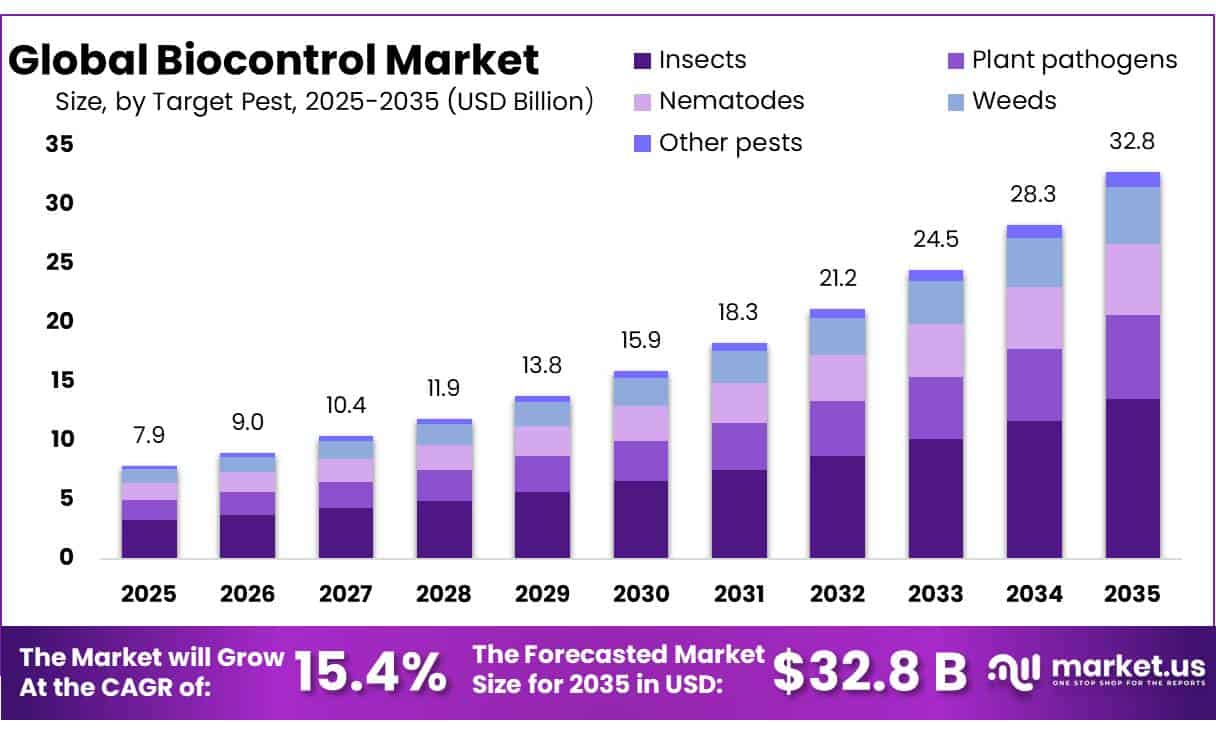
According to the supplied Market.us report, the global biocontrol market was valued at USD 7.9 billion in 2025 and is projected to reach USD 32.8 billion by 2035, representing a compound annual growth rate of 15.4% from 2026 to 2035. North America accounted for 36% of the market in 2025, equivalent to approximately USD 2.8 billion. Biopesticides represented 67%, microbial sources 59%, insect-targeted solutions 41%, and foliar spraying 48% of their respective market segments.
The industry’s outlook is linked to rising demand for crop protection, pest resistance management, and biological alternatives within integrated farming programs. However, product performance, storage stability, registration requirements, farmer awareness, and application costs will influence adoption. Continued research, reliable field results, and clear product guidance will be important for long-term growth.
Key Takeaways
-
Market growth: Market.us estimates growth from USD 7.9 billion in 2025 to USD 32.8 billion by 2035, at a 15.4% CAGR.
-
Leading region: North America held 36% of the market in 2025, valued at approximately USD 2.8 billion.
-
Leading product type: Biopesticides accounted for 67% of the market’s type segment.
-
Microbial solutions: Microbials represented 59% of the source segment.
-
Main target: Insect control accounted for 41% of the target-pest segment.
- Application method: Foliar spraying held 48% of the application segment.
Regional Analysis
North America: Market.us identifies North America as the leading region, with a 36% share and approximately USD 2.8 billion in 2025 revenue. The region benefits from established crop-protection markets and a regulatory pathway for biopesticides. The United States Environmental Protection Agency (EPA) classifies biopesticides into biochemical pesticides, microbial pesticides, and plant-incorporated protectants, and evaluates products before they can be marketed.
Europe: European demand is influenced by crop-protection regulation, food safety expectations, and efforts to manage pests through integrated approaches. Biological products must meet the applicable authorisation and safety requirements for their intended use. Registration and evidence requirements can affect the time and cost involved in bringing new products to market.
Market Dynamics
1. Driver: Rising Pest Pressure and Crop Losses
Crop pests and plant diseases are a major reason for demand for effective crop protection. The Food and Agriculture Organization of the United Nations estimates that plant pests and diseases cause losses of up to 40% of global crop production each year, with annual economic costs exceeding USD 220 billion.
Biocontrol can help farmers manage selected pests through beneficial insects, fungi, bacteria, and other natural enemies. These solutions can be included in integrated pest management programs, alongside crop monitoring and other control methods. Their effectiveness depends on the pest, crop, climate, timing, and correct application.
2. Trend: Greater Use of Integrated Pest Management
A key trend is the use of biocontrol alongside crop rotation, field monitoring, resistant crop varieties, and carefully selected pesticides. This integrated approach helps farmers choose treatments based on the pest and crop conditions instead of relying on a single method.
The United States Department of Agriculture describes biological control as the use of natural enemies such as predators, parasites, pathogens, and competitors to suppress pest populations. The United States Environmental Protection Agency also supports biopesticides as components of integrated pest management. Demand will depend on dependable field results, clear application guidance, and compatibility with existing farming practices.
3. Restraint: Inconsistent Performance and Handling Needs
Biocontrol products may be sensitive to temperature, humidity, sunlight, storage conditions, and application timing. Living organisms can also perform differently depending on the crop, target pest, and surrounding environment.
These factors can make results less predictable than farmers expect, particularly when products are applied without suitable technical guidance. The United States Environmental Protection Agency requires biopesticide registration reviews that consider product composition, toxicity, degradation, and other relevant characteristics. These safeguards help protect people and the environment, but registration, testing, storage, and farmer training can add costs and slow market entry.
4. Opportunity: New Biological Solutions and Targeted Pest Control
Research into beneficial microbes, predatory insects, parasitoids, and naturally derived substances creates opportunities for new biocontrol products. The United States Department of Agriculture’s National Institute of Food and Agriculture supports research into bio-based pest management, including the development, assessment, and monitoring of biological control agents.
Such work can help identify agents suited to specific pests and production systems. Product developers can also focus on better shelf life, easier application, and compatibility with integrated pest management. Wider adoption will require evidence of safety and performance, reliable manufacturing, and practical guidance for farmers and crop advisers.
Emerging Trends
1. Microbial Biocontrol Products
Microbial products use selected bacteria, fungi, or other microorganisms to manage certain pests and plant diseases. Market.us reports that microbials accounted for 59% of the biocontrol source segment in 2025. Research continues to examine how these organisms work under different field conditions.
2. Increased Focus on Integrated Pest Management
Biocontrol is increasingly considered part of a broader pest-management plan that includes crop monitoring, prevention, and targeted treatments. The United Nations Food and Agriculture Organization estimates that pests and diseases cause up to 40% of global crop losses annually, highlighting the need for effective management.
3. More Attention to Biopesticide Registration
Product developers are focusing on safety data, product consistency, and regulatory requirements. The United States Environmental Protection Agency notes that new biopesticides are often registered in less than one year, compared with an average of more than three years for conventional pesticides, while still requiring safety reviews.
4. Biological Control of Invasive Species
Biocontrol is being studied to manage invasive insects and weeds that spread into new environments. The United States Department of Agriculture supports research into natural enemies and post-release monitoring. Careful testing is essential to check that introduced organisms do not harm non-target species.
5. Expansion of Foliar Applications
Foliar application delivers biological products directly to leaves and other above-ground plant surfaces. Market.us reports that foliar spraying held 48% of the application segment in 2025. Product success still depends on spray coverage, weather, timing, and following the product label.
Use Cases
1. Insect Control in Field Crops
Farmers can use beneficial insects, parasitoids, and microbial products to manage selected crop-damaging insects. Market.us reports that insects represented 41% of the biocontrol target-pest segment in 2025. Field scouting helps farmers decide when and where biological treatments are needed.
2. Disease Management in Horticulture
Selected beneficial fungi, bacteria, and biochemical products can help suppress certain plant diseases in fruits and vegetables. Their suitability depends on the crop, disease, climate, and product label. The USDA Agricultural Research Service studies beneficial microbes for use in sustainable pest-management systems.
3. Biological Control of Weeds
Some biological control programs use carefully evaluated natural enemies to reduce invasive weed populations. The USDA supports research to identify, assess, and monitor potential control agents. Before release, scientists must consider non-target effects to reduce the risk of unintended harm to native plants and ecosystems.
4. Pest Management in Greenhouses
Greenhouse growers can release beneficial insects or predatory mites to target selected pests on vegetables and ornamental plants. Protected cultivation can make monitoring and controlled releases easier, although temperature, humidity, and pest levels affect results. Correct identification and timing are essential for effective control.
5. Invasive Pest Management
Government agencies and researchers use biological control to help manage invasive pests that threaten agriculture and natural areas. FAO estimates that invasive insects cause at least USD 70 billion in economic losses each year. Any release must be supported by appropriate risk assessment and monitoring.
Frequently Asked Questions on Biocontrol
1. What is biocontrol?
Biocontrol, or biological control, uses natural enemies such as beneficial insects, predators, parasites, fungi, and bacteria to suppress pests. It can help protect crops and can be included in integrated pest management programs.
2. What is the projected size of the biocontrol market?
According to Market.us, the global biocontrol market was valued at USD 7.9 billion in 2025 and is projected to reach USD 32.8 billion by 2035, representing a reported compound annual growth rate of 15.4%.
3. What is driving demand for biocontrol?
Demand is supported by the need to manage crop pests, reduce dependence on conventional pesticides in suitable applications, and improve integrated pest management. FAO estimates that plant pests and diseases cause up to 40% of global crop production losses annually.
4. Which region led the biocontrol market in 2025?
Market.us identifies North America as the leading region in 2025, with a 36% share and reported revenue of approximately USD 2.8 billion. This is a market-report estimate, not an independently verified government market statistic.
5. What are the main types of biocontrol products?
Biocontrol solutions include microbial products, biochemical pesticides, beneficial insects, predatory mites, parasitoids, and other natural enemies. The appropriate option depends on the target pest, crop, local conditions, application method, and relevant product registration.
Conclusion
The biocontrol market is attracting interest as agriculture seeks more targeted and sustainable approaches to pest management. Market.us estimates that the market will increase from USD 7.9 billion in 2025 to USD 32.8 billion by 2035, with a reported CAGR of 15.4%.
North America led the market in 2025, while biopesticides and microbial solutions held leading positions in their respective segments. Official sources highlight the scale of the crop-protection challenge, with FAO estimating that pests and diseases cause up to 40% of global crop losses annually. Future adoption will depend on reliable field performance, suitable regulation, improved product handling, research, and farmer education.




















