


Overview
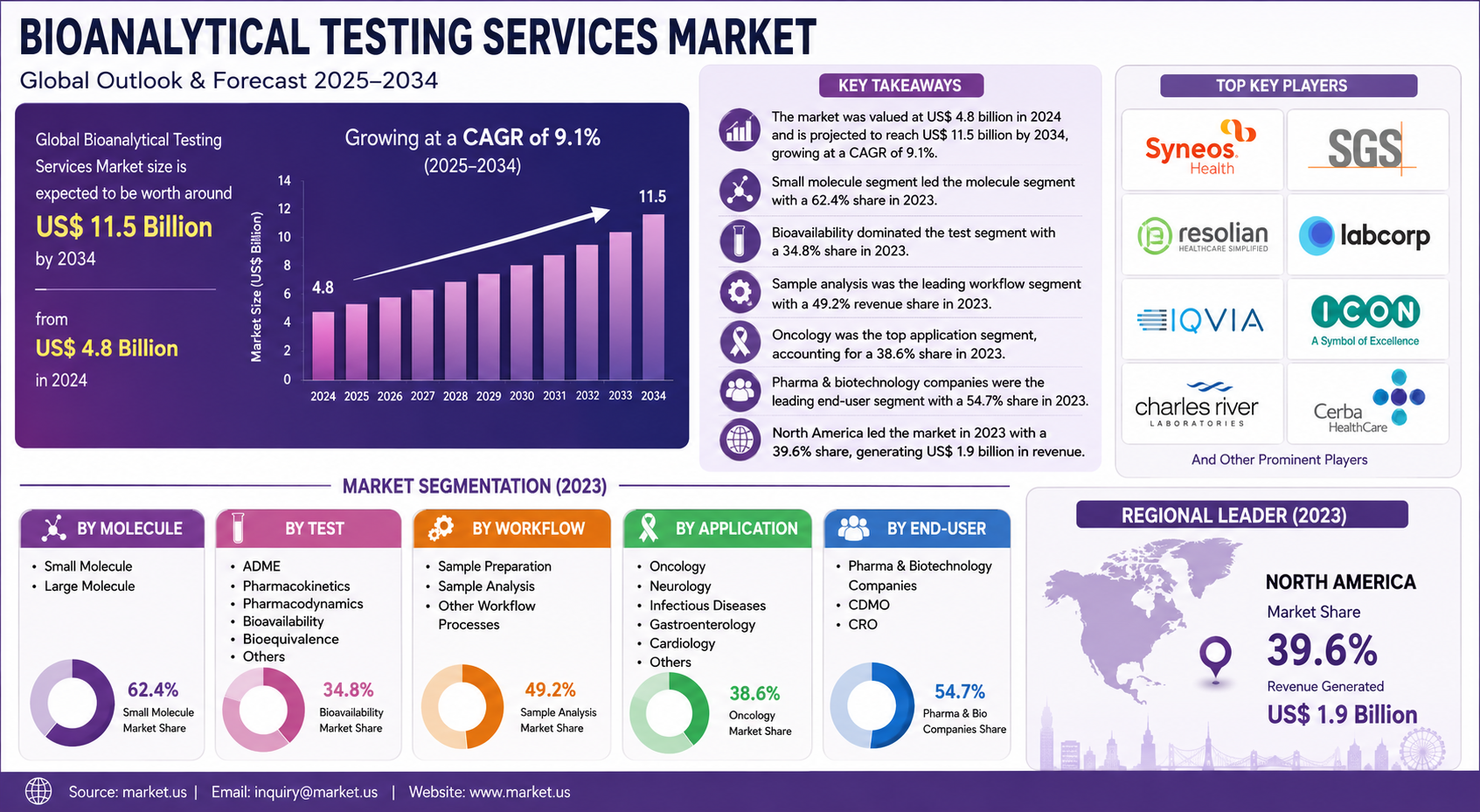
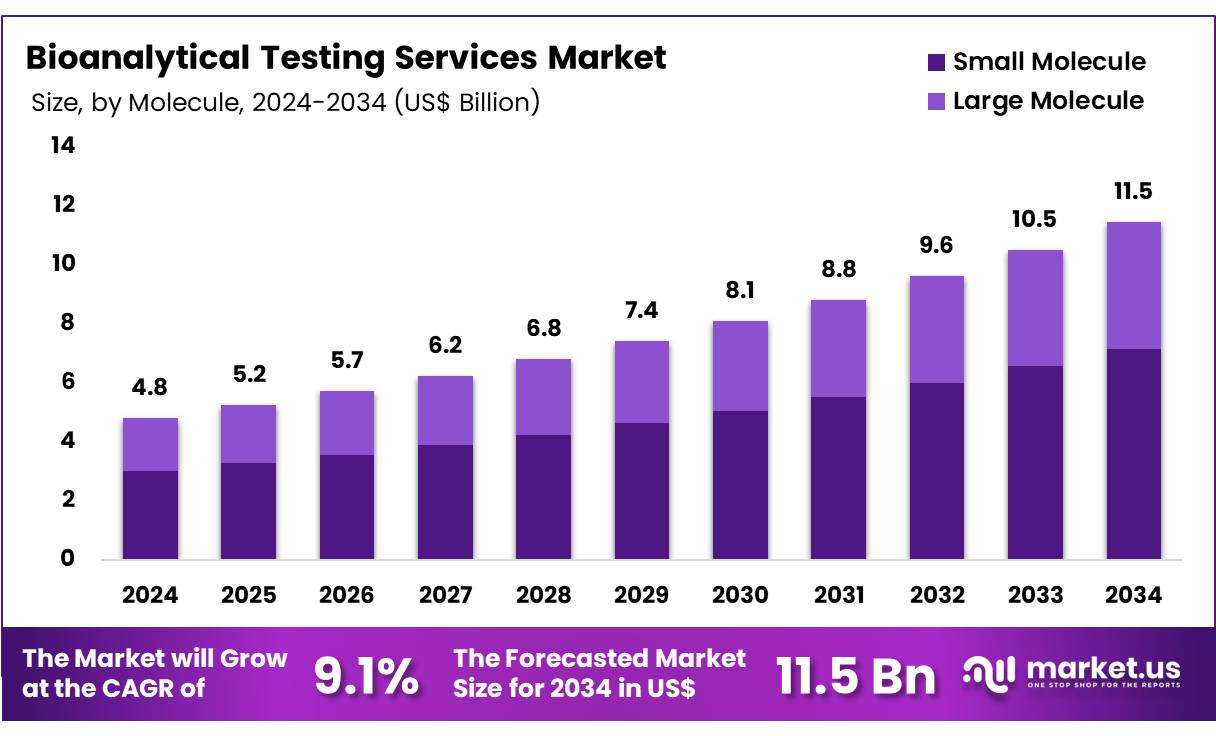
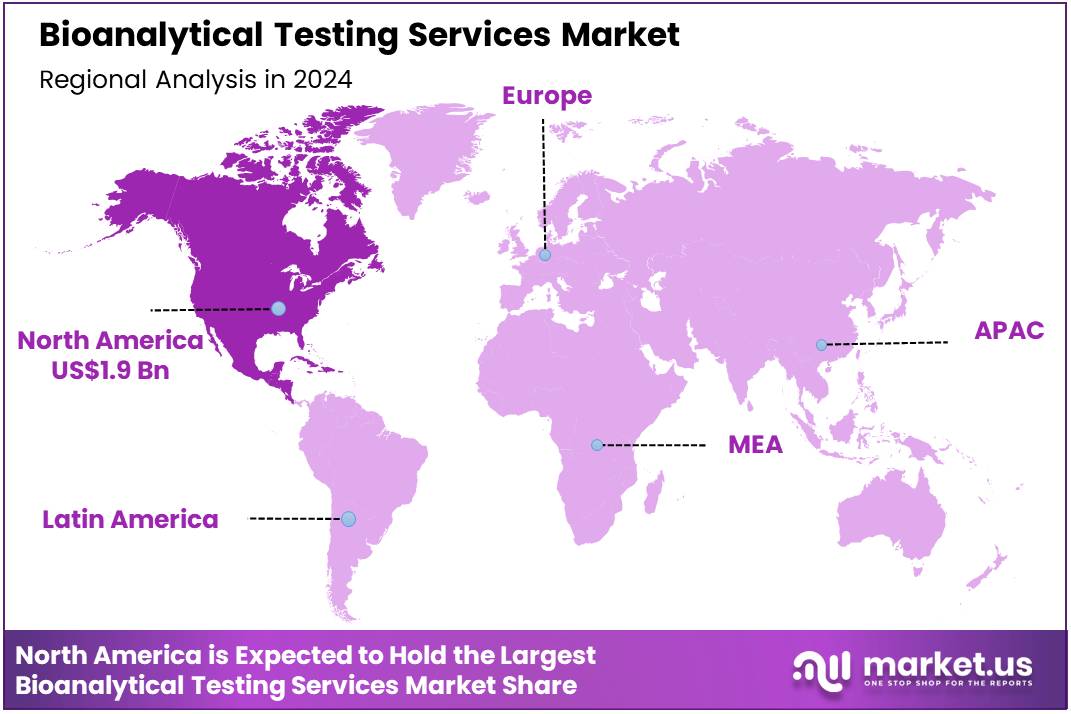
Global Bioanalytical Testing Services Market size is expected to be worth around US$ 11.5 Billion by 2034 from US$ 4.8 Billion in 2024, growing at a CAGR of 9.1% during the forecast period 2025 to 2034. In 2023, North America led the market, achieving over 39.6% share with a revenue of US$ 1.9 Billion.
The Bioanalytical Testing Services Market is expanding steadily as pharmaceutical and biotechnology companies increase investments in developing innovative drugs, biologics, biosimilars, and advanced therapies. Bioanalytical testing is a critical step in drug development because it measures drugs, metabolites, and biomarkers in biological samples to evaluate safety, efficacy, and dosage before regulatory approval. As clinical pipelines become more complex, demand for highly accurate, validated, and reproducible analytical testing services continues to rise across preclinical and clinical research.
Regulatory agencies are also strengthening requirements for analytical quality and data integrity. The U.S. Food and Drug Administration (FDA) has issued harmonized guidance under ICH M10 Bioanalytical Method Validation and Study Sample Analysis, providing standardized recommendations for validating bioanalytical assays used in nonclinical and clinical studies that support regulatory submissions.
In addition, the FDA released updated guidance for biomarker bioanalytical method validation in 2026, reinforcing the importance of robust validation for biomarker-based drug development. These initiatives are encouraging pharmaceutical sponsors and contract research organizations (CROs) to adopt advanced testing technologies and standardized laboratory practices.
Technological advancements such as liquid chromatography-mass spectrometry (LC-MS/MS), ligand-binding assays, automation, and high-throughput laboratory platforms are improving analytical sensitivity, operational efficiency, and turnaround times. At the same time, the increasing number of biologic therapies, cell and gene therapies, and precision medicine programs is creating greater demand for specialized bioanalytical expertise. Growing outsourcing of laboratory services to experienced CROs is further supporting market expansion by enabling drug developers to reduce costs, accelerate clinical timelines, and meet evolving global regulatory standards while maintaining high-quality analytical data.
Key Takeaways
- In 2024, the Bioanalytical Testing Services Market was valued at US$ 4.8 billion and is anticipated to reach US$ 11.5 billion by 2034, expanding at a CAGR of 9.1% over the forecast period.
- Based on molecule type, the market is classified into small molecules and large molecules, with the small molecule segment accounting for the highest share of 62.4% in 2023.
- By test type, the market is segmented into ADME, pharmacokinetics, pharmacodynamics, bioavailability, bioequivalence, and other testing services. Among these, bioavailability represented the leading segment with a 34.8% market share in 2023.
- According to workflow, the market is categorized into sample preparation, sample analysis, and other workflow processes. Sample analysis remained the dominant segment, contributing 49.2% of the total market revenue in 2023.
- In terms of application, the market is divided into oncology, neurology, infectious diseases, gastroenterology, cardiology, and other therapeutic areas. The oncology segment held the largest revenue share of 38.6% in 2023.
- Based on end user, the market comprises pharmaceutical & biotechnology companies, contract development and manufacturing organizations (CDMOs), and contract research organizations (CROs). Pharmaceutical & biotechnology companies accounted for the largest share at 54.7% in 2023.
- In 2023, North America emerged as the leading regional market, capturing 39.6% of the global market share.
Statistical Information
- The FDA issued its final Bioanalytical Method Validation for Biomarkers guidance on April 10, 2026, providing standardized validation recommendations for biomarker assays used in INDs, NDAs, BLAs, and ANDAs.
- The FDA biomarker validation guidance applies to four regulatory submission pathways: Investigational New Drug Applications (INDs), New Drug Applications (NDAs), Biologics License Applications (BLAs), and Abbreviated New Drug Applications (ANDAs).
- The FDA’s 2025 finalized biomarker guidance identifies eight critical analytical performance characteristics for biomarker assays: accuracy, precision, sensitivity, selectivity, parallelism, range, reproducibility, and stability.
- A 2025 peer-reviewed statistical framework for biomarker validation introduced a two-stage sequential testing design to reduce unnecessary specimen consumption while maintaining statistical validity during biomarker evaluation.
- The same 2025 study demonstrated that the sequential testing framework maintains Type I error control while allowing early stopping for efficacy or futility, improving specimen utilization in multicenter biomarker studies.
- The finalized FDA biomarker guidance specifically recommends using two major analytical assay platforms for biomarker method validation:
1. Chromatography-based assays
2. Ligand-binding assays - The FDA’s 2026 guidance states that validated bioanalytical biomarker methods are applicable across four major development stages:
1. Nonclinical studies
2. Clinical studies
3. Method validation
4. Regulatory submissions
Segmentation Analysis
The small molecule segment accounted for 62.4% of the market in 2023, supported by strong demand for developing and testing therapies across oncology, cardiovascular, and infectious diseases. Their versatility, established manufacturing processes, and broad therapeutic applications continue to strengthen adoption. Ongoing innovation in drug discovery, advanced analytical technologies, and increasing focus on personalized medicine are expected to sustain segment growth over the forecast period.
Bioavailability testing captured 34.8% of the market, driven by the need to evaluate drug absorption, distribution, and therapeutic performance. Pharmaceutical companies increasingly rely on these studies to improve efficacy and safety during development. Rising investments in biologics, personalized medicines, and novel drug candidates, together with stringent regulatory approval requirements, are expected to support continued expansion of this testing segment.
The sample analysis segment represented 49.2% of market revenue, reflecting increasing demand for accurate and efficient testing throughout drug development. Technologies such as high-throughput screening and mass spectrometry enhance precision, reliability, and turnaround times when analyzing biological samples. Growing complexity in pharmaceutical research, clinical trials, and regulatory compliance is expected to further accelerate demand for advanced sample analysis services.
The oncology segment generated 38.6% of market revenue, supported by expanding cancer research and the development of targeted therapies. Bioanalytical testing is essential for biomarker identification, treatment monitoring, and safety assessment of oncology drugs. Increasing cancer incidence, higher investments in clinical research, and widespread adoption of personalized medicine are expected to drive sustained growth in this application segment.
Pharmaceutical and biotechnology companies held 54.7% of the market, driven by rising outsourcing of bioanalytical testing to CROs and CDMOs. These services support drug discovery, pharmacokinetic studies, bioavailability assessment, and clinical development while ensuring regulatory compliance. Continued investment in innovative therapeutics, combined with increasing demand for specialized testing expertise, is expected to strengthen growth across this end-user segment.
Regional Analysis
North America leads the bioanalytical testing services market due to its well-established pharmaceutical and biotechnology industries, advanced clinical research infrastructure, and strong regulatory framework. The region continues to benefit from extensive drug development activities supported by the U.S. Food and Drug Administration (FDA), which approved 46 novel drugs in 2025, including 20 first-in-class therapies, creating sustained demand for bioanalytical testing throughout preclinical and clinical development. Additionally, 23 of the 46 approvals (50%) were for rare or orphan diseases, further increasing the need for specialized biomarker and bioanalytical assays.
The FDA also released updated guidance on Bioanalytical Method Validation for Biomarkers in April 2026, strengthening analytical standards for biomarker testing and encouraging the adoption of advanced laboratory technologies. North America also benefits from a high concentration of clinical trials, research institutions, and contract research organizations (CROs), supported by continuous federal investment in biomedical research. These factors collectively reinforce the region’s leadership in bioanalytical testing services by driving innovation, regulatory compliance, and demand for high-quality analytical testing.
Driver: Rising Biopharmaceutical Development and Clinical Trial Activity
The growth of the bioanalytical testing services market is being driven by the increasing development of biopharmaceuticals, including monoclonal antibodies, biosimilars, cell therapies, and gene therapies. These complex therapeutics require comprehensive bioanalytical testing throughout drug discovery, preclinical studies, and clinical trials to ensure safety, efficacy, and regulatory compliance.
Pharmaceutical and biotechnology companies are expanding research pipelines and outsourcing specialized testing to contract research organizations to reduce costs and accelerate product development timelines. In addition, the growing number of clinical trials across therapeutic areas such as oncology, immunology, and rare diseases continues to increase demand for advanced bioanalytical testing services globally.
Trend: Increasing Adoption of Advanced Analytical Technologies and Automation
A significant trend shaping the bioanalytical testing services market is the growing adoption of advanced analytical technologies combined with laboratory automation. High-resolution mass spectrometry, ligand-binding assays, next-generation sequencing, and multiplex immunoassays are increasingly being utilized to improve sensitivity, precision, and data quality.
Automation and digital laboratory management systems are also enhancing testing efficiency, minimizing human error, and reducing turnaround times. Artificial intelligence and advanced data analytics are supporting faster interpretation of complex datasets, enabling better decision-making during drug development. These technological advancements are improving operational efficiency while meeting evolving regulatory requirements for increasingly sophisticated biologics and personalized medicines.
Opportunity: Expanding Demand for Precision Medicine and Emerging Markets
The expansion of precision medicine and growing pharmaceutical investments in emerging economies present significant opportunities for the bioanalytical testing services market. Personalized therapies require highly specialized biomarker analysis, pharmacokinetic studies, and companion diagnostic testing, increasing the need for sophisticated bioanalytical capabilities.
At the same time, countries across Asia-Pacific, Latin America, and the Middle East are strengthening healthcare infrastructure, increasing clinical research activities, and attracting global pharmaceutical investments due to favorable regulatory reforms and cost advantages. Service providers can capitalize on these developments by expanding laboratory networks, enhancing technical expertise, and offering integrated testing solutions that support global drug development programs and regional clinical trials.
Emerging Trends
- Standardized biomarker validation is improving testing quality: In April 2026, the U.S. FDA issued its final Bioanalytical Method Validation for Biomarkers guidance. The guidance covers 4 regulatory application types (INDs, NDAs, BLAs, and ANDAs) and defines 8 critical analytical performance characteristics, encouraging laboratories to improve accuracy, precision, sensitivity, and reproducibility in biomarker testing:
- Advanced biomarker testing is becoming a core part of drug development: Recent bioanalytical workflows increasingly support precision medicine by using pharmacodynamic biomarkers throughout clinical development. A 2026 peer-reviewed review highlights the growing use of biomarkers for dose optimization, treatment monitoring, and personalized therapies across multiple disease areas, improving clinical decision-making and analytical performance
- Regulatory agencies are encouraging modern statistical approaches: In January 2026, the FDA released draft guidance promoting Bayesian statistical methods in clinical trials. These approaches help sponsors analyze existing and new data together, enabling more efficient study designs and stronger evidence generation while maintaining scientific rigor during drug development
- New laboratory technologies are expanding bioanalytical capabilities: Modern bioanalytical laboratories are increasingly using two major analytical platforms LC-MS/MS (chromatography-based assays) and ligand-binding assays. These technologies provide higher analytical sensitivity and support reliable measurement of drugs, metabolites, and biomarkers for regulatory submissions
- Alternative drug development methods are gaining attention: The FDA’s March 2026 draft guidance promotes the use of New Approach Methodologies (NAMs) to improve human relevance while reducing dependence on animal studies. This trend is increasing demand for advanced bioanalytical testing methods capable of supporting innovative laboratory models
Use Cases
- Bioanalytical testing supports biomarker validation for regulatory approval: The FDA’s 2026 guidance enables laboratories to validate biomarker assays used in 4 major regulatory submissions (INDs, NDAs, BLAs, and ANDAs), helping pharmaceutical companies generate reliable analytical data required for drug approvals
- Precision medicine programs rely on biomarker analysis: Bioanalytical laboratories use validated biomarkers to monitor treatment response, select appropriate patient groups, and optimize dosing. FDA recognizes biomarkers as essential tools for diagnosis, safety monitoring, and evaluating therapeutic effectiveness in precision medicine programs
- Clinical trials use bioanalytical testing to measure drug exposure: Validated chromatographic and ligand-binding assays are widely applied to determine drug concentrations, metabolites, and pharmacokinetic profiles in clinical studies, supporting regulatory-quality data throughout nonclinical and clinical development
- Cell and gene therapy development requires specialized bioanalysis: Emerging advanced therapies increasingly depend on sensitive biomarker assays to evaluate biological activity, treatment response, and safety. Recent scientific publications emphasize robust assay validation as a critical requirement for these complex therapeutic products
- Pharmaceutical companies use bioanalytical testing to improve regulatory compliance: The FDA’s 2026 biomarker guidance specifies 8 analytical validation parameters, helping laboratories produce accurate, reproducible, and high-quality data for regulatory submissions while reducing variability in drug development studies.
Conclusion
The Bioanalytical Testing Services Market is experiencing steady growth as pharmaceutical and biotechnology companies increasingly rely on high-quality analytical testing to support drug discovery, clinical trials, and regulatory approvals. The expanding development of biologics, biosimilars, cell and gene therapies, and precision medicines is driving demand for advanced bioanalytical capabilities. Recent FDA initiatives, including the 2026 Bioanalytical Method Validation for Biomarkers guidance, are strengthening analytical standards and encouraging wider adoption of validated testing methods and advanced technologies.
Automation, LC-MS/MS, ligand-binding assays, and biomarker-based testing continue to improve laboratory efficiency and data reliability. With increasing outsourcing to contract research organizations and evolving regulatory expectations, the market is well positioned to support innovation, improve drug development efficiency, and deliver reliable analytical data for future therapeutic advancements.




















