


Overview
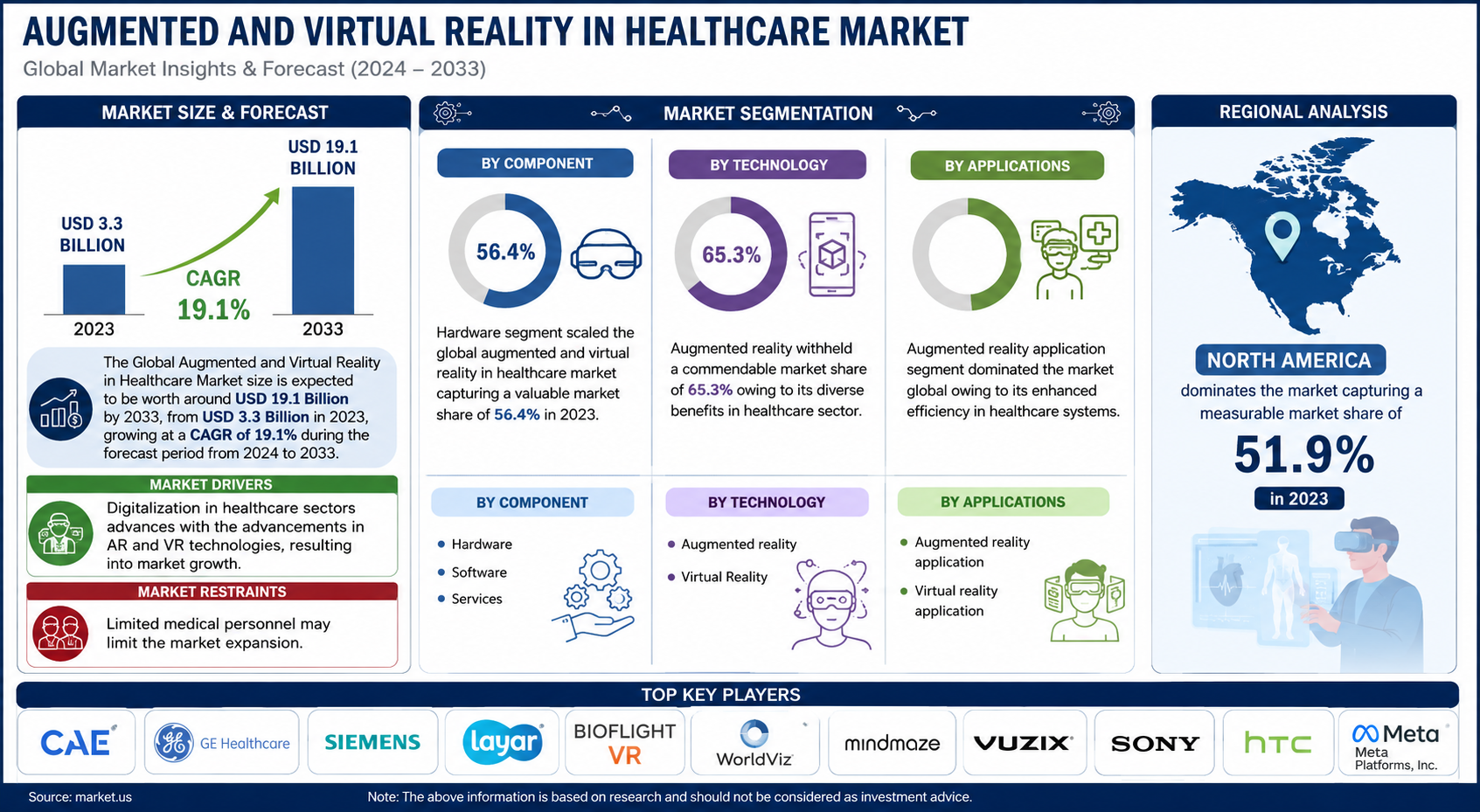
New York, NY – August 05, 2026 – The Global Augmented and Virtual Reality in Healthcare Market size is expected to be worth around USD 19.1 Billion by 2033, from USD 3.3 Billion in 2023, growing at a CAGR of 19.1% during the forecast period from 2024 to 2033.
The global Augmented and Virtual Reality (AR/VR) in Healthcare market is gaining momentum as healthcare providers increasingly adopt immersive technologies to improve patient care, medical education, and clinical decision-making. AR and VR are being integrated into surgical planning, rehabilitation, pain management, mental health therapy, and professional training, enabling more interactive and personalized healthcare experiences.
According to the U.S. Food and Drug Administration (FDA), these technologies can support minimally invasive procedures, improve diagnostic accuracy, expand access to remote care, and enhance healthcare professionals’ ability to prepare for complex treatments. The FDA also maintains a growing list of authorized AR/VR-enabled medical devices, reflecting the expanding regulatory acceptance of immersive healthcare technologies.
Healthcare organizations are also increasing investments in immersive training platforms to strengthen workforce readiness and patient outcomes. A 2024 umbrella review published in PubMed analyzed 50 systematic reviews evaluating AR and VR in medical education, highlighting broad evidence supporting their role in improving clinical skills, knowledge retention, and simulation-based learning across healthcare disciplines.
In parallel, the FDA continues to advance research through its Medical Extended Reality Program to establish performance standards and support the safe adoption of innovative AR/VR medical devices. As hospitals and digital health providers expand virtual care capabilities, AR and VR are expected to play a growing role in delivering efficient, accessible, and technology-driven healthcare services worldwide.

Key Takeaways
- The global Augmented and Virtual Reality in Healthcare Market is projected to reach USD 19.1 billion by 2033, rising from USD 3.3 billion in 2023.
- The market is anticipated to expand at a CAGR of 19.1% during the forecast period from 2024 to 2033.
- By component, the hardware segment accounted for the largest share of the global Augmented and Virtual Reality in Healthcare market, holding 56.4% of the market in 2023.
- By technology, the augmented reality (AR) segment led the market with a 65.3% share in 2023, driven by its broad range of applications and advantages across healthcare settings.
- Based on application, the augmented reality application segment emerged as the leading category with a 74.2% market share in 2023, supported by its ability to improve operational efficiency and clinical workflows in healthcare.
- North America held the dominant regional position in the global Augmented and Virtual Reality in Healthcare market, accounting for 51.9% of the total market share in 2023.
Statistical Information
- The U.S. FDA’s AR/VR Medical Device List included more than 90 authorized medical devices as of July 2026, covering specialties such as radiology, neurology, orthopedics, ophthalmology, rehabilitation, and surgical navigation. This demonstrates rapidly expanding regulatory acceptance of immersive healthcare technologies.
- In 2026 alone, the FDA cleared at least 6 new AR/VR-enabled medical devices during the first three months of the year (January–March 2026), highlighting accelerating innovation in mixed reality platforms for surgery planning, medical imaging, and clinical visualization.
- AppliedVR’s RelieVRx received FDA 510(k) clearance in December 2024 as a prescription virtual reality behavioral therapy for chronic pain, becoming one of the first FDA-cleared VR therapeutics to support non-opioid pain management.
- A U.S. clinical trial involving 100 hospitalized patients found that 65% of patients using virtual reality achieved meaningful pain relief, compared with 40% receiving standard distraction therapy, demonstrating significantly higher patient response with immersive treatment.
- Another U.S. randomized clinical trial of 120 hospitalized patients reported an immediate pain score reduction of 1.72 points with VR, compared with 0.46 points in the control group, confirming the effectiveness of VR-assisted pain management.
- The FDA identifies 10 major healthcare application areas for AR/VR technologies, including surgery planning, intraoperative procedures, pain management, neurology, ophthalmology, rehabilitation, pediatric care, telemedicine, virtual care, and mental health treatment, reflecting broad clinical adoption.
- The FDA’s Medical Extended Reality (MXR) Program is one of 20 regulatory science research programs within the Center for Devices and Radiological Health (CDRH), dedicated to evaluating the safety and effectiveness of AR/VR medical devices before widespread clinical use.
- According to the FDA product classification database, virtual reality behavioral therapy devices for pain relief are regulated as Class II medical devices under Regulation Number 890.5800, requiring manufacturers to demonstrate safety and performance before commercialization in the U.S.
Market Segmentation Analysis
Component Analysis
The hardware segment dominated the market with a 56.4% share in 2023, supported by increasing adoption of head-mounted displays, smart glasses, 3D sensors, and advanced imaging systems across healthcare settings. According to the U.S. Food and Drug Administration (FDA), AR/VR hardware is being integrated into surgical guidance, rehabilitation, diagnostics, telemedicine, and medical training. The FDA also maintains a growing list of authorized AR/VR medical devices, reflecting expanding clinical adoption and commercialization.
Technology Analysis
The augmented reality (AR) segment accounted for 65.3% of the market in 2023, driven by its ability to overlay digital information onto real-world clinical environments. The U.S. FDA recognizes AR applications in surgery planning, intraoperative navigation, ophthalmic diagnostics, telemedicine, and rehabilitation. Continued regulatory support, increasing availability of FDA-authorized AR medical devices, and expanding research into medical extended reality technologies are strengthening AR adoption across healthcare systems.
Application Analysis
The augmented reality application segment captured 74.2% of the market in 2023, reflecting its broad use in complex surgeries, medical education, rehabilitation, and patient care. According to the U.S. FDA, AR technologies improve visualization by overlaying patient-specific anatomical information during procedures, helping clinicians enhance precision and decision-making. FDA guidance also highlights AR’s expanding role in virtual care, diagnostics, rehabilitation, and treatment planning across diverse healthcare specialties.
Regional Analysis
North America accounted for the largest share of the global Augmented and Virtual Reality (AR/VR) in Healthcare market in 2023, holding 51.9% of the total market. The region’s leadership is supported by advanced healthcare infrastructure, widespread adoption of digital health technologies, and strong investments in medical innovation.
The U.S. Food and Drug Administration (FDA) continues to support the development of AR and VR medical devices through regulatory guidance and approvals, encouraging their use in surgical planning, medical training, diagnostics, rehabilitation, and patient care. In addition, federal agencies such as the National Institutes of Health (NIH) fund research on immersive technologies to improve clinical outcomes and healthcare delivery.
Asia-Pacific is expected to record the fastest growth during the forecast period due to expanding healthcare infrastructure, rapid digital transformation, and increasing government support for digital health initiatives. Countries including China, India, Japan, and South Korea are investing in AI, telemedicine, and immersive healthcare technologies to improve access to quality care.
The World Health Organization (WHO) highlights that digital health strategies across the Asia-Pacific region are accelerating technology adoption, creating favorable conditions for AR and VR integration in healthcare services and medical education.

Business Opportunities
The augmented and virtual reality (AR/VR) in healthcare market presents significant business opportunities as healthcare providers increasingly invest in digital technologies to improve patient outcomes and operational efficiency. Hospitals are expanding the use of AR-assisted surgical navigation, enabling medical professionals to perform complex procedures with greater precision while reducing complications. Medical schools and training centers are also adopting immersive VR platforms to provide realistic, risk-free clinical education, creating demand for advanced simulation software and hardware.
Rehabilitation and mental healthcare represent another promising growth area. VR-based therapies are being used for pain management, stroke rehabilitation, anxiety disorders, and post-traumatic stress disorder, supported by increasing clinical evidence and regulatory interest. Companies offering therapeutic content, wearable devices, and remote monitoring solutions can benefit from this expanding adoption.
The integration of AR/VR with artificial intelligence, cloud computing, digital twins, and 5G connectivity creates opportunities for real-time collaboration, remote consultations, and personalized treatment planning. Government initiatives promoting digital health, along with growing investments in healthcare infrastructure and medical innovation, further support market expansion. As healthcare systems prioritize value-based care and workforce training, AR/VR solution providers can establish long-term partnerships with hospitals, academic institutions, and healthcare technology developers.
Emerging Trends
- Regulated AR/VR medical devices are expanding rapidly. The U.S. FDA maintains an official database of 90+ authorized AR/VR medical devices, showing growing adoption in surgical navigation, orthopedics, neurology, ophthalmology, rehabilitation, and radiology. Increasing regulatory approvals are encouraging hospitals to integrate immersive technologies into routine patient care.
- Healthcare organizations are moving beyond pilot projects. According to the Digital Health Most Wired 2025 report, about 50% of healthcare organizations are using or piloting AR/VR and digital twin technologies for clinical training, patient education, or operational simulation, reflecting broader adoption across healthcare systems.
- Virtual reality is becoming a mainstream healthcare training tool. The CDC’s OneLab VR provides a 50,000-square-foot virtual laboratory, enabling healthcare professionals to receive immersive laboratory education remotely. This trend supports standardized workforce development while reducing training costs and improving accessibility for public health laboratories.
- Digital healthcare infrastructure is supporting immersive technologies. The CDC’s 2024 National Electronic Health Records Survey found 95.0% of U.S. office-based physicians had adopted electronic health records. High digitalization improves integration of AR/VR platforms with clinical workflows, medical imaging, and patient information systems.
- Government agencies are investing in medical extended reality research. The FDA continues expanding its Medical Extended Reality (MXR) regulatory science program to evaluate safety, effectiveness, cybersecurity, and human factors, accelerating responsible adoption of AR/VR technologies across diagnosis, treatment, rehabilitation, and remote healthcare delivery.
Use Cases
- Virtual reality is improving laboratory workforce training. During the CDC VR pilot, 95% (56 participants) agreed VR made learning easier, while 100% (23 participants) without previous biosafety cabinet experience reported increased confidence after completing immersive laboratory training.
- AR supports real-time surgical navigation. According to the FDA, AR systems overlay patient-specific CT and MRI images directly onto the surgical field, allowing surgeons to visualize anatomy during procedures. This improves precision, supports minimally invasive surgery, and enhances clinical decision-making across multiple specialties.
- VR is expanding home-based rehabilitation services. The FDA recognizes VR as a technology that enables rehabilitation and specialist care outside hospitals, allowing patients to complete therapy remotely while improving access for individuals living in underserved or rural communities.
- Immersive technology is strengthening medical education. In the CDC laboratory pilot, 94% (34 participants) with previous biosafety cabinet experience agreed VR provided practical hands-on learning, demonstrating its value for clinical skills development without exposing learners to biological hazards.
- Virtual reality is supporting mental health and pain management. The FDA highlights VR applications for treating post-traumatic stress disorder, chronic pain, neurological conditions, and pediatric care, while enabling self-directed therapy and improving patient engagement through immersive treatment experiences in both hospitals and home settings.
Recent Developments
- In October 2025, GE HealthCare its 2025 AI Innovation Lab was advancing healthcare solutions, and in December 2025 it introduced advanced imaging solutions powered by NVIDIA, reflecting continued investment in next-generation clinical workflow technology.
- In April 2025, SimX and Elevate Healthcare announced a strategic collaboration to combine VR healthcare training with simulation-based education for medical training and patient outcomes.
- In February 2025, XRHealth said it acquired RealizedCare to add immersive digital therapeutics for chronic pain, stress, anxiety, and behavioral health to its AI-driven therapeutic XR platform.
Conclusion
The global augmented and virtual reality (AR/VR) in healthcare market is positioned for strong long-term growth as healthcare systems increasingly embrace immersive technologies to improve patient care, medical training, and clinical efficiency. Expanding regulatory support from the U.S. FDA, rising adoption of AR/VR-enabled medical devices, and continued investments in digital health innovation are accelerating commercialization across multiple healthcare specialties.
Applications in surgery, rehabilitation, pain management, mental health, and medical education continue to broaden the market’s potential. As artificial intelligence, cloud computing, and remote healthcare become more integrated with immersive technologies, AR and VR are expected to play an increasingly important role in delivering safer, more personalized, and accessible healthcare services worldwide.




















