Introduction
The Global Biometrics is turning from a hardware-led identity business into a platform market built on software and recurring contracts. Government digital-ID programmes, border automation and passwordless sign-in are the main drivers. The EU’s Entry/Exit System was fully deployed at all external Schengen crossings on April 10, 2026, and it already handled more than 52 million crossings by late April. On the other side, deepfake presentation attacks, restrictions under the EU AI Act, and BIPA-style lawsuits in the US are raising compliance costs and pushing vendors toward multimodal, liveness-verified authentication.
Market Size & Statistics
- The global biometrics market was valued at USD 54.6 billion in 2025.
- It is projected to reach about USD 203.5 billion by 2035.
- That implies a compound annual growth rate of 14.1% from 2026 to 2035.
- North America led in 2025 with more than 30.0% of the market, about USD 16.4 billion in revenue.
- Hardware was the largest component at 64.0%.
- Fingerprint recognition was the largest technology at 39.0%.
- Physiological biometrics, such as fingerprint, face, and iris, made up 90.0% of the market by biometric type.
- Single-factor authentication accounted for 67.0% by authentication type.
- Government and defense was the largest end-use industry at 25.0%.
- Asia Pacific is the fastest-growing region, and national digital-ID and e-passport rollouts add about 2.6 percentage points to the forecast CAGR.
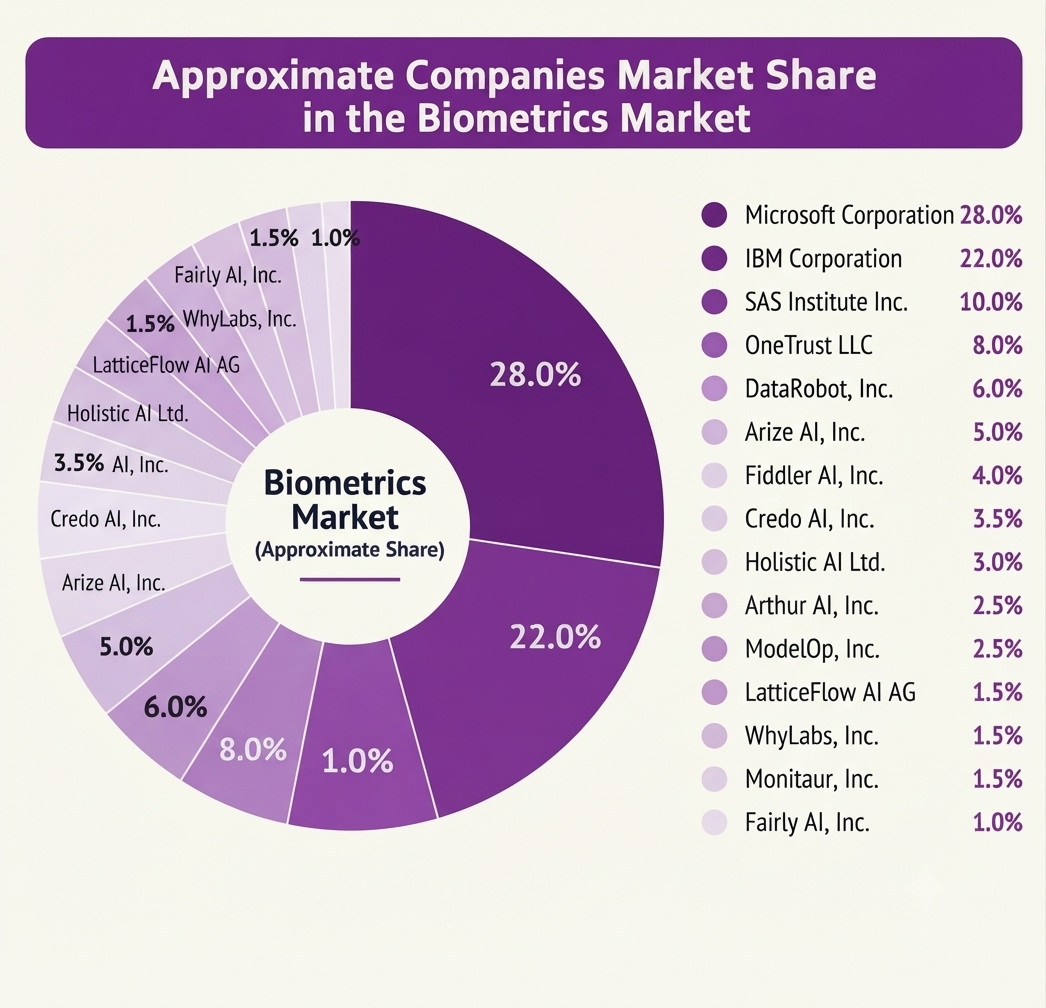
| Company | Approx. Market Share (%) | Relative Positioning in Biometrics |
|---|---|---|
| Microsoft Corporation | 28.0% | Tier 1. Pushes passwordless and biometric sign-in to millions of business users through its cloud platforms, backed by USD 32.5 billion of R&D in fiscal 2025 |
| IBM Corporation | 22.0% | Tier 1. Part of the original IBM–Atos–Leonardo consortium on the EU Entry/Exit System; IBM MaaS360 also reports device biometric settings |
| SAS Institute Inc. | 10.0% | Tier 2. Analytics and fraud-detection software that sits next to biometric checks |
| OneTrust LLC | 8.0% | Tier 2. Privacy and consent management relevant to rules on handling biometric data |
| DataRobot, Inc. | 6.0% | Tier 2. Machine-learning model management |
| Arize AI, Inc. | 5.0% | Tier 2. AI evaluation and monitoring; raised a USD 70 million Series C in February 2025 |
| Fiddler AI, Inc. | 4.0% | Niche. Explainable AI and model monitoring |
| Credo AI, Inc. | 3.5% | Niche. AI governance and compliance for EU AI Act requirements |
| Holistic AI Ltd. | 3.0% | Niche. AI risk and bias auditing, relevant to demographic bias in face recognition |
| Arthur AI, Inc. | 2.5% | Niche. Model performance and bias monitoring |
| ModelOp, Inc. | 2.5% | Niche. Model operations and governance for large enterprises |
| LatticeFlow AI AG | 1.5% | Niche. AI model robustness and EU AI Act compliance checks |
| WhyLabs, Inc. | 1.5% | Niche. AI data and model monitoring |
| Monitaur, Inc. | 1.5% | Niche. AI governance and assurance for regulated industries |
| Fairly AI, Inc. | 1.0% | Niche. AI risk management and compliance automation |
Top Companies List
- Microsoft Corporation
- IBM Corporation
- SAS Institute Inc.
- OneTrust LLC
- DataRobot, Inc.
- Arize AI, Inc.
- Fiddler AI, Inc.
- Credo AI, Inc.
- Holistic AI Ltd.
- Arthur AI, Inc.
- ModelOp, Inc.
- LatticeFlow AI AG
- WhyLabs, Inc.
- Monitaur, Inc.
- Fairly AI, Inc.
Microsoft Corporation
About Microsoft Corporation
Microsoft builds biometric sign-in into Windows itself and into its Entra identity platform, which large organisations use to manage employee logins. Its main advantage is reach: Windows Hello face and fingerprint unlock protects passkeys on hundreds of millions of devices. In biometrics, it also sells Face Check, a selfie-to-photo matching service run on Azure AI.
a) Company Overview Table
| Attribute | Company Data |
|---|---|
| Microsoft Corporation | Global software, cloud, and AI company; provider of Windows Hello and Microsoft Entra identity platforms |
| Ticker Symbol | MSFT (NASDAQ) |
| Industry | Software, cloud computing, cybersecurity, and artificial intelligence |
| Headquarters | Redmond, Washington, USA |
| Founded | April 4, 1975 |
| Founders | Bill Gates and Paul Allen |
| Current CEO | Satya Nadella (Chairman and CEO) |
| Latest Quarterly Revenue | USD 92.3 billion (Q1 FY2027, quarter ended September 30, 2026) |
| YoY Revenue Growth | +19% (Microsoft Cloud +30%; Azure +48%) |
| Primary Segments | Agents and Infra (USD 76.8B, +25%), Devices and Consumer (USD 15.5B, −3%) |
b) Financial Details
Microsoft doesn’t break out revenue for biometrics or identity. Windows Hello comes with Windows, which is reported in Devices and Consumer. Entra Verified ID and its paid Face Check feature are sold as part of the Microsoft Entra Suite and counted in Agents and Infra. Agents and Infra revenue grew 25% to USD 76.8 billion in Q1 FY2027. Microsoft Cloud revenue reached USD 63.9 billion, up 30%, and Microsoft 365 commercial cloud, which includes Entra identity licences, grew 17%.
Devices and Consumer revenue fell 3% to USD 15.5 billion, so the device side of Windows Hello is shrinking even as the cloud identity business grows. For context on scale, Microsoft says hundreds of millions of people sign in to its consumer services with passkeys every day. It also guided fiscal Q2 revenue to USD 96–97.1 billion.
c) Strategic Developments
- Windows Hello and passwordless updates at Ignite 2026 (November 17–20, 2026): Microsoft improved face recognition in everyday conditions, made fingerprint unlock work as soon as a device wakes from sleep, extended web sign-in to hybrid-joined devices, and added a new Security page in Windows Settings.
- Entra passkeys on Windows (late May 2026): Passkeys stored in the Windows Hello container became generally available for personal and unmanaged Windows devices, protected by fingerprint, face or PIN.
- Passkeys for Entra External ID (late May 2026): Businesses can now offer passkey sign-in on their customer-facing apps.
- Face Check with Entra Verified ID: High-assurance face matching, run on Azure AI services, included in the Microsoft Entra Suite and listed at ₹1,000 per user per month in India. It also supports account recovery using a government ID and a live face check.
- Identity-verification partner network: Entra Verified ID connects with partners such as 1Kosmos for remote onboarding, account recovery, and privacy-preserving identity checks.
- FIDO Alliance leadership: Microsoft is a founding member of the FIDO Alliance, which estimates there are already 5 billion passkeys in use. Microsoft will remove security questions as a password-reset option in Entra ID from January 2027.
- Funding and acquisitions: I found no biometrics-specific acquisitions by Microsoft in 2026. Its investment in this area runs through Windows, Entra, and Azure AI development.
IBM Corporation
About IBM Corporation
IBM sells hybrid cloud, AI, and security software and consulting to large organisations. Its strength is decades of government work and deep ties with big companies’ IT systems. In biometrics, its IBM Verify software handles biometric-backed passkeys and multi-factor sign-in, and it helped build the central platform for the EU’s biometric Entry/Exit System.
a) Company Overview Table
| Attribute | Company Data |
|---|---|
| IBM Corporation | International Business Machines Corporation; global hybrid cloud, AI, security software and consulting company |
| Ticker Symbol | IBM (NYSE) |
| Industry | Information technology: software, IT consulting and infrastructure |
| Headquarters | Armonk, New York, USA |
| Founded | June 16, 1911 (as Computing-Tabulating-Recording Company) |
| Founders | Charles Ranlett Flint |
| Current CEO | Arvind Krishna (Chairman and CEO) |
| Latest Quarterly Revenue | USD 17.1 billion (Q3 2026) |
| YoY Revenue Growth | +5% (+6% at constant currency) |
| Primary Segments | Software (USD 7.8B, including IBM Verify), Consulting (USD 5.3B), Infrastructure, Financing |
b) Financial Details
IBM doesn’t break out biometrics or identity revenue. IBM Verify, its main biometric authentication product, is part of the Software segment. Software revenue grew 8% to USD 7.8 billion in Q3 2026 (9% at constant currency), helped by 11% growth at Red Hat and 20% growth in Data, and software annual recurring revenue reached USD 24.9 billion. IBM’s government biometrics work shows up in Consulting, which was flat at USD 5.3 billion (up 2% at constant currency).
The largest such project, the EU Entry/Exit System, has become a liability. eu-LISA sued IBM, Atos and Leonardo in Estonia in December 2025 over delays in building the central system, after the contract’s value had grown from €142 million to €212 million. The original consortium’s responsibility ended in August 2026, so IBM gets no further revenue from the project.
c) Strategic Developments
- EU Entry/Exit System lawsuit: eu-LISA sued the IBM Belgium–Atos–Leonardo consortium, which won the main EES contract in 2019, over delays in building the central platform. The suit doesn’t cover the separate biometric matching system, which Idemia and Sopra Steria built.
- EES handover (June–August 2026): A consortium of Sword Services, Netcompany and Sopra Steria won a four-year, €93 million contract to develop and maintain the EES central system. IBM’s role ended in August 2026.
- IBM Verify passkey autofill (October 2026): A new sign-in flow asks for a username first and then lets users sign in with a passkey unlocked by their device’s fingerprint, face, or PIN.
- IBM Verify updates (October 2026): Better device security and more flexible authentication, plus a webinar on how IBM moved its own global workforce to passwordless passkeys.
- Biometric multi-factor authentication: IBM Verify accepts fingerprint, retina, voice, and face as factors for multi-factor sign-in.
- Funding and acquisitions: I found no biometrics-specific acquisitions in 2026. IBM’s recent large deal, Confluent, was a data-streaming company, not biometrics.
SAS Institute Inc.
About SAS Institute Inc.
SAS sells analytics, AI and decisioning software on its SAS Viya platform. Its strength is decades of fraud and risk models built for banks, insurers and governments. It doesn’t build biometric hardware. Instead, SAS Fraud Decisioning takes in identity, device and behavioural signals to catch account takeover, synthetic identities and deepfake-enabled fraud in real time.
a) Company Overview Table
| Attribute | Company Data |
|---|---|
| SAS Institute Inc. | Privately held data, AI, and analytics software company; developer of SAS Viya and SAS Fraud Decisioning |
| Ticker Symbol | Not publicly listed (private company) |
| Industry | Enterprise software: analytics, AI, fraud and risk management |
| Headquarters | Cary, North Carolina, USA |
| Founded | 1976 |
| Founders | James Goodnight, John Sall, Anthony Barr and Jane Helwig |
| Current CEO | Jim Goodnight (Co-founder and CEO) |
| Latest Quarterly Revenue | Not disclosed quarterly (private); annual sales above USD 3 billion in 2025 |
| YoY Revenue Growth | Not disclosed; SAS reports an unbroken record of annual profitability |
| Primary Segments | SAS Viya platform, Risk, Fraud and Compliance (SAS Fraud Decisioning, AML), industry solutions, agentic AI and decision intelligence |
b) Financial Details
SAS is private and doesn’t disclose quarterly figures or revenue for its fraud and identity business. Its 2025 annual report confirms only that sales exceeded USD 3 billion and that the company stayed profitable, with more than half of sales outside the US. Its most useful contribution to biometrics is the 2026 Anti-Fraud Technology Benchmarking Report, produced with the ACFE. It found that physical biometrics is now the most widely used emerging anti-fraud technology, with adoption rising from 34% in 2022 to 45% in 2026.
Behavioural biometrics is among the technologies most expected to be adopted next, with 37% of organisations planning to use it. Separately, about a quarter of banks surveyed already use it, and 30% expect to within two years. The report also found that 55% of organisations expect anti-fraud technology budgets to rise. That’s direct demand for SAS Fraud Decisioning, which combines biometric and behavioural signals with transaction data.
c) Strategic Developments
- ACFE research partnership (March 2026): SAS co-published the 2026 Anti-Fraud Technology Benchmarking Report, which found physical biometrics adoption at 45% and that 77% of anti-fraud professionals are seeing more deepfake social engineering.
- Fraud and AML platform expansion (August 24, 2026): SAS added unified AI and agentic governance tools to SAS Viya for combined fraud and anti-money-laundering decisions.
- Hazy acquisition: SAS bought synthetic-data specialist Hazy to strengthen its data foundation, which can be used to train fraud models without exposing real personal or biometric data.
- Analyst recognition (2026): SAS was named a Leader in the Forrester Wave for Financial Crime Management (Q3 2026), the first Gartner Magic Quadrant for Decision Intelligence Platforms and the IDC MarketScape for Agentic AI Platforms, and a category leader in the Chartis RiskTech Quadrant for enterprise and payment fraud.
- Government identity fraud focus (November 2026): For International Fraud Awareness Week, SAS named AI-driven identity fraud, including cloned voices, deepfake video, and synthetic identities, as one of the top five fraud risks for governments in 2027.
- Funding: SAS has no outside funding rounds. It is self-funded and owned by its founders.
OneTrust LLC
About OneTrust LLC
OneTrust sells an “AI-Ready Governance Platform” that combines privacy, consent, third-party risk, and AI governance. Its strength is scale: more than 14,000 customers, including 75% of the Fortune 100, and over 450 million consent records captured daily. In biometrics, it helps companies comply with laws such as Illinois’s BIPA when they collect fingerprints, face scans, or other biometric data.
a) Company Overview Table
| Attribute | Company Data |
|---|---|
| OneTrust LLC | Privately held privacy, data governance, and AI governance software company |
| Ticker Symbol | Not publicly listed (private company) |
| Industry | Enterprise software: privacy, security, GRC and AI governance |
| Headquarters | Atlanta, Georgia, USA |
| Founded | 2016 |
| Founders | Kabir Barday |
| Current CEO | Kabir Barday (Founder and CEO) |
| Latest Quarterly Revenue | Not disclosed quarterly (private); about USD 550 million ARR in 2025 (Crunchbase estimate) |
| YoY Revenue Growth | About +9% a year on average, from USD 464M ARR in 2023 to USD 550M in 2025 (estimate) |
| Primary Segments | Privacy & Data Governance (including Universal Consent & Preference Management), AI Governance, Third-Party Risk Management, GRC and Security Assurance |
b) Financial Details
OneTrust is private and doesn’t disclose quarterly figures or revenue tied to biometrics. The latest estimate is about USD 550 million ARR in 2025, up from USD 464 million in 2023, with the company reportedly cash-flow positive. More than 1,200 customers pay over USD 100,000 a year. Its biometrics-related revenue comes from compliance tools, not biometric technology. Its OnePIA privacy impact assessment template includes Illinois’s BIPA, Texas’s biometric identifier law (CUBIL) and Washington’s biometric privacy law.
It also has questions on consent for sensitive data, which help customers assess how they collect fingerprint, face, and voice data. Its Universal Consent & Preference Management module captures over 450 million consent transactions a day, more than 3 billion a week, and serves as the record of the consent these biometric laws require. Its last priced round valued the company at USD 4.5 billion, and it has raised about USD 1.1 billion in total.
c) Strategic Developments
- Fall ’26 Release (November 13, 2026): Moves from one-off compliance checks to ongoing governance, with the CORIE AI assistant, MCP/Claude Code integration, AI-driven assessments, automated records of data processing and conversational consent.
- Artefact partnership expansion (September 15, 2026): The consulting firm brought its OneTrust partnership from Europe to the US and Canada, with joint sales and implementation for AI governance and privacy.
- Workday integration (2026): OneTrust plans to extend its AI governance to Workday Agent Passport.
- Databricks and Hightouch alliances: One puts the Databricks AI Security Framework into practice; the other turns consented customer data into compliant marketing.
- Microsoft Security Copilot: OneTrust built an AI privacy agent with Microsoft Security Copilot.
- Quarterly product releases: Winter ’26 (February 20), Spring ’26 (May 15), and Summer ’26 (August 7) added AI guardrails, real-time AI system monitoring, and stronger audit and regulatory-response features.
- Funding history: USD 210M Series B (February 2020), USD 510M Series C (April 2021, peak valuation USD 5.3B), USD 150M Series D led by Generation Investment Management with Sands Capital (July 2023, USD 4.5B valuation), and a secondary sale in August 2023. I found no new rounds or biometrics-related acquisitions in 2026.
DataRobot, Inc.
About DataRobot, Inc.
DataRobot started in automated machine learning and now sells an Agent Workforce Platform for building AI agents. It combines predictive, generative, and agentic AI under one set of governance controls. Its strength is a decade of AutoML work and model governance, plus options to run AI on a customer’s own infrastructure. It has no dedicated biometrics product. Its relevance comes indirectly from fraud and identity-risk models it can run for financial, insurance, and government customers.
a) Company Overview Table
| Attribute | Company Data |
|---|---|
| DataRobot, Inc. | Privately held enterprise AI platform company (AutoML, MLOps, agentic AI) |
| Ticker Symbol | Not publicly listed (private company) |
| Industry | Enterprise software: data science, machine learning, and agentic AI platforms |
| Headquarters | Boston, Massachusetts, USA |
| Founded | 2012 |
| Founders | Jeremy Achin and Tom de Godoy |
| Current CEO | Debanjan Saha (CEO since July 2022) |
| Latest Quarterly Revenue | Not disclosed quarterly (private); about USD 285 million annual revenue in 2024 (GetLatka estimate) |
| YoY Revenue Growth | Not disclosed. The company cut 26% of staff in 2023, and 7% in 2024, and its valuation fell from USD 6.3B (2021) to about USD 500M (early 2025) |
| Primary Segments | Agent Workforce Platform, Predictive AI / AutoML, MLOps and AI governance, sovereign and on-premises AI deployment |
b) Financial Details
DataRobot is private and doesn’t disclose quarterly figures or any revenue metrics. The latest estimate is about USD 285 million in annual revenue for 2024, which the company hasn’t confirmed, with about 869 employees as of April 2026. Its finances have been under pressure. Staff cuts of 26% in 2023 and 7% in 2024 came alongside a drop in valuation from USD 6.3 billion in July 2021 to roughly USD 500 million in early 2025.
Secondary-market prices on Forge have risen sharply over the past six months, which suggests investors are regaining interest after the move to agentic AI. DataRobot has no dedicated biometrics product. Any biometrics exposure is indirect, through customers in financial services, healthcare and government who might run fraud and identity models on its platform.
c) Strategic Developments
- Dell Technologies, Middle East (November 17, 2026): The companies will offer agentic AI that runs entirely within local infrastructure for regulated organisations in the Middle East.
- Etisalat UAE multi-year agreement (October 13, 2026): The Agent Workforce Platform will run inside Etisalat UAE’s own data centre, extending a partnership that began in 2022.
- Gartner recognition (June 24, 2026): DataRobot was named a Leader in the Gartner Magic Quadrant for Data Science and Machine Learning Platforms for the third time.
- Chevron collaboration (June 2, 2026): Agentic AI for autonomous inspections at Chevron facilities.
- Nebius and NVIDIA partnership (March 18, 2026): Bringing enterprise AI agents into production on NVIDIA AI infrastructure.
- Aon collaboration: Agentic AI to speed up client onboarding, a process that typically includes identity checks.
- Acquisitions: DataRobot has made seven acquisitions, including Agnostiq (AI agent development), Algorithmia, and Nexosis. I found none related to biometrics.
- Funding history: About USD 1.3 billion raised in total, with investors including ServiceNow, Snowflake, and Intel. Its peak valuation was USD 6.3 billion in 2021, and I found no new priced rounds in 2026.
Arize AI, Inc.
About Arize AI, Inc.
Arize sells an AI observability and evaluation platform called Arize AX, plus an open-source tool called Phoenix, that lets companies test, trace, and monitor machine-learning models, LLMs, and AI agents. Its strength is tracking how image, text, and audio inputs change over time, which it calls embedding drift. In biometrics, that applies to computer-vision models such as face-recognition systems, where it can catch model quality slipping in production.
a) Company Overview Table
| Attribute | Company Data |
|---|---|
| Arize AI, Inc. | AI observability and LLM evaluation platform; subsidiary of Dynatrace, Inc. since October 1, 2026 |
| Ticker Symbol | Not independently listed; parent company Dynatrace trades as DT (NYSE) |
| Industry | Enterprise software: AI/ML observability, LLM evaluation and agent engineering |
| Headquarters | Berkeley, California, USA |
| Founded | 2020 |
| Founders | Jason Lopatecki and Aparna Dhinakaran |
| Current CEO | Jason Lopatecki (Co-founder and CEO; now part of Dynatrace) |
| Latest Quarterly Revenue | Not disclosed (private before the acquisition, now included in Dynatrace’s results); valued at about USD 915 million in the deal |
| YoY Revenue Growth | Not disclosed; usage grew to more than 1 billion AI evaluations a year and 1 trillion spans processed in total |
| Primary Segments | Arize AX (enterprise observability and evaluation), Arize Phoenix (open source), ML and computer-vision monitoring (embedding drift), AI agent tracing and evaluation |
b) Financial Details
Arize has never published financial results, and from Q3 2026 its revenue is included in Dynatrace’s results without a separate line. The best guide to its value is the deal itself: Dynatrace reportedly paid about USD 915 million, roughly seven times the USD 131 million Arize had raised across four rounds. The last of those was a USD 70 million Series C in February 2025 led by Adams Street Partners.
Arize has no product built for biometrics and doesn’t disclose any revenue from it. Its connection is its computer-vision monitoring, which tracks how image inputs and model outputs change over time and visualises the differences to find degraded or unfamiliar images. That covers the kinds of problems face- and fingerprint-recognition systems run into, such as lighting changes, new camera hardware or shifts in the people being scanned.
c) Strategic Developments
- Dynatrace acquisition (agreed August 13, 2026; completed October 1, 2026): A strategic deal reportedly worth about USD 915 million that joins Arize’s AI evaluation tools with Dynatrace’s observability platform, so customers can test AI applications before launch and monitor them afterwards.
- SIRAYA partnership, Taiwan (November 10, 2026): The Singapore AI company is bringing Arize’s observability expertise to companies in Taiwan, starting with an AI Agent Forum on November 25, 2026.
- LG Uplus collaboration (September 1, 2026): Arize is helping the Korean telecom operator evaluate its AI agents and keep them safe.
- Deloitte Canada partnership (May 14, 2026): Deloitte Canada became an approved Arize reseller, offering joint workshops for building systems where several AI agents work together.
- Infogain partnership (October 30, 2025): Arize AX was built into Infogain’s Ignis agentic platform, adding agent tracing, evaluations, and real-time monitoring.
- Tokyo Electron Device partnership (August 27, 2025): A deal to sell and support Arize in Japan.
- Funding history: About USD 131 million raised across four rounds, from a USD 4 million seed in February 2020 to the USD 70 million Series C in February 2025. Investors include Foundation Capital, Battery Ventures, TCV, Swift Ventures, Datadog, PagerDuty, and M12. I found no biometrics-specific deals.
Fiddler AI, Inc.
About Fiddler AI, Inc.
Fiddler sells an AI observability, explainability, and security platform that it calls a neutral “control plane” for ML models, LLMs, and AI agents. Its main technical asset is a patent-pending, cluster-based Vector Monitoring method for detecting drift in unstructured data. In biometrics, that applies to monitoring computer-vision models such as face-recognition systems, and to explaining their decisions for regulators.
a) Company Overview Table
| Attribute | Company Data |
|---|---|
| Fiddler AI, Inc. | Enterprise AI observability, explainability, and security platform; being acquired by CrowdStrike (definitive agreement signed November 3, 2026) |
| Ticker Symbol | Not publicly listed; acquirer CrowdStrike trades as CRWD (NASDAQ) |
| Industry | Enterprise software: AI/ML observability, explainable AI and agent security |
| Headquarters | Palo Alto, California, USA |
| Founded | 2018 |
| Founders | Krishna Gade and Amit Paka |
| Current CEO | Krishna Gade (Founder; listed as Founder and COO in January 2026 company materials) |
| Latest Quarterly Revenue | Not disclosed (private); total funding USD 100 million; acquisition price not disclosed |
| YoY Revenue Growth | Not disclosed; about 118 employees as of September 2026 |
| Primary Segments | AI agent observability, LLM and ML monitoring (including computer vision through Vector Monitoring), explainable AI, AI governance (Agent Registry, Lumeus.ai) and AI security guardrails |
b) Financial Details
Fiddler has never published financial results, and CrowdStrike didn’t disclose the purchase price. It said only that the deal will be paid mostly in cash, with part in stock that vests over time. The product will become Falcon Observe, generally available in CrowdStrike’s fiscal Q4 2027.
The best guide to Fiddler’s value is its January 2026 Series C of USD 30 million, led by RPS Ventures with new strategic investors LG Technology Ventures, Benhamou Global Ventures and LDV Partners. Fiddler has no product built for biometrics and doesn’t disclose any revenue from it.
Its connection is its computer-vision monitoring, which uses model embeddings to spot when the images a system receives start to differ from its training data. That’s the kind of shift face- and fingerprint-recognition systems face from new cameras, lighting conditions, or groups of people. Its explainability tools also help with the transparency and fairness rules regulators apply to high-risk biometric AI.
c) Strategic Developments
- CrowdStrike acquisition (definitive agreement November 3, 2026): Announced at Fal. Con Europe 2026, the deal brings pre-launch testing, ongoing monitoring of AI agent behaviour, and explainability into CrowdStrike’s Falcon platform as Falcon Observe.
- AMD collaboration (November 16–17, 2026): AMD is pairing its AI computing hardware with Fiddler’s enterprise agent monitoring and controls.
- Agent Registry launch (November 10, 2026): A continuously updated inventory of a company’s AI agents, built for governance.
- AWS Pattern Partner (October 13, 2026): AWS selected Fiddler’s AI observability and security as a Pattern Partner.
- Lumeus.ai acquisition (April 2026): Fiddler bought Lumeus.ai to add AI governance and access-control capabilities.
- Series C funding (January 27, 2026): USD 30 million led by RPS Ventures, with Lightspeed, Lux Capital, Insight Partners, Capgemini Ventures, Dallas VC, Dentsu Ventures and Mozilla Ventures, bringing total funding to USD 100 million.
- Earlier funding: Rounds from a USD 3M seed (2018) to a USD 18.6M Series B-Prime (2024), plus strategic investments from Lockheed Martin and Amazon (2020).
- Biometrics-specific deals: I found none.
Credo AI, Inc.
About Credo AI, Inc.
Credo AI sells software that helps companies govern their AI systems and prove they comply with the rules. Its strength is ready-made policy packs that turn the EU AI Act, NIST AI RMF, and ISO 42001 into checklists of controls, backed by OEM partnerships with IBM and Microsoft. In biometrics, it helps companies classify and document high-risk systems such as remote biometric identification.
a) Company Overview Table
| Attribute | Company Data |
|---|---|
| Credo AI, Inc. | Privately held AI governance, risk, and compliance (GRC for AI) software company |
| Ticker Symbol | Not publicly listed (private company); not related to Credo Technology Group (NASDAQ: CRDO) |
| Industry | Enterprise software: AI governance, risk management and regulatory compliance |
| Headquarters | Los Altos, California, USA |
| Founded | 2020 |
| Founders | Navrina Singh |
| Current CEO | Navrina Singh (Founder and CEO) |
| Latest Quarterly Revenue | Not disclosed (private); total funding USD 41.3 million as of July 2024 |
| YoY Revenue Growth | Not disclosed; ranked No. 6 in Applied AI on Fast Company’s Most Innovative Companies 2026 |
| Primary Segments | AI Governance Platform (AI Registry, risk management, policy packs), agentic AI governance (AIUC-1 standard), AI Governance Advisory Services, public-sector governance |
b) Financial Details
Credo AI has never published financial results, and it doesn’t break out any revenue from biometrics. Its last disclosed raise was USD 21 million in July 2024 from CrimsoNox Capital, Mozilla Ventures and FPV Ventures, joined by Sands Capital, Decibel VC, Booz Allen Hamilton and AI Fund, for USD 41.3 million in total. Demand for its biometrics-related compliance tools is driven by regulation.
The EU AI Act already bans real-time remote biometric identification in public spaces for law enforcement, untargeted scraping of facial images, emotion recognition at work and biometric categorisation used to infer protected traits. Remote biometric identification, emotion recognition and biometric categorisation are classed as high-risk and must meet strict rules from December 2, 2027.
Biometric verification, confirming that someone is who they claim to be, is neither banned nor high-risk. Credo AI’s platform helps companies sort biometric AI uses into these categories, produce the technical documentation, and set up human oversight. That is the demand driving its sales in this area.
c) Strategic Developments
- G42 partnership (February 2026): Credo AI and the Abu Dhabi tech group signed an agreement at India’s AI Impact Summit to build an agentic AI governance framework and training programmes for India and the Global South.
- AI Governance Insights Hub (February 2026): A free public platform with regulatory mappings, risk frameworks, and sector-specific guidance.
- Carahsoft partnership (January 7, 2026): Carahsoft became Credo AI’s main government distributor, opening sales to agencies through NASA SEWP V, ITES-SW2, NASPO ValuePoint, TIPS and OMNIA Partners contracts.
- AIUC-1 integration: Credo AI added AIUC-1, described as the world’s first AI agent standard, to its governance platform.
- Global partner programme: Partners include Microsoft, an OEM partnership with IBM on compliance accelerators, Databricks, McKinsey, Booz Allen, Slalom and Version 1.
- AI4 2026 track sponsor (August 4–6, 2026): Credo AI was the official sponsor of the conference’s AI oversight, governance, and model-risk track.
- Funding history: USD 41.3 million in total. I found no new rounds, acquisitions, or biometrics-specific deals in 2026.
Holistic AI Ltd.
About Holistic AI Ltd.
Holistic AI sells an AI governance platform that lists a company’s AI systems, tests them for bias, security, and robustness, and keeps evidence ready for audits under the EU AI Act, NIST AI RMF, and ISO 42001. Its strength is its origins in UCL research. In biometrics, it audits facial recognition and identity-verification (IDV) models for bias across demographic groups.
a) Company Overview Table
| Attribute | Company Data |
|---|---|
| Holistic AI Ltd. | Privately held AI governance, risk management, and AI security company |
| Ticker Symbol | Not publicly listed (private company) |
| Industry | Enterprise software: AI governance, risk, bias auditing, and AI security |
| Headquarters | London, United Kingdom |
| Founded | 2020 |
| Founders | Adriano Koshiyama and Emre Kazim |
| Current CEO | Adriano Koshiyama and Emre Kazim (Co-founders and Co-CEOs) |
| Latest Quarterly Revenue | Not disclosed (private); total funding about USD 35 million |
| YoY Revenue Growth | Not disclosed; named a Challenger in the 2026 Gartner Magic Quadrant for AI Governance Platforms |
| Primary Segments | Holistic AI Governance Platform (inventory, risk and bias testing, audit evidence), EndLayer Guardian Agent Platform (AI usage visibility and policy enforcement), AI bias assessments and audits |
b) Financial Details
Holistic AI has never published financial results, and it doesn’t break out any revenue from biometrics. Its funding totals about USD 35 million, including a round Preqin dates to May 2024, from investors such as Tola Capital, Mozilla Ventures, Premji Invest, and Dallas Venture Capital. It counts Unilever, Siemens, and Starling Bank among its customers. Its biometrics work is consulting and auditing rather than biometric technology.
It assesses facial recognition and identity-verification models for bias, for example, accuracy gaps by race and gender, and checks how representative their training data is. In IDV, it audits the step that compares a document photo with a selfie, and it produces independent bias reports to share with regulators and other stakeholders. Its white paper on biometrics regulation calls for regular testing and auditing of biometric systems and stronger risk management, which is what its services offer and what the EU AI Act’s high-risk biometrics rules will require.
c) Strategic Developments
- CPP Associates partnership (November 23, 2026): The New Jersey IT services firm will deploy, manage, and support Holistic AI’s EndLayer Guardian Agent Platform for its business clients.
- Nexview partnership (November 13, 2026): A London deal combining Holistic AI’s governance tools with Nexview’s legal-operations expertise for law firms and in-house legal teams.
- Impelsys partnership (October 8, 2026): Holistic AI’s governance platform was built into mon’k Fabric, Impelsys’s AI framework for publishers.
- Board appointment (June 25, 2026): Vahé Torossian, a former Microsoft executive, joined Holistic AI’s board.
- Gartner recognition (2026): Holistic AI was named a Challenger in the 2026 Gartner Magic Quadrant for AI Governance Platforms.
- UCL Great Agent Hack: Holistic AI partnered with University College London on a hackathon focused on AI agent performance, visibility, and trust.
- Biometrics thought leadership: Its published research covers facial recognition risk management, bias in identity verification, and a white paper on AI regulation in biometrics.
- Funding history: About USD 35 million raised in total. I found no new rounds or acquisitions in 2026.
Arthur AI, Inc.
About Arthur AI, Inc.
Arthur sells an AI monitoring, guardrails, and governance platform for traditional machine-learning models, LLMs, and AI agents. Its open-source Arthur Engine is designed for regulated industries. Its strength is bias detection that compares results across demographic groups. In biometrics, it released one of the first enterprise tools for monitoring computer-vision models, aimed at catching bias in facial recognition.
a) Company Overview Table
| Attribute | Company Data |
|---|---|
| Arthur AI, Inc. | Privately held AI performance, monitoring, guardrails and governance company |
| Ticker Symbol | Not publicly listed (private company) |
| Industry | Enterprise software: AI/ML observability, bias detection, LLM guardrails and AI governance |
| Headquarters | New York City, New York, USA |
| Founded | 2018 |
| Founders | Adam Wenchel, Liz O’Sullivan, Priscilla Alexander and John Dickerson |
| Current CEO | Adam Wenchel (Co-founder and CEO) |
| Latest Quarterly Revenue | Not disclosed (private); about USD 63 million raised in total, plus USD 2.67 million closed in July 2026 |
| YoY Revenue Growth | Not disclosed; estimated valuation about USD 43 million (Caplight), down from its 2022 Series B level |
| Primary Segments | Arthur Platform (model monitoring, drift and bias detection, explainability), Arthur Engine (open-source LLM guardrails and evaluation), AI agent observability, computer-vision and NLP monitoring |
b) Financial Details
Arthur has never published financial results, and it doesn’t break out any revenue from biometrics. Its July 21, 2026 SEC Form D shows a planned USD 6 million offering, of which USD 2.67 million has closed, including convertible notes converted into equity. Before that, it raised about USD 63 million, including a USD 42 million Series B in September 2022 led by Acrew Capital and Greycroft, with Index Ventures and Work-Bench taking part.
Caplight’s estimate of its current valuation, about USD 43 million, is well below the 2022 level. Arthur’s biometrics exposure is indirect. Its computer-vision monitoring catches performance problems, data drift, and unfamiliar images for image-classification and object-detection models. Its bias tools compare results across groups and alert users when fairness crosses a set threshold. Arthur launched the computer-vision tool citing studies that found commercial facial recognition was less accurate for darker-skinned people and women, which ties it directly to risks in face-recognition systems.
c) Strategic Developments
- Form D financing (July 21, 2026): USD 2.67 million of a planned USD 6 million offering has closed, including converted notes; investors weren’t disclosed.
- June 2026 platform release (June 30, 2026): Added support for multiple separate client environments in one platform, end-to-end guardrails, and full monitoring of AI agents.
- April 2026 release (April 28, 2026): Added a single interface for evaluation tools, testing across many traces at once, automated 24-hour compliance checks, configurable trace retention, and an AI assistant called Engine Chatbot.
- March 2026 release (April 2, 2026): Introduced a policy management framework, a built-in Engine Assistant, and Claude Code session tracing.
- Bank model-risk positioning: Arthur’s monitoring results can be used as evidence for the US bank model-risk guidance (SR 26-2, which replaced SR 11-7 in April 2026) and for EU AI Act requirements.
- Computer-vision bias monitoring: One of the first enterprise tools for monitoring image models, including bias detection designed around facial recognition.
- Biometrics-specific deals: I found no acquisitions or biometrics-related deals in 2026.
ModelOp, Inc.
About ModelOp, Inc.
ModelOp sells the Enterprise AI Command Center, which acts as the official record of every AI model and agent a company uses. It tracks their approval, delivery, and governance across traditional ML, GenAI, agentic, and third-party AI. Its strength is risk tiering and checks built into delivery workflows, used by major banks and insurers. It has no product specific to biometrics.
a) Company Overview Table
| Attribute | Company Data |
|---|---|
| ModelOp, Inc. | Privately held enterprise AI lifecycle management and AI governance software company |
| Ticker Symbol | Not publicly listed (private company) |
| Industry | Enterprise software: ModelOps, AI governance and AI lifecycle automation |
| Headquarters | 227 W. Monroe Street, Chicago, Illinois, USA |
| Founded | 2018 |
| Founders | Pete Foley, Stu Bailey and Robert Grossman |
| Current CEO | Dave Trier (formerly SVP of Product) |
| Latest Quarterly Revenue | Not disclosed (private); last announced round was a USD 10 million Series B (August 2024) |
| YoY Revenue Growth | Not disclosed; about 39 employees (October 2026) |
| Primary Segments | Enterprise AI Command Center (AI inventory, governance, lifecycle automation), MADE™ AI Delivery Engine, runtime policy enforcement, AI FinOps and value tracking |
b) Financial Details
ModelOp has never published financial results, and it doesn’t break out any revenue from biometrics. Its last announced funding was a USD 10 million Series B in August 2024, led by Baird Capital with existing investors, and the company hasn’t said how much it has raised in total. It is small, with about 39 employees, and its customers are mainly large regulated companies such as banks and insurers, Fidelity among them.
Its link to biometrics is indirect. It doesn’t build or monitor biometric models itself. Instead, its platform covers the whole governance process for any AI model: intake, risk tiering, compliance reviews, recurring validation, monitoring, retirement, and audit reporting. Companies could use it to govern AI systems that the EU AI Act classifies as high-risk biometric applications.
c) Strategic Developments
- AHEAD partnership (October 6, 2026): Combines ModelOp’s Enterprise AI Command Center and MADE™ AI Delivery Engine with AHEAD’s AI strategy, engineering and implementation work, to move projects from pilot to governed production.
- Kong partnership (July 16, 2026): Connects ModelOp to Kong’s API and AI connectivity platform, so companies can automatically allow, restrict or block access to AI models, agents, and tools based on approval status and risk.
- Gartner recognition (2026): Named a Visionary in the 2026 Gartner Magic Quadrant for AI Governance Platforms, and a Market Shaper in the 2026 Gartner Emerging Market Quadrant for AI FinOps Tools.
- Forrester recognition (Q2 2026): Included in Forrester’s Responsible AI Landscape.
- CEO change: Dave Trier, previously SVP of Product, replaced co-founder Pete Foley as CEO. Jennifer Grunebaum joined as CFO.
- Funding history: USD 10 million Series B led by Baird Capital (August 2024). I found no new rounds, acquisitions or biometrics-related deals in 2026.
LatticeFlow AI AG
About LatticeFlow AI AG
LatticeFlow AI is a Swiss spin-off from ETH Zurich that turns AI rules and frameworks into technical tests and evidence that a model complies. Its strength is research-grade evaluation methods, including COMPL-AI, which it calls the first framework for evaluating models against the EU AI Act. In biometrics, it can assess the accuracy, robustness, and security of high-risk AI systems before they are deployed.
a) Company Overview Table
| Attribute | Company Data |
|---|---|
| LatticeFlow AI AG | Privately held Swiss company focused on AI trust, risk, and security management |
| Ticker Symbol | Not publicly listed (private company) |
| Industry | Enterprise software: AI governance, technical AI assessments and AI risk control |
| Headquarters | Zürich, Switzerland (US presence in San Francisco) |
| Founded | 2020 (spin-off from ETH Zurich) |
| Founders | Petar Tsankov, Pavol Bielik, Prof. Martin Vechev and Prof. Andreas Krause |
| Current CEO | Petar Tsankov (Co-founder and CEO) |
| Latest Quarterly Revenue | Not disclosed (private); total funding about USD 17.8 million (FundedIQ) |
| YoY Revenue Growth | Not disclosed; recognised in the first Gartner Magic Quadrant for AI Governance Platforms (2026) |
| Primary Segments | LatticeFlow AI Risk Center (managed governance service), AI GO! platform (governance through technical assessments), COMPL-AI (EU AI Act evaluation framework), AI Atlas (public registry of frameworks), defence and public-sector AI assessments |
b) Financial Details
LatticeFlow AI has never published financial results, and it doesn’t break out any revenue from biometrics. FundedIQ lists USD 17.8 million raised across three rounds, the latest an undisclosed USD 3 million round in October 2024. Its sales come from managed services and assessments rather than biometric technology.
The LatticeFlow AI Risk Center, launched September 24, 2026, combines its platform with expert services to keep assessing a customer’s AI systems against the frameworks they must meet, with monitoring on a set schedule. Its EU AI Act work matters for biometrics.
It produces measurable evidence on accuracy, robustness and cybersecurity, which are core requirements for high-risk systems such as remote biometric identification, as it did for the HR-tech client PastaHR. Its customers include the U.S. Army, under a three-year engagement for mission-critical AI, and Axpo in critical infrastructure. These defence and public-sector clients are where biometric and computer-vision assessments are most likely to come up.
c) Strategic Developments
- AI Risk Center launch (September 24, 2026): Described as the first managed AI governance service for continuous risk control, combining platform technology with expert services.
- Gartner recognition (2026): Included in the first Gartner Magic Quadrant for AI Governance Platforms.
- AI Atlas (April 30, 2026): A free public registry of AI governance frameworks, standards, and regulations, each linked to technical evaluations that can be run directly.
- SAP partnership (March 17, 2026): LatticeFlow’s platform is now on the SAP Store, so SAP customers can turn AI frameworks and regulatory requirements into verifiable technical assessments.
- Unique AI collaboration: Developed what it calls the first technical blueprint for securing agentic AI in banking that follows FINMA, the Swiss financial regulator’s guidance.
- COMPL-AI framework (with ETH Zurich and INSAIT): An open-source EU AI Act evaluation framework using 27 benchmarks, which has been used to assess models such as DeepSeek R1, flagging cybersecurity and bias gaps.
- Government and defence: Member of the U.S. AI Safety Institute Consortium (AISIC), with a three-year strategic engagement with the U.S. Army.
- Funding history: About USD 17.8 million raised across three rounds, including a USD 12 million Series A and an undisclosed USD 3 million round in October 2024. I found no acquisitions or biometrics-specific deals.
WhyLabs, Inc.
About WhyLabs, Inc.
WhyLabs was a Seattle AI observability company spun out of the Allen Institute for AI. It monitored data drift, model performance, and LLM security through whylogs, its open standard for privacy-preserving data logging. Apple acquired it in 2025, and it has since stopped operating. It had no dedicated biometrics product; its tools are now open-source projects maintained by the community.
a) Company Overview Table
| Attribute | Company Data |
|---|---|
| WhyLabs, Inc. | Former AI observability company; acquired by Apple (2025); operations discontinued |
| Ticker Symbol | None (was private; now part of Apple Inc., NASDAQ: AAPL) |
| Industry | Enterprise software: AI/ML observability, data monitoring and LLM security |
| Headquarters | Seattle, Washington, USA (former) |
| Founded | 2019 (spun out of the Allen Institute for AI incubator) |
| Founders | Alessya Visnjic, Sam Gracie, Andy Dang and Maria Karaivanova |
| Current CEO | None (company discontinued); former CEO Alessya Visnjic now works at Apple |
| Latest Quarterly Revenue | Not applicable (operations discontinued; revenue was never disclosed) |
| YoY Revenue Growth | Not applicable (operations discontinued) |
| Primary Segments | Former products: WhyLabs Observe (ML and data observability), WhyLabs Secure (LLM guardrails and security). Remaining open-source projects: whylabs-oss, whylogs, and LangKit (Apache 2.0) |
b) Financial Details
There are no recent quarterly results for WhyLabs, and it never disclosed revenue from biometrics or anything else. The company no longer operates on its own. Apple bought it in a quiet deal, which the European Commission published under the Digital Markets Act with a date of January 24, 2025.
Apple received the right to hire certain Americas-based employees and a non-exclusive, worldwide, perpetual and irrevocable licence to all of WhyLabs’ intellectual property. No price was disclosed. Before the deal, WhyLabs was backed by investors including Madrona, Defy, AI Fund and Bezos Expeditions, and it raised a USD 10 million Series A.
It never had dedicated biometrics revenue. Its link to the sector is technical: whylogs builds statistical profiles of data instead of storing the raw records, which suits privacy-sensitive data such as biometric data. Its monitoring of drift and performance applies to any kind of model, including computer vision. Companies that need these tools now have to host and maintain the open-source code themselves.
c) Strategic Developments
- Apple acquisition (EC listing dated January 24, 2025): Apple acquired hiring rights for certain Americas-based employees and a perpetual, irrevocable licence to all of WhyLabs’ intellectual property. The European Commission disclosed it under the Digital Markets Act.
- Founders join Apple (reported September 2025): The founding team, including CEO Alessya Visnjic, moved into AI roles at Apple.
- Discontinuation and open-sourcing: WhyLabs announced it was “discontinuing operations” and released its complete platform (whylabs-oss), along with whylogs and LangKit, under the Apache 2.0 licence.
- Status in 2026: The commercial platform is no longer sold, and the GitHub projects receive only community contributions.
- Funding history: USD 10 million Series A, with backers including AI Fund and Jeff Bezos (Bezos Expeditions). I found no biometrics-specific deals, partnerships or acquisitions.
Monitaur, Inc.
About Monitaur, Inc.
Monitaur is an AI governance and assurance platform for regulated companies that have to prove their AI works. It combines policy management, independent validation, and risk quantification. Its strength is deep insurance expertise, with customers such as Tokio Marine. In biometrics, its role is indirect: governing insurance and financial AI that may use biometric or health data.
a) Company Overview Table
| Attribute | Company Data |
|---|---|
| Monitaur, Inc. | Privately held AI governance and assurance software company |
| Ticker Symbol | Not publicly listed (private company) |
| Industry | Enterprise software: AI governance, model assurance, and risk management for regulated industries |
| Headquarters | Boston, Massachusetts, USA |
| Founded | 2019 |
| Founders | Anthony Habayeb, Andrew Clark and Michael Herman |
| Current CEO | Anthony Habayeb (Co-founder and CEO) |
| Latest Quarterly Revenue | Not disclosed (private); total funding reported between USD 10.6 million and about USD 17.3 million |
| YoY Revenue Growth | Not disclosed; named a Visionary in the 2026 Gartner Magic Quadrant for AI Governance Platforms |
| Primary Segments | Monitaur AI governance platform (policy management, AI inventory, validation, evidence), independent assurance and validation services, AI risk quantification, governance of third-party AI |
b) Financial Details
Monitaur has never published financial results, and it doesn’t break out any revenue from biometrics. FundedIQ lists USD 10.6 million raised across two rounds, most recently a USD 6 million Series A on May 13, 2024. aVenture counts USD 6.7 million in disclosed funding from investors including Hub Angels, Studio VC, Presidio Ventures and Plug and Play, while a 2026 profile of the CEO cites about USD 17.3 million.
Its growth comes from insurance and financial services, not biometrics. Recent drivers include a deal with TMNA Services, a Tokio Marine U.S. company, to roll out its platform across the business. Another is a September 2026 alliance with Milliman, under which Milliman’s actuarial experts review clients’ AI systems inside Monitaur’s software. Its link to biometrics comes through regulation.
Insurers using AI underwriting or claims models that draw on biometric, wearable or health data face oversight such as the NAIC’s AI Risk Evaluation Supplement, piloted in 12 US states from March 2026. Monitaur’s validation and evidence tools are built to meet that kind of oversight.
c) Strategic Developments
- Milliman alliance (September 30, 2026): Milliman added Monitaur to its Strategic Alliances and Ecosystems Program. Milliman consultants can build on Monitaur’s platform, and Milliman experts provide independent reviews of clients’ key AI systems inside it.
- Tokio Marine customer win: TMNA Services, a Tokio Marine U.S. company, signed on to roll out Monitaur’s platform for visibility, compliance, and independent assurance of its AI systems.
- Gartner recognition (2026): Named a Visionary in the first Gartner Magic Quadrant for AI Governance Platforms.
- Forrester recognition (Q3 2025): Named a Strong Performer, and the only Customer Favorite, in The Forrester Wave™: AI Governance Solutions.
- NAIC regulatory alignment (2026): Positioned for the NAIC AI Risk Evaluation Supplement pilot, launched in March 2026 in 12 states including California, Colorado, Connecticut, and Florida.
- Funding history: Pre-seed (2020), seed rounds (2021 and January 2023), and a USD 6 million Series A (May 2024). I found no acquisitions or biometrics-specific deals.
Fairly AI, Inc.
About Fairly AI, Inc.
Fairly AI, now part of Asenion, turns AI regulations into controls, tests, and audit-ready evidence. Its strength is testing methods drawn from bank model-risk practice, with automated agents that check AI for fairness, privacy, and security. In biometrics, its role is indirect: bias audits and privacy testing of hiring AI that may analyse candidates’ faces or voices.
a) Company Overview Table
| Attribute | Company Data |
|---|---|
| Fairly AI, Inc. | Privately held AI governance company; operating as Asenion since June 2025 (Fairly AI is now its HR AI brand) |
| Ticker Symbol | Not publicly listed (private company) |
| Industry | Enterprise software: AI governance, risk and compliance (AI TRiSM), AI bias auditing and assurance |
| Headquarters | 290 King St E, Kitchener, Ontario, Canada |
| Founded | 2020 |
| Founders | David Van Bruwaene and Fion Lee-Madan |
| Current CEO | David Van Bruwaene (Co-founder and CEO, Asenion) |
| Latest Quarterly Revenue | Not disclosed (private); total funding about USD 3.4 million (aggregator estimate) |
| YoY Revenue Growth | Not disclosed; headcount down 14.3% year on year to about 24 employees (Q2 2026, Revelio Labs) |
| Primary Segments | Asenion AI Control System (ControlGen™, Policy Packs™, Verify pre-deployment testing, Witness runtime checks), Fairly AI HR AI bias audits and hiring compliance, independent AI assurance services |
b) Financial Details
Fairly AI has never published financial results, and it doesn’t break out any revenue from biometrics. It has disclosed three funding events: a USD 1.1 million pre-seed in June 2021, a USD 600,000 extension in November 2022, and a CAD 2.2 million (USD 1.7 million) seed in April 2023 led by Flying Fish Partners. Backstage Capital, XFactor Ventures, Loyal VC and NEXT Canada also took part. Aggregators put total funding at about USD 3.4 million.
Revelio Labs data suggests the company is cutting costs: about 24 employees in Q2 2026, down from 28 a year earlier. Its business today centres on AI governance under the Asenion name, plus bias audits and compliance tracking for hiring AI under the Fairly AI brand. Its link to biometrics comes from tests for privacy, fairness, data integrity and drift. These apply to hiring tools that analyse candidates’ video, voice, or faces, which fall under AI hiring laws and the EU AI Act’s rules on high-risk uses in employment and biometrics.
c) Strategic Developments
- Acquisition of anch.AI (announced June 18, 2025): Fairly AI bought the Swedish AI governance startup anch.AI for undisclosed terms and renamed the combined company Asenion, adding European expertise on the EU AI Act.
- Fairly AI as HR AI brand (2026): Fairly AI now offers independent bias audits, screening for prohibited interview questions, and tracking of AI hiring laws across jurisdictions, including Australia’s deadline of December 10, 2026.
- Global AI Assurance Sandbox (2026): Provided independent assurance for SAVOS, an agentic hiring assistant.
- Platform launch: Asenion ControlGen™ and Policy Packs™ turn regulations into machine-executable controls. Verify (pre-deployment red-teaming and testing) and Witness (runtime checks on agents) are the testing layers.
- EY collaboration: Combined EY’s Confidence Index with Fairly AI’s management system to form a responsible-AI offering.
- Analyst recognition: Named a major player in the IDC MarketScape for Worldwide AI Governance Platforms (2023–2026), and a representative vendor in four Gartner AI TRiSM categories.
- Funding history: USD 1.1 million pre-seed (June 2021), USD 600,000 extension (November 2022) and a CAD 2.2 million seed (April 2023). I found no biometrics-specific deals.
Conclusion
Biometrics is shifting from selling scanners and sensors to selling software platforms with recurring contracts. Government digital-ID programmes, automated border control and passwordless sign-in are driving that change. Large platform companies have the advantage of reach. Microsoft builds biometric sign-in into Windows and its Entra identity platform, and IBM brings long-standing government and enterprise relationships. Around them, a growing group of analytics, privacy and AI governance companies has become part of the market.
Firms such as SAS, OneTrust and specialist AI-monitoring vendors don’t make biometric hardware, but they help organisations detect fraud, manage consent and keep their models fair and reliable. The next phase of growth will depend as much on trust as on technology. Deepfake attacks, stricter rules under the EU AI Act and lawsuits under laws like BIPA are raising the cost and risk of handling biometric data.
That pressure is pushing buyers toward multimodal authentication with liveness checks, plus strong privacy and governance controls. Large public projects also carry execution risk, as the problems around the EU Entry/Exit System showed. The vendors most likely to win long-term contracts are the ones that combine secure, accurate identity checks with clear compliance, fairness, and responsible data handling.