Introduction
The global smartwatch is entering a high-value growth phase. Market.us projects revenue to grow at a 26.8% CAGR through 2035, driven by health monitoring, ecosystem integration, and standalone connectivity. Unit shipments, however, show a maturing market. They grew 4% in 2025, then fell 4% year over year in Q2 2026 and 6% in Q3 2026 as replacement cycles lengthened and basic smartwatches declined. Brands are competing on premium health sensing, satellite connectivity, and platform lock-in. Watches with medical-grade features increasingly drive average selling prices.
Market Size & Statistics
- The global smartwatch market was valued at USD 235.5 million in the 2025 base year.
- The market is projected to reach USD 2,527.1 million by 2035.
- The market is expected to grow at a CAGR of 26.8% from 2026 to 2035.
- North America held a dominant 37.1% share, worth about USD 87.3 million.
- Europe accounted for 28.4% of the market, or USD 66.8 million.
- Asia Pacific represented 24.6% of the market, or USD 57.9 million.
- Latin America and the Middle East & Africa held 5.6% and 4.3% shares, respectively.
- By operating system, watchOS led with a 52.3% share.
- By display technology, AMOLED led with a 57.7% revenue share.
- By connectivity, Bluetooth-only models commanded 65.5% of the market.
- By application, fitness and wellness accounted for a 45.8% share.
- Worldwide smartwatch users are expected to reach 454.6 million in 2025, up from 323.99 million in 2023.
- More than 92% of users rely on smartwatches for health and fitness monitoring.
- Smartwatch ownership has reached 25% of the adult population in the United States.
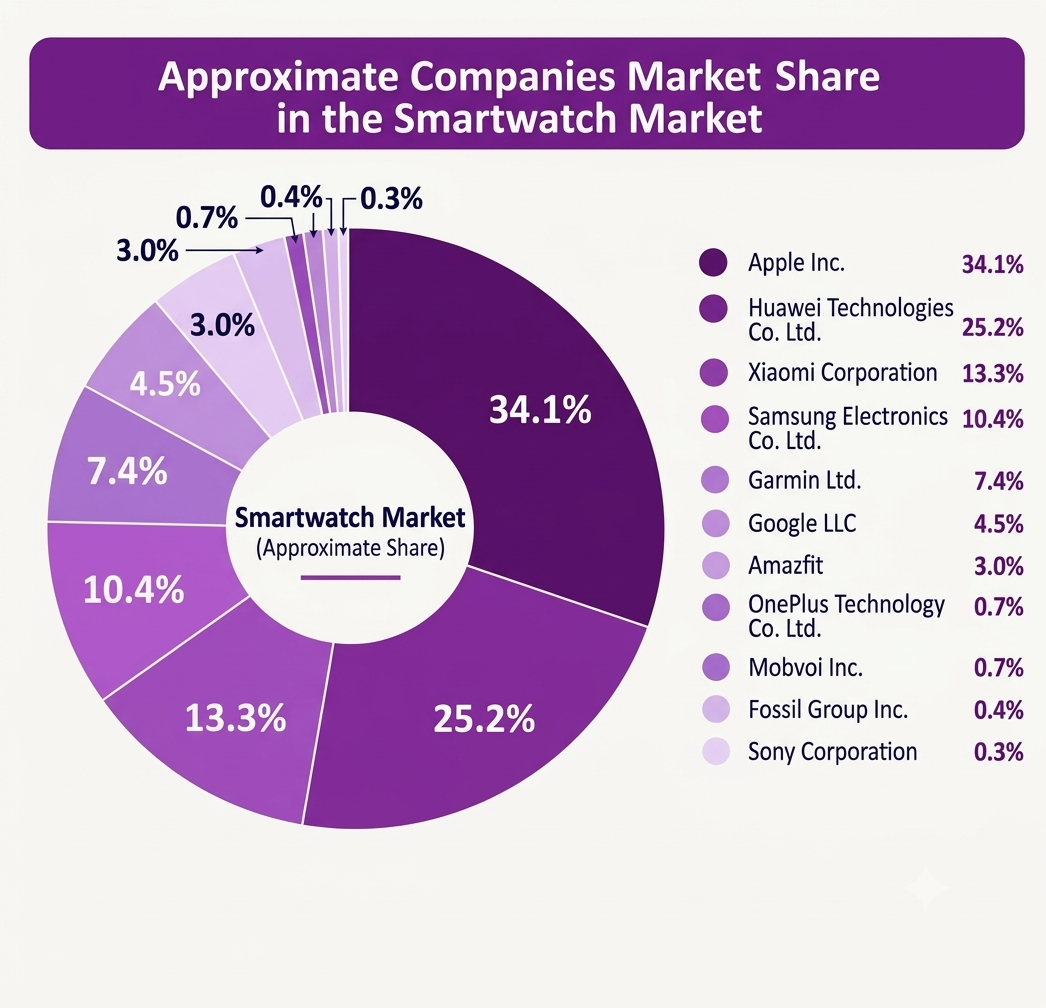
| Company | Approx. Market Share (%) | Positioning Note |
|---|---|---|
| Apple Inc. | 34.1% | Global leader; Apple Watch Ultra 3 and Series 11 launched in September 2025; back at No. 1 in Q3 2026 |
| Huawei Technologies Co. Ltd. | 25.2% | Record 22% shipment share in Q2 2026; HarmonyOS ecosystem with strong China presence |
| Xiaomi Corporation | 13.3% | Value-focused volume player; exposed to the shrinking basic segment |
| Samsung Electronics Co. Ltd. | 10.4% | Leading Wear OS brand; Galaxy Watch lineup |
| Garmin Ltd. | 7.4% | Leads in fitness, outdoor and sports performance watches |
| Google LLC | 4.5% | Pixel Watch 4 offers satellite SOS through a Skylo partnership |
| Amazfit | 3.0% | Long battery life and value-priced devices |
| OnePlus Technology Co. Ltd. | 0.7% | Premium Wear OS offering built around ecosystem integration |
| Mobvoi Inc. | 0.7% | AI-enabled TicWatch wearables with voice and health features |
| Fossil Group Inc. | 0.4% | Design-focused hybrid smartwatches |
| Sony Corporation | 0.3% | Niche presence focused on sensor accuracy and hardware |
Top Companies List
- Apple Inc.
- Huawei Technologies Co. Ltd.
- Xiaomi Corporation
- Samsung Electronics Co. Ltd.
- Garmin Ltd.
- Google LLC
- Amazfit
- OnePlus Technology Co. Ltd.
- Mobvoi Inc.
- Fossil Group Inc.
- Sony Corporation
Apple Inc.
About Apple Inc.
Apple sells premium hardware, software, services, and its own silicon as one closed ecosystem with more than 2.5 billion active devices. That deep integration with iPhone, plus its health-sensing and payment features, is its main advantage in smartwatches. The current lineup includes Apple Watch Series 12, Ultra 4, and SE 3.
a) Company Overview Table
| Attribute | Company Data |
|---|---|
| Apple Inc. | Consumer technology and services company; maker of Apple Watch |
| Ticker Symbol | AAPL (NASDAQ) |
| Industry | Consumer electronics/technology hardware |
| Headquarters | Cupertino, California, USA |
| Founded | April 1, 1976 |
| Founders | Steve Jobs, Steve Wozniak, Ronald Wayne |
| Current CEO | John Ternus |
| Latest Quarterly Revenue | $114.48 billion (Q4 FY2026, quarter ended September 26, 2026) |
| YoY Revenue Growth | +11.7% (about 12%) |
| Primary Segments | iPhone ($57.6B), Services ($31.57B), Mac ($10.8B), Wearables/Home/Accessories ($8.30B), iPad ($6.23B) |
b) Financial Details
Apple doesn’t report Apple Watch sales on its own. The watch sits inside Wearables, Home and Accessories, which fell 8% year over year in Q4 FY2026, from $9.01 billion to $8.30 billion. That was below the roughly $8.99 billion analysts expected. Management said the drop came from a tough comparison with last year’s launches of Apple Watch SE 3 and AirPods Pro 3.
For the full fiscal year, the segment was roughly flat at $35.58 billion versus $35.69 billion. The wearables installed base still hit an all-time high, and more than half of Apple Watch buyers were new to the product, which points to healthy user growth even as revenue dipped. Looking ahead, Apple guided for 7–10% total revenue growth in the December quarter.
c) Strategic Developments
- Q.ai acquisition (January 2026): Apple bought the Israeli AI startup for about $2 billion, its second-largest deal after Beats. Q.ai’s technology lets devices understand whispered speech and clean up audio in noisy places, and analysts expect it to help the Watch work more independently of the iPhone.
- Future hardware: Reports say Apple Watch models with under-display cameras could arrive around 2027.
- Axis Bank partnership in India (September 2026): Apple Pay launched with Axis Bank, so customers can pay with cards stored on iPhone and Apple Watch.
- India retail growth: A Hyderabad store opens December 10, 2026, Apple’s seventh in India, selling Apple Watch Series 12 and Ultra 4. Apple’s annual India sales passed $10 billion for the first time.
- (PRODUCT)RED return: Apple is reportedly preparing a 20th-anniversary (RED) collection around December 1, which may include an Apple Watch Sport Band.
Huawei Technologies Co. Ltd.
About Huawei Technologies Co. Ltd.
Huawei combines its own HarmonyOS software, in-house chips, and its TruSense health-sensing platform with a lineup that runs from cheap fitness bands to premium watches. It has about 40% of China’s smartwatch market. It is the world’s second-largest maker of full smartwatches (25%) and the largest maker of wrist-worn devices overall (20%).
a) Company Overview Table
| Attribute | Company Data |
|---|---|
| Huawei Technologies Co. Ltd. | Private, employee-owned ICT and consumer electronics company |
| Ticker Symbol | Not publicly listed (no ticker) |
| Industry | Telecommunications equipment, consumer electronics, cloud and intelligent automotive |
| Headquarters | Shenzhen, Guangdong, China |
| Founded | 1987 |
| Founders | Ren Zhengfei |
| Current CEO | Ren Zhengfei (founder and CEO); the company is run day-to-day by rotating chairmen |
| Latest Quarterly Revenue | Not reported quarterly; H1 2026 revenue was RMB 467.82 billion (about $69.6 billion) |
| YoY Revenue Growth | +9.6% (H1 2026); net profit fell 36% to RMB 23.81 billion |
| Primary Segments | ICT Infrastructure, Consumer Business (smartphones, wearables, PCs), Cloud Computing, Digital Power, Intelligent Automotive Solutions |
b) Financial Details
Huawei doesn’t break out wearables revenue, so this section relies on third-party shipment estimates for Q3 2026. Counterpoint puts Huawei second in global smartwatches with an 18% share, behind Apple’s 23%, while the overall market shrank 6% from a year earlier. Smart Analytics Global estimates that Huawei’s shipments of full smartwatches grew 16% in Q3, even as that segment fell 6% overall.
Huawei’s total wrist-wearable shipments rose 2%, keeping it first in that category with 20%. That growth came off a strong Q2, when Huawei hit a record 22% of global smartwatch shipments; nearly 80% of that volume was sold in China. At the company level, H1 2026 profit fell 36% as memory-chip costs and R&D spending (25.9% of revenue) rose, which squeezed margins on consumer devices.
c) Strategic Developments
- Huawei Watch Air (November 24, 2026): Launched in China alongside the Mate X8 and Mate 90 Air at 2,499–2,699 yuan, with sales starting December 4.
- Global launch in Madrid (February 26, 2026): Introduced the Watch GT Runner 2, Watch Ultimate 2, Band 11 and Band 11 Pro.
- Watch Faces Summit Milano (November 19, 2026): Huawei met with European designers, design schools and agencies to grow its watch-face ecosystem outside China.
- Venice Biennale tie-in: The Watch GT 6 series got exclusive watch faces linked to the Biennale, as part of Huawei’s push into lifestyle and design.
- Funding and acquisitions: I found no smartwatch-related funding rounds or acquisitions. As a private company, Huawei pays for wearables work from its own R&D budget.
Xiaomi Corporation
About Xiaomi Corporation
Xiaomi offers good hardware at aggressive prices, tied into its HyperOS ecosystem of 1.2 billion connected devices. Its main advantage is huge scale. It ranks second worldwide in wearable bands, and its watch lineup spans the budget REDMI Watch 6 series up to the premium Xiaomi Watch S5.
a) Company Overview Table
| Attribute | Company Data |
|---|---|
| Xiaomi Corporation | Consumer electronics, smart-device ecosystem, and electric-vehicle company |
| Ticker Symbol | 1810 (HKEX) |
| Industry | Consumer electronics/technology hardware |
| Headquarters | Beijing, China |
| Founded | April 6, 2010 |
| Founders | Lei Jun, with co-founders including Lin Bin |
| Current CEO | Lei Jun (Chairman and CEO) |
| Latest Quarterly Revenue | RMB 107.2 billion (Q3 2026, about $15 billion) |
| YoY Revenue Growth | −5.2% |
| Primary Segments | Smartphones (RMB 45.6B), IoT and Lifestyle Products (RMB 27.2B), Internet Services (RMB 9.5B), NEV/AI and New Initiatives (RMB 23.9B) |
b) Financial Details
Xiaomi doesn’t report watch revenue on its own. Wearables sit inside IoT and lifestyle products, which fell 1.4% year over year to RMB 27.2 billion. That’s a much smaller drop than the roughly 20% declines of the previous three quarters, as the boost from last year’s state subsidies wore off. Segment gross margin was 21.7%, down from 23.9% a year earlier because key components cost more.
It was up 1.6 points from Q2, helped by higher margins and a larger revenue share from wearables sold outside China. Management said several wearable categories grew again year over year in Q3, and that average selling prices rose as the lineup moved upmarket. Xiaomi kept the No. 2 spot globally in wearable bands, though shipments of full smartwatches remain much smaller than Huawei’s and Apple’s.
c) Strategic Developments
- Global wearables launch (November 17–18, 2026): Xiaomi introduced the Watch S5 41mm (from €229.90), Smart Band 11 and Xiaomi Clip open-ear earbuds alongside the Xiaomi 18 Pro series.
- Payments partnerships: The Watch S5 supports Xiaomi Pay and Google Pay. Its Japan launch on November 27, 2026 supports Visa and Mastercard tap-to-pay but not Suica.
- Philippines launch with bundles: People who pre-order the Xiaomi 18 Pro between November 27 and December 17 get a free Watch S5 46mm (worth P10,999), which helps pull buyers into Xiaomi’s watch ecosystem.
- Budget lineup refresh: The REDMI Watch 6 (up to 24 days of battery) and Smart Band 11 Active launched in Europe alongside the REDMI Note 17 series.
- Funding and acquisitions: I found no smartwatch-specific acquisitions or funding rounds in 2026. Xiaomi is growing its wearables business through new products and expansion outside China rather than deals.
Samsung Electronics Co. Ltd.
About Samsung Electronics Co. Ltd.
Samsung combines its own displays, memory chips, and Galaxy AI with Wear OS, which it co-develops with Google. Its main advantage is control over components plus a large Android user base. In smartwatches, it is the leading Android brand outside China, and its Galaxy Watch9 and Watch Ultra2 run Qualcomm’s new Snapdragon Wear Elite chip.
a) Company Overview Table
| Attribute | Company Data |
|---|---|
| Samsung Electronics Co. Ltd. | Global semiconductor, mobile and consumer electronics company; maker of Galaxy Watch |
| Ticker Symbol | 005930 (KRX); SMSN (LSE GDR) |
| Industry | Semiconductors, consumer electronics and mobile devices |
| Headquarters | Suwon, Gyeonggi-do, South Korea |
| Founded | January 13, 1969 |
| Founders | Lee Byung-chul |
| Current CEO | Co-CEO structure; Won-joon Choi leads the device business after the November 2026 leadership reshuffle |
| Latest Quarterly Revenue | KRW 195.3 trillion (Q3 2026); operating profit KRW 107.4 trillion |
| YoY Revenue Growth | +127% (+14% QoQ) |
| Primary Segments | DS (Memory, System LSI, Foundry), DX (MX/Networks KRW 37.7T, VD/DA KRW 13.9T), SDC (Display), Harman |
b) Financial Details
Samsung doesn’t report Galaxy Watch revenue on its own. Wearables are included in the MX business, which grew to KRW 37.3 trillion in Q3 2026, up 15% year over year and 11% from the previous quarter. Management credited new flagship launches, including the Galaxy Z Fold8 and Galaxy Watch Ultra2. Even so, the combined MX and Networks business posted an operating loss of KRW 0.6 trillion, as higher memory and component prices more than offset better pricing.
On the earnings call, Samsung said the Fold8 and Watch Ultra2, together with cost cuts, improved profitability from Q2. For Q4, it plans new premium devices and the launch of its intelligent eyewear for the holiday season, but it expects MX revenue and profit to fall from Q3. The broader DX device division has now lost money for two quarters in a row, which led to a leadership change aimed at foldables, on-device AI, and wearables.
c) Strategic Developments
- Qualcomm Snapdragon Wear Elite partnership (July 22, 2026): The Galaxy Watch9 and Watch Ultra2 are Samsung’s first watches built on a Snapdragon chip rather than its own Exynos processors. The chip combines data from multiple sensors to give more personalized AI health insights.
- Galaxy Unpacked (July 2026): Samsung launched the Galaxy Watch9 and Watch Ultra2 alongside the Z Fold8 Ultra, Z Fold8, Z Flip8 and its first intelligent eyewear, presenting the watch as an always-on AI companion.
- Samsung–Google–Qualcomm on Android XR: The three companies are extending their Android XR work from headsets to eyewear, which connects Galaxy Watch to a wider set of wearables.
- Leadership reshuffle (November 2026): After two straight quarterly losses, Samsung put Won-joon Choi in charge of the device business, with a focus on wearables, foldables and on-device AI.
- Funding and acquisitions: I found no smartwatch-specific acquisitions or funding rounds in 2026. Samsung’s investment in this area runs through chip partnerships and in-house R&D (KRW 14.4 trillion company-wide in Q3).
Garmin Ltd.
About Garmin Ltd.
Garmin builds GPS sports and adventure watches known for precise tracking, very long battery life (up to 57 days on solar fēnix 9 Pro models), and data from its Garmin Connect platform. Its main advantage is decades of GPS and sensor know-how. It leads premium multisport watches with its Forerunner, Venu, fēnix, Enduro and Instinct lines.
a) Company Overview Table
| Attribute | Company Data |
|---|---|
| Garmin Ltd. | GPS technology and wearables company; maker of fēnix, Forerunner and Venu smartwatches |
| Ticker Symbol | GRMN (NYSE) |
| Industry | Consumer electronics / GPS navigation and wearable technology |
| Headquarters | Schaffhausen, Switzerland (main U.S. operations in Olathe, Kansas) |
| Founded | 1989 |
| Founders | Gary Burrell and Min Kao |
| Current CEO | Clifton A. Pemble (President and CEO) |
| Latest Quarterly Revenue | $1.99 billion (Q3 2026) |
| YoY Revenue Growth | +12% |
| Primary Segments | Fitness ($694M), Outdoor ($597M), Marine, Aviation, Auto OEM |
b) Financial Details
Garmin’s watch business drove its record Q3 2026. The Fitness segment (Forerunner, Venu, CIRQA) grew 16% to $694 million on strong wearable demand, with gross and operating margins of 63% and 33%, or $231 million of operating income. That was below the Zacks consensus of $728.6 million. The Outdoor segment (fēnix, Instinct, Enduro) did better than expected, growing 20% to $597 million against a $545.7 million estimate.
Growth came mainly from adventure watches and the new fēnix 9 series, with gross and operating margins of 68% and 39% ($233 million of operating income). Company-wide, operating income rose 34% to $612 million, the operating margin widened to 30.8%, and management raised full-year 2026 revenue guidance to about $8.15–8.2 billion.
c) Strategic Developments
- fēnix 9 and fēnix 9 Pro launch (August 25, 2026): Garmin’s flagship watches got their first all-titanium case option and the largest AMOLED display ever on a fēnix, starting at $999.99 and $1,099.99.
- CIRQA Smart Band (Q3 2026): A screenless wellness wearable that Garmin says expands its addressable market, competing with subscription bands like Whoop.
- Further 2026 launches: The Enduro 4, Approach S72 golf watch, Forerunner 70 and Forerunner 170 running watches broaden the lineup at different price points.
- Pipeline reports: Garmin is reportedly preparing the tactix 9 for late 2026 and a CIRQA Smart Ring and CIRQA Smart Band Pro for late 2026 to early 2027.
- Connectivity and subscriptions: Garmin is expanding LTE and satellite communication across its watches, which adds recurring subscription revenue alongside Connect+.
- VST ECS distribution partnership (November 2026): Garmin partnered with VST ECS to widen distribution of its running, wellness, and outdoor wearables in the Philippines.
- Funding and acquisitions: I found no smartwatch-related acquisitions in 2026. Garmin’s watch strategy is driven by in-house products.
Google LLC
About Google LLC
Google controls Wear OS, the operating system used by most non-Apple smartwatches, and pairs it with Gemini AI and Fitbit’s health data. Its main advantage is control of the platform plus AI built into the watch. Its own watches include the Pixel Watch 5 and Fitbit trackers, and Wear OS also runs Samsung’s Galaxy Watches.
a) Company Overview Table
| Attribute | Company Data |
|---|---|
| Google LLC | Wholly owned subsidiary of Alphabet Inc.; developer of Wear OS, Pixel Watch, and Fitbit |
| Ticker Symbol | Traded through parent Alphabet Inc.: GOOGL and GOOG (NASDAQ) |
| Industry | Internet services, AI, cloud computing and consumer hardware |
| Headquarters | Mountain View, California, USA |
| Founded | September 4, 1998 |
| Founders | Larry Page and Sergey Brin |
| Current CEO | Sundar Pichai (CEO of Google and Alphabet) |
| Latest Quarterly Revenue | $127.6 billion (Alphabet, Q3 2026) |
| YoY Revenue Growth | +25% (24.7%) |
| Primary Segments | Google Services ($96.3B, including Subscriptions, Platforms and Devices at $14.3B), Google Cloud ($30.7B), Other Bets |
b) Financial Details
Google doesn’t report smartwatch revenue on its own. Pixel Watch and Fitbit sales are inside Google subscriptions, platforms and devices, which grew 11% to $14.3 billion in Q3 2026, up from $12.87 billion. Management credited most of that growth to YouTube Music and Premium (more than 150 million subscribers), and Google One AI plans, not hardware, so the watches’ exact share of the line can’t be separated out.
Q3 included the first full sales period for the Pixel Watch 5, which went on sale August 20, 2026. Holiday discounts suggest Google is pushing for volume: the 41mm Wi-Fi model reached a record low of $284.99, against a $399.99 list price, in late November.
c) Strategic Developments
- Pixel Watch 5 launch (August 12, 2026): Announced at Made by Google in New York alongside the Pixel 11 series. It has a 3,000-nit Actua 360 display, Gemini built in, blood-pressure trend tracking, and up to 40 hours of battery life.
- Stephen Curry partnership: A Stephen Curry edition of the Pixel Watch 5 went on sale September 3, 2026, for $579.
- Fitbit Edge (October 2026): A new fitness tracker sold from $179.99 in select markets, with an India launch reportedly coming soon after it cleared certification there.
- Fitbit folded into Google Health: The Fitbit app became the Google Health app on May 19, 2026. From November 28, 2026, Fitbit smartwatches can only install apps and watch faces made by Fitbit and Google, which steers developers toward Wear OS.
- Qualcomm chip partnership: The Pixel Watch 5 runs Qualcomm’s Snapdragon W5 Gen 2 chip on Wear OS 7.
- Funding and acquisitions: I found no smartwatch-related acquisitions in 2026. Google’s main move is bringing its Fitbit hardware and software under Pixel and Wear OS.
Amazfit
About Amazfit
Amazfit sells feature-rich smartwatches with multi-week battery life at lower prices than Garmin and Apple. Its main advantages are its own BioTracker sensors, Zepp OS, and an AI-driven Zepp app for training and recovery. The lineup spans the T-Rex, Balance, Cheetah, Active, and Bip lines, and Zepp has shipped more than 200 million devices in over 90 countries.
a) Company Overview Table
| Attribute | Company Data |
|---|---|
| Amazfit | Smart wearables brand owned by Zepp Health Corporation (formerly Huami) |
| Ticker Symbol | ZEPP (NYSE, through parent Zepp Health) |
| Industry | Consumer electronics / smart wearables and health technology |
| Headquarters | Gorinchem, Netherlands (principal office); U.S. office in Milpitas, California |
| Founded | 2013 (as Huami; Amazfit brand launched in 2015) |
| Founders | Wang Huang (Wayne Huang) |
| Current CEO | Wang Huang (Chairman and CEO of Zepp Health) |
| Latest Quarterly Revenue | $68.3 million (Q3 2026) |
| YoY Revenue Growth | −9.9% (+7.5% QoQ) |
| Primary Segments | Amazfit smartwatches (T-Rex, Balance, Cheetah, Active, Bip), smart bands and straps (Helio), Zepp Aura and Zepp Clarity health services |
b) Financial Details
Almost all of Zepp Health’s revenue comes from Amazfit smartwatches. Q3 2026 revenue of $68.3 million was down 9.9% from $75.8 million a year earlier but within guidance. Gross margin fell to 35.0% from 38.2%, and the net loss widened to $12.6 million from $1.6 million. Device activations for the higher-priced Balance family rose about 43% from Q2, and sales of the Active series grew sharply year over year, so the move toward pricier models is working.
Selling and marketing costs rose 50% to $18 million because of spending on Best Buy in-store displays, REI promotions, and launch campaigns for the Balance 3, Balance Ultra, and T-Rex Dual Solar. Nine-month revenue rose to $183.4 million from $173.7 million, and management guided Q4 revenue to $90–95 million, up about 6–12% year over year.
c) Strategic Developments
- HYROX three-year global partnership (April 15, 2026): Amazfit turned a regional deal into a worldwide one, becoming the exclusive provider of smartwatches, rings, straps, cameras, and glasses for HYROX fitness racing and its HYROX 365 gym network.
- Josh Kerr partnership (February 2, 2026): Amazfit signed the two-time Olympic medalist, who joins Grant Fisher on its team of elite athlete partners.
- 2026 product launches: T-Rex Ultra 2, Active 3 Premium, Cheetah 2 Pro, Cheetah 2 Ultra, Balance 3, Balance Ultra, the Helio Strap Pro and T-Rex Dual Solar (September 22).
- Retail expansion in the U.S.: Zepp invested in Amazfit displays at selected Best Buy stores and in-store materials at REI ahead of the holidays.
- Funding and acquisitions: I found no acquisitions or outside funding rounds in 2026. Zepp is paying for Amazfit’s push into premium products from its own resources, even as its stock has fallen more than 90% this year.
OnePlus Technology Co. Ltd.
About OnePlus Technology Co. Ltd.
OnePlus sells premium-feeling Android devices at mid-range prices, backed by Oppo’s shared research, supply chain and software. Its strengths are fast charging and long battery life on Wear OS. Its watches include the OnePlus Watch 4 (titanium, up to 16 days of battery), Watch 3, Watch 2R, and Watch Lite, with India and China as its main markets.
a) Company Overview Table
| Attribute | Company Data |
|---|---|
| OnePlus Technology Co. Ltd. | Consumer electronics brand and subsidiary of Guangdong Oppo Mobile Telecommunications Corp. (BBK ecosystem) |
| Ticker Symbol | Not publicly listed (no ticker) |
| Industry | Consumer electronics/smartphones and connected devices |
| Headquarters | Shenzhen, Guangdong, China |
| Founded | December 16, 2013 |
| Founders | Pete Lau and Carl Pei |
| Current CEO | Pete Lau (founder; also oversees product strategy at Oppo). OnePlus India CEO Robin Liu stepped down in 2026, and India now reports up to Oppo group leadership. |
| Latest Quarterly Revenue | Not disclosed (private subsidiary; results included in Oppo’s unreported figures) |
| YoY Revenue Growth | Not disclosed; global shipments and market share have reportedly fallen in key markets |
| Primary Segments | Smartphones (Number series, Nord, Ace), tablets, audio (Buds), wearables (OnePlus Watch 4, Watch 3, Watch 2R, Watch Lite) |
b) Financial Details
OnePlus doesn’t publish financial results, and I found no reliable third-party estimate of its smartwatch revenue or shipments for the latest quarter. The available information is about strategy, not sales. In November 2026, OnePlus confirmed it will stop launching new products in Europe and North America, which shrinks the market for its Wear OS watches outside Asia.
Counterpoint reports that Oppo has formally given OnePlus a focus on China and India, with Oppo as the group’s main global premium brand and realme covering mass-market sales overseas. In India, OnePlus has cut costs by returning to a mostly online sales model, closing offline retail and expanding its service network through Oppo from about 400 to more than 600 centres. Its watches compete there on price: the Watch 2R sells for about ₹13,999–14,999, against new rivals such as Vivo’s Watch GT 2 at ₹14,999.
c) Strategic Developments
- Exit from Europe and North America (November 2026): OnePlus announced a “proactive global strategy adjustment” and will stop launching new products in those regions, following Bloomberg’s report on Oppo’s restructuring.
- Oppo group restructuring: The group is merging software, research, purchasing, and platform development across Oppo, OnePlus, and realme, with OnePlus assigned to China and India.
- Move from OxygenOS to ColorOS 17: Eligible OnePlus devices worldwide can switch to Oppo’s ColorOS 17, which cuts duplicated software work across the group’s products.
- India rumours denied: Reports say OnePlus could wind down India by 2027. OnePlus India denies this and says local operations are on track.
- Watch lineup: The current range includes the Watch 4 (titanium, Wear OS), the premium Watch 3 with sapphire glass, the Watch 2R and the Watch Lite (EUR 179, up to 10 days of battery).
- Funding and acquisitions: I found no funding rounds, acquisitions, or outside investment in OnePlus’s smartwatch business in 2026. The group is consolidating rather than investing.
Mobvoi Inc.
About Mobvoi Inc.
Mobvoi is a Chinese AI company with its own voice-interaction and generative AI technology. That voice AI is its main advantage. Best known for TicWatch Wear OS smartwatches, it is now moving from fitness watches to AI productivity wearables such as the TicNote Watch, which records, transcribes, and summarizes conversations from the wrist.
a) Company Overview Table
| Attribute | Company Data |
|---|---|
| Mobvoi Inc. | AI and smart-wearables company (出門問問有限公司); maker of TicWatch and TicNote |
| Ticker Symbol | 2438 (HKEX) |
| Industry | Artificial intelligence software and consumer AI hardware |
| Headquarters | Beijing, China |
| Founded | 2012 |
| Founders | Li Zhifei (former Google research scientist) |
| Current CEO | Li Zhifei (Founder, Chairman and CEO) |
| Latest Quarterly Revenue | Reports every six months; H1 2026 revenue was RMB 78.7 million |
| YoY Revenue Growth | −56% (H1 2026 vs RMB 178.9 million in H1 2025) |
| Primary Segments | AI Software Solutions (RMB 42.5M), AI Hardware including smartwatches, treadmills and TicNote devices (RMB 36.2M) |
b) Financial Details
Mobvoi doesn’t report quarterly results, so this section uses its H1 2026 interim figures. AI Hardware, which includes TicWatch smartwatches, fell to RMB 36.2 million from RMB 98.3 million a year earlier, a drop of about 63%. Management said the decline was deliberate: it cut resources for discontinued smartwatch and hardware models and lowered prices to clear old inventory.
Selling that inventory below the original prices pushed gross margin down from 59.4% to 46.6%, and the net loss widened to RMB 49.6 million from RMB 2.9 million. Mobvoi is now putting its money into AI-agent products, with the TicNote Watch as the main wearable that brings its AI to users.
c) Strategic Developments
- TicNote Watch reveal at CES 2026 (January 7, 2026): Mobvoi presented it as the first AI smartwatch built for voice notes and translation, with Shadow Agent 2.0, dual microphones, and an AI Diary.
- TicNote Watch launches: It launched in China in June 2026, followed by a global launch from San Francisco on September 30, 2026.
- Tencent WeCom co-brand (July 2026): Mobvoi released a TicNote edition made with Tencent’s WeCom (Enterprise WeChat), aimed at business users.
- Olares partnership (December 2025): The two companies teamed up on TicNote Pods, which they call the first hybrid-cloud note-taking earbuds, extending Mobvoi’s ecosystem beyond the watch.
- CodeBanana launch (April 2026): An AI-native collaboration platform for businesses that connects to TicNote hardware.
- Strategic shift: Mobvoi has moved resources away from older TicWatch fitness models and into AI productivity wearables.
- Funding and acquisitions: I found no new funding rounds or acquisitions in 2026. Historically, Mobvoi was backed by Google and Volkswagen Group China before its 2024 Hong Kong IPO.
Fossil Group Inc.
About Fossil Group Inc.
Fossil Group is a fashion-watch company built on its own Fossil brand and long-term licences for Michael Kors, Armani, Diesel and BMW. Its strength is design, licensing, and global wholesale distribution rather than technology. It was once a major Wear OS watchmaker, but it stopped making smartwatches in 2024 and is now refocusing on analog watches.
a) Company Overview Table
| Attribute | Company Data |
|---|---|
| Fossil Group Inc. | Global designer, marketer, and distributor of watches, jewellery, and fashion accessories |
| Ticker Symbol | FOSL (NASDAQ) |
| Industry | Consumer fashion accessories/watches |
| Headquarters | Richardson, Texas, USA |
| Founded | 1984 |
| Founders | Tom Kartsotis (with Kosta Kartsotis) |
| Current CEO | Franco Fogliato (since September 2024) |
| Latest Quarterly Revenue | $271.2 million (Q3 FY2026) |
| YoY Revenue Growth | +0.4% reported; +2% in constant currency |
| Primary Segments | Americas, Europe, Asia (+15.1% in Q3, led by India); products include the Fossil brand and licensed watches (Michael Kors, Emporio Armani, Armani Exchange, Diesel, BMW) plus jewellery |
b) Financial Details
Fossil no longer reports smartwatch revenue because it stopped developing new smartwatches in January 2024. The Gen 6 was its last model, and its current results come almost entirely from traditional watches and jewellery. In Q3 FY2026, net sales rose 0.4% to $271.2 million, beating the Zacks consensus by 9.7%. It was Fossil’s first sales growth in four years.
Operating income was $25.3 million, compared with a $21.7 million loss a year earlier, and net income was about $21 million. Adjusted EPS was $0.19, compared with a $0.63 loss a year earlier. Management raised full-year sales guidance to $980–990 million. In the smartwatch market, Fossil’s role is now limited to remaining stock of Gen 6 and hybrid models, such as the Machine Gen 6 Hybrid at about ₹17,633 in India, with software support continuing for a limited time.
c) Strategic Developments
- Smartwatch exit (January 2024): Fossil ended smartwatch development to focus on analog watches, leaving a gap among Wear OS watchmakers. CNBC reported that its push into smartwatches had held back earlier performance.
- Michael Kors licence extension (November 24, 2026): A new five-year global deal runs through 2032, covering watches and jewellery in more than 150 countries, with a Spring/Summer 2027 collection planned.
- Diesel licence extension (November 10, 2026): Fossil signed a five-year extension of its global Diesel licence.
- BMW licence (October 2026): Fossil signed a new global licensing agreement with BMW.
- Nick Jonas partnership: He continues as global brand ambassador and design collaborator into 2028, alongside collaborations with Marvel, Lucasfilm (The Mandalorian) and Shelby American.
- Refinancing and cost cuts: Fossil completed a major refinancing in November 2025 and has cut about $100 million in costs under its “shrink-to-grow” plan, including closing about 15 stores in 2026.
- Funding and acquisitions: I found no smartwatch-related funding rounds, acquisitions or investments in 2026, which fits with its exit from the category.
Sony Corporation
About Sony Corporation
Sony is an electronics and entertainment group whose main technology advantage is image sensors and audio. In smartwatches, it was best known for wena, a hybrid strap that added smart features to an analog watch. After ending Wena 3 in 2026 and transferring the brand, Sony now takes part in the sector mainly by supplying sensors.
a) Company Overview Table
| Attribute | Company Data |
|---|---|
| Sony Corporation | Electronics subsidiary of Sony Group Corporation, the listed parent since 2021; diversified electronics, entertainment and semiconductor group |
| Ticker Symbol | 6758 (TSE); SONY (NYSE ADR) |
| Industry | Consumer electronics, gaming, entertainment and semiconductors |
| Headquarters | Minato, Tokyo, Japan |
| Founded | May 7, 1946 (as Tokyo Tsushin Kogyo) |
| Founders | Masaru Ibuka and Akio Morita |
| Current CEO | Hiroki Totoki (President and CEO, Sony Group Corporation) |
| Latest Quarterly Revenue | ¥3,429.4 billion (Q2 FY2026, about $21.6 billion) |
| YoY Revenue Growth | +10% (about +4% in constant currency) |
| Primary Segments | Game & Network Services (¥1,208.5B), Music (¥598.4B), Imaging & Sensing Solutions (¥577.6B), Entertainment, Technology & Services (¥567.8B), Pictures (¥513.7B) |
b) Financial Details
Sony doesn’t report any smartwatch revenue, and its consumer smartwatch product line has effectively ended. Services for Wena 3 stopped on February 28, 2026. Setup, Suica payments, MAMORIO tracking, and Apple Health syncing no longer work, and the device now only counts steps. The two segments most relevant to wearables were mixed in Q2 FY2026.
Entertainment, Technology & Services, which covers consumer electronics, saw sales dip slightly to ¥567.8 billion. Imaging & Sensing Solutions sales fell 6% to ¥577.6 billion, while its operating income rose 12% to ¥154.6 billion. Group operating income rose 45% to ¥622.3 billion, driven by gaming and Spider-Man: Brand New Day, and Sony raised its FY2026 forecast to ¥13 trillion in sales and ¥1.87 trillion in operating income.
c) Strategic Developments
- wena 3 shutdown (February 28, 2026): Sony, which announced the end of the service in late 2024, permanently shut down wena 3’s cloud services, ending its own smartwatch strap product.
- wena brand transfer (March 2026): Sony moved the “wena” trademark and the wena.jp domain to a new company, augment AI Inc.
- wena X relaunch by augment AI (March 17, 2026): Billed as the “world’s smallest smartwatch from Japan” and the fourth-generation wena, it launched through crowdfunding on GREEN FUNDING from March 20, priced from ¥56,800 (about $359), with shipping planned from late December 2026.
- Startup programme origins: wena started inside Sony’s Sony Startup Acceleration Program (SSAP), which reflects Sony’s approach of testing new hardware through small internal startups.
- Funding and acquisitions: I found no smartwatch-related acquisitions or investments by Sony in 2026. The wena brand transfer was effectively a spin-out.
Conclusion
The smartwatch is moving from fast unit growth to a phase where value matters more than volume. Basic, low-cost models are losing ground, and buyers are keeping their devices longer. At the same time, premium watches with advanced health sensing, satellite connectivity and AI features are raising average selling prices. That shift favours brands that combine their own hardware, software and services into one ecosystem.
Apple’s iPhone integration and Huawei’s HarmonyOS lead in China show how platform lock-in turns watch buyers into loyal, long-term customers. Samsung and Google are strengthening the Wear OS side through chip partnerships and connected wearables, while Garmin keeps its lead in fitness and outdoor performance.
The next stage of competition will likely depend on who can turn the smartwatch into a dependable health companion that works without a phone, without hurting margins. Rising component costs and slowing replacement demand put pressure on every brand, especially value players exposed to the shrinking budget segment. Companies that invest in medical-grade features, on-device AI, payments, and growth in emerging markets such as India are better placed to keep growing.