Report Overview
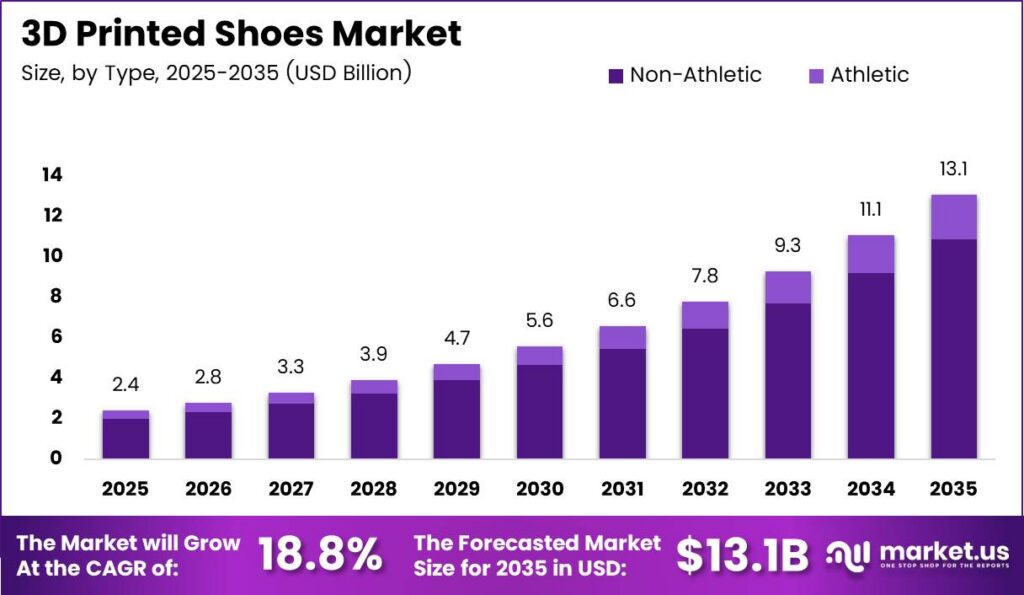
Global 3D Printed Shoes Market size is expected to be worth around USD 13.1 Billion by 2035 from USD 2.4 Billion in 2025, growing at a CAGR of 18.8% during the forecast period 2026 to 2035. Three-dimensional printed shoes use digital light synthesis, selective laser sintering, or polymer extrusion to build lattice midsoles and stitchless single-piece footwear directly from digital files, cutting mold capital and inventory waste for brands.
Footwear supply chains span fashion retail, performance sports, and clinical podiatry, where digital printers replace manual cut-and-sew assembly lines. According to the European Patent Office, additive manufacturing patent families expanded 26.3% annually between 2013 and 2020, surpassing 50,000 filings globally and beating the 3.3% all-technology average. Consequently, chemical suppliers and hardware makers control proprietary resin patents, forcing footwear brands into long-term licensing deals to secure production capacity.
Key Takeaways
- The global 3D Printed Shoes Market was valued at USD 2.4 Billion in 2025.
- Global market revenue will reach USD 13.1 Billion by 2035.
- The market expands at a compound annual growth rate of 18.8% from 2026 to 2035.
- Non-Athletic footwear led the Type segment with an 82.34% share in 2025, while Athletic footwear expands fastest.
- Women captured a 62.13% share of the End User segment in 2025, whereas the Men segment registers the fastest expansion.
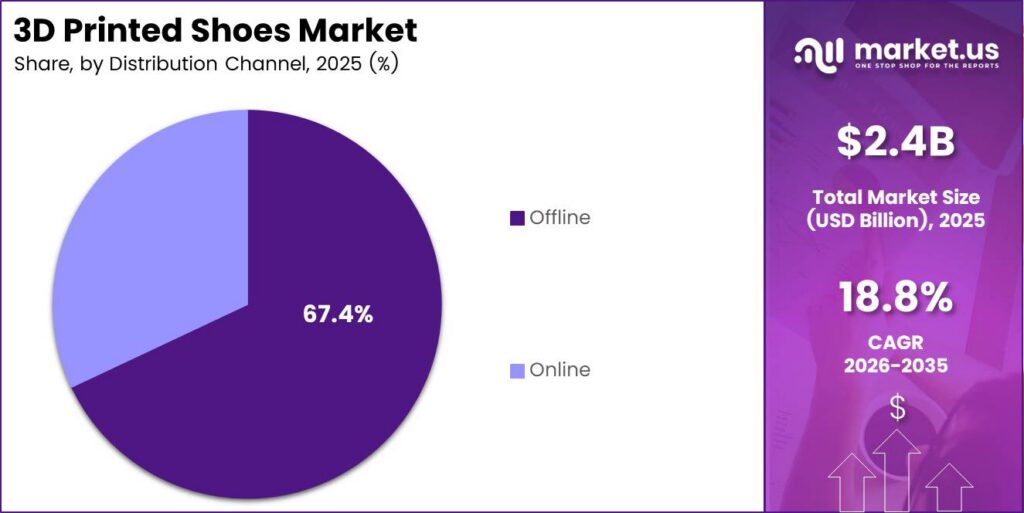
- Offline stores held a 67.45% share in the Distribution Channel segment in 2025, while Online channels grow fastest.
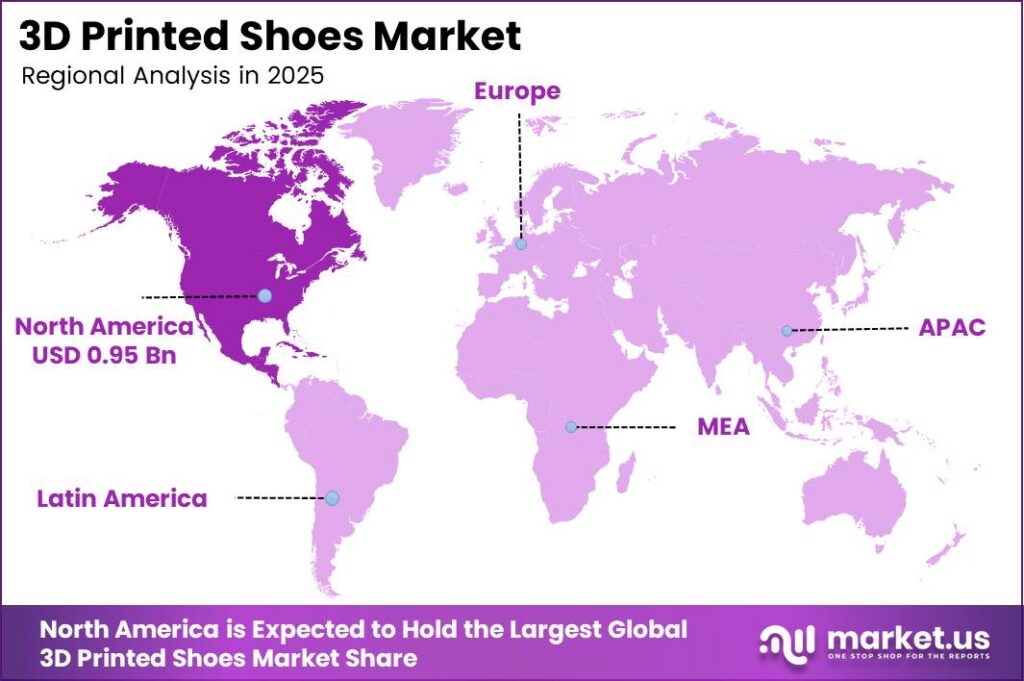
- North America dominated global revenue in 2025 with a 39.78% share valued at USD 0.95 Billion, while Asia-Pacific grows fastest from 2026 to 2035.
National intellectual property frameworks and design protection laws now safeguard digital shoe files as commercial footwear shifts toward downloadable manufacturing assets. Data from the World Intellectual Property Organization shows global industrial design filings rose 2.6% to 1.22 million applications covering 1.6 million designs in 2024, alongside 3.7 million patent applications. This means footwear investors can monetize digital shoe geometries through enforceable design rights while blocking unauthorized local copying.
Venture capital now backs automated domestic print farms that bypass offshore contract factories entirely. In June 2026, Zellerfeld Shoe Company Inc. raised USD 30 million in Series A-3 funding to bring total capital near USD 100 million while scaling its Austin facility to 1,700 active printers approaching 1 million pairs per year. This signals that automated print hubs have crossed unit-volume thresholds needed to fulfill mainstream brand drops.
North America commands a 39.78% market share in 2025 because domestic footwear labels face heavy import exposure and seek onshore speed. Figures from UN Comtrade show United States footwear imports reached USD 27.19 billion in 2025 after hitting USD 28.39 billion in 2024, ranking first worldwide. Therefore, American brands deploy regional additive print farms to replace ocean-freighted Asian stock with high-margin domestic restocks.
Early-stage reshoring capital continues to expand domestic printer capacity across secondary American production hubs. By contrast, conventional footwear startups still wait months for overseas factory slots. In June 2025, California footwear maker Koobz closed a USD 7.2 million seed round led by Uncork Capital to scale its 10,000-square-foot plant to 100 printers. As a result, regional contract printers lower entry barriers for independent footwear labels.
Type Analysis
Non-Athletic dominates with 82.34% share in 2025 due to high-margin casual fashion drops.
In 2025, Non-Athletic held an 82.34% share in the Type segment of the 3D Printed Shoes Market. Based on UN Comtrade data, global leather-upper shoe imports hit USD 55.50 billion and plastic footwear reached USD 34.40 billion in 2024, while HUGO and Zellerfeld launched scan-to-order printed loafers in 5 colors at USD 229 to USD 249 in July 2025. Single-piece thermoplastic polyurethane printing eliminates 60-part stitching and size-graded steel molds for casual silhouettes. Therefore, fashion labels capture higher gross margins without holding seasonal markdown stock.
Athletic footwear represents the fastest-expanding category within the Type segment as brands engineer tuned energy-return midsoles for runners. Eurostat found that sports footwear accounted for 29.4% of the European Union’s EUR 11.8 billion extra-EU sporting goods imports in 2025 , and Nike with Zellerfeld released the faster-printing Air Max 1000.2 alongside an 8-city design program in May 2026. Variable-density elastomeric lattices absorb heel impact better than uniform molded foam. Consequently, sportswear makers command premium retail prices above USD 170 per pair.
Orthotic, medical, and recovery footwear serves clinical podiatry buyers who require patient-specific plantar pressure relief inside everyday shoe architectures. As reported by Materialise NV in its Form 20-F filing, Medical segment revenue covering Phits printed orthotics and foot-scan plates climbed 15.4% to EUR 134.2 million in 2025. Powder-bed fusion printers translate dynamic gait scans directly into multi-stiffness arch zones that plaster casting cannot match. This creates recurring consumable revenue for podiatry clinics and contract printers.
End User Analysis
Women dominates with 62.13% share in 2025 due to frequent seasonal style purchases.
In 2025, Women held a 62.13% share in the End User segment of the 3D Printed Shoes Market. Data from the U.S. Census Bureau shows females represented 50.9% of the 341.78 million United States population in 2025 , while Dolce Vita and HILOS rolled out made-to-order printed sandals in women’s sizes 6 to 13 at USD 130 in June 2025. Zero-tooling powder fusion lets footwear labels test intricate heel geometries in small batches without risking unsold women’s fashion stock. As a result, women’s retailers shorten design cycles and protect full-price sell-through.
Men represent the fastest-growing buyer group in the End User segment, propelled by sneaker collecting and active running adoption. According to the World Health Organization, 31% of adults or 1.8 billion people worldwide remain physically inactive, with men maintaining lower inactivity at 29% versus 34% among women , while Mallet London and Zellerfeld launched the printed Nebula sneaker in 4 colorways at USD 229 in March 2025. Heavier male strike loads benefit directly from tuned lattice midsoles that resist foam compression. Therefore, brands target male sneaker buyers with high-ticket collector drops.
Kids footwear forms an emerging custom-fit niche where rapid foot growth creates frequent replacement cycles for households. The U.S. Census Bureau indicates that youth under age 18 totaled 73.1 million or 21.1% of the national population in 2024 and 2025, with families raising children averaging 4.0 persons per household. Recyclable mono-material polyurethane printing lets parents trade in outgrown pairs for shredded and reprinted larger sizes instead of discarding glued shoes. This creates sticky family subscription revenue for circular footwear startups.
Distribution Channel Analysis
Offline dominates with 67.45% share in 2025 due to in-store biometric foot scanning.
In 2025, Offline held a 67.45% share in the Distribution Channel segment of the 3D Printed Shoes Market. Figures from the U.S. Census Bureau show physical employer shoe stores under NAICS 4482 generated USD 34.31 billion in 2024 sales and USD 3,784 million during August 2026. Shoppers paying over USD 150 for unfamiliar lattice midsoles insist on physical try-ons and optical in-store gait scans before purchasing. Consequently, flagship athletic stores act as essential conversion hubs that cut costly sizing returns.
Online retail is the fastest-growing sales channel as mobile photogrammetry turns smartphones into home fitting rooms. Based on Eurostat data, clothing and footwear led European Union online shopping at 45% of individuals as internet buyer penetration hit 78% in 2025 , while Syntilay launched USD 150 printed shoes in January 2025 using phone scans capturing 5,000 biometric points. Scan-to-order digital checkout removes wholesale distributor markups and size-run warehouse storage. This means digital-native shoe brands keep full retail margins while carrying zero finished inventory.
Omnichannel hybrid fulfillment bridges physical showrooming with centralized cloud print farms for established footwear chains. As reported by the National Retail Federation, core United States retail sales will expand 4.4% to USD 5.6 trillion in 2026 after total retail trade reached USD 7.5 trillion in 2025 through store-and-digital integration. Store clerks capture volumetric foot profiles on tablets while regional print centers ship customized pairs straight to shoppers within days. Therefore, omnichannel retailers lift sales per square foot without expanding backroom stockrooms.
Key Market Segments
By Type
- Non-Athletic
- Athletic
By End User
- Women
- Men
- Kids
By Distribution Channel
- Offline
- Online
Regional Analysis
North America Dominates the 3D Printed Shoes Market with a Market Share of 39.78% in 2025, Valued at USD 0.95 Billion
North America leads global revenue with a 39.78% share worth USD 0.95 Billion in 2025, anchored by major athletic brand headquarters, venture-backed print farms, and strong digital consumer spending. Data from the U.S. Census Bureau shows quarterly American retail e-commerce jumped 12.2% year-over-year to USD 340.2 billion in Q2 2026, capturing 17.1% of total retail after hitting USD 1,233.7 billion in 2025. High online checkout adoption lets domestic brands scale scan-to-order footwear drops directly to American buyers without wholesale middlemen.
Europe represents the second major commercial hub as strict circular-economy laws and high consumer footwear budgets push brands toward recyclable single-polymer shoes. Eurostat found that household spending on footwear across the 27 European Union nations totaled EUR 75,257.7 million in 2024, while overall real household consumption rose 1.6% in 2025. Strong European Union consumer purchasing power absorbs USD 160 to USD 250 retail price tags, allowing regional print facilities in Germany and Belgium to run profitable small-batch production.
Asia-Pacific registers the fastest regional expansion from 2026 to 2035 as legacy shoe factories automate, while Latin America builds localized production resilience. According to the International Labour Organization, Asia-Pacific’s garment, textile, and footwear sector employs 65 million workers or over 4% of regional jobs , whereas World Bank data indicates Latin American GDP will grow 2.2% in 2026 with manufacturing at 17% of GDP. Consequently, Asian contract manufacturers install industrial laser sintering lines to defend export accounts against Western reshoring.
Key Regions and Countries
North America
- US
- Canada
Europe
- Germany
- France
- The UK
- Spain
- Italy
- Rest of Europe
Asia Pacific
- China
- Japan
- South Korea
- India
- Australia
- Rest of APAC
Latin America
- Brazil
- Mexico
- Rest of Latin America
Middle East and Africa
- GCC
- South Africa
- Rest of MEA
Market Dynamics
Commercial economics in additive footwear hinge on regulatory waste penalties colliding with high specialty resin costs and post-printing labor bottlenecks. As reported by the European Commission, Regulation EU 2024/1781 prohibited large companies from destroying unsold footwear across CN codes 6401 to 6405 starting 19 July 2026, with medium-sized businesses entering scope on 19 July 2030. Therefore, footwear executives must weigh zero-inventory on-demand printing gains against steep photopolymer prices and machine capital requirements when planning factory budgets.
Drivers
Footwear labels are replacing 60-part cut-and-sew assembly with stitchless single-polymer printing to eliminate unsold stock and upfront tooling. Zellerfeld began scaling from 200 to 5,000 networked printers in April 2025, Adidas released its USD 140 polyurethane Climacool line in May 2025 plus a laced version in March 2026, and Nike debuted its Air Max 95000 series in October 2025. Skipping steel molds saves USD 60,000 to USD 120,000 per style.
On-demand polymer printing also compresses concept-to-shelf lead times from 15 months down to 3 weeks while cutting pre-consumer factory scrap by 65% to 80%. Consequently, brands shift from working-capital-heavy wholesale batches toward direct digital drops priced between USD 140 and USD 250 per pair. This model shortens customer acquisition payback periods by 25% and lifts gross margins by 800 to 1,200 basis points for participating footwear sellers.
| Driver | (~) % Impact on CAGR Forecast | Geographic Relevance | Impact Timeline |
|---|---|---|---|
| Mono-Material On-Demand Footwear Commercialization | +4.2% | North America & Western Europe | Short term (≤ 2 years) |
| EU Unsold Footwear Destruction Ban | +3.4% | European Union | Short term (≤ 2 years) |
| Asian Footwear Import Tariff Escalation | +2.9% | United States & Southeast Asia | Medium term (2–4 years) |
| Medicare Additive Orthotic Reimbursement Parity | +2.4% | United States | Short term (≤ 2 years) |
| Multi-Zone Lattice Biomechanical Midsole Adoption | +2.1% | Global | Medium term (2–4 years) |
| Smartphone Volumetric Foot-Scanning Retail Integration | +1.6% | North America, Europe & East Asia | Medium term (2–4 years) |
Restraints
Concentrated chemical supplier pricing keeps UV-curable polyurethane resins and laser sintering powders far costlier than standard footwear plastics. Bulk ethylene-vinyl acetate and injection polyurethane pellets cost USD 1.50 to USD 4.00 per kilogram, whereas additive footwear elastomers run USD 45 to USD 110 per kilogram. Raw materials alone reach USD 14 to USD 32 for a 320-gram midsole pair versus USD 2.80 to USD 4.50 in Asian molding.
Machine amortization across 30-minute midsole cycles and 24-hour full-shoe builds pushes total ex-factory costs to USD 38 to USD 65 per pair. This cost floor blocks entry into the sub-USD 100 retail tier representing over 75% of global shoe volume. As a result, tier-1 brands cap additive runs below 250,000 pairs per SKU and delay multi-million-dollar printer fleet investments for mass-market lines.
| Restraint | (~) % Impact on CAGR Forecast | Geographic Relevance | Impact Timeline |
|---|---|---|---|
| Proprietary Elastomer Resin Unit-Cost Disparity | -3.8% | Global | Medium term (2–4 years) |
| Industrial Printer Fleet Capital Intensity | -2.7% | Global | Short term (≤ 2 years) |
| Occupational Safety Toe Certification Exclusions | -1.9% | North America & Europe | Medium term (2–4 years) |
| Closed-Ecosystem Hardware Resin Lock-In Contracts | -1.5% | North America & Western Europe | Short term (≤ 2 years) |
| Chemical Monomer Workplace Exposure Limits | -1.1% | European Union & North America | Long term (≥ 4 years) |
Challenges
Automated build chambers outpace manual downstream finishing steps such as support removal, centrifugal solvent washing, thermal curing, and vapor smoothing. Across mid-scale photopolymer and powder plants, post-processing takes 35% to 50% of door-to-door production time and requires 1.4 to 1.8 full-time technicians per 10 active printers. Manual depowdering and spin-cleaning also add USD 4.50 to USD 8.20 per pair while tearing delicate struts, causing 4% to 7% scrap rates.
Overcoming this finishing bottleneck forces plant operators to redirect 20% to 30% of automation capital away from new printers. Instead, manufacturers must fund robotic vision-guided wash cells, solvent-free microwave curing tunnels, and self-supporting lattice designs that trim manual handling below 90 seconds per pair. Until plants automate finishing, labor overhead caps factory throughput and squeezes contract manufacturing margins.
| Challenge | (~) % CAGR Friction Drag | Geographic Relevance | Mitigation Horizon |
|---|---|---|---|
| Post-Processing Labor Bottlenecks | -2.6% | Global | Medium term (2–4 years) |
| Computational Lattice Engineering Deficit | -2.0% | North America, Europe & Asia-Pacific | Medium term (2–4 years) |
| Hydrolysis & UV Lattice Degradation | -1.7% | Asia-Pacific, Latin America & Middle East | Long term (≥ 4 years) |
| Cross-Plant Print Repeatability Variance | -1.4% | Global | Medium term (2–4 years) |
| Thermoset End-of-Life Depolymerization Friction | -1.2% | European Union & North America | Long term (≥ 4 years) |
Opportunities
Upcoming Digital Product Passport rules under Regulation EU 2024/1781 starting in 2027 and eco-modulated waste fees open white space for circular shoe subscriptions. Unglued thermoplastic polyurethane shoes score near 10 out of 10 on recyclability indices and blend at 70% to 85% recycled content after mechanical grinding. Brands launching QR-linked memberships at USD 18 to USD 28 per month can reclaim worn pairs and reprint fresh styles on demand.
Running closed-loop take-back programs slashes virgin polymer spending by 55% to 70% per replacement cycle, saving USD 7.50 to USD 12.00 in raw material per pair. Early movers also qualify for Extended Producer Responsibility fee rebates of 30% to 50%. Consequently, circular subscription labels boost customer lifetime value by 2.4 times and expand lifecycle operating margins by 600 to 950 basis points over one-off retail sales.
| Opportunity | (~) % Potential CAGR Upside | Geographic Relevance | Execution Window |
|---|---|---|---|
| Closed-Loop Subscription Re-Printing Ecosystems | +3.6% | European Union & North America | Medium term (2–4 years) |
| B2B Industrial Ergonomic Fleet Contracts | +2.8% | North America, Western Europe & Japan | Medium term (2–4 years) |
| Decentralized In-Clinic Podiatric Micro-Factories | +2.3% | North America & Asia-Pacific | Short term (≤ 2 years) |
| Bio-Derived Castor & Algae Photopolymers | +1.9% | European Union & North America | Long term (≥ 4 years) |
| Generative AI Athlete-Specific Cleat Customization | +1.5% | North America & Western Europe | Medium term (2–4 years) |
Key Company Insights
Adidas AG
Adidas AG anchors global commercial lattice footwear through its Futurecraft 4D and Climacool franchises across Europe, North America, and Asia. According to the Adidas Annual Report 2025, consolidated net sales reached EUR 24,811 million in 2025, with Footwear generating EUR 14,232 million on 12% currency-neutral brand expansion and a 51.6% group gross margin. This scale lets Adidas spread photopolymer printer commitments across global retail doors while defending premium price tiers.
Adidas continues converting limited additive concepts into repeatable global retail franchises with Carbon, Inc. As reported by The Verge and 3DPrint.com, Adidas launched its single-piece Digital Light Synthesis Climacool slip-on globally at USD 140 in May 2025, followed in July 2025 by the Climacool Laced model at USD 160 using a 24-hour polymer cycle. Adding adjustable lacing widened buyer fit acceptance and moved printed shoes from novelty drops into core lifestyle rotation.
Nike, Inc.
Nike, Inc. leverages its global athletic footprint and direct digital apps to commercialize sculpted additive sneakers paired with pressurized Air cushioning units. Data from Nike’s FY2025 SEC Form 10-K shows consolidated revenue totaled USD 46,309 million, led by NIKE Brand Footwear at USD 29,510 million and USD 18.8 billion in NIKE Direct sales. Direct digital app reach allows Nike to match scarce printed sneaker allocations directly to verified SNKRS members without wholesale markdown risk.
Nike pairs outsourced multicolor printing with internal material engineering to differentiate its additive silhouettes. Based on Nike Official Newsroom data, the company unveiled the 3D-printed Air Max 95000 at ComplexCon in October 2025 retailing at USD 250, built on Zellerfeld Gen3 printers with Nike’s Project Nectar durability process. Combining proprietary traction coatings with external printer fleets lets Nike test bold USD 250 footwear designs without locking capital into owned print hardware.
Key Players
- Adidas AG
- Nike, Inc.
- New Balance Athletics, Inc.
- Under Armour, Inc.
- ECCO Sko A/S
- ASICS Corporation
- Puma SE
- Reebok International Limited
- Hoka One One
- Carbon, Inc.
- Materialise NV
- Stratasys Ltd.
- 3D Systems Corporation
- Other Key Players
Recent Developments
2026
- November 2026: Stratasys Ltd. launched the industrial SAF H550 powder-bed fusion printer with a 34.2-liter build volume cutting ownership costs up to 30% alongside its PowderEase T2 workflow supporting 6 printers in under 30 minutes of operator labor per build according to Stratasys Official Press Release.
- November 2026: 3D Systems Corporation released its MJP 300 MultiJet plastic printer, TSR automated powder systems, and DRM-enabled 3D Sprint software at Formnext 2026 following FY 2025 consolidated revenues of USD 386.9 million according to 3D Systems Official Press Release.
- November 2026: Adidas AG launched limited-edition white and black 3D-printed athletic soccer boots commercially at USD 300 per pair after its July 2026 Fall/Winter Climacool rollout at USD 170 across US sizes 4 to 14 as reported by Footy Headlines.
- November 2026: Materialise NV expanded clinical capacity for Phits Dynaprint 3D-printed custom orthotic insoles across the US and Europe, doubling UK and Ireland unit volume and tripling Q3 volume while maintaining EUR 273 million to EUR 283 million FY 2026 revenue guidance according to Materialise Earnings Release.
- November 2026: Carbon, Inc. and Arkema expanded their 13-year polymer partnership to co-market UV-curable elastomeric resins and Digital Light Synthesis lattice structures for foot-scanned sandals and athletic midsoles as reported by 3D Printing Industry.
- November 2026: Drifbolt launched 3 AI-assisted mono-material bio-TPU 3D-printed shoe collections in India that print each made-to-order single-piece shoe in 3 hours instead of assembling 40 traditional components according to Indian Retailer.
- October 2026: Havaianas and Zellerfeld launched the 3D-printed closed-toe Top Toe Mule in 5 colorways at USD 119 per pair, expanding their collaboration after the USD 89 Top Toe flip-flop debut in 6 colorways as reported by WWD.
2025
- July 2025: TPM3D introduced a 3-step Selective Laser Sintering 3D-printed footwear manufacturing system at CISCE 2025 that cuts production cycle time to 25 minutes per shoe according to TPM3D Official Release.
- April 2025: PUMA SE and A$AP Rocky commercialized the resin-based 3D-printed Mostro 3.D footwear silhouette at USD 250 per pair, adding 2 monochromatic colorways following its initial launch according to PUMA Official Newsroom.
Geopolitical Impact Analysis
Cross-border trade realignment and maritime chokepoint disruptions directly reshape sourcing economics for footwear brands weighing Asian contract molding against localized polymer printing. According to the World Trade Organization, world merchandise trade volume grew 4.6% in 2025 and will expand 3.9% in 2026, led by 9.9% Asian export growth and 5.7% North American growth. However, UNCTAD found that Red Sea vessel rerouting around the Cape of Good Hope drove a 17% jump in global shipping ton-miles during 2024 while slowing containerized volume expansion to 1.4% in 2025. Longer ocean transit voyages delay imported ethylene-vinyl acetate outsoles, stitched uppers, and finished Asian footwear containers by weeks while inflating freight surcharges. Consequently, North American and European footwear distributors shift urgent seasonal capsules to onshore thermoplastic polyurethane print farms to protect retail launch dates.
Energy market shocks and sticky inflation simultaneously squeeze raw chemical feedstocks required for UV-curable polyurethane resins and laser sintering powders. Figures from the World Bank show global commodity prices will climb 23% in 2026, propelled by a 32% spike in energy costs with Brent crude oil averaging USD 91 per barrel. Meanwhile, the International Monetary Fund indicates global GDP expansion will ease from 3.5% in 2025 to 3.1% in 2026 as headline global inflation reaches 4.7%. Expensive crude oil raises petrochemical monomer and diisocyanate input bills for specialty elastomer formulators just as 4.7% inflation curbs discretionary household shoe budgets. Therefore, additive footwear manufacturers must lock in multi-year resin supply contracts and adopt closed-loop ground polyurethane recycling to shield operating margins.
Report Scope
| Report Features | Description |
|---|---|
| Market Value (2025) | USD 2.4 Billion |
| Forecast Revenue (2035) | USD 13.1 Billion |
| CAGR (2026-2035) | 18.8% |
| Base Year for Estimation | 2025 |
| Historic Period | 2021-2025 |
| Forecast Period | 2026-2035 |
| Report Coverage | Revenue Forecast, Market Dynamics, Market Opportunity Analysis, Technology and Innovation Landscape, Competitive Landscape, Recent Developments |
| Segments Covered | By Type (Non-Athletic, Athletic), By End User (Women, Men, Kids), By Distribution Channel (Offline, Online) |
| Regional Analysis | North America (US and Canada), Europe (Germany, France, The UK, Spain, Italy, and Rest of Europe), Asia Pacific (China, Japan, South Korea, India, Australia, and Rest of APAC), Latin America (Brazil, Mexico, and Rest of Latin America), Middle East and Africa (GCC, South Africa, and Rest of MEA) |
| Competitive Landscape | Adidas AG, Nike, Inc., New Balance Athletics, Inc., Under Armour, Inc., ECCO Sko A/S, ASICS Corporation, Puma SE, Reebok International Limited, Hoka One One, Carbon, Inc., Materialise NV, Stratasys Ltd., 3D Systems Corporation, Other Key Players |
| Customization Scope | Customization for segments, region / country-level will be provided. Additional customization can be done based on requirements. |
| Purchase Options | We have three licenses to opt for: Single User License | Multi-User License (Up to 5 Users) | Corporate Use License (Unlimited User and Printable PDF) |