Report Overview
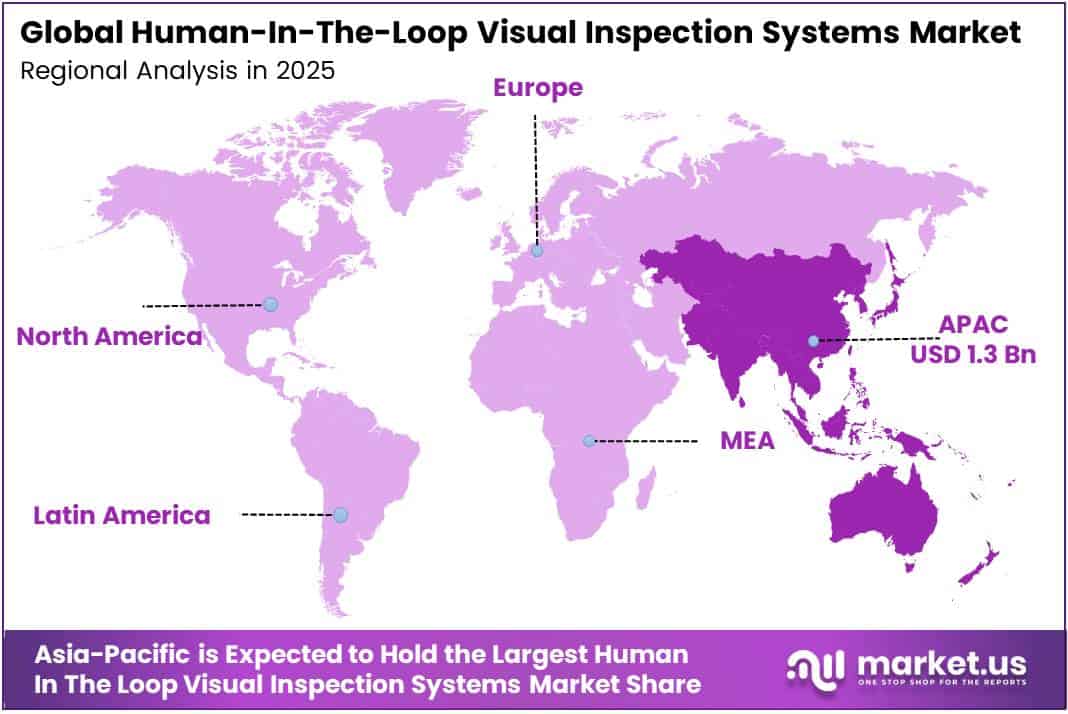
In 2025, the Global Human-In-The-Loop Visual Inspection Systems Market was valued at USD 3.4 billion. The market is projected to grow at a CAGR of 9.7% during 2026–2035, reaching approximately USD 8.6 billion by 2035. Asia-Pacific dominated the global market in 2025, accounting for more than 37.2% of the total market share and generating approximately USD 1.3 billion in revenue.
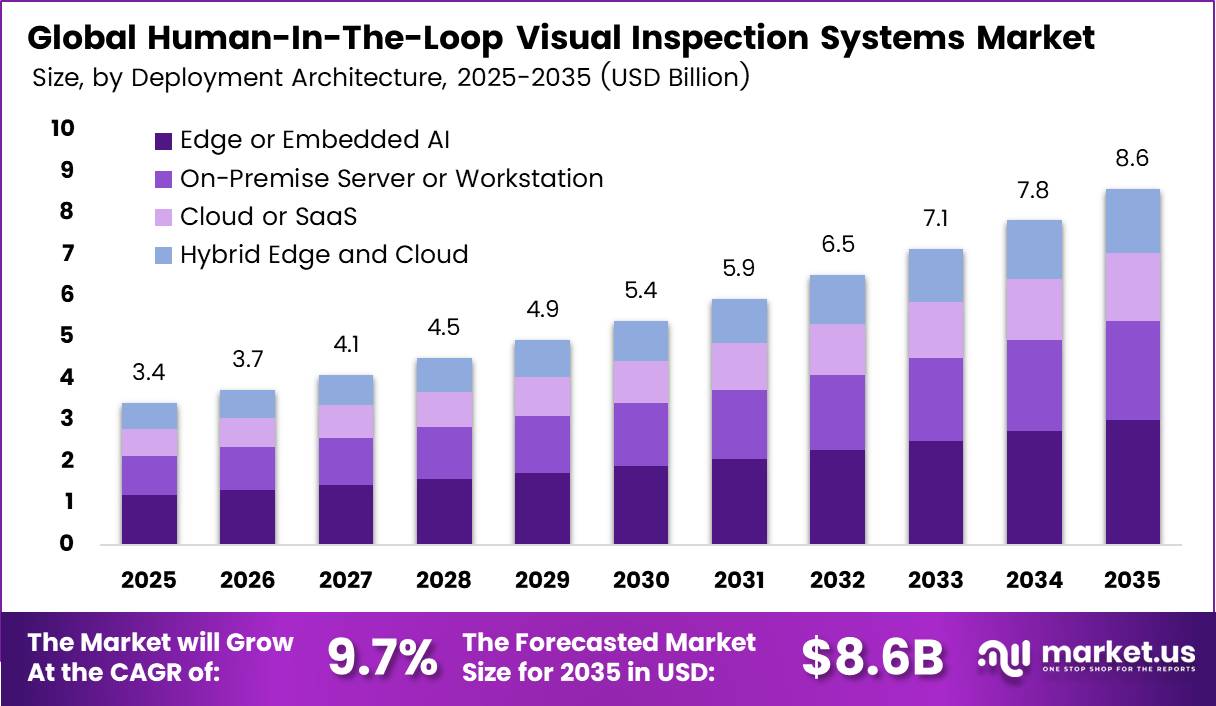
These systems pair AI cameras with human reviewers. The AI flags defects, and trained operators confirm the hard cases. Growth in factory automation drives this demand. The International Federation of Robotics reported 541,302 new industrial robots installed worldwide in 2023, and every robot cell needs vision checks.
WSTS projected global semiconductor sales near USD 700 billion in 2025. Chip and electronics plants rely on human review to cut false rejects on high-value wafers and boards. Basler AG, a vision maker, grew its sales 22.2% to EUR 224.5 million in 2025, which shows strong buyer demand for vision hardware.
The Asia-Pacific region holds the world’s largest electronics, battery, and auto supply chains. The IFR reported that China alone installed 276,288 industrial robots in 2023, more than half of global installs. The World Bank shows that manufacturing adds about 26% to China’s GDP, which keeps inspection needs high.
Japan and South Korea also run some of the densest robot fleets, with South Korea at over 1,000 robots per 10,000 workers. These plants produce high volumes, so human reviewers stay essential for confirming edge case defects at scale.
Key Takeaways
- The Human-In-The-Loop Visual Inspection Systems Market reached USD 3.4 billion in 2025 and will reach USD 8.6 billion by 2035. at a CAGR of 9.7% from 2026 to 2035.
- Edge or Embedded AI leads the Deployment Architecture segment with a 42.1% share.
- Inline or In-Process Inspection leads the Inspection Mode segment with a 61.2% share.
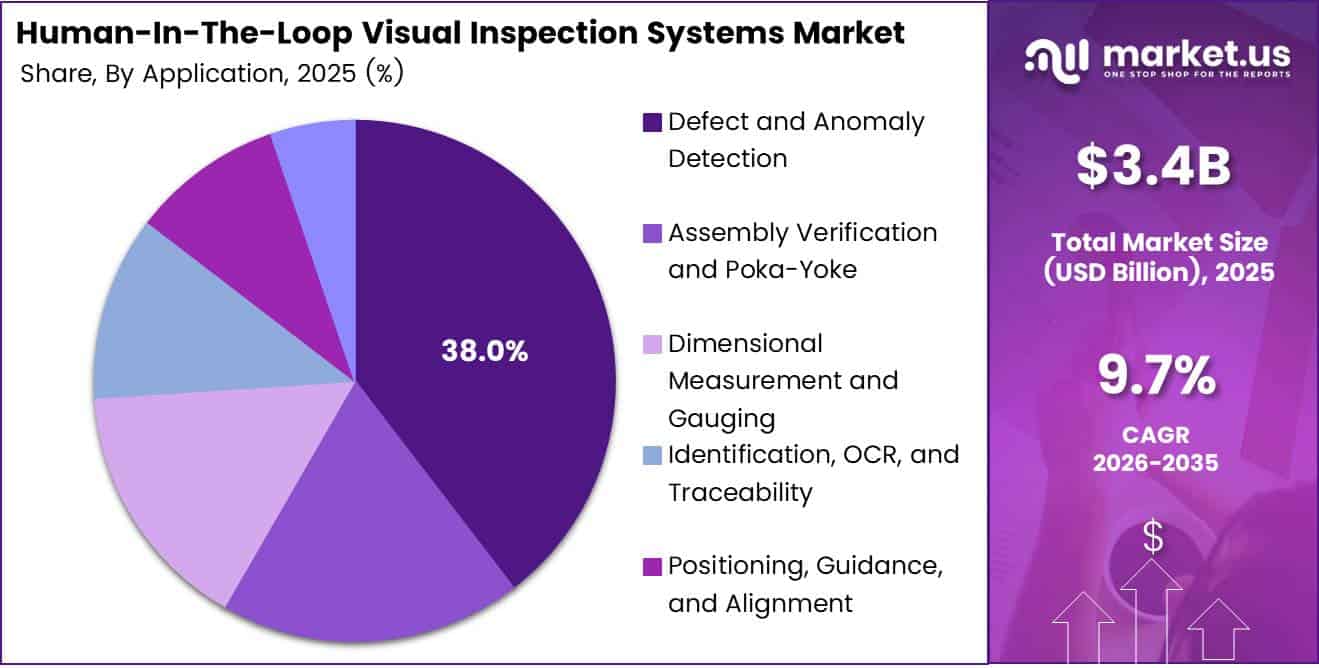
- Defect and Anomaly Detection leads the Application segment with a 38.0% share.
- Electronics and Semiconductor leads the End User segment with a 27.4% share.
- Asia-Pacific leads with a 37.2% share and USD 1.3 billion in revenue.
By Deployment Architecture
Edge or Embedded AI dominates with 42.1% due to real-time defect calls at line speed.
Edge or Embedded AI leads because factories need instant pass or fail decisions right next to the machine. Plants now run about 4,664,000 industrial robots, 9% more than the year before, and each robot cell needs fast, local vision checks. Edge devices let human reviewers see flagged parts in milliseconds, without network delays.
Chip makers also push AI into small edge devices. SEMI expects AI gains to drive “massive growth” in edge devices across automotive electronics, IoT, and robotics. It also projects 300mm fab equipment spending to pass $100 billion for the first time, at $107 billion. Cheaper, stronger chips make embedded inspection easy to scale.
Cloud or SaaS is the fastest-growing deployment model. Buyers want shared dashboards where remote experts review edge cases and retrain models across many sites. MHI and Deloitte found that 55% of supply chain leaders are raising technology budgets, and 19% plan to spend over $10 million. Subscription pricing lowers upfront costs, so mid-sized plants can buy cloud review tools more easily.
By Inspection Mode
Inline or In-Process Inspection dominates with 61.2% due to catching defects before costly rework.
Inline inspection leads because manufacturers want to find faults while parts are still moving, not after a whole batch is finished. Factories installed 542,000 industrial robots in 2024, more than double the number from ten years earlier. Each automated line creates a natural spot for a camera and a human review station.
Demand also stays steady. Yearly installations topped 500,000 units for the fourth year in a row. This steady base of new lines keeps inline systems the default choice. Plant managers can fix the cause of a defect within one shift, instead of scrapping finished goods.
Portable or Handheld Inspection is the fastest-growing mode. Maintenance teams, incoming-goods checkers, and field auditors need vision tools they can carry to the part. The IFR expects installations to grow 6% to 575,000 units in 2025. As fleets grow, technicians need handheld devices to check fixtures, welds, and labels on site.
By Application
Defect and Anomaly Detection dominates with 38.0% due to zero-defect quality demands from buyers.
Defect and Anomaly Detection holds the top share because scratches, voids, and cracks cost the most when they reach customers. SEMI projects 300mm front-end fab equipment spending to hit a record $149 billion in 2026, up 31% from the year before.
Spending keeps building. SEMI sees fab equipment investment reaching $227 billion by 2029, and construction is set to begin on 20 new 300mm fabs or lines in 2026. Each fab needs anomaly checks at many process steps.
Positioning, Guidance, and Alignment is the fastest-growing application. Dense robot cells need vision to guide arms to the exact spot, with humans handling unclear cases. Korea leads robot density at 1,220 robots, followed by Singapore at 818 and China at 567. Higher density means tighter work cells and less room for error.
By End User
Electronics and Semiconductor dominate with 27.4% due to microscopic tolerances on every board.
Electronics and Semiconductor makers lead because their parts are tiny, valuable, and easy to damage. In 2024, electronics accounted for 128,899 new robot installations, up 2.5%, which made it the largest robotics sector again. Those lines need constant visual checks with human sign-off on borderline calls.
Electronics also pulled ahead of automotive, where demand fell to 126,088 units, down 6.9%. This shift moves inspection budgets toward circuit boards, displays, and chip packaging. Trained reviewers remain key there, because false rejects waste costly material.
Logistics and Warehousing is the fastest-growing end user. Warehouses face labor shortages and need vision to check labels, damage, and package counts. The 2026 MHI report shows 56% of supply chain leaders raising technology and innovation budgets, and 52% plan to spend over $1 million. These budgets target AI and robotics for visibility and resilience.
Key Market Segments
By Deployment Architecture
- Edge or Embedded AI
- On-Premise Server or Workstation
- Cloud or SaaS
- Hybrid Edge and Cloud
By Inspection Mode
- Inline or In-Process Inspection
- At-Line or Near-Line Inspection
- Offline or Laboratory Inspection
- Portable or Handheld Inspection
By Application
- Defect and Anomaly Detection
- Assembly Verification and Poka-Yoke
- Dimensional Measurement and Gauging
- Identification, OCR, and Traceability
- Positioning, Guidance, and Alignment
- Other
By End User
- Electronics and Semiconductor
- Automotive and EV Manufacturing
- Pharmaceutical and Medical Devices
- Food and Beverage
- Aerospace and Defense
- Metals, Plastics, Paper, and Packaging Manufacturing
- Logistics and Warehousing
- Other
Geopolitical Impact Analysis
Trade tensions between the US and China directly raise costs for inspection hardware. The US raised Section 301 tariffs on Chinese semiconductors to 50% in 2025. Image sensors, FPGAs, and processors make up a large share of a smart camera’s bill of materials. Vendors that source these chips from China now face higher landed costs and must pass them to buyers.
Shipping disruption adds delays. UNCTAD reported that Red Sea attacks cut Suez Canal transits by more than 50% in early 2024. Vessels rerouted around the Cape of Good Hope add about 10 to 14 days to Asia-to-Europe trips. European integrators that buy Asian lenses, lighting, and compute modules now carry more stock to protect delivery dates.
Commodity swings also hit component pricing. The World Bank reported that copper prices rose above USD 9,000 per ton in 2024 and stayed high in 2025. Copper feeds cables, connectors, and circuit boards in every inspection station. Export controls on gallium and germanium, which China put in place in 2023, raise risk for infrared and specialty sensor makers.
Trade flows are shifting as a result. The WTO forecast goods trade volume growth of about 2.7% in 2025, below past trends. Buyers now favor suppliers with plants in Mexico, Vietnam, and India. This “China plus one” approach creates new factories, and each new line needs fresh visual inspection setups with human review.
Regional Analysis
Asia-Pacific dominates the Human-In-The-Loop Visual Inspection Systems Market, holding a 37.2% share and generating USD 1.3 billion in revenue. China drives most of this volume. Its National Bureau of Statistics reported that industrial value added grew about 5.8% in 2024.
China also produced more than 12 million new energy vehicles in 2024, according to CAAM. Each battery cell, motor, and body panel passes through several vision checkpoints. Japan adds high-precision demand. METI data show Japan exporting over JPY 4 trillion in chip-making equipment each year, and those tools need tight optical inspection.
North America is the fastest-growing region in the Human-In-The-Loop Visual Inspection Systems Market. The US CHIPS and Science Act set aside USD 52.7 billion for domestic chip manufacturing and research. New fabs from Intel, TSMC Arizona, and Samsung Texas need dense inspection coverage. The US Census Bureau reported that factory construction spending passed USD 200 billion a year in 2024.
Europe holds a strong position built on auto and pharma quality rules. Germany’s VDA reported that German carmakers produced over 4 million vehicles at home in 2024. The EU Chips Act targets EUR 43 billion in public and private funding. EU GMP Annex 1 rules require strict visual checks on sterile drug containers, so human-in-the-loop review fits pharma plants well.
Key Regions and Countries
North America
- US
- Canada
Europe
- Germany
- France
- The UK
- Spain
- Italy
- Rest of Europe
Asia Pacific
- China
- Japan
- South Korea
- India
- Australia
- Rest of APAC
Latin America
- Brazil
- Mexico
- Rest of Latin America
Middle East and Africa
- GCC
- South Africa
- Rest of MEA
Market Dynamics
Drivers
| Driver | (~) % Impact on CAGR Forecast | Geographic Relevance | Impact Timeline |
|---|---|---|---|
| AI-Assisted Inspection with Human Verification Mandates | +2.4% | Global, led by EU and North America | Short term (2 years or less) |
| Semiconductor and Advanced Packaging Capacity Build-Out | +1.9% | Asia-Pacific, North America | Medium term (2 to 4 years) |
| EV Battery Cell Quality Assurance Demand | +1.6% | China, Europe, North America | Short term (2 years or less) |
| Stricter Medical Device and Pharma GMP Inspection Rules | +1.2% | North America, Europe | Short term (2 years or less) |
| Aerospace MRO Digital Inspection Adoption | +0.8% | North America, Europe, Middle East | Medium term (2 to 4 years) |
| Edge Computing Cost Declines | +0.7% | Global | Short term (2 years or less) |
AI-Assisted Inspection with Human Verification Mandates
The root cause is regulation. The EU AI Act entered into force in August 2024, and per the European Commission, its human-oversight obligations under Article 14 for high-risk systems apply from August 2026. Many inspection systems built into regulated products, such as machinery, medical devices, and vehicles, fall into the high-risk category.
The mechanism shows up in vision platform revenue. Disclosures from Cognex and Keyence point to software and deep-learning tools making up a growing share of vision revenue. Per the International Federation of Robotics, about 541,000 industrial robots were installed worldwide in 2023, which widens the base of automated cells that need operator review stations.
In practice, human reviewers adjudicate the uncertain cases, roughly 5–15% of frames below the confidence threshold, which cuts false-reject rates by around 30–50% compared with rule-based systems.
The business impact is a move from one-time hardware licences toward per-station and per-inspection SaaS pricing. Annotation and review workflows now generate recurring software revenue at an estimated 65–75% gross margin, against roughly 40–50% for camera hardware. Customer acquisition costs are also shifting toward compliance-led enterprise selling.
Restraints
| Restraint | (~) % Impact on CAGR Forecast | Geographic Relevance | Impact Timeline |
|---|---|---|---|
| Elevated Interest Rates Delaying Factory CapEx | -1.6% | North America, Europe | Short term (2 years or less) |
| High Upfront Integration Cost for SMEs | -1.2% | Global, acute in emerging markets | Short term (2 years or less) |
| Export Controls on Advanced Vision Chips | -0.8% | China, Asia-Pacific | Medium term (2 to 4 years) |
| Tariff Escalation on Imaged Components | -0.7% | North America, China | Short term (2 years or less) |
| Data Residency Restrictions on Cloud Review | -0.5% | Europe, China, India | Medium term (2 to 4 years) |
Elevated Interest Rates Delaying Factory CapEx
The root cause is the cost of capital. Policy rates have stayed high since the 2022–2023 tightening cycle: per Federal Reserve data, the federal funds target peaked at 5.25–5.50%, and ECB deposit rates reached 4.00%. Even after later cuts, financing for discretionary automation is still well above pre-2022 levels.
The bottleneck shows up in factory spending. ISM Manufacturing PMI readings stayed below 50 for most of 2023–2024, and per Eurostat industrial production indices, euro-area output contracted. Inspection cells typically cost an estimated USD 80,000–250,000 each and need payback within about 18–24 months. A 300–400 basis point rise in borrowing costs can stretch that payback by about 4–6 months.
The business impact is deferred purchase orders, longer sales cycles of roughly 9–12 months, and discounting of about 5–10% on integration services. Integrator margins compress, and lower-tier OEMs and Tier-2 suppliers postpone brownfield retrofits.
Challenges
| Challenge | (~) % CAGR Friction Drag | Geographic Relevance | Mitigation Horizon |
|---|---|---|---|
| Skilled Inspector Workforce Shortage | -1.3% | North America, Europe, Japan | Long term (4 years or more) |
| Operator Fatigue and Consistency | -0.7% | Global | Medium term (2 to 4 years) |
| Defect Data Labeling Scarcity | -0.6% | Global | Medium term (2 to 4 years) |
| Legacy Line Interoperability Gaps | -0.5% | Europe, Asia-Pacific | Medium term (2 to 4 years) |
| Industrial Cybersecurity Exposure Risks | -0.4% | Global | Short term (2 years or less) |
Skilled Inspector Workforce Shortage
The structural weakness is demographic. The Manufacturing Institute and Deloitte project that up to 1.9 million U.S. manufacturing jobs could go unfilled by 2033. Per Japan’s Ministry of Health, Labour and Welfare, the country’s working-age population keeps shrinking.
The friction is measurable. Per U.S. Bureau of Labor Statistics data, inspector wages have risen roughly 4–5% a year, and qualifying a new reviewer takes about 6–12 months. Each review station needs about 2–3 certified operators to cover shifts, so throughput is limited on lines already running at capacity.
Navigating this requires long-term changes. Companies need remote review hubs that let one inspector oversee 4–8 lines; they need to build credentialing partnerships with community colleges; and they need to invest in interface design that cuts per-decision time by an estimated 20–35%.
Opportunities
| Opportunity | (~) % Potential CAGR Upside | Geographic Relevance | Execution Window |
|---|---|---|---|
| Inspection-as-a-Service Remote Review Networks | +1.8% | Global, India and Southeast Asia hubs | Medium term (2 to 4 years) |
| Food and Agri-Processing Vertical Expansion | +1.1% | Asia-Pacific, Latin America | Medium term (2 to 4 years) |
| Renewable Asset Drone Inspection | +0.9% | Europe, North America, India | Long term (4 years or more) |
| Human-Labeled Defect Data Monetization | +0.7% | Global | Medium term (2 to 4 years) |
| Integrator Roll-Up Consolidation | +0.5% | North America, Europe | Short term (2 years or less) |
Inspection-as-a-Service Remote Review Networks
This is still untapped. Today’s Drivers involve review stations on the factory floor. A pooled, cross-client network of certified reviewers, paid per decision, does not yet operate at scale. NASSCOM workforce data on India’s technology-services labour pool and the delivery models of global business process providers show there is enough skilled offshore capacity to support it.
The unit economics are the main appeal. Per OECD wage comparisons, labour arbitrage could cut cost per adjudicated image by an estimated 40–60%, from about USD 0.08–0.12 to USD 0.03–0.05. Recurring platform fees could lift vendor gross margins by about 10–15 percentage points.
Key Players Analysis
Tier 1 leaders include Teledyne Technologies, OMRON Corporation, SICK AG, and TKH Group. Teledyne stands out by scale. Its Digital Imaging segment, which includes Teledyne DALSA and e2v machine vision products, posted USD 3,163.9 million in 2025 sales, up 3.0% from USD 3,070.8 million in 2024. Segment operating income rose 19.5% to USD 528.2 million.
Teledyne grows through acquisitions. It spent about USD 850 million on acquisitions in 2025. This included Excelitas’ Qioptiq optics business for USD 702.8 million and TransponderTech for USD 57.9 million. OMRON entered a growth phase after it completed its NEXT 2025 reform program in September 2025. It then launched its SF 2nd Stage roadmap for FY2026 to FY2030.
Tier 2 challengers include Basler AG, Datalogic, LMI Technologies, Allied Vision, JAI, Baumer, Euresys, and Pleora. Basler leads this group in growth. Its sales rose 22.2% to EUR 224.5 million in 2025. EBT swung to EUR 16.2 million from a loss of EUR 12.6 million. Order entry rose 23% to EUR 237.1 million, and gross profit climbed 28% to EUR 106.4 million.
Basler guides 2026 revenue at EUR 232 to 257 million, which signals continued demand for vision components. Its R&D in 2025 focused on application software, SDK tools, and full vision systems. Niche players such as Euresys and Pleora compete on frame grabbers and video interfaces, while LMI targets 3D smart sensors for gauging.
Top Key Players in the Market
- OMRON Corporation
- Teledyne Technologies Incorporated
- Basler AG
- Datalogic S.p.A.
- SICK AG
- LMI Technologies Inc.
- Allied Vision Technologies GmbH
- JAI A/S
- Baumer Holding AG
- TKH Group N.V.
- Euresys SA
- Pleora Technologies Inc.
Recent Developments
- In February 2025, Teledyne Technologies closed its purchase of Excelitas’ Qioptiq optical systems and advanced electronics businesses for USD 702.8 million in cash.
- In September 2025, OMRON Corporation signed an agreement to buy the remaining 70% stake in iCARE Co., Ltd., taking full 100% ownership.
- In November 2025, FairCap GmbH completed its purchase of 100% of Omron Automotive Electronics Italy from OMRON Corporation and rebranded it as OBITEC S.r.l.
Report Scope
| Report Features | Description |
|---|---|
| Market Value (2025) | USD 3.4 Billion |
| Forecast Revenue (2035) | USD 8.6 Billion |
| CAGR (2026-2035) | 9.7% |
| Base Year for Estimation | 2025 |
| Historic Period | 2020-2024 |
| Forecast Period | 2026-2035 |
| Report Coverage | Revenue Forecast, Market Dynamics, Competitive Landscape, Recent Developments |
| Segments Covered | By Deployment Architecture (Edge or Embedded AI, On-Premise Server or Workstation, Cloud or SaaS, Hybrid Edge and Cloud); By Inspection Mode (Inline or In-Process Inspection, At-Line or Near-Line Inspection, Offline or Laboratory Inspection, Portable or Handheld Inspection); By Application (Defect and Anomaly Detection, Assembly Verification and Poka-Yoke, Dimensional Measurement and Gauging, Identification, OCR, and Traceability, Positioning, Guidance, and Alignment, Other); By End User (Electronics and Semiconductor, Automotive and EV Manufacturing, Pharmaceutical and Medical Devices, Food and Beverage, Aerospace and Defense, Metals, Plastics, Paper, and Packaging Manufacturing, Logistics and Warehousing, Other) |
| Regional Analysis | North America – US, Canada; Europe – Germany, France, The UK, Spain, Italy, Rest of Europe; Asia Pacific – China, Japan, South Korea, India, Australia, Singapore, Rest of APAC; Latin America – Brazil, Mexico, Rest of Latin America; Middle East & Africa – GCC, South Africa, Rest of MEA |
| Competitive Landscape | OMRON Corporation, Teledyne Technologies Incorporated, Basler AG, Datalogic S.p.A., SICK AG, LMI Technologies Inc., Allied Vision Technologies GmbH, JAI A/S, Baumer Holding AG, TKH Group N.V., Euresys SA, Pleora Technologies Inc. |
| Customization Scope | Customization for segments, region/country-level will be provided. Additionally, we can provide further customization based on your requirements. |
| Purchase Options | We have three licenses to opt for: Single User License, Multi-User License (Up to 5 Users), Corporate Use License (Unlimited Users and Printable PDF) |