Introduction
The global Wearable Technology is moving from basic step-tracking toward clinical-grade, AI-driven health monitoring, driven by rising chronic disease, ageing populations, and widespread 5G and Bluetooth Low Energy connectivity. Market.us values the market at USD 89.0 billion in 2025, with Health & Fitness the leading end use. Recent results show premium, health-focused devices outgrowing the mass market. Apple’s Wearables, Home and Accessories revenue fell 8% to USD 8.30 billion in its September 2026 quarter. Over the same period, Garmin’s Fitness segment grew 16% to a record USD 694 million.
Market Size & Statistics
- The global Wearable Technology market was valued at USD 89.0 billion in 2025.
- The market is projected to reach approximately USD 297.3 billion by 2035.
- The market is expected to grow at a 12.9% CAGR from 2026 to 2035.
- The Active segment accounted for 62.5% of the market by type and is expected to grow fastest.
- IoT-based wearables led the technology segment with a 68.7% share in 2025.
- Health & Fitness held a 41.2% share by end use and is projected to be the fastest-growing application.
- North America dominated the market with a 36.5% share, generating approximately USD 32.5 billion in 2025.
- Global wearable shipments reached 145.7 million units in Q1 2026, up 4.3% year over year.
- India’s total wearable shipments declined 4.0% in 2025 to 114.2 million units, including 28.9 million smartwatches, down 17.6%.
- Clinical wearables are expected to add about 2.5 percentage points to the market’s CAGR, while consumer fatigue and device commoditization are expected to subtract about 1.3 percentage points.
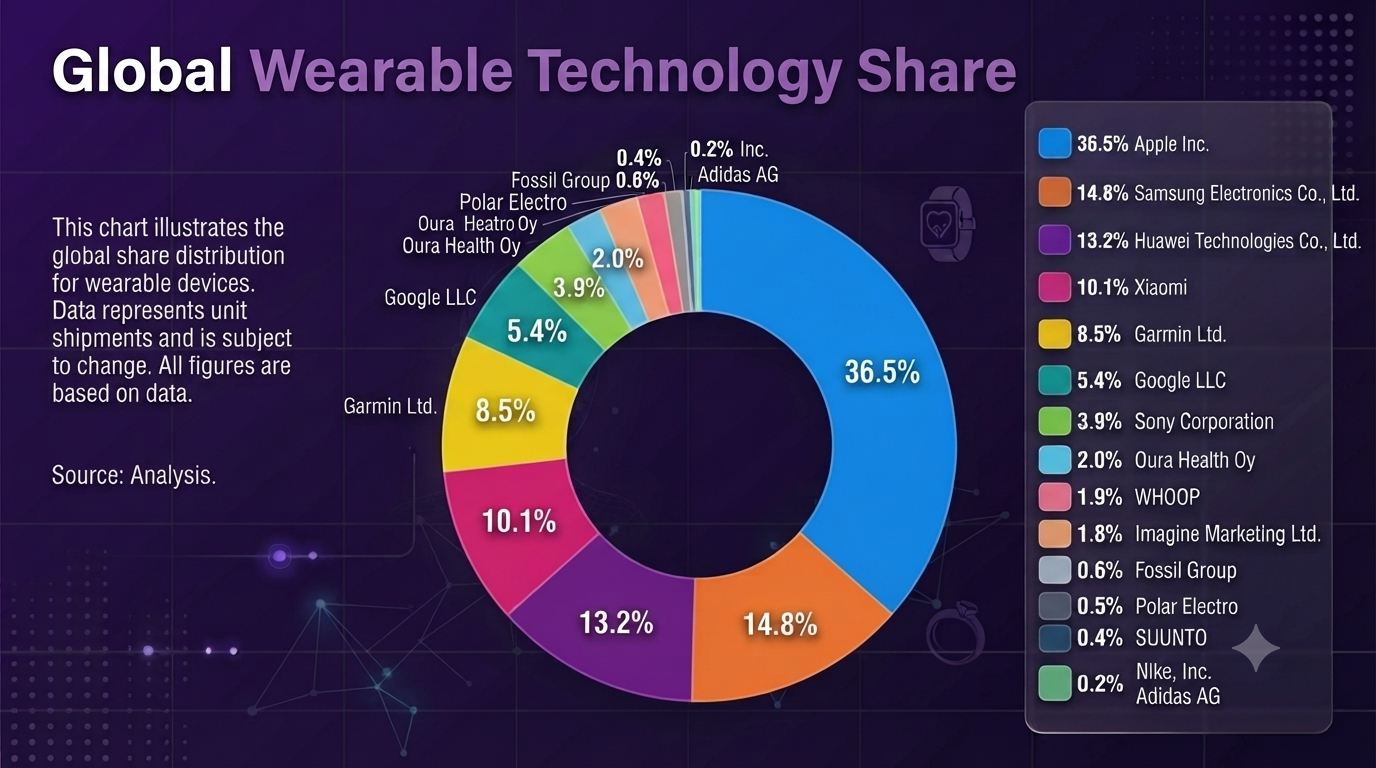
The shares below are estimated revenue-based ranges, anchored to Market.us’s estimate that the six Tier-1 vendors hold about 55–60% of global wearable shipments and revenue. Where possible, they are cross-checked against company-reported wearables revenue and funding disclosures.
| Company | Approx. Market Share (%) | Market Positioning |
|---|---|---|
| Apple Inc. | 36.5% | Revenue leader through Apple Watch and AirPods; FY2026 Wearables, Home and Accessories revenue of USD 35.6 billion; Q4 FY2026 revenue of USD 8.30 billion (−8% YoY) |
| Samsung Electronics Co., Ltd. | 14.8% | Leading Android smartwatch, Galaxy Ring and Galaxy Buds ecosystem |
| Huawei Technologies Co., Ltd. | 13.2% | Volume leader in wrist-worn devices with 200 million+ cumulative wearable shipments |
| Xiaomi | 10.1% | Mass-market leader in affordable smart bands and budget smartwatches |
| Garmin Ltd. | 8.5% | Premium sports and outdoor leader; Q3 2026 Fitness revenue of USD 694 million (+16%) and Outdoor revenue of USD 597 million (+20%) |
| Google LLC | 5.4% | Pixel Watch, Fitbit and Pixel Buds, with Wear OS platform reach |
| Sony Corporation | 3.9% | Premium audio wearables (WH and WF series) and XR headsets |
| Oura Health Oy | 2.0% | Smart-ring category leader; USD 900 million+ Series E (July 2026) at a valuation of about USD 11 billion |
| WHOOP | 1.9% | Subscription performance wearable; bookings run-rate of about USD 1.1 billion and 2.5 million members; USD 10.1 billion valuation |
| Imagine Marketing Ltd. | 1.8% | boAt brand; leading Indian audio wearables and value smartwatch vendor |
| Fossil Group | 0.6% | Has exited smartwatches; residual hybrid and connected watch presence |
| Polar Electro | 0.5% | Niche heart-rate and sports-training specialist (Tier-2 per Market.us) |
| SUUNTO | 0.4% | Niche outdoor and dive-watch specialist |
| Nike, Inc. | 0.2% | Indirect presence through partnerships (Apple Watch Nike) and connected apps |
| Adidas AG | 0.2% | Minimal presence through the adidas Running app and partner integrations |
Top Companies List
- Apple Inc.
- Samsung Electronics Co., Ltd.
- Huawei Technologies Co., Ltd.
- Xiaomi
- Garmin Ltd.
- Google LLC
- Sony Corporation
- Oura Health Oy
- WHOOP
- Imagine Marketing Ltd.
- Fossil Group
- Polar Electro
- SUUNTO
- Nike, Inc.
- Adidas AG
1. Apple Inc.
About Apple Inc.: Apple is the revenue leader in global wearables through Apple Watch, AirPods, Beats, and Vision Pro. Its moat is deep iPhone integration, custom silicon, and clinically validated health features such as ECG, sleep apnea, and hypertension notifications. Apple Watch Series 12 adds a new Health Sensing System, extending Apple’s lead in health wearables.
a) Company Overview Table
| Attribute | Company Data |
|---|---|
| Apple Inc. | Apple Inc. |
| Ticker Symbol | AAPL (NASDAQ) |
| Industry | Consumer Electronics, Wearables, Software & Digital Services |
| Headquarters | Cupertino, California, United States |
| Founded | April 1, 1976 |
| Founders | Steve Jobs, Steve Wozniak and Ronald Wayne |
| Current CEO | John Ternus (CEO since September 1, 2026); Tim Cook is Executive Chairman |
| Latest Quarterly Revenue | USD 114.48 billion total (Q4 FY2026); Wearables, Home and Accessories: USD 8.30 billion |
| YoY Revenue Growth | Total: +12% YoY; Wearables, Home and Accessories: −7.9% YoY (USD 8.30 Billion vs. USD 9.01 Billion) |
| Primary Segments | Product categories: iPhone; Mac; iPad; Wearables, Home and Accessories (Apple Watch, AirPods, Beats, Vision Pro, HomePod); Services. Reportable segments: Americas, Europe, Greater China, Japan, Rest of Asia Pacific |
b) Financial Details
Apple’s Wearables, Home and Accessories revenue fell 7.9% to USD 8.30 billion in Q4 FY2026, from USD 9.01 billion a year earlier, even as group revenue hit a September-quarter record of USD 114.5 billion (+12%). Management blamed a tough comparison: the prior-year quarter included the launches of the low-cost Apple Watch SE 3 and AirPods Pro 3, while this year had no new SE model.
The segment’s full-year FY2026 revenue was essentially flat at USD 35.58 billion, against USD 35.69 billion in FY2025. That confirms a mature, replacement-driven business rather than a collapse in demand. Management cited a record installed base of wearables. New launches in September 2026 (Apple Watch Series 12, Ultra 4 and AirPods 5) give the December quarter a stronger lineup. The main near-term headwinds are memory-driven supply limits and margin pressure; CEO Ternus called memory pricing “unprecedented” and expects it to rise further in the December quarter.
c) Strategic Developments
- September 9, 2026: Launched Apple Watch Series 12 with an all-new Health Sensing System: new optical and electrical heart sensors, heart-rate readings every five seconds, HRV sensing, and a Readiness score. Apple calls it the most accurate heart-rate sensing in any wearable. It also launched Apple Watch Ultra 4 and AirPods 5.
- September 2026: Added hypertension notifications, sleep apnea alerts, ECG, Blood Oxygen, and a Vitals app on Series 12 and Ultra 4. Hypertension notifications are delayed in India until 2027, pending regulatory clearance.
- AI features: Brought Siri AI and Audio Intelligence features (beta in late 2026) to Apple Watch, as part of CEO John Ternus’s push to combine AI with Apple hardware.
- September 1, 2026: Completed its leadership transition, with former hardware engineering chief John Ternus, who helped develop its wearables lines, succeeding Tim Cook as CEO.
- December 1, 2026 (expected): Plans (PRODUCT)RED editions of AirPods Max 2, plus a red AirPods Pro Wrist Strap and Apple Watch Sport Band.
- Retail expansion: Is opening its first Hyderabad store, which will showcase Apple Watch Series 12, Ultra 4, and AirPods 5 as it grows in India.
2. Samsung Electronics Co., Ltd.
About Samsung Electronics Co., Ltd.: Samsung is the leading Android wearables maker, spanning the Galaxy Watch, Galaxy Ring, Galaxy Buds and Galaxy Fit. Its moat is vertical integration across memory, displays, and batteries, plus Samsung Health and its BioActive sensor platform. It is pushing clinical-grade features such as Vitals, Heart Health Score, and sleep apnea detection through its Galaxy ecosystem.
a) Company Overview Table
| Attribute | Company Data |
|---|---|
| Samsung Electronics Co., Ltd. | Samsung Electronics Co., Ltd. |
| Ticker Symbol | 005930 (Korea Exchange); SMSN (London Stock Exchange GDR) |
| Industry | Semiconductors, Consumer Electronics, Mobile Devices & Wearables |
| Headquarters | Suwon, Gyeonggi Province, South Korea |
| Founded | January 13, 1969 |
| Founders | Lee Byung-chul (founder of the Samsung Group) |
| Current CEO | Co-CEOs: Vice Chairman Jun Young-hyun (DS Division) and President TM Roh (DX Division); MX Business led by President Choi Won-joon (from November 2026) |
| Latest Quarterly Revenue | KRW 195.3 trillion total (Q3 2026); MX: KRW 37.3 trillion; DX Division: KRW 52.1 trillion |
| YoY Revenue Growth | Total: +127% YoY; MX: +11% YoY (+15% QoQ); DX: +8% YoY |
| Primary Segments | Device Solutions (Memory, System LSI, Foundry); Device eXperience (Mobile eXperience incl. wearables, Networks, Visual Display, Digital Appliances); Samsung Display; Harman |
b) Financial Details
Samsung does not report wearables revenue separately; Galaxy Watch, Ring, Buds and Fit sit within MX. MX revenue rose 11% year over year (15% quarter on quarter) to KRW 37.3 trillion in Q3 2026, helped by the Galaxy Z Fold 8 and Galaxy Watch 9 and Watch Ultra 2, launched July 22, 2026 and on sale from August 7. MX and Networks together posted a KRW 0.6 trillion operating loss, against KRW 3.6 trillion profit a year earlier, as memory costs rose.
The wider DX division also lost KRW 0.8 trillion. Group results, by contrast, were dominated by AI chips: record revenue of KRW 195.3 Trillion (+127%) and KRW 107.4 Trillion in operating profit, of which semiconductors contributed KRW 106.5 Trillion. Rising memory prices are squeezing device margins, which weighs on wearables profitability. Samsung plans to push year-end peak-season sales of its new ecosystem products, including wearables.
c) Strategic Developments
- July 22, 2026 (Galaxy Unpacked, London): Launched the Galaxy Watch 9 (from USD 379.99) and Galaxy Watch Ultra 2, switching from in-house Exynos chips to Qualcomm’s 3nm Snapdragon Wear Elite. It added bigger batteries, brighter displays, and new Sports and Misty bands, and dropped the Classic model.
- Mid-November 2026: Rolled out One UI 9 Watch, bringing Vitals, Heart Health Score, Daily Cardio Load, Fitness Index, and upgraded Sleep Apnea detection to the Galaxy Watch 8 and 8 Classic.
- Galaxy Fit 4: Expected to launch at about EUR 79.90, priced well below Google’s Fitbit Edge (USD 179.99). Galaxy Ring 2 is expected in 2027.
- November 20, 2026: Named President Choi Won-joon head of MX, with a mandate to strengthen foldables, on-device AI and wearables. TM Roh stays as DX Division CEO and is focusing on robotics.
- 2027 executive reshuffle: Cut DX promotions to 61 from 92 while rewarding semiconductor leaders, a sign of performance pressure on devices, including wearables.
3. Huawei Technologies Co., Ltd.
About Huawei Technologies Co., Ltd.: Huawei is a global volume leader in wrist-worn wearables, with the Watch, Watch GT, Watch D, Band, and FreeBuds/FreeClip lines and 200 million+ cumulative wearable shipments. Its moat is in-house health sensing, including the X-TAP multi-sensor, ECG, arterial stiffness, and the blood-pressure-measuring Watch D. HarmonyOS ties its wearables into one ecosystem.
a) Company Overview Table
| Attribute | Company Data |
|---|---|
| Huawei Technologies Co., Ltd. | Huawei Technologies Co., Ltd. (wholly owned by Huawei Investment & Holding Co., Ltd.) |
| Ticker Symbol | Private (not publicly listed); employee-owned through its union shareholding scheme |
| Industry | ICT Infrastructure, Consumer Electronics (Smartphones, Wearables), Cloud, AI Chips & Intelligent Automotive Solutions |
| Headquarters | Shenzhen, Guangdong, China |
| Founded | 1987 |
| Founders | Ren Zhengfei |
| Current CEO | No single CEO (rotating chair system); Xu Zhijun (Eric Xu) is Rotating and Acting Chairman from October 1, 2026 to March 31, 2027; Ren Zhengfei remains Founder and CEO of the holding company |
| Latest Quarterly Revenue | Not reported quarterly (private); H1 2026 revenue of RMB 467.82 billion (about USD 70 billion), averaging about RMB 234 billion per quarter |
| YoY Revenue Growth | H1 2026: +9.6% YoY (its strongest first half since 2020); H1 net profit −36% to RMB 23.81 Billion |
| Primary Segments | ICT Infrastructure; Consumer Business (smartphones, wearables, audio, tablets, PCs); Cloud Computing; Digital Power; Intelligent Automotive Solutions |
b) Financial Details
Huawei does not publish quarterly results or wearables revenue. In H1 2026, it reported revenue of RMB 467.82 billion, up 9.6%, its strongest first half since 2020, putting it on course to pass RMB 900 billion in annual sales. Net profit fell 36% to RMB 23.81 billion as memory costs surged and R&D spending reached 25.9% of revenue. Wearables sit within the Consumer Business, which grew to about USD 51 billion in 2025, or 39% of group revenue.
That is a recovery from about USD 34 billion in 2021, after US sanctions halved the business. Rising memory costs also weigh on its device margins, including wearables. Its wearables momentum shows in a fuller 2026 lineup and in its HarmonyOS ecosystem of 90 Million+ devices, with 450,000 apps and services and 11 million developers. FreeClip earbud sales in the Middle East passed 1 million units.
c) Strategic Developments
- September 2, 2026 (Munich/IFA): Launched the Watch 6 series (from GBP 399.99), the Watch 6 Pro (from GBP 599.99) and the Watch GT 7 series globally. They feature an upgraded 12-channel X-TAP sensor tracking 11–14 health metrics, separate ECG, eSIM, and AI-powered workout insights.
- Watch D3: Launched the Watch D3 at IFA 2026, extending its blood-pressure wearable line for hypertension management.
- Health research: Opened opt-in studies through the HUAWEI Research app on coronary heart disease, diabetes risk and hypertension risk, plus confirmed Pulse Wave Arrhythmia Analysis.
- November 24, 2026: Launched the Huawei Watch Air, a 6.9mm titanium smartwatch, adding to its ultra-thin premium range.
- GT 6 Pro: Expanded the Watch GT 6 Pro in Southeast Asia, with wrist-based cycling power, up to 21 days of battery life, and Huawei Health+ subscriptions.
- October 1, 2026: Rotated leadership to Eric Xu as Acting Chairman, succeeding David Wang, while keeping its focus on HarmonyOS ecosystem growth across wearables, phones, and vehicles.
4. Xiaomi
About Xiaomi: Xiaomi is the global mass-market leader in affordable wearables, ranking No. 2 worldwide in both wearable bands and TWS earbuds through its Smart Band, Watch, and Redmi Buds lines. Its moat is aggressive cost-to-feature pricing and a huge AIoT ecosystem of 1.2 billion+ connected devices. It is now pushing upmarket for higher prices.
a) Company Overview Table
| Attribute | Company Data |
|---|---|
| Xiaomi | Xiaomi Corporation |
| Ticker Symbol | 1810 (HKEX); XIACY / XIACF (US OTC) |
| Industry | Consumer Electronics, Smartphones, AIoT & Wearables, Smart Home, Electric Vehicles |
| Headquarters | Beijing, China |
| Founded | April 6, 2010 |
| Founders | Lei Jun, with co-founders including Lin Bin, Li Wanqiang, Hong Feng, Huang Jiangji, Liu De, Wong Kong Kat, and Zhou Guangping |
| Current CEO | Lei Jun (Founder, Chairman & CEO) |
| Latest Quarterly Revenue | RMB 107.2 billion total (Q3 2026); IoT and lifestyle products (incl. wearables): RMB 27.2 billion |
| YoY Revenue Growth | Total: −5.2% YoY (third straight quarterly decline); IoT and lifestyle products: −1.4% YoY |
| Primary Segments | Smartphone x AIoT (Smartphones; IoT and Lifestyle Products incl. wearables; Internet Services); NEV, AI and Other New Initiatives |
b) Financial Details
Xiaomi does not report wearables revenue separately. Its IoT and lifestyle products line, which includes wearables, fell 1.4% year over year to RMB 27.2 billion in Q3 2026, from RMB 27.6 billion. Lower revenue from some lifestyle products outweighed gains in laptops, large home appliances and overseas tablets.
Gross margin fell to 21.7% from 23.9% because of rising component prices. It still rose 1.6 percentage points from the previous quarter, which Xiaomi attributed partly to higher margins and a larger revenue share from overseas wearables. Management said wearables went back to year-on-year growth during the quarter and are moving upmarket with higher prices.
Xiaomi says it ranked No. 2 globally and in mainland China for both wearable bands and TWS earbuds. Group revenue fell 5.2% to RMB 107.2 billion, and adjusted net profit fell 56.8% to RMB 4.9 billion. Management expects high memory prices to last through the first half of 2027.
c) Strategic Developments
- Q3 2026: Ranked No. 2 globally and in mainland China for wearable bands (basic bands, basic watches and smartwatches) and TWS earbuds, by its own shipment figures.
- November 2026: Launched the Xiaomi Buds 6, Watch S5 46mm and Smart Band 10 in Indonesia (from IDR 599,000), and five new wearables and audio devices with the Redmi Note 17 series in Greece, expanding overseas wearables.
- Premium wearables: Shifted wearables toward higher-priced products, with management citing rising ASPs. Overseas wearables were singled out as a margin driver.
- AIoT ecosystem: Passed 1.20 billion connected AIoT devices (+16% YoY, excluding phones and tablets) and 771.9 million global monthly active users, which helps sell more of its own wearables to existing users.
- Custom chips: Completed post-silicon validation of its XRING 03, 0100 and D100 chips and released its MiMo-V2.6 AI models, building the in-house chip and AI base for future devices, including wearables.
5. Garmin Ltd.
About Garmin Ltd.: Garmin is the premium leader in GPS sports, outdoor and health wearables, spanning fēnix, Forerunner, Venu, vívoactive, Instinct, Enduro and the new CIRQA smart band. Its moat is long battery life, satellite connectivity (inReach), Firstbeat-based training analytics, and a subscription-free Garmin Connect ecosystem. Its coaching platform now includes TrainingPeaks and TrainHeroic.
a) Company Overview Table
| Attribute | Company Data |
|---|---|
| Garmin Ltd. | Garmin Ltd. |
| Ticker Symbol | GRMN (NYSE) |
| Industry | Consumer Electronics, GPS Navigation & Wearable Technology (Fitness, Outdoor, Aviation, Marine, Auto OEM) |
| Headquarters | Schaffhausen, Switzerland (registered); Olathe, Kansas, United States (main operations) |
| Founded | 1989 |
| Founders | Gary Burrell and Min Kao |
| Current CEO | Clifton (Cliff) Pemble, President & CEO |
| Latest Quarterly Revenue | USD 1.99 Billion total (Q3 2026); Fitness: USD 694 Million; Outdoor: USD 597 Million |
| YoY Revenue Growth | Total: +12% YoY (record Q3); Fitness: +16%; Outdoor: +20% |
| Primary Segments | Fitness; Outdoor; Aviation; Marine; Auto OEM |
b) Financial Details
Garmin had a record third quarter. Revenue rose 12% to USD 1.99 billion, and operating income rose 34% to USD 612 million, at gross and operating margins of 63% and 33%. Adjusted EPS of USD 2.76 beat the USD 2.38 consensus. The two wearable-heavy segments led the growth.
Fitness revenue grew 16% to USD 694 million on strong demand for wearables, after 25% growth in Q2 and 32% in the first half. Outdoor grew 20% to USD 597 million, helped by the fēnix 9 and fēnix 9 Pro launched during the quarter. For context, Fitness and Outdoor brought in USD 2.36 billion and USD 2.05 billion in fiscal 2025.
Garmin raised its full-year guidance in Q2. On the Q3 call, management also flagged cost pressures, including memory component prices. Unlike subscription-led rivals Oura and WHOOP, Garmin keeps its core health features free, which supports both volume and loyalty.
c) Strategic Developments
- July 22, 2026: Acquired TrainingPeaks and TrainHeroic, the leading endurance and strength-training platforms for athletes and coaches, adding coaching software and subscriptions to its wearables (terms undisclosed).
- Late July 2026: Launched the CIRQA Smart Band, Garmin’s first screenless smart band, with no subscription required. It competes directly with WHOOP (USD 25/month) and Oura (USD 5.99/month).
- August 25, 2026: Launched fēnix 9 (from USD 999.99) and fēnix 9 Pro (from USD 1,099.99), with up to 29 days of smartwatch battery, a full titanium case, diving, and optional LTE and satellite connectivity. The Pro switches to a single Ambiq processor.
- September 22, 2026: Released free software updates bringing fall detection, hands-free voice control, and new running plans to the fēnix 8, Forerunner 570/970, Venu 4, and vívoactive 6.
- September 16, 2026: Acquired Applied Ballistics, adding long-range ballistic solver technology to its tactical and outdoor wearables, including the Tactix and Instinct lines.
- 2026 lineup: Also refreshed the Enduro 4, Approach S72, Forerunner 170/70, MARQ Gen 3, and Quatix 8 Pro, and filed a trademark for a possible “Muscle Battery” sensor wearable.
6. Google LLC
About Google LLC: Google competes in wearables through Pixel Watch, Fitbit trackers, the screenless Fitbit Air, and Android XR smart glasses. Its moat is Gemini AI and Google Health’s AI Health Coach on top of Wear OS, the leading Android smartwatch platform, which also powers Samsung’s watches. It is expanding into AI eyewear with Samsung, Warby Parker, and Gentle Monster.
a) Company Overview Table
| Attribute | Company Data |
|---|---|
| Google LLC | Google LLC (wholly owned subsidiary of Alphabet Inc.) |
| Ticker Symbol | GOOGL / GOOG (NASDAQ – parent Alphabet Inc.) |
| Industry | Internet Services, Digital Advertising, Cloud, AI, Consumer Hardware & Wearables |
| Headquarters | Mountain View, California, United States |
| Founded | September 4, 1998; Fitbit acquired in January 2021 |
| Founders | Larry Page and Sergey Brin |
| Current CEO | Sundar Pichai (CEO of Google and Alphabet) |
| Latest Quarterly Revenue | Alphabet: USD 127.58 Billion (Q3 2026); Google subscriptions, platforms and devices (incl. Pixel Watch and Fitbit): USD 14.29 Billion |
| YoY Revenue Growth | Alphabet: +25% YoY; subscriptions, platforms and devices: +11% YoY (USD 14.29 Billion vs. USD 12.87 Billion) |
| Primary Segments | Google Services (Advertising; Subscriptions, Platforms and Devices incl. Pixel, Pixel Watch, Fitbit); Google Cloud; Other Bets |
b) Financial Details
Google does not report wearables revenue; Pixel Watch and Fitbit sit within the subscriptions, platforms and devices line. That line grew 11% to USD 14.29 billion in Q3 2026, from USD 12.87 billion. Management credited the growth mainly to YouTube Music and Premium, which passed 150 million subscribers, and to AI plans in Google One, not to hardware.
That suggests wearables are a small share of the line. Wearables revenue comes mainly from Pixel Watch 5 and the Fitbit range, plus a growing subscription layer: Google Health Premium and its AI Health Coach bundle three months free with new trackers. Alphabet’s revenue rose 25% to USD 127.6 billion, and Google Cloud more than doubled to USD 30.7 billion.
The Q4 2026 quarter is the first to include both the Fitbit Edge (retail from October 27) and Intelligent Eyewear (on sale December 10).
c) Strategic Developments
- October 12, 2026: Launched the Google Fitbit Edge (USD 179.99), an ultra-slim tracker with GPS, ECG, seven-day battery, and the Gemini-powered Health Coach. It sits between the Pixel Watch 5 and the screenless Fitbit Air (USD 99.99), and has cleared India’s BIS certification ahead of launch there.
- Pixel Watch 5: Launched with the Pixel 11 series at Made by Google, keeping the Snapdragon platform and adding Gemini-powered fitness coaching. It was named PCMag’s Editors’ Choice for best Android smartwatch of 2026.
- November 12, 2026: Opened preorders for Android XR “Intelligent Eyewear” with Samsung, using Warby Parker frames (from USD 395) and Gentle Monster frames (from USD 449). The Gemini-powered, display-free camera and audio glasses weigh about 41g, last about nine hours, and go on sale December 10 in the US and South Korea.
- Android XR: Extended the Android XR platform, announced at Google I/O, from the Samsung Galaxy XR headset (2025) to smart glasses and Xreal’s upcoming Project Aura, competing directly with Meta’s Ray-Ban glasses.
- November 2026: Brought Gemini Live Guided Vision to iPhone, part of its plan to put Gemini across devices, including AI glasses.
7. Sony Corporation
About Sony Corporation: Sony’s wearables footprint is mainly premium hearables: its 1000X noise-cancelling headphones and earbuds, now in their tenth year, plus the LinkBuds line. Its moat is in-house noise-cancelling processors, high-resolution audio, and sound engineering. It also has niche wearables in mocopi motion trackers and the Reon Pocket personal cooling device.
a) Company Overview Table
| Attribute | Company Data |
|---|---|
| Sony Corporation | Sony Corporation (electronics subsidiary of Sony Group Corporation) |
| Ticker Symbol | 6758 (Tokyo Stock Exchange); SONY (NYSE) – parent Sony Group Corporation |
| Industry | Consumer Electronics, Audio & Hearables, Gaming, Image Sensors, Music & Pictures |
| Headquarters | Minato, Tokyo, Japan |
| Founded | May 7, 1946 (as Tokyo Tsushin Kogyo) |
| Founders | Masaru Ibuka and Akio Morita |
| Current CEO | Kenji Tanaka (President & CEO, Sony Corporation; Officer in charge of ET&S); Hiroki Totoki (President & CEO, Sony Group Corporation) |
| Latest Quarterly Revenue | Sony Group: JPY 3,429.4 Billion (Q2 FY2026); ET&S segment (incl. audio/wearables): JPY 567.8 Billion |
| YoY Revenue Growth | Sony Group: +10% YoY (record Q2); ET&S: −1% YoY (JPY −7.9 Billion) |
| Primary Segments | Game & Network Services; Music; Pictures; Entertainment, Technology & Services (ET&S, incl. headphones/audio); Imaging & Sensing Solutions |
b) Financial Details
Sony does not report headphones or wearables revenue; they sit within the ET&S segment. ET&S sales fell 1% year over year to JPY 567.8 billion in Q2 FY2026, from JPY 575.7 billion, on lower unit sales across several businesses, mainly Imaging. Without a JPY 26.6 billion boost from currency movements, the drop would have been larger.
ET&S operating income still rose 5% to JPY 64.1 Billion, mainly thanks to US tariff refunds. Sony kept its full-year ET&S forecast of JPY 2,250 billion in sales and JPY 150 billion in operating income, slightly below fiscal 2025. Sony Group posted record Q2 sales of JPY 3,429.4 Billion (+10%) and operating income of JPY 622.3 Billion (+45%), driven by gaming and Pictures rather than hardware. The holiday quarter (Q3 FY2026) is usually the biggest for Sony’s audio products.
c) Strategic Developments
- February 13, 2026: Launched the WF-1000XM6 noise-cancelling earbuds in Asia Pacific and added a Sand Pink WH-1000XM6, updating its flagship earbuds.
- July 30, 2026: Marked ten years of the 1000X series by launching the premium WH-1000XX “Collexion” headphones (INR 59,990) and the WF-1000XM6 (INR 29,990) in India, moving further into luxury audio.
- WH-1000XM6: Readied the headphones for LE Audio with ultra-low latency, extending their use to gaming alongside the PlayStation ecosystem.
- Mobility: Recorded about JPY 30 billion in extra Q2 losses at Sony Honda Mobility. This is not a wearables investment, but it shows where Sony’s hardware spending is going.
- No 2026 deals: No wearables-specific funding rounds, mergers, or acquisitions by Sony were found in 2026 (Data Unavailable).
8. Oura Health Oy
About Oura Health Oy: Oura is the category leader in smart rings, with 5.5 million+ rings sold and 6 million+ paying members. Its moat is continuous finger-based sensing of temperature, HRV, SpO₂, and sleep, plus a USD 5.99/month membership. Clinical tie-ups with Dexcom and Eli Lilly, and the pending Counsel Health deal, push it into care delivery.
a) Company Overview Table
| Attribute | Company Data |
|---|---|
| Oura Health Oy | Oura Health Oy (operating company; IPO filing entity: Oura Inc.) |
| Ticker Symbol | Private; planned Nasdaq ticker “OURA” (IPO postponed September 29, 2026) |
| Industry | Wearable Technology, Smart Rings, Digital Health & Health Intelligence Software |
| Headquarters | Oulu, Finland (registered); main US operations in San Francisco, California |
| Founded | 2013 |
| Founders | Petteri Lahtela, Kari Kivelä and Markku Koskela |
| Current CEO | Tom Hale |
| Latest Quarterly Revenue | USD 533 Million (fiscal Q4 2026, quarter ended September 30, 2026; company-disclosed, unaudited) |
| YoY Revenue Growth | +153% YoY (fiscal Q4 2026); nine months to June 30, 2026: +74% (USD 1.21 billion vs. USD 697 million) |
| Primary Segments | Ring Hardware (about 80% of revenue); Membership Software & Subscriptions (about 20%); Enterprise/B2B Health Partnerships |
b) Financial Details
Oura reported a record fiscal fourth quarter, with revenue of USD 533 million for the three months to September 30, 2026, up 153% year over year. That puts fiscal 2026 revenue at about USD 1.75 billion (+92%), up from USD 907.9 million in fiscal 2025. Oura’s IPO filing showed nine-month revenue to June 30, 2026 of USD 1.21 Billion (+74%) at a 55% gross margin.
Net income for the same period jumped to USD 60.8 million from USD 1.6 million, making Oura one of the few profitable pure-play wearables companies. Ring hardware brings in about 80% of revenue. Membership revenue is growing faster: it rose about 121% to USD 240.5 million over the nine months.
The IPO targeted USD 40–44 per share, or about USD 15.6 billion fully diluted, before Oura postponed it over IPO-market uncertainty. Its last private valuation was about USD 11 billion, set in its October 2025 Series E.
c) Strategic Developments
- November 10, 2026: Agreed to acquire Counsel Health, an AI-native, physician-supervised care platform and a partner since mid-2026, for USD 625 million in cash, its largest deal yet. It is expected to close near year-end and will put physician-backed care inside the Oura App.
- September 2026: Filed its S-1 publicly on September 3 for a Nasdaq IPO, with Goldman Sachs, Morgan Stanley, J.P. Morgan and others underwriting. Eli Lilly indicated interest in up to USD 100 million and Dragoneer up to USD 300 million. Oura postponed the IPO on September 29.
- July 2026: Received a USD 50 million convertible investment from Eli Lilly and expanded its LillyDirect partnership with GLP-1 therapy support tools.
- 2026 acquisitions: Bought Doublepoint (March 2026, gesture recognition) and Galen AI (April 2026, links ring data to records from 800+ healthcare networks).
- Dexcom integration: Brings glucose readings from Dexcom’s Stelo sensor into the Oura app, building on Dexcom’s USD 75 million Series D investment (December 2024, USD 5.2 billion valuation).
- Product and distribution: Launched the Oura Ring 5 (USD 299), billed as the world’s smallest smart ring. Signed a long-term deal making Oura the official wearable of all 27 U.S. Soccer national teams. Expanded in Australia through Myer and The Good Guys in November 2026.
9. WHOOP
About WHOOP: WHOOP makes a screenless, subscription-only performance wearable that tracks strain, recovery, sleep, an FDA-cleared ECG, and Healthspan longevity metrics. Its moat is recovery science validated with elite athletes, a membership model with no upfront hardware cost, and Advanced Labs blood testing. It is now the official wearable of Formula 1.
a) Company Overview Table
| Attribute | Company Data |
|---|---|
| WHOOP | WHOOP, Inc. |
| Ticker Symbol | Private (not publicly listed); IPO targeted in about 18 months, per company executives in August 2026 |
| Industry | Wearable Technology, Health & Performance Monitoring, Subscription Digital Health |
| Headquarters | Boston, Massachusetts, United States |
| Founded | 2012 |
| Founders | Will Ahmed, John Capodilupo and Aurelian Nicolae |
| Current CEO | Will Ahmed (Founder & CEO) |
| Latest Quarterly Revenue | Data Unavailable (private; quarterly results not disclosed). Latest company figure: USD 1.1 billion revenue run rate at end of 2025 |
| YoY Revenue Growth | Data Unavailable (quarterly). FY2025 bookings growth: +103% YoY (company-reported) |
| Primary Segments | WHOOP Memberships (One / Peak / Life tiers, hardware included); Advanced Labs (blood biomarker testing); WHOOP Body & Accessories; Enterprise, Team & Government Programs |
b) Financial Details
WHOOP does not publish quarterly revenue. Its most recent figures show bookings, which include money members pay up front, grew 103% in 2025, ending the year at a USD 1.1 billion revenue run rate. In March 2026, WHOOP raised a USD 575 million Series G led by Collaborative Fund at a USD 10.1 billion post-money valuation.
Investors included Qatar Investment Authority, Mubadala, Abbott Laboratories, and GP Bullhound. The round values WHOOP at about 9.2x revenue, close to Oura’s roughly USD 11 billion valuation. Total funding now exceeds USD 950 million, and WHOOP plans to hire about 600 people in 2026, a roughly 75% increase in headcount.
Because hardware comes with the membership, its revenue is mostly recurring subscriptions, which makes it steadier than one-time device sales. Independent estimates of 2026 annual revenue range widely, from USD 830 million to USD 1.56 billion, and have not been confirmed by the company.
c) Strategic Developments
- March 2026: Raised a USD 575 Million Series G at a USD 10.1 Billion valuation, led by Collaborative Fund, with Qatar Investment Authority, Mubadala, Abbott Laboratories and GP Bullhound participating. Athletes including Cristiano Ronaldo and LeBron James also invested.
- May 7, 2026: Formed a strategic partnership with Mubadala, anchored by a USD 75 million investment. It covers a UAE office, a local Advanced Labs rollout, and the WHOOP–Mubadala Health Research Initiative.
- November 18, 2026: Signed a four-year global partnership with Formula 1, becoming its Official Health & Fitness Wearable Partner and the first consumer wearable approved by the FIA for in-race use. “WHOOP Live” will show drivers’ biometrics on broadcasts from 2027, and the deal also covers F1 ACADEMY. It builds on WHOOP’s January 2026 Scuderia Ferrari deal.
- November 24–25, 2026: Opened WHOOP Qatar in Doha, its first international performance center, WHOOP Labs site, and first flagship store. It also signed an agreement with Qatar’s internal security force, Lekhwiya, to use WHOOP for personnel training and readiness.
- Healthcare partnerships: Partnered with Novo Nordisk on its NovoCare direct-to-consumer program, and with HealthEx to bring members’ medical records into the WHOOP app (announced at HLTH 2026).
- Advanced Labs: Launched an 11-biomarker Women’s Health panel in March 2026, then opened Advanced Labs to non-members in August 2026.
- Regulatory: Received an FDA closeout letter on June 17, 2026, resolving the July 2025 warning letter over Blood Pressure Insights after WHOOP changed the feature and its labeling.
- January 2026: Signed a multi-year creative partnership with designer Samuel Ross (“PROJECT TERRAIN”), with his SR_A brand joining as an investor. Also partnered with the PGA Tour and the Giro d’Italia.
10. Imagine Marketing Ltd.
About Imagine Marketing Ltd.: Imagine Marketing owns boAt, which it describes as India’s No. 1 wearables brand, selling budget smartwatches (Ultima, Wave, Chrome) and TWS earbuds. Its moat is fast design cycles, strong branding, and mostly India-based production. It is building a premium edge through Crest Pay NFC payments and a locally packaged chip co-developed with Hrdwyr and Tata Electronics.
a) Company Overview Table
| Attribute | Company Data |
|---|---|
| Imagine Marketing Ltd. | Imagine Marketing Limited (parent of the boAt brand) |
| Ticker Symbol | Unlisted; SEBI-approved INR 1,500 crore IPO on NSE/BSE, listing date not yet announced |
| Industry | Consumer Electronics, Wearables (Smartwatches), Audio (TWS, Headphones), Peripherals |
| Headquarters | Mumbai, Maharashtra, India |
| Founded | 2013 (boAt brand launched 2016) |
| Founders | Aman Gupta and Sameer Mehta |
| Current CEO | Gaurav Nayyar (Managing Director & CEO) |
| Latest Quarterly Revenue | INR 638.44 Crore total income (Q1 FY26, April–June 2025; latest quarter in the IPO prospectus). More recent quarters: Data Unavailable |
| YoY Revenue Growth | +11.5% YoY (Q1 FY26 vs. INR 572.37 Crore in Q1 FY25) |
| Primary Segments | Audio (TWS, Neckbands, Headphones, Speakers); Wearables (Smartwatches, Kids’ Watches, Smart Rings); Peripherals (Chargers, Cables, Gaming); Personal Care |
b) Financial Details
boAt does not publish quarterly results. For FY26 (April 2025–March 2026), it reported revenue from operations of INR 2,931 Crore and profit after tax of INR 84.5 Crore, up 38% from INR 61.1 Crore. Wearables led the improvement, swinging to a profit of about INR 7 Crore from a loss of INR 54 Crore in FY25.
That suggests its push toward pricier smartwatches and the end of loss-making price wars are working. Peripherals revenue more than doubled to INR 45 Crore. The latest quarter in its IPO prospectus, Q1 FY26, showed total income of INR 638.44 Crore (+11.5%) and PAT of INR 21.35 Crore, against a loss of INR 31.08 Crore a year earlier.
Total borrowing fell to INR 572 Crore from INR 1,236 Crore in FY23, though EBITDA margin is still thin at 4.64% for FY25. boAt is targeting an IPO valuation of about USD 1.5 Billion, with Warburg Pincus as its main backer.
c) Strategic Developments
- IPO approval: Received SEBI approval for an IPO of about INR 1,500 crore, after filing confidentially in April 2025, at a target valuation of about USD 1.5 Billion. The listing date is still pending.
- July 28, 2026: Entered kids’ wearables with the Kid Series, led by the Sailor Nav 4G smartwatch (INR 6,499) with Google Maps tracking, video calling, geo-fencing and SOS alerts, plus Sailor Play headphones (from INR 1,499).
- Chip partnership: Partnered with Hrdwyr and Tata Electronics on India’s first locally packaged chip, an edge-AI and power-management MCU (microcontroller) for its premium TWS earbuds, which are about 20% of its TWS shipments. Mass production is planned for 2026, alongside planned Google Gemini integration.
- Payments partnership: Teamed up with Axis Bank and Mastercard on tap-and-pay NFC payments through its Crest Pay app on the Wave Fortune smartwatch (INR 3,299), first launched in June 2025.
- Retail partnerships: Ran festive campaigns through quick-commerce platform Blinkit, featuring the Chrome Iris smartwatch and Rockerz audio range, to strengthen fast-delivery channels.
11. Fossil Group
About Fossil Group: Fossil is a fashion-watch house (Fossil, Michael Kors, Armani Exchange, Diesel, Skagen) that pioneered Wear OS hybrid and touchscreen smartwatches. It is now mostly a legacy wearables player: it wound down smartwatches during its 2025 restructuring. Its edge is brand licensing, design and global distribution, and it is refocusing on analog watches.
a) Company Overview Table
| Attribute | Company Data |
|---|---|
| Fossil Group | Fossil Group, Inc. |
| Ticker Symbol | FOSL (NASDAQ) |
| Industry | Fashion Accessories, Watches (Traditional & Legacy Smartwatches), Jewelry, Leather Goods |
| Headquarters | Richardson, Texas, United States |
| Founded | 1984 |
| Founders | Tom Kartsotis and Kosta Kartsotis |
| Current CEO | Franco Fogliato (since September 18, 2024) |
| Latest Quarterly Revenue | USD 271.2 Million total (Q3 FY2026); Smartwatches: under USD 1 Million |
| YoY Revenue Growth | Total: +0.4% reported / +2.0% constant currency (first return to growth); Traditional watches: +6.4%; Smartwatches: sharply down (exact figure: Data Unavailable) |
| Primary Segments | Traditional Watches (about 86% of sales); Leathers; Jewelry; Smartwatches (legacy, wind-down); Geographic: Americas, Europe, Asia |
b) Financial Details
Fossil’s wearables business has almost disappeared. Smartwatch sales were under USD 1 million in Q3 FY2026, down from USD 1.7 million in Q1. In Q1, falling smartwatch sales and store closures together took about 280 basis points off growth. Management now treats smartwatches as a closed chapter.
The CEO said a key to recovery was not chasing the smartwatch trend, and Fossil has moved its investment back to analog watches. The wider turnaround is working: net sales returned to growth, at USD 271.2 million (+0.4% reported, +2.0% constant currency), well above the USD 248.7 million consensus.
Operating income was USD 25.3 Million, against a loss of USD 21.7 Million a year earlier, as SG&A fell to 49.4% of sales from 54.3%. Asia grew 15.1%, led by India. Fossil raised its full-year guidance to USD 980–990 million in net sales.
c) Strategic Developments
- Smartwatch exit: Withdrew from smartwatches during the 2025 restructuring under CEO Franco Fogliato, ending a run that began with its 2014 Google Wear OS collaboration. Fossil sold its smartwatch technology unit to Google in 2019 and kept the partnership going.
- November 24, 2026: Signed a new five-year global license for Michael Kors watches and jewelry through 2032, covering more than 150 countries, starting with the Spring/Summer 2027 collection. Shares rose as much as 9%. Michael Kors was once home to Fossil’s Bradshaw-style smartwatches.
- November 10, 2026: Extended its global Diesel watch and jewelry license by five years through 2032, continuing a partnership of more than 25 years.
- Product strategy: Opened innovation centers, including one in Richardson, and launched archive-inspired, smaller-case and limited-edition watches, such as the Marvel Avengers: Doomsday collection in November 2026. These replace connected devices in its lineup.
- No 2026 deals: No wearables-specific funding rounds, acquisitions or tech partnerships by Fossil were found in 2026 (Data Unavailable).
12. Polar Electro
About Polar Electro: Polar invented the wireless heart-rate monitor in 1977 and remains a specialist in science-backed sports wearables (Vantage, Grit X, Pacer, Ignite, H10 chest strap and the screenless Polar Loop). Its moat is its validated heart-rate and recovery algorithms, which it licenses through “Powered by Polar” to Motorola, Casio, and Sennheiser. All its features come without a subscription.
a) Company Overview Table
| Attribute | Company Data |
|---|---|
| Polar Electro | Polar Electro Oy |
| Ticker Symbol | Private (not publicly listed) |
| Industry | Wearable Technology, Sports & Fitness Monitoring, Heart-Rate Sensing, B2B Health Algorithms |
| Headquarters | Kempele, Finland |
| Founded | 1977 |
| Founders | Seppo Säynäjäkangas |
| Current CEO | Sander Werring |
| Latest Quarterly Revenue | Data Unavailable (private; no quarterly reporting). Latest annual filing: EUR 41.1 million (FY2025, parent company only) |
| YoY Revenue Growth | Data Unavailable (quarterly). FY2025 parent company: +25.3% YoY (EUR 41.1 Million vs. EUR 32.8 Million) |
| Primary Segments | Sports & Multisport Watches; Fitness Trackers (Polar Loop); Heart-Rate Sensors (H10, Verity Sense); B2B “Powered by Polar” Algorithm Licensing; Team Solutions (Polar Team Pro) |
b) Financial Details
Polar does not report quarterly. Finnish filings show the parent company, Polar Electro Oy, grew revenue 25.3% to EUR 41.1 million in FY2025, from EUR 32.8 million in 2024. That is its first rise after several years of decline from EUR 56.5 million in 2021.
The company is still losing money: an operating loss of EUR −12.5 Million (−22.8% margin) and a net loss of about EUR −5.2 Million, with 363 employees and equity of only 17% of assets. These parent-company figures understate group sales; the whole group had about EUR 110 million in revenue in 2023, before falling as Garmin’s competition grew.
The 2025 rebound coincides with the Polar Loop launch in September 2025 at USD 199.90 / EUR 179.90. The Loop is a one-time purchase with no subscription, which sets Polar against WHOOP’s membership model. Polar’s online sales are estimated at about USD 94 million in 2025 (+5%), an outside estimate rather than a company figure.
c) Strategic Developments
- January 6, 2026: Signed a “Powered by Polar” partnership with Motorola, the first smartphone brand to license Polar’s algorithms. The new Moto watch uses Polar’s sleep, training, recovery, and wellness analytics.
- Licensing program: Has expanded “Powered by Polar” since 2023 to include Casio (G-Shock G-Squad GBD-H2000), Sennheiser, and Phlex. The CEO has hinted that another unnamed partner will announce itself, a sign that Polar is shifting toward software licensing.
- September 2025: Launched the screenless, subscription-free Polar Loop as a cheaper alternative to WHOOP. It went on sale in India at INR 15,999 and won the iF DESIGN AWARD 2026 in February 2026.
- Polar Fitness Program: Offers an optional paid tier of about USD 70 a year on top of the free Polar Flow features, a light subscription model.
- No 2026 deals: No 2026 funding rounds or acquisitions by Polar were found (Data Unavailable).
13. SUUNTO
About SUUNTO: SUUNTO is a 90-year-old Finnish maker of outdoor, dive, and adventure GPS watches (Race 2, Race 3S, Vertical 2, Run 2, Ocean). It offers expedition-grade durability, long dual-band GPS battery life, and free offline maps, priced below Garmin. Its moat is diving and navigation heritage. Chinese owner Liesheng is now moving its operations to China.
a) Company Overview Table
| Attribute | Company Data |
|---|---|
| SUUNTO | Suunto Oy (wholly owned by Dongguan Liesheng Electronic Co., Ltd. since 2022) |
| Ticker Symbol | Private (not publicly listed); parent Liesheng is also unlisted |
| Industry | Wearable Technology, Sports & Outdoor GPS Watches, Dive Computers, Heart-Rate Sensors |
| Headquarters | Vantaa, Finland |
| Founded | 1936 |
| Founders | Tuomas Vohlonen |
| Current CEO | Ma Hao (Managing Director; also Chairman, per Liesheng’s 2022 acquisition statements) |
| Latest Quarterly Revenue | Data Unavailable (private; no quarterly reporting). FY2025: EUR 106.5 Million group revenue; EUR 85.6 Million at Suunto Oy |
| YoY Revenue Growth | Data Unavailable (quarterly). FY2025: group +27% (vs. EUR 83.9 Million); Suunto Oy +13.1% |
| Primary Segments | Sports & Adventure Watches (Race, Vertical, Run, Core); Dive Computers (Ocean, D-Series); Heart-Rate Sensors (Smart Heart Rate Belt 2); Earbuds/Audio (Wing, Sonic) |
b) Financial Details
SUUNTO does not report quarterly. In FY2025, group revenue rose 27% to EUR 106.5 million, from EUR 83.9 million in 2024. That was its best result since the Liesheng takeover, helped by the Race and Vertical lines. The Finnish operating company, Suunto Oy, grew revenue 13.1% to EUR 85.6 million, with an operating profit of about EUR 2.0 million (2.3% margin) and 214 staff.
The finances remain fragile, however. Operating cash flow was negative, and equity stayed below zero (−11% equity ratio at Suunto Oy) until Liesheng converted a USD 13.9 Million loan into equity in March 2026. Cost-cutting is also squeezing product development: R&D spending fell from EUR 13.7 million in 2023 to EUR 7.4 million in 2025, and the share of production done in Vantaa dropped from 63% to 42%. On November 9, 2026, staff learned that Liesheng plans to cut up to 118 of about 160 Finnish roles and move work mainly to China. Its next watches are likely to be designed and made in China.
c) Strategic Developments
- November 9–12, 2026: Liesheng began required staff consultations on cutting up to 118 of about 160 Finnish jobs, about 74% of staff, and moving operations mainly to China and other European countries. No final decisions have been announced.
- March 2026: Liesheng converted a USD 13.9 million loan into equity to fix SUUNTO’s negative balance sheet, effectively a funding injection from its owner.
- Ownership: Owned by Dongguan Liesheng Electronic, maker of Haylou earbuds, which bought SUUNTO from Amer Sports in a deal announced January 10, 2022. Liesheng gives it Asian sourcing, product development help, and access to Asian markets.
- September 8, 2026: Launched the Run 2 (from USD 349), a 35g road-running watch with a 2,000-nit AMOLED display, about 10 days of battery, new dual-band GNSS, a 12-channel heart-rate sensor and free offline maps, alongside the Smart Heart Rate Belt 2.
- October 29, 2026: Released the Race 3S (USD 599 titanium) in the US, replacing the Race S. A July 2026 firmware update raised on-watch route storage on the Race 2 and Vertical 2 from 15 to 200 routes.
- No 2026 deals: No external funding rounds, acquisitions, or third-party tech partnerships were found in 2026 (Data Unavailable).
14. Nike, Inc.
About Nike, Inc.: Nike is the world’s largest athletic apparel and footwear brand. In wearables, it works through software and partnerships: the Apple Watch Nike co-branded edition, the Nike Run Club and Training Club apps, and Project Amplify, its powered robotic footwear built with Dephy. Its moat is the Nike Sport Research Lab, athlete data, and its brand reach.
a) Company Overview Table
| Attribute | Company Data |
|---|---|
| Nike, Inc. | NIKE, Inc. |
| Ticker Symbol | NKE (NYSE) |
| Industry | Athletic Footwear, Apparel & Equipment; Digital Fitness Apps; Powered/Connected Footwear (Project Amplify) |
| Headquarters | Beaverton, Oregon, United States |
| Founded | January 25, 1964 (as Blue Ribbon Sports; renamed Nike in 1971) |
| Founders | Phil Knight and Bill Bowerman |
| Current CEO | Elliott Hill (President & CEO) |
| Latest Quarterly Revenue | USD 11.21 Billion total (Q1 FY2027, quarter ended August 31, 2026); wearables-specific revenue: Data Unavailable |
| YoY Revenue Growth | −4.3% reported / −5% currency-neutral YoY; wearables-specific: Data Unavailable |
| Primary Segments | NIKE Brand (Footwear, Apparel, Equipment) across North America, EMEA, Greater China and APLA; Converse; Jordan Brand; Global Brand Divisions (incl. digital and activity apps) |
b) Financial Details
Nike does not report any wearables revenue. Its digital fitness apps are free and support its products, and Apple Watch Nike revenue goes to Apple. Group revenue fell 4.3% to USD 11.21 billion in Q1 FY2027, missing the USD 11.40 billion consensus. Greater China fell 26%, EMEA fell 5%, and North America grew 2%. Gross margin rose 60 basis points to 42.8%, and EPS of USD 0.48 beat the USD 0.43 estimate.
The parts of the business closest to wearables are doing well. NIKE Performance, about USD 16 billion, grew in the high single digits, and Running has grown for nine straight quarters, six of them by double digits. Sportswear (down low double digits) and Jordan (down mid-teens) are the weak spots. Nike expects FY2027 revenue to fall by a high single-digit percentage and reports Q2 on December 17, 2026. It is targeting about USD 5 billion in extra revenue by FY2031, mainly from performance sports.
c) Strategic Developments
- Project Amplify: Developing the world’s first powered footwear system with robotics partner Dephy. It pairs a calf-worn motor and battery cuff with a carbon-plated shoe, uses algorithms that adapt to each wearer, and is controlled from a phone app. Unveiled October 23, 2025, it is targeted for commercial launch in 2028 with enough battery for about a 10K run.
- November 16, 2026: Showed its next-generation innovations at its investor day, including Tuned Air (a digital way to make its Air cushioning), cooling apparel, and a running and recovery pipeline. These are the main tech bets behind the USD 4 billion performance-sports growth target.
- November 20, 2026: Licensee Dimension 6 Fitness partnered with Beyond Power to sell the USD 2,199 Voltra I smart resistance trainer on NikeStrength.com. It is Nike Strength’s first connected device that tracks power, speed, and range of motion.
- May 19, 2026: Partnered with Google to sell Nike products directly through Gemini and AI Mode in Search, linked to its activity apps and Nike App ecosystem.
- Cycling: Took an active innovation and design role with cycling team Visma-Lease a Bike for 2027, a new test bed for performance apparel.
- No 2026 deals: No wearables-specific funding rounds or acquisitions by Nike were found in 2026 (Data Unavailable).
15. Adidas AG
About Adidas AG: Adidas is the world’s second-largest sportswear company. Its wearables footprint is mainly software: the adidas Running app (formerly Runtastic), plus sensor-equipped products such as the Kinexon-built Connected Ball used in the 2026 World Cup. Its moat is biomechanics research, TECHFIT compression apparel, and elite-athlete data, not device hardware.
a) Company Overview Table
| Attribute | Company Data |
|---|---|
| Adidas AG | adidas AG |
| Ticker Symbol | ADS (XETRA / Frankfurt Stock Exchange; DAX constituent); ADDYY (US OTC ADR) |
| Industry | Athletic Footwear, Apparel & Accessories; Digital Fitness Apps; Sensor-Enabled Sports Equipment |
| Headquarters | Herzogenaurach, Bavaria, Germany |
| Founded | 1949 |
| Founders | Adolf “Adi” Dassler |
| Current CEO | Bjørn Gulden |
| Latest Quarterly Revenue | EUR 7,252 million total (Q3 2026, record quarter); wearables-specific revenue: Data Unavailable |
| YoY Revenue Growth | +9% reported / +7% currency-neutral (vs. EUR 6,630 million); wearables-specific: Data Unavailable |
| Primary Segments | Footwear; Apparel; Accessories & Equipment (incl. connected balls); Geographic: Europe, North America, Greater China, Latin America, Emerging Markets, Japan/South Korea |
b) Financial Details
Adidas does not report wearables revenue. Its adidas Running app is free with an optional Premium tier, which third-party trackers estimate at about USD 30–50 a year in the US. Its connected products, like the sensor-equipped ball, are sold as standard sports equipment. Group revenue hit a quarterly record of EUR 7,252 million in Q3 2026, up 9% reported and 7% currency-neutral.
Growth came from double-digit gains in apparel and direct-to-consumer sales, while footwear was roughly flat. Operating profit also hit a record EUR 1,008 million (+37%). First-nine-month revenue rose 10% to EUR 20,587 million (+11% currency-neutral). Adidas now expects 2026 currency-neutral growth of 9–10% and operating profit of about EUR 2.5 billion. Marketing spend rose 11% to EUR 2,513 million over the nine months, helped by its role as official match-ball supplier for the World Cup.
c) Strategic Developments
- 2026 FIFA World Cup: Supplied the official Trionda ball for all 104 matches. It carries the latest Connected Ball Technology, a 500Hz motion sensor that streams live data to VAR for faster offside and handball calls. It was built with Munich-based sensor company Kinexon, Adidas’s partner since the Al Rihla ball in 2022.
- adidas Running app: Continues to develop the app (formerly Runtastic, acquired in 2015). It tracks 90+ sports with GPS, adds personalized training plans after a fitness assessment, and connects with third-party watches. It was last updated on Google Play on November 4, 2026.
- TECHFIT+ apparel: Developed the TECHFIT+ Endurance Suit, a close-to-skin garment Adidas says improves running economy by up to 1%. Yomif Kejelcha wore it in 2026 for a record half marathon and only the second marathon ever run in under two hours. Adidas plans to extend TECHFIT to track, hybrid and functional fitness.
- No 2026 deals: No wearables-specific funding rounds, acquisitions or device partnerships by Adidas were found in 2026 (Data Unavailable). It has not sold its own wearable devices since retiring its miCoach line.
Conclusion
The global Wearable Technology market is moving away from basic step-counting toward clinical-grade, AI-driven health monitoring. Market.us values it at USD 89.0 billion in 2025 and projects USD 297.3 billion by 2035, a 12.9% CAGR, with Health & Fitness the largest and fastest-growing end use at a 41.2% share. The Q3 2026 results show premium, health-focused companies pulling ahead of the mass market.
Apple’s Wearables, Home and Accessories revenue fell 7.9% to USD 8.30 billion, and full-year revenue was flat at USD 35.58 billion, which points to a mature business driven by replacement purchases. Garmin’s Fitness and Outdoor segments, by contrast, grew 16% and 20%. Oura’s quarterly revenue jumped 153% to USD 533 million, and it is one of the few profitable pure-play wearables companies. The large ecosystem players are adding clinical features to defend their positions.