



Introduction
The global Graphics Processing Unit (GPU) market is undergoing a major transformation as GPUs evolve from graphics-rendering components into essential processors for artificial intelligence, high-performance computing, cloud infrastructure, gaming, automotive systems, and edge computing.
Rising investments in AI data centers, increasing demand for parallel computing, and advances in semiconductor architecture are strengthening market opportunities. NVIDIA maintains a strong competitive position in AI accelerators, while AMD and Intel compete across data center, desktop, and integrated graphics. Meanwhile, Qualcomm, Arm, Samsung, and Imagination support the expanding mobile and embedded GPU ecosystem.
Market Size & Statistics
-
The global GPU market was valued at USD 62.4 billion in 2024.
-
The market is projected to reach approximately USD 821.3 billion by 2034.
-
The market is expected to expand at a compound annual growth rate (CAGR) of 29.40% between 2025 and 2034.
-
Asia-Pacific accounted for a dominant 42.1% market share in 2024.
-
Asia-Pacific generated approximately USD 26.2 billion in GPU market revenue in 2024.
-
The market includes discrete GPUs, integrated GPUs, and hybrid GPUs.
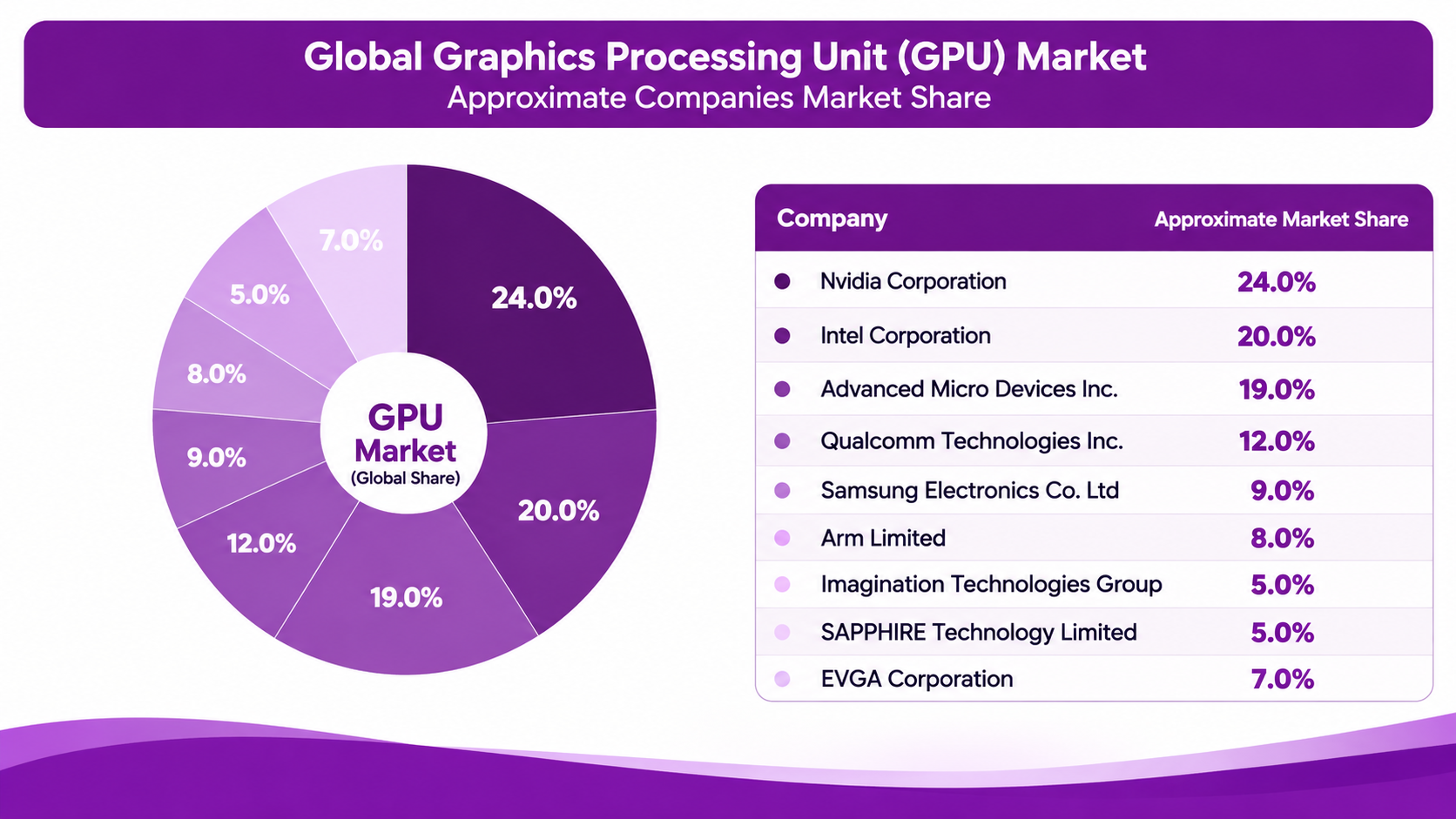
The GPU market has a fragmented competitive structure across integrated graphics, discrete graphics cards, mobile GPUs, workstation processors, and AI data-center accelerators. A single market-share percentage cannot accurately represent all these categories because companies participate in different parts of the value chain.
Latest PC GPU shipment evidence: Jon Peddie Research reported that the global PC GPU market shipped 72.8 million units in Q3 2026, down 3.6% quarter over quarter and 5.0% year over year. Intel gained 2.6 percentage points of overall PC GPU share, while AMD lost 1.3 percentage points and NVIDIA lost 1.26 percentage points. These are quarterly changes, not absolute market-share percentages.
Important market-share qualification: The above positioning is a qualitative competitive assessment, not a fabricated percentage allocation. Publicly comparable revenue or unit-share figures covering all nine companies across the complete GPU market are unavailable. NVIDIA, AMD, and Intel are the principal direct competitors in PC graphics, while Arm, Imagination, and Qualcomm have different business models based substantially on GPU IP and integrated processors.
NVIDIA Corporation
About NVIDIA Corporation: NVIDIA is a leading GPU developer specializing in AI accelerators, gaming graphics, professional visualization, and high-performance computing. Its CUDA software ecosystem, advanced GPU architectures, and data-center platforms provide a major competitive advantage in AI training and inference.
a) Company Overview Table
| Attribute | Company Data |
|---|---|
| Company Name | NVIDIA Corporation |
| Ticker Symbol | NASDAQ: NVDA |
| Industry | Semiconductors and AI Computing |
| Headquarters | Santa Clara, California, USA |
| Founded | 1993 |
| Founders | Jensen Huang, Chris Malachowsky, Curtis Priem |
| Current CEO | Colette Kress (Interim CEO, as reported in Q3 FY2027 announcement) |
| Latest Quarterly Revenue | USD 115.8 billion, Q3 FY2027 |
| YoY Revenue Growth | 103% |
| Primary Segments | Compute & Networking, Graphics |
b) Financial Details
NVIDIA reported revenue of USD 115.8 billion for the third quarter of fiscal 2027, representing 103% year-over-year growth. Data Center revenue reached USD 107.6 billion, increasing 110% year over year, reflecting strong demand for AI computing infrastructure. The company’s traditional Graphics segment generated USD 22.5 billion in fiscal 2026, increasing 57% year over year. However, NVIDIA does not separately disclose all revenue attributable exclusively to individual GPU models. The latest quarterly growth demonstrates the importance of accelerated computing in its financial performance.
c) Strategic Developments
-
November 2026: NVIDIA expanded long-term supply agreements with Samsung Electro-Mechanics, Kinsus, Amkor, and SPIL to increase advanced packaging and semiconductor substrate capacity.
-
November 2026: NVIDIA began volume shipments of its Vera Rubin NVL72 platform, supporting next-generation AI computing infrastructure.
-
November 2026: NVIDIA expanded manufacturing collaborations with Foxconn and other supply-chain partners to support GPU and networking platform production.
Intel Corporation
About Intel Corporation: Intel develops integrated and discrete GPU technologies for personal computers, workstations, and data-centric applications. Its Intel Arc graphics family and Xe architecture support gaming, content creation, and accelerated computing, while integrated graphics remain an important part of its processor portfolio.
a) Company Overview Table
| Attribute | Company Data |
|---|---|
| Company Name | Intel Corporation |
| Ticker Symbol | NASDAQ: INTC |
| Industry | Semiconductors |
| Headquarters | Santa Clara, California, USA |
| Founded | 1968 |
| Founders | Robert Noyce and Gordon Moore |
| Current CEO | Lip-Bu Tan |
| Latest Quarterly Revenue | USD 16.5 billion, Q3 2026 |
| YoY Revenue Growth | 20.9% |
| Primary Segments | Client Computing Group, Data Center and AI, Intel Products, Intel Foundry |
b) Financial Details
Intel reported third-quarter 2026 revenue of USD 16.5 billion, increasing approximately 20.9% year over year. Its financial results reflect demand for computing processors and data-center products. However, Intel does not separately disclose revenue from its GPU business in the reported quarterly headline figures. Its graphics business remains strategically important through integrated Intel Graphics, Arc discrete GPUs, and graphics acceleration capabilities. The company continues to develop its graphics architecture to improve performance, energy efficiency, and software compatibility.
c) Strategic Developments
-
2026: Intel continued developing its Arc graphics portfolio and Xe-based graphics architecture for PC and gaming applications.
-
2026: Intel’s graphics strategy remained linked to its broader processor and AI computing roadmap.
-
2026: The company focused on expanding semiconductor manufacturing capabilities and improving product availability to support its broader computing portfolio.
Advanced Micro Devices Inc. (AMD)
About Advanced Micro Devices: AMD develops discrete and integrated GPUs for gaming, professional graphics, and data-center computing. Its Radeon and Instinct product families address different workloads, while its ROCm software ecosystem supports GPU programming, AI development, and high-performance computing.
a) Company Overview Table
| Attribute | Company Data |
|---|---|
| Company Name | Advanced Micro Devices Inc. |
| Ticker Symbol | NASDAQ: AMD |
| Industry | Semiconductors |
| Headquarters | Santa Clara, California, USA |
| Founded | 1969 |
| Founders | Jerry Sanders and founding engineering team |
| Current CEO | Dr. Lisa Su |
| Latest Quarterly Revenue | USD 13.377 billion, Q3 2026 |
| YoY Revenue Growth | 45% |
| Primary Segments | Data Center, Client and Gaming, Embedded |
b) Financial Details
AMD generated USD 13.377 billion in third-quarter 2026 revenue, increasing 45% year over year. Its Data Center segment delivered USD 8.546 billion, representing 97% growth, supported by strong demand for Instinct GPUs and EPYC processors. Client and Gaming revenue reached USD 3.722 billion, declining 8% year over year, while gaming revenue was USD 773 million. These figures demonstrate that data-center GPU demand is becoming a major growth contributor, although the reported Data Center segment also includes CPU revenue.
c) Strategic Developments
-
July 2026: AMD and Anthropic announced a strategic agreement covering the deployment of up to 2 gigawatts of Instinct MI450 GPUs in AMD Helios rack-scale systems. The first gigawatt deployment was planned for the first half of 2027.
-
July 2026: AMD announced a potential strategic equity investment of up to USD 5 billion in Anthropic as part of the wider collaboration.
-
November 2026: AMD introduced additional MI400-series GPU developments, including MI450X and MI430X products for AI and scientific computing.
- November 2026: AMD presented additional performance information for MI455X GPUs operating in its Helios rack-scale platform.
Qualcomm Technologies Inc.
About Qualcomm Technologies: Qualcomm develops Adreno GPU technology for mobile processors, automotive platforms, and connected devices. Its graphics capabilities are integrated into Snapdragon system-on-chip products, supporting mobile gaming, visual processing, augmented reality, and increasingly demanding on-device AI applications.
a) Company Overview Table
| Attribute | Company Data |
|---|---|
| Company Name | Qualcomm Technologies Inc. |
| Ticker Symbol | NASDAQ: QCOM (Parent company) |
| Industry | Wireless Technology and Semiconductors |
| Headquarters | San Diego, California, USA |
| Founded | 1985 |
| Founders | Irwin Jacobs, Andrew Viterbi and founding team |
| Current CEO | Cristiano Amon |
| Latest Quarterly Revenue | USD 10.3 billion, Q4 FY2026 |
| Primary Segments | Qualcomm CDMA Technologies (QCT), Qualcomm Technology Licensing (QTL) |
b) Financial Details
Qualcomm reported fiscal fourth-quarter 2026 QCT revenue of USD 9.015 billion, while total fiscal 2026 revenue reached USD 43.1 billion. Its graphics business is primarily associated with Adreno GPU technology integrated into Snapdragon platforms. These processors serve smartphones, automotive infotainment, and other connected computing devices. Qualcomm does not separately disclose Adreno GPU revenue, making it difficult to calculate the direct financial contribution of graphics processing to its quarterly results.
c) Strategic Developments
-
November 2026: Qualcomm announced a multigenerational product collaboration with Amazon for AI data-center applications, broadening its computing platform strategy.
-
November 2026: Qualcomm reported its first quarterly automotive revenue above USD 2 billion, representing 89% year-over-year growth, expanding its automotive computing ecosystem.
-
2026: Qualcomm continued developing Snapdragon and Adreno technologies for mobile graphics, gaming, and automotive computing.
Arm Limited
About Arm Limited: Arm provides semiconductor intellectual property and processor architectures to chip manufacturers worldwide. Its Mali GPU portfolio supports mobile, embedded, and automotive graphics, while its licensing model enables semiconductor companies to integrate GPU technology into their own system-on-chip products.
a) Company Overview Table
| Attribute | Company Data |
|---|---|
| Company Name | Arm Limited |
| Ticker Symbol | NASDAQ: ARM |
| Industry | Semiconductor Intellectual Property |
| Headquarters | Cambridge, England, UK |
| Founded | 1990 |
| Founders | Acorn Computers, Apple and VLSI Technology development team |
| Current CEO | Rene Haas |
| Latest Quarterly Revenue | USD 1.44 billion, Q2 FY2027 |
| YoY Revenue Growth | 27% |
| Primary Segments | Licensing and Royalties |
b) Financial Details
Arm reported second-quarter fiscal 2027 revenue of USD 1.44 billion, an increase of 27% year over year. Licensing revenue reached USD 773 million, while royalty revenue was USD 670 million. Although these figures include the wider Arm intellectual-property business and are not GPU-specific, the Mali GPU portfolio remains important to its licensing strategy. Arm’s business model generates revenue through technology licensing and royalties rather than selling a large standalone GPU product portfolio.
c) Strategic Developments
-
September 2026: Arm introduced its CSS for Mobile 2 platform, featuring the Mali G2-Ultra NX GPU with dedicated neural acceleration capabilities.
-
September 2026: The company expanded its mobile graphics strategy by integrating AI-native graphics technologies and ray-tracing improvements into its GPU platform.
-
2026: Arm continued strengthening its ecosystem for mobile gaming, graphics rendering, and on-device AI processing.
Samsung Electronics Co. Ltd.
About Samsung Electronics: Samsung Electronics participates in the GPU market through its Exynos mobile processors, semiconductor design operations, and graphics-related technologies. Its semiconductor ecosystem combines processor development, memory manufacturing, and advanced chip production, supporting integrated graphics and high-performance computing applications.
a) Company Overview Table
| Attribute | Company Data |
|---|---|
| Company Name | Samsung Electronics Co. Ltd. |
| Ticker Symbol | KRX: 005930 |
| Industry | Electronics and Semiconductors |
| Headquarters | Suwon, South Korea |
| Founded | 1969 |
| Founders | Samsung Group, founded by Lee Byung-chul |
| Latest Quarterly Revenue | KRW 195.3 trillion, Q3 2026 |
| Primary Segments | Device Solutions, Device eXperience, Samsung Display |
b) Financial Details
Samsung Electronics reported consolidated revenue of KRW 195.3 trillion in the third quarter of 2026, with operating profit of KRW 107.4 trillion. Its Device Solutions division generated KRW 147.1 trillion in revenue. The System LSI business reported growth supported by system-on-chip and image-sensor production. Samsung’s GPU exposure is primarily linked to Exynos processors and integrated graphics development. However, the company does not separately disclose GPU-specific revenue or operating profit.
c) Strategic Developments
-
October 2026: Samsung reported growth in System LSI operations, supported by Exynos system-on-chip production and new customer partnerships.
-
2026: Samsung continued strengthening its advanced semiconductor manufacturing and system-on-chip capabilities to support high-performance computing applications.
-
2026: Its semiconductor operations benefited from growing demand for AI-related processing and advanced memory products.
Imagination Technologies Group
About Imagination Technologies: Imagination Technologies specializes in GPU intellectual property for mobile devices, automotive systems, embedded electronics, and other power-efficient computing applications. Its PowerVR architecture provides graphics and compute capabilities to semiconductor manufacturers that license its technology.
a) Company Overview Table
| Attribute | Company Data |
|---|---|
| Company Name | Imagination Technologies Group |
| Ticker Symbol | Private Company |
| Industry | Semiconductor IP and GPU Technology |
| Headquarters | Kings Langley, Hertfordshire, UK |
| Founded | 1985 |
| Founders | Tony Maclaren and David Harold |
| Current CEO | Markus Mosen |
| Primary Segments | GPU IP, Automotive Graphics, Embedded Graphics, AI and Compute IP |
b) Financial Details
Imagination Technologies operates primarily through GPU intellectual-property licensing and technology development. It does not publicly disclose the same level of quarterly financial information as major listed semiconductor manufacturers. Its GPU business focuses on PowerVR graphics technology, automotive-grade graphics, and programmable compute solutions. Its E-Series GPU architecture also extends its addressable market into edge AI applications, with configurations scaling up to 200 TOPS for specified AI workloads.
c) Strategic Developments
-
June 2026: Imagination contributed its DXS GPU IP to the European CHASSIS project, supporting the development of a 5nm automotive base die.
-
February 2026: Imagination appointed Markus Mosen as its new chief executive officer.
-
May 2025: The company introduced its E-Series GPU IP, designed to support graphics and AI processing across edge devices.
SAPPHIRE Technology Limited
About SAPPHIRE Technology: SAPPHIRE Technology is a graphics-card manufacturer specializing in AMD Radeon-based products. Its portfolio includes gaming graphics cards, professional graphics solutions, embedded platforms, and PC components, with a strong presence in the enthusiast graphics-card market.
a) Company Overview Table
| Attribute | Company Data |
|---|---|
| Company Name | SAPPHIRE Technology Limited |
| Ticker Symbol | Private Company |
| Industry | Computer Hardware and Graphics Cards |
| Headquarters | Hong Kong |
| Founded | 2001 |
| Current CEO | KD Au |
| Primary Segments | Radeon Graphics Cards, Motherboards, Embedded Solutions, Mini PCs |
b) Financial Details
SAPPHIRE operates as a specialist graphics-card supplier and AMD Radeon partner. Its commercial activities include manufacturing and distributing discrete graphics cards for gaming, professional graphics, and embedded applications. The company does not publish independently verifiable quarterly revenue or GPU-specific financial results. Its competitive position is supported by Radeon-based product development, cooling technologies, gaming graphics solutions, and distribution relationships across international PC hardware markets.
c) Strategic Developments
-
2026: SAPPHIRE continued expanding its Radeon graphics-card portfolio through its NITRO+, PULSE, and PURE product families.
-
2026: The company expanded its EDGE AI Mini PC portfolio, targeting local AI computing and embedded applications.
-
2026: SAPPHIRE highlighted growth opportunities in next-generation graphics, embedded systems, and edge AI during its 25th-anniversary activities.
EVGA Corporation
About EVGA Corporation: EVGA is a computer hardware company historically recognized for NVIDIA-based graphics cards, gaming motherboards, and power supplies. Its graphics-card business previously held a meaningful enthusiast-market position through customized cooling systems and performance-oriented GPU products.
a) Company Overview Table
| Attribute | Company Data |
|---|---|
| Company Name | EVGA Corporation |
| Ticker Symbol | Private Company |
| Industry | Computer Hardware |
| Headquarters | Brea, California, USA |
| Founded | 1999 |
| Founders | Andrew Han |
| Current CEO | Andrew Han |
| Primary Segments | Historical GPU Products, Motherboards, Power Supplies and Computer Hardware |
b) Financial Details
EVGA does not publicly report quarterly financial statements or separate GPU revenue. Historically, the company was an important NVIDIA graphics-card partner, offering customized GeForce products for gaming and performance-oriented PC users. However, EVGA announced its withdrawal from the graphics-card market in September 2022 and ended its NVIDIA graphics-card partnership. Therefore, it should be considered a historical competitor rather than an active major GPU manufacturer in the current market.
c) Strategic Developments
-
September 2022: EVGA announced that it would stop producing graphics cards and would not develop NVIDIA’s next-generation graphics-card products.
-
2022 onward: The company discontinued its active graphics-card partnership with NVIDIA.
-
2026: No verified new GPU manufacturing partnership, GPU product launch, or GPU-specific investment was identified in the reviewed sources.
Conclusion
The GPU market is increasingly shaped by two major competitive opportunities: AI and data-center acceleration, and traditional graphics processing across personal computers, mobile devices, and gaming systems. NVIDIA has established a substantial advantage in AI computing through its accelerator portfolio, software ecosystem, and data-center partnerships. AMD is strengthening its position through Instinct GPUs and rack-scale infrastructure, while Intel continues to compete through integrated and discrete graphics.
Over the next 12–24 months, competition is expected to intensify around memory bandwidth, energy efficiency, advanced packaging, GPU software ecosystems, and AI inference performance. Mobile and embedded GPU developers will also benefit from increasing demand for on-device AI and automotive computing.
Overall, the GPU market has a strong long-term growth trajectory, supported by expanding AI infrastructure and increasing parallel-processing requirements. However, competition will vary significantly between the AI accelerator, discrete graphics, and integrated GPU segments.



