Introduction
Valued at USD 782.5 billion in 2025, the global cloud computing market is expanding toward USD 3,478.2 billion by 2035 at a 16.1% CAGR, while enterprise spending on cloud infrastructure services surged 55% year-over-year to reach USD 168 billion in Q3 2026 alone. Structural market dynamics are defined by an aggressive architectural pivot from legacy infrastructure rentals toward GPU-dense, AI-optimized compute clusters and cloud-native application platforms. Macroeconomic tailwinds, including surging hyperscaler capital expenditures projected above USD 750 billion for full-year 2026, enterprise digital transformation mandates, and sovereign data localization frameworks, continue to reshape global cloud capacity and pricing power.
Market Size & Statistics
The global cloud computing market reached a base-year valuation of USD 782.5 billion in 2025 and is forecast to reach approximately USD 3,478.2 billion by 2035, advancing at a 16.1% CAGR between 2026 and 2035.
- Software as a Service (SaaS) led all service models with approximately 44.0% of total market revenue, whereas Platform as a Service (PaaS) represents the fastest-growing service model segment.
- Public cloud deployments generated roughly 62% of total cloud deployment revenue, while hybrid cloud architectures are projected to record the fastest growth trajectory.
- Large enterprises accounted for approximately 60.0% of global cloud computing expenditure, while small and medium-sized enterprises (SMEs) form the fastest-expanding organization-size segment.
- IT and telecommunications end users captured the largest vertical market share at roughly 22.0%, whereas healthcare is projected to be the fastest-growing end-user industry.
- North America dominated the regional landscape in 2025 by capturing 42.0% of global revenue, equivalent to approximately USD 328.7 billion, while Asia Pacific is forecast to achieve the fastest regional growth rate.
Market share within cloud computing is structurally segmented between core cloud infrastructure and platform services (IaaS, PaaS, and hosted private cloud), where quarterly enterprise spending reached USD 168 billion in Q3 2026, and broader enterprise SaaS and private-cloud virtualization software layers. Within the core cloud infrastructure and platform services benchmark tracked by Synergy Research Group, the top three hyperscalers collectively command 61% of global spending as of Q3 2026, while specialized enterprise software, sovereign cloud, and private-cloud vendors capture distinct operational niches across IaaS, PaaS, and SaaS.
| Company | Cloud Infrastructure & Platform Share (Q3 2026) | Cloud Segment Revenue & Financial Scale | Core Cloud Strategic Positioning |
|---|---|---|---|
| Amazon Web Services | ~26% | USD 46.0 billion in Q3 2026 (+39% YoY); USD 184 billion annualized run rate | Global Tier-1 leader in public cloud IaaS, PaaS, and custom AI silicon infrastructure |
| Microsoft Azure | ~19% | USD 33.2 billion Azure revenue in Q1 FY27 (+48% YoY); USD 133 billion annualized run rate; USD 63.9 billion total Microsoft Cloud quarterly revenue | #2 global hyperscaler integrating enterprise SaaS, hybrid cloud, and GPU supercomputing |
| Google Cloud Platform | ~16% | USD 30.7 billion in Q3 2026 (+103% YoY); USD 123 billion annualized run rate | Fastest-growing Tier-1 hyperscaler, gaining 300 bps YoY via custom TPU clusters and Gemini AI workloads |
| Oracle Cloud | ~4% | USD 11.61 billion Q1 FY27 cloud revenue (+62% YoY), comprising USD 7.4 billion IaaS (+121% YoY) and USD 4.2 billion SaaS (+10% YoY) | #4 global infrastructure provider scaling autonomous database migrations and mega-scale AI training clusters |
| Salesforce | ~2% | USD 10.82 billion Q2 FY27 subscription and support revenue (+12% YoY); FY27 total revenue guidance of USD 46.1 to USD 46.4 billion | Global pure-play enterprise CRM SaaS leader expanding data integration and Agentforce AI clouds |
| Alibaba Cloud | ~4% | RMB 60.97 billion / USD 9.09 billion AI Cloud & Compute Services revenue in Q2 FY27 (+53% YoY; external cloud +64% YoY) | Dominant APAC and China public cloud leader scaling proprietary AI foundation models and custom silicon |
| SAP Cloud | ~1% | EUR 6.67 billion Q3 2026 cloud revenue (+26% YoY); FY26 cloud revenue guidance of EUR 25.8 to EUR 26.2 billion | Premier enterprise ERP SaaS provider migrating legacy on-premises ERP estates to cloud subscriptions |
| VMware (Broadcom) | Data Unavailable (On-Premises / Private Cloud Software Model) | USD 8.75 billion Broadcom Infrastructure Software revenue in Q3 FY26 (+29% YoY); USD 27 billion in FY25 driven by VMware Cloud Foundation | Dominant private and hybrid cloud virtualization software stack enabling public-to-private workload repatriation |
| IBM Cloud | ~1% (~2% in Q4 2025) | USD 7.80 billion Q3 2026 Software revenue (+8.2% YoY); Red Hat Hybrid Cloud up 11% YoY with OpenShift ARR >USD 2.4 billion | Enterprise hybrid cloud, sovereign cloud, and regulated-industry middleware specialist anchored by Red Hat |
| Huawei Cloud | ~1% (~2% in Q4 2025) | CNY 32,161 million (approx. USD 4.6 billion) FY25 Cloud Computing segment revenue; positive YoY growth in H1 2026 | Major Chinese and emerging-market sovereign cloud, AI compute, and telecom infrastructure vendor |
| Tencent Cloud | ~1% (~2% in Q4 2025) | Standalone dollar revenue Data Unavailable (+35% YoY cloud revenue growth in Q3 2026 within RMB 63.66 billion FinTech & Business Services segment) | Leading APAC PaaS, gaming, media delivery, and enterprise digital ecosystem cloud provider |
| Rackspace Technology | <1% (Outside Top 20 Infrastructure Share) | USD 609.1 million Q3 2026 consolidated revenue (Public Cloud USD 349.1 million; Private Cloud USD 260.0 million); FY26 guidance of USD 2.51 to USD 2.56 billion | Pure-play managed multi-cloud services and sovereign private AI pod operator |
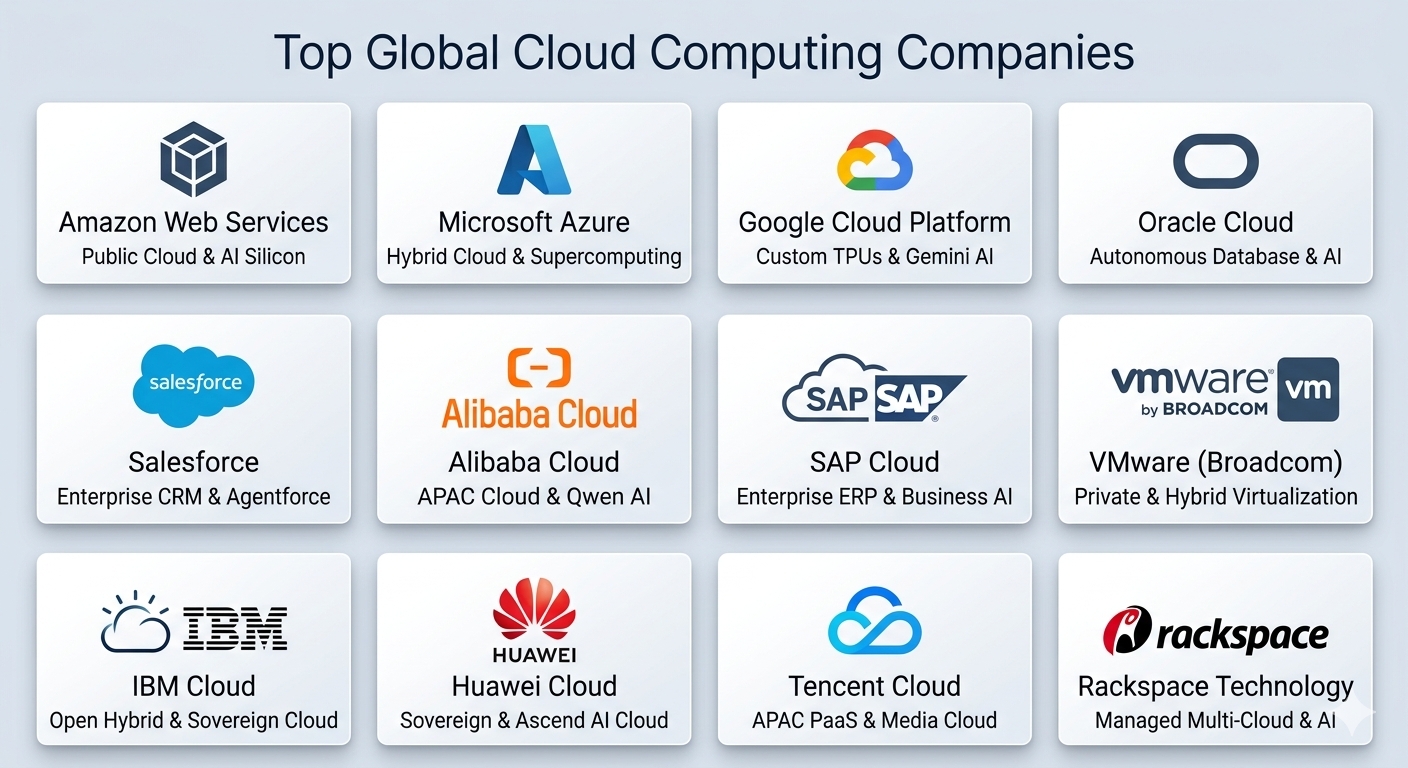
Top Companies List
- Amazon Web Services
- Microsoft Azure
- Google Cloud Platform
- Oracle Cloud
- Salesforce
- Alibaba Cloud
- SAP Cloud
- VMware (Broadcom)
- IBM Cloud
- Huawei Cloud
- Tencent Cloud
- Rackspace Technology
Amazon Web Services
About Amazon Web Services: Amazon Web Services (AWS) is the world’s largest public cloud hyperscaler, delivering over 200 IaaS, PaaS, and AI services globally. Its technological moat rests on unmatched regional infrastructure density, custom Graviton and Trainium silicon, and the multi-model Amazon Bedrock generative AI platform.
Company Overview
| Attribute | Company Data |
|---|---|
| Company Name | Amazon Web Services, Inc. (Subsidiary of Amazon.com, Inc.) |
| Ticker Symbol | NASDAQ: AMZN (Parent) |
| Industry | Cloud Computing (IaaS, PaaS, Enterprise AI Infrastructure) |
| Headquarters | Seattle, Washington, United States (Parent & AWS) |
| Founded | 2006 (AWS commercial launch); 1994 (Amazon.com, Inc.) |
| Founders | Jeff Bezos (Amazon.com, Inc.) |
| Current CEO | Matt Garman (CEO, AWS); Andy Jassy (President & CEO, Amazon.com, Inc.) |
| Latest Quarterly Revenue | USD 45.98 billion / ~USD 46.0 billion (AWS Segment, Q3 2026); USD 201.9 billion (Amazon Consolidated, Q3 2026) |
| YoY Revenue Growth | +39% YoY (AWS Segment, Q3 2026); +12% YoY (Amazon Consolidated, Q3 2026) |
| Primary Segments | AWS Cloud Computing (Compute, Storage, Databases, Analytics, Bedrock & SageMaker AI); Amazon North America & International (Parent) |
Financial Details: In Q3 2026 (ended September 30, 2026), AWS generated USD 45.98 billion (reported at USD 46.0 billion) in segment revenue, accelerating to 39% year-over-year growth and reaching an annualized revenue run rate of approximately USD 184 billion. While parent Amazon’s consolidated net sales rose 12% to USD 201.9 billion, AWS remained the primary profit engine and absorbed the vast majority of Amazon’s USD 75.9 billion Q3 cash capital expenditure. Full-year 2026 cash CapEx is guided at approximately USD 220 billion to expand data center power envelopes and custom AI accelerator clusters.
Strategic Developments:
- Expanded its strategic partnership with Anthropic in April 2026 via an additional USD 5 billion immediate investment (with up to USD 20 billion more tied to milestones), securing a USD 100 billion-plus, 10-year AWS compute commitment across up to 5 gigawatts of Trainium2, Trainium3, Trainium4, and Graviton capacity.
- Entered into a definitive agreement in late 2026 to acquire DuckLabs, the commercial engineering entity behind the analytical database DuckDB, strengthening AWS’s cloud-native analytics stack.
- Signed major enterprise and sovereign cloud infrastructure agreements in Q3 and Q4 2026 with OpenAI (bringing OpenAI models onto Amazon Bedrock), Meta, Oracle, Qualcomm, Verizon, and NATO.
- Launched the Golden Age of Science Accelerator in October 2026 with up to USD 50 million in cloud compute credits and made its AI-powered cloud security service, Continuum, generally available.
Microsoft Azure
About Microsoft Azure: Microsoft Azure is the second-largest global cloud platform, uniquely fusing hyperscale public IaaS and PaaS infrastructure with enterprise hybrid cloud (Azure Arc) and SaaS ecosystems. Its competitive moat stems from deep Windows Server and SQL enterprise entrenchment alongside frontier AI supercomputing clusters.
Company Overview
| Attribute | Company Data |
|---|---|
| Company Name | Microsoft Corporation (Microsoft Azure Division) |
| Ticker Symbol | NASDAQ: MSFT |
| Industry | Cloud Computing, Enterprise Software, and AI Infrastructure |
| Headquarters | Redmond, Washington, United States |
| Founded | 2010 (Azure commercial launch); 1975 (Microsoft Corporation) |
| Founders | Bill Gates, Paul Allen (Microsoft Corporation) |
| Current CEO | Satya Nadella (Chairman & CEO, Microsoft Corporation) |
| Latest Quarterly Revenue | USD 33.17 billion / ~USD 33.2 billion (Azure, Q1 FY27); USD 63.9 billion (Microsoft Cloud, Q1 FY27); USD 92.3 billion (Consolidated, Q1 FY27) |
| YoY Revenue Growth | +48% YoY (Azure, Q1 FY27); +30% YoY (Microsoft Cloud, Q1 FY27); +19% YoY (Consolidated, Q1 FY27) |
| Primary Segments | Azure Infrastructure & AI Services, Microsoft 365 Commercial Cloud, Dynamics 365 / Industry Solutions Cloud (Microsoft Cloud) |
Financial Details: In Q1 FY27 (quarter ended September 30, 2026), standalone Azure revenue surged 48% year-over-year (in both reported and constant currency) to USD 33.2 billion, up from USD 22.4 billion in the prior-year period and establishing a USD 133 billion annualized run rate. Broader Microsoft Cloud revenue, encompassing Azure, Microsoft 365 Commercial Cloud, and Industry Solutions, reached USD 63.9 billion, accelerating to 30% year-over-year growth (31% in constant currency). Commercial cloud backlog reached USD 677 billion, supported by USD 45.2 billion in quarterly data center capital expenditures.
Strategic Developments:
- Deployed NVIDIA’s first production Vera Rubin GPU racks in August 2026 and completed the initial phase of its Mount Pleasant hyperscale AI data center campus in June 2026 to alleviate Azure capacity constraints.
- Executed a strategic investment commitment of up to USD 5 billion in Anthropic paired with a USD 30 billion Azure cloud compute consumption agreement, diversifying its frontier AI hosting beyond its flagship OpenAI partnership.
- Expanded multicloud database interconnectivity with Oracle across global Azure regions, fueling enterprise migrations of mission-critical database workloads onto Azure infrastructure.
Google Cloud Platform
About Google Cloud Platform: Google Cloud Platform (GCP) is the fastest-growing Tier-1 hyperscaler, combining planet-scale fiber networking, Kubernetes-native container orchestration, BigQuery data analytics, and vertically integrated AI infrastructure. Its technological moat pairs proprietary custom Tensor Processing Units (TPUs) with native Gemini enterprise models.
Company Overview
| Attribute | Company Data |
|---|---|
| Company Name | Google Cloud (Operating Segment of Alphabet Inc.) |
| Ticker Symbol | NASDAQ: GOOGL / GOOG (Parent) |
| Industry | Cloud Computing (IaaS, PaaS, SaaS Workspace, AI Infrastructure) |
| Headquarters | Mountain View, California, United States |
| Founded | 2008 (Google Cloud launch); 1998 (Google) |
| Founders | Larry Page, Sergey Brin (Google / Alphabet Inc.) |
| Current CEO | Thomas Kurian (CEO, Google Cloud); Sundar Pichai (CEO, Alphabet Inc.) |
| Latest Quarterly Revenue | USD 30.71 billion (Google Cloud Segment, Q3 2026); USD 127.58 billion (Alphabet Consolidated, Q3 2026) |
| YoY Revenue Growth | +103% YoY (Google Cloud Segment, Q3 2026); +25% YoY (Alphabet Consolidated, Q3 2026) |
| Primary Segments | Google Cloud Platform (AI Infrastructure, Core GCP, Data Analytics, TPU Systems), Google Workspace; Google Services & Other Bets (Parent) |
Financial Details: Google Cloud delivered an unprecedented top-line inflection in Q3 2026 (ended September 30, 2026), with segment revenue rising 103% year-over-year from USD 15.16 billion to USD 30.71 billion, accounting for roughly 24% of Alphabet’s USD 127.58 billion consolidated revenue. Segment operating income more than tripled (+209% YoY) to USD 11.12 billion, expanding Google Cloud’s operating margin from 23.7% to 36.2%. Cloud backlog climbed to USD 561 billion (with over 55% expected to convert within 24 months), backed by USD 51.4 billion in Q3 Alphabet capital expenditures and full-year 2026 CapEx guidance of USD 175 billion to USD 185 billion.
Strategic Developments:
- Integrated cloud security leader Wiz into Google Cloud’s security portfolio in 2026, driving over 45% sequential growth in protected AI cloud workloads and nearly 90% customer adoption of AI security controls.
- Launched the Gemini Enterprise Agent Platform at Cloud Next ‘26 (April 2026) as an enterprise-grade evolution of Vertex AI for building, governing, and orchestrating autonomous cloud agents.
- Scaled commercial sales and cloud rentals of custom TPU supercomputing systems alongside NVIDIA Vera Rubin GPU clusters, supported by a newly established USD 750 million Google Cloud Partner Network AI fund.
Oracle Cloud
About Oracle Cloud: Oracle Cloud combines high-performance, RDMA-networked bare-metal compute clusters via Oracle Cloud Infrastructure (OCI) with mission-critical Autonomous Database and Fusion SaaS applications. Its core moat lies in low-latency gigawatt-scale AI training clusters and native multicloud database deployments embedded directly inside rival hyperscalers.
Company Overview
| Attribute | Company Data |
|---|---|
| Company Name | Oracle Corporation |
| Ticker Symbol | NYSE: ORCL |
| Industry | Cloud Infrastructure (IaaS), Enterprise Database Software, and Cloud Applications (SaaS) |
| Headquarters | Austin, Texas, United States |
| Founded | 1977 |
| Founders | Larry Ellison, Bob Miner, Ed Oates |
| Current CEO | Clay Magouyrk and Mike Sicilia (Co-CEOs) |
| Latest Quarterly Revenue | USD 11.61 billion (Total Cloud: IaaS + SaaS, Q1 FY27); USD 19.35 billion (Oracle Consolidated, Q1 FY27) |
| YoY Revenue Growth | +62% YoY Total Cloud (+121% YoY IaaS; +10% YoY SaaS, Q1 FY27); +30% YoY Consolidated |
| Primary Segments | Cloud Services (Oracle Cloud Infrastructure IaaS, Fusion & NetSuite Cloud Applications SaaS), Cloud License and On-Premise Support, Hardware, Services |
Financial Details: In Q1 FY27 (quarter ended August 31, 2026), Oracle’s total cloud revenue (IaaS plus SaaS) jumped 62% year-over-year (61% in constant currency) to USD 11.61 billion, accounting for 60% of Oracle’s record USD 19.35 billion consolidated quarterly revenue. Growth was propelled by OCI Cloud Infrastructure (IaaS) revenue soaring 121% year-over-year to USD 7.4 billion while operating at 97.9% GPU cluster utilization, alongside Cloud Applications (SaaS) rising 10% to USD 4.2 billion. Remaining Performance Obligations (RPO) hit USD 664 billion (+USD 209 billion YoY) after booking over USD 30 billion in new AI cloud contracts, prompting management to guide Q2 FY27 cloud revenue growth at 65% to 71%.
Strategic Developments:
- Expanded multicloud database infrastructure across AWS, Microsoft Azure, and Google Cloud to 70 active multicloud database regions in 2026, driving 353% year-over-year multicloud database revenue growth.
- Committed USD 1 billion over four years at Oracle AI World (October 2026) to expand the Oracle PartnerNetwork (OPN) with cloud migration funding and AI specialization incentives.
- Integrated xAI’s Grok 4.6 and 4.7 models into OCI Enterprise AI and launched AI Agent Studio for Industry Applications in October 2026, while scaling annual infrastructure CapEx toward USD 50 billion.
Salesforce
About Salesforce: Salesforce is the global pure-play category leader in enterprise Software-as-a-Service (SaaS) customer relationship management. Its cloud moat integrates Sales, Service, Marketing, Slack collaboration, MuleSoft API orchestration, and Informatica master data management onto a unified metadata platform powering autonomous Agentforce cloud workflows.
Company Overview
| Attribute | Company Data |
|---|---|
| Company Name | Salesforce, Inc. |
| Ticker Symbol | NYSE: CRM |
| Industry | Enterprise Cloud Software (SaaS CRM, Data Cloud, Agentic AI) |
| Headquarters | San Francisco, California, United States |
| Founded | March 8, 1999 |
| Founders | Marc Benioff, Parker Harris, Dave Moellenhoff, Frank Dominguez |
| Current CEO | Marc Benioff (Chair & CEO) |
| Latest Quarterly Revenue | USD 10.82 billion (Subscription & Support Cloud Revenue, Q2 FY27); USD 11.35 billion (Total Consolidated Revenue, Q2 FY27) |
| YoY Revenue Growth | +12% YoY (+11% CC, Subscription & Support); +11% YoY (Total Consolidated Revenue, Q2 FY27) |
| Primary Segments | Subscription and Support (Sales, Service, Platform & Other/Slack, Marketing & Commerce, Integration & Analytics/MuleSoft/Tableau/Informatica), Professional Services |
Financial Details: Because Q3 FY27 earnings are scheduled for release on December 2, 2026, Q2 FY27 (ended July 31, 2026) represents the latest reported quarter. In Q2 FY27, pure-play cloud Subscription and Support revenue rose 12% year-over-year (11% in constant currency) to USD 10.82 billion, including a USD 440 million contribution from Informatica, out of USD 11.35 billion in total revenue. Current remaining performance obligation (cRPO) accelerated 14% year-over-year to USD 33.5 billion (with total RPO reaching USD 66.3 billion), Agentforce AI ARR surpassed USD 1.5 billion (+240% YoY), and management raised full-year FY27 revenue guidance to between USD 46.1 billion and USD 46.4 billion.
Strategic Developments:
- Integrated enterprise cloud data management vendor Informatica (acquired for approximately USD 8 billion in November 2025) into Data 360 and MuleSoft throughout 2026 to create a unified cloud metadata pipeline for Agentforce.
- Completed the USD 1.5 billion acquisition of headless cloud content management platform Contentful on September 1, 2026, and signed a definitive agreement in June 2026 to acquire usage-based cloud billing specialist m3ter.
- Expanded localized enterprise SaaS delivery in Greater China through its ongoing “Salesforce on Alibaba Cloud” strategic infrastructure partnership.
Alibaba Cloud
About Alibaba Cloud: Alibaba Cloud (now reporting within Alibaba’s AI Cloud and Compute Services group) is Asia-Pacific’s largest cloud infrastructure provider. Its full-stack technological moat unifies hyperscale IaaS and PaaS data centers with proprietary T-Head server semiconductors and the open-weight Qwen foundation model family.
Company Overview
| Attribute | Company Data |
|---|---|
| Company Name | Alibaba Cloud / AI Cloud and Compute Services (Division of Alibaba Group Holding Limited) |
| Ticker Symbol | NYSE: BABA / HKEX: 9988 (Parent) |
| Industry | Cloud Computing (IaaS, PaaS, Custom Cloud Silicon, Enterprise AI) |
| Headquarters | Hangzhou, Zhejiang, China |
| Founded | 2009 (Alibaba Cloud); 1999 (Alibaba Group Holding Limited) |
| Founders | Jack Ma and 17 co-founders (Alibaba Group); Wang Jian (Alibaba Cloud architect) |
| Current CEO | Eddie Wu (CEO, Alibaba Group & Cloud Intelligence) |
| Latest Quarterly Revenue | RMB 60.97 billion / USD 9.09 billion (AI Cloud & Compute Services, Q2 FY27); RMB 271.52 billion / USD 40.5 billion (Alibaba Consolidated, Q2 FY27) |
| YoY Revenue Growth | +53% YoY Total Cloud (+64% YoY External Cloud Revenue, Q2 FY27); +9.6% YoY Consolidated |
| Primary Segments | AI Cloud and Compute Services (Alibaba Cloud & T-Head); Alibaba E-commerce Group, AI Labs and Applications, All Others (Parent) |
Financial Details: Following Alibaba’s mid-2026 segment reorganization combining Cloud Intelligence Group with T-Head silicon into AI Cloud and Compute Services, Q2 FY27 (quarter ended September 30, 2026, reported November 19, 2026) cloud segment revenue surged 53% year-over-year to RMB 60.97 billion (USD 9.09 billion). External cloud customer revenue accelerated 64% year-over-year to approximately RMB 47.0 billion (~77% of segment revenue), while AI-related cloud product revenue hit RMB 17.92 billion, posting its 13th consecutive quarter of triple-digit growth. Segment adjusted EBITA jumped 121% year-over-year to lift operating margins to 14.5%, supported by RMB 50.48 billion (+60% YoY) in Q2 capital expenditure.
Strategic Developments:
- Unveiled the proprietary Zhenwu V900 cloud AI chip at the September 2026 Apsara (Yunqi) Conference, delivering 3x the performance of its M890 predecessor ahead of Q1 2027 commercial deployment, alongside the 2.4-trillion-parameter Qwen4-Max model.
- Advanced its RMB 380 billion three-year cloud and AI infrastructure investment plan (with RMB 190 billion deployed through mid-2026), announcing new cloud regions in Türkiye, Finland, and the Netherlands toward a >20 GW global data center target by 2032.
- Deepened cloud ecosystem partnerships including Apple Intelligence integration on Qwen in China and hosting localized Salesforce CRM workloads.
SAP Cloud
About SAP Cloud: SAP Cloud spearheads enterprise application modernization by migrating complex, mission-critical ERP estates onto cloud subscriptions through RISE with SAP and GROW with SAP. Its moat combines unrivaled transactional business process depth, SAP Business Technology Platform (BTP) PaaS, and embedded Joule Business AI.
Company Overview
| Attribute | Company Data |
|---|---|
| Company Name | SAP SE |
| Ticker Symbol | XETRA: SAP / NYSE: SAP |
| Industry | Enterprise Application Software (Cloud ERP SaaS, PaaS, Business AI) |
| Headquarters | Walldorf, Baden-Württemberg, Germany |
| Founded | April 1, 1972 |
| Founders | Dietmar Hopp, Hasso Plattner, Claus Wellenreuther, Klaus Tschira, Hans-Werner Hector |
| Current CEO | Christian Klein (CEO, SAP SE) |
| Latest Quarterly Revenue | EUR 6.67 billion (Cloud Segment, Q3 2026); EUR 10.27 billion (SAP Consolidated, Q3 2026) |
| YoY Revenue Growth | +26% YoY (+25% CC, Cloud Segment, Q3 2026); +13% YoY (+12% CC, Consolidated, Q3 2026) |
| Primary Segments | Cloud (Cloud ERP Suite, Extension Suite / BTP), Software Licenses and Support, Services |
Financial Details: In Q3 2026 (ended September 30, 2026), SAP’s Cloud revenue expanded 26% year-over-year (25% at constant currencies) to EUR 6,668 million, propelling total company quarterly revenue past the EUR 10 billion threshold for the first time in history at EUR 10,270 million (+13% YoY). Core Cloud ERP Suite revenue climbed 29% year-over-year (28% CC), IFRS cloud gross profit rose 25% to EUR 4,930 million at a 73.9% cloud gross margin, and current cloud backlog jumped 28% (26% CC) to EUR 24.1 billion. SAP now expects full-year 2026 cloud revenue toward the upper end of its EUR 25.8 billion to EUR 26.2 billion constant-currency guidance range.
Strategic Developments:
- Entered into a definitive agreement in Q3 2026 to acquire TechWolf, an AI work and skills intelligence platform, enhancing SAP SuccessFactors and cloud HCM agentic capabilities.
- Expanded its strategic cloud partnership with IBM Cloud (RISE with SAP on IBM Power Virtual Server), enabling large regulated enterprises to migrate mission-critical on-premises ERP systems onto certified cloud instances paired with SAP Joule and IBM watsonx.
- Scaled multi-hyperscaler deployment partnerships across AWS, Microsoft Azure, and Google Cloud to accelerate legacy ECC customer conversions into recurring Cloud ERP Suite backlogs.
VMware (Broadcom)
About VMware (Broadcom): Operating as the cornerstone of Broadcom’s Infrastructure Software division, VMware delivers the industry-standard private and hybrid cloud virtualization stack via VMware Cloud Foundation (VCF). Its technological moat unifies hypervisor compute, software-defined storage, networking, and native Kubernetes (VKS) on a single control plane.
Company Overview
| Attribute | Company Data |
|---|---|
| Company Name | VMware (Infrastructure Software Division of Broadcom Inc.) |
| Ticker Symbol | NASDAQ: AVGO (Parent) |
| Industry | Private & Hybrid Cloud Infrastructure Software, Virtualization (alongside Parent Semiconductors) |
| Headquarters | Palo Alto, California, United States |
| Founded | 1998 (VMware, acquired by Broadcom in Nov 2023); 1961 / 1991 (Broadcom Inc.) |
| Founders | Diane Greene, Mendel Rosenblum, Scott Devine, Edward Wang, Edouard Bugnion (VMware); Henry Samueli, Henry Nicholas III (Broadcom) |
| Current CEO | Hock E. Tan (President & CEO, Broadcom Inc.) |
| Latest Quarterly Revenue | USD 8.75 billion (Broadcom Infrastructure Software incl. VMware, Q3 FY26); USD 29.6 billion (Broadcom Consolidated, Q3 FY26) |
| YoY Revenue Growth | +29% YoY (Infrastructure Software, Q3 FY26); +86% YoY (Broadcom Consolidated, Q3 FY26) |
| Primary Segments | Infrastructure Software (VMware Cloud Foundation, vSphere Kubernetes Service, Tanzu, Private AI Cloud); Semiconductor Solutions (Parent) |
Financial Details: Broadcom does not report standalone VMware revenue separately from its Infrastructure Software segment, which is overwhelmingly driven by enterprise transitions to subscription-based VMware Cloud Foundation (VCF). In Q3 FY26 (ended August 2, 2026), Broadcom’s Infrastructure Software segment generated USD 8.75 billion in revenue, advancing 29% year-over-year (accelerating from USD 7.2 billion and +9% YoY in Q2 FY26), while consolidated Broadcom revenue rose 86% to USD 29.6 billion. Management guided Q4 FY26 consolidated revenue to USD 34.8 billion (~USD 9.0 billion implied for Infrastructure Software as semiconductor revenue is guided at ~USD 25.8 billion).
Strategic Developments:
- Released VMware Cloud Foundation 9.1 and introduced VMware Private AI Cloud at VMware Explore 2026, adding integrated compliance, cyber-resilience, and GPU virtualization for sovereign on-premises AI deployments.
- Expanded strategic sovereign and managed private cloud alliances in 2026, including a five-year VCF 9.0 renewal with London Stock Exchange Group (LSEG), a global AI private cloud consulting alliance with Kyndryl, and multitenant VCF 9.1 launch partnerships with Rackspace, NetApp, Uniserver, and Viettel IDC.
- Contributed open-source projects Velero (March 2026) and VM API (November 2026) to the Cloud Native Computing Foundation (CNCF) Sandbox to standardize Kubernetes management of virtual machines.
IBM Cloud
About IBM Cloud: IBM Cloud focuses on open hybrid cloud orchestration, sovereign cloud compliance, and mission-critical workload modernization across financial services, telecom, and government sectors. Its moat centers on Red Hat OpenShift container portability, HashiCorp cloud automation, Confluent data streaming, and watsonx AI governance.
Company Overview
| Attribute | Company Data |
|---|---|
| Company Name | International Business Machines Corporation (IBM) |
| Ticker Symbol | NYSE: IBM |
| Industry | Hybrid Cloud Software, Cloud Infrastructure, Enterprise AI & IT Consulting |
| Headquarters | Armonk, New York, United States |
| Founded | 2011 (IBM Cloud launch); June 16, 1911 (IBM) |
| Founders | Charles Ranlett Flint |
| Current CEO | Arvind Krishna (Chairman & CEO) |
| Latest Quarterly Revenue | USD 7.80 billion (Software incl. Hybrid Cloud/Red Hat, Q3 2026); USD 3.71 billion (Infrastructure, Q3 2026); USD 17.10 billion (Consolidated, Q3 2026) |
| YoY Revenue Growth | +8.2% YoY Software (+11% YoY Red Hat Hybrid Cloud); +4.2% YoY Infrastructure; +4.7% YoY Consolidated (Q3 2026) |
| Primary Segments | Software (Hybrid Cloud / Red Hat, Automation, Data & AI, Transaction Processing), Consulting, Infrastructure (Hybrid & Distributed Infrastructure, IBM Cloud) |
Financial Details: IBM structures its cloud disclosures primarily through Hybrid Cloud (Red Hat), Software ARR, and Hybrid Infrastructure rather than a standalone public IaaS figure. In Q3 2026 (ended September 30, 2026), IBM’s consolidated revenue grew 4.7% year-over-year to USD 17.10 billion, led by Software revenue climbing 8.2% (8.7% CC) to USD 7.80 billion and Software ARR reaching USD 24.9 billion (+8% YoY). Within Software, Hybrid Cloud revenue led by Red Hat expanded 11% year-over-year with high-teens bookings growth, Red Hat OpenShift ARR surpassed USD 2.4 billion (>+30% YoY), Data software jumped 20% CC on Confluent contributions, and Infrastructure revenue rose 4.2% to USD 3.71 billion.
Strategic Developments:
- Completed the USD 11 billion all-cash acquisition of real-time cloud data streaming leader Confluent on March 17, 2026, targeting USD 500 million in operational run-rate synergies by 2027 to power hybrid cloud AI agents.
- Achieved ahead-of-schedule EBITDA accretion in 2026 from its USD 6.4 billion HashiCorp acquisition (closed February 2025), integrating Terraform and Vault multi-cloud lifecycle automation with Red Hat OpenShift.
- Expanded its RISE with SAP on IBM Power Virtual Server partnership on IBM Cloud across global regulated enterprise accounts.
Huawei Cloud
About Huawei Cloud: Huawei Cloud is a premier Chinese and emerging-market cloud infrastructure provider operating across 30 global regions and 100 availability zones under a “Technology-as-a-Service” architecture. Its vertical moat integrates indigenous Kunpeng CPUs, Ascend AI accelerators, CloudMatrix supernodes, GaussDB, and industry-tuned Pangu AI models.
Company Overview
| Attribute | Company Data |
|---|---|
| Company Name | Huawei Cloud Computing Technologies Co., Ltd. (Business Unit of Huawei Investment & Holding Co., Ltd.) |
| Ticker Symbol | Private (Employee-Owned Private Company; No Public Ticker) |
| Industry | Cloud Computing (IaaS, PaaS, Sovereign Cloud, Full-Stack AI Compute) |
| Headquarters | Shenzhen, Guangdong, China (Parent); Gui’an / Dongguan Cloud Hubs |
| Founded | 2010 / 2017 (Huawei Cloud BU formalization); 1987 (Huawei Technologies) |
| Founders | Ren Zhengfei (Huawei Technologies) |
| Current CEO | Dr. Peter Zhou (CEO, Huawei Cloud) & Zhang Ping’an (Chairman, Huawei Cloud BU); Ren Zhengfei (CEO, Huawei) |
| Latest Quarterly Revenue | Standalone Quarterly Cloud Revenue Data Unavailable; Parent H1 2026 Revenue: CNY 467.82 billion (~USD 69.6 billion); FY25 Cloud Segment Revenue: CNY 32.16 billion (~USD 4.6 billion) |
| YoY Revenue Growth | Standalone Cloud YoY Data Unavailable (Positive YoY growth confirmed in H1 2026); Parent H1 2026 Revenue +9.6% YoY |
| Primary Segments | Huawei Cloud Computing (AI Cluster Service, Kunpeng Cloud, Pangu MaaS, GaussDB); ICT Infrastructure, Consumer, Digital Power, Intelligent Automotive (Parent) |
Financial Details: As a privately held corporation, Huawei does not publish quarterly standalone financial figures for Huawei Cloud. In its latest interim financial disclosure for H1 2026 (six months ended June 30, 2026), parent Huawei Technologies reported consolidated revenue of CNY 467.82 billion (USD 69.6 billion), up 9.6% year-over-year, alongside CNY 121.38 billion in R&D expenditure (+25.2% YoY), confirming that all business units, including Cloud Computing, recorded positive year-over-year revenue growth. In its most recent full-year segmented filing (FY25), Huawei Cloud generated CNY 32,161 million in external segment revenue while expanding its partner-led cloud business by more than 50% across over 10 million developers and 59,000 partners.
Strategic Developments:
- Launched its next-generation AI Cluster Service (AICS) built on Ascend SuperPoDs and CloudMatrix supernodes at HUAWEI CONNECT 2026 (September 2026), reaching commercial availability in China on September 30, 2026, and global markets on November 30, 2026.
- Rolled out a three-year locked Global Sales Partner Policy and GoCloud and KooGallery incentive framework in Singapore (January 2026) across more than 4,000 international partners in APAC, Latin America, Türkiye, and the Middle East.
- Activated its out-of-the-box AI Token Service in Hong Kong and expanded vertical Pangu AI model deployments across 35 industrial sectors and over 500 enterprise scenarios.
Tencent Cloud
About Tencent Cloud: Tencent Cloud (operating under Tencent’s Cloud and Smart Industries Group) spans 25 global cloud regions and 70 availability zones across 150+ countries. Its specialized moat leverages low-latency audio and video PaaS, gaming infrastructure, Weixin enterprise connectivity, GPU Model-as-a-Service, and WorkBuddy AI productivity agents.
Company Overview
| Attribute | Company Data |
|---|---|
| Company Name | Tencent Cloud (Cloud and Smart Industries Group of Tencent Holdings Limited) |
| Ticker Symbol | HKEX: 0700 / OTC: TCEHY (Parent) |
| Industry | Cloud Computing (IaaS, Audio/Video & Gaming PaaS, Enterprise SaaS & AI) |
| Headquarters | Shenzhen, Guangdong, China |
| Founded | 2013 (Tencent Cloud); November 11, 1998 (Tencent Holdings Limited) |
| Founders | Ma Huateng (Pony Ma), Zhang Zhidong, Xu Chenye, Chen Yidan, Zeng Liqing |
| Current CEO | Dowson Tong (CEO, Cloud and Smart Industries Group); Ma Huateng (Chairman & CEO, Tencent Holdings) |
| Latest Quarterly Revenue | Standalone Cloud Revenue Dollar Figure Data Unavailable; FinTech & Business Services Segment: RMB 63.66 billion (Q3 2026); Tencent Consolidated: RMB 207.34 billion / USD 31.1 billion (Q3 2026) |
| YoY Revenue Growth | +35% YoY (Tencent Cloud Services Revenue, Q3 2026); +9% YoY (FinTech & Business Services); +8% YoY (Consolidated) |
| Primary Segments | FinTech and Business Services (Tencent Cloud IaaS/PaaS, MaaS, WorkBuddy SaaS, Commercial Payments); Value-Added Services, Marketing Services (Parent) |
Financial Details: While Tencent Holdings bundles exact cloud revenue figures inside its FinTech and Business Services segment, which rose 9% year-over-year to RMB 63.66 billion at a 50% gross margin in Q3 2026 (ended September 30, 2026), management explicitly disclosed that standalone Tencent Cloud services revenue accelerated sharply to 35% year-over-year growth in Q3 2026, up from 21% in Q2 2026 and teens-level growth in 2025. Sequential momentum was propelled by GPU compute rentals, Model-as-a-Service (MaaS) revenue more than tripling quarter-over-quarter, WorkBuddy enterprise AI revenue surging over fivefold sequentially, and Tencent Cloud’s active international customer base doubling year-over-year.
Strategic Developments:
- Expanded global data center capacity in 2026 across Frankfurt, Osaka, Riyadh, Malaysia, Mexico, and Thailand, while previewing its proprietary Hy4 and Hy4 Flash enterprise foundation models at the October 2026 Tencent Global Digital Ecosystem Summit.
- Secured major international cloud migration and AI partnerships in late 2026 with XLSMART (migrating >1,000 microservices in Indonesia), CP AXTRA (Thailand), eMAG and iyzico (Europe), The MUI Group (Malaysia), Newlinks and NaaS Technology (Energy IoT), and Middle Eastern enterprises Alsaif Gallery and TruKKer.
- Signed a strategic MoU with Visa in October 2026 extending into Tencent’s overseas enterprise AI and cross-border cloud commerce ecosystems.
Rackspace Technology
About Rackspace Technology: Rackspace Technology is a pure-play hybrid multicloud managed services and sovereign private cloud operator. Its operational moat combines existing data center power footprints, Broadcom Advantage Partner VCF 9.1 multitenancy, and governed “sovereign AI pods” built for regulated healthcare, government, and financial enterprises.
Company Overview
| Attribute | Company Data |
|---|---|
| Company Name | Rackspace Technology, Inc. |
| Ticker Symbol | NASDAQ: RXT |
| Industry | Managed Multicloud Services, Private Cloud Hosting, and Sovereign Enterprise AI Infrastructure |
| Headquarters | San Antonio, Texas, United States |
| Founded | 1998 (Incorporated as Rackspace; 1996 predecessor Cymitar) |
| Founders | Richard Yoo, Dirk Elmendorf, Patrick Condon (with early co-founding partners Graham Weston and Morris Miller) |
| Current CEO | Gajen Kandiah (CEO) |
| Latest Quarterly Revenue | USD 609.1 million Consolidated (USD 349.1 million Public Cloud; USD 260.0 million Private Cloud, Q3 2026) |
| YoY Revenue Growth | -9.3% YoY Consolidated (-17.2% YoY Public Cloud; +4.2% YoY Private Cloud, Q3 2026) |
| Primary Segments | Public Cloud (Managed Hyperscaler Services & Cloud Resale), Private Cloud (Hosted Private Cloud, Sovereign Cloud & Dedicated AI Infrastructure) |
Financial Details: As a 100% cloud-focused operator, Rackspace reported Q3 2026 (ended September 30, 2026) consolidated revenue of USD 609.1 million, down 9.3% year-over-year, though outperforming consensus estimates and enabling management to raise full-year 2026 revenue guidance to between USD 2.51 billion and USD 2.56 billion. Segment performance diverged sharply during its strategic pivot toward higher-margin AI operations: Private Cloud GAAP revenue grew 4.2% year-over-year to USD 260.0 million on strong healthcare vertical implementations, whereas Public Cloud revenue declined 17.2% year-over-year to USD 349.1 million as low-margin infrastructure resale accounts transitioned to direct hyperscaler billing.
Strategic Developments:
- Signed a multi-year definitive agreement with Together AI in November 2026 carrying an anticipated USD 380 million total contract value to deploy and operate liquid-cooled NVIDIA GB300 AI infrastructure (expected online by mid-2027), alongside a broader target of 20 MW to 22 MW of AMD and NVIDIA AI compute by year-end 2027.
- Formed a strategic operational partnership with Palantir Technologies in February 2026 to host and manage Palantir Foundry and AIP across Private Cloud and UK Sovereign data centers; by November 2026, Palantir held an approximate 2% equity stake in Rackspace common stock with seven joint enterprise contracts signed and over 800 Rackspace engineers certified.
- Launched “Rackspace Cloud” in August 2026 as one of the industry’s first fully managed multitenant cloud platforms powered by Broadcom’s VMware Cloud Foundation 9.1 across Dallas, Northern Virginia, and Chicago.
Conclusion & Analyst Outlook
The global cloud computing market has fundamentally transitioned from an elastic IT utility model into a capital-intensive, power-constrained industrial supercycle anchored by AI infrastructure and autonomous enterprise software. While the long-term expansion from USD 782.5 billion in 2025 toward USD 3,478.2 billion by 2035 (16.1% CAGR) remains structurally intact, value capture is bifurcating sharply between vertically integrated infrastructure titans and domain-dominant application control planes.
Current Competitive Dynamics:
- Tier-1 Hyperscaler Rebalancing: AWS (~26% infrastructure share), Microsoft Azure (~19%), and Google Cloud (~16%) retain a 61% collective grip on global cloud infrastructure spending, which hit USD 168 billion in Q3 2026. However, AWS’s historical market-share lead is compressing as Google Cloud (+103% YoY revenue growth on TPU and Gemini adoption) and Microsoft Azure (+48% YoY on enterprise AI integration) capture disproportionate shares of incremental AI compute workloads.
- Specialized Infrastructure and Regional Insulation: Oracle Cloud (+121% YoY IaaS growth and USD 664 billion in RPO) has broken out as the fourth Western infrastructure pillar by embedding database regions directly inside rival clouds and operating near-100% utilized GPU superclusters. Simultaneously, Alibaba Cloud (+53% YoY), Huawei Cloud, and Tencent Cloud (+35% YoY) have insulated their APAC and emerging-market footprints by pairing indigenous silicon (Zhenwu, Ascend) with proprietary foundation models.
- SaaS Metadata Lock-In and Hybrid Repatriation: In enterprise applications, Salesforce and SAP are defending high-70% gross margins by binding transactional ERP and CRM records to agentic AI layers (Agentforce, Joule). Concurrently, Broadcom’s VMware Cloud Foundation (USD 8.75 billion quarterly segment run rate), IBM (Red Hat, HashiCorp, Confluent), and Rackspace are capitalizing on enterprise reluctance to run every workload on public multi-tenant clouds, turning hybrid orchestration and private cloud repatriation into high-margin growth engines.
Near-Term Structural Developments (12 to 24 Months):
- Grid Power and Capital Discipline Replace Chip Scarcity: As collective hyperscaler capital expenditures surge past USD 1 trillion annually in 2027, physical grid interconnection delays, 36-month transformer lead times, and multi-gigawatt electricity shortfalls across North America, Europe, and Southeast Asia will govern market share. With capital spending outpacing internal operating cash flows and forcing deeper reliance on corporate debt and private credit, competitive advantage will shift toward operators holding pre-permitted, powered land and behind-the-meter generation.
- Shift from Training Megaclusters to Distributed Agentic Inference: Enterprise cloud consumption will pivot from centralized model training toward continuous, multi-step agentic AI inference. Because uncapped token-based API pricing exposes enterprises to severe budget overruns projected to exceed initial IT estimates by over 50% through 2027, SaaS and PaaS vendors will re-architect commercial contracts around per-action credits, outcome-based SLAs, and tiered small-model routing.
- Proliferation of Sovereign Cloud and Hybrid AI Execution: Cross-border data residency laws, EU AI Act enforcement, and export controls will accelerate a structural split in workload placement. Regulated enterprises will increasingly run fine-tuned, open-weight models on localized private cloud stacks (VCF 9.1, Red Hat OpenShift, sovereign AI pods) for high-frequency sensitive workflows, reserving public hyperscalers for burst compute and frontier reasoning.
- Custom Silicon Proliferation and Margin Defense: Persistent hardware and memory cost inflation will compel AWS (Trainium3 and Trainium4), Google (TPUs), Microsoft, and Alibaba to migrate internal and customer inference workloads onto proprietary ASICs to protect cloud operating margins as rising depreciation schedules weigh on income statements.