


Introduction
The global Chiplets Market is becoming an important part of the semiconductor industry’s transition from monolithic system-on-chip architectures to modular, multi-die designs. Growing demand for artificial intelligence (AI), high-performance computing, advanced data centers, and power-efficient processors is accelerating adoption.
Chiplets enable semiconductor manufacturers to combine specialized processing, memory, and input/output components within a single package. Intel, AMD, TSMC, NVIDIA, and Samsung are strengthening their positions through advanced packaging, heterogeneous integration, and die-to-die interconnect technologies. Standardization through Universal Chiplet Interconnect Express (UCIe) is also supporting ecosystem development and interoperability.
Market Size & Statistics
-
The global Chiplets Market was valued at USD 4.4 billion in 2024.
-
The market is projected to reach approximately USD 107.0 billion by 2033.
-
The market is expected to expand at a compound annual growth rate (CAGR) of 42.5% between 2024 and 2033.
-
Asia-Pacific generated approximately USD 1.2 billion in chiplet revenue in 2023.
-
Asia-Pacific accounted for more than 40% of the global market in 2023.
-
CPU chiplets represented more than 41% of the market in 2023.
-
Consumer electronics accounted for more than 26% of the market in 2023.
-
IT and telecommunication services captured more than 24% of the market in 2023.
-
North America was reported to hold approximately 29.8% of the market.
-
Latin America accounted for approximately 5.7%, while the Middle East and Africa represented approximately 3.1%.
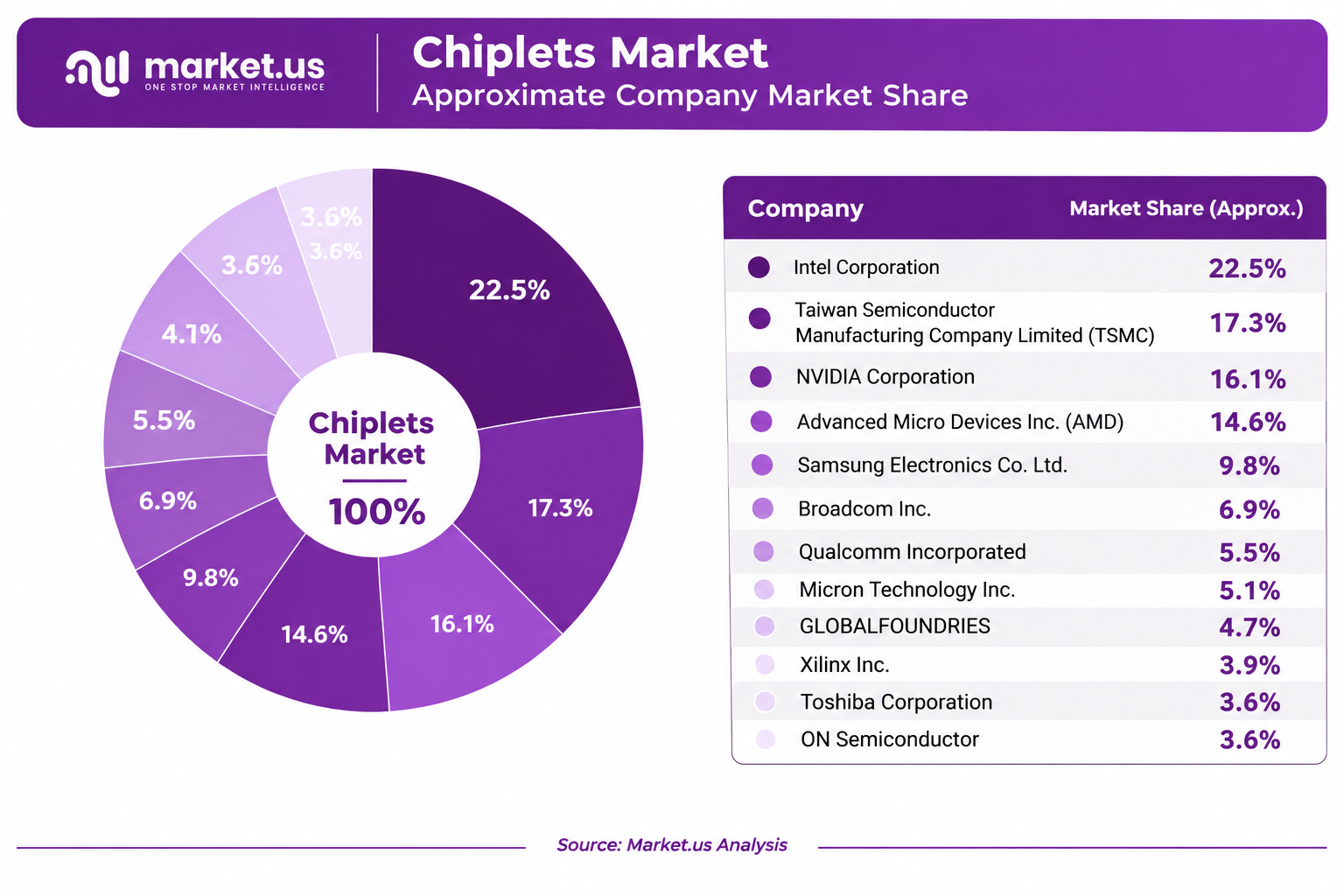
The chiplet ecosystem does not have a consistently published, independently audited company-level market-share dataset. Chiplet revenue is also not separately disclosed by most semiconductor manufacturers. Their participation spans chiplet design, intellectual property, wafer fabrication, advanced packaging, memory integration, and die-to-die connectivity.
Intel Corporation
Intel Corporation is a major semiconductor manufacturer with expertise in processor architecture, advanced packaging, and heterogeneous integration. Its Foveros 3D packaging and Embedded Multi-die Interconnect Bridge (EMIB) technologies provide an important foundation for combining multiple semiconductor dies into high-performance computing products.
a) Company Overview Table
| Attribute | Company Data |
|---|---|
| Company Name | Intel Corporation |
| Ticker Symbol | NASDAQ: INTC |
| Industry | Semiconductors |
| Headquarters | Santa Clara, California, USA |
| Founded | 1968 |
| Founders | Robert Noyce and Gordon Moore |
| Current CEO | Lip-Bu Tan |
| Latest Quarterly Revenue | USD 16.5 billion, Q3 2026 |
| YoY Revenue Growth | 21% |
| Primary Segments | Client Computing, Data Center and AI, Intel Foundry, Network and Edge |
b) Financial Details
Intel reported third-quarter 2026 revenue of USD 16.5 billion, representing 21% year-over-year growth. The company continued investing in process technology and advanced packaging to support its manufacturing and product roadmap.
c) Strategic Developments
-
March 2024: Intel demonstrated its Optical Compute Interconnect chiplet at the Optical Fiber Communications Conference. The technology supported a bidirectional data rate of 4 terabits per second, targeting high-bandwidth AI infrastructure.
-
January 2024: Intel opened Fab 9 in New Mexico, supported by a reported USD 3.5 billion investment in advanced semiconductor packaging.
-
Intel continues to develop Foveros and EMIB packaging technologies to improve integration density, performance, and manufacturing flexibility.
Advanced Micro Devices Inc. (AMD)
Advanced Micro Devices is a leading fabless semiconductor company specializing in high-performance CPUs, GPUs, and adaptive computing. Its chiplet architecture allows the company to combine processing dies and input/output components to improve scalability, product flexibility, and manufacturing efficiency.
a) Company Overview Table
| Attribute | Company Data |
|---|---|
| Company Name | Advanced Micro Devices Inc. |
| Ticker Symbol | NASDAQ: AMD |
| Industry | Semiconductors |
| Headquarters | Santa Clara, California, USA |
| Founded | 1969 |
| Founders | Jerry Sanders and seven co-founders |
| Current CEO | Dr. Lisa Su |
| Latest Quarterly Revenue | USD 13.4 billion, Q3 2026 |
| Primary Segments | Data Center, Client and Gaming, Embedded |
b) Financial Details
AMD reported record third-quarter 2026 revenue of USD 13.4 billion, with gross margin of 54% and operating income of USD 2.8 billion. Its Data Center segment recorded 97% year-over-year growth, supported by Instinct GPU and EPYC processor demand. These products strengthen the commercial importance of AMD’s chiplet-based architectures. However, AMD does not disclose separate chiplet revenue or margins.
c) Strategic Developments
-
August 2026: AMD announced Universal Chiplet Interconnect Express (UCIe) 1.1 connectivity for selected Versal RF adaptive SoCs, enabling communication with specialized co-packaged chiplets.
-
February 2023: AMD completed its acquisition of Xilinx, strengthening its adaptive computing portfolio and expanding its FPGA and heterogeneous integration capabilities.
-
AMD continues developing multi-die processor architectures and high-performance computing platforms for AI and data center applications.
Taiwan Semiconductor Manufacturing Company Limited (TSMC)
Taiwan Semiconductor Manufacturing Company is a leading pure-play semiconductor foundry. Its chiplet ecosystem is supported by advanced wafer fabrication, System on Integrated Chips (SoIC), Chip-on-Wafer-on-Substrate (CoWoS), and integrated packaging capabilities that allow customers to combine multiple dies within sophisticated semiconductor packages.
a) Company Overview Table
| Attribute | Company Data |
|---|---|
| Company Name | Taiwan Semiconductor Manufacturing Company Limited |
| Ticker Symbol | NYSE: TSM |
| Industry | Semiconductor Foundry |
| Headquarters | Hsinchu, Taiwan |
| Founded | 1987 |
| Founders | Morris Chang |
| Current CEO | C.C. Wei |
| Latest Quarterly Revenue | USD 46.72 billion, Q3 2026 |
| YoY Revenue Growth | 41.2% in USD |
| Primary Segments | Wafer Fabrication, Advanced Packaging, Specialty Technologies |
b) Financial Details
TSMC reported third-quarter 2026 revenue of USD 46.72 billion, representing 41.2% year-over-year growth in US dollar terms. Net income reached NT$763.06 billion, while gross margin was 66.4%. Advanced manufacturing technologies accounted for 79% of wafer revenue. Although these results demonstrate strong demand for advanced semiconductor production, TSMC does not separately disclose chiplet-specific revenue.
c) Strategic Developments
-
TSMC continues expanding its CoWoS advanced packaging capabilities to address growing demand for AI accelerators and high-performance computing processors.
-
Its SoIC technology supports three-dimensional integration of semiconductor dies, providing a foundation for advanced chiplet architectures.
-
TSMC continues working with fabless semiconductor customers to integrate advanced process nodes, high-bandwidth memory, and multi-die packaging into next-generation products.
NVIDIA Corporation
NVIDIA Corporation is a leading AI and accelerated computing company. Its technological strength comes from GPU architecture, high-bandwidth memory integration, networking, and advanced packaging. Its multi-die computing platforms benefit from the same heterogeneous integration developments driving the wider chiplet ecosystem.
a) Company Overview Table
| Attribute | Company Data |
|---|---|
| Company Name | NVIDIA Corporation |
| Ticker Symbol | NASDAQ: NVDA |
| Industry | Semiconductors and AI Computing |
| Headquarters | Santa Clara, California, USA |
| Founded | 1993 |
| Founders | Jensen Huang, Chris Malachowsky and Curtis Priem |
| Current CEO | Colette Kress, interim CEO as reported in the latest release |
| Latest Quarterly Revenue | USD 115.8 billion, Q3 FY2027 |
| YoY Revenue Growth | 103% |
| Primary Segments | Data Center, Gaming, Professional Visualization, Automotive |
b) Financial Details
NVIDIA reported revenue of USD 115.8 billion for its third quarter of fiscal 2027, an increase of 103% year over year. Data Center revenue reached USD 107.6 billion, growing 110%. The company’s AI computing platforms create substantial demand for advanced packaging, high-bandwidth memory, and high-density semiconductor integration. Nevertheless, NVIDIA does not separately disclose chiplet-related revenue.
c) Strategic Developments
-
November 2026: NVIDIA announced that its Vera Rubin NVL72 computing platform had shipped, extending its AI infrastructure roadmap.
-
NVIDIA continues strengthening its accelerated computing ecosystem through GPU, networking, memory, and advanced packaging integration.
-
The company’s expanding AI infrastructure business supports demand for advanced semiconductor packaging and heterogeneous computing technologies.
Samsung Electronics Co. Ltd.
Samsung Electronics operates across memory semiconductors, logic chips, foundry services, and advanced packaging. Its high-bandwidth memory capabilities and heterogeneous integration technologies provide an important competitive advantage in the development of high-performance chiplet-based semiconductor systems.
a) Company Overview Table
| Attribute | Company Data |
|---|---|
| Company Name | Samsung Electronics Co. Ltd. |
| Ticker Symbol | KRX: 005930 |
| Industry | Semiconductors and Electronics |
| Headquarters | Suwon, South Korea |
| Founded | 1969 |
| Founders | Samsung Group, founded by Lee Byung-chul |
| Current CEO | Jun Young-hyun and TM Roh, co-CEOs |
| Latest Quarterly Revenue | KRW 195.3 trillion, Q3 2026 |
| YoY Revenue Growth | Approximately 127% |
| Primary Segments | Device Solutions, Device eXperience, Samsung Display, Harman |
b) Financial Details
Samsung Electronics reported third-quarter 2026 consolidated revenue of KRW 195.3 trillion, with operating profit of KRW 107.4 trillion. Its Device Solutions division generated KRW 147.1 trillion in revenue. Strong memory demand and semiconductor production activity support its position in advanced chip integration. However, chiplet-specific sales and packaging revenue are not separately disclosed.
c) Strategic Developments
-
Samsung continues developing its I-Cube and X-Cube advanced packaging technologies to support heterogeneous semiconductor integration.
-
Its memory business is strengthening its position in AI-related applications through high-bandwidth memory products.
-
Samsung is expanding its semiconductor manufacturing and advanced packaging capabilities to address growing demand for high-performance computing.
GLOBALFOUNDRIES
GLOBALFOUNDRIES is a semiconductor manufacturing company focused on specialty process technologies, radio-frequency applications, connectivity, and power-efficient semiconductor solutions. Its manufacturing expertise supports chiplet ecosystems requiring different process technologies and integration of specialized semiconductor dies.
a) Company Overview Table
| Attribute | Company Data |
|---|---|
| Company Name | GLOBALFOUNDRIES Inc. |
| Ticker Symbol | NASDAQ: GFS |
| Industry | Semiconductor Manufacturing |
| Headquarters | Malta, New York, USA |
| Founded | 2009 |
| Founders | Established through the separation of AMD manufacturing operations |
| Current CEO | Tim Breen |
| Latest Quarterly Revenue | USD 1.899 billion, Q3 2026 |
| Primary Segments | Communications Infrastructure, Data Center, Automotive, IoT and Home and Industrial |
b) Financial Details
GLOBALFOUNDRIES reported third-quarter 2026 revenue of USD 1.899 billion, with a gross margin of 30.1%. The company recorded strong momentum in communications infrastructure and data center applications. Its specialty manufacturing technologies are relevant to chiplet architectures that combine different semiconductor processes. However, dedicated chiplet revenue and advanced integration contributions were not separately disclosed.
c) Strategic Developments
-
GLOBALFOUNDRIES continues developing specialty manufacturing technologies for automotive, communications, and data center applications.
-
The company is strengthening its manufacturing capabilities for high-value semiconductor applications, including technologies that can support heterogeneous integration.
-
Its manufacturing footprint provides customers with alternatives for specialty semiconductor production outside the most advanced logic nodes.
Xilinx Inc.
Xilinx was a major supplier of programmable logic devices and adaptive computing technologies. Its FPGA and adaptive SoC technologies remain relevant to chiplet-based systems that require customized processing and heterogeneous integration. Xilinx is now part of AMD and does not operate as an independent publicly listed competitor.
a) Company Overview Table
| Attribute | Company Data |
|---|---|
| Company Name | Xilinx Inc. |
| Ticker Symbol | No independent ticker |
| Industry | Programmable Semiconductors |
| Headquarters | San Jose, California, USA, historically |
| Founded | 1984 |
| Founders | Ross Freeman, Bernard Vonderschmitt and James V Barnett II |
| Current CEO | Integrated into AMD; no separate CEO |
| Primary Segments | FPGA, Adaptive SoCs, Programmable Logic and Embedded Computing |
b) Financial Details
Xilinx was acquired by AMD in February 2022, and its financial performance is now included within AMD’s consolidated reporting. AMD does not publish a separate quarterly revenue figure for the former Xilinx business or its contribution to chiplet-related operations.
c) Strategic Developments
-
February 2022: AMD completed its acquisition of Xilinx in an approximately USD 49 billion all-stock transaction based on the announced deal valuation.
-
The integration expanded AMD’s adaptive computing portfolio, including FPGA and adaptive SoC technologies.
-
AMD’s August 2026 UCIe announcement for selected Versal RF devices demonstrates continued development of the adaptive computing portfolio inherited from Xilinx.
Micron Technology Inc.
Micron Technology is a major memory semiconductor manufacturer specializing in DRAM, NAND, and high-bandwidth memory technologies. Its products are important components of AI accelerators and advanced computing systems, where memory bandwidth, power efficiency, and physical integration influence chiplet architecture performance.
a) Company Overview Table
| Attribute | Company Data |
|---|---|
| Company Name | Micron Technology Inc. |
| Ticker Symbol | NASDAQ: MU |
| Industry | Memory Semiconductors |
| Headquarters | Boise, Idaho, USA |
| Founded | 1978 |
| Founders | Ward Parkinson, Joe Parkinson, Dennis Wilson and Doug Pitman |
| Current CEO | Sanjay Mehrotra |
| Latest Quarterly Revenue | USD 54.23 billion, Q4 FY2026 |
| YoY Revenue Growth | Approximately 379% |
| Primary Segments | Compute and Networking Business Unit, Mobile Business Unit, Embedded Business Unit, Storage Business Unit |
b) Financial Details
Micron reported record fiscal fourth-quarter 2026 revenue of USD 54.23 billion, compared with USD 11.32 billion in the corresponding previous-year quarter. Growth was supported by strong AI-driven memory demand and operational execution. Its high-bandwidth memory technologies are important for chiplet-based AI computing systems. However, the company does not separately report chiplet-specific revenue.
c) Strategic Developments
-
Micron continues expanding its high-bandwidth memory portfolio to address AI accelerator and data center demand.
-
The company is investing in memory manufacturing and advanced technology development to improve bandwidth, capacity, and energy efficiency.
-
Its memory products remain important components in heterogeneous computing architectures that combine logic dies and memory technologies.
Broadcom Inc.
Broadcom Inc. is a semiconductor designer with a strong presence in custom AI accelerators, networking, and connectivity technologies. Its custom silicon business supports hyperscale data center customers and benefits from advanced packaging solutions that integrate processing, memory, and networking components.
a) Company Overview Table
| Attribute | Company Data |
|---|---|
| Company Name | Broadcom Inc. |
| Ticker Symbol | NASDAQ: AVGO |
| Industry | Semiconductors and Infrastructure Software |
| Headquarters | Palo Alto, California, USA |
| Founded | 1961, as HP’s semiconductor products business predecessor |
| Founders | Hewlett-Packard founders Bill Hewlett and David Packard, historical business origin |
| Current CEO | Hock Tan |
| Latest Quarterly Revenue | USD 29.6 billion, Q3 FY2026 |
| YoY Revenue Growth | 86% |
| Primary Segments | Semiconductor Solutions and Infrastructure Software |
b) Financial Details
Broadcom generated USD 29.6 billion in third-quarter fiscal 2026 revenue, representing 86% year-over-year growth. AI semiconductor revenue reached USD 16.7 billion, growing 221% year over year.
c) Strategic Developments
-
September 2026: Broadcom reported AI semiconductor revenue of USD 16.7 billion for Q3 FY2026, supported by custom AI accelerator and networking demand.
-
The company forecast fourth-quarter fiscal 2026 revenue of approximately USD 34.8 billion.
-
Broadcom continues developing custom silicon and networking solutions for hyperscale computing customers, supporting demand for advanced semiconductor integration.
Qualcomm Incorporated
Qualcomm Incorporated develops mobile processors, connectivity chipsets, automotive semiconductors, and computing platforms. Its expertise in heterogeneous processing and integrated semiconductor architectures provides opportunities in chiplet-enabled computing, particularly across connectivity, automotive, and emerging data center applications.
a) Company Overview Table
| Attribute | Company Data |
|---|---|
| Company Name | Qualcomm Incorporated |
| Ticker Symbol | NASDAQ: QCOM |
| Industry | Semiconductors and Wireless Technology |
| Headquarters | San Diego, California, USA |
| Founded | 1985 |
| Founders | Irwin Jacobs, Andrew Viterbi and co-founders |
| Current CEO | Cristiano Amon |
| Latest Quarterly Revenue | USD 10.322 billion, Q4 FY2026 |
| YoY Revenue Growth | -8% |
| Primary Segments | Qualcomm CDMA Technologies, Qualcomm Technology Licensing, Qualcomm Strategic Initiatives |
b) Financial Details
Qualcomm reported fiscal fourth-quarter 2026 revenue of USD 10.322 billion, down 8% year over year. Its combined automotive and IoT revenues recorded 36% year-over-year growth. The company also announced a multi-generational product collaboration with Amazon for AI data centers and maintained a fiscal 2027 data center revenue target of USD 5 billion.
c) Strategic Developments
-
November 2026: Qualcomm announced a multi-generational product collaboration with Amazon focused on AI data center applications.
-
The company reiterated a fiscal 2027 data center revenue target of USD 5 billion.
-
Qualcomm continues expanding its automotive and IoT semiconductor portfolio, increasing its participation in specialized computing applications.
Toshiba Corporation
Toshiba Corporation operates across industrial systems, electronic components, power devices, and storage technologies. Its semiconductor expertise supports specialized industrial and power applications. Its contribution to the chiplet market is more specialized than that of leading CPU and GPU chiplet developers.
a) Company Overview Table
| Attribute | Company Data |
|---|---|
| Company Name | Toshiba Corporation |
| Ticker Symbol | Not publicly listed; delisted in December 2023 |
| Industry | Industrial Technology and Electronics |
| Headquarters | Kawasaki, Kanagawa, Japan |
| Founded | 1875 |
| Founders | Historical predecessor companies include Tanaka Seizo-sho and Hakunetsu-sha |
| Current CEO | Taro Shimada |
| Primary Segments | Energy Systems, Infrastructure, Electronic Devices, Digital Solutions |
b) Financial Details
Toshiba’s common shares were delisted in December 2023 following its privatization. The company published its FY2026 first-half business results on November 13, 2026. Its corporate financial reporting does not provide a separately identifiable chiplet revenue category.
c) Strategic Developments
-
Toshiba’s semiconductor and electronic-device operations continue supporting industrial, power management, and specialized computing applications.
-
The company published its FY2026 first-half business results in November 2026.
-
Its contribution to the chiplet ecosystem remains focused on specialized semiconductor technologies rather than large-scale commercial CPU and GPU chiplet platforms.
ON Semiconductor (onsemi)
onsemi develops power semiconductors, intelligent sensing products, and automotive semiconductor solutions. Its strengths in silicon carbide, power management, and sensing technologies support specialized semiconductor integration in automotive, industrial, and energy-related computing applications.
a) Company Overview Table
| Attribute | Company Data |
|---|---|
| Company Name | onsemi (ON Semiconductor Corporation) |
| Ticker Symbol | NASDAQ: ON |
| Industry | Power and Intelligent Sensing Semiconductors |
| Headquarters | Scottsdale, Arizona, USA |
| Founded | 1999 |
| Founders | Established as a Motorola semiconductor spin-off |
| Current CEO | Hassane El-Khoury |
| Latest Quarterly Revenue | USD 1.7223 billion, Q3 2026 |
| YoY Revenue Growth | 11% |
| Primary Segments | Power Solutions Group, Analog and Mixed-Signal Group, Intelligent Sensing Group |
b) Financial Details
onsemi reported third-quarter 2026 revenue of USD 1.7223 billion, representing 11% year-over-year growth. GAAP gross margin reached 41.4%, while operating cash flow increased to USD 516 million.
c) Strategic Developments
-
November 2026: onsemi reported third-quarter revenue growth of 11%, supported by stronger demand in AI data center and industrial markets.
-
The company reported that AI data center revenue increased 175% year over year.
- onsemi’s silicon carbide and power semiconductor technologies support efficient power delivery and management in advanced computing infrastructure.
Conclusion
The global Chiplets Market is entering a significant growth phase as semiconductor manufacturers increasingly adopt modular architectures to overcome the physical and economic limitations of traditional monolithic chip designs. Intel, AMD, and TSMC are particularly well positioned because of their combined expertise in chiplet architecture, advanced fabrication, and semiconductor packaging. NVIDIA and Broadcom are benefiting from growing AI infrastructure requirements, while Samsung and Micron are strengthening the memory integration ecosystem.



