Introduction
The global Green Technology sector integrates environmental sustainability with digital infrastructure, leveraging IoT, cloud computing, AI analytics, digital twins, cybersecurity, and blockchain to curb carbon emissions and optimize resource efficiency. Expansion is propelled by government subsidies, tax incentives, feed-in tariffs, and stringent environmental regulations, though high upfront capital expenditure and legacy fossil-fuel policies remain structural restraints. Across 2025 and 2026, accelerating electrification, grid modernization, and energy-efficient data center buildouts driven by AI workloads have intensified enterprise demand, positioning industrial energy-technology leaders and enterprise sustainability software vendors at the core of market growth.
Market Size & Statistics
- The Global Green Technology Market was valued at USD 13.8 Billion in the 2022 base year.
- The market is projected to expand to USD 112.4 Billion by 2032.
- The industry is forecast to grow at a Compound Annual Growth Rate (CAGR) of 24.0% from 2023 to 2032.
- By component, the Solutions segment dominates the market with a 65% revenue share during the forecast period.
- By technology, the Internet of Things (IoT) segment leads the market with a revenue share of almost 38%.
- By application, the Non-Residential segment dominates market demand, driven by green buildings and carbon footprint management.
- Regionally, North America leads global green technology adoption and consumption.
- According to the World Economic Forum, Ethereum’s transition from Proof of Work to Proof of Stake is expected to reduce energy consumption by 99.0%.
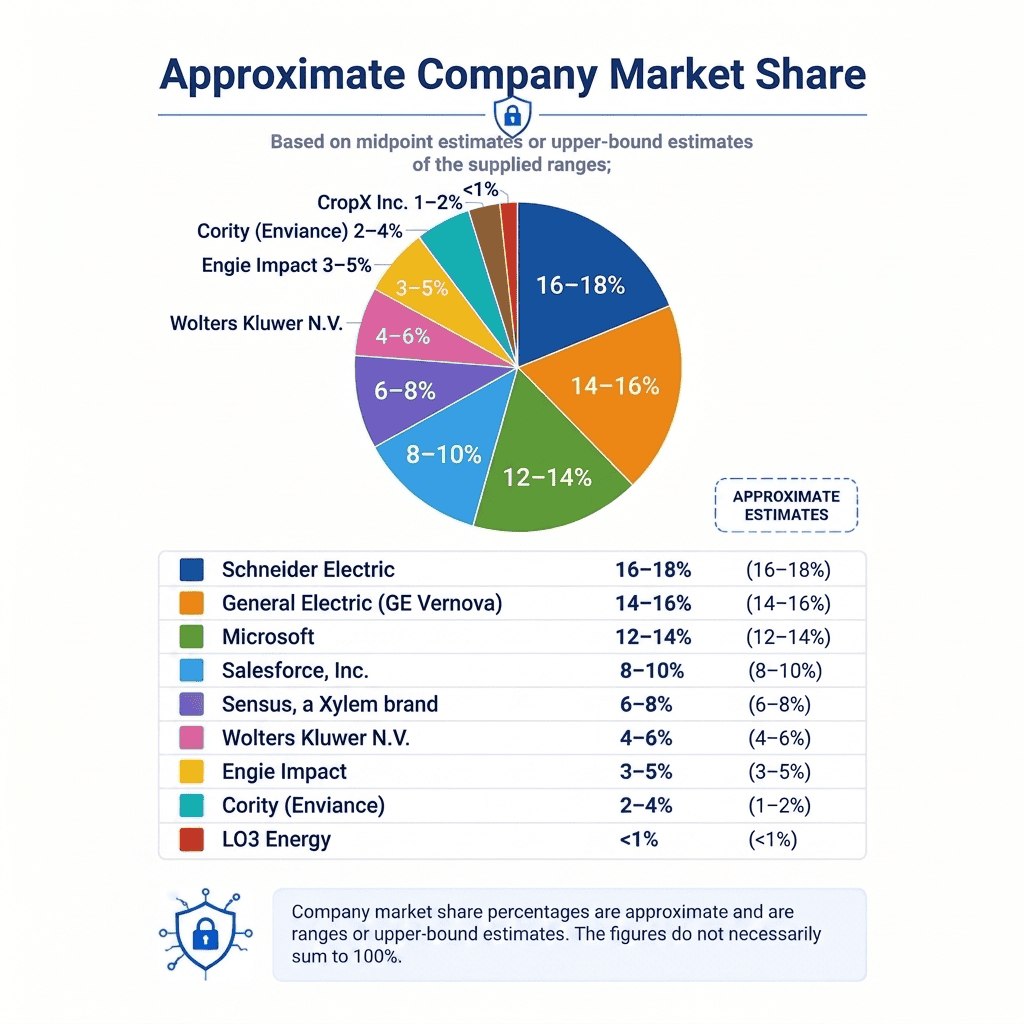
| Company | Green Technology Focus Area | Strategic Positioning & Footprint | Approx. Market Share (Estimate) |
|---|---|---|---|
| Schneider Electric | Energy Management, EcoStruxure, Resource Advisor sustainability software | Global leader in energy management (FY2025 Energy Management revenue: €33.13 Bn; Group revenue: €40.2 Bn) | ~16–18% |
| General Electric (GE Vernova) | Grid Solutions, Electrification Software, Wind, Power Conversion & Storage | Major grid and electrification provider (FY2025 revenue: USD 38.1 Bn; Electrification Software: USD 973 Mn) | ~14–16% |
| Microsoft | Microsoft Cloud for Sustainability, Azure IoT, AI emissions analytics | Hyperscale enterprise sustainability platform embedded across global Azure and Microsoft 365 ecosystems | ~12–14% |
| Salesforce, Inc. | Net Zero Cloud (carbon accounting, ESG reporting) | Leading enterprise CRM-integrated carbon accounting and automated ESG disclosure platform | ~8–10% |
| Sensus, a Xylem brand | Smart water, gas, and electric metering; IoT utility networks | Core utility infrastructure provider specializing in FlexNet communication networks and smart metering | ~6–8% |
| Wolters Kluwer N.V. | Enablon EHS and ESG management software | Established enterprise EHS, operational risk, and ESG compliance software provider for heavy industry | ~4–6% |
| Engie Impact | Sustainability consulting, decarbonization, and energy-data platforms | Specialized corporate decarbonization advisory backed by global energy utility Engie | ~3–5% |
| Cority (Enviance) | EHS, environmental compliance, and air-emissions software | Dedicated cloud EHSQ and environmental compliance suite serving regulated industrial enterprises | ~2–4% |
| CropX Inc. | IoT soil sensing and precision agriculture analytics | AgTech specialist focused on soil-sensor telemetry, irrigation optimization, and sustainable farming | ~1–2% |
| LO3 Energy | Blockchain-based peer-to-peer energy trading (Exergy platform) | Niche innovator in decentralized microgrid management and transactive energy markets | <1% |
Note: Market share percentages are analytical estimates of relative positioning based on sector scale, portfolio breadth, and industry footprint.
Top Companies List
- Schneider Electric
- General Electric (GE Vernova)
- Microsoft
- Salesforce, Inc.
- Sensus, a Xylem brand
- Wolters Kluwer N.V.
- Engie Impact
- Cority (Enviance)
- CropX Inc.
- LO3 Energy
1. Schneider Electric
About Schneider Electric: Schneider Electric is a global energy technology leader. It combines electrification, automation, and digital software (EcoStruxure, AVEVA, and Resource Advisor) to decarbonize buildings, grids, industry, and data centers. Its moat is a full hardware-to-software stack built on a large installed base, and it has ranked first in TIME and Statista’s World’s Most Sustainable Companies list for three years running (2024–2026).
a) Company Overview Table
| Attribute | Company Data |
|---|---|
| Company Name | Schneider Electric SE |
| Ticker Symbol | SU (Euronext Paris); SBGSY (OTC ADR) |
| Industry | Energy Management & Industrial Automation (Energy Technology) |
| Headquarters | Rueil-Malmaison, France |
| Founded | 1836 |
| Founders | Adolphe Schneider and Eugène Schneider |
| Current CEO | Olivier Blum |
| Latest Quarterly Revenue | €11,460 Million (Q3 2026) |
| YoY Revenue Growth | +17.9% reported; +16.9% organic (Q3 2026) |
| Primary Segments | Energy Management; Industrial Automation |
b) Financial Details
Schneider Electric posted record Q3 2026 revenue of €11,460 million, up 17.9% reported and 16.9% organically, the highest of any quarter in its history. Energy Management, the segment behind its green technology work (electrification, microgrids, EV charging and energy-efficiency systems), grew 19.6% reported and 18.8% organically to €9,615 million.
That is about 84% of group revenue. North America led with 19.9% organic growth to €4,637 million, and Systems sales rose about 22% organically. Data center demand grew at a triple-digit rate. Nine-month 2026 revenue reached €32,686 million, up 15.0% organically. The company raised its full-year 2026 guidance to 12%–14% organic revenue growth and 18%–21% organic Adjusted EBITA growth.
c) Strategic Developments
- October 2026: Signed a definitive agreement to acquire PTC Inc. for $205 per share in cash, valuing PTC’s equity at about USD 22.6 Billion (USD 23.7 Billion enterprise value). Schneider expects €250 Million in cost synergies by year 3 and about €800 Million in revenue synergies, with closing expected by Q3 2027.
- November 2026: Received early termination of the US Federal Trade Commission waiting period for the PTC acquisition.
- September 2026: Agreed to acquire Shelly Group, a smart-home and IoT energy device maker, through a voluntary tender offer valued at about €1.2 Billion.
- November 2026: Announced it will double liquid-cooling CDU manufacturing capacity at its Conselve, Italy plant from January 2027 and raise Big Chiller capacity by 50% by end-2026. The expansion builds on its Motivair acquisition and targets energy-efficient AI data centers.
- Sustainability Impact 2030: The program reached a score of 4.04 in Q3 2026.
2. General Electric (GE Vernova)
About General Electric (GE Vernova): GE Vernova is the energy business spun off from General Electric. It works across power generation, grid electrification and wind to help the world electrify and decarbonize. Its moat is a huge installed base of turbines and grid equipment, a record USD 197 Billion backlog and a vertically integrated high-voltage transmission portfolio.
a) Company Overview Table
| Attribute | Company Data |
|---|---|
| General Electric (GE Vernova) | GE Vernova Inc. (spun off from General Electric) |
| Ticker Symbol | GEV (NYSE) |
| Industry | Energy Technology – Power Generation, Grid Electrification & Wind |
| Headquarters | Cambridge, Massachusetts, United States |
| Founded | 2024 (spin-off from General Electric; GE founded 1892) |
| Founders | General Electric (parent); GE originally founded by Thomas Edison, Charles Coffin, Elihu Thomson and Edwin Houston |
| Current CEO | Scott Strazik |
| Latest Quarterly Revenue | USD 12,642 Million (Q3 2026) |
| YoY Revenue Growth | +27% reported; +18% organic (Q3 2026) |
| Primary Segments | Power; Electrification; Wind |
b) Financial Details
GE Vernova reported Q3 2026 revenue of USD 12,642 Million, up 27% reported and 18% organically, with net income of USD 1.3 Billion. Orders rose 96% organically to USD 29.3 Billion, lifting the backlog to a record USD 197 Billion. The Electrification segment, which drives grid modernization and renewable integration, grew revenue 51% to USD 3,862 Million (16% organically).
That growth came from AC substation solutions, HVDC systems, switchgear and transformers. Electrification orders fell 9% organically to USD 5.4 Billion because of tough comparisons with a year earlier, but the segment’s equipment backlog still reached USD 42.2 Billion. The Wind segment grew revenue 4% to USD 2,741 Million and posted a small EBITDA profit of USD 72 Million. Management still expects a full-year Wind EBITDA loss of USD 400–500 Million. GE Vernova raised its 2026 revenue guidance to USD 46.5–47.5 Billion.
c) Strategic Developments
- October 2026: Agreed to buy Trench Group, a high-voltage grid equipment maker, from Triton Partners for about USD 9.0 Billion. Closing is expected in late 2027, and Trench is projected to generate USD 1.9 Billion in revenue at about a 36% adjusted EBITDA margin by 2028.
- February 2026: Completed the purchase of the remaining 50% of Prolec GE from Xignux for USD 5.275 Billion. This brought the transformer business fully into the Electrification segment.
- October 2026: The Board doubled the share repurchase authorization from USD 10 Billion to USD 20 Billion.
- Grid demand: Electrification orders linked to data centers passed USD 5 Billion in the first half of 2026.
3. Microsoft
About Microsoft: Microsoft brings green technology to enterprises at hyperscale through Microsoft Cloud for Sustainability, Azure IoT and AI-driven emissions analytics. Its moat is the reach of Azure, Microsoft 365 and Dynamics 365. It is also one of the world’s largest corporate buyers of clean energy, with 40 GW of renewables contracted across 26 countries.
a) Company Overview Table
| Attribute | Company Data |
|---|---|
| Microsoft | Microsoft Corporation |
| Ticker Symbol | MSFT (NASDAQ) |
| Industry | Cloud Computing, Enterprise Software & AI Infrastructure |
| Headquarters | Redmond, Washington, United States |
| Founded | 1975 |
| Founders | Bill Gates and Paul Allen |
| Current CEO | Satya Nadella |
| Latest Quarterly Revenue | USD 92,279 Million (Q1 FY2027, quarter ended September 30, 2026) |
| YoY Revenue Growth | +19% (Q1 FY2027) |
| Primary Segments | Agents and Infra; Devices and Consumer |
b) Financial Details
Microsoft reported Q1 FY2027 revenue of USD 92,279 Million, up 19% from USD 77,673 Million a year earlier. Operating income rose 21% to USD 45.9 Billion, and net income reached USD 36.6 Billion. Microsoft does not report revenue for its sustainability products separately.
Its green technology offerings, including Microsoft Cloud for Sustainability, Azure IoT and the emissions tools in Dynamics 365, sit within Microsoft Cloud, which grew 30% to USD 63.9 Billion. Azure revenue rose 48% to USD 33.2 Billion, and Industry solutions cloud, which includes Dynamics 365, grew 10%. For Q2 FY2027, management guided to revenue of USD 96–97.1 Billion, or 18–19% growth.
c) Strategic Developments
- February 2026: Matched 100% of its annual global electricity use with renewable energy, meeting its 2025 goal. It has contracted 40 GW of new renewable supply across 26 countries through more than 400 contracts, and 19 GW of that is now online.
- September–October 2026: Disclosed that it signed offtake agreements for 80 million tonnes of additional carbon dioxide removal between mid-2023 and summer 2026, in support of its carbon-negative-by-2030 goal.
- August 2026: Signed a carbon removal agreement with Crew Carbon for up to 23,602 units from wastewater alkalinity enhancement. It also signed deals with BioCirc (650,000 tonnes, bioenergy carbon capture and storage) and Alt Carbon (36,920 tonnes, enhanced rock weathering in Darjeeling, India).
- Renewable PPAs: Its contracts include a 500+ MW solar agreement with Sol Systems, a 250 MW agreement with Volt Energy Utility, a 15-year agreement with FRV Australia and a wind repowering agreement with ENGIE in France.
- November 2026: Building a second data center in Auckland, New Zealand. The NZ North Cloud Region runs on a 10-year geothermal power agreement with Contact Energy (Te Huka 3, 51 MW) and uses air cooling, so it uses no water for cooling.
4. Salesforce, Inc.
About Salesforce, Inc.: Salesforce is the world’s leading AI CRM company. Its green technology footprint comes from its Net Zero Cloud sustainability management platform, which handles carbon accounting, energy-use tracking and ESG reporting. Its moat is a CRM-native data model plus Agentforce AI agents, which bring emissions data into enterprise workflows. It also runs a Net Zero Marketplace for buying carbon credits.
a) Company Overview Table
| Attribute | Company Data |
|---|---|
| Salesforce, Inc. | Salesforce, Inc. |
| Ticker Symbol | CRM (NYSE) |
| Industry | Enterprise Cloud Software – AI CRM & Sustainability Management |
| Headquarters | San Francisco, California, United States |
| Founded | 1999 |
| Founders | Marc Benioff, Parker Harris, Dave Moellenhoff and Frank Domingues |
| Current CEO | Marc Benioff (Chair and CEO) |
| Latest Quarterly Revenue | USD 11,350 Million (Q2 FY2027, quarter ended July 31, 2026) |
| YoY Revenue Growth | +11% reported (approx. +6% organic, excluding Informatica) |
| Primary Segments | Subscription & Support (Sales, Service, Platform & Slack, Marketing & Commerce, Integration & Analytics); Professional Services |
b) Financial Details
Salesforce posted record Q2 FY2027 revenue of USD 11.35 Billion, up 11% from a year earlier. That includes USD 456 Million from Informatica, so organic growth was about 6%. Subscription and support revenue rose 12% to USD 10.82 Billion. Current remaining performance obligation (cRPO) grew 14% to USD 33.5 Billion, and total RPO reached USD 66.3 Billion.
Salesforce does not report Net Zero Cloud revenue separately; it sits within subscription and support. Agentforce ARR, the AI layer increasingly built into its sustainability workflows, reached USD 1.5 Billion. Free cash flow rose 81.5% to USD 1.10 Billion, and the non-GAAP operating margin was 34.1%. Management raised FY2027 revenue guidance to USD 46.1–46.4 Billion and guided Q3 revenue to USD 11.42–11.50 Billion (11–12% growth).
c) Strategic Developments
- Product evolution: Net Zero Cloud has been renamed and repositioned as a complete sustainability management solution. It calculates greenhouse gas emissions using global emissions factors and collects, analyzes and reports energy-use data, alongside the Net Zero Marketplace for carbon credits.
- Agentic sustainability: Salesforce now promotes “agentic sustainability” with Agentforce. One example is Good360, which routes disaster-recovery donations three times faster and cuts its carbon footprint by up to 20%.
- March 2026: Published an updated Sustainable Bond Framework and Sustainability Bond Report to fund climate and sustainability projects.
- Operational commitments: Maintains net zero residual emissions across its full value chain and matches 100% of its global electricity use with renewable energy.
- M&A: The Informatica acquisition added about USD 456 Million in quarterly revenue and strengthens the data layer behind ESG reporting. Expected contributions from the Contentful and Fin acquisitions added USD 200 Million to FY2027 guidance.
5. Sensus, a Xylem brand
About Sensus, a Xylem brand: Sensus is Xylem’s smart metering and network technology brand. It gives investor-owned utilities, cooperatives and municipalities advanced metering infrastructure (AMI) for water, gas and electricity. Its moat is the FlexNet communication network, a large installed base of North American utility customers and data analytics that support water conservation and efficient use of energy.
a) Company Overview Table
| Attribute | Company Data |
|---|---|
| Sensus, a Xylem brand | Sensus (North American smart metering business of Xylem Inc.) |
| Ticker Symbol | XYL (NYSE – parent company Xylem Inc.) |
| Industry | Smart Utility Metering, AMI Networks & Water Technology |
| Headquarters | Morrisville (Raleigh), North Carolina, United States (Sensus); Washington, D.C., United States (Xylem) |
| Founded | Xylem founded 2011 (spin-off from ITT Corporation); Sensus acquired by Xylem in 2016 for USD 1.7 Billion |
| Founders | Xylem was created by ITT Corporation as an independent water technology spin-off |
| Current CEO | Matthew Pine (President and CEO, Xylem); Meredith Emmerich (EVP and President, Measurement & Control Solutions) |
| Latest Quarterly Revenue | USD 436 Million (Measurement & Control Solutions segment, Q3 2026); Xylem total: USD 2.2 Billion |
| YoY Revenue Growth | -16% reported; -5% organic (Measurement & Control Solutions, Q3 2026) |
| Primary Segments | Water Metering; Gas Metering; Electric Metering; FlexNet AMI Networks; Analytics & Software |
b) Financial Details
Xylem’s Measurement and Control Solutions segment, which includes the Sensus smart metering portfolio, reported Q3 2026 revenue of USD 436 Million. That was down 16% reported and 5% organically, mainly because of lower Electric Metering and Analytics volumes, a tough comparison with 11% growth a year earlier, and the sale of International Metrology.
Segment orders rose 13% reported and 30% organically to USD 504 Million, driven by large water and gas metering contracts. The book-to-bill ratio was 1.16, and the backlog stood at about USD 1.3 Billion, with deployments scheduled mainly for the second half of 2027 and into 2028. Segment EBITDA margin rose 270 basis points to 24.5%, helped by productivity gains, pricing and the divestiture. Xylem as a whole reported Q3 revenue of USD 2.2 Billion, down 3%, and lowered its full-year 2026 revenue guidance to about USD 8.95 Billion.
c) Strategic Developments
- May 2026: Completed the sale of its water and heat metering business outside North America to AURELIUS, which now runs it as Sensus International. Sensus North America remains part of Xylem as its main smart metering platform.
- October 2026: Announced that from January 1, 2027, Xylem will reorganize into three segments: Treatment and Services, Flow Solutions, and Measurement and Analytics. The Measurement and Analytics segment, which will include Sensus, will be led by Meredith Emmerich.
- Q3 2026: Won large water and gas AMI metering contracts that drove a 30% organic rise in segment orders, adding to a long-term deployment pipeline running into 2028.
- Utility deployments: Fort Worth Water installed Sensus AMI to provide data-driven network management and promote water conservation across its growing service area.
- Product innovation: Launched the Cordonel commercial and industrial (C&I) meter, with a unique flow tube that measures usage, flow, temperature and pressure across water networks.
6. Wolters Kluwer N.V.
About Wolters Kluwer N.V.: Wolters Kluwer is a global professional information and software company. Its green technology footprint runs through Enablon, an integrated EHS, ESG and operational risk software platform for heavy industry, chemicals and data centers. Its moat is deep regulatory expertise combined with cloud SaaS, and Enablon was named a Leader in the 2026 Verdantix Green Quadrant for Process Safety Management software.
a) Company Overview Table
| Attribute | Company Data |
|---|---|
| Wolters Kluwer N.V. | Wolters Kluwer N.V. |
| Ticker Symbol | WKL (Euronext Amsterdam); WTKWY (OTC ADR) |
| Industry | Professional Information, Software & Services – including EHS & ESG Software (Enablon) |
| Headquarters | Alphen aan den Rijn, the Netherlands |
| Founded | 1836 (J.B. Wolters); merged with Kluwer in 1987 |
| Founders | Jan-Berend Wolters and Æbele Everts Kluwer |
| Current CEO | Stacey Caywood (CEO and Chair of the Executive Board, since February 2026) |
| Latest Quarterly Revenue | Not reported quarterly; FY2025 annual revenue: €6.1 Billion |
| YoY Revenue Growth | +6% organic; +4% constant currency; +2% reported (9M 2026) |
| Primary Segments | Health; Tax & Accounting; Financial & Corporate Compliance; Legal & Regulatory; Corporate Performance & ESG |
b) Financial Details
In its nine-month 2026 trading update, Wolters Kluwer reported 6% organic group revenue growth, with a pick-up in the third quarter, and a 10% rise in adjusted operating profit in constant currencies. The Corporate Performance & ESG division, which houses Enablon, grew revenue 9% in constant currencies and 7% organically, helped by the StandardFusion and Marosa acquisitions.
Within it, the EHS & ESG unit, its green technology business, slowed to 3% organic growth from 10% a year earlier. Cloud and on-premise software revenue grew well, but implementation services fell amid geopolitical uncertainty in key regions. Management expects full-year 2026 organic growth for the division to match 2025’s 7%, and reaffirmed group guidance of about a 28.0% adjusted operating margin and €1,300–1,350 Million in adjusted free cash flow.
c) Strategic Developments
- January 2026: Acquired StandardFusion, a governance, risk and compliance (GRC) software provider, strengthening the Corporate Performance & ESG division.
- August 2026: Acquired Marosa for the Corporate Performance & ESG division. Total acquisition spending in the first nine months of 2026 was €145 Million.
- 2026 recognition: Enablon was named a Leader in the Verdantix Green Quadrant for Process Safety Management Software 2026, with the strongest showing in product capabilities.
- September 2026: Enablon won the 2026 Stratus Award for Cloud Computing (SaaS category) for connected operational risk management.
- Data center expansion: Enablon now markets integrated EHS, ESG and operational risk software to fast-growing data center operators, including at DCD Connect Virginia (November 2026).
- Leadership transition: Stacey Caywood formally succeeded Nancy McKinstry as CEO in February 2026.
7. Engie Impact
About Engie Impact: Engie Impact handles utility expense and data management, energy procurement and sustainability advice for multi-site and energy-intensive businesses. It manages energy, water, waste, telecom and carbon for over 1,000 clients, including 20% of the Fortune 500. Its moat is a 30-year operating record and large-scale utility data processing, now being combined with Arcadia’s AI utility data platform.
a) Company Overview Table
| Attribute | Company Data |
|---|---|
| Engie Impact | ENGIE Impact (utility data, energy procurement and sustainability advisory business; being acquired by Arcadia) |
| Ticker Symbol | Private (not listed); former parent ENGIE SA trades as ENGI (Euronext Paris) |
| Industry | Energy Management, Utility Data Analytics & Corporate Sustainability Advisory |
| Headquarters | Operates globally; acquirer Arcadia is based in Washington, D.C., United States |
| Founded | Launched by ENGIE in 2018, building on a 30-year operating history (including the former Ecova business) |
| Founders | Created by the ENGIE Group as its sustainability solutions business |
| Current CEO | Being integrated into Arcadia under Arcadia’s leadership; former parent ENGIE is led by CEO Catherine MacGregor |
| Latest Quarterly Revenue | Not separately reported; former parent ENGIE: implied Q3 2026 revenue of about €17.6 Billion (9M 2026: €54.27 Billion) |
| YoY Revenue Growth | ENGIE Group 9M 2026: +2.9% gross; +2.5% organic |
| Primary Segments | Utility Expense & Data Management; Energy Procurement; Sustainability Advisory; Carbon, Water, Waste & Telecom Management |
b) Financial Details
Engie Impact has never reported its own revenue, so the most reliable recent figures come from the Arcadia acquisition announcement. The combined Arcadia–ENGIE Impact platform will serve over 1,500 enterprise customers, including about 25% of the Fortune 500. It will manage over 4.5 Million meters worldwide and process over USD 30 Billion in annual utility payments. Deal terms were not disclosed.
For context, former parent ENGIE reported 9M 2026 revenue of €54.27 Billion, up 2.9% gross and 2.5% organically, which implies Q3 revenue of about €17.6 Billion. ENGIE signed more than 3 GW of power purchase agreements during those nine months. It expects full-year 2026 results at the upper end of its guidance range, with net recurring income (Group share) of €4.9–5.5 Billion, as it focuses on renewables, battery storage and networks.
c) Strategic Developments
- May 2026: Arcadia, an energy intelligence platform for businesses, signed a definitive agreement to acquire ENGIE Impact. The deal combines ENGIE Impact’s global scale with Arcadia’s AI-powered utility data platform across the full lifecycle of utility data, from bill payment to energy procurement.
- Integration: Customers of both companies keep uninterrupted service during integration and gain access to a wider set of energy management, decarbonization and procurement tools.
- Parent strategy: ENGIE has refocused on renewables, storage and networks. CEO Catherine MacGregor ruled out new nuclear investments after agreeing to sell ENGIE’s Belgian reactors to the Belgian state.
- October 2026: ENGIE and CMA CGM agreed to invest jointly in biomethane production in Le Havre, France.
- November 2026: A consortium of ENGIE and Orascom Construction reached financial close on its third Egyptian wind farm.
8. Cority (Enviance)
About Cority (Enviance): Cority is a Toronto-based provider of enterprise EHS+ software. Its CorityOne platform combines environmental compliance, air emissions management, safety, and ESG reporting, much of it built on the acquired Enviance environmental compliance technology. Its moat is AI-powered emissions calculation and permit analysis used by over 1,500 organizations, and it has been a Verdantix Green Quadrant Leader for seven years running.
a) Company Overview Table
| Attribute | Company Data |
|---|---|
| Cority (Enviance) | Cority Software Inc. (formerly Medgate; acquired Enviance environmental compliance software) |
| Ticker Symbol | Private (not publicly listed; backed by Thoma Bravo) |
| Industry | Environmental, Health, Safety & Quality (EHSQ) and ESG Software |
| Headquarters | 250 Bloor Street East, Toronto, Ontario, Canada |
| Founded | 1985 |
| Founders | Mark Wallace |
| Current CEO | Ryan Magee (President & CEO) |
| Latest Quarterly Revenue | Not publicly reported (private); estimated annual revenue of USD 146–158 million, or roughly USD 37–40 million per quarter |
| YoY Revenue Growth | Not publicly reported (private); third-party sources point to continued growth, with staff estimates of 518–800+ employees |
| Primary Segments | Environmental Compliance & Air Emissions; Health & Safety; Occupational Health; Quality Management; Sustainability & ESG Cloud |
b) Financial Details
As a private, Thoma Bravo-backed company, Cority does not publish quarterly results. Third-party estimates put its annual revenue at USD 146–158 million, with an estimated valuation of up to about USD 2 billion. These figures are unaudited and should be treated as directional. Recent announcements suggest its sustainability product line is gaining ground.
Cority won two 2026 Environment+Energy Leader Awards for its AI-driven Compliance Permit Analysis Agent and its Next-Gen Emissions Calculation Management Toolset. Those tools help more than 1,500 organizations automate environmental reporting and lower regulatory risk. In October 2026, it earned three G2 Fall 2026 Leader badges in Environmental Health & Safety (Enterprise) and Occupational Health & Safety (Enterprise and Overall), pointing to strong enterprise demand.
c) Strategic Developments
- Sustainability acquisitions: Bought Greenstone, a UK-based sustainability and ESG reporting software provider for enterprises, supply chains and asset managers. It was Cority’s third sustainability-focused acquisition in two years, after WeSustain, and Greenstone now sits within Cority’s Sustainability Cloud.
- Enviance integration: Bought Enviance, an environmental compliance and air-emissions software company. Its technology underpins Cority’s environmental module, alongside earlier acquisitions of IQS, Actio and Remedy Interactive.
- 2026 AI launches: Introduced Cortex AI and showcased customer AI use cases at its Converge Studio event, including the Compliance Permit Analysis Agent for environmental permits.
- 2026 recognition: Named a Leader in the Verdantix Green Quadrant for EHS Software for the seventh year running, and recognized in Verdantix’s 2026 Process Safety Management Software report.
- October 2026: Earned three G2 Fall 2026 Grid Leader badges across the EHS and Occupational Health categories.
9. CropX Inc.
About CropX Inc.: CropX is a digital agronomy company. It combines proprietary soil sensors, weather data, satellite imagery and AI agronomic models into one platform for precision irrigation, nutrient management and sustainability reporting. Its moat is a hardware-plus-software data loop built through eight acquisitions. It serves farms in over 70 countries and more than 80 crop types, cutting water, energy and fertilizer use.
a) Company Overview Table
| Attribute | Company Data |
|---|---|
| CropX Inc. | CropX Technologies Ltd. (CropX Inc.) |
| Ticker Symbol | Private (venture-backed; not publicly listed) |
| Industry | AgTech – Digital Agronomy, IoT Soil Sensing & Precision Irrigation |
| Headquarters | Tel Aviv, Israel (with offices in the United States, New Zealand, and Europe) |
| Founded | 2013 (New Zealand) |
| Founders | Founded in New Zealand to develop soil-sensor technology and digital agronomic platforms; Isaac Bentwich (founding CEO) |
| Current CEO | Tomer Tzach (CEO since February 2017) |
| Latest Quarterly Revenue | Not publicly reported (private); ARR approaching USD 20 million (August 2026), or roughly USD 5 million per quarter |
| YoY Revenue Growth | Not publicly reported (private); management describes the company as close to profitability, which it expects in 2027 |
| Primary Segments | Soil Sensing Hardware; Irrigation Management; Farm Management Software; Disease & Nutrient Management; Sustainability & Scope 3 Reporting; NIR Crop-Quality Measurement (SCIO) |
b) Financial Details
CropX does not publish quarterly financials. Its most recent disclosure came with the August 2026 SCIO acquisition, when the company said its ARR was approaching USD 20 million, implying roughly USD 5 million in recurring revenue per quarter, and that it expects to become profitable in 2027.
Management has called the business “very close to profitability”. CropX extended its Series C mainly to fund acquisitions rather than day-to-day operations, and that process is now complete, with an undisclosed mix of debt and equity secured. Its revenue base comes mostly from enterprise customers, including agribusinesses, irrigation companies and food companies. Its product focus is on reducing water use and agricultural emissions, for example by cutting irrigation by one-third on a Colorado farm.
c) Strategic Developments
- August 2026: Acquired SCIO, a portable near-infrared (NIR) spectroscopy company with about 10,000 devices deployed worldwide. It was CropX’s eighth acquisition since 2020 and its largest yet, extending the platform to pre- and post-harvest crop-quality measurement.
- May 2026: Launched an integration with the Cool Farm Platform to simplify Scope 3 emissions measurement and sustainability reporting for agribusinesses and food companies.
- April 2026: Added the Apex soil sensor to its portfolio, bringing high-resolution root-zone data into the platform for more precise irrigation.
- March 2026: Launched CropX Vision, an AI-powered canopy imaging tool that measures vineyard water stress from a single photo, now available worldwide.
- October 2026: Joined the Lincoln University McCain Foods NextGen Regenerative Farm in New Zealand as a collaborator, supplying soil sensing data.
- Funding history: Closed a USD 30 Million Series C in 2023, led by Aliaxis, with Newtree Impact joining later as a strategic investor. Acquisitions are funded through a mix of shares, cash and debt.
10. LO3 Energy
About LO3 Energy: LO3 Energy is a Brooklyn-based pioneer of blockchain-enabled transactive energy. It built the Exergy platform and the Brooklyn Microgrid, the world’s first blockchain-based peer-to-peer solar energy trading pilot. Its main asset was Pando, a white-label marketplace for utilities to manage distributed energy resources (DERs). Public activity has since largely stopped.
a) Company Overview Table
| Attribute | Company Data |
|---|---|
| LO3 Energy | LO3 Energy Inc. |
| Ticker Symbol | Private (venture-backed; not publicly listed) |
| Industry | Transactive Energy, Blockchain-Based DER Marketplaces & Microgrid Technology |
| Headquarters | Brooklyn, New York, United States |
| Founded | 2012 |
| Founders | Lawrence Orsini |
| Current CEO | Lawrence Orsini (Founder and CEO, last publicly listed) |
| Latest Quarterly Revenue | Not publicly reported (private); total recorded funding includes an USD 11.0 Million Series B (March 2021) |
| YoY Revenue Growth | Not publicly reported (private); no public commercial activity documented since its Brooklyn Microgrid pilot ended |
| Primary Segments | Pando DER Marketplace Platform; Exergy Transactive Energy Protocol; Smart Metering Hardware; Energy Program Advisory |
b) Financial Details
LO3 Energy has never published financial results, and no reliable recent revenue estimates exist. Its last recorded funding event was a USD 11.0 million Series B in March 2021. Before that, it raised strategic investments from Braemar Energy Ventures and Centrica Innovations in October 2017, plus an undisclosed investment from Shell. The company’s sector footprint has shrunk sharply since then.
Public activity on the Brooklyn Microgrid runs from its first trades in 2016 to a regulatory sandbox effort in 2019. A 2025 Electrosuisse review found the Brooklyn. energy site had not been updated since 2019, LO3’s website was gone, and the marketplace was no longer running. LO3 should therefore be seen as an early innovator in blockchain energy trading rather than an active commercial competitor in the green technology market today.
c) Strategic Developments
- March 2021: Raised an USD 11.0 Million Series B, its latest recorded funding round.
- October 2017: Received strategic investments from Braemar Energy Ventures and Centrica Innovations (the venture arm of Centrica plc) to commercialize its blockchain-based peer-to-peer energy marketplace platform. Terms were not disclosed.
- Corporate backing: Shell made an undisclosed investment in LO3 Energy.
- Platform commercialization: Positioned Pando as a white-label solution for retail energy providers and distribution utilities, letting households and businesses trade energy and services from DERs and community assets.
- Early partnerships: Worked with strategic partners Siemens, KIT, AEMO and DB&R on demonstration projects, including Brooklyn Microgrid metering at over 50 sites.
- Current status: The Brooklyn Microgrid pilot had stopped operating by 2025, and no new partnerships, funding or product launches have been publicly documented since.
Conclusion
The green technology market is growing fast and is likely to keep doing so. It is projected to rise from USD 13.8 billion in 2022 to USD 112.4 billion by 2032, a CAGR of 24.0%. Industrial energy-technology firms lead the field. Schneider Electric posted record Q3 2026 revenue of €11,460 million, and its Energy Management segment grew 18.8% organically. GE Vernova’s backlog hit a record USD 197 billion on strong grid and electrification demand.
Hyperscale software players such as Microsoft and Salesforce take a different route: they build carbon accounting, emissions analytics, and ESG reporting into enterprise systems their customers already use. Large deals, including Schneider’s USD 22.6 billion purchase of PTC and GE Vernova’s USD 9.0 billion purchase of Trench Group, show how much leaders want to own the full stack from hardware to software. Much of this spending is aimed at power grids and energy-efficient AI data centers.
Below the top tier, the market is more uneven. Specialists such as Wolters Kluwer’s Enablon, Cority and Sensus have strong positions in EHS compliance and smart metering, but slower implementation work and lumpy utility deployment schedules weigh on their growth. Smaller players are changing shape. Engie Impact is being folded into Arcadia, CropX expects to become profitable in 2027 after eight acquisitions, and LO3 Energy has largely gone quiet.