Introduction
The global semiconductor market is a critical part of the digital economy, supporting artificial intelligence, cloud computing, automotive electronics, smartphones, industrial automation, and advanced communication systems. Industry growth is increasingly driven by demand for high-performance computing, advanced memory, and smaller process nodes.
Competition is intensifying among integrated device manufacturers, foundries, fabless chip designers, and semiconductor equipment suppliers. Artificial intelligence infrastructure investment, manufacturing localization, and advanced packaging are expected to remain important factors shaping the industry’s development over the next 12 to 24 months.
Market Statistics from the supplied source
- The global semiconductor market was valued at USD 662.6 billion in 2025.
- The market is projected to reach approximately USD 1,593.9 billion by 2035.
- The semiconductor market is expected to expand at a CAGR of 9.1% between 2026 and 2035.
- Asia Pacific dominated the global market in 2025, accounting for approximately 60.0% share, equivalent to USD 397.6 billion.
- Logic chips represented the largest product category, accounting for 38.0% of the market.
- Mature semiconductor nodes above 28 nm accounted for approximately 42.0% of the market.
- Consumer electronics represented the leading application category, with a 28.0% share.
- Consumer electronics original equipment manufacturers accounted for 28.0% of the end-user market.
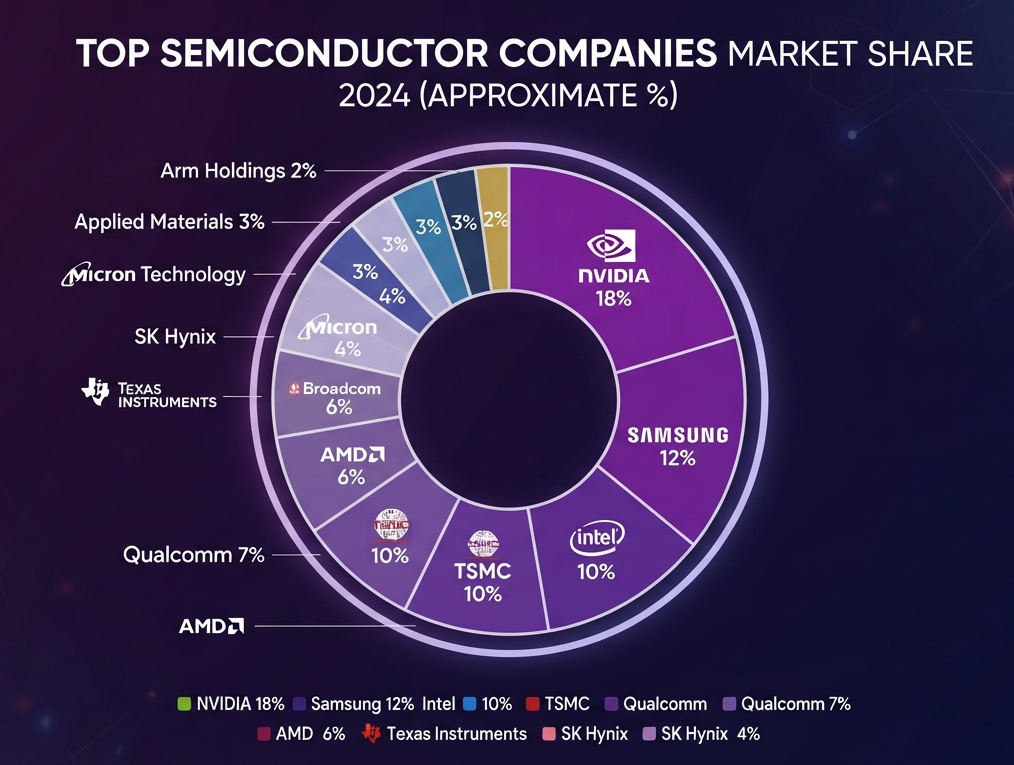
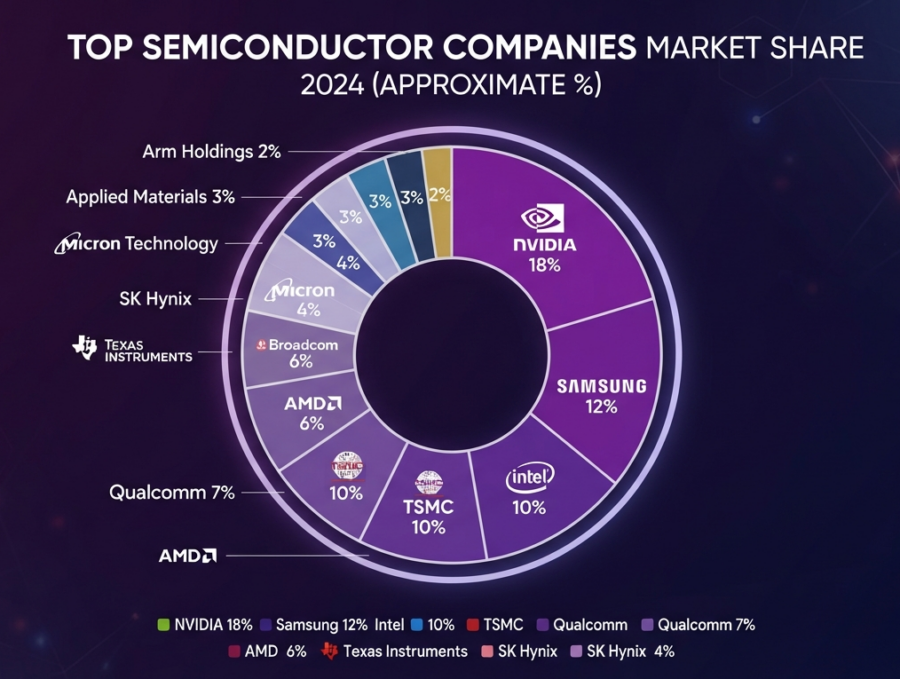
The global semiconductor landscape in 2026 is characterized by strong competition across AI computing, memory manufacturing, foundry services, analog chips, semiconductor equipment, and intellectual property. The following table summarizes the approximate market positioning of major companies based on the supplied estimates and industry categories.
NVIDIA Corporation
About NVIDIA Corporation: NVIDIA is a leading semiconductor company specializing in graphics processing units, AI accelerators, and high-performance computing platforms. Its competitive advantage comes from its GPU architecture, CUDA software ecosystem, networking technologies, and integrated AI computing systems used in cloud data centers and enterprise infrastructure.
a) Company Overview Table
| Attribute | Company Data |
|---|---|
| Company Name | NVIDIA Corporation |
| Ticker Symbol | NASDAQ: NVDA |
| Industry | Semiconductors |
| Headquarters | Santa Clara, California, USA |
| Founded | 1993 |
| Founders | Jensen Huang, Chris Malachowsky, Curtis Priem |
| Current CEO | Jensen Huang |
| Latest Quarterly Revenue | USD 115.8 billion (Q3 FY2027) |
| YoY Revenue Growth | 103% |
| Primary Segments | Data Center, Gaming, Professional Visualization, Automotive, Edge Computing |
b) Financial Details
NVIDIA reported revenue of USD 115.8 billion in the third quarter of fiscal 2027, representing a 103% year-over-year increase. Data Center revenue reached USD 107.6 billion, increasing 110% year over year. Strong demand for AI infrastructure, accelerated computing, networking products, and large-scale GPU deployments supported the performance. The company also began shipping its Vera Rubin NVL72 platform, extending its product portfolio beyond the Blackwell generation. These results demonstrate the importance of AI data-center spending to NVIDIA’s semiconductor business.
c) Strategic Developments
-
November 2026 – Vera Rubin Platform: NVIDIA began shipping its Vera Rubin NVL72 systems, supporting next-generation AI infrastructure and high-performance computing.
-
November 2026 – Hugging Face Acquisition Agreement: NVIDIA announced an agreement to acquire Hugging Face to expand its AI development ecosystem and support broader access to AI technologies.
-
November 2026 – Manufacturing Partnerships: NVIDIA expanded supply-chain cooperation with Amkor Technology, Samsung Electro-Mechanics, IBIDEN, and other manufacturing partners to increase production capacity for AI infrastructure.
- November 2026 – Cloud Partnerships: The company expanded its Vera Rubin ecosystem with Google Cloud, Oracle Cloud Infrastructure, Microsoft Azure, and other infrastructure providers.
Samsung Electronics
About Samsung Electronics: Samsung Electronics is a major semiconductor manufacturer with strong capabilities in memory chips, foundry services, and system semiconductors. Its competitive advantage comes from large-scale fabrication facilities, DRAM and NAND technologies, advanced memory packaging, and investments in high-bandwidth memory for AI computing.
a) Company Overview Table
| Attribute | Company Data |
|---|---|
| Company Name | Samsung Electronics Co., Ltd. |
| Ticker Symbol | KRX: 005930 |
| Industry | Semiconductors and Electronics |
| Headquarters | Suwon, South Korea |
| Founded | 1969 |
| Founders | Lee Byung-chul |
| Latest Quarterly Revenue | KRW 147.1 trillion (Q3 2026, Device Solutions Division) |
| Primary Segments | Memory, System LSI, Foundry, Semiconductor Manufacturing |
b) Financial Details
Samsung Electronics reported consolidated revenue of KRW 195.3 trillion in the third quarter of 2026. Its Device Solutions Division recorded revenue of KRW 147.1 trillion and operating profit of KRW 106.5 trillion. The division includes semiconductor-related operations, although its reported revenue should not be treated as a pure semiconductor-only figure. Memory products delivered record quarterly revenue and operating profit, supported by demand from AI servers and high-performance computing applications. The company’s memory and foundry businesses remain important contributors to its semiconductor positioning.
c) Strategic Developments
-
October 2026 – Memory Business Expansion: Samsung reported record quarterly memory revenue and operating profit, reflecting stronger demand for advanced memory products.
-
October 2026 – AI Semiconductor Strategy: The company emphasized meeting growing demand for AI applications through its Device Solutions business.
-
2026 – Advanced Memory Development: Samsung continued developing high-bandwidth memory and advanced semiconductor manufacturing capabilities to strengthen its position in AI infrastructure.
- 2026 – Foundry Development: The company continued focusing on advanced manufacturing processes and foundry competitiveness to attract external semiconductor customers.
Taiwan Semiconductor Manufacturing Company (TSMC)
About TSMC: TSMC is the world’s leading dedicated semiconductor foundry, manufacturing advanced chips for global technology companies. Its competitive advantage comes from process technology, fabrication scale, manufacturing yields, advanced packaging, and long-standing relationships with leading fabless semiconductor designers.
a) Company Overview Table
| Attribute | Company Data |
|---|---|
| Company Name | Taiwan Semiconductor Manufacturing Company Limited |
| Ticker Symbol | NYSE: TSM / TWSE: 2330 |
| Industry | Semiconductor Manufacturing |
| Headquarters | Hsinchu, Taiwan |
| Founded | 1987 |
| Founders | Morris Chang |
| Current CEO | C. C. Wei |
| Latest Quarterly Revenue | USD 46.72 billion (Q3 2026) |
| YoY Revenue Growth | 41.2% |
| Primary Segments | Wafer Fabrication, Advanced Nodes, Specialty Technologies, Advanced Packaging |
b) Financial Details
TSMC reported third-quarter 2026 revenue of USD 46.72 billion, increasing 41.2% year over year. Net income reached NT$763.06 billion, while gross margin stood at 66.4%. Advanced manufacturing technologies accounted for 79% of total wafer revenue, including 2 nm, 3 nm, 5 nm, and 7 nm processes. The 3 nm technology contributed 33% of wafer revenue, while 2 nm accounted for 8%. These results reflect continued demand for advanced processors used in AI infrastructure, smartphones, and high-performance computing.
c) Strategic Developments
-
October 2026 – 2 nm Production Ramp: TSMC reported that 2 nm technology had started contributing to wafer revenue, with production expected to increase further.
-
October 2026 – Advanced Manufacturing: Advanced technologies at 7 nm and below accounted for 79% of total wafer revenue, demonstrating the importance of leading-edge manufacturing.
-
2026 – Capacity Expansion: TSMC continued its focus on increasing advanced semiconductor manufacturing capacity to serve international customers.
- 2026 – Advanced Packaging: The company continued developing advanced packaging capabilities to support high-performance processors and AI accelerator integration.
SK hynix Inc.
About SK hynix: SK hynix is a major global semiconductor manufacturer specializing in DRAM, NAND flash memory, and high-bandwidth memory. Its competitive advantage is supported by memory technology, high-performance storage products, advanced packaging, and strong relationships with AI server and data-center customers.
a) Company Overview Table
| Attribute | Company Data |
|---|---|
| Company Name | SK hynix Inc. |
| Ticker Symbol | KRX: 000660 |
| Industry | Semiconductors |
| Headquarters | Icheon, South Korea |
| Founded | 1983 |
| Founders | Hyundai Group |
| Current CEO | Kwak Noh-Jung |
| Latest Quarterly Revenue | KRW 104.62 trillion (Q3 2026) |
| YoY Revenue Growth | 328% |
| Primary Segments | DRAM, NAND Flash, HBM, Enterprise SSD |
b) Financial Details
SK hynix reported revenue of KRW 104.62 trillion in the third quarter of 2026, representing a 328% year-over-year increase. Operating profit reached KRW 83.33 trillion, producing an operating margin of approximately 80%. The company benefited from strong demand for server DDR5, high-bandwidth memory, and enterprise solid-state drives. HBM4 shipments also began expanding during the quarter. The results demonstrate the growing importance of advanced memory in AI servers and large-scale computing infrastructure.
c) Strategic Developments
-
October 2026 – HBM4 Shipments: SK hynix reported that HBM4 shipments had begun in earnest, with the product expected to become a mainstream offering from the fourth quarter.
-
October 2026 – Long-Term Customer Agreements: The company secured long-term agreements covering more than 50% of its 2027–2028 production capacity.
-
October 2026 – Enterprise SSD Expansion: SK hynix expanded sales of 321-layer TLC enterprise SSD products to support data-center storage requirements.
-
October 2026 – Solidigm Strategy: The company announced that it would discontinue its review of a potential Solidigm initial public offering.
Intel Corporation
About Intel Corporation: Intel is a major semiconductor company specializing in central processing units, data-center processors, networking technologies, and semiconductor manufacturing. Its competitive position is supported by its x86 processor ecosystem, engineering capabilities, global customer relationships, and investments in advanced foundry manufacturing.
a) Company Overview Table
| Attribute | Company Data |
|---|---|
| Company Name | Intel Corporation |
| Ticker Symbol | NASDAQ: INTC |
| Industry | Semiconductors |
| Headquarters | Santa Clara, California, USA |
| Founded | 1968 |
| Founders | Robert Noyce, Gordon Moore |
| Current CEO | Lip-Bu Tan |
| Latest Quarterly Revenue | USD 16.5 billion (Q3 2026) |
| YoY Revenue Growth | 21% |
| Primary Segments | Client Computing, Data Center and AI, Intel Foundry |
b) Financial Details
Intel generated USD 16.5 billion in third-quarter 2026 revenue, representing a 21% year-over-year increase. Its Data Center and AI business recorded revenue of USD 7.3 billion, growing 78% year over year. Client Computing revenue reached USD 8.1 billion, while Intel Foundry reported USD 6.7 billion in segment revenue, including intersegment transactions. Total Intel Products revenue was USD 15.4 billion. Demand for Xeon processors and improved manufacturing execution supported the company’s quarterly performance.
c) Strategic Developments
-
October 2026 – Data Center Business Expansion: Intel reported 78% year-over-year growth in its Data Center and AI segment, reflecting stronger processor demand.
-
October 2026 – Foundry Business Development: Intel Foundry revenue increased 58% year over year to USD 6.7 billion, including internal manufacturing transactions.
-
2026 – Xeon Processor Supply: Intel prioritized increasing supply of Xeon processors to meet demand from data-center customers.
- 2026 – Manufacturing Investment: Intel continued advancing process technology and manufacturing capacity to strengthen its position in the global foundry market.
Micron Technology, Inc.
About Micron Technology: Micron Technology is a leading semiconductor company focused on memory and storage products. Its portfolio includes DRAM, NAND flash, high-bandwidth memory, and solid-state storage. Its competitive advantage comes from memory engineering, advanced manufacturing, product reliability, and increasing participation in AI infrastructure supply chains.
a) Company Overview Table
| Attribute | Company Data |
|---|---|
| Company Name | Micron Technology, Inc. |
| Ticker Symbol | NASDAQ: MU |
| Industry | Semiconductors |
| Headquarters | Boise, Idaho, USA |
| Founded | 1978 |
| Founders | Ward Parkinson, Joe Parkinson, Dennis Wilson, Doug Pitman |
| Current CEO | Sanjay Mehrotra |
| Latest Quarterly Revenue | USD 54.23 billion (Q4 FY2026) |
| YoY Revenue Growth | Approximately 379% |
| Primary Segments | DRAM, NAND, HBM, Storage Products |
b) Financial Details
Micron reported record fiscal fourth-quarter 2026 revenue of USD 54.23 billion, compared with USD 11.32 billion in the corresponding quarter of the previous year. This represented approximately 379% year-over-year growth. GAAP net income reached USD 37.70 billion, while operating cash flow stood at USD 43.97 billion. Demand for high-bandwidth memory, advanced DRAM, and enterprise storage products supported its financial performance. Micron also highlighted strategic customer agreements and increased investments in technology, products, and manufacturing for fiscal 2027.
c) Strategic Developments
-
September 2026 – Strategic Customer Agreements: Micron highlighted strategic customer agreements designed to provide stronger visibility into future demand and improve revenue predictability.
-
September 2026 – Manufacturing Investment: The company announced plans to increase investment in technology, products, and manufacturing to support expected growth in fiscal 2027.
-
September 2026 – AI Memory Expansion: Micron continued strengthening its HBM and advanced DRAM portfolio to support AI computing requirements.
-
2026 – Production and Technology Development: The company maintained its focus on improving memory performance, manufacturing efficiency, and product capacity.
Qualcomm Incorporated
About Qualcomm: Qualcomm is a fabless semiconductor company specializing in mobile processors, wireless communication technologies, radio-frequency components, automotive semiconductors, and Internet of Things solutions. Its competitive advantage comes from Snapdragon platforms, wireless intellectual property, modem technologies, and its established relationships with device manufacturers.
a) Company Overview Table
| Attribute | Company Data |
|---|---|
| Company Name | Qualcomm Incorporated |
| Ticker Symbol | NASDAQ: QCOM |
| Industry | Semiconductors |
| Headquarters | San Diego, California, USA |
| Founded | 1985 |
| Founders | Irwin Jacobs, Andrew Viterbi and co-founders |
| Current CEO | Cristiano Amon |
| Latest Quarterly Revenue | USD 10.32 billion (Q4 FY2026) |
| YoY Revenue Growth | -8% |
| Primary Segments | QCT, QTL, Handsets, Automotive, IoT |
b) Financial Details
Qualcomm reported fourth-quarter fiscal 2026 revenue of USD 10.32 billion, compared with USD 11.27 billion in the corresponding period of the previous year. This represented an 8% year-over-year decline on a GAAP basis. However, the company continued to expand its non-handset semiconductor operations. Combined QCT automotive and IoT revenue grew 36% year over year, while automotive revenue reached a record quarterly level of approximately USD 2 billion. Qualcomm is increasingly targeting automotive computing, connected devices, and AI data-center processors to diversify its semiconductor revenue base.
c) Strategic Developments
-
November 2026 – Amazon AI Data Center Collaboration: Qualcomm announced a multi-generational product collaboration with Amazon focused on AI data-center applications.
-
November 2026 – Automotive Semiconductor Growth: Qualcomm achieved its first USD 2 billion automotive revenue quarter, reflecting increased demand for automotive computing solutions.
-
November 2026 – Non-Handset Expansion: The company reiterated its fiscal 2027 data-center revenue target of USD 5 billion.
-
2026 – Modular Acquisition: Qualcomm completed the acquisition of Modular Inc., creating an open software foundation for generative and agentic AI development.
Broadcom Inc.
About Broadcom: Broadcom is a major semiconductor designer supplying networking, broadband, wireless, storage, and custom AI accelerator solutions. Its competitive advantage comes from specialized chip design, networking technologies, custom silicon capabilities, and strong relationships with hyperscale data-center operators.
a) Company Overview Table
| Attribute | Company Data |
|---|---|
| Company Name | Broadcom Inc. |
| Ticker Symbol | NASDAQ: AVGO |
| Industry | Semiconductors and Infrastructure Software |
| Headquarters | Palo Alto, California, USA |
| Founded | 1961 (as HP’s semiconductor business) |
| Founders | Hewlett-Packard founding organization; later developed through corporate restructuring |
| Current CEO | Hock E. Tan |
| Latest Quarterly Revenue | USD 29.59 billion (Q3 FY2026) |
| YoY Revenue Growth | 86% |
| Primary Segments | Semiconductor Solutions, Infrastructure Software |
b) Financial Details
Broadcom reported third-quarter fiscal 2026 revenue of USD 29.59 billion, an increase of 86% year over year. Its Semiconductor Solutions segment generated USD 20.84 billion, representing 70% of consolidated revenue and increasing 127% year over year. AI semiconductor revenue reached USD 16.7 billion, growing 221% year over year. Demand for custom AI accelerators and networking products was a major contributor. The results demonstrate Broadcom’s increasing exposure to AI data-center infrastructure and specialized semiconductor solutions.
c) Strategic Developments
-
September 2026 – AI Semiconductor Expansion: Broadcom reported USD 16.7 billion in AI semiconductor revenue for Q3 FY2026, supported by custom accelerators and networking solutions.
-
September 2026 – Custom AI Chip Development: The company continued strengthening its custom accelerator business to support hyperscale customers.
-
September 2026 – Networking Solutions: Broadcom maintained investment in high-performance networking semiconductors for large-scale AI computing infrastructure.
- September 2026 – Quarterly Business Outlook: Broadcom forecast fourth-quarter fiscal 2026 revenue of approximately USD 34.8 billion, reflecting continued expected demand for semiconductor and infrastructure products.
Advanced Micro Devices, Inc. (AMD)
About AMD: AMD is a fabless semiconductor company designing CPUs, GPUs, and adaptive computing products for consumer devices, enterprise servers, and data centers. Its competitive advantage comes from EPYC server processors, Ryzen CPUs, Instinct accelerators, and its growing position in AI computing infrastructure.
a) Company Overview Table
| Attribute | Company Data |
|---|---|
| Company Name | Advanced Micro Devices, Inc. |
| Ticker Symbol | NASDAQ: AMD |
| Industry | Semiconductors |
| Headquarters | Santa Clara, California, USA |
| Founded | 1969 |
| Founders | Jerry Sanders and co-founders |
| Current CEO | Lisa Su |
| Latest Quarterly Revenue | USD 13.38 billion (Q3 2026) |
| YoY Revenue Growth | 45% |
| Primary Segments | Data Center, Client and Gaming, Embedded |
b) Financial Details
AMD reported third-quarter 2026 revenue of USD 13.38 billion, increasing 45% year over year. Its Data Center segment generated a record USD 8.5 billion, representing 97% year-over-year growth. Demand for EPYC server processors and Instinct AI accelerators supported the expansion. Client and Gaming revenue reached USD 3.7 billion, while the embedded business continued serving industrial and specialized computing markets. The performance highlights AMD’s growing importance in AI accelerators and enterprise computing.
c) Strategic Developments
-
November 2026 – Instinct MI450 Series: AMD reported strong demand for its Instinct MI450 Series GPUs, supporting expansion in AI computing.
-
November 2026 – Helios Platform: The company continued scaling its Helios AI infrastructure platform to address demand from large-scale data-center customers.
-
November 2026 – Venice Processor Development: AMD highlighted the planned production expansion of its next-generation Venice processors.
- November 2026 – EPYC Expansion: AMD continued strengthening its server processor portfolio to increase its presence in enterprise and cloud computing.
Texas Instruments Incorporated
About Texas Instruments: Texas Instruments is a major semiconductor manufacturer specializing in analog integrated circuits and embedded processing products. Its competitive advantage comes from a broad analog chip portfolio, long product lifecycles, manufacturing capabilities, and strong relationships with industrial, automotive, and electronics manufacturers.
a) Company Overview Table
| Attribute | Company Data |
|---|---|
| Company Name | Texas Instruments Incorporated |
| Ticker Symbol | NASDAQ: TXN |
| Industry | Semiconductors |
| Headquarters | Dallas, Texas, USA |
| Founded | 1930 |
| Founders | Cecil H. Green, J. Erik Jonsson, Eugene McDermott, Patrick Haggerty |
| Current CEO | Haviv Ilan |
| Latest Quarterly Revenue | USD 6.055 billion (Q3 2026) |
| YoY Revenue Growth | 28% |
| Primary Segments | Analog, Embedded Processing, Other |
b) Financial Details
Texas Instruments reported third-quarter 2026 revenue of USD 6.055 billion, representing a 28% year-over-year increase. Analog revenue reached USD 4.911 billion, growing 32%, while embedded processing revenue increased 21% to USD 858 million. Operating profit reached USD 2.874 billion, while net income was USD 2.425 billion. Growth across industrial, automotive, and data-center applications supported its quarterly performance. The company continues to benefit from its broad analog product portfolio and investments in 300 mm wafer manufacturing.
c) Strategic Developments
-
October 2026 – Analog Semiconductor Growth: TI reported 32% year-over-year growth in analog revenue, reflecting stronger demand across industrial and automotive markets.
-
October 2026 – Embedded Processing Expansion: Embedded processing revenue increased 21% year over year, demonstrating continued demand for microcontrollers and embedded semiconductor products.
-
October 2026 – Manufacturing Investment: TI reported USD 2.6 billion in capital expenditure over the preceding 12 months, supporting manufacturing capacity and operational development.
- 2026 – 300 mm Manufacturing: The company continued emphasizing 300 mm wafer production to improve manufacturing efficiency and strengthen its long-term cost position.
Applied Materials, Inc.
About Applied Materials: Applied Materials is a leading semiconductor equipment supplier providing manufacturing technologies used in chip fabrication. Its portfolio supports deposition, etching, inspection, materials engineering, and advanced packaging. Its competitive advantage comes from process technology, equipment innovation, and close collaboration with semiconductor manufacturers.
a) Company Overview Table
| Attribute | Company Data |
|---|---|
| Company Name | Applied Materials, Inc. |
| Ticker Symbol | NASDAQ: AMAT |
| Industry | Semiconductor Equipment and Materials |
| Headquarters | Santa Clara, California, USA |
| Founded | 1967 |
| Founders | Michael A. McNeilly and co-founders |
| Current CEO | Gary Dickerson |
| Latest Quarterly Revenue | USD 10.409 billion (Q4 FY2026) |
| YoY Revenue Growth | 53% |
| Primary Segments | Semiconductor Systems, Applied Global Services, Display and Adjacent Markets |
b) Financial Details
Applied Materials reported record fourth-quarter fiscal 2026 revenue of USD 10.409 billion, representing a 53% year-over-year increase. Full-year revenue reached USD 34.446 billion, increasing 21% compared with the previous fiscal year. Its Semiconductor Systems segment generated USD 7.996 billion in fourth-quarter revenue, while foundry and logic applications represented 58% of that segment’s revenue. DRAM contributed 33%, and flash memory accounted for 9%. These results reflect demand for equipment used in advanced logic, memory, and AI-related semiconductor production.
c) Strategic Developments
-
November 2026 – EPIC Center Development: Applied Materials unveiled its EPIC Center in Silicon Valley to support semiconductor research and development.
-
November 2026 – Research Partnerships: The company added four new research and development partnerships, increasing its announced EPIC engagements to 15.
-
November 2026 – Semiconductor Equipment Expansion: Applied Materials reported record Semiconductor Systems revenue, supported by stronger foundry, logic, and DRAM equipment demand.
- 2026 – Advanced Manufacturing Research: The company continued collaborating with chipmakers and research organizations to develop materials engineering and next-generation manufacturing technologies.
Arm Holdings plc
About Arm Holdings: Arm Holdings is a semiconductor intellectual property company specializing in processor architectures and technology licensing. Its competitive advantage comes from energy-efficient CPU designs, a broad licensing ecosystem, and widespread adoption across smartphones, automotive systems, cloud computing, and AI-enabled devices.
a) Company Overview Table
| Attribute | Company Data |
|---|---|
| Company Name | Arm Holdings plc |
| Ticker Symbol | NASDAQ: ARM |
| Industry | Semiconductor Intellectual Property |
| Headquarters | Cambridge, United Kingdom |
| Founded | 1990 |
| Founders | Joint venture established by Acorn Computers, Apple, and VLSI Technology |
| Current CEO | Rene Haas |
| Latest Quarterly Revenue | USD 1.44 billion (Q2 FY2027) |
| YoY Revenue Growth | 27% |
| Primary Segments | Licensing, Royalties, Processor IP, Compute Platforms |
b) Financial Details
Arm reported second-quarter fiscal 2027 revenue of USD 1.44 billion, representing a 27% year-over-year increase. Licensing revenue reached USD 773 million, while royalty revenue stood at USD 670 million. The company recorded its fifth consecutive quarter of total revenue growth exceeding 20% year over year. Demand for processor intellectual property in AI infrastructure, cloud computing, smartphones, and energy-efficient computing platforms supported its performance. Arm’s licensing model allows semiconductor manufacturers to use its architecture without requiring Arm to operate large-scale chip fabrication facilities.
c) Strategic Developments
- November 2026 – Licensing Business Expansion: Arm reported USD 773 million in licensing revenue, reflecting demand for its processor architecture and semiconductor IP.
- November 2026 – Royalty Revenue Growth: Royalty revenue reached USD 670 million, supported by semiconductor products incorporating Arm technology.
- 2026 – AI Computing Development: Arm continued expanding its compute platform strategy to address demand from AI infrastructure, cloud providers, and enterprise computing customers.
- 2026 – Ecosystem Partnerships: The company continued working with semiconductor manufacturers and technology companies to increase adoption of its processor architecture across different computing markets.
Conclusion
The semiconductor industry is becoming increasingly dependent on advanced computing, artificial intelligence infrastructure, high-bandwidth memory, and sophisticated manufacturing technologies. NVIDIA has strengthened its position through AI accelerators, while TSMC remains strategically important because of its advanced foundry capabilities. Samsung, SK hynix, and Micron are benefiting from growing memory requirements, particularly for AI servers.
Over the next 12 to 24 months, competition is expected to intensify around advanced process nodes, chiplet architectures, high-bandwidth memory, advanced packaging, and custom AI processors. Manufacturing capacity, access to advanced equipment, and long-term customer agreements will remain important competitive advantages. Overall, the semiconductor market is positioned for sustained expansion, with AI infrastructure and advanced memory likely to influence its growth trajectory.