


Introduction
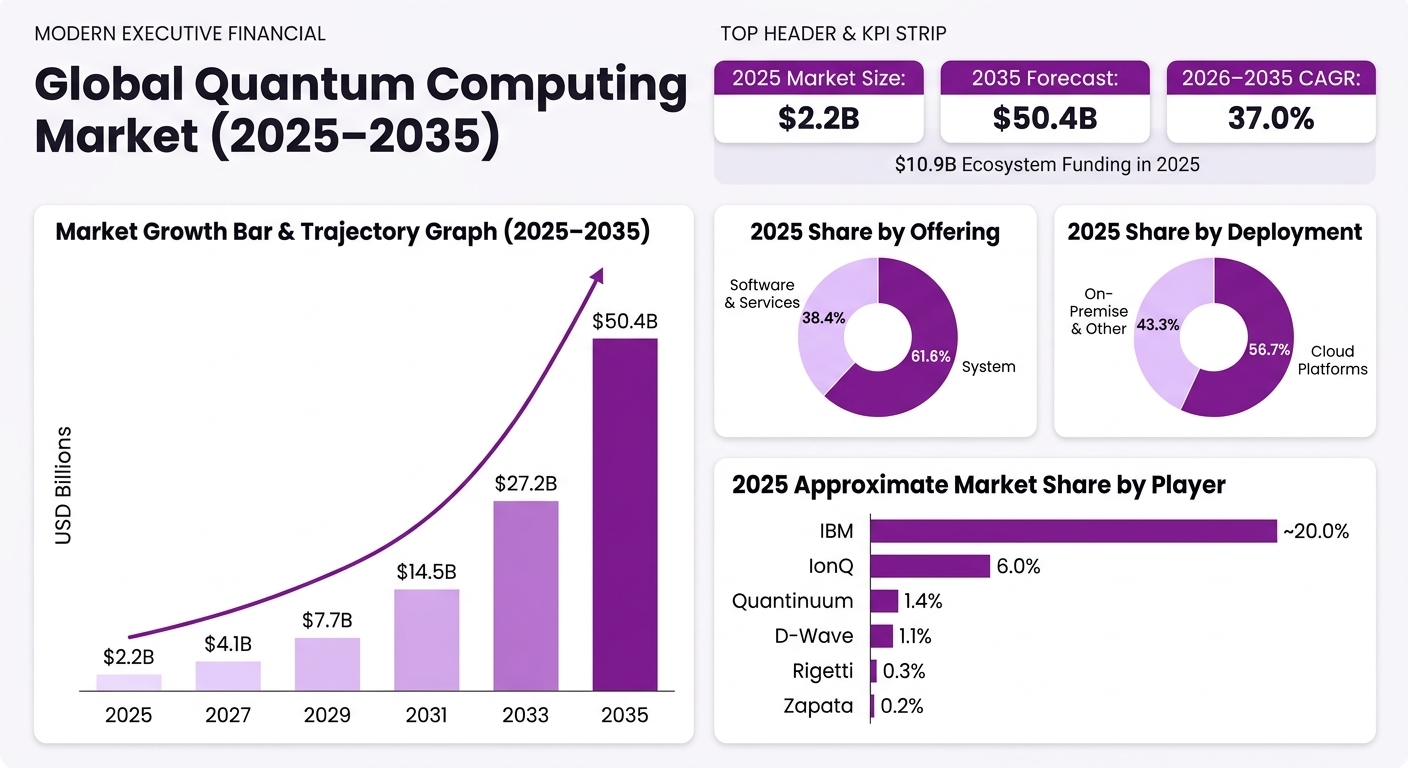
The quantum computing market is moving from experimental physics into commercial engineering. It was valued at USD 2.2 billion in 2025 and is projected to reach USD 50.4 billion by 2035. Growth rests on three things: cloud access to quantum systems, superconducting and trapped-ion hardware, and steady progress in correcting qubit errors. Capital is plentiful. Ecosystem funding reached USD 10.9 billion in 2025, and government programs and post-quantum cryptography mandates add further demand. The main constraints are scarce cryogenic electronics, export controls and a shortage of skilled engineers.
Market Size and Statistics
- The global quantum computing market was valued at USD 2.2 billion in the 2025 base year and is forecast to reach USD 50.4 billion by 2035.
- Market revenue is projected to grow at a compound annual growth rate of 37.0% from 2026 through 2035.
- By offering, the System segment led the market in 2025 with 61.6% of global revenue.
- By deployment model, cloud platforms led the market in 2025 with a 56.7% share.
- By application, Optimization held the largest share in 2025 at 32.7%, while Machine Learning is the fastest-growing application.
- By technology, superconducting qubits led in 2025 with a 38.9% share, while topological systems are expected to grow fastest, at a CAGR of 40% to more than 50%.
- By end user, banking, financial services and insurance led in 2025 with 16.8% of market revenue.
- By region, North America held more than 38.4% of the market in 2025, about USD 0.9 billion, while Asia Pacific is the fastest-growing region.
Precise market shares can’t be calculated for the whole sector. IBM, Google, Microsoft, Intel and Accenture include their quantum work inside larger cloud, research or consulting units and don’t report it separately. The positions below therefore combine reported quantum revenue, the size of each company’s commitments and industry consensus. Share percentages for pure-play companies are based on their FY2025 revenue against the USD 2.2 billion 2025 market.
| Company | Approximate Share and Positioning | Key Quantum-Relevant Financial Metrics | Market Cap, Nov 2026 |
|---|---|---|---|
| IBM Corporation | Tier-1 leader, with an estimated 18%–22% share by industry consensus; more than 400,000 cloud users | More than USD 1.0B in cumulative quantum bookings by early 2025; more than USD 10.0B committed to quantum over five years; whole-company Q3 2026 revenue of USD 17.10B and net income of USD 2.19B | USD 220.21B |
| IonQ | Largest pure-play company, about 6.0% share | FY2025 revenue USD 130.0M; Q3 2026 revenue USD 173.83M; 2026 guidance USD 505M–515M; backlog USD 1.2B; pro-forma cash USD 3.7B | USD 9.71B–10.80B |
| Google LLC | Tier-1 co-leader in hardware and error correction; 105-qubit Willow processor | Alphabet Q3 2026 revenue USD 127.58B and net income USD 26.17B; 2026 AI and infrastructure capital spending guidance USD 195B–205B | USD 3.40T–3.47T |
| Microsoft Corporation | Tier-1 contender in topological qubits and cloud distribution through Azure Quantum | Q1 FY27 revenue USD 92.28B and net income USD 36.63B; potential DARPA award of up to USD 300M | USD 3.68T–3.80T |
| Quantinuum Ltd. | Second-largest pure-play company, about 1.4% share | FY2025 revenue USD 30.9M; Q3 2026 revenue USD 9.05M; cash USD 1,936.11M; no debt | USD 7.92B |
| Accenture Plc. | Leading enterprise quantum integrator | FY2026 revenue USD 74.18B; net income USD 8.37B; free cash flow USD 11.6B | USD 131.3B–145.2B |
| D-Wave Systems Inc. | Leader in quantum annealing, about 1.1% share | FY2025 revenue USD 24.6M; Q3 2026 revenue USD 4.51M; nine-month 2026 bookings USD 37.4M; cash USD 503.4M | USD 2.48B–3.70B |
| Rigetti & Co, Inc. | Mid-tier superconducting pure-play, about 0.3% share | FY2025 revenue USD 7.1M; nine-month 2026 revenue USD 10.9M; cash USD 497.1M; no debt | USD 3.90B–4.33B |
| Intel Corporation | Emerging full-stack contender in silicon spin qubits | Pending Classiq acquisition worth about USD 2.3B; Q3 2026 revenue USD 16.5B; cash USD 21.8B | USD 291.26B |
| Riverlane | Leader in the quantum error-correction niche | Total funding USD 118.41M–120.43M; FY2024 cash GBP 71.17M | Private |
| QC Ware | Boutique quantum and quantum-inspired software specialist | Total funding USD 33.25M across eight rounds | Private |
| Zapata Computing | Micro-cap software vendor in restructuring, about 0.2% share in 2025 | FY2025 revenue USD 3.88M; nine-month 2026 net loss USD 6.04M; cash USD 11.24M | USD 91.33M |
Top Companies List
- IBM Corporation
- IonQ
- Google LLC
- Microsoft Corporation
- Quantinuum Ltd.
- Accenture Plc.
- D-Wave Systems Inc.
- Rigetti & Co, Inc.
- Intel Corporation
- Riverlane
- QC Ware
- Zapata Computing
IBM Corporation
IBM is the most commercially established full-stack quantum vendor. It combines superconducting Heron and Nighthawk processors, the Qiskit software stack and the IBM Quantum Network. It has a public roadmap to Starling, a fault-tolerant system with 200 logical qubits planned for 2029.
a) Company Overview
| Attribute | Company Data |
|---|---|
| Company Name | International Business Machines Corporation |
| Ticker Symbol | NYSE: IBM |
| Industry | Hybrid cloud, AI software, consulting and quantum computing |
| Headquarters | Armonk, New York, USA |
| Founded | 1911 |
| Founders | Charles Ranlett Flint |
| Current CEO | Arvind Krishna |
| Latest Quarterly Revenue | USD 17.1B, whole company, Q3 2026 |
| YoY Revenue Growth | +5%, or +6% at constant currency |
| Primary Segments | Software, Consulting, Infrastructure, Financing |
b) Financial Details
IBM’s most recent quantum-specific disclosure is more than USD 1.0B in cumulative quantum bookings by early 2025. In Q3 2026, the whole company earned USD 17.1B in revenue and USD 2.19B in GAAP net income, and held USD 11.1B in cash. IBM has committed more than USD 10.0B to quantum over five years, with up to USD 1.0B in possible federal foundry support.
c) Strategic Developments
- Announced the 520-qubit Nighthawk r3 processor in November 2026 and plans a system of more than 1,000 qubits in 2027.
- Clients including E.ON, Algorithmiq and Q-CTRL have run more than 34 billion circuits on Nighthawk r2.
- Installed an IBM Quantum System Two at the University of Chicago.
- Is a member of the U.S. Genesis Mission consortium alongside Cleveland Clinic and RIKEN.
- Added NVIDIA GPUs to its quantum error-correction work at Fermilab.
IonQ
IonQ is the largest pure-play quantum company by revenue. Its Tempo trapped-ion computers sit within a vertically integrated business that spans networking, sensing, security, space and chip manufacturing through SkyWater Foundry.
a) Company Overview
| Attribute | Company Data |
|---|---|
| Company Name | IonQ, Inc. |
| Ticker Symbol | NYSE: IONQ |
| Industry | Quantum computing, networking and foundry |
| Headquarters | College Park, Maryland, USA |
| Founded | 2015 |
| Founders | Christopher Monroe and Jungsang Kim |
| Current CEO | Niccolo de Masi |
| Latest Quarterly Revenue | USD 173.83M, Q3 2026 |
| YoY Revenue Growth | +336.0% |
| Primary Segments | Quantum platform and SkyWater Foundry |
b) Financial Details
Q3 2026 revenue was USD 173.83M: USD 90.3M from the quantum platform, up 127% year over year, and USD 83.5M from SkyWater Foundry. The operating loss was USD 433.1M. GAAP net income was USD 563.96M because of a USD 896.16M non-cash warrant gain. FY2026 revenue guidance is USD 505M–515M, backlog is USD 1.2B and pro-forma cash is USD 3.7B.
c) Strategic Developments
- Completed the USD 1.8B acquisition of SkyWater Technology in July 2026.
- Agreed to buy Elisity, a Zero Trust security company, in an all-stock deal worth up to USD 1.3B.
- Acquired Nexus Photonics, an integrated-photonics developer.
- Earlier acquired Oxford Ionics, Capella Space, Vector Atomic, Lightsynq and a controlling stake in ID Quantique.
- Will install a 256-qubit system at the University of Cambridge by summer 2027.
Google LLC
Google Quantum AI leads on superconducting error correction. Its 105-qubit Willow chip demonstrated verifiable quantum advantage, and in 2026 Google cut errors 40-fold with a technique called magic state cultivation.
a) Company Overview
| Attribute | Company Data |
|---|---|
| Company Name | Google LLC, a subsidiary of Alphabet Inc. |
| Ticker Symbol | NASDAQ: GOOGL / GOOG |
| Industry | Internet services, cloud computing, AI and quantum computing |
| Headquarters | Mountain View, California, USA |
| Founded | 1998 |
| Founders | Larry Page and Sergey Brin |
| Current CEO | Sundar Pichai |
| Latest Quarterly Revenue | USD 127.58B, Alphabet, Q3 2026 |
| YoY Revenue Growth | +24.7% |
| Primary Segments | Google Services, Google Cloud, Other Bets |
b) Financial Details
Google Quantum AI is a research unit that reports no revenue of its own. Alphabet’s Q3 2026 results show the resources behind it: USD 127.58B in revenue, USD 26.17B in net income and USD 265.1B in cash and securities. Alphabet expects to spend USD 195B–205B on AI and infrastructure in 2026.
c) Strategic Developments
- Demonstrated magic state cultivation on Willow in October 2026, published in Science.
- Showed quantum contextuality across all 105 qubits in November 2026.
- Ran the Willow Early Access Program for selected research partners.
- Demonstrated verifiable quantum advantage with the Quantum Echoes algorithm.
Microsoft Corporation
Microsoft is pursuing topological qubits through its Majorana chips. Majorana 2 improved qubit reliability 1,000-fold, and Microsoft sells quantum access through Azure Quantum. It now targets a scalable quantum computer by 2029.
a) Company Overview
| Attribute | Company Data |
|---|---|
| Company Name | Microsoft Corporation |
| Ticker Symbol | NASDAQ: MSFT |
| Industry | Software, cloud computing, AI and quantum computing |
| Headquarters | Redmond, Washington, USA |
| Founded | 1975 |
| Founders | Bill Gates and Paul Allen |
| Current CEO | Satya Nadella |
| Latest Quarterly Revenue | USD 92.28B, whole company, Q1 FY27 |
| YoY Revenue Growth | +19% |
| Primary Segments | Productivity and Business Processes, Intelligent Cloud, More Personal Computing |
b) Financial Details
Microsoft’s quantum revenue is included in Azure. In Q1 FY27, the company earned USD 92.28B in revenue and USD 36.63B in GAAP net income. Microsoft Cloud brought in USD 63.9B, and contracted future commercial revenue stood at USD 677B. Its quantum contract upside includes up to USD 300M from DARPA’s benchmarking program.
c) Strategic Developments
- Unveiled Majorana 2 in June 2026, with qubits lasting about 20 seconds on average.
- Entered the final phase of DARPA’s Quantum Benchmarking Initiative.
- Moved its target for a scalable quantum computer forward to 2029.
- Set up a team in Israel to prepare encryption systems for the quantum era.
Quantinuum Ltd.
Quantinuum is the second-largest pure-play quantum company. Its Helios trapped-ion systems lead on error-corrected qubit quality: in October 2026, its error-corrected qubits failed five times in a million cycles. It went public in 2026 and holds more than USD 1.9B in cash.
a) Company Overview
| Attribute | Company Data |
|---|---|
| Company Name | Quantinuum Inc. |
| Ticker Symbol | NASDAQ: QNT |
| Industry | Full-stack quantum computing |
| Headquarters | Broomfield, Colorado, USA |
| Founded | 2021 |
| Founders | Honeywell International and Cambridge Quantum, led by Ilyas Khan |
| Current CEO | Dr. Rajeeb Hazra |
| Latest Quarterly Revenue | USD 9.05M, Q3 2026 |
| YoY Revenue Growth | +233.3% |
| Primary Segments | Helios systems, Nexus cloud platform, quantum software and services |
b) Financial Details
Q3 2026 revenue was USD 9.05M, up from USD 2.72M a year earlier. Revenue for the first nine months of 2026 was USD 22.29M. The consolidated GAAP net loss was USD 117.85M, and the non-GAAP net loss was USD 75.2M. With USD 1,936.11M in cash and no debt, the company raised its FY2026 revenue guidance to USD 31M–34M.
c) Strategic Developments
- Raised USD 1.7B in gross proceeds in its 2026 IPO.
- Expanded its RIKEN partnership in November 2026.
- Agreed to sell a Helios system to Oracle and has a partnership with HPE.
- Signed a memorandum of understanding with Mitsubishi Electric in June 2026.
- Is working with BP on quantum methods for mapping underground oil and gas.
Accenture Plc.
Accenture is the leading enterprise integrator for quantum computing. It advises large companies on readiness, post-quantum cryptography and hybrid quantum-AI deployments, and co-produces the MIT Quantum Index Report.
a) Company Overview
| Attribute | Company Data |
|---|---|
| Company Name | Accenture plc |
| Ticker Symbol | NYSE: ACN |
| Industry | IT services, consulting and quantum integration |
| Headquarters | Dublin, Ireland |
| Founded | 1989 |
| Founders | Formed from the consulting division of Arthur Andersen |
| Current CEO | Julie Sweet |
| Latest Quarterly Revenue | USD 18.68B, whole company, Q4 FY26 |
| YoY Revenue Growth | +6% in U.S. dollars, +7% in local currency |
| Primary Segments | Strategy and Consulting, Technology and Operations services |
b) Financial Details
Accenture’s quantum work is included in its technology consulting business. In Q4 FY26, the whole company earned USD 18.68B in revenue and USD 1.99B in net income, with USD 22.2B in bookings. For FY2026, revenue was USD 74.18B and free cash flow was USD 11.6B.
c) Strategic Developments
- Co-authored the 2026 MIT Quantum Index Report.
- Invested in Dragos, an industrial cybersecurity company, in June 2026.
D-Wave Systems Inc.
D-Wave was the first company to sell quantum computers commercially and leads in quantum annealing, a method suited to optimization problems. Buying Quantum Circuits in 2026 added error-corrected gate-model systems as a second technology.
a) Company Overview
| Attribute | Company Data |
|---|---|
| Company Name | D-Wave Quantum Inc. |
| Ticker Symbol | NYSE: QBTS |
| Industry | Quantum computing, annealing and gate-model |
| Headquarters | Palo Alto, California, USA |
| Founded | 1999 |
| Founders | Geordie Rose, Haig Farris, Bob Wiens and Alexandre Zagoskin |
| Current CEO | Dr. Alan Baratz |
| Latest Quarterly Revenue | USD 4.51M, Q3 2026 |
| YoY Revenue Growth | +20.7% |
| Primary Segments | Cloud quantum services, system sales, professional services |
b) Financial Details
Q3 2026 revenue was USD 4.51M: USD 2.2M from cloud quantum services and USD 2.0M from professional services. The GAAP net loss was USD 48.2M and the operating loss USD 53.5M. Nine-month 2026 bookings rose 611% to USD 37.4M, and cash was USD 503.4M.
c) Strategic Developments
- Completed the USD 550M acquisition of Quantum Circuits in January 2026.
- Was awarded up to USD 100M under the CHIPS Act.
- Has a pending USD 20M system sale to Florida Atlantic University.
- Uses SkyWater, now owned by IonQ, to manufacture its chips.
Rigetti & Co, Inc.
Rigetti is a full-stack superconducting quantum company with its own chip factory. It builds modular, chiplet-based processors such as the 108-qubit Cepheus-1 and sells the Novera on-premises system.
a) Company Overview
| Attribute | Company Data |
|---|---|
| Company Name | Rigetti Computing, Inc. |
| Ticker Symbol | NASDAQ: RGTI |
| Industry | Full-stack quantum-classical computing |
| Headquarters | Berkeley, California, USA |
| Founded | 2013 |
| Founders | Chad Rigetti |
| Current CEO | Dr. Subodh Kulkarni |
| Latest Quarterly Revenue | USD 1.41M, Q3 2026 |
| YoY Revenue Growth | -27.5% |
| Primary Segments | Quantum processors and systems, cloud services, government R&D contracts |
b) Financial Details
Q3 2026 revenue was USD 1.41M, with a gross margin of 60.7%. The operating loss was USD 33.19M, and the GAAP net loss was USD 3.14M after a USD 25.3M warrant gain. Nine-month revenue grew 110% to USD 10.9M. The company has USD 497.1M in cash and no debt.
c) Strategic Developments
- Signed an agreement with the U.S. Department of Commerce for up to USD 100M under the CHIPS Act.
- Received an USD 8.4M order for a 108-qubit system from India’s C-DAC.
- Is building the TangleLab hybrid testbed with HPE and the Pittsburgh Supercomputing Center.
- Has an alliance with Quanta Computer in which each side plans to invest more than USD 100M.
Intel Corporation
Intel is betting on silicon spin qubits made on its standard 300mm chip production lines. Its pending USD 2.3B acquisition of Classiq would add quantum software and make Intel a full-stack quantum provider.
a) Company Overview
| Attribute | Company Data |
|---|---|
| Company Name | Intel Corporation |
| Ticker Symbol | NASDAQ: INTC |
| Industry | Semiconductors, foundry and quantum computing |
| Headquarters | Santa Clara, California, USA |
| Founded | 1968 |
| Founders | Robert Noyce and Gordon Moore |
| Current CEO | Lip-Bu Tan |
| Latest Quarterly Revenue | USD 16.5B, whole company, Q3 2026 |
| YoY Revenue Growth | +20.9% |
| Primary Segments | Client Computing, Data Center and AI, Intel Foundry |
b) Financial Details
In Q3 2026, Intel earned USD 16.5B in revenue and USD 3.3B in GAAP net income, and held USD 21.8B in cash. The Classiq deal includes about USD 1.85B–1.9B upfront plus USD 350M–400M in payments tied to milestones.
c) Strategic Developments
- Agreed on October 26, 2026 to acquire Classiq, with closing expected in the first half of 2027.
- At about USD 2.3B, this would be the largest quantum acquisition to date.
- Expanded its Azure collaboration with Microsoft in November 2026.
Riverlane
Riverlane leads in quantum error correction. Its Deltaflow decoders work with superconducting, trapped-ion and neutral-atom machines, making it a key supplier for any company building fault-tolerant systems.
a) Company Overview
| Attribute | Company Data |
|---|---|
| Company Name | Riverlane Ltd |
| Ticker Symbol | Private, UK company no. 10260255 |
| Industry | Quantum error correction |
| Headquarters | Cambridge, England, UK, with a U.S. headquarters in Maryland |
| Founded | 2016 |
| Founders | Steve Brierley |
| Current CEO | Steve Brierley |
| Primary Segments | Error-correction stack, decoder hardware, error-correction partnerships |
b) Financial Details
Riverlane filed its accounts for the year ended December 31, 2025 with UK Companies House in September 2026. It has raised USD 118.41M–120.43M in total and reported GBP 71.17M in cash in its FY2024 filing. Its investor Molten Ventures reported an increase in Riverlane’s valuation during H1 2026.
c) Strategic Developments
- Raised a 2026 funding round with participation from NVentures, NVIDIA’s venture arm.
- Opened a U.S. headquarters in Maryland’s Discovery District in September 2026.
- Has hardware partnerships with IQM and Quantum Motion.
- Previously raised a USD 75M Series C.
QC Ware
QC Ware is a quantum and quantum-inspired software company that doesn’t depend on any one hardware maker. Its main product, Promethium, is a GPU-accelerated computational chemistry platform for drug discovery and materials research.
a) Company Overview
| Attribute | Company Data |
|---|---|
| Company Name | QC Ware Corp. |
| Ticker Symbol | Private |
| Industry | Quantum and quantum-inspired software |
| Headquarters | Palo Alto, California, USA |
| Founded | 2014 |
| Founders | Matt Johnson and Randall Correll |
| Current CEO | Matt Johnson |
| Primary Segments | Promethium chemistry platform, quantum algorithm research, professional services |
b) Financial Details
QC Ware has raised USD 33.25M in total across eight funding rounds. It has shifted toward GPU-based, quantum-inspired software that earns revenue now, ahead of fault-tolerant hardware.
c) Strategic Developments
- Repositioned Promethium for AI-driven drug discovery.
- Has published research with Goldman Sachs, JPMorgan Chase and Itaú Unibanco.
- Lost two former senior executives, who left to co-found Quantum Signals.
Zapata Computing
Zapata Computing, now Zapata Quantum, Inc., builds quantum algorithms and applications that run on any vendor’s hardware. After a restructuring, it relaunched around research tools including ForShor.ai and its Quantum Pilot platform.
a) Company Overview
| Attribute | Company Data |
|---|---|
| Company Name | Zapata Quantum, Inc. |
| Ticker Symbol | OTCQB: ZPTA |
| Industry | Quantum software and algorithms |
| Headquarters | Boston, Massachusetts, USA |
| Founded | 2017 |
| Founders | Christopher Savoie, Alán Aspuru-Guzik, Yudong Cao and others |
| Current CEO | Sumit Kapur |
| Latest Quarterly Revenue | USD 0, Q3 2026 |
| FY2025 Revenue | USD 3.88M |
| Primary Segments | Subscription quantum software and algorithm development |
b) Financial Details
Zapata had no revenue in Q3 2026 or the first nine months of 2026, after USD 3.88M in FY2025. Its Q3 net loss was USD 2.90M, and its nine-month net loss was USD 6.04M. Cash was USD 11.24M, debt USD 4.72M and shareholders’ equity USD 1.53M.
c) Strategic Developments
- Joined the IBM Quantum Network in October 2026.
- Launched the ForShor.ai research challenge in November 2026.
- CEO Sumit Kapur was named to the Boston Business Journal’s 2026 Power 50.
- Appointed new quantum experts in October 2026.
Conclusion
The quantum computing market now has three tiers. At the top, IBM, Google and Microsoft fund quantum from huge cloud businesses and set the technical pace, with IBM furthest ahead commercially. In the middle, well-funded pure-plays are pulling away from smaller rivals. IonQ is building scale through acquisitions, and Quantinuum leads on error-corrected qubit quality. At the bottom, smaller firms such as Rigetti and Zapata are struggling to turn their technology into steady revenue.
Valuations remain far ahead of revenue. Gartner estimates the sector’s 2026 revenue at USD 869.9M, while the five public pure-plays alone are worth well over USD 20B. Recent swings in quantum stocks show how fragile investor sentiment is.
Over the next 12 to 24 months, five developments look most likely:
- More consolidation. Intel’s purchase of Classiq, IonQ’s run of acquisitions and D-Wave’s purchase of Quantum Circuits point to more buyers securing software, chip manufacturing and error-correction capabilities.
- Error correction becomes the main contest. Companies will compete on logical qubits, the error-corrected units that count toward fault tolerance, rather than on raw qubit counts. IBM’s system of more than 1,000 qubits planned for 2027 and the DARPA benchmarking program are the key tests.
- Governments act as anchor customers. CHIPS Act awards for D-Wave and Rigetti, national programs and post-quantum cryptography mandates will keep supporting demand.
- Hybrid quantum-AI-supercomputer systems become the main way customers use quantum. Examples include the RIKEN, Oracle and HPE deployments.
- Revenue rises toward about USD 1.1B in 2027, according to Gartner, while profitability stays several years away for most pure-plays.



