Introduction
The global Metaverse is moving from speculative virtual worlds toward infrastructure-heavy, monetizable ecosystems spanning hardware, AI compute, 3D engines, and creator platforms. Market.us values the market at USD 149.6 billion in 2025, supported by about 6 billion internet users, 3.1 billion 5G subscriptions, and rising enterprise cloud spending. Q3 2026 results show a market that is consolidating. Meta’s Reality Labs posted a USD 4.13 billion quarterly operating loss on USD 443 million in revenue. Roblox’s daily active users fell 9% to 138 million. Unity grew revenue 32% to USD 622 million with its first GAAP profit since its IPO.
Market Size & Statistics
- The global Metaverse market was valued at USD 149.6 billion in 2025.
- The market is projected to reach approximately USD 6,192.1 billion by 2035.
- The market is expected to grow at a CAGR of 45.2% between 2026 and 2035.
- The hardware segment led the market by product, with a 38.7% share in 2025.
- Desktops and laptops were the leading platform type, with a 56.4% share.
- Mixed Reality dominated the technology segment, with a 51.2% share.
- Media and Entertainment was the leading end-use industry, with a 26.5% share.
- North America dominated the market with a 42.4% share, generating about USD 63.4 billion in 2025.
- Asia-Pacific is expected to be the fastest-growing regional market over the forecast period.
- Edge and 5G deployment is estimated to add 3.2 percentage points to the market’s CAGR, while XR hardware affordability is expected to subtract about 2.0 percentage points.
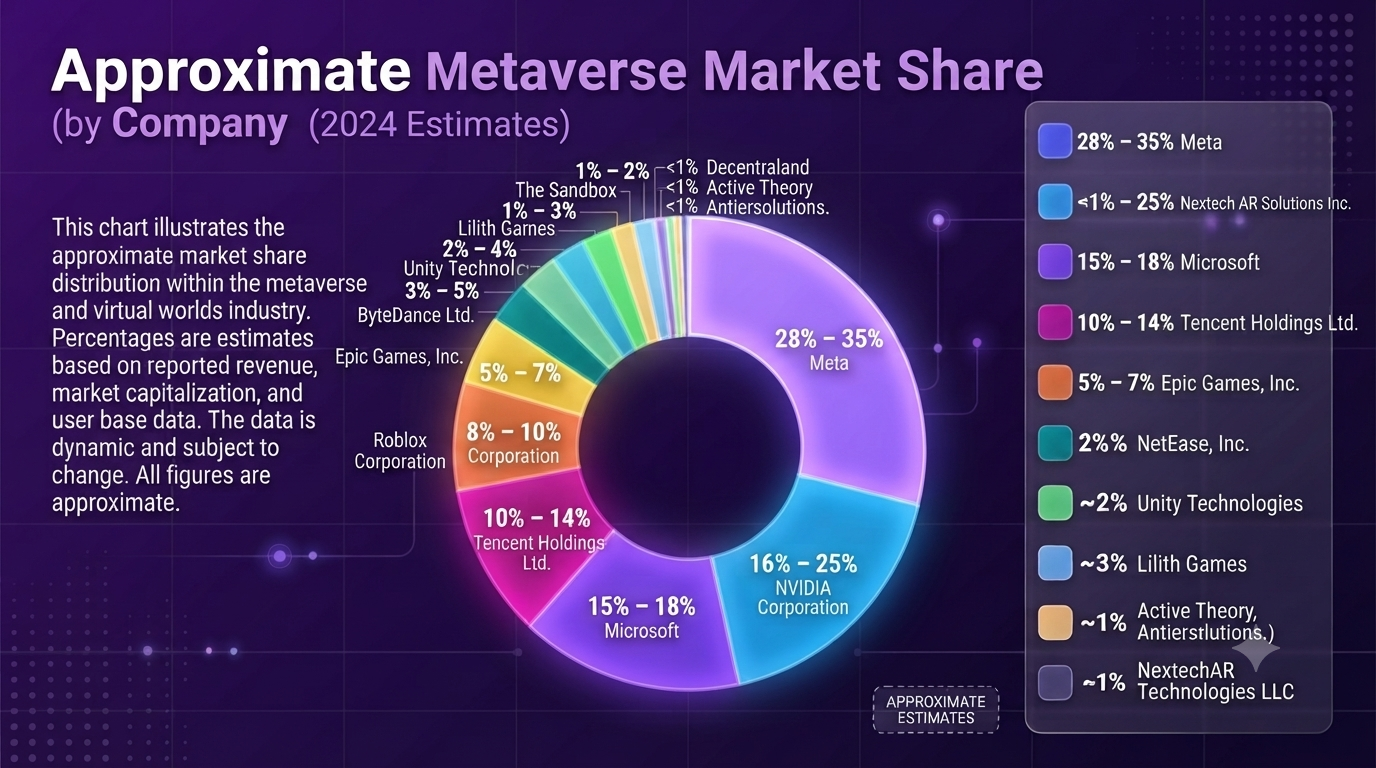
The shares below are estimated ranges of each company’s metaverse-related revenue and value capture, not audited segment figures. They are anchored to Market.us’s estimate that Meta, Microsoft, and NVIDIA together control about 50–60% of the metaverse infrastructure value pool.
| Company | Approx. Market Share (%) | Market Positioning |
|---|---|---|
| Meta | 28% – 35% | Tier-1 consumer metaverse leader through Reality Labs (Quest, Horizon, AI glasses); Q3 2026 RL revenue of USD 443 million and an expected 2026 RL loss of USD 18–19 billion |
| NVIDIA Corporation | 16% – 25% | Core compute and simulation layer; Omniverse commercialized as physical AI microservices for digital twins (May 2026) |
| Microsoft | 15% – 18% | Tier-1 through Xbox, Azure and Mesh-enabled collaboration; FY2025 Gaming revenue up 9% |
| Tencent Holdings Ltd. | 10% – 14% | Leading Asia-Pacific gaming, social and cloud ecosystem with stakes in global metaverse content |
| Roblox Corporation | 8% – 10% | Strongest pure-play metaverse platform; Q3 2026 revenue of USD 1.6 billion (+16%), bookings of USD 1.7 billion (−12%), and 138 million DAUs |
| Epic Games, Inc. | 5% – 7% | Unreal Engine and Fortnite creator ecosystem; Tier-2 challenger |
| ByteDance Ltd. | 3% – 5% | Pico XR hardware and short-video-driven immersive content in Asia-Pacific |
| NetEase, Inc. | 2% – 4% | Tier-2 content-led challenger in immersive online games and virtual worlds |
| Unity Technologies | 2% – 4% | Leading real-time 3D engine; Q3 2026 revenue of USD 622 million (+32%) with its first GAAP-profitable quarter |
| Lilith Games | 1% – 3% | Chinese game developer with immersive and mobile-first virtual world titles |
| The Sandbox | 1% – 2% | Blockchain-based, user-owned virtual world (Tier-2 per Market.us) |
| Decentraland | <1% | Decentralized, DAO-governed virtual world built on Ethereum |
| Active Theory | <1% | Creative studio for immersive web-based metaverse experiences (Tier-2 per Market.us) |
| Antiersolutions. | <1% | Blockchain and metaverse development services provider |
| Nextech AR Solutions Inc. | <1% | Niche AR and 3D model creation provider for e-commerce |
Top Companies List
- Meta
- NVIDIA Corporation
- Microsoft
- Tencent Holdings Ltd.
- Roblox Corporation
- Epic Games, Inc.
- ByteDance Ltd.
- NetEase, Inc.
- Unity Technologies
- Lilith Games
- The Sandbox
- Decentraland
- Active Theory
- Antiersolutions.
- Nextech AR Solutions Inc.
1. Meta
About Meta: Meta Platforms is the largest consumer metaverse investor through its Reality Labs segment. That segment spans Quest headsets, Horizon OS, AI glasses with EssilorLuxottica, and the Horizon Worlds platform. Its moat is a hardware-software-AI stack backed by 3.64 billion daily users across its apps, now focused on AI wearables and VR entertainment.
a) Company Overview Table
| Attribute | Company Data |
|---|---|
| Meta | Meta Platforms, Inc. |
| Ticker Symbol | META (NASDAQ); new non-voting Class C shares to be listed from January 2027 |
| Industry | Social Technology, Digital Advertising, AI & Immersive Technologies (VR/AR/Metaverse) |
| Headquarters | Menlo Park, California, United States |
| Founded | 2004 (as Facebook; renamed Meta Platforms in October 2021) |
| Founders | Mark Zuckerberg, Eduardo Saverin, Andrew McCollum, Dustin Moskovitz and Chris Hughes |
| Current CEO | Mark Zuckerberg (Founder, Chairman & CEO) |
| Latest Quarterly Revenue | USD 64.60 Billion total (Q3 2026); Reality Labs: USD 443 Million |
| YoY Revenue Growth | Total: +26% YoY; Reality Labs: −5.7% YoY (USD 443 Million vs. USD 470 Million) |
| Primary Segments | Family of Apps (Facebook, Instagram, Messenger, WhatsApp); Reality Labs (VR/AR hardware, software and content) |
b) Financial Details
Reality Labs, Meta’s metaverse segment, generated USD 443 Million in Q3 2026 revenue, down 5.7% from USD 470 Million a year earlier. Over the first nine months of 2026, RL revenue rose slightly to USD 1.28 Billion from USD 1.25 Billion. The segment lost USD 4.13 Billion in the quarter, narrower than the USD 4.43 Billion loss in Q3 2025, and USD 12.78 Billion over nine months.
That compares with USD 17.12 Billion in Q3 operating income from Family of Apps. Management expects 2026 RL losses of USD 18–19 Billion, narrowing to about USD 15 Billion in 2027 as money shifts toward AI. Group headcount fell 15% to 66,775, which included Reality Labs cuts earlier in 2026. The results confirm a pivot away from social virtual worlds toward AI glasses and VR entertainment.
c) Strategic Developments
- January–March 2026: Restructured Reality Labs, with layoffs of more than 1,000 roles reported in January and about 700 more in March. It closed several internal VR studios, cut the VR budget by a reported 30%, and stopped new content for Supernatural.
- March 2026: Separated Horizon Worlds from Quest, deprecating Horizon Engine-based Worlds on VR devices. Worlds is moving to a new Horizon Create app and to Facebook and Instagram; the Horizon app may be rebranded “Meta VR.”
- March 2026: Expanded its multiyear EssilorLuxottica partnership with Ray-Ban Meta prescription styles (Blayzer and Scriber Optics Gen 2), adding to Oakley Meta HSTN, Oakley Meta Vanguard and Meta Ray-Ban Display.
- September 2026 (Connect 2026): Added navigation, hologram video calling and an Explore app to Meta Ray-Ban Display, with launches in the UK, Canada, France, Italy and Germany.
- VR Glasses launch: Announced Meta VR Glasses with 2.4K micro-OLED displays, a weight of 100 grams and a Qualcomm Snapdragon Reality Elite puck, launching in spring 2027 for about USD 1,299.
- November 2026: Launched more than 150 3D movies to rent or buy on Quest 3/3S, with Disney+ 3D titles and thousands more planned for 2027. It also expanded Quest Virtual Display with Microsoft through Mixed Reality Link.
- November 2026: Brought Ray-Ban Meta and Oakley Meta AI glasses to South Africa with EssilorLuxottica.
- Regulatory and legal risks: Faces a smart-glasses privacy lawsuit from Germany’s consumer federation (vzbv) and a Solos patent suit that a US court refused to dismiss on November 23, 2026.
2. NVIDIA Corporation
About NVIDIA Corporation: NVIDIA provides the computing backbone of the metaverse through GPUs, the CUDA software ecosystem and Omniverse, its OpenUSD-based platform for physically accurate simulation. Its moat is a full-stack hardware-software-AI platform that developers rely on. In the metaverse, it supplies industrial digital twins, robotics simulation, AI factory blueprints and cloud-streamed 3D experiences.
a) Company Overview Table
| Attribute | Company Data |
|---|---|
| NVIDIA Corporation | NVIDIA Corporation |
| Ticker Symbol | NVDA (NASDAQ) |
| Industry | Semiconductors, Accelerated Computing, AI Infrastructure & 3D Simulation (Omniverse) |
| Headquarters | Santa Clara, California, United States |
| Founded | 1993 |
| Founders | Jensen Huang, Chris Malachowsky and Curtis Priem |
| Current CEO | Jensen Huang (reinstated as President, CEO and Board Director on November 23, 2026, after resigning on November 12, 2026; CFO Colette Kress served as interim CEO in between) |
| Latest Quarterly Revenue | USD 115.8 Billion (Q3 FY2027, quarter ended October 25, 2026) |
| YoY Revenue Growth | +103% YoY; +20% QoQ |
| Primary Segments | Market platforms: Data Center (USD 107.6 Billion) and Edge Computing (USD 8.2 Billion, including gaming, robotics and RTX Spark); reportable segments: Compute & Networking (USD 106.0 Billion) and Graphics (USD 9.85 Billion, including Omniverse and professional visualization) |
b) Financial Details
NVIDIA does not report metaverse revenue separately, so the most relevant figures come from its Graphics and Edge Computing businesses. In Q3 FY2027, the Graphics segment, which covers GeForce and RTX professional GPUs and Omniverse enterprise software, posted record revenue of USD 9.85 Billion, up 61.5% from a year earlier and 25% from the previous quarter.
Edge Computing, which now includes gaming GPUs, robotics and RTX Spark laptops, grew 42% to USD 8.2 Billion, above the USD 7.47 Billion StreetAccount estimate. Group revenue rose 103% to USD 115.8 Billion, with net income of USD 65.3 Billion, a 56% margin. Data Center revenue of USD 107.6 Billion, up 110%, includes the industrial and enterprise AI compute that runs large Omniverse digital twins. Q4 FY2027 guidance is USD 130.0 Billion, plus or minus 3%.
c) Strategic Developments
- March 2026 (GTC 2026): Made the Omniverse DSX Blueprint generally available alongside the Vera Rubin DSX AI Factory reference design. It enables physically accurate OpenUSD digital twins of 50-acre, gigawatt-scale AI factories, with power, thermal and operations simulation.
- November 2026: Updated the Omniverse DSX Blueprint for cloud deployment, with SimReady asset pipelines, surrogate simulation models and an AI factory digital twin runtime.
- Inception program: Works with startups such as Holon Robotics and Nexuni that use Omniverse libraries, the Newton physics engine and Isaac Sim to build Real-to-Sim digital-twin environments for robot training.
- Services partners: Partners such as SoftServe, recognized as NPN Partner of the Year in 2026, deliver Omniverse-based digital twins for TerraPower, SICK and Siemens Energy.
- November 2026: Expanded supply agreements with Kinsus and Samsung Electro-Mechanics to add substrate capacity. Supply commitments rose to USD 390 Billion from USD 279 Billion.
- November 2026 governance: Jensen Huang resigned on November 12 and was unanimously reinstated on November 23 under White House pressure, briefly unsettling leadership and the share price.
3. Microsoft
About Microsoft: Microsoft is a leading cloud and AI platform company whose metaverse presence now runs mainly through Xbox gaming. That includes Minecraft, Game Pass and cloud gaming, backed by Azure. Its moat is the Azure, Windows and Xbox ecosystem plus Activision Blizzard’s content library. It is retiring Mesh, Teams immersive events and the HoloLens-era tools.
a) Company Overview Table
| Attribute | Company Data |
|---|---|
| Microsoft | Microsoft Corporation |
| Ticker Symbol | MSFT (NASDAQ) |
| Industry | Cloud Computing, AI, Enterprise Software, Gaming & Consumer Devices |
| Headquarters | Redmond, Washington, United States |
| Founded | April 4, 1975 |
| Founders | Bill Gates and Paul Allen |
| Current CEO | Satya Nadella (Chairman & CEO); Xbox led by Asha Sharma |
| Latest Quarterly Revenue | USD 92.3 Billion total (Q1 FY2027); Xbox: USD 5.38 Billion |
| YoY Revenue Growth | Total: +19% YoY; Xbox: −2% YoY (USD 5.379 Billion vs. USD 5.508 Billion) |
| Primary Segments | Agents and Infra (Azure, Microsoft 365 Commercial, GitHub, Dynamics); Devices and Consumer (Xbox, Windows OEM, Surface, Search & Advertising, LinkedIn advertising) |
b) Financial Details
Microsoft does not report metaverse revenue. Its closest reported line is Xbox, which now sits in the new Devices and Consumer segment. Xbox revenue fell 2% to USD 5.38 Billion in Q1 FY2027, an improvement on the 10% drop the previous quarter. Content and services fell 2% (1% in constant currency) as Game Pass and third-party titles weakened, though first-party content grew. Hardware revenue fell 14% on lower console volumes.
Minecraft, Microsoft’s largest persistent virtual world, had record engagement and revenue, and PC platform revenue grew by double digits. Management expects Xbox content and services to grow by mid-to-high single digits in Q2 FY2027, helped by Modern Warfare 4 and Grand Theft Auto VI. In enterprise metaverse tools, Microsoft retired Mesh in December 2025 and will end Teams immersive events and avatars on April 2, 2027.
c) Strategic Developments
- December 2025: Retired the standalone Mesh app, the mesh.cloud.microsoft site and the avatar-based “Immersive spaces (3D)” view in Teams, replacing them with “immersive events in Teams.” HoloLens 2 production had already ended in 2024.
- October 2026: Said Teams immersive events, the format that replaced Mesh, and Teams Avatars will retire on April 2, 2027. That ends its Mesh-era workplace metaverse effort.
- November 2026: Worked with Meta to upgrade Windows Virtual Display on Quest through Mixed Reality Link, adding camera, microphone, USB and input passthrough. This makes Quest its main mixed reality endpoint.
- Minecraft: Expanded the Minecraft ecosystem with Minecraft Dungeons II, its first DLC “The Humblers Awaken” (December 1, 2026), the 26.4 “Deep Freeze” update and licensed Marketplace worlds such as SpongeBob Biomes.
- Project Helix: Developing Project Helix, its next-generation Xbox, expected no earlier than late 2027. Recent reports say plans for open PC storefront support have been reversed.
- September 2026: Reorganized into two segments, Agents and Infra and Devices and Consumer, and renamed its “Gaming” revenue line “Xbox.”
4. Tencent Holdings Ltd.
About Tencent Holdings Ltd.: Tencent is the world’s largest games publisher and runs Weixin/WeChat, China’s dominant super-app. Its moat combines a vast social network with self-developed hit games, Riot Games and Supercell, plus minority stakes including about 40% of Epic Games. Its metaverse reach covers persistent multiplayer worlds, Unreal Engine content and Tencent Cloud rendering.
a) Company Overview Table
| Attribute | Company Data |
|---|---|
| Tencent Holdings Ltd. | Tencent Holdings Limited |
| Ticker Symbol | 0700.HK (Hong Kong Stock Exchange); TCEHY (US OTC ADR) |
| Industry | Internet Services, Online Games, Social Media, Digital Advertising, FinTech & Cloud |
| Headquarters | Shenzhen, Guangdong, China |
| Founded | November 1998 |
| Founders | Ma Huateng (Pony Ma), Zhang Zhidong, Xu Chenye, Chen Yidan and Zeng Liqing |
| Current CEO | Ma Huateng (Pony Ma), Chairman & CEO |
| Latest Quarterly Revenue | RMB 207.3 Billion (about USD 31.1 Billion), Q3 2026; total games: RMB 66.5 Billion |
| YoY Revenue Growth | Total: +8% YoY; domestic games: +11%; international games: −9% (−4% in constant currency) |
| Primary Segments | Value-Added Services (games, social networks); Marketing Services; FinTech & Business Services (including Tencent Cloud) |
b) Financial Details
Tencent does not report metaverse revenue; its games lines are the closest measure of its virtual-world business. Combined games revenue was RMB 66.5 Billion in Q3 2026, up about 4.6% from RMB 63.6 Billion. Domestic games grew 11% to RMB 47.6 Billion, led by Delta Force, VALORANT MOBILE and Honour of Kings; Delta Force and VALORANT MOBILE both hit record daily active users.
International games fell 9% to RMB 18.9 Billion (−4% in constant currency), against a strong prior-year base from Supercell titles and Dying Light: The Beast. Value-Added Services revenue rose 3% to RMB 98.3 Billion, with gross margin up 3 percentage points to 64% as more revenue came from self-developed games. Group revenue rose 8% to RMB 207.3 Billion, below the LSEG consensus of RMB 210.8 Billion. Adjusted operating profit fell 6% to RMB 68.1 Billion, mainly because of spending on its AI products.
c) Strategic Developments
- November 2026: Committed RMB 1 Billion (about USD 140 Million) over three years to Golden Spatula, its China-only mobile version of Riot’s Teamfight Tactics, which has 240 Million+ registered users and 50 Million+ monthly players. It also launched an annual championship with a RMB 10 Million prize pool.
- Persistent online worlds: Grew engagement in Delta Force and VALORANT MOBILE to record daily active users in Q3 2026, and VALORANT gross receipts rose with the Champions 2026 collection.
- Epic Games stake: Holds about 40% of Epic Games (since 2012), giving it indirect exposure to Fortnite’s creator ecosystem and Unreal Engine, the leading 3D engine for metaverse building.
- Owned studios: Owns 100% of Riot Games and controls Supercell (about USD 8.6 Billion consortium deal in 2016). It holds stakes in Ubisoft, Frontier Developments, Sumo Group, Funcom and Yager across more than 800 investments.
- Century Huatong: Holds about 10% of Century Huatong, a gaming company. Tencent says the stake is purely for gaming, but Reuters reported in November 2026 that Century Huatong’s Shanghai AI supercomputing center has drawn regulatory scrutiny.
- AI and cloud: Tencent Cloud grew 35% in Q3 2026, and Tencent is investing in its Hunyuan models and AI agents, including Yuanbao and Xiaowei. These support AI-generated 3D content and real-time rendering for virtual worlds.
5. Roblox Corporation
About Roblox Corporation: Roblox is the largest pure-play metaverse platform, an immersive 3D world where millions of creators build and earn from experiences. Its moat is a self-reinforcing creator economy: the Robux currency, a Developer Exchange paying USD 403 million per quarter, and AI creation tools. It reaches 138 million daily users across 180+ countries.
a) Company Overview Table
| Attribute | Company Data |
|---|---|
| Roblox Corporation | Roblox Corporation |
| Ticker Symbol | RBLX (NYSE) |
| Industry | Immersive Gaming, Metaverse Platform & Creator Economy |
| Headquarters | San Mateo, California, United States |
| Founded | 2004 (platform launched in 2006) |
| Founders | David Baszucki and Erik Cassel |
| Current CEO | David Baszucki (Co-Founder, President & CEO) |
| Latest Quarterly Revenue | USD 1.572 Billion (Q3 2026); Bookings: USD 1.697 Billion |
| YoY Revenue Growth | Revenue: +16% YoY; Bookings: −12% YoY; DAUs: −9% YoY (138 Million) |
| Primary Segments | Single operating segment (Roblox platform: Robux virtual currency, Developer Exchange, advertising, subscriptions); reported by region: US & Canada, Europe, APAC, Rest of World |
b) Financial Details
Roblox’s Q3 2026 results showed a turning point. Revenue grew 16% to USD 1.572 Billion, but bookings fell 12% to USD 1.697 Billion, against a prior year when bookings grew 70%. Even so, bookings beat the top of the company’s USD 1.576–1.653 Billion guidance. Revenue and bookings diverge because Roblox recognizes most bookings over about 27 months. Daily active users fell for the first time, down 9% to 138 Million, short of the roughly 145.8 Million consensus.
Hours engaged dropped 15% to 34 Billion, and declines hit every region. Net loss narrowed to USD 230 Million from USD 258 Million, adjusted EBITDA rose 200% to USD 138 Million, and free cash flow fell 18% to USD 364 Million. For Q4 2026, Roblox expects bookings of USD 1.89–2.0 Billion (−10% to −15%) and negative adjusted EBITDA and free cash flow. It plans USD 380 Million in AI-related capital spending and faces a headwind from the Grand Theft Auto VI launch.
c) Strategic Developments
- November 25, 2026: Signed a music-licensing agreement with UK collecting society PRS for Music covering music used across the platform. Royalty payments to songwriters and publishers begin in 2027.
- November 12, 2026: Added Symphonic Distribution’s catalog to the Roblox Creator Store and the Moments discovery tab, alongside earlier deals with DistroKid and Too Lost. A later correction confirmed that Symphonic’s artists receive no royalties.
- November 24, 2026: Partnered with ITV Studios’ Metavision to bring the Thunderbirds IP to Roblox for the first time, in a high-fidelity Tracy Island experience.
- AI product roadmap: Plans to roll out Roblox Build, Roblox Everywhere and Universal Player between December 2026 and the first half of 2027 to speed up creation and expand cross-platform reach. AI-built games are already reaching the charts.
- Capital allocation: Bought back about USD 200 Million of stock in Q3 2026 under a USD 3 Billion authorization, and held USD 6.2 Billion in cash and investments.
- Regulatory risk: Faces child-safety scrutiny, including calls in Kazakhstan in November 2026 to seek a child-safety agreement instead of a nationwide ban.
6. Epic Games, Inc.
About Epic Games, Inc.: Epic Games builds the core tools of the open metaverse: Unreal Engine, Fortnite and the Epic Games Store. Its moat is a vertically integrated stack linking the leading real-time 3D engine to a creator economy that has paid out USD 1 billion+. Creator islands now account for 47% of Fortnite playtime.
a) Company Overview Table
| Attribute | Company Data |
|---|---|
| Epic Games, Inc. | Epic Games, Inc. |
| Ticker Symbol | Private (not publicly listed); major shareholders include Tencent (about 40%), Sony and Disney |
| Industry | Video Games, Real-Time 3D Engine Technology, Digital Distribution & Creator Economy |
| Headquarters | Cary, North Carolina, United States |
| Founded | 1991 (as Potomac Computer Systems; renamed Epic MegaGames, then Epic Games in 1999) |
| Founders | Tim Sweeney |
| Current CEO | Tim Sweeney (Founder & CEO) |
| Latest Quarterly Revenue | Not publicly reported (private); third-party estimates of about USD 5.7 Billion (2024) and about USD 6 Billion (2026 projection), or roughly USD 1.5 Billion per quarter |
| YoY Revenue Growth | Not publicly reported (private); creator payouts grew about 11% to USD 352 Million in 2024, and lifetime payouts passed USD 1 Billion in June 2026 |
| Primary Segments | Fortnite (V-Bucks, Battle Pass, Crew); Unreal Engine (licensing & royalties); Epic Games Store; Creator Economy (UEFN / Fortnite Creative) |
b) Financial Details
As a private company, Epic does not report quarterly results. Third-party estimates put revenue at about USD 5.7 Billion in 2024 and about USD 6 Billion projected for 2026, mostly from Fortnite; treat these as directional. The most reliable metaverse metric is Epic’s own creator data. Payouts through Unreal Editor for Fortnite (UEFN) and Fortnite Creative passed USD 1 Billion at Unreal Fest on June 17, 2026, including USD 352 Million in 2024. Creator islands now make up 47% of Fortnite playtime, and about 40% of net Item Shop revenue goes into the monthly engagement pool.
Since January 2026, creators have kept 100% of in-island item sales; that drops to 50% from February 2027. Finances came under strain in 2025 as Fortnite engagement slipped. In March 2026, Epic cut more than 1,000 jobs, about 20% of its staff, saying it was spending more cash than it earned. Its last valuation was USD 22.5 Billion, set by Disney’s USD 1.5 Billion investment in February 2024.
c) Strategic Developments
- November 2026: Confirmed that Unreal Engine 6 will drop Blueprints and the Actor framework in favor of Verse and Scene Graph, using AI to help migrate. It has already ported more than 20,000 Fortnite Blueprints into about 3 million lines of Verse code.
- Disney partnership: The USD 1.5 Billion Disney investment (February 2024) is funding a persistent Disney–Fortnite universe. A Disney-branded extraction shooter was reported for a November 2026 launch, with two more titles planned.
- November 2026: Added more licensed IP to Fortnite, including Scott Pilgrim vs. The World (Item Shop from November 29), with a reported Doki Doki Literature Club collaboration. The Chapter 7 “Out of Time” finale is set for December 5, 2026.
- 2026 creator incentives: Creators keep 100% of in-island V-Bucks sales until January 31, 2027, then 50%. Developers keep 100% of the first USD 1 Million per product each year, with a 12% commission after that.
- March 2026: Laid off more than 1,000 employees, about 20% of staff, to cut costs after the Fortnite engagement downturn.
- Apple appeal (Supreme Court): Won amicus support from 32 states and the District of Columbia (November 20, 2026) in Apple’s Supreme Court appeal of the contempt ruling over external-payment commissions. Oral arguments are set for January 11, 2027. Epic has settled its long-running antitrust case with Google.
7. ByteDance Ltd.
About ByteDance Ltd.: ByteDance is the world’s largest social media company by revenue, running TikTok, Douyin and the Doubao AI assistant. Its moat is an AI recommendation engine serving billions of users. In the metaverse, it competes through Pico, its VR/MR headset unit, which is preparing the Pico Space Pro flagship to take on Apple Vision Pro.
a) Company Overview Table
| Attribute | Company Data |
|---|---|
| ByteDance Ltd. | ByteDance Ltd. (parent of TikTok, Douyin and Pico) |
| Ticker Symbol | Private (not publicly listed); November 2026 buyback at USD 241.35 per share, valuing it at about USD 400 Billion |
| Industry | Internet Platforms, Short-Video & Social Media, AI, Digital Advertising & XR Hardware (Pico) |
| Headquarters | Beijing, China (incorporated in the Cayman Islands) |
| Founded | 2012 |
| Founders | Zhang Yiming and Liang Rubo |
| Current CEO | Liang Rubo (Co-Founder, Chairman & CEO); TikTok led by CEO Shou Zi Chew; Pico led by Li Xiaokai (since July 2026) |
| Latest Quarterly Revenue | Not officially reported (private); press-reported H1 2026 revenue of about USD 120 Billion, or roughly USD 60 Billion per quarter |
| YoY Revenue Growth | About +30% YoY (H1 2026, press-reported); H1 net profit of about USD 20 Billion, down by a single-digit percentage on AI compute spending |
| Primary Segments | Content Platforms (Douyin, TikTok, Toutiao, Hongguo); AI & Discovery (Doubao, Volcano Engine); Transactional Services (e-commerce, local services); XR Hardware (Pico) |
b) Financial Details
ByteDance does not publish financial statements or segment figures for Pico. Press reports put H1 2026 revenue at about USD 120 Billion, up about 30% and above Meta’s USD 117.1 Billion for the same period. Net profit slipped by a single-digit percentage to about USD 20 Billion, weighed down by AI computing costs. In November 2026, ByteDance offered to buy back up to USD 6 Billion of shares from investors at USD 241.35 each, about USD 400 Billion, up 20% from its previous buyback. Its main XR asset, Pico, is still a small investment-stage business.
Pico currently sells the Pico 4 Ultra (consumer), the Pico 4 Ultra Enterprise (USD 850–1,199) and the Pico G3. In immersive content, its free Hongguo short-drama app had 168 Million daily users by July 2026. It earned over RMB 5 Billion in Q1 2026, and ByteDance takes 56–59% of China’s microdrama revenue.
c) Strategic Developments
- Pico Space Pro: Previewed in March 2026 under the codename Project Swan with Pico OS 6, MicroOLED displays of about 4,000 PPI and a custom XR chip. ByteDance cancelled a September 2 Beijing launch event and moved release to Q4 2026, and Chinese media report a December 2, 2026 launch.
- July 28, 2026: Put Pico under Li Xiaokai, the engineer who had led ByteDance’s displays, chips and perception work, a sign of a hardware-first approach to its XR revival.
- November 2026: Proposed buying back up to USD 6 Billion of shares from investors at a valuation of about USD 400 Billion, and to extend its deadline for an IPO or liquidity event.
- AI investment: Increased AI infrastructure spending in 2026, including Doubao models and Volcano Engine cloud. That compute supports AI-generated 3D content and Pico’s spatial computing software.
- Developer program: Running a Pico Space Pro developer competition using the PICO Emulator, with finalists testing new hardware at a finale in Q1 2027.
- Immersive content: Expanding its free, ad-funded Hongguo microdrama model into Southeast Asia and the US. ByteDance, Tencent and Kuaishou together hold 82% of China’s microdrama revenue.
8. NetEase, Inc.
About NetEase, Inc.: NetEase is China’s second-largest games publisher, building persistent multiplayer worlds such as Where Winds Meet, Marvel Rivals and Fantasy Westward Journey, and the upcoming open-world Ananta. Its moat is deep in-house development and long-running game franchises. In the metaverse, it runs persistent social virtual worlds where users gather, trade and attend live events.
a) Company Overview Table
| Attribute | Company Data |
|---|---|
| NetEase, Inc. | NetEase, Inc. |
| Ticker Symbol | NTES (NASDAQ); 9999 (HKEX) |
| Industry | Online Games, Internet Services, Music Streaming & Education Technology |
| Headquarters | Hangzhou, Zhejiang, China |
| Founded | June 1997 |
| Founders | William Ding (Ding Lei) |
| Current CEO | William Ding (Founder, Director & CEO) |
| Latest Quarterly Revenue | RMB 27.9 Billion (USD 4.2 Billion), Q3 2026; games and related VAS: RMB 22.9 Billion (USD 3.4 Billion) |
| YoY Revenue Growth | Total: −1.8% YoY; games and related VAS: −1.7% YoY (first decline since Q3 2024) |
| Primary Segments | Games & Related Value-Added Services; Youdao (EdTech); NetEase Cloud Music; Innovative Businesses & Others (Yanxuan, etc.) |
b) Financial Details
NetEase does not report metaverse revenue; its games segment is the closest measure of its virtual-world business. Games and related value-added services brought in RMB 22.9 Billion in Q3 2026, down 1.7% from RMB 23.3 Billion and 8.3% from the previous quarter’s RMB 25.0 Billion. This was the segment’s first year-on-year decline since Q3 2024. Online games, 97.5% of the segment, fell to RMB 22.4 Billion from RMB 22.8 Billion a year earlier, as some self-developed titles slowed.
Management also pointed to fewer new launches, a high prior-year base and competition from short-video platforms. Profitability held up: segment gross profit rose about 5.4% to RMB 17.05 Billion, with gross margin widening to 74.3%. Group revenue of RMB 27.9 Billion missed the roughly RMB 30.3 Billion consensus, and non-GAAP EPS of 14.21 missed estimates of about 16.1–16.4. Non-GAAP net income was RMB 9.2 Billion. Where Winds Meet passed 100 Million players worldwide in August 2026.
c) Strategic Developments
- November 26, 2026: Launched Marvel Rivals Season 11 and “Rivals’ Day 2026”, its second anniversary. It added the 18v18 Chrono Annihilation mode, the Ghostworks Arcade minigame hub and the Van Dyne’s virtual fashion boutique in the Times Square Galactic Center social hub.
- Ananta: Plans a multiplatform global launch on January 15, 2027 for Ananta, its open-world urban game. Management called it the clearest near-term growth driver.
- November 2026: Pulled funding from Nagoshi Studio, founded by Yakuza creator Toshihiro Nagoshi, which officially closed after needing about ¥7 Billion (USD 44.4 Million) more to finish its game.
- Western studio retreat: Since 2024 it has cut ties with, or closed, more than six overseas studios. These include Worlds Untold, Jar of Sparks, T-Minus Zero, Fantastic Pixel Castle, Bad Brain, Jackalyptic Games and Ouka Studio.
- Live-service investment: Continues to invest in content for Marvel Rivals and Where Winds Meet while increasing AI investment across game development.
9. Unity Technologies
About Unity Technologies: Unity is the world’s leading real-time 3D game engine and powers a large share of XR and immersive content. Its moat is cross-platform reach across 20+ platforms, including Meta Quest, Apple Vision Pro and Android XR, plus the Vector AI ad network. In the metaverse, it supplies the tools behind XR experiences, digital twins and industrial simulation.
a) Company Overview Table
| Attribute | Company Data |
|---|---|
| Unity Technologies | Unity Software Inc. (operating as Unity Technologies) |
| Ticker Symbol | U (NYSE) |
| Industry | Real-Time 3D Development Software, Game Engines, XR/Spatial Computing & AI-Driven Advertising |
| Headquarters | San Francisco, California, United States |
| Founded | 2004 (Copenhagen, Denmark) |
| Founders | David Helgason, Joachim Ante and Nicholas Francis |
| Current CEO | Matt Bromberg (President & CEO) |
| Latest Quarterly Revenue | USD 622.1 Million (Q3 2026); Create Solutions: USD 165.1 Million; Grow Solutions: USD 457.0 Million |
| YoY Revenue Growth | Total: +32% YoY; Create Solutions: +8%; Grow Solutions: +44%; Strategic Revenue: +59% |
| Primary Segments | Create Solutions (Unity Engine, Unity Industry, XR/visionOS/Android XR tooling, Cloud); Grow Solutions (Unity Ads Network, Unity Vector) |
b) Financial Details
Unity does not report metaverse or XR revenue separately; its engine, XR tooling and Unity Industry digital-twin products sit within Create Solutions. Create Solutions revenue grew 8% to USD 165.1 Million in Q3 2026, as higher subscription revenue offset lower cloud and hosting revenue after the 2025 portfolio reset. Strategic Create, which excludes divested businesses, grew 11%, helped by higher revenue per user and strength in China. Group revenue rose 32% to USD 622.1 Million, about 10% above consensus.
The main driver was the Vector AI ad network, which grew 126% year on year and 40% from the previous quarter. Unity posted its first GAAP-profitable quarter since its IPO, with net income of USD 122 Million (20% margin) against a USD 127 Million loss a year earlier. Adjusted EBITDA was USD 257 Million (41% margin), free cash flow was USD 220 Million, and cash stood at USD 2.65 Billion. For Q4 2026, Unity expects Strategic Create growth of only 4–6% and Strategic Grow of 105–107%.
c) Strategic Developments
- October 2026: Announced a non-exclusive strategic partnership with Google and launched Unity Spark, a browser-based, collaborative no-code creation platform. A closed beta is planned for 2026 and full launch for 2027, with freemium, subscription, usage-based and advertising pricing.
- Android XR: Released Unity 6.6, which extends support to Android XR glasses such as XREAL Project Aura. It built on day-one Android XR general availability for Samsung’s Galaxy XR headset (October 2025).
- Unity Industry 2026: Shipped Unity 6.4–6.6, with 6.7 LTS coming, adding a shared Android render service and multi-window controls for automotive HMI, digital twins, robotics and XR training.
- Platform support: Maintains first-party XR plug-ins for Meta Quest (OpenXR: Meta), Apple Vision Pro (PolySpatial visionOS, requiring Pro, Enterprise or Industry tiers) and Android XR. The legacy Oculus package is deprecated from Unity 6.5.
- August 4, 2026: Sold the Supersonic publishing business for USD 37.2 Million, after shutting down the ironSource Ads network in Q2 2026, to focus on its strategic engine and Vector businesses.
- Capital allocation: Plans to repay its convertible notes due November 15, 2026 from its USD 2.65 Billion cash position.
10. Lilith Games
About Lilith Games: Lilith Games is a Shanghai-based mobile game developer and publisher behind global hits such as Rise of Kingdoms, AFK Arena and Farlight 84. Its moat is strong strategy-game design plus a self-funded investment arm. In the metaverse, it runs massively multiplayer persistent worlds and backs web3 gaming through a dedicated crypto fund.
a) Company Overview Table
| Attribute | Company Data |
|---|---|
| Lilith Games | Shanghai Lilith Technology Co., Ltd. (Lilith Games) |
| Ticker Symbol | Private (not publicly listed); early institutional backer IDG Capital |
| Industry | Mobile & PC Game Development and Publishing; Corporate Venture Investment (gaming, web3) |
| Headquarters | Jiading District, Shanghai, China |
| Founded | May 2013 |
| Founders | Wang Xinwen (Kenny Wang), Yuan Shuai and Zhang Hao (Nanjing University classmates; Wang is a former Tencent game designer) |
| Current CEO | Wang Xinwen (Kenny Wang), Founder & CEO |
| Latest Quarterly Revenue | Not publicly reported (private); new title Clash of Critters passed USD 50 Million in under five months (October 2026). Sensor Tower estimates about USD 6 Million in iOS revenue for its tracked publisher account in the most recent month, a partial view |
| YoY Revenue Growth | Not publicly reported (private); new-title momentum from Clash of Critters, which reached USD 45.6 Million in four months and is expanding into markets such as Japan |
| Primary Segments | Strategy & SLG (Rise of Kingdoms, Call of Dragons, Warpath); RPG & Idle (AFK Arena, AFK Journey, Dislyte); Shooters (Farlight 84); PC/Indie Publishing (Steam); Corporate Investments (incl. Lilith Games Crypto Fund) |
b) Financial Details
Lilith Games is private and does not disclose quarterly or metaverse-specific results, so only third-party estimates are available. Its standout performer in 2026 is Clash of Critters, which earned USD 45.6 Million in its first four months (September 2026) and passed USD 50 Million in under five months (October 2026). That makes it Lilith’s most significant new launch in recent years.
Sensor Tower’s tracked iOS account shows about USD 6 Million in worldwide iOS revenue in the most recent month. That understates the group’s total, because it excludes Android, other publisher accounts and Chinese Android stores. Lilith’s Steam publishing remains small, at about USD 3.1 Million in lifetime revenue across titles such as Survival Log (August 2026) and Ars Notoria. Its metaverse-relevant revenue comes mainly from persistent, massively multiplayer strategy worlds such as Rise of Kingdoms, where hundreds of thousands of players share live, alliance-driven maps. Lilith funds its investments from its own operating profits rather than outside LP capital.
c) Strategic Developments
- 2026 new-title push: Launched Clash of Critters, which passed USD 50 Million in under five months and is gradually expanding into key markets including Japan.
- Steam and PC publishing: Expanded its PC portfolio with Survival Log (August 12, 2026), the Logisticats demo (September 24, 2026) and Ars Notoria (November 2025), moving into PC survival and crafting genres.
- Web3 and crypto investment: Runs the Lilith Games Crypto Fund to back Web3 gaming and blockchain infrastructure, its most direct link to decentralized metaverse ecosystems.
- Corporate investment arm: Holds stakes in Xinxin (operator of the TapTap game platform) and in Chinese animation and network technology developers. It frequently co-invests with IDG Capital and miHoYo.
11. The Sandbox
About The Sandbox: The Sandbox is a blockchain-based, user-owned virtual world where creators build, own and earn from games and experiences using LAND NFTs and the SAND token. Its moat is a large licensed-brand portfolio and the new Sandbox Studio engine. It is a leading decentralized metaverse, now rebuilding around SANDchain and creator publishing.
a) Company Overview Table
| Attribute | Company Data |
|---|---|
| The Sandbox | The Sandbox (TSB Gaming Ltd.), a subsidiary of Animoca Brands |
| Ticker Symbol | Private company; native token SAND (about USD 0.033, market cap about USD 98 Million, November 26, 2026) |
| Industry | Blockchain Gaming, Decentralized Metaverse, NFTs & User-Generated Content (UGC) |
| Headquarters | Hong Kong (Animoca Brands group); founding team originally based in Paris, France |
| Founded | 2011 (as Pixowl; The Sandbox game launched in 2012); acquired by Animoca Brands in 2018 |
| Founders | Arthur Madrid and Sébastien Borget |
| Current CEO | Arthur Madrid (Co-Founder & CEO); Sébastien Borget left his COO role in July 2025 and is now an Ambassador |
| Latest Quarterly Revenue | Not publicly reported (private); SAND trading volume of about USD 25.6 Million per day and a market cap of about USD 98–107 Million in November 2026 |
| YoY Revenue Growth | Not publicly reported (private); SAND down 33.8% over 30 days to November 25, 2026, and about 99% below its peak |
| Primary Segments | LAND (virtual real estate NFTs); The Sandbox Studio (game engine, formerly Game Maker); Marketplace & ASSETS (NFTs); SAND token & SANDchain (Ethereum Layer 2); Brand Partnerships & Seasons |
b) Financial Details
The Sandbox is private and does not disclose quarterly revenue. Its health shows mainly through SAND token metrics and platform activity, and those signals are weak. SAND traded around USD 0.031–0.033 in late November 2026, down 33.79% in 30 days, as crypto sentiment sat at “extreme fear”. Market cap fell from about USD 133 Million (November 5) to about USD 98–107 Million, against about USD 187 Million in October 2026. On August 21–22, 2026, attackers drained about 14.7 Million SAND from its Base and BNB Chain bridges.
The team retired those contracts and promised 1:1 repayment, and Korean exchanges lifted trading caution labels on October 2, briefly lifting SAND more than 50%. The company runs with less than half its former staff, staking and the DAO are paused, and CoinTR delisted SAND pairs on November 20, 2026. Its last major funding round was USD 93 Million led by SoftBank Vision Fund 2 (November 2021), raised when platform transaction volume passed USD 144 Million.
c) Strategic Developments
- October 2026: Publicly released The Sandbox Studio after beta testing, with more than 100 creators building more than 100 games. It adds multiplayer, matchmaking, dedicated servers and AI creation tools, plus the new Silicon in-game currency and creator payout model.
- LAND utility overhaul: Launched with the Studio rollout in Q4 2026. Games published on LAND get catalog placement weighted by tier and a bigger revenue cut, and LAND owners will later host and curate other creators’ games. The Map is being rebuilt in isometric 3D, with more updates through 2027.
- SANDchain: Its Ethereum Layer 2, with SAND as the gas token, has run a testnet since late 2025, with mainnet targeted for 2026.
- February 2026: Released Season 7 with browser play that needs no download, following Season 6 (September 2025, with Cirque du Soleil), which passed 100,000 gameplay hours.
- October 2026: Co-founders Madrid and Borget became lead investors and partners in a Hollywood film project using web3 community building, with The Sandbox providing marketing and community support.
- Brand partnerships: Holds a long-running brand portfolio including Snoop Dogg, Ubisoft (Rabbids), Warner Music Group, Paris Hilton, TIME (“TIME Square”), Tony Hawk and Mega City Hong Kong.
- November 26, 2026: Held a Discord community call to discuss the latest engine release and upcoming project announcements.
12. Decentraland
About Decentraland: Decentraland is a decentralized, DAO-governed 3D virtual world on Ethereum, repositioned in 2026 as “the free social gaming world for adults.” Its moat is user-owned LAND, wearables and NAMEs, plus a creator-first economy: creators keep every tip and 97.5% of shop sales. It now reaches users on desktop, iOS, Android and Epic Games Store.
a) Company Overview Table
| Attribute | Company Data |
|---|---|
| Decentraland | Decentraland (Decentraland Foundation, Decentraland DAO and development partner DCL Regenesis Labs) |
| Ticker Symbol | No equity listing; native token MANA (about USD 0.054–0.057, market cap about USD 112 Million, November 26, 2026) |
| Industry | Decentralized Metaverse, Blockchain Social Gaming, NFTs & Creator Economy |
| Headquarters | Decentralized/DAO-governed; Foundation communications issued from London, United Kingdom |
| Founded | 2015 (development began); 2017 MANA token sale; public platform launched February 2020 |
| Founders | Ari Meilich and Esteban Ordano |
| Current CEO | No CEO; Esteban Ordano (Co-Founder) serves as Executive Director of the Decentraland Foundation, as interim since May 2026, succeeding Yemel Jardi |
| Latest Quarterly Revenue | Not publicly reported (nonprofit/DAO); creator payouts of USD 349,000+ in 2026 to date, versus USD 660,000+ in 2025 |
| YoY Revenue Growth | Not publicly reported; MANA down about 26–30% over 30 days to late November 2026 |
| Primary Segments | LAND & Estates (virtual real estate NFTs); Wearables & Emotes Marketplace; NAMEs; Creator Games & Events (Genesis Plaza); DAO Treasury & Grants; Mobile and Epic Games Store Clients |
b) Financial Details
Decentraland has no corporate revenue reporting. Its economy is tracked through MANA token data, the DAO treasury and creator payouts. MANA traded at about USD 0.054–0.057 in late November 2026, down about 29.8% over 30 days and below key moving averages, with a circulating market cap of about USD 111.7 Million. The best measure of its creator economy is payouts: more than USD 660,000 went to creators in 2025, and more than USD 349,000 so far in 2026.
Creators keep 100% of tips and 97.5% of shop sales. Its staged Creator Success program, launched in Q3 2026, gives grants starting at up to USD 4,100 per game. A November 19, 2026 court filing listed MANA among tokens linked to a USD 6.3 Billion crypto theft, but Decentraland itself was not breached.
c) Strategic Developments
- November 11, 2026: Launched the Creator Fund Beta Season, a USD 30,000 pool running November 15 to December 31, 2026 in three USD 10,000 cycles. It is funded jointly by the Decentraland Foundation and DCL Regenesis Labs, with shares based on new players, play time and returning players.
- March–April 2026: Launched on the Epic Games Store (March 30, 2026), then on iOS and Google Play (April 27, 2026). This came after a 2026 mobile roadmap focused on social features, Communities, voice chat and quests.
- May 12, 2026: Executive Director Yemel Jardi moved to an advisory role, and co-founder Esteban Ordano returned as interim Executive Director, with the leadership team unchanged.
- August 2026: Ran the Friendzone Buildathon with DCL Regenesis Labs, a three-week hackathon for mobile-first social spaces.
- AI build tools: Gave every creator direct access to Decentraland’s AI build skills to make game creation easier without studio backing.
- Community events: Held its fifth annual Pride (June 2026), Halloweeks 2026 (October), weekly watch parties and New Portals in Genesis Plaza (May 2026).
- Governance overhaul: Is discussing a DAO governance overhaul to tackle low participation in proposals and voting.
13. Active Theory
About Active Theory: Active Theory is a Los Angeles creative technology studio that builds award-winning immersive web experiences for brands such as Google, Spotify, Netflix and Xbox. Its moat is Hydra, a proprietary WebGL/WebGPU framework for high-performance 3D in the browser. It builds browser-based virtual worlds, AR/VR activations and interactive brand spaces.
a) Company Overview Table
| Attribute | Company Data |
|---|---|
| Active Theory | Active Theory (Creative Technology & Experience Studio) |
| Ticker Symbol | Private (not publicly listed); independent, founder-owned studio |
| Industry | Creative Technology, Immersive Web (WebGL/WebGPU), AR/VR & Interactive Digital Experiences |
| Headquarters | 615 Hampton Drive, Venice, California, United States (second studio in Amsterdam, Netherlands) |
| Founded | 2012 (Michael Anthony Modena began using the name for HTML5 experiments in 2011) |
| Founders | Michael Anthony Modena, Andy Thelander and Nick Mountford |
| Current CEO | No designated CEO; co-founder Nick Mountford serves as Managing Director and Andy Thelander as Creative Director. Co-founder Michael Anthony Modena left in September 2025 to start Forged |
| Latest Quarterly Revenue | Not publicly reported (private); third-party estimates of about USD 3.0–4.0 Million annual revenue (2025), or roughly USD 0.75–1.0 Million per quarter |
| YoY Revenue Growth | Not publicly reported (private); third-party data shows a 30% drop in employee count in an earlier period, with headcount now estimated at 23–38 |
| Primary Segments | Immersive Web Experiences (WebGL/WebGPU); AR/VR & XR Activations; Interactive Brand Campaigns & Virtual Spaces; Proprietary Hydra Framework & Tooling |
b) Financial Details
Active Theory is private and does not disclose financials. Third-party estimates put 2025 annual revenue at about USD 3.0–4.0 Million, or roughly USD 0.75–1.0 Million per quarter, with 23–38 employees. Some estimates value the business at about USD 9.6 Million; treat all of these figures as unaudited and directional. Its metaverse revenue comes from project-based brand work rather than platform or token income, delivered through Hydra, its in-house framework.
Recent and notable work includes the Xbox Museum (with Luis Bizarro), the Cyera “AI Guardian” interactive experience, Harry Potter “Discover Your Patronus” and Prometheus. Its 2026 portfolio site showcases Hydra with real-time particles, immersive 3D environments modeled on its LA and Amsterdam offices, and AI-chat navigation. The main near-term risk is losing co-founder and Chief Innovation Officer Modena, who left in September 2025 to launch Forged.
c) Strategic Developments
- September–October 2025: Co-founder and Chief Innovation Officer Michael Anthony Modena left after 13 years and founded Forged, a separate creative technology venture.
- January 2026: Relaunched its portfolio site on Hydra, with WebGL/WebGPU real-time particles, AI-powered conversational navigation and immersive office-inspired 3D worlds. It was featured on WebGPU.com and mesh3d.gallery.
- Brand partnerships: Continues to deliver browser-based immersive experiences for enterprise clients including Google, Spotify, Netflix, Xbox and Cyera.
- Amsterdam studio: Expanded to Amsterdam to serve European clients, building its multi-region capacity for immersive campaigns.
- Funding: No outside funding rounds, mergers or acquisitions are disclosed. The studio remains independent and self-funded.
14. Antiersolutions.
About Antiersolutions: Antier Solutions is an Indian blockchain, Web3 and AI engineering firm with 1,000+ global projects. Its moat is deep multi-chain expertise across 20+ layer-1 and layer-2 networks, combining metaverse platforms with DeFi and tokenization. It builds white-label virtual worlds, NFT-based metaverse games, AI-powered avatars and virtual economy systems.
a) Company Overview Table
| Attribute | Company Data |
|---|---|
| Antiersolutions | Antier Solutions Pvt. Ltd. (operating as Antier) |
| Ticker Symbol | Private (not publicly listed); bootstrapped, with the founder aiming for a future public listing |
| Industry | Blockchain, Web3, AI & Metaverse Development Services; Tokenization & Digital Asset Infrastructure |
| Headquarters | C-208, Phase 8B Industrial Area, Mohali, Punjab, India |
| Founded | 2011 (incorporated); the founder’s first business was registered in 2005, and the IT startup began in 2009 |
| Founders | Vikram R. Singh |
| Current CEO | Vikram R. Singh (Founder & CEO) |
| Latest Quarterly Revenue | Not publicly reported (private); company-disclosed annual revenue of over USD 11.6 Million, or roughly USD 2.9 Million per quarter on average |
| YoY Revenue Growth | Not publicly reported (private); described as driven by repeat client partnerships, with a workforce of 600+ across India and overseas |
| Primary Segments | Blockchain & Stablecoin Infrastructure; Tokenization (RWA, funds, mortgages); Web3 & Metaverse Game Development; AI Metaverse Solutions (avatars, generative worlds, virtual economies); ASB Academy (education) |
b) Financial Details
Antier is privately held, bootstrapped for about 17 years, and has never disclosed quarterly figures. The company says it has crossed USD 11.6 Million in annual revenue across blockchain infrastructure, AI and digital asset work, or roughly USD 2.9 Million per quarter on average. It does not report metaverse revenue separately. That work, including Web3 metaverse games, NFT platforms, white-label virtual worlds and AI-powered avatars, is part of a wider services portfolio. Its 2026 focus has clearly shifted toward stablecoins, tokenization and AI.
Recent flagship work includes a stablecoin remittance platform for the US–Latin America corridor and multi-chain tokenized fund distribution on Solana and Ethereum. Its new AI metaverse services, covering avatar intelligence, generative world-building, moderation agents and virtual economy analytics, show it repositioning toward AI-led metaverse demand.
c) Strategic Developments
- June 10, 2026: Signed a five-year MoU with NIELIT, under India’s Ministry of Electronics and IT (MeitY), to co-develop blockchain and AI curricula, NIELIT Digital University infrastructure, governance prototypes and secure examination systems.
- 2026 AI metaverse services: Launched AI metaverse development services covering generative AI for virtual worlds, wearables and 3D assets, AI agents for moderation and onboarding, and integration with existing 3D engines and blockchain stacks.
- Web3 metaverse games: Offers end-to-end Web3 metaverse game development, combining NFTs, DeFi and IoT so that virtual economies can be traded on-chain.
- ASB Academy: Launched ASB Academy together with metaverse solutions, extending its reach into education and immersive digital environments.
- November 2026: Was selected for the World Economic Forum Global Shapers Chandigarh Hub’s “Meet the Leaders” series as one of Punjab’s fastest-growing technology companies.
- Funding: No outside funding rounds or acquisitions are disclosed. The company remains self-funded and works with governments, financial institutions and enterprises in several countries.
15. Nextech AR Solutions Inc.
About Nextech AR Solutions Inc.: Nextech AR Solutions, now Nextech3D.ai, began as an AR and 3D model creation company. It has since become an AI-first event technology platform built on Map D, Eventdex and KraftyLabs. Its remaining metaverse presence comes from ARway, its spatial-computing AR wayfinding app, and its 3D asset and immersive event capabilities for 1,000+ enterprise customers.
a) Company Overview Table
| Attribute | Company Data |
|---|---|
| Nextech AR Solutions Inc. | Nextech3D.ai Corp. (formerly NexTech AR Solutions Corp.) |
| Ticker Symbol | NTAR (CSE); NEXCF (OTCQB); 1SS (FSE) |
| Industry | AI Event Technology, Enterprise Software, Spatial Computing (AR) & 3D Modeling |
| Headquarters | Toronto, Ontario, Canada (with operations in New York City, United States) |
| Founded | 2018 |
| Founders | Evan Gappelberg |
| Current CEO | Evan Gappelberg (Founder, CEO & Director); CFO Anum Waqas |
| Latest Quarterly Revenue | CAD 779,570 (fiscal Q2 2027, quarter ended September 30, 2026) |
| YoY Revenue Growth | About +100% YoY (vs. CAD 390,755); +18% QoQ; event technology revenue +113% YoY |
| Primary Segments | Event Technology (Map D, Eventdex); Event Experience & Services (KraftyLabs); Spatial Computing (ARway AR wayfinding); 3D Modeling & AI Assets |
b) Financial Details
Nextech’s fiscal Q2 2027 revenue roughly doubled to CAD 779,570 from CAD 390,755 a year earlier, and rose 18% from CAD 660,159 the previous quarter. Event technology grew 113% to CAD 601,866, and event experience and services added CAD 90,315. Together they made up about 89% of revenue, which shows how little now comes from AR and 3D modeling.
Gross profit rose 98% to CAD 678,239 at an 87% margin, up from 80% the previous quarter. The net loss widened to CAD 591,494 from CAD 484,549 a year earlier, though it improved 30% from the previous quarter. Its most direct metaverse asset, ARway, earned about CAD 1.58 Million in revenue with CAD 1.52 Million gross profit in fiscal 2026 on a standalone basis. The balance sheet is weak: market value is only about USD 9.9 Million, the company has negative equity, and it relies on management-led financing.
c) Strategic Developments
- July 24, 2026: Signed a definitive agreement to acquire all remaining shares of ARway Corporation (CSE:ARWY), its spatial-computing AR wayfinding subsidiary, with closing expected in October 2026. ARway would become wholly owned, bringing its AR technology and IP under one structure.
- November 9, 2026: Closed a CAD 720,000 management-led private placement of 12 Million units at CAD 0.06. About CAD 350,000 came from the CEO and CFO.
- September 2026: Settled CAD 742,088 of accrued CEO salary by issuing 7,420,880 shares at CAD 0.10, after an August open-market purchase of 250,000 shares that took Gappelberg’s holding above 30 Million shares.
- Product launches: Launched AI-assisted dynamic booth pricing (2026), the “KATE” training intelligence platform (September 2026) and the KraftyLabs AI event marketplace (May 2026). It showcased Map D and Eventdex at IAEE Expo! Expo! 2026.
- May 2026: Partnered with HotelPlanner to embed lodging bookings into its event technology platform.
- Strategic pivot: Moved away from lower-margin 3D modeling toward a single AI-powered Event OS. It now serves 1,000+ customers, including Google and Netflix, with blockchain payment capabilities.
Conclusion
The global Metaverse market is moving past its speculative phase and into consolidation. Infrastructure, AI compute, and monetizable creator ecosystems now matter more than standalone virtual worlds. The market is valued at USD 149.6 billion in 2025 and is projected to reach about USD 6,192.1 billion by 2035, a CAGR of 45.2%.
The Q3 2026 results show who is capturing that value. NVIDIA’s Graphics segment, which includes Omniverse, hit a record USD 9.85 billion, up 61.5%, and Unity grew revenue 32% to USD 622.1 million, its first GAAP-profitable quarter since its IPO. Meta’s Reality Labs, by contrast, lost USD 4.13 billion on just USD 443 million in revenue and is moving away from social virtual worlds toward AI glasses and VR entertainment. Microsoft is retiring Mesh and Teams immersive events, which shows the same shift: the companies leading this market sell the tools, compute and hardware that virtual worlds run on, rather than the worlds themselves.
Consumer platforms are showing that engagement is not guaranteed. Roblox’s daily active users fell for the first time, down 9% to 138 million, and bookings dropped 12%. Epic cut about 20% of its staff after Fortnite engagement fell, even though its lifetime creator payouts have passed USD 1 billion. NetEase’s games revenue declined for the first time since Q3 2024. Asian ecosystems are still competing hard.
Tencent’s domestic games grew 11%, ByteDance is preparing to launch the Pico Space Pro, and NetEase and Lilith are investing in persistent multiplayer worlds such as Ananta and Clash of Critters. Child-safety scrutiny, privacy lawsuits, platform-fee disputes, and expensive XR hardware all remain real risks. Over the next decade, the likely winners are companies that combine AI-driven content creation, cross-platform reach and sustainable creator economics with the compute and engine layers that the wider metaverse depends on.