Introduction
Conversational AI has moved from scripted chatbots to LLM-driven, agentic systems that resolve tasks across voice and messaging. Market.us sizes the market at USD 10.1 Billion in 2023, rising to USD 79.4 Billion by 2033. Hyperscalers set the pace: the Gemini app reached one billion users, Azure grew 48% and AWS 39.3% in their latest quarters, funding enterprise agent platforms. Specialists such as Kore.ai compete on deployment flexibility and vertical depth. Heavy capital expenditure and uneven monetization define today’s landscape.
Market Size & Statistics
- The global Conversational AI market was valued at USD 10.1 billion in 2023, the report’s base year.
- It is projected to reach USD 79.4 billion by 2033.
- The forecast CAGR for 2024 to 2033 is 22.9%.
- North America led in 2023 with over 35% share, equal to roughly USD 3.5 billion in revenue.
- Europe is cited at a 24.3% share in the report’s market commentary.
- The Solution segment held more than 64.1% of the market in 2023.
- On-Premise deployment captured over 58.5% share.
- Chatbots led by type, with more than 64.9% share.
- Natural Language Processing dominated by technology, holding over 42.3%.
- Retail and E-commerce led the industry verticals with over 22.5% share.
Top Companies List
Ranking reflects analyst judgment of prominence in conversational AI, weighing platform reach, disclosed AI momentum and revenue scale. It is not a disclosed market-share ranking.
- Google LLC
- Microsoft Corporation
- Amazon Web Services, Inc.
- IBM Corporation
- Oracle Corporation
- Baidu, Inc.
- Kore.ai Inc.
- Jio Haptik Technologies Limited
- Inbenta Holdings Inc.
- Avaamo
1. Google LLC
About Google LLC: Google LLC, Alphabet’s primary operating subsidiary, combines Gemini foundation models, proprietary TPU infrastructure and Google Cloud’s Gemini Enterprise for Customer Experience. Its moat is full-stack integration, from silicon to consumer distribution across Search, Android and Workspace, giving conversational agents broad reach.
Company Overview Table
| Attribute | Company Data |
|---|---|
| Company Name | Google LLC (subsidiary of Alphabet Inc.) |
| Ticker Symbol | GOOGL / GOOG (Alphabet, NASDAQ) |
| Industry | Internet services, cloud computing and artificial intelligence |
| Headquarters | Mountain View, California, USA |
| Founded | 1998 |
| Founders | Larry Page and Sergey Brin |
| Current CEO | Sundar Pichai (CEO of Google and Alphabet) |
| Latest Quarterly Revenue | Alphabet: USD 127.6 billion (Q3 2026, quarter ended September 30, 2026); Google Cloud: USD 30.7 billion. |
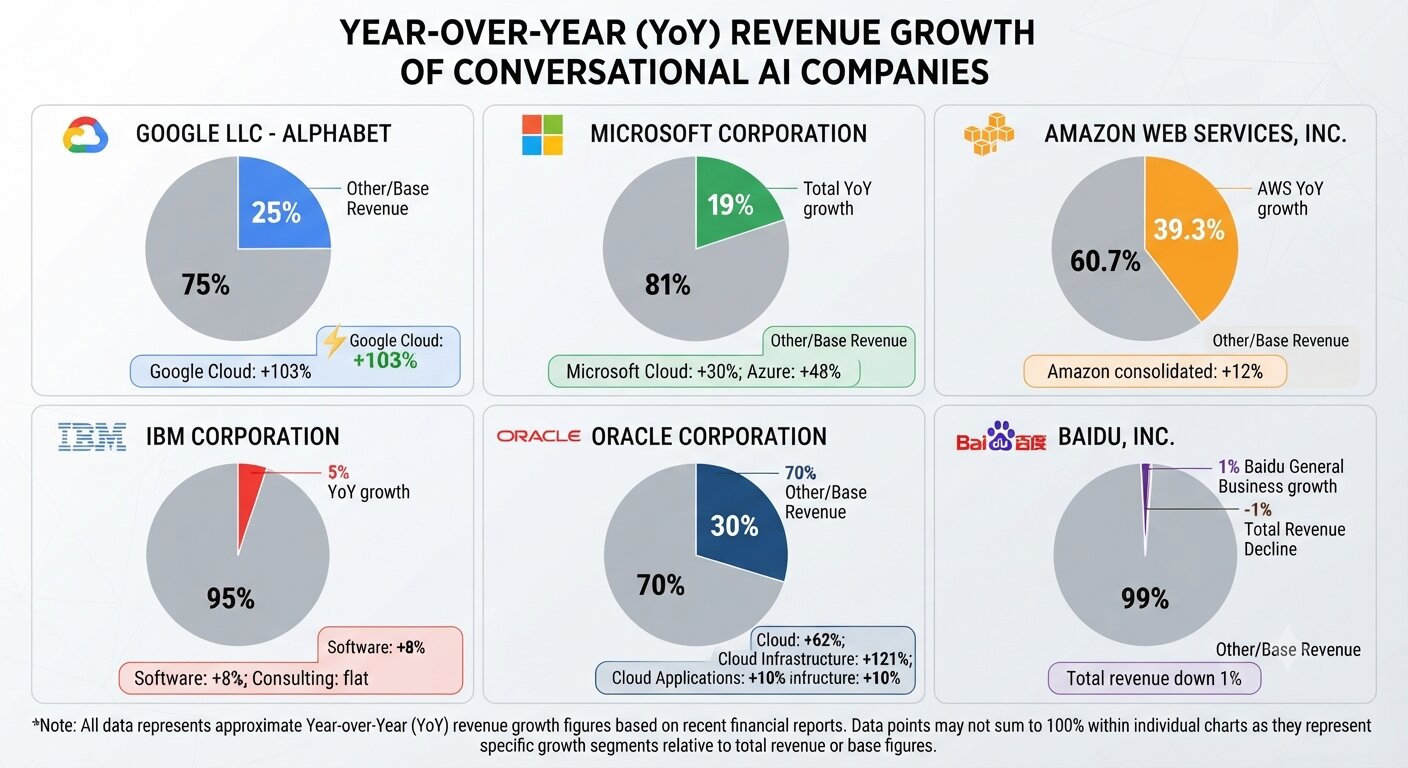
| YoY Revenue Growth | Alphabet: 25%; Google Cloud: 103% |
| Primary Segments | Google Services; Google Cloud; Other Bets |
Financial Details
The relevant evidence is Google Cloud, the channel through which Customer Engagement Suite and Gemini Enterprise are sold. Google Cloud revenue more than doubled to USD 30.7 billion in Q3 2026, with operating income of USD 11.1 billion, a margin of about 36%, driven by enterprise AI infrastructure, enterprise AI solutions, core cloud services and TPU system sales.
Management said the Gemini app reached one billion users and that first-party model APIs process nearly 32 billion tokens per minute, up 40% quarter over quarter. The cost of this position is visible: capital expenditure reached USD 51.4 billion in the quarter and free cash flow was negative USD 9.1 billion.
Strategic Developments
- Gemini app surpassed one billion users, reported with Q3 2026 results (October 28, 2026).
- Introduced Gemini Enterprise in 2025, with a low-code builder that lets customers build a customer engagement agent once and deploy it across telephony, web, mobile, email and chat, in more than 40 languages.
- Launched Gemini Enterprise for Customer Experience and Customer Experience Agent Studio, adding multimodal support agents and a Food Ordering agent.
- Expanded the Salesforce partnership: Service Cloud paired with Customer Engagement Suite as an end-to-end contact center solution, scheduled for general availability in the first half of 2026.
- Backed open agent standards, the Agent2Agent Protocol and the Agent Payments Protocol.
- Raised USD 84.8 billion in equity in June 2026, including USD 10 billion from Berkshire Hathaway, to fund AI investment (group-level, not conversational AI-specific).
2. Microsoft Corporation
About Microsoft Corporation: Microsoft embeds conversational AI across Copilot, Microsoft Foundry, Copilot Studio and Nuance-derived Dragon Copilot for healthcare. Its moat is enterprise distribution: Microsoft 365, Teams and Dynamics put agents inside existing workflows, while Azure supplies model choice, including OpenAI models, and governance.
Company Overview Table
| Attribute | Company Data |
|---|---|
| Company Name | Microsoft Corporation |
| Ticker Symbol | MSFT (NASDAQ) |
| Industry | Software, cloud computing and artificial intelligence |
| Headquarters | Redmond, Washington, USA |
| Founded | 1975 |
| Founders | Bill Gates and Paul Allen |
| Current CEO | Satya Nadella |
| Latest Quarterly Revenue | USD 92.3 billion (Q1 FY2027, quarter ended September 30, 2026); Microsoft Cloud: USD 63.9 billion; Azure: USD 33.2 billion |
| YoY Revenue Growth | 19% (Microsoft Cloud 30%; Azure 48%) |
| Primary Segments | Agents and Infra; Devices and Consumer (two-segment structure adopted from fiscal 2027) |
Financial Details
Microsoft does not break out conversational AI revenue (Data Unavailable). Its Q1 FY2027 results show demand for the agent layer: the Agents and Infra segment generated USD 76.8 billion, up 25%, and Azure accelerated to 48% growth. Copilot daily users rose nearly 50% sequentially and more than fivefold year over year, customers consuming Copilot credits through usage-based billing grew more than 75% in the quarter, and customers with more than 50,000 Copilot seats rose more than eightfold.
Foundry passed 120,000 customers with revenue more than tripling. Management flagged weaker Microsoft 365 E3 sales execution and said demand still exceeds supply. Q2 guidance is USD 96 billion to USD 97.1 billion in revenue, with Azure growth of 49% to 50% in constant currency and capital expenditure above USD 50 billion.
Strategic Developments
- Dragon Copilot, built on the Nuance acquisition, evolved into a unified clinical assistant at HIMSS 2026, with partner-built agents (Canary Speech, Humata Health, Optum, Regard) deployable through Microsoft Marketplace.
- Extended ambient AI to nurses in October 2025 and made the healthcare agent service in Copilot Studio generally available.
- Shifted Copilot toward combined subscription and consumption billing, widening monetization beyond licensed seats.
- Completed pre-training of its MAI Base 2 first-party model and released DecisionOne, used by more than 4,000 customers in its first month.
- Plans to scale in-house Maia accelerators to multi-gigawatt deployments from 2027 as the primary inference system for its own AI services.
- Added 24 new data centers across five continents in the quarter.
3. Amazon Web Services, Inc.
About Amazon Web Services, Inc.: AWS delivers conversational AI through Amazon Connect, Amazon Lex, Bedrock AgentCore and Nova Sonic speech-to-speech models. Its moat combines the largest cloud run rate (USD 184 billion), custom silicon (Trainium, Graviton) lowering inference cost, and contact-center-native distribution that lets enterprises deploy voice and messaging agents without rebuilding infrastructure.
Company Overview Table
| Attribute | Company Data |
|---|---|
| Company Name | Amazon Web Services, Inc. (subsidiary of Amazon.com, Inc.) |
| Ticker Symbol | AMZN (parent, NASDAQ); AWS is not separately listed |
| Industry | Cloud computing, AI infrastructure and services |
| Headquarters | Seattle, Washington, USA |
| Founded | 2006 (AWS launch); parent Amazon founded 1994 |
| Founders | Jeff Bezos (parent Amazon); AWS launched under Andy Jassy |
| Current CEO | Matt Garman (AWS); Andy Jassy (Amazon.com) |
| Latest Quarterly Revenue | AWS: USD 46.0 billion (Q3 2026, quarter ended September 30, 2026); Amazon consolidated: USD 201.9 billion |
| YoY Revenue Growth | AWS: 39.3%; Amazon consolidated: 12% |
| Primary Segments | Amazon reports North America, International and AWS; AWS spans compute, storage, databases, AI/ML (Bedrock) and contact center (Amazon Connect) |
Financial Details
AWS posted USD 46.0 billion in Q3 2026 revenue, its fastest growth in nearly five years, with operating income of USD 17.8 billion versus USD 11.4 billion a year earlier.
Sector-relevant indicators include Fortune 500 spending on Bedrock up nearly 7x year over year and total Bedrock token volume up nearly 17x; tens of thousands of customers use Bedrock AgentCore and deployed twice as many agents in Q3 as in the prior three quarters combined. Management expects AWS growth above 40% in both 2027 and 2028, against 2026 capital expenditure of about USD 220 billion.
Strategic Developments
- Introduced agentic self-service in Amazon Connect (November 30, 2025), integrating Nova Sonic speech models for natural, adaptive voice interactions.
- Expanded agentic speech-to-speech experiences to three additional AWS Regions and ten locales (April 20, 2026).
- Released a preview of Agentic CX designer (NLX) for Amazon Connect Customer (June 22, 2026), a builder for AI self-service experiences.
- Added expanded language support and speech controls for Connect agentic voice (July 2026).
- Reported revenue commitments for Graviton and Trainium each up more than 20x, and plans to sell Trainium outside AWS from late 2027.
- Maintains a strategic investment in Anthropic, which contributed USD 9.5 billion of pre-tax gains in Q3 2025 (group-level).
4. IBM Corporation
About IBM Corporation: IBM offers enterprise conversational AI through watsonx Orchestrate and watsonx Assistant, aimed at regulated industries needing governance, hybrid deployment and mainframe-grade integration. Its moat is installed-base access through Red Hat, consulting and transaction systems, reinforced by Confluent’s real-time data layer.
Company Overview Table
| Attribute | Company Data |
|---|---|
| Company Name | International Business Machines Corporation (IBM) |
| Ticker Symbol | IBM (NYSE) |
| Industry | Enterprise software, hybrid cloud, AI and consulting |
| Headquarters | Armonk, New York, USA |
| Founded | 1911 (as Computing-Tabulating-Recording Company; renamed IBM in 1924) |
| Founders | Charles Ranlett Flint (founder of the predecessor C-T-R) |
| Current CEO | Arvind Krishna |
| Latest Quarterly Revenue | USD 17.1 billion (Q3 2026, quarter ended September 30, 2026); Software: USD 7.8 billion; Consulting: USD 5.3 billion |
| YoY Revenue Growth | 5% (6% at constant currency); Software 8%; Consulting flat |
| Primary Segments | Software; Consulting; Infrastructure |
Financial Details
In Q3 2026, Software revenue rose 8% to USD 7.8 billion, with software annual recurring revenue at USD 24.9 billion, up 8%, and the Data portfolio up 19%. Generative AI accounted for about 30% of quarterly Consulting revenue and 35% of the consulting backlog, though Consulting signings of USD 5 billion fell 2% at constant currency.
Management reiterated full-year constant-currency revenue growth of 4% to 5% and raised its free cash flow outlook. IBM has invested USD 11.4 billion in acquisitions in 2026, which tilts its AI story toward data and orchestration rather than stand-alone chatbots.
Strategic Developments
- Completed the acquisition of Confluent on March 17, 2026, at USD 31 per share in cash, an enterprise value of about USD 11 billion, to give AI agents a governed real-time data layer integrated with watsonx.data, IBM MQ and IBM Z.
- Framed its AI offering around four platforms: Confluent, watsonx (including Bob and Orchestrate), HashiCorp/Apptio and Red Hat.
- Announced a collaboration with SAP on operations modernization and AI-readiness (October 7, 2026).
- Mainframe deals that slipped from Q2 closed in Q3, which management cited as evidence of timing rather than demand softness.
5. Oracle Corporation
About Oracle Corporation: Oracle embeds conversational and agentic AI directly into Fusion Applications through AI Agent Studio, supported by OCI GPU infrastructure and database-level AI. Its moat is proprietary enterprise data and business-process context in ERP, HCM and healthcare systems, with agents bundled at no added license fee.
Company Overview Table
| Attribute | Company Data |
|---|---|
| Company Name | Oracle Corporation |
| Ticker Symbol | ORCL (NYSE) |
| Industry | Enterprise software and cloud infrastructure |
| Headquarters | Austin, Texas, USA |
| Founded | 1977 |
| Founders | Larry Ellison, Bob Miner and Ed Oates |
| Current CEO | Clay Magouyrk and Mike Sicilia (co-CEOs) |
| Latest Quarterly Revenue | USD 19.3 billion (Q1 FY2027, quarter ended August 31, 2026); Cloud: USD 11.6 billion |
| YoY Revenue Growth | 30% (Cloud 62%; Cloud Infrastructure 121%; Cloud Applications 10%) |
| Primary Segments | Cloud (infrastructure and applications); Software; Hardware; Services |
Financial Details
Oracle does not disclose conversational AI revenue (Data Unavailable), and because Fusion AI agents are included at no extra license fee, direct monetization shows up indirectly in Cloud Applications, which grew 10% to USD 4.2 billion in Q1 FY2027.
The larger financial story is infrastructure: Cloud Infrastructure rose 121% to USD 7.4 billion, remaining performance obligations reached USD 664 billion after more than USD 30 billion of new AI cloud contracts, and free cash flow was negative USD 5 billion. Oracle completed a USD 20 billion at-the-market equity sale in the quarter and guides fiscal 2027 revenue to at least USD 90 billion. Q2 FY2027 results had not been announced as of this report’s date.
Strategic Developments
- Expanded Oracle AI Agent Studio with an agentic applications builder and workflow orchestration (March 24, 2026), with Accenture, Deloitte and PwC as launch ecosystem partners.
- Introduced an AI-native builder experience (July 14, 2026) for Fusion Agentic Applications, extending more than 1,000 delivered AI agents and 22 Fusion Agentic Applications, available at no additional cost.
- Expanded the AI Agent Marketplace to carry agentic applications in addition to individual agents.
- Launched Oracle AI Data Platform, which automates creation of an enterprise ontology so models can reason over private business data.
- Announced an agentic AI healthcare management and electronic health records system.
- Raised USD 20 billion through equity sales to fund its capital investment program.
6. Baidu, Inc.
About Baidu, Inc.: Baidu is China’s leading search company pivoting to AI cloud, with ERNIE foundation models, the Qianfan model-as-a-service platform, DuMate work agent and Kunlunxin chips. Its moat is Chinese-language data, search distribution and domestic compute, though advertising erosion constrains the funding of its conversational AI transition.
Company Overview Table
| Attribute | Company Data |
|---|---|
| Company Name | Baidu, Inc. |
| Ticker Symbol | BIDU (NASDAQ); 9888 (HKEX, HKD counter); 89888 (HKEX, RMB counter) |
| Industry | Internet search, artificial intelligence and cloud computing |
| Headquarters | Beijing, China |
| Founded | 2000 |
| Founders | Robin Li and Eric Xu |
| Current CEO | Robin Li |
| Latest Quarterly Revenue | RMB 30.8 billion, about USD 4.60 billion (Q3 2026, quarter ended September 30, 2026); Baidu General Business: RMB 25.0 billion |
| YoY Revenue Growth | Total revenue down 1%; Baidu General Business up 1% |
| Primary Segments | Baidu General Business (AI Cloud Infra, AI Applications, online and AI-native marketing); iQIYI |
Financial Details
Baidu’s Q3 2026 results show a business funding its AI shift from a shrinking advertising base. AI Cloud Infra revenue rose 94% to RMB 8.2 billion, with GPU Cloud up 191% year over year and 43% quarter over quarter. AI Applications revenue was RMB 2.6 billion, roughly flat, while AI-native marketing services fell 15% to RMB 2.4 billion and total online marketing fell 22% to RMB 11.9 billion.
AI-powered businesses reached RMB 13.2 billion, up 37% and 53% of General Business revenue. Revenue from external customers’ token usage on the Qianfan platform, the closest proxy for model-driven conversational workloads, rose 1,159% year over year. Non-GAAP net income was RMB 2.4 billion.
Strategic Developments
- Unveiled ERNIE 5.5 Flash Preview in November 2026, the latest model in the ERNIE family; ERNIE 5.0, a natively multimodal model, followed Baidu World in 2025.
- Enhanced DuMate, its general work agent, by integrating its internal workplace agent dodo, the Comate coding assistant and the Miaoda vibe coding platform.
- Introduced Token Exchange, a marketplace connecting AI model providers with buyers.
- Reduced production costs for Yijing hyper-realistic digital humans by about 80% versus Q4 2025.
- Shifted AI Cloud Infra toward a more diversified customer base, higher customer prepayments and longer-term contracts.
7. Kore.ai Inc.
About Kore.ai Inc.: Kore.ai is a private enterprise AI platform company offering agent-first products for customer service and employee productivity, with deployment flexibility across cloud, on-premise and virtual environments. Its moat is a model-agnostic platform with built-in guardrails and fine-tuned models, backed by NVIDIA and large private-capital investors.
Company Overview Table
| Attribute | Company Data |
|---|---|
| Company Name | Kore.ai Inc. |
| Ticker Symbol | Not listed (private) |
| Industry | Enterprise AI, conversational and agentic AI software |
| Headquarters | Orlando, Florida, USA |
| Founded | 2014 |
| Founders | Raj Koneru |
| Current CEO | Raj Koneru (Founder and CEO) |
| Primary Segments | AI for Service; AI for Work; AI platform layer for customization |
Financial Details
The most recent reliable financial event is the strategic growth investment announced on January 27, 2026, led by AllianceBernstein Private Credit Investors with continued participation from existing investors; the amount was not stated in the announcements reviewed.
It follows a USD 150 million round in January 2024 led by FTV Capital and NVIDIA, which took total capital raised to about USD 223 million at that time. The company says the proceeds fund product innovation, commercial expansion and international growth.
Strategic Developments
- Secured a strategic growth investment led by AllianceBernstein Private Credit Investors (January 27, 2026) to scale its agentic enterprise AI platform.
- Raised USD 150 million in January 2024 from FTV Capital, NVIDIA, Vistara Growth, Sweetwater PE, NextEquity, Nicola and Beedie.
- Repositioned around an agent-first strategy built on two pillars, AI for Service and AI for Work, plus a customization platform layer.
- Maintains its deployment-flexibility differentiator, supporting cloud, local and virtual-machine deployments with fine-tuning options.
8. Jio Haptik Technologies Limited
About Jio Haptik Technologies Limited: Jio Haptik is Reliance Jio Platforms’ conversational AI arm, building enterprise chatbots, voice agents and WhatsApp-based customer engagement, with a strong India and emerging-market footprint. Its moat is Jio distribution, low-cost multilingual deployment and a decade-long base of enterprise integrations, though disclosure is limited.
Company Overview Table
| Attribute | Company Data |
|---|---|
| Company Name | Jio Haptik Technologies Limited |
| Ticker Symbol | Not listed (subsidiary of Reliance Jio Platforms) |
| Industry | Conversational AI software |
| Headquarters | Mumbai, India |
| Founded | 2013 |
| Founders | Aakrit Vaish and Swapan Rajdev |
| Current CEO | Ahshad Jussawalla (since 2024) |
| Primary Segments | Enterprise conversational AI (chat and voice agents); AI agents for small businesses |
Financial Details
Haptik files audited statements as an Indian company, but the latest figures could not be retrieved and no quarterly numbers are published, so the latest quarter is Data Unavailable. A secondary-source profile reports FY2024 revenue of INR 156.6 crore, up 68.3%, with profit after tax of INR 11.2 crore; this has not been verified against the filing.
Former CEO Aakrit Vaish has said the business grew from about USD 500,000 to USD 35 million in annual recurring revenue within five years of the Reliance deal and turned cash-flow positive. Treat these as founder-reported or secondary estimates rather than audited sector data.
Strategic Developments
- Reliance Jio acquired about 87% of Haptik in April 2019 for roughly USD 100 million.
- Acquired Los Angeles-based Convrg (July 2019) and Mumbai-based Buzzo.ai (September 2019).
- Handed the CEO role from co-founder Aakrit Vaish to long-time employee Ahshad Jussawalla in 2024.
- Expanding into AI agents for small businesses through Interakt, with Jio Platforms distribution as the backbone.
9. Inbenta Holdings Inc.
About Inbenta Holdings Inc.: Inbenta provides enterprise conversational AI for customer service, combining a neuro-symbolic, lexicon-based language engine with generative models. Its Chat, Search, Knowledge, Assist and Learn products serve regulated sectors such as banking, where grounded answers differentiate it from pure large-language-model chatbots.
Company Overview Table
| Attribute | Company Data |
|---|---|
| Company Name | Inbenta Holdings Inc. (operating as Inbenta AI) |
| Ticker Symbol | Not listed (private) |
| Industry | Conversational AI and customer service software |
| Headquarters | Allen, Texas, USA (origins in Barcelona, Spain) |
| Founded | 2005 (some company materials cite 2011) |
| Founders | Jordi Torras (now Chief Innovation Officer) |
| Current CEO | Melissa Solis |
| Primary Segments | Chat; Search; Knowledge; Assist; Learn (product lines) |
Financial Details
The latest verifiable financing is the USD 40 million round led by Tritium Partners in January 2023, which brought total funding to roughly USD 60 million to USD 63 million depending on the account. That round came with a leadership change: Tritium’s Melissa Solis became CEO and founder Jordi Torras moved to Chief Innovation Officer. No later priced round was found.
Strategic Developments
- Raised USD 40 million led by Tritium Partners (January 2023) to fund product innovation and expansion into new markets.
- Acquired Horizn (August 2023), adding interactive product demos and digital-adoption tooling through its Learn module.
- Appointed channel veteran Brandon Pineda as Head of Global Partnerships (December 18, 2025) to expand its ecosystem.
- Introduced its Encore platform, positioned to move customers from proof-of-concept to production deployments.
10. Avaamo
About Avaamo: Avaamo is a Silicon Valley enterprise conversational AI vendor building deep-learning virtual assistants and voice agents for large organizations in healthcare, financial services, insurance and HR. Its moat is domain-trained models and enterprise connectors, though its scale is small relative to hyperscalers.
Company Overview Table
| Attribute | Company Data |
|---|---|
| Company Name | Avaamo |
| Ticker Symbol | Not listed (private) |
| Industry | Enterprise conversational AI software |
| Headquarters | Los Altos, California, USA |
| Founded | 2014 |
| Founders | Ram Menon and Sriram Chakravarthy |
| Current CEO | Ram Menon |
| Primary Segments | Conversational AI platform; enterprise voice agents |
Financial Details
The most recent reliable funding announcement located is the USD 14.2 million Series A led by Intel Capital in 2018, which brought total funding to USD 23.5 million at that point. No verified 2026 funding, acquisition or earnings disclosure was found. Third-party revenue estimates exist but could not be corroborated, so they are not reported here.
Strategic Developments
- Raised a USD 14.2 million Series A led by Intel Capital (2018) to expand sales and marketing for enterprise conversational AI.
- Published an enterprise voice strategy in July 2026 positioning AI voice agents beyond traditional call centers.
Conclusion
Conversational AI is increasingly integrated into broader cloud and agent platforms. Microsoft, Amazon and Google are monetizing through infrastructure and consumption-led models, supported by strong cloud growth. IBM and Oracle leverage established customer bases by bundling AI agents into existing enterprise solutions. Baidu reflects similar regional dynamics, while independent vendors such as Kore.ai, Haptik, Inbenta and Avaamo face scale-related challenges.
Over the next 12–24 months, pricing is expected to shift from per-seat subscriptions toward usage- and outcome-based models. Voice-native agents, infrastructure capacity and capital investment will become key competitive factors. Independent vendors may increasingly consolidate or focus on regulated and specialized markets.
The market is transitioning from conventional chatbots toward agentic automation. Hyperscaler growth indicates potential upside to Market.us’s projected 22.9% CAGR, although sector-specific revenue disclosures remain limited. Overall, value is increasingly concentrated among platform providers, while specialized vendors retain opportunities through governance, deployment flexibility and domain expertise.