


Introduction
The global High-Performance Computing (HPC) market is evolving as organizations require greater computing capacity to process complex workloads, train artificial intelligence models, conduct scientific simulations, and analyze large datasets. Demand is supported by investments in hyperscale data centers, government supercomputing programs, advanced processors, and high-speed networking.
Competition is increasingly shaped by integrated computing platforms combining central processing units, graphics processing units, memory, storage, and software. Cloud-based HPC and energy-efficient architectures are also becoming important as computing requirements and infrastructure costs increase.
Market Size and Key Statistics
-
The global HPC market was valued at USD 59.14 billion in 2025.
-
The market is projected to reach USD 134.95 billion by 2035.
-
The market is expected to expand at a CAGR of 8.6% between 2025 and 2035.
-
North America dominated the market in 2025 with a 41.62% share.
-
North American HPC market revenue reached USD 24.61 billion in 2025.
-
Hardware represented the largest component segment, accounting for 58.4%.
-
On-premises deployment held a leading 52.7% share.
-
Large enterprises accounted for 82.6% of the market.
-
Simulation and Modeling represented 38.9% of application demand.
-
Government and Defense accounted for 31.8% of end-user demand.
Hewlett Packard Enterprise Company
About Hewlett Packard Enterprise: Hewlett Packard Enterprise Company is a major HPC infrastructure provider through its Cray supercomputing portfolio. Its technological strengths include liquid-cooled systems, high-speed interconnects, scalable computing architectures, and integrated AI and scientific computing infrastructure.
a) Company Overview Table
| Attribute | Company Data |
|---|---|
| Company Name | Hewlett Packard Enterprise Company |
| Ticker Symbol | NYSE: HPE |
| Industry | Information Technology and HPC |
| Headquarters | Spring, Texas, USA |
| Founded | 2015 |
| Founders | Hewlett-Packard enterprise business separation |
| Current CEO | Antonio Neri |
| Latest Quarterly Revenue | USD 12.2 billion, Q3 FY2026 |
| YoY Revenue Growth | 34% |
| Primary Segments | Server, Hybrid Cloud, Networking, Financial Services |
b) Financial Details
HPE reported revenue of USD 12.2 billion in its third quarter of fiscal 2026, representing 34% year-over-year growth. HPC-specific revenue was not separately disclosed. The company’s compute and supercomputing operations remain important to its infrastructure portfolio, particularly through Cray systems and integrated AI infrastructure.
c) Strategic Developments
-
Continued development of the Cray supercomputing portfolio for scientific research and AI-intensive workloads.
-
Expansion of liquid-cooled infrastructure to support high-density computing.
-
Continued investment in integrated AI and HPC systems for enterprise and government customers.
Dell Technologies, Inc.
About Dell Technologies: Dell Technologies, Inc. is a major HPC infrastructure supplier offering PowerEdge servers, storage platforms, and high-performance networking. Its competitive strength comes from scalable server configurations, enterprise distribution, and integrated AI infrastructure for scientific and industrial computing.
a) Company Overview Table
| Attribute | Company Data |
|---|---|
| Company Name | Dell Technologies, Inc. |
| Ticker Symbol | NYSE: DELL |
| Industry | Information Technology and HPC |
| Headquarters | Round Rock, Texas, USA |
| Founded | 1984 |
| Founders | Michael Dell |
| Current CEO | Michael Dell |
| Latest Quarterly Revenue | USD 54.9 billion, Q3 FY2027 |
| YoY Revenue Growth | 103% |
| Primary Segments | Infrastructure Solutions Group, Client Solutions Group |
b) Financial Details
Dell reported record third-quarter fiscal 2027 revenue of USD 54.9 billion, an increase of 103% year over year. Infrastructure Solutions Group generated USD 42.0 billion, increasing 198%. AI-optimized server revenue reached USD 22.0 billion, up 291%. Although AI server revenue is not identical to traditional HPC revenue, this performance demonstrates Dell’s growing position in accelerated computing infrastructure.
c) Strategic Developments
-
Expanded AI-optimized PowerEdge server production.
-
Increased investment in high-density computing and advanced server infrastructure.
-
Continued development of integrated server, storage, and networking solutions for large-scale AI and HPC deployments.
Lenovo Group Limited
About Lenovo Group: Lenovo Group Limited supplies HPC infrastructure through its ThinkSystem and Neptune liquid-cooling platforms. Its competitive advantage includes large-scale server manufacturing, energy-efficient computing, and infrastructure integration for scientific research, enterprise applications, and AI workloads.
a) Company Overview Table
| Attribute | Company Data |
|---|---|
| Company Name | Lenovo Group Limited |
| Ticker Symbol | HKEX: 992 |
| Industry | Technology and HPC Infrastructure |
| Headquarters | Beijing, China |
| Founded | 1984 |
| Founders | Liu Chuanzhi and founding team |
| Current CEO | Yuanqing Yang |
| Latest Quarterly Revenue | USD 21.6 billion, Q4 FY2025/26 |
| YoY Revenue Growth | 27% |
| Primary Segments | Intelligent Devices Group, Infrastructure Solutions Group, Solutions and Services Group |
b) Financial Details
Lenovo reported fourth-quarter fiscal 2025/26 revenue of USD 21.6 billion, increasing 27% year over year. Its Infrastructure Solutions Group generated full-year revenue of USD 19.2 billion. The company also reported that AI-related revenue increased 84% during the fourth quarter. HPC-specific revenue was not separately disclosed.
c) Strategic Developments
-
Continued expansion of Neptune liquid-cooling technology.
-
Increased development of AI and HPC server infrastructure.
-
Strengthened hybrid AI infrastructure capabilities through its Infrastructure Solutions Group.
Inspur Electronic Information Industry Co., Ltd.
About Inspur: Inspur Electronic Information Industry Co., Ltd. is a Chinese computing infrastructure supplier with capabilities in HPC servers, AI servers, and large-scale data processing systems. Its competitive position is supported by server engineering, domestic enterprise relationships, and high-density computing solutions.
a) Company Overview Table
| Attribute | Company Data |
|---|---|
| Company Name | Inspur Electronic Information Industry Co., Ltd. |
| Ticker Symbol | Shenzhen: 000977 |
| Industry | Computing Hardware and HPC |
| Headquarters | Jinan, Shandong, China |
| Founded | 1998 |
| Primary Segments | Servers, Storage, AI Computing, HPC Infrastructure |
b) Financial Details
Inspur’s HPC business focuses on high-performance servers and computing infrastructure for scientific research, industrial simulation, and AI applications.
c) Strategic Developments
-
Continued development of high-density computing and AI server platforms.
-
Expansion of domestic HPC infrastructure capabilities.
-
Investment in advanced server architectures for large-scale computing workloads.
International Business Machines Corporation
About IBM: International Business Machines Corporation maintains an HPC presence through enterprise computing, IBM Power systems, advanced computing research, and hybrid cloud infrastructure. Its strengths include high-reliability architectures, scientific computing expertise, and integration of conventional HPC with emerging quantum computing technologies.
a) Company Overview Table
| Attribute | Company Data |
|---|---|
| Company Name | International Business Machines Corporation |
| Ticker Symbol | NYSE: IBM |
| Industry | Information Technology and HPC |
| Headquarters | Armonk, New York, USA |
| Founded | 1911 |
| Founders | Charles Ranlett Flint; predecessor businesses |
| Current CEO | Arvind Krishna |
| Latest Quarterly Revenue | USD 17.1 billion, Q3 2026 |
| YoY Revenue Growth | 5% |
| Primary Segments | Software, Consulting, Infrastructure |
b) Financial Details
IBM reported third-quarter 2026 revenue of USD 17.1 billion, increasing 5% year over year. Infrastructure revenue grew 4%, while the company continued to develop enterprise computing and advanced infrastructure solutions. IBM does not separately report revenue generated exclusively from HPC systems, making a direct HPC revenue comparison unavailable.
c) Strategic Developments
-
Continued research into quantum computing integration with classical HPC infrastructure.
-
Expansion of enterprise infrastructure and high-performance computing capabilities.
-
Development of advanced computing architectures for scientific and industrial applications.
Atos SE
About Atos: Atos SE is a European digital infrastructure and supercomputing supplier through its Eviden business. Its HPC capabilities include BullSequana systems, advanced computing integration, and infrastructure for national research institutions, government organizations, and scientific laboratories.
a) Company Overview Table
| Attribute | Company Data |
|---|---|
| Company Name | Atos SE |
| Ticker Symbol | Euronext Paris: ATO |
| Industry | Information Technology and Supercomputing |
| Headquarters | Bezons, France |
| Founded | 1997 |
| Founders | Bernard Bourigeaud |
| Primary Segments | Digital Services, Eviden, Advanced Computing |
b) Financial Details
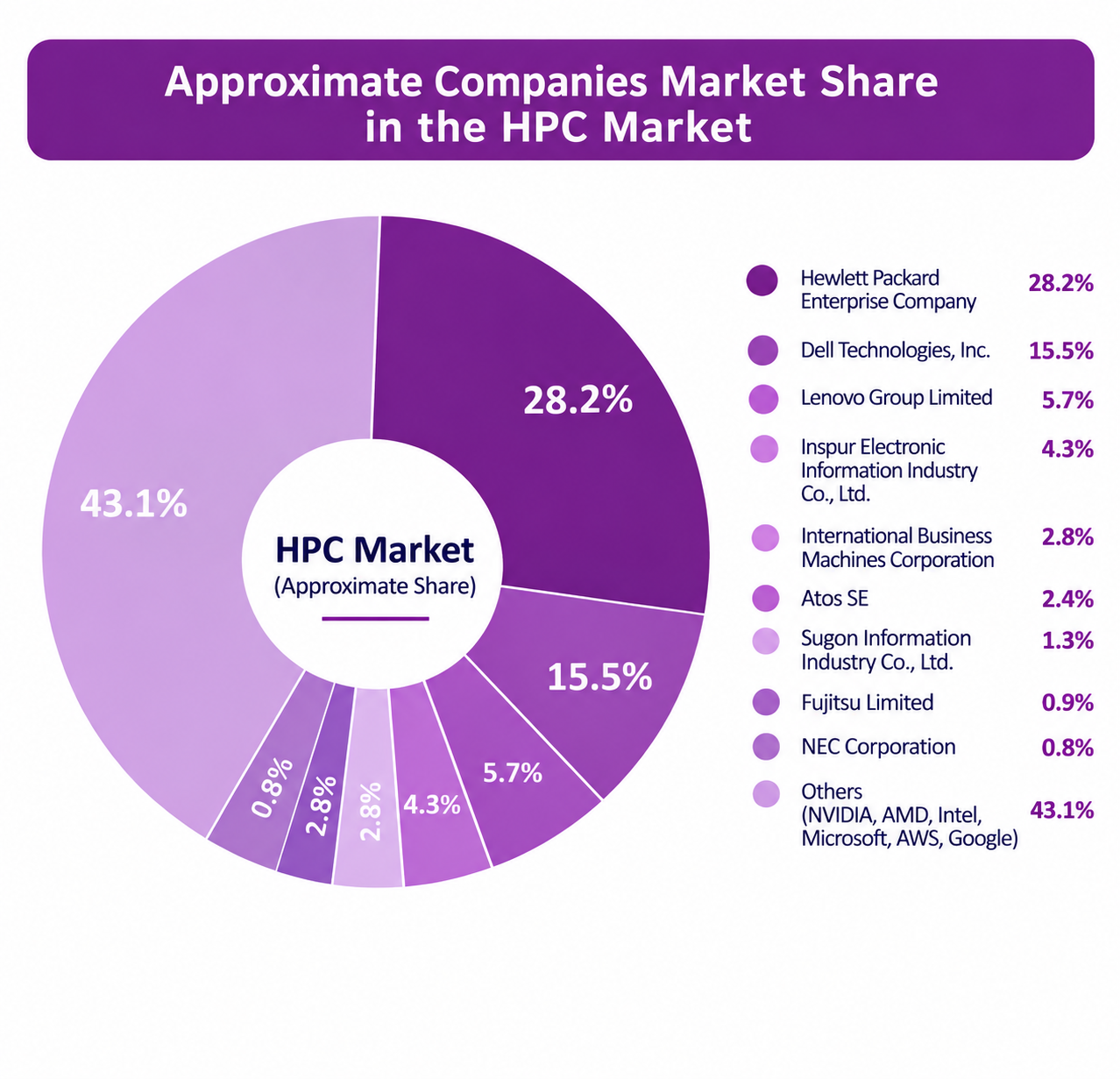
Atos participates in the HPC market through its advanced computing activities, including supercomputing systems and scientific infrastructure. The company has historically served European research institutions and government customers. Its 2024 HPC/AI server-market share was approximately 2.8%.
c) Strategic Developments
-
Continued development of BullSequana supercomputing systems.
-
Participation in European scientific computing and research infrastructure projects.
-
Focus on advanced computing, AI infrastructure, and high-performance system integration.
Sugon Information Industry Co., Ltd.
About Sugon: Sugon Information Industry Co., Ltd. develops high-performance computing systems, servers, and advanced computing infrastructure. Its competitive position is based on domestic HPC installations, specialized computing hardware, and solutions for scientific research and industrial simulation.
a) Company Overview Table
| Attribute | Company Data |
|---|---|
| Company Name | Sugon Information Industry Co., Ltd. |
| Ticker Symbol | SSE: 603019 |
| Industry | Computing Infrastructure and HPC |
| Headquarters | Beijing, China |
| Founded | 2006 |
| Primary Segments | HPC Systems, Servers, Storage, Advanced Computing |
b) Financial Details
Sugon is an established participant in China’s HPC infrastructure market, supplying specialized computing systems for research and enterprise workloads.
c) Strategic Developments
-
Continued development of domestically manufactured HPC infrastructure.
-
Expansion of advanced computing and server technologies.
-
Focus on scientific simulation and large-scale data processing systems.
NVIDIA Corporation
About NVIDIA: NVIDIA Corporation is a leading accelerated-computing technology provider. Its GPU architecture, CUDA software ecosystem, NVLink interconnects, and integrated computing platforms are widely used in AI training, scientific simulation, engineering, and next-generation supercomputing.
a) Company Overview Table
| Attribute | Company Data |
|---|---|
| Company Name | NVIDIA Corporation |
| Ticker Symbol | NASDAQ: NVDA |
| Industry | Semiconductors and Accelerated Computing |
| Headquarters | Santa Clara, California, USA |
| Founded | 1993 |
| Founders | Jensen Huang, Chris Malachowsky, Curtis Priem |
| Current CEO | Colette Kress, interim CEO as reported November 2026 |
| Latest Quarterly Revenue | USD 115.8 billion, Q3 FY2027 |
| YoY Revenue Growth | 103% |
| Primary Segments | Data Center, Gaming, Professional Visualization, Automotive |
b) Financial Details
NVIDIA reported third-quarter fiscal 2027 revenue of USD 115.8 billion, up 103% year over year. Data Center revenue reached USD 107.6 billion, increasing 110%. The segment includes AI and accelerated computing platforms, but the company does not disclose a separate traditional HPC revenue figure. NVIDIA’s Vera Rubin NVL72 systems began shipping during the quarter.
c) Strategic Developments
-
November 2026: Began shipping Vera Rubin NVL72 computing systems.
-
Expanded the Vera Rubin cloud ecosystem with Google Cloud and Oracle Cloud Infrastructure.
-
Continued partnerships with Microsoft, Google, and other infrastructure providers to scale accelerated computing.
-
Expanded its integrated CPU, GPU, networking, and software ecosystem.
Advanced Micro Devices, Inc.
About AMD: Advanced Micro Devices, Inc. competes in HPC through EPYC server processors and Instinct accelerator GPUs. Its open computing ecosystem, high-core-count processors, and rack-scale platforms support scientific workloads, AI infrastructure, and large-scale data-center computing.
a) Company Overview Table
| Attribute | Company Data |
|---|---|
| Company Name | Advanced Micro Devices, Inc. |
| Ticker Symbol | NASDAQ: AMD |
| Industry | Semiconductors and HPC Processors |
| Headquarters | Santa Clara, California, USA |
| Founded | 1969 |
| Founders | Jerry Sanders and founding team |
| Current CEO | Lisa Su |
| Latest Quarterly Revenue | USD 13.4 billion, Q3 2026 |
| YoY Revenue Growth | 45% |
| Primary Segments | Data Center, Client and Gaming, Embedded |
b) Financial Details
AMD reported third-quarter 2026 revenue of USD 13.377 billion, increasing 45% year over year. Its Data Center segment generated USD 8.546 billion, representing 97% growth. Demand was supported by EPYC processors and Instinct GPUs, strengthening AMD’s position in accelerated computing and HPC infrastructure.
c) Strategic Developments
-
November 2026: Reported strong demand for EPYC and Instinct products.
-
Expanded deployment of AMD Helios rack-scale infrastructure.
-
Announced large-scale computing deployments with Microsoft, Meta, Anthropic, and Oracle Cloud Infrastructure.
-
Continued development of next-generation CPU and GPU architectures.
Intel Corporation
About Intel: Intel Corporation supplies HPC infrastructure through Xeon processors, networking technologies, and advanced semiconductor development. Its competitive strengths include established server compatibility, enterprise software support, and processor platforms for scientific computing and data-intensive applications.
a) Company Overview Table
| Attribute | Company Data |
|---|---|
| Company Name | Intel Corporation |
| Ticker Symbol | NASDAQ: INTC |
| Industry | Semiconductors and HPC Computing |
| Headquarters | Santa Clara, California, USA |
| Founded | 1968 |
| Founders | Robert Noyce and Gordon Moore |
| Current CEO | Lip-Bu Tan |
| Latest Quarterly Revenue | USD 16.5 billion, Q3 2026 |
| YoY Revenue Growth | 21% |
| Primary Segments | Data Center and AI, Client Computing, Intel Foundry |
b) Financial Details
Intel reported third-quarter 2026 revenue of USD 16.5 billion, up 21% year over year. Its Data Center and AI business generated USD 7.3 billion, increasing 78%. Strong demand for Xeon processors supported the company’s data-center performance. However, the company does not separately disclose revenue from HPC-specific deployments.
c) Strategic Developments
-
Continued expansion of Xeon processor supply to address data-center demand.
-
Investment in advanced semiconductor manufacturing and process technologies.
-
Development of computing platforms for AI and scientific workloads.
Fujitsu Limited
About Fujitsu: Fujitsu Limited is a Japanese technology company with established supercomputing capabilities. Its HPC portfolio includes PRIMEHPC systems, processor technologies, and advanced scientific computing solutions. The company has a strong position in climate research, simulation, and national research infrastructure.
a) Company Overview Table
| Attribute | Company Data |
|---|---|
| Company Name | Fujitsu Limited |
| Ticker Symbol | TSE: 6702 |
| Industry | Information Technology and HPC |
| Headquarters | Kawasaki, Japan |
| Founded | 1935 |
| Founders | Fuji Electric predecessor business |
| Current CEO | Takahito Tokita |
| Primary Segments | Services Solutions, Hardware Solutions, Ubiquitous Solutions |
b) Financial Details
Fujitsu continues to commercialize advanced computing technologies developed through its Fugaku supercomputer program. Its HPC activities include scientific simulation, climate modeling, and pharmaceutical research. The company published its first-half fiscal 2026 financial results on October 29, 2026.
c) Strategic Developments
-
Continued commercialization of technologies developed for the Fugaku supercomputer.
-
Expansion of cloud-based HPC services for scientific and industrial customers.
-
Development of advanced processor architectures and energy-efficient computing systems.
-
Continued research into AI and high-performance computing integration.
NEC Corporation
About NEC: NEC Corporation provides HPC systems, advanced computing infrastructure, and scientific research technologies. Its capabilities include SX-series vector computing, supercomputer development, and integrated solutions for government research, weather forecasting, and industrial simulation.
a) Company Overview Table
| Attribute | Company Data |
|---|---|
| Company Name | NEC Corporation |
| Ticker Symbol | TSE: 6701 |
| Industry | Information Technology and HPC |
| Headquarters | Tokyo, Japan |
| Founded | 1899 |
| Founders | Kunihiko Iwadare |
| Current CEO | Takayuki Morita |
| Primary Segments | IT Services, Social Infrastructure, Network Services |
b) Financial Details
NEC’s HPC activities focus on scientific computing, advanced vector processors, and research infrastructure. Its systems support specialized workloads that require high computational throughput and reliability. The company held approximately 0.8% of the measured 2024 HPC/AI server market.
c) Strategic Developments
-
November 2025: Presented research infrastructure solutions at SC25, including SCUP-HPC provenance management for tracking supercomputing workflows.
-
Continued development of scientific computing infrastructure.
-
Expanded solutions for AI research, data-intensive computing, and university research environments.
Microsoft Corporation
About Microsoft: Microsoft Corporation participates in HPC through Azure infrastructure, high-performance virtual machines, advanced networking, and large-scale AI computing platforms. Its cloud ecosystem enables enterprises and research institutions to access scalable computing resources without owning complete supercomputing installations.
a) Company Overview Table
| Attribute | Company Data |
|---|---|
| Company Name | Microsoft Corporation |
| Ticker Symbol | NASDAQ: MSFT |
| Industry | Technology and Cloud Computing |
| Headquarters | Redmond, Washington, USA |
| Founded | 1975 |
| Founders | Bill Gates and Paul Allen |
| Current CEO | Satya Nadella |
| Latest Quarterly Revenue | USD 92.3 billion, Q1 FY2027 |
| YoY Revenue Growth | 19% |
| Primary Segments | Agents and Infrastructure, Devices and Consumer |
b) Financial Details
Microsoft reported first-quarter fiscal 2027 revenue of USD 92.3 billion, increasing 19% year over year. Azure revenue increased 48%, while Microsoft Cloud revenue reached USD 63.9 billion, growing 30%. These results demonstrate increasing demand for cloud computing infrastructure that also supports HPC workloads. The company does not separately disclose Azure HPC revenue.
c) Strategic Developments
-
Continued investment in Azure AI and HPC infrastructure.
-
Expanded large-scale computing partnerships with NVIDIA.
-
Increased infrastructure capacity to support advanced AI training and simulation.
-
Continued development of specialized cloud computing environments for enterprise customers.
Amazon Web Services, Inc.
About Amazon Web Services: Amazon Web Services, Inc. provides cloud-based HPC infrastructure through scalable computing instances, high-speed networking, storage, and GPU acceleration. Its pay-as-you-go model enables organizations to conduct computationally intensive research and simulations without significant upfront hardware investments.
a) Company Overview Table
| Attribute | Company Data |
|---|---|
| Company Name | Amazon Web Services, Inc. |
| Ticker Symbol | Not separately listed; Amazon: NASDAQ AMZN |
| Industry | Cloud Computing and HPC |
| Headquarters | Seattle, Washington, USA |
| Founded | 2006 |
| Founders | Amazon.com founding organization |
| Current CEO | Matt Garman |
| Latest Quarterly Revenue | USD 46.0 billion, Q3 2026 |
| YoY Revenue Growth | 39% |
| Primary Segments | Cloud Infrastructure, Computing, Storage, Networking, AI Services |
b) Financial Details
AWS reported third-quarter 2026 revenue of USD 46.0 billion, representing 39% year-over-year growth. Operating income reached USD 17.8 billion. Its infrastructure business supports HPC through GPU-based computing, scalable storage, and high-performance networking. However, AWS does not separately disclose revenue generated exclusively from HPC services.
c) Strategic Developments
-
Continued expansion of GPU-based cloud infrastructure.
-
Increased investment in data-center capacity and AI computing infrastructure.
-
Expansion of cloud services for scientific simulation and data-intensive applications.
-
Continued development of specialized computing instances for demanding workloads.
Google LLC
About Google: Google LLC participates in HPC through Google Cloud, Tensor Processing Units, accelerated computing infrastructure, and advanced data-processing technologies. Its strengths include custom silicon, large-scale distributed computing, and cloud platforms for scientific research and AI-intensive workloads.
a) Company Overview Table
| Attribute | Company Data |
|---|---|
| Company Name | Google LLC |
| Ticker Symbol | Not separately listed; Alphabet: NASDAQ GOOGL |
| Industry | Technology and Cloud Computing |
| Headquarters | Mountain View, California, USA |
| Founded | 1998 |
| Founders | Larry Page and Sergey Brin |
| Current CEO | Sundar Pichai |
| Latest Quarterly Revenue | Google Cloud: USD 30.7 billion, Q3 2026 |
| YoY Revenue Growth | Google Cloud: 103% |
| Primary Segments | Google Services, Google Cloud, Other Bets |
b) Financial Details
Google Cloud generated USD 30.7 billion in third-quarter 2026 revenue, increasing 103% year over year. Growth was supported by enterprise AI infrastructure, Google Cloud Platform services, and TPU system sales. Its custom accelerators and distributed computing infrastructure support HPC-related workloads, although Google does not disclose a separate HPC revenue category.
c) Strategic Developments
-
Expanded Google Cloud infrastructure for accelerated computing.
-
Continued development of Tensor Processing Units for large-scale AI and computational workloads.
-
Expanded its partnership with NVIDIA through Vera Rubin-powered cloud infrastructure.
-
Continued investment in data-center capacity and advanced computing infrastructure.
Conclusion
The High-Performance Computing market is entering a period of structural expansion driven by artificial intelligence, scientific research, advanced simulation, and enterprise digital infrastructure investments. HPE and Dell maintain strong positions in traditional HPC server systems, while Lenovo, Inspur, Atos, and Sugon strengthen competition across regional and specialized installations. NVIDIA, AMD, and Intel remain strategically important because processor and accelerator performance directly influences system capabilities. Meanwhile, Microsoft, AWS, and Google are expanding the availability of HPC through cloud infrastructure.
Over the next 12–24 months, competition is expected to focus on GPU-accelerated computing, rack-scale architectures, liquid cooling, high-speed interconnects, and energy-efficient supercomputers. Cloud-based and hybrid HPC deployments should gain importance as organizations seek flexible computing capacity. Demand from government laboratories, defense organizations, manufacturing, healthcare, and scientific research is also expected to support infrastructure investment.
Overall market outlook: The HPC market is positioned for sustained growth. Competitive advantage will increasingly depend on integrated computing platforms, energy efficiency, accelerator availability, software ecosystems, and the ability to deliver scalable infrastructure at a competitive operating cost.



