


Introduction
The global serverless computing market represents a foundational shift in enterprise cloud architecture, abstracting server provisioning in favor of event-driven, consumption-priced execution. Expanding from USD 12.16 billion in 2023 toward a projected USD 81.1 billion by 2033, sector momentum is propelled by enterprise demands for IT overhead reduction, rapid microservice deployment, and elastic scaling for generative AI inference and real-time IoT pipelines. While public cloud hyperscalers dominate core Function-as-a-Service and serverless container runtimes, macroeconomic cost scrutiny and data-sovereignty mandates are accelerating hybrid, Knative-based, and multi-cloud observability deployments across regulated industries.
Market Size & Statistics
- The global serverless computing market was valued at USD 12.16 billion in the base estimation year of 2023.
- Worldwide market revenue is projected to reach USD 81.1 billion by 2033, expanding at a compound annual growth rate of 20.9% from 2024 to 2033.
- By service category, the professional services segment dominated the market in 2023 by capturing more than 61% revenue share.
- Within deployment models, the public cloud segment led global adoption in 2023, accounting for over 75% of total market share.
- Among end-user verticals, the Banking, Financial Services, and Insurance sector held the largest share in 2023 at more than 23%.
- Regionally, North America commanded the leading global position in 2023, capturing over 38.0% of total market share and generating USD 4.6 billion in revenue.
- Platform telemetry shows serverless adoption grew by 7% on Google Cloud, 6% on Azure, and 3% on AWS, with customer penetration exceeding 70% on AWS, 60% on Google Cloud, and reaching 49% on Azure.
- Generative AI serverless adaptations in early 2024 demonstrated potential inference and deployment cost reductions of up to 50% compared to traditional provisioning models.
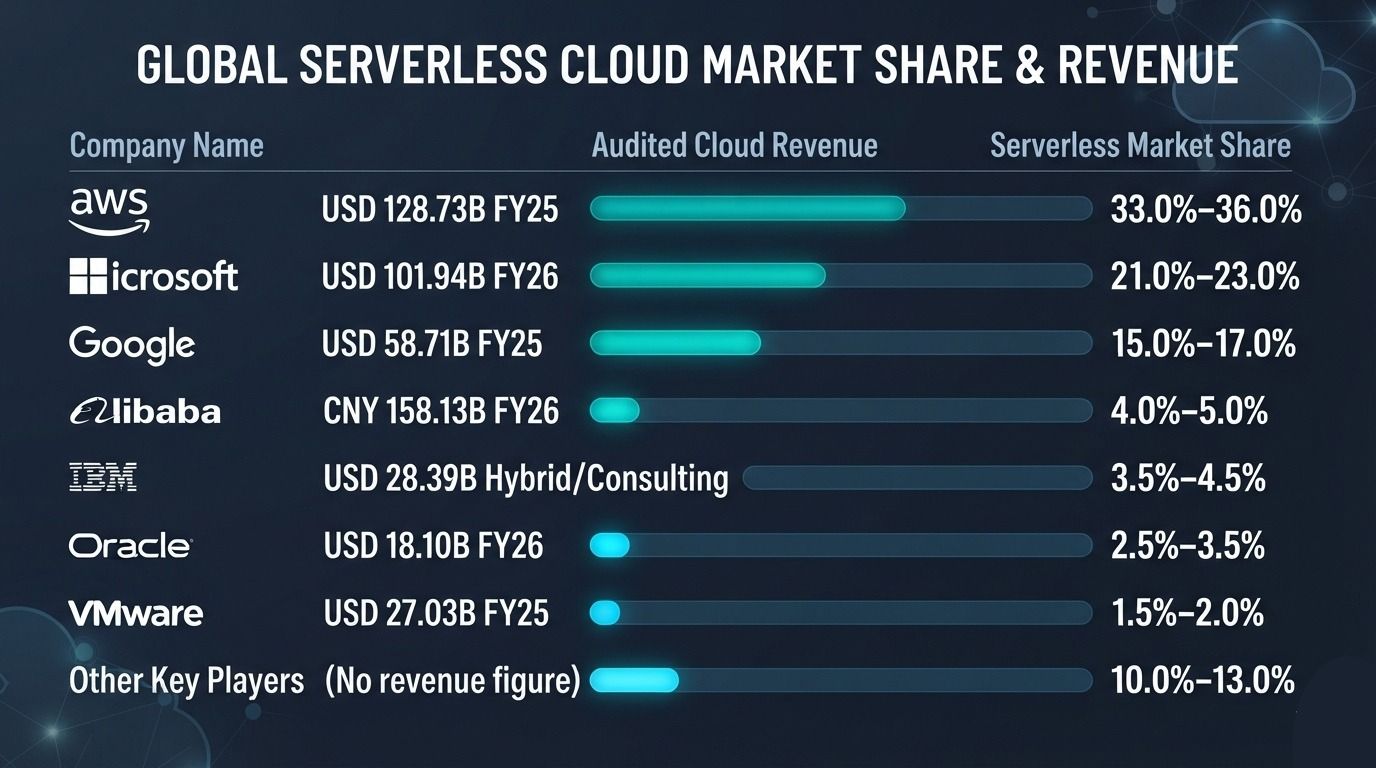
Public cloud hyperscalers AWS, Microsoft, and Google capture a combined 69.0%–76.0% of global serverless computing revenue, outperforming their 61.0%–63.0% share of broader cloud infrastructure due to event-driven service gravity. The remaining market revenue is distributed across Asia-Pacific cloud leaders, hybrid Knative and OpenShift runtime vendors, full-stack observability platforms, and managed cloud consulting providers.
| Company | Closest Audited Cloud / Software Segment Revenue | Serverless Revenue Share | Primary Serverless Revenue Drivers & Telemetry |
|---|---|---|---|
| AWS | USD 128.73B FY2025 AWS Segment; USD 45.98B Q3 2026 AWS Segment | 33.0%–36.0% | 26%–28% global cloud share; 65%–70%+ customer FaaS penetration; 52.8% web-detected serverless platform share via AWS Lambda and AWS Fargate |
| Microsoft | USD 101.94B FY2026 Azure Revenue; USD 33.17B Q1 FY2027 Azure Revenue | 21.0%–23.0% | 19%–20% global cloud share; 49%–56% Azure serverless customer adoption across Azure Functions, App Service, Container Apps, and Cosmos DB Serverless |
| USD 58.71B FY2025 Google Cloud; USD 30.71B Q3 2026 Google Cloud | 15.0%–17.0% | 15%–16% global cloud share; industry-high 70% customer adoption on Knative-based Cloud Run and 11.5% web-detected serverless platform share | |
| Alibaba | CNY 158.13B FY2026 Cloud Intelligence Group; CNY 60.97B Q2 FY2027 AI Cloud | 4.0%–5.0% | 4.0% global cloud infrastructure share; leads APAC FaaS via Alibaba Cloud Function Compute and PAI-EAS serverless generative AI inference |
| IBM Corporation | USD 7.33B Hybrid Cloud Software & USD 21.06B Consulting FY2025 | 3.5%–4.5% | Monetizes hybrid runtime licensing via Red Hat OpenShift Serverless and IBM Cloud Code Engine plus enterprise serverless refactoring in the 61%+ professional services segment |
| Oracle Corporation | USD 18.10B FY2026 OCI Revenue; USD 7.39B Q1 FY2027 OCI Revenue | 2.5%–3.5% | 3%–4% global cloud infrastructure share; scales enterprise event execution via OCI Functions and Oracle Autonomous AI Database Serverless |
| VMware, Inc. | USD 27.03B FY2025 Broadcom Infrastructure Software; USD 8.75B Q3 FY2026 | 1.5%–2.0% | Leverages 59.3% enterprise virtualization share to deliver private-cloud Knative Cloud Native Runtimes on VMware Tanzu and Wavefront serverless observability |
| Cisco | USD 1.10B Observability & USD 8.23B Security FY2026 | 1.0%–1.5% | Captures distributed FaaS tracing, cold-start diagnostics, and APM spend across AWS Lambda and Azure Functions via Splunk Observability Cloud and AppDynamics |
| Hewlett Packard Enterprise Company | USD 34.34B FY2026 Cloud & AI; USD 5.75B FY2025 Hybrid Cloud | 0.8%–1.2% | USD 3.5B HPE GreenLake ARR; monetizes consumption-billed private cloud Kubernetes and serverless analytics engines via HPE Ezmeral |
| Rackspace Inc. | USD 1.70B Public Cloud & USD 0.99B Private Cloud FY2025; USD 349.1M Q3 2026 Public Cloud | 0.7%–1.0% | Monetizes AWS Lambda and Azure Functions architecture, cold-start optimization, and managed operations alongside Rackspace Spot managed Kubernetes |
| NetApp | USD 688.0M Public Cloud & USD 6.24B Hybrid Cloud FY2026 | 0.3%–0.5% | Divested Spot Ocean serverless Kubernetes unit to Flexera for USD 100M in March 2025; active serverless revenue derives from Cloud Volumes ONTAP stateful storage |
| Quest Software | USD 853.0M Annual Revenue; USD 350.0M 2025 AI/Cloud Capital Infusion | 0.1%–0.3% | Generates cloud migration assessment, workload cost-modeling, and hybrid database observability revenue across AWS and Azure via Foglight Evolve |
| Other Key Players | USD 167.7B Q3 2026 Global Cloud Ecosystem Non-Top-5 Pool | 10.0%–13.0% | Vercel holds 23.6% of web-detected serverless frontend domains; Cloudflare Workers exceeds 4.5M developers; includes Tencent Cloud, Huawei Cloud, and Datadog |
Top Companies List
- AWS
- Microsoft
- Alibaba
- IBM Corporation
- Oracle Corporation
- VMware, Inc.
- Cisco
- Hewlett Packard Enterprise Company
- Rackspace Inc.
- NetApp
- Quest Software
- Other Key Players
AWS
AWS anchors the global serverless computing market through its Firecracker microVM isolation architecture, powering AWS Lambda, AWS Fargate, Step Functions, and EventBridge. With over 65%–70% customer FaaS penetration and native event triggers across 200+ cloud services, AWS commands the industry’s deepest event-driven technological moat.
Company Overview
| Attribute | Company Data |
|---|---|
| Company Name | Amazon Web Services, Inc., subsidiary of Amazon.com, Inc. |
| Ticker Symbol | NASDAQ: AMZN |
| Industry | Cloud Computing & Serverless Infrastructure |
| Headquarters | Seattle, Washington, United States |
| Founded | 2006 AWS launch; 1994 Amazon.com, Inc. |
| Founders | Jeff Bezos |
| Current CEO | Matt Garman, CEO of AWS; Andrew R. Jassy, President & CEO of Amazon.com, Inc. |
| Latest Quarterly Revenue | USD 45.98B AWS Segment Q3 2026; USD 201.94B Consolidated AMZN Q3 2026 |
| YoY Revenue Growth | +39.3% YoY AWS Segment Q3 2026; +12.1% YoY Consolidated AMZN |
| Primary Segments | AWS Serverless Compute including Lambda, Fargate, Bedrock AgentCore, Aurora and ElastiCache Serverless; North America; International |
Financial Details
In Q3 2026 ended September 30, 2026, the AWS segment generated USD 45.98 billion in revenue, accelerating 39.3% year-over-year from USD 33.01 billion in Q3 2025, while AWS operating income surged 55.4% YoY to USD 17.77 billion. Multi-year enterprise cloud commitments pushed AWS Remaining Performance Obligations to USD 578.0 billion in Q3 2026, up 189.0% YoY. Within this base, serverless computing acts as a high-margin consumption multiplier: AWS captures 33.0%–36.0% of global serverless revenue, underpinned by production AWS Lambda adoption across 65%–70%+ of AWS enterprise accounts and surging demand for ElastiCache Serverless, Redshift Serverless, and Firecracker-backed AI agent execution.
Strategic Developments
- Doubled the maximum execution timeout of on-demand AWS Lambda Event Functions from 15 minutes to 30 minutes in November 2026—its first timeout expansion in eight years—unlocking long-running AI orchestration and batch ETL pipelines.
- Launched GPU instance support on AWS Lambda Managed Instances in November 2026, enabling serverless ML inference, rendering, and media processing with automated lifecycle and concurrency scaling.
- Released Amazon Bedrock AgentCore Runtime V2 and AWS Nitro Sandboxes in November 2026, utilizing AWS Lambda’s underlying Firecracker microVM architecture to execute autonomous AI agents and Step Functions as native agent tools.
- Signed a Strategic Collaboration Agreement with Couchbase in November 2026 to scale governed AI Data Plane deployments for production serverless and agentic workloads on AWS.
Microsoft
Microsoft commands enterprise serverless modernization through Azure Functions, Azure Container Apps, and Azure Logic Apps, reinforced by native KEDA and Dapr orchestration alongside deep GitHub and Microsoft 365 developer integration. Its hybrid consumption plans bridge event-driven FaaS with GPU-backed serverless microservice containers.
Company Overview
| Attribute | Company Data |
|---|---|
| Company Name | Microsoft Corporation |
| Ticker Symbol | NASDAQ: MSFT |
| Industry | Software – Infrastructure |
| Headquarters | Redmond, Washington, United States |
| Founded | 1975 |
| Founders | Bill Gates, Paul Allen |
| Current CEO | Satya Nadella |
| Latest Quarterly Revenue | USD 33.17B Azure Revenue Q1 FY2027; USD 92.28B Consolidated MSFT Q1 FY2027 |
| YoY Revenue Growth | +48.2% YoY GAAP / +48.0% CC Azure; +18.8% YoY Consolidated MSFT |
| Primary Segments | Intelligent Cloud including Azure Functions, Azure Container Apps, Cosmos DB Serverless; Productivity & Business Processes; More Personal Computing |
Financial Details
In Q1 FY2027 ended September 30, 2026, standalone Azure revenue reached USD 33.17 billion, expanding 48.2% year-over-year from USD 22.38 billion in the prior-year period, while total Microsoft Cloud revenue climbed 30.1% YoY to USD 63.90 billion and commercial Remaining Performance Obligations reached USD 677.0 billion. Microsoft captures 21.0%–23.0% of global serverless computing revenue, propelled by 49%–56% serverless penetration across Azure enterprise accounts. Consumption growth in the quarter was heavily weighted toward per-second ephemeral compute in Azure Container Apps, KEDA-scaled Azure Functions, and AI agent dynamic sessions.
Strategic Developments
- Introduced Azure Container Apps Sandboxes and custom KEDA scale-rule overrides for Azure Functions at Microsoft Build 2026 in June 2026, providing isolated ephemeral compute with scale-to-zero and per-second billing for AI-generated code.
- Expanded Azure Functions at Build 2026 with native Model Context Protocol tool servers, Durable Tasks for stateful serverless agents, Go runtime support, and access to over 1,400 enterprise M365 and Teams connectors.
- Launched the on-demand Azure SRE Agent inside the Azure Container Apps portal alongside cross-cloud AWS and Google Cloud diagnostic connectors at Microsoft Ignite 2026 in November 2026.
Operating through Google Cloud, Alphabet leads industry container-serverless convergence via Knative-based Cloud Run and unified Cloud Run functions. Its technological moat rests on sub-second container autoscaling, pay-as-you-go serverless GPUs, and seamless eventing across BigQuery, Pub/Sub, and Vertex AI.
Company Overview
| Attribute | Company Data |
|---|---|
| Company Name | Google, operating division of Alphabet Inc. |
| Ticker Symbol | NASDAQ: GOOGL |
| Industry | Internet Content & Information / Cloud Infrastructure |
| Headquarters | Mountain View, California, United States |
| Founded | 1998 |
| Founders | Larry Page, Sergey Brin |
| Current CEO | Sundar Pichai, CEO of Alphabet & Google; Thomas Kurian, CEO of Google Cloud |
| Latest Quarterly Revenue | USD 30.71B Google Cloud Q3 2026; USD 127.58B Consolidated Alphabet Q3 2026 |
| YoY Revenue Growth | +102.6% YoY Google Cloud Q3 2026; +24.7% YoY Consolidated Alphabet |
| Primary Segments | Google Cloud including Cloud Run, Cloud Run functions, Workflows, Eventarc; Google Services; Other Bets |
Financial Details
Google Cloud delivered breakout financial performance in Q3 2026 ended September 30, 2026, more than doubling segment revenue by 102.6% year-over-year to USD 30.71 billion from USD 15.16 billion in Q3 2025 and tripling segment operating income by 209.4% YoY to USD 11.12 billion, backed by a USD 567.7 billion revenue backlog. Capturing 15.0%–17.0% of global serverless revenue, Google Cloud boasts the highest serverless customer penetration among major hyperscalers—70% of Google Cloud customers actively run Cloud Run in production—fueled by pay-per-use serverless GPU inference and unified container-function billing.
Strategic Developments
- Consolidated Google Cloud Functions and Cloud Run into a unified serverless compute architecture comprising Cloud Run and Cloud Run functions, standardizing Knative container portability with event-driven FaaS execution.
- Released Cloud Run Sandboxes into public preview in 2026, enabling isolated execution of untrusted and AI-agent-generated code within existing Cloud Run services without provisioning separate microVM clusters.
- Introduced project-level FinOps Spend Caps for Cloud Run and Cloud Run functions in 2026 alongside expanded runtime support across Python, Node.js, Go, Ruby, and PHP.
Alibaba
Through Alibaba Cloud, Alibaba dominates Asia-Pacific serverless computing with Function Compute, Serverless App Engine, and Elastic Container Instance. Its platform excels at extreme concurrency—capable of spinning up 100,000 isolated cloud sandboxes per minute—paired with cost-optimized serverless AI inference.
Company Overview
| Attribute | Company Data |
|---|---|
| Company Name | Alibaba Group Holding Limited / Alibaba Cloud |
| Ticker Symbol | NYSE: BABA |
| Industry | Cloud Computing & Digital Infrastructure |
| Headquarters | Hangzhou, People’s Republic of China |
| Founded | 1999 Alibaba Group; 2009 Alibaba Cloud |
| Founders | Jack Ma and 17 co-founders |
| Current CEO | Yongming Eddie Wu |
| Latest Quarterly Revenue | CNY 60.97B / USD 8.5B AI Cloud & Compute Services Q2 FY2027; CNY 271.52B Consolidated BABA Q2 FY2027 |
| YoY Revenue Growth | +52.8% YoY AI Cloud & Compute Services; +9.6% YoY Consolidated BABA |
| Primary Segments | AI Cloud & Compute Services including Function Compute and PAI-EAS Serverless; China E-Commerce; International Digital Commerce; AI Labs |
Financial Details
Under Alibaba’s updated segment reporting for Q2 FY2027 ended September 30, 2026, AI Cloud and Compute Services revenue jumped 52.8% year-over-year to CNY 60.97 billion from CNY 39.91 billion a year earlier, while segment Adjusted EBITA more than doubled by 121.0% YoY to CNY 8.84 billion. Holding a 4.0% global cloud infrastructure share and a 4.0%–5.0% global serverless computing revenue share, Alibaba Cloud’s serverless monetization is propelled by enterprise migration to Function Compute 3.0 and PAI-EAS serverless deployments, which cut generative AI inference expenses by up to 50%.
Strategic Developments
- Launched Alibaba Cloud Agent Sandbox on Function Compute in September 2026, supporting 100,000 sandbox instantiations per minute, million-scale concurrent execution, E2B API compatibility, and native Kubernetes interfaces.
- Rolled out a new granular consumption billing model for Function Compute Cloud Sandboxes in July 2026 to optimize bursty enterprise workloads.
- Integrated the open-source AgentScope framework and Model Context Protocol tooling directly onto Function Compute across late 2025 and 2026 while scaling PAI-EAS serverless Stable Diffusion inference to cut enterprise AI compute costs by up to 50%.
IBM Corporation
IBM leads enterprise hybrid-cloud serverless orchestration through IBM Cloud Code Engine and Red Hat OpenShift Serverless. Built on open-source Knative and Kubernetes, IBM enables regulated BFSI and telecom enterprises to run container images, batch jobs, and FaaS identically across on-premises and multicloud environments.
Company Overview
| Attribute | Company Data |
|---|---|
| Company Name | International Business Machines Corporation |
| Ticker Symbol | NYSE: IBM |
| Industry | Information Technology Services & Hybrid Cloud Software |
| Headquarters | Armonk, New York, United States |
| Founded | 1911 |
| Founders | Charles Ranlett Flint |
| Current CEO | Arvind Krishna |
| Latest Quarterly Revenue | USD 2.09B Hybrid Cloud Software Q3 2026; USD 17.10B Consolidated IBM Q3 2026 |
| YoY Revenue Growth | +10.6% YoY Hybrid Cloud Software; +4.7% YoY Consolidated IBM |
| Primary Segments | Software including Red Hat OpenShift Serverless, IBM Cloud Code Engine, HashiCorp Automation; Consulting; Infrastructure; Financing |
Financial Details
In Q3 2026 ended September 30, 2026, IBM’s Software segment rose 8.3% year-over-year to USD 7.80 billion at an 82.5% gross margin, led by Hybrid Cloud Red Hat revenue climbing 10.6% YoY to USD 2.09 billion and Automation revenue reaching USD 1.87 billion. Simultaneously, IBM Consulting generated USD 5.34 billion in Q3 revenue with USD 5.03 billion in quarterly signings at a 1.04x book-to-bill ratio. IBM captures 3.5%–4.5% of global serverless revenue by monetizing both high-margin OpenShift Serverless and Code Engine subscriptions alongside enterprise serverless architecture consulting within the market’s dominant professional services tier.
Strategic Developments
- Completed the USD 6.4 billion enterprise-value acquisition of HashiCorp in February 2025, integrating Terraform infrastructure-as-code and Vault secrets management directly into Red Hat OpenShift Serverless and hybrid cloud automation workflows.
- Expanded IBM Cloud Code Engine capabilities in 2026 as a unified, scale-to-zero Kubernetes runtime executing source code, container images, FaaS, and batch AI jobs under single-pane consumption billing.
- Scaled pay-as-you-go managed hybrid serverless deployments via Red Hat OpenShift Service on AWS and Azure Red Hat OpenShift, bundling Knative serverless, CI/CD, and OpenShift AI.
Oracle Corporation
Oracle differentiates its serverless portfolio by combining open-source Fn Project-based OCI Functions with Oracle Autonomous AI Database Serverless on Exadata infrastructure. Its multicloud architecture allows enterprises to execute serverless database and FaaS workloads natively inside AWS, Azure, and Google Cloud regions.
Company Overview
| Attribute | Company Data |
|---|---|
| Company Name | Oracle Corporation |
| Ticker Symbol | NYSE: ORCL |
| Industry | Software – Infrastructure |
| Headquarters | Austin, Texas, United States |
| Founded | 1977 |
| Founders | Larry Ellison, Bob Miner, Ed Oates |
| Current CEO | Clay Magouyrk and Mike Sicilia, Co-CEOs |
| Latest Quarterly Revenue | USD 7.39B Cloud Infrastructure OCI Q1 FY2027; USD 19.35B Consolidated ORCL Q1 FY2027 |
| YoY Revenue Growth | +120.7% YoY USD / +120.0% CC OCI Revenue; +29.6% YoY Consolidated ORCL |
| Primary Segments | Cloud Services & License Support including OCI Functions and Autonomous AI Database Serverless; Cloud License & On-Premise; Hardware; Services |
Financial Details
In Q1 FY2027 ended August 31, 2026, Oracle Cloud Infrastructure revenue surged 120.7% year-over-year to USD 7.39 billion from USD 3.35 billion in Q1 FY2026, driving total Oracle Cloud revenue up 61.5% YoY to USD 11.61 billion and pushing total Remaining Performance Obligations to USD 664.0 billion. Accounting for 2.5%–3.5% of global serverless revenue, Oracle’s serverless growth is propelled by ECPU consumption billing on Autonomous AI Database Serverless, dedicated elastic pools, and multicloud co-location agreements.
Strategic Developments
- Launched Oracle Autonomous AI Database Serverless on Oracle AI Database@AWS in June–July 2026, enabling native AWS EventBridge, S3, CloudWatch, and Zero-ETL serverless integrations inside AWS regions.
- Released Autonomous AI Vector Database Serverless in November 2026, Gemini Enterprise Agent Platform support in October 2026, Agent2Agent protocol servers in July 2026, and built-in MCP Servers on Serverless Exadata Infrastructure.
- Introduced Long-Running OCI Functions supporting up to 60-minute detached execution, Response Destinations, Node 24 and Java 21 runtimes, and direct SQL invocation of AWS Lambda and Google Cloud Run functions between late 2025 and June 2026.
VMware, Inc.
Operating as the flagship enterprise software division of Broadcom Inc., VMware delivers private-cloud serverless execution through Knative-based Cloud Native Runtimes on VMware Tanzu Platform and VMware Cloud Foundation, paired with multi-cloud FaaS telemetry via Tanzu Observability.
Company Overview
| Attribute | Company Data |
|---|---|
| Company Name | VMware LLC, wholly owned subsidiary of Broadcom Inc. |
| Ticker Symbol | NASDAQ: AVGO |
| Industry | Infrastructure Software |
| Headquarters | Palo Alto / San Jose, California, United States |
| Founded | 1998; acquired by Broadcom Inc. in November 2023 |
| Founders | Diane Greene, Mendel Rosenblum, Scott Devine, Ellen Wang, Edouard Bugnion |
| Current CEO | Hock E. Tan, President & CEO of Broadcom Inc. |
| Latest Quarterly Revenue | USD 8.75B Broadcom Infrastructure Software Q3 FY2026; USD 29.59B Consolidated AVGO Q3 FY2026 |
| YoY Revenue Growth | +29.0% YoY Infrastructure Software Segment; +85.5% YoY Consolidated AVGO |
| Primary Segments | Infrastructure Software including VMware Cloud Foundation, VMware Tanzu Platform, Tanzu Observability; Semiconductor Solutions |
Financial Details
In Q3 FY2026 ended August 2, 2026, Broadcom’s Infrastructure Software segment—anchored by VMware Cloud Foundation and Tanzu subscription conversions—generated USD 8.75 billion in revenue, rising 29.0% year-over-year from USD 6.79 billion in Q3 FY2025, with segment operating income climbing 39.8% YoY to USD 7.33 billion at an 83.7% operating margin. Leveraging a 59.3% enterprise virtualization footprint, VMware captures 1.5%–2.0% of global serverless revenue by bundling Tanzu Knative serverless runtimes and Tanzu Observability into multi-year private-cloud VCF subscriptions.
Strategic Developments
- Released VMware Cloud Foundation 9.1.2 in November 2026 featuring self-service, native S3-compatible object storage via VCF Automation and vSphere Kubernetes Service, enabling event-driven private-cloud pipelines and zero-copy AI agent queries.
- Repositioned VMware Tanzu Platform and Tanzu Data Intelligence across 2025–2026 as an AI-ready private-cloud PaaS integrating containerized serverless runtimes with Kubernetes-native Tanzu Greenplum analytics.
Cisco
Cisco monetizes the serverless computing ecosystem through full-stack observability, distributed tracing, and cloud-native security. By unifying Splunk Observability Cloud with AppDynamics, Cisco provides real-time cold-start diagnostics, invocation cost tracking, and APM across AWS Lambda, Azure Functions, and Kubernetes.
Company Overview
| Attribute | Company Data |
|---|---|
| Company Name | Cisco Systems, Inc. |
| Ticker Symbol | NASDAQ: CSCO |
| Industry | Communication Equipment & Cloud Observability Software |
| Headquarters | San Jose, California, United States |
| Founded | 1984 |
| Founders | Leonard Bosack, Sandy Lerner |
| Current CEO | Charles H. Robbins |
| Latest Quarterly Revenue | USD 279.0M Observability Segment Q1 FY2027; USD 18.52B Consolidated CSCO Q1 FY2027 |
| YoY Revenue Growth | +1.8% YoY Observability Segment; +24.4% YoY Consolidated CSCO |
| Primary Segments | Networking; Security; Collaboration; Observability including Splunk Observability Cloud and AppDynamics; Services |
Financial Details
In Q1 FY2027 ended October 24, 2026, Cisco reported consolidated revenue of USD 18.52 billion, up 24.4% YoY, and Total Annualized Recurring Revenue of USD 32.70 billion. Cisco’s dedicated Observability reporting segment generated USD 279.0 million in Q1 FY2027, up 1.8% YoY following USD 1.10 billion in full-year FY2026 observability revenue, complemented by USD 2.12 billion in Security revenue. Cisco captures 1.0%–1.5% of global serverless revenue through Splunk and AppDynamics enterprise APM seats monitoring ephemeral FaaS and microservice topologies.
Strategic Developments
- Rolled out unified Splunk AppDynamics and Splunk Platform observability workflows across 2025–2026—including Log Observer Connect and unified transaction snapshots in March–June 2026—giving DevOps teams single-pane visibility across serverless FaaS, containers, and network fabrics.
- Expanded OpenTelemetry-native serverless instrumentation inside Splunk Observability Cloud following the USD 28.0 billion Splunk integration to capture high-growth AI and cloud-native monitoring spend.
Hewlett Packard Enterprise Company
HPE enables consumption-billed, private-cloud serverless and container environments through its HPE GreenLake edge-to-cloud platform and HPE Ezmeral Unified Analytics and Kubernetes software, allowing data-sovereign enterprises to replicate public-cloud pay-per-use economics inside on-premises data centers.
Company Overview
| Attribute | Company Data |
|---|---|
| Company Name | Hewlett Packard Enterprise Company |
| Ticker Symbol | NYSE: HPE |
| Industry | Computer Hardware & Hybrid Cloud Infrastructure |
| Headquarters | Houston, Texas, United States |
| Founded | 2015 corporate split; 1939 Hewlett-Packard heritage |
| Founders | Bill Hewlett, Dave Packard; Meg Whitman led 2015 HPE spin-off |
| Current CEO | Antonio Fabio Neri |
| Latest Quarterly Revenue | USD 11.26B Cloud & AI Segment Q4 FY2026; USD 14.55B Consolidated HPE Q4 FY2026 |
| YoY Revenue Growth | +68.6% YoY Cloud & AI Segment; +50.3% YoY Consolidated HPE |
| Primary Segments | Cloud & AI including HPE GreenLake, HPE Ezmeral, Servers, Hybrid Cloud; Networking including Aruba and Juniper; Financial Services |
Financial Details
In Q4 FY2026 ended October 31, 2026, HPE consolidated revenue surged 50.3% year-over-year to USD 14.55 billion. HPE’s realigned Cloud & AI segment—which houses HPE GreenLake hybrid cloud services, HPE Ezmeral cloud-native software, and AI compute—jumped 68.6% YoY to USD 11.26 billion while generating USD 2.08 billion in segment operating earnings, up 234.7% YoY, alongside USD 3.5 billion in GreenLake ARR. HPE captures 0.8%–1.2% of global serverless revenue through metered GreenLake private-cloud container runtimes and serverless Spark and analytics execution in HPE Ezmeral.
Strategic Developments
- Completed the landmark acquisition of Juniper Networks in July 2025, doubling HPE’s networking business and integrating AI-native cloud fabric automation into HPE GreenLake hybrid cloud deployments.
- Expanded HPE Ezmeral Unified Analytics Software through November 2026 to deliver cloud-native, Kubernetes-orchestrated serverless data lakehouse and AI/ML pipelines across hybrid multicloud estates.
Rackspace Inc.
Operating as Rackspace Technology, the company is a pure-play multicloud managed services provider specializing in serverless application refactoring, AWS Lambda and Azure Functions lifecycle management, cold-start optimization, and auction-priced serverless Kubernetes compute via Rackspace Spot.
Company Overview
| Attribute | Company Data |
|---|---|
| Company Name | Rackspace Technology, Inc. |
| Ticker Symbol | NASDAQ: RXT |
| Industry | Software – Infrastructure / Managed Multicloud Services |
| Headquarters | San Antonio, Texas, United States |
| Founded | 1998; 1996 Cymitar Network Systems origin |
| Founders | Richard Yoo, Dirk Elmendorf, Patrick Condon, Graham Weston, Morris Miller |
| Current CEO | Gajen Kandiah |
| Latest Quarterly Revenue | USD 349.1M Public Cloud Segment Q3 2026; USD 609.1M Consolidated RXT Q3 2026 |
| YoY Revenue Growth | -17.2% YoY Public Cloud Segment; -9.3% YoY Consolidated RXT; +8.5% YoY Adjusted EBITDA |
| Primary Segments | Public Cloud including Managed AWS/Azure/GCP Serverless & Rackspace Spot; Private Cloud Sovereign & Enterprise AI Pods |
Financial Details
In Q3 2026 ended September 30, 2026, Rackspace reported consolidated revenue of USD 609.1 million, beating analyst consensus by USD 35.15 million while growing Adjusted EBITDA 8.5% YoY to USD 75.0 million. Public Cloud segment revenue stood at USD 349.1 million, reflecting a planned shift away from low-margin infrastructure resale toward higher-margin cloud-native consulting, prompting management to raise full-year 2026 Public Cloud revenue guidance to USD 1.515–USD 1.545 billion. Rackspace captures 0.7%–1.0% of global serverless revenue within the dominant 61%+ professional services tier.
Strategic Developments
- Signed definitive enterprise cloud and AI infrastructure agreements with Together AI and Blacksmith in Q3 2026 representing approximately USD 610.0 million in combined contract value.
- Scaled its strategic deployment partnership with Palantir Technologies—securing seven new enterprise contracts in Q3 2026 with Palantir taking an approximate 2% equity stake—alongside a USD 66.0 million Voss Capital-led equity investment.
- Positioned Rackspace Spot in 2026 as a fully managed, spot-priced serverless Kubernetes alternative to hyperscaler container runtimes.
NetApp
NetApp provides intelligent, stateful data infrastructure for serverless containers and cloud-native functions across multicloud environments. Following the 2025 divestiture of its Spot FinOps unit, NetApp focuses squarely on first-party serverless storage integrations via ONTAP across AWS, Azure, and Google Cloud.
Company Overview
| Attribute | Company Data |
|---|---|
| Company Name | NetApp, Inc. |
| Ticker Symbol | NASDAQ: NTAP |
| Industry | Computer Hardware & Cloud Data Infrastructure |
| Headquarters | San Jose, California, United States |
| Founded | 1992 |
| Founders | David Hitz, James K. Lau, Michael Malcolm |
| Current CEO | George Kurian |
| Latest Quarterly Revenue | USD 206.0M Public Cloud Segment Q1 FY2027; USD 2.03B Consolidated NTAP Q1 FY2027 |
| YoY Revenue Growth | +28.0% YoY Public Cloud Segment; +29.9% YoY Consolidated NTAP |
| Primary Segments | Public Cloud including Amazon FSx for NetApp ONTAP, Azure NetApp Files, Google Cloud NetApp Volumes; Hybrid Cloud |
Financial Details
In Q1 FY2027 ended July 31, 2026, NetApp’s Public Cloud segment revenue accelerated 28.0% year-over-year to USD 206.0 million from USD 161.0 million in Q1 FY2026, while Public Cloud gross profit expanded 38.0% YoY to USD 178.0 million—achieving an 86.4% segment gross margin even after removing divested Spot revenues. Consolidated NetApp revenue rose 29.9% YoY to USD 2.025 billion. NetApp holds a 0.3%–0.5% share of the serverless computing market, driven by consumption-billed persistent file and block storage attached to AWS Fargate, Lambda, and Azure serverless container workloads.
Strategic Developments
- Completed the USD 100.0 million divestiture of its Spot by NetApp FinOps and Spot Ocean serverless Kubernetes portfolio to Flexera in March 2025, sharpening capital allocation onto high-margin first-party cloud storage services.
- Unveiled expanded AWS cloud-native data transformation and hybrid AWS Outposts integrations across 2025 and November 2026, connecting ONTAP unified storage directly to serverless AI and container pipelines.
Quest Software
Backed by Clearlake Capital Group, Quest Software operates at the pre-deployment, migration, and database observability layer of the serverless and hybrid cloud market. Its Foglight Evolve and Foglight Cloud Migration suites model consumption costs and monitor cloud databases across AWS and Azure.
Company Overview
| Attribute | Company Data |
|---|---|
| Company Name | Quest Software, Inc. |
| Ticker Symbol | Private, portfolio company of Clearlake Capital Group |
| Industry | Enterprise Systems Management, Data Governance & Cloud Migration Software |
| Headquarters | Austin, Texas, United States |
| Founded | 1987 |
| Founders | David M. Doyle, Doran G. Machin |
| Current CEO | Tim Page |
| Latest Quarterly Revenue | USD 213.3M Quarterly Run-Rate on USD 853.0M Annual Revenue |
| YoY Revenue Growth | Backed by USD 350.0M May 2025 growth capital infusion for AI and cloud modernization expansion |
| Primary Segments | Data Management & Database Observability via Foglight; Platform Modernization & Cloud Migration; Cybersecurity |
Financial Details
Operating as a privately held enterprise software vendor under Clearlake Capital Group, Quest Software generates approximately USD 853.0 million in annual revenue—equating to a USD 213.3 million quarterly run-rate across roughly 3,500 employees. In May 2025, Quest fortified its balance sheet with a USD 350.0 million capital infusion from institutional lenders specifically earmarked to accelerate AI-ready data governance and cloud platform modernization. Quest captures a 0.1%–0.3% share of the serverless ecosystem through Foglight hybrid cloud migration and cloud database performance monitoring licenses.
Strategic Developments
- Secured a USD 350.0 million lender capital infusion in May 2025 to fund AI data-foundation tooling, hybrid cloud observability, and automated workload modernization.
- Appointed cloud infrastructure veteran Tim Page—co-founder of VCE and former CloudSoda executive—as Chief Executive Officer in January 2025 to overhaul enterprise cloud and AI go-to-market execution.
- Released Foglight for Cloud Migration versions 6.1.0 through 7.1.0 across 2025 to automate right-sizing, TCO modeling, and workload migration into AWS and Azure cloud-native environments.
Other Key Players
The specialized serverless tier—representing 10.0%–13.0% of global serverless revenue—is spearheaded by edge-serverless pioneer Cloudflare through Cloudflare Workers and frontend serverless cloud leader Vercel, alongside pure-play FaaS observability leader Datadog and Asia-Pacific hyperscalers Tencent Cloud and Huawei Cloud.
Company Overview
| Attribute | Company Data |
|---|---|
| Company Name | Other Key Players — Benchmark Pure-Play Leaders: Cloudflare, Inc. and Vercel Inc. alongside Datadog, Tencent, Huawei, SAP SE |
| Ticker Symbol | NYSE: NET for Cloudflare, Inc.; Private for Vercel Inc.; NASDAQ: DDOG for Datadog |
| Industry | Edge Serverless Compute, Frontend Cloud & Cloud-Native Infrastructure |
| Headquarters | San Francisco, California, United States |
| Founded | 2009 Cloudflare, Inc.; 2015 Vercel Inc. |
| Founders | Matthew Prince, Lee Holloway, Michelle Zatlyn at Cloudflare; Guillermo Rauch at Vercel |
| Current CEO | Matthew Prince at Cloudflare, Inc.; Guillermo Rauch at Vercel Inc. |
| Latest Quarterly Revenue | USD 782.5M Cloudflare Q3 2026; USD 200.0M+ ARR Run-Rate at Vercel |
| YoY Revenue Growth | +39.2% YoY Cloudflare Q3 2026; +100%+ YoY ARR Growth at Vercel |
| Primary Segments | Edge Serverless Developer Platform including Cloudflare Workers, D1, R2; Frontend Serverless Functions at Vercel; FaaS Observability |
Financial Details
Financial momentum among pure-play edge and frontend serverless challengers outpaces legacy infrastructure averages. Benchmark leader Cloudflare reported record Q3 2026 revenue of USD 782.5 million, accelerating 39.2% year-over-year—its fastest growth rate in nearly four years—and guided full-year 2026 revenue to USD 2.963–USD 2.964 billion, up 37% YoY, propelled by monetization of its Act 4 Workers developer and agentic AI stack. Concurrently, private frontend serverless leader Vercel doubled its annual recurring revenue past USD 200.0 million at triple-digit growth rates while capturing 23.6% of web-detected serverless domains.
Strategic Developments
- Cloudflare onboarded nearly two million new developers onto its V8-isolate Cloudflare Workers serverless platform in a single quarter during 2026, surpassing 4.5 million cumulative developers and monetizing non-human AI agent edge traffic across 300+ global cities.
- Cloudflare issued USD 2.5 billion in convertible senior notes in Q3 2026 to scale global GPU and edge serverless network capacity while achieving accelerated GAAP profitability guidance for Q4 2026.
- Vercel closed a USD 300.0 million Series F funding round in September 2025 led by Accel and GIC at a USD 9.3 billion valuation to scale automated serverless function execution for AI-native applications.
Conclusion
The global serverless computing market has transitioned from an experimental execution model for lightweight, stateless event triggers into the primary execution fabric for enterprise AI inference, autonomous agent orchestration, and cloud-native modernization. Expanding along a 20.9% compound annual trajectory toward USD 81.1 billion by 2033, the sector exhibits a sharply bifurcated competitive structure. At the infrastructure core, AWS, Microsoft, and Google command roughly 69.0%–76.0% of global serverless revenue—exceeding their 61.0%–63.0% share of broader cloud infrastructure—because proprietary event buses, managed serverless databases, and unified identity planes reinforce deep platform stickiness. Simultaneously, because professional consulting, refactoring, and observability capture more than 61% of total serverless outlay, hybrid orchestrators including IBM, VMware, and HPE, multicloud database challengers such as Oracle, observability leaders like Cisco, and edge disruptors led by Cloudflare and Vercel continue to defend highly profitable, non-commoditized revenue pools.
Over the next 12 to 24 months, four structural shifts will redefine industry positioning:
- Convergence of FaaS, Containers, and Isolated AI Sandboxes: The historical boundary between short-lived Functions-as-a-Service and container orchestration is dissolving. Following AWS Lambda’s 30-minute timeout expansion and GPU-backed Managed Instances, Google’s unification of Cloud Run functions, Microsoft’s ACA Sandboxes, and Alibaba’s 100,000-per-minute Function Compute Agent Sandboxes, near-term competition will center on microVM-isolated ephemeral sandboxes built to execute untrusted, LLM-generated code and multi-step agentic workflows.
- Serverless GPU Consumption and FinOps Guardrails: As enterprise AI shifts from model training to high-frequency production inference, pay-per-second serverless GPU allocation will outpace CPU-only FaaS growth. Unpredictable burst billing risks are simultaneously driving enterprises to mandate native spend caps, OpenTelemetry cost attribution, and automated workload portability between public FaaS and private Knative or OpenShift clusters.
- Multicloud Data Gravity and Edge Decentralization: Co-located serverless database architectures—exemplified by Oracle Autonomous AI Database Serverless running natively inside AWS, Azure, and Google Cloud data centers—will erode single-cloud data lock-in. Concurrently, V8-isolate edge networks led by Cloudflare Workers and Vercel will capture a rising share of sub-50ms user-facing and agent-to-agent API traffic away from centralized regional data centers.
- Portfolio Realignment in Observability and Automation: Following IBM’s USD 6.4 billion HashiCorp acquisition, HPE’s Juniper integration, Cisco’s Splunk-AppDynamics unification, and NetApp’s divestiture of Spot to Flexera, enterprise infrastructure vendors will continue divesting non-core tooling while acquiring AI-SRE and automated governance platforms to monetize multicloud serverless complexity.
Over the decade ahead, serverless computing will cease to operate as a standalone cloud product category and instead become the default, invisible consumption layer of enterprise IT—absorbing container orchestration, database scaling, and AI agent execution into an automated, usage-priced utility dominated by hyperscaler scale at the core, Knative portability across hybrid estates, and V8-isolate speed at the global edge.



