


Introduction
The global Tensor Processing Unit (TPU) market is expanding as enterprises, hyperscale cloud providers, and technology companies increase investments in artificial intelligence infrastructure. TPUs are specialized application-specific integrated circuits designed to accelerate tensor operations used in machine learning, deep learning, model training, and inference.
Google remains the technology pioneer in commercial TPU development, while Amazon Web Services, Microsoft, and other technology companies are developing competing custom AI accelerators. Increasing generative AI adoption, demand for lower inference costs, high-performance computing requirements, and data center expansion are reshaping the competitive landscape. The industry is moving toward specialized, energy-efficient AI computing architectures.
Market Size & Statistics
-
The global Tensor Processing Unit market was valued at USD 35.8 billion in 2024.
-
The market is projected to reach approximately USD 1,073.1 billion by 2034.
-
The market is expected to register a compound annual growth rate (CAGR) of 40.5% between 2025 and 2034.
-
North America dominated the global market in 2024, accounting for more than 33% market share.
-
North America’s TPU market generated approximately USD 11.81 billion in revenue in 2024.
-
The United States TPU market was valued at approximately USD 9.5 billion in 2024.
-
The United States market is projected to reach USD 151.8 billion by 2034.
-
The United States market is expected to grow at a CAGR of 32.0% between 2025 and 2034.
-
Artificial Intelligence and Machine Learning represented the leading application segment, accounting for more than 38.7% share in 2024.
-
Cloud-based deployment accounted for more than 55.3% of the global market in 2024.
-
The IT and Telecom sector represented more than 30.7% of the market in 2024.
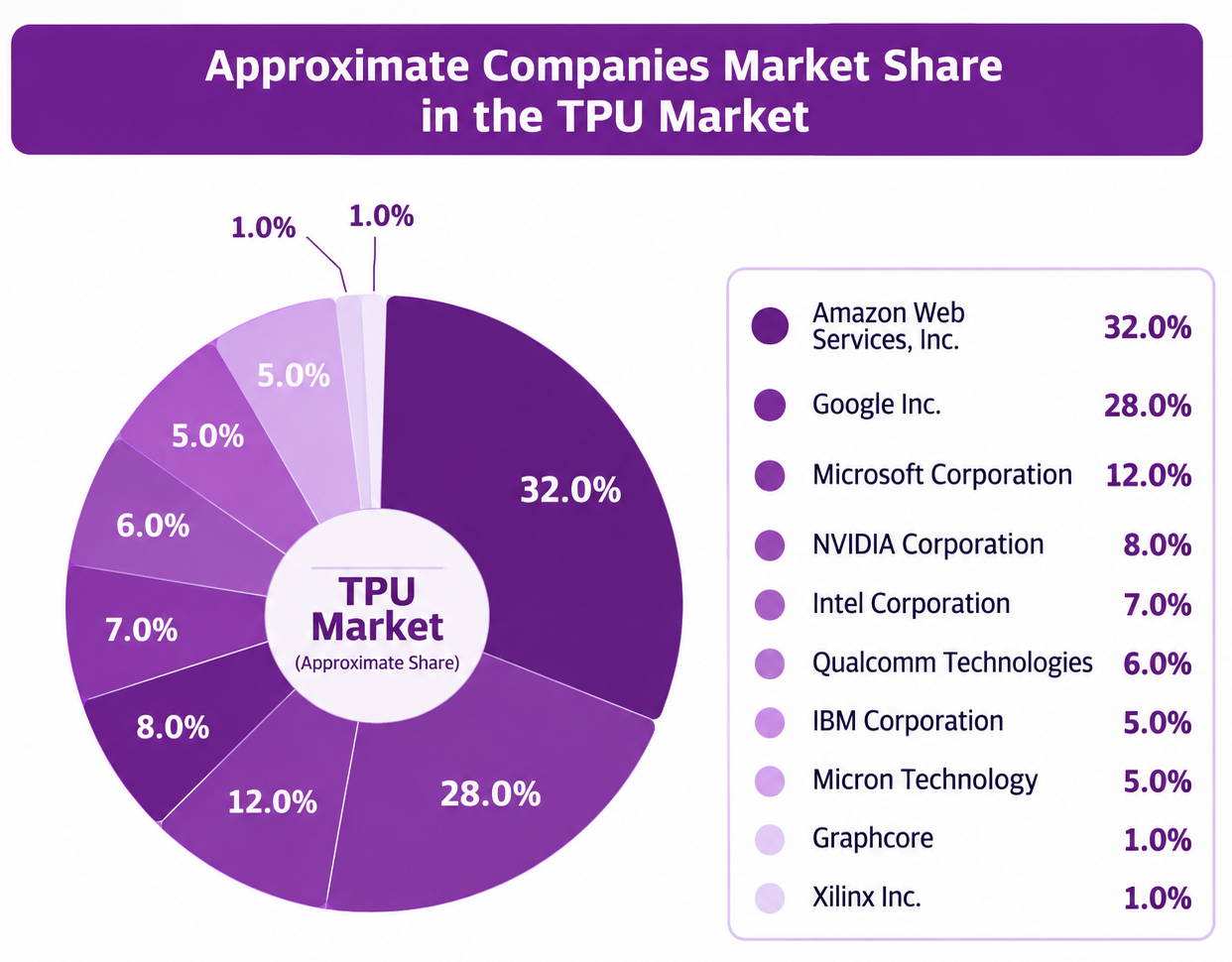
The TPU market has a differentiated competitive structure. Google has a direct advantage through its proprietary Tensor Processing Unit architecture, while AWS and Microsoft are developing their own silicon platforms to reduce dependence on third-party accelerators. NVIDIA remains a major competitor in the broader AI accelerator industry through its GPU-based computing platforms.
Important market-share qualification: The companies do not publish audited revenue or shipment shares for a consistently defined TPU-only market. Therefore, assigning precise percentages to individual companies would create unsupported figures.
Google Inc.
Google is the principal commercial developer of Tensor Processing Units. Its technological advantage comes from proprietary accelerator architecture, in-house AI software, and Google Cloud infrastructure. Its TPU portfolio supports large-scale model training, inference, and enterprise AI deployments.
a) Company Overview Table
| Attribute | Company Data |
|---|---|
| Company Name | Google LLC (Alphabet Inc.) |
| Ticker Symbol | NASDAQ: GOOGL / GOOG (Parent) |
| Industry | Technology, Cloud Computing and AI |
| Headquarters | Mountain View, California, USA |
| Founded | 1998 |
| Founders | Larry Page and Sergey Brin |
| Current CEO | Sundar Pichai |
| Latest Quarterly Revenue | USD 127.6 billion (Q3 2026, Alphabet) |
| YoY Revenue Growth | 25% |
| Primary Segments | Google Services, Google Cloud, Other Bets |
b) Financial Details
Alphabet reported revenue of USD 127.6 billion in Q3 2026, representing 25% year-over-year growth. Google Cloud revenue reached USD 30.7 billion, increasing 103%. The company specifically identified TPU systems sales as a meaningful contributor to Google Cloud’s growth. This provides direct evidence of commercial demand for Google’s TPU infrastructure.
c) Strategic Developments
-
April 2025: Google introduced Ironwood, its seventh-generation TPU, designed for demanding AI inference workloads.
-
2026: Google Cloud expanded the availability of TPU7x, its Ironwood architecture, through cloud infrastructure.
-
Google continued developing TPU systems for large-scale dense and mixture-of-experts models.
-
Google Cloud expanded its infrastructure strategy to support both proprietary TPUs and third-party GPU platforms.
-
October 2026: Alphabet confirmed that TPU systems sales contributed meaningfully to Google Cloud revenue growth.
Amazon Web Services, Inc.
About Amazon Web Services, Inc.:
Amazon Web Services is a major cloud infrastructure provider developing custom AI processors to improve machine learning training and inference economics. Its Trainium and Inferentia technologies provide alternatives to conventional GPU infrastructure and strengthen AWS’s position in cloud-based AI computing.
a) Company Overview Table
| Attribute | Company Data |
|---|---|
| Company Name | Amazon Web Services, Inc. |
| Ticker Symbol | NASDAQ: AMZN (Parent) |
| Industry | Cloud Computing and Technology |
| Headquarters | Seattle, Washington, USA |
| Founded | 2006 |
| Founders | Jeff Bezos (Amazon founder) |
| Current CEO | Matt Garman |
| Latest Quarterly Revenue | USD 46.0 billion (Q3 2026, AWS) |
| YoY Revenue Growth | 39.3% |
| Primary Segments | Compute, Storage, Database, Networking, AI and Machine Learning |
b) Financial Details
AWS reported revenue of USD 46.0 billion in Q3 2026, representing 39.3% year-over-year growth. Its quarterly operating income reached USD 17.8 billion. AWS does not separately disclose Trainium or Inferentia revenue. However, growing AI infrastructure investment and adoption of proprietary processors support its strategy of improving computing efficiency and reducing dependence on external accelerator suppliers.
c) Strategic Developments
-
December 2025: AWS announced general availability of Trainium3-powered EC2 Trn3 UltraServers.
-
Trainium3 uses a 3-nanometer manufacturing process and provides 2.52 petaflops of FP8 computing performance per chip.
-
Trn3 UltraServers can scale up to 144 Trainium3 chips and deliver 362 FP8 petaflops.
-
September 2026: AWS and Qualcomm announced a multigenerational product collaboration for next-generation AI data center infrastructure.
-
AWS continues expanding its custom accelerator ecosystem through Trainium and Inferentia.
Graphcore
About Graphcore:
Graphcore develops specialized AI processors known as Intelligence Processing Units. Its architecture is designed for parallel computing and machine intelligence workloads. The company operates under SoftBank ownership and contributes specialized processor technology to the broader AI accelerator ecosystem.
a) Company Overview Table
| Attribute | Company Data |
|---|---|
| Company Name | Graphcore Limited |
| Ticker Symbol | Private company; no public ticker |
| Industry | Semiconductors and AI Computing |
| Headquarters | Bristol, United Kingdom |
| Founded | 2016 |
| Founders | Nigel Toon and Simon Knowles |
| Primary Segments | IPU Processors, AI Systems, Software and Machine Intelligence |
b) Financial Details
Graphcore does not publish regular independent quarterly financial statements. Its commercial position is based on specialized AI processors and software designed for machine intelligence applications. The company was acquired by SoftBank in July 2024 and became a wholly owned subsidiary.
c) Strategic Developments
-
July 2024: SoftBank Group acquired Graphcore, making it a wholly owned subsidiary.
-
Graphcore retained its company name and Bristol headquarters following the acquisition.
-
The acquisition strengthened SoftBank’s presence in specialized AI semiconductor technology.
-
Graphcore continues to focus on AI computing architectures and machine intelligence applications.
IBM Corporation
IBM develops enterprise computing, semiconductor technologies, and AI infrastructure solutions. Its competitive advantage comes from enterprise relationships, hybrid cloud capabilities, and specialized AI processing technologies. IBM participates in the broader accelerator market rather than manufacturing Google’s branded TPUs.
a) Company Overview Table
| Attribute | Company Data |
|---|---|
| Company Name | International Business Machines Corporation |
| Ticker Symbol | NYSE: IBM |
| Industry | Information Technology and Enterprise Computing |
| Headquarters | Armonk, New York, USA |
| Founded | 1911 |
| Founders | Charles Ranlett Flint (CTR predecessor); Thomas J. Watson led IBM’s development |
| Current CEO | Arvind Krishna |
| Latest Quarterly Revenue | USD 17.1 billion (Q3 2026) |
| YoY Revenue Growth | 5% |
| Primary Segments | Software, Consulting, Infrastructure and Financing |
b) Financial Details
IBM reported USD 17.1 billion in Q3 2026 revenue, increasing 5% year-over-year. Software revenue increased 8% to USD 7.8 billion, while Infrastructure revenue increased 4% to USD 3.7 billion. These results reflect IBM’s broader technology operations and are not directly attributable to TPU hardware. The company does not disclose separate TPU or AI accelerator revenue. Its opportunity is concentrated in enterprise AI infrastructure and specialized computing solutions.
c) Strategic Developments
-
IBM continued developing its Spyre Accelerator platform for enterprise generative AI and inference applications.
-
The company expanded integration of AI capabilities into its enterprise infrastructure portfolio.
-
IBM continued strengthening hybrid cloud and enterprise AI deployment capabilities.
-
October 2026: IBM reported 5% year-over-year quarterly revenue growth, supported by Software and Infrastructure.
Intel Corporation
Intel is a semiconductor manufacturer competing in AI acceleration through specialized processors, Gaudi accelerators, and data center computing products. Its manufacturing capabilities, semiconductor research, and enterprise relationships provide a technological foundation for competing in the wider AI hardware market.
a) Company Overview Table
| Attribute | Company Data |
|---|---|
| Company Name | Intel Corporation |
| Ticker Symbol | NASDAQ: INTC |
| Industry | Semiconductors and Computing |
| Headquarters | Santa Clara, California, USA |
| Founded | 1968 |
| Founders | Robert Noyce and Gordon Moore |
| Current CEO | Lip-Bu Tan |
| Latest Quarterly Revenue | USD 16.5 billion (Q3 2026) |
| YoY Revenue Growth | 21% |
| Primary Segments | Client Computing and Physical AI, Data Center and AI, Intel Foundry |
b) Financial Details
Intel reported USD 16.5 billion in Q3 2026 revenue, increasing 21% year-over-year. Its Data Center and AI business generated USD 7.3 billion, representing 78% growth. However, this segment includes multiple products and does not represent Gaudi accelerator revenue alone. Intel’s competitive position depends on expanding AI processing capabilities, improving manufacturing performance, and increasing adoption of its data center products.
c) Strategic Developments
-
Intel continued developing its Gaudi accelerator family for AI training and inference.
-
The company expanded its data center and AI product development activities.
-
Intel continued investing in advanced semiconductor manufacturing and packaging.
-
October 2026: Intel reported Q3 revenue of USD 16.5 billion, with Data Center and AI revenue increasing 78%.
Micron Technology
Micron Technology manufactures advanced semiconductor memory products used in AI computing infrastructure. Its high-bandwidth memory technology supports the data-transfer requirements of advanced processors and accelerators. The company is an important AI hardware supplier rather than a direct branded TPU manufacturer.
a) Company Overview Table
| Attribute | Company Data |
|---|---|
| Company Name | Micron Technology, Inc. |
| Ticker Symbol | NASDAQ: MU |
| Industry | Semiconductor Memory and Storage |
| Headquarters | Boise, Idaho, USA |
| Founded | 1978 |
| Founders | Ward Parkinson, Joe Parkinson, Dennis Wilson and Doug Pitman |
| Current CEO | Sanjay Mehrotra |
| Latest Quarterly Revenue | USD 54.23 billion (Q4 FY2026) |
| YoY Revenue Growth | Approximately 379% |
| Primary Segments | DRAM, NAND, High-Bandwidth Memory and Storage |
b) Financial Details
Micron reported record revenue of USD 54.23 billion in Q4 FY2026, compared with USD 11.32 billion in the corresponding period of the previous year. AI-related demand has strengthened its high-bandwidth memory business, which supports advanced accelerator architectures. The company does not disclose HBM sales specifically attributable to Google TPU systems or other individual accelerator platforms.
c) Strategic Developments
-
Micron expanded its HBM3E portfolio for AI accelerator applications.
-
2026: The company reported high-volume production of HBM4 36GB 12-high memory.
-
Its HBM4 technology is designed to provide higher memory bandwidth and improved power efficiency.
-
Micron continued expanding its advanced DRAM manufacturing and memory technology capabilities.
-
The company is positioning HBM as an important component of next-generation AI infrastructure.
Microsoft Corporation
Microsoft is expanding its position in specialized AI computing through proprietary Maia accelerators and Azure cloud infrastructure. Its technological advantage combines custom silicon, enterprise cloud distribution, AI software, and large-scale computing capacity. Maia is designed to improve inference economics across Microsoft’s AI services.
a) Company Overview Table
| Attribute | Company Data |
|---|---|
| Company Name | Microsoft Corporation |
| Ticker Symbol | NASDAQ: MSFT |
| Industry | Software, Cloud Computing and AI |
| Headquarters | Redmond, Washington, USA |
| Founded | 1975 |
| Founders | Bill Gates and Paul Allen |
| Current CEO | Satya Nadella |
| Latest Quarterly Revenue | USD 92.3 billion (Q1 FY2027) |
| YoY Revenue Growth | 19% |
| Primary Segments | Productivity and Business Processes, Intelligent Cloud, More Personal Computing |
b) Financial Details
Microsoft reported USD 92.3 billion in revenue during Q1 FY2027, representing 19% year-over-year growth. Its custom accelerator business is strategically connected to Azure’s AI infrastructure requirements. Maia 200 is designed to improve inference performance and computing economics. Microsoft does not separately report Maia-specific revenue, operating profit, or shipment volumes. Its commercial potential depends on internal deployments and wider Azure AI infrastructure expansion.
c) Strategic Developments
-
January 2026: Microsoft introduced Maia 200, an inference-focused AI accelerator.
-
Maia 200 uses TSMC’s 3-nanometer process and incorporates 216 GB of HBM3e memory.
-
Microsoft reported 30% better performance per dollar compared with its existing latest-generation infrastructure.
-
October 2026: Microsoft confirmed that Maia 200 was serving production workloads, including Microsoft Copilot.
-
Microsoft announced plans for multi-gigawatt Maia infrastructure deployments beginning in 2027.
NVIDIA Corporation
NVIDIA develops accelerated computing platforms used for AI training, inference, and high-performance computing. Its competitive advantage comes from GPU architecture, CUDA software, advanced networking, and integrated computing systems. It competes with TPU developers through its broader AI accelerator ecosystem.
a) Company Overview Table
| Attribute | Company Data |
|---|---|
| Company Name | NVIDIA Corporation |
| Ticker Symbol | NASDAQ: NVDA |
| Industry | Semiconductors and AI Computing |
| Headquarters | Santa Clara, California, USA |
| Founded | 1993 |
| Founders | Jensen Huang, Chris Malachowsky and Curtis Priem |
| Current CEO | Colette Kress (interim CEO, as stated in Q3 FY2027 release) |
| Latest Quarterly Revenue | USD 115.8 billion (Q3 FY2027) |
| YoY Revenue Growth | 103% |
| Primary Segments | Compute and Networking, Graphics |
b) Financial Details
NVIDIA generated USD 115.8 billion in Q3 FY2027 revenue, increasing 103% year-over-year. Its Data Center revenue reached USD 107.6 billion, up 110%. The Data Center business includes GPUs, networking, and related AI infrastructure, not TPU-specific products. NVIDIA’s strong performance demonstrates the scale of demand for accelerated computing and reinforces its competitive position against proprietary hyperscaler processors.
c) Strategic Developments
-
November 2026: NVIDIA announced that its Vera Rubin NVL72 platform had entered shipment.
-
The company expanded its integrated AI computing portfolio across GPUs, networking, and software.
-
NVIDIA continued strengthening relationships with major cloud infrastructure providers.
-
The company reported USD 107.6 billion in Data Center revenue during Q3 FY2027.
- NVIDIA continued developing its AI infrastructure roadmap for training, reasoning, and inference workloads.
Qualcomm Technologies
Qualcomm Technologies develops semiconductor solutions for mobile computing, automotive systems, edge AI, and data center infrastructure. Its AI200 and AI250 accelerators extend its activities into inference-focused computing. The company is targeting energy-efficient AI processing and diversified semiconductor revenue.
a) Company Overview Table
| Attribute | Company Data |
|---|---|
| Company Name | Qualcomm Technologies, Inc. |
| Ticker Symbol | NASDAQ: QCOM (Parent) |
| Industry | Semiconductors and Wireless Technology |
| Headquarters | San Diego, California, USA |
| Founded | 1985 |
| Founders | Irwin Jacobs, Andrew Viterbi and co-founders |
| Current CEO | Cristiano Amon |
| Latest Quarterly Revenue | USD 10.322 billion (Q4 FY2026) |
| YoY Revenue Growth | -8% |
| Primary Segments | Qualcomm CDMA Technologies, Qualcomm Technology Licensing, Qualcomm Strategic Initiatives |
b) Financial Details
Qualcomm reported USD 10.322 billion in Q4 FY2026 revenue, declining 8% year-over-year. Its AI data center strategy is an emerging growth opportunity rather than an established major revenue contributor. The company reiterated a USD 5 billion fiscal 2027 data center revenue target and expects strong growth in non-handset businesses. AI200 and AI250 are designed to expand its presence in inference-focused data center infrastructure.
c) Strategic Developments
-
October 2025: Qualcomm introduced AI200 and AI250 data center accelerator platforms.
-
June 2026: Qualcomm announced a broader strategy to expand its data center business.
-
September 2026: Qualcomm announced a multigenerational product collaboration with Amazon for next-generation AI data center infrastructure.
-
Qualcomm reiterated its USD 5 billion fiscal 2027 data center revenue target in November 2026.
-
The company is expanding its AI processing portfolio beyond smartphones and mobile chipsets.
Xilinx Inc.
Xilinx developed programmable semiconductor technologies, including field-programmable gate arrays and adaptive system-on-chip products. Its technology supports specialized computing and AI inference applications. Following its acquisition by AMD, its adaptive computing capabilities contribute to AMD’s wider semiconductor portfolio.
a) Company Overview Table
| Attribute | Company Data |
|---|---|
| Company Name | Xilinx Inc. (AMD-owned business) |
| Ticker Symbol | No independent ticker; integrated into NASDAQ: AMD |
| Industry | Semiconductors and Adaptive Computing |
| Headquarters | San Jose, California, USA (historical headquarters) |
| Founded | 1984 |
| Founders | Ross Freeman, Bernard Vonderschmitt and James V Barnett |
| Current CEO | No separate CEO; integrated into AMD |
| Primary Segments | FPGAs, Adaptive SoCs, Embedded Computing and AI Inference |
b) Financial Details
Xilinx no longer publishes independent financial results following AMD’s acquisition in February 2022. AMD reported consolidated revenue of USD 13.377 billion in Q3 2026, representing 45% year-over-year growth. Its Data Center business benefited from strong demand for Instinct GPUs and EPYC processors. These figures cannot be attributed directly to Xilinx’s former operations.
c) Strategic Developments
-
February 2022: AMD completed its acquisition of Xilinx through an all-stock transaction.
-
Xilinx became part of AMD’s adaptive and embedded computing portfolio.
-
The acquisition expanded AMD’s FPGA, adaptive SoC, and high-performance computing capabilities.
-
AMD continued developing its Instinct AI accelerator portfolio alongside its adaptive computing technologies.
-
November 2026: AMD reported 97% year-over-year growth in Data Center segment revenue, driven by Instinct GPUs and EPYC processors.
Conclusion
The Tensor Processing Unit market is entering a period of significant technological and competitive development. Google maintains a strong position through its proprietary TPU architecture, while Amazon Web Services and Microsoft are increasing investments in custom AI accelerators to strengthen their cloud computing businesses.
NVIDIA remains a formidable competitor through its GPU-based AI infrastructure, while Qualcomm, Intel, AMD, and Graphcore are developing alternative processing architectures.



