


Overview
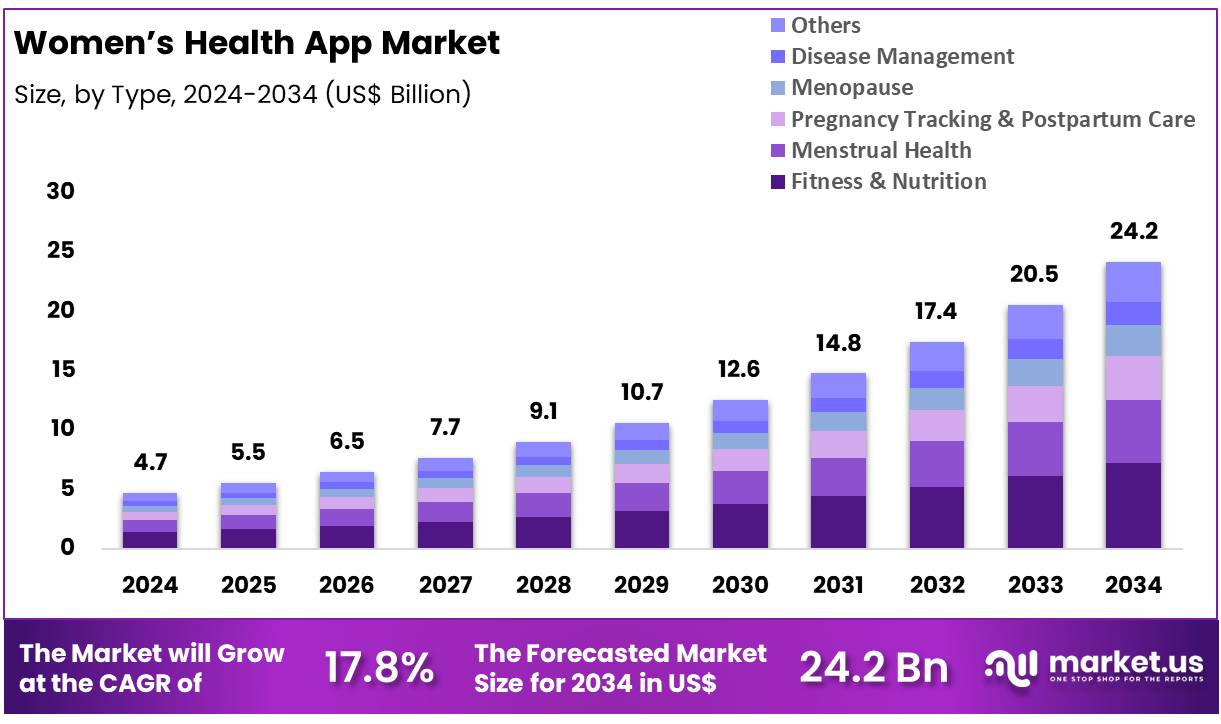
Global Women’s Health App Market size is expected to be worth around US$ 24.2 Billion by 2034 from US$ 4.7 Billion in 2024, growing at a CAGR of 17.8% during the forecast period from 2025 to 2034. In 2024, North America led the market, achieving over 37.2% share with a revenue of US$ 1.7 Billion.
The rapid adoption of digital health technologies is creating new opportunities for women’s health applications that support menstrual tracking, fertility planning, pregnancy care, menopause management, mental wellness, and chronic disease monitoring. Growing smartphone penetration, improved internet connectivity, and increasing awareness of preventive healthcare are encouraging women to use mobile applications for personalized health management.
Healthcare providers are also integrating digital tools into routine care, enabling better patient engagement, symptom monitoring, and remote consultations. Government initiatives promoting digital health ecosystems and electronic health records are further strengthening the foundation for connected healthcare services.
“Women’s health continues to represent a significant public health priority. According to the U.S. Centers for Disease Control and Prevention (CDC), 41.3% of women aged 20 years and older have obesity, 44.6% of women aged 18 years and older have hypertension, while 15.5% of adult women report fair or poor health.”
These figures highlight the growing need for digital solutions that support continuous health monitoring, lifestyle management, and preventive care beyond traditional clinical settings. Mobile health applications are increasingly being used to record symptoms, medication adherence, physical activity, menstrual cycles, and reproductive health information, helping users make informed healthcare decisions.
The CDC also emphasizes that surveillance systems such as the Pregnancy Risk Assessment Monitoring System (PRAMS), the National ART Surveillance System (NASS), and the Pregnancy Mortality Surveillance System (PMSS) provide critical reproductive health data used to improve maternal and infant outcomes. These public health efforts complement the growing use of digital health applications that enable women to securely monitor pregnancies, fertility treatments, and postpartum recovery while facilitating communication with healthcare professionals.
At the same time, data privacy and cybersecurity remain key priorities for developers and regulators as women’s health applications increasingly handle sensitive reproductive and personal health information. Government agencies and healthcare organizations continue to encourage secure, transparent, and evidence-based digital health solutions that improve access to quality care while protecting user data.
Key Takeaways
- Market size: The global women’s health app market is projected to reach approximately US$24.2 billion by 2034, up from US$4.7 billion in 2024.
- Market growth: The market is expected to expand at a compound annual growth rate (CAGR) of 17.8% from 2025 through 2034.
- Type analysis: Fitness & Nutrition is the largest segment, accounting for 30.1% of the market.
- Modality analysis: Smartphones lead usage, representing 68.4% of the market.
- Regional analysis: In 2024, North America was the largest regional market with a 37.2% share.
Statistical Information
- 13.7% of women aged 20-49 in the United States had used fertility services at some point in their lives.
- 10.4% of women received medical help to become pregnant, nearly double the percentage who sought medical help to prevent pregnancy loss.
- 6.9% of women underwent infertility testing for themselves or their partner.
- 4.5% of women used ovulation-inducing medications as part of fertility treatment.
- 2.0% of women underwent artificial insemination during fertility treatment.
- 1.7% of women received surgery or medication for endometriosis or uterine fibroids to improve fertility.
- 1.6% of women underwent in vitro fertilization (IVF) or other assisted reproductive technology procedures.
- Women with private health insurance reported a 16.0% lifetime use of fertility services, compared with 9.4% among publicly insured women and 9.6% among uninsured women.
- Use of fertility services increased as household income increased, indicating greater utilization of reproductive healthcare among higher-income women.
- Asian women (16.0%) and White women (15.2%) reported higher lifetime use of fertility services than Black women (9.5%).
- The fertility rate among U.S. women aged 40 years and older increased by 24% between 2015 and 2024, reflecting delayed childbearing and greater need for fertility management.
Regional Analysis
North America accounted for 37.2% of the global women’s health app market in 2024, driven by high smartphone penetration, advanced digital literacy, and robust healthcare infrastructure. Public health agencies and government-led initiatives have increased awareness of women’s health priorities, encouraging adoption of digital tools for preventive care and chronic-condition management.
Supportive regulatory frameworks and reimbursement policies have helped integrate telehealth and mobile health solutions into routine care, while investments in Fem-Tech and public–private collaborations have expanded app availability and clinical validation.
The United States and Canada lead regional adoption, with programs focused on maternal health, reproductive care, and chronic disease prevention that emphasize personalized, data-driven management. Together, these factors technology access, government-backed awareness campaigns, enabling regulations, and sustained investment have established North America as the largest and most mature market for women’s health applications.
Emerging Trends
- AI-powered personalized women’s health management is expanding rapidly: Women’s health apps are increasingly using artificial intelligence to analyze menstrual cycles, fertility patterns, pregnancy symptoms, and menopause changes. The U.S. FDA recognizes AI, machine learning, wearable devices, telehealth, and mobile health as key components of modern digital healthcare, encouraging more personalized and data-driven care.
- Menopause-focused digital health is becoming a major growth area: Most women naturally experience menopause between 45 and 55 years of age, creating demand for applications that monitor hot flashes, sleep quality, mood, and hormone-related symptoms. Digital tools now help users track long-term symptom patterns and support discussions with healthcare providers.
- Digital health is improving healthcare access for underserved women: The World Health Organization reports that digital health technologies improve women’s access to healthcare, maternal services, reproductive health information, and mental health support, especially where geographical or social barriers limit in-person care. These benefits are driving wider adoption of women’s health applications globally.
- Wearables are increasingly integrated with women’s health applications: Modern women’s health apps increasingly connect with smartwatches and wearable sensors to collect continuous information on heart rate, sleep, physical activity, skin temperature, and menstrual patterns. These connected devices enable continuous health monitoring instead of relying only on occasional clinical visits.
- Greater emphasis is being placed on secure digital health platforms: Healthcare organizations are encouraging digital applications that support secure data sharing, interoperability, and standardized health information exchange. As women’s health apps manage sensitive reproductive and personal health information, stronger privacy, security, and transparent data management have become essential product differentiators.
Use Cases
- Pregnancy monitoring and maternal care support: Women increasingly use mobile applications to record fetal movements, blood pressure, weight changes, prenatal appointments, medication reminders, and educational content. WHO recognizes digital technologies as effective tools for improving maternal health outcomes and increasing healthcare accessibility throughout pregnancy.
- Fertility and ovulation tracking for family planning: Women’s health applications help users monitor ovulation windows, menstrual regularity, fertility indicators, and reproductive health records. These digital records support family planning decisions while enabling healthcare professionals to review long-term reproductive health patterns more efficiently.
- Menopause symptom management through continuous tracking: Women use digital applications to monitor hot flashes, night sweats, sleep disturbances, mood changes, and menstrual irregularities over several years. WHO notes that the menopausal transition can last for years, making continuous digital symptom tracking valuable for long-term care.
- Remote consultations through integrated telehealth services: Many women’s health applications now provide virtual consultations, secure messaging, electronic prescriptions, and follow-up care within a single platform. These capabilities reduce travel time while improving access to reproductive, maternal, and preventive healthcare services.
- Preventive wellness and healthy lifestyle management: Women’s health apps increasingly combine nutrition tracking, exercise monitoring, sleep analysis, stress management, and wellness reminders. According to the CDC, 20.4% of U.S. women meet the federal aerobic and muscle-strengthening physical activity guidelines, highlighting opportunities for apps to encourage healthier lifestyles and long-term disease prevention.
Conclusion
The global women’s health app market is witnessing strong momentum as digital technologies become an integral part of preventive and personalized healthcare. Increasing adoption of smartphones, wearable devices, telehealth services, and AI-powered health tools is enabling women to better manage fertility, pregnancy, menopause, fitness, and chronic conditions through convenient mobile platforms. Growing awareness of reproductive and preventive healthcare, along with supportive government initiatives and improved digital health infrastructure, continues to strengthen market expansion.
As developers focus on data privacy, clinical accuracy, and personalized user experiences, women’s health applications are expected to play an increasingly important role in improving healthcare accessibility, patient engagement, and long-term health outcomes worldwide.




















