


Overview
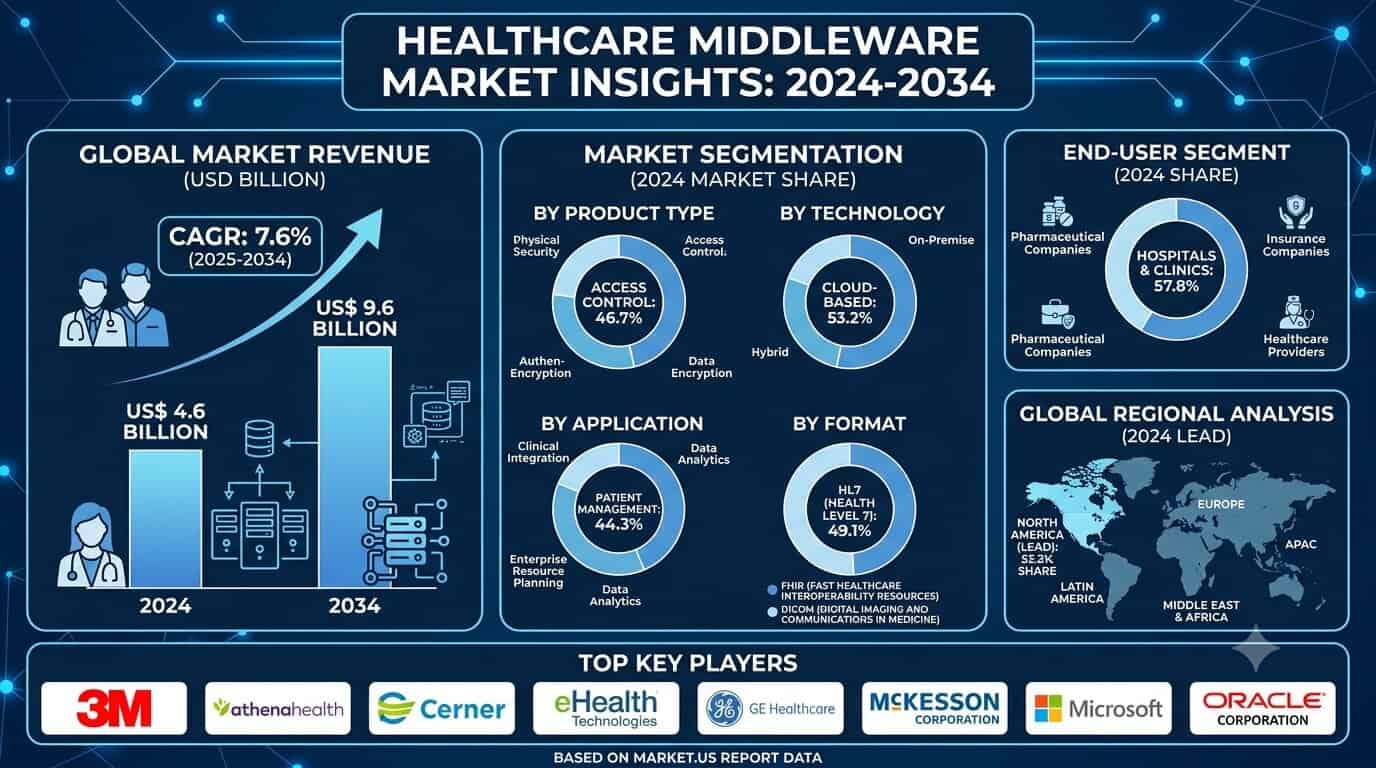
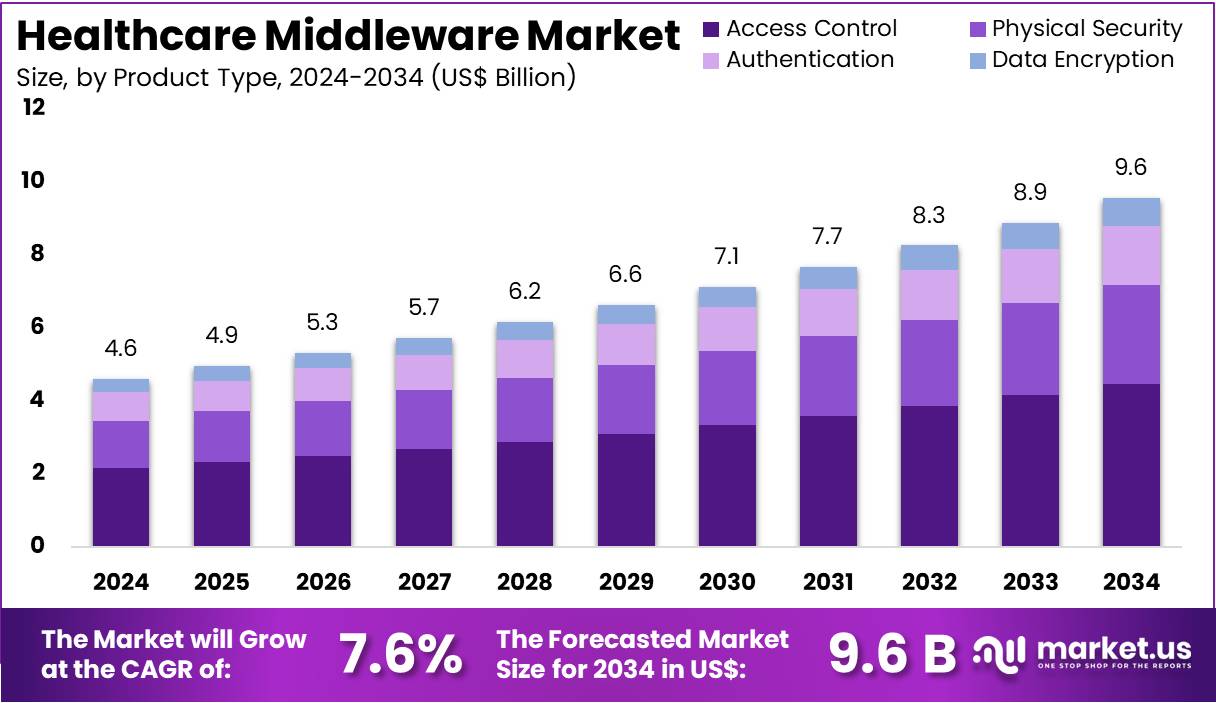
The Healthcare Middleware Market Size is expected to be worth around US$ 9.6 Billion by 2034 from US$ 4.6 Billion in 2024, growing at a CAGR of 7.6% during the forecast period 2025 to 2034.
The healthcare industry is increasingly prioritizing seamless data exchange as hospitals, health systems, payers, laboratories, and digital health platforms manage information across diverse technology environments. Healthcare middleware serves as an important integration layer, helping connect electronic health records (EHRs), medical devices, clinical applications, laboratory systems, and other healthcare platforms while supporting standardized data exchange.
According to the U.S. Office of the National Coordinator for Health Information Technology (ONC), approximately 9 in 10 hospitals enabled patient electronic access to health information through APIs in 2024. In addition, 7 in 10 hospitals reported using standards-based APIs, including HL7 Fast Healthcare Interoperability Resources (FHIR), for patient access. These findings highlight the growing importance of API-based interoperability and integration infrastructure across healthcare organizations.
FHIR is becoming a key foundation for modern healthcare data exchange. ONC describes FHIR as a widely used API-focused standard capable of supporting the exchange of clinical and administrative health information. Its resource-based architecture enables healthcare applications and systems to communicate through standardized interfaces.
Regulatory initiatives are further strengthening demand for interoperability technologies. In 2026, ONC continued advancing interoperability standards through its annual Interoperability Standards Advisory and proposed updated implementation specifications for patient, provider, and payer APIs. As healthcare organizations modernize legacy infrastructure, middleware solutions are increasingly positioned to support system integration, data normalization, API connectivity, workflow automation, and secure information exchange across complex digital healthcare ecosystems.
Key Takeaways
- In 2024, the Healthcare Middleware Market generated US$ 4.6 billion in revenue, growing at a 7.6% CAGR, and is expected to reach US$ 9.6 billion by 2034.
- The access control segment led the product type category in 2024, accounting for a 46.7% market share.
- The cloud-based technology segment dominated the healthcare middleware market, securing a 53.2% share in 2024.
- The patient management application segment held the leading position, accounting for 44.3% of the market revenue in 2024.
- The Health Level 7 (HL7) format segment dominated the market with a 49.1% revenue share in 2024.
- Among end users, hospitals & clinics held the largest market share, accounting for 57.8% in 2024.
- North America dominated the healthcare middleware market in 2024, capturing a 53.2% market share.
Statistical Information
- 91% of U.S. hospitals integrated data from third-party technology into their EHR for at least one clinical purpose in 2024, highlighting strong demand for healthcare integration infrastructure.
- 83% of U.S. hospitals provided EHR data to third-party technology for at least one clinical purpose in 2024, demonstrating the growing need for bidirectional data exchange.
- 87% of U.S. hospitals integrated third-party data into their EHR for at least one administrative purpose in 2024, creating opportunities for middleware supporting scheduling, prior authorization, and administrative workflows.
- Only 39% of hospitals used standards-based APIs to provide clinical data to third-party technology in 2024, indicating considerable room for FHIR-based middleware and API modernization.
- Only 32% of hospitals used standards-based APIs to provide administrative data to third-party technology, showing that substantial healthcare integration still relies on proprietary or non-standard approaches.
- 71% of health information organizations (HIOs) reported experiencing at least one instance of potential information blocking in 2025, although this declined from 91% in 2019. The continuing friction supports demand for technologies that facilitate compliant information exchange.
- Only 28% of physicians surveyed by athenahealth in 2025 said sending and receiving patient data from a different EHR was easy, while 80% said inadequate data sharing between information systems increased their stress levels.
- Epic’s Care Everywhere network reports 28 million charts exchanged daily, with half exchanged with other platforms, demonstrating the enormous scale of healthcare interoperability and cross-system connectivity.
- CMS requires impacted payers to add certain prior-authorization information to their HL7 FHIR Patient Access APIs by January 1, 2027, creating a concrete opportunity for FHIR gateways, API management, data transformation, and payer-provider middleware.
Market Segmentation Analysis
Product Type Analysis
The access control segment accounted for 46.7% of the healthcare middleware market, supported by growing concerns surrounding patient privacy, cybersecurity, and unauthorized system access. Healthcare organizations increasingly require solutions that can regulate access to sensitive clinical and administrative information while supporting compliance with data protection requirements.
The growing frequency and sophistication of cyberattacks targeting healthcare systems is further increasing demand for identity management, authentication, and permission-based access technologies. Integration with multi-factor authentication, biometrics, and centralized monitoring improves security while streamlining administrative processes. As healthcare providers strengthen digital security frameworks and prioritize protection against data breaches, access control is expected to remain a key component of healthcare middleware solutions.
Technology Analysis
The cloud-based segment held a 53.2% market share, driven by its scalability, flexibility, and ability to reduce the need for extensive on-premise IT infrastructure. Healthcare organizations are increasingly adopting cloud environments to connect electronic health records, digital health applications, medical devices, and other systems across distributed networks. Cloud-based middleware enables faster data exchange and supports changing workloads without requiring major infrastructure investments.
The growing use of telemedicine, remote healthcare services, and mobile applications is also creating greater demand for flexible integration technologies. In addition, centralized security management, automated updates, and disaster recovery capabilities make cloud deployment attractive. Continued healthcare digitalization is expected to strengthen adoption of cloud-based middleware.
Application Analysis
The patient management segment accounted for 44.3% of the healthcare middleware market, reflecting the increasing focus on coordinated and patient-centered care. Middleware solutions enable seamless integration of patient information across electronic health records, scheduling systems, billing platforms, and other clinical applications. This connectivity helps healthcare providers improve workflows, minimize administrative errors, and provide timely access to relevant patient information.
Growing demand for personalized treatment, chronic disease management, and coordinated care is further supporting adoption. Middleware can also connect patient management systems with analytics platforms, enabling providers to monitor performance and allocate resources more effectively. As healthcare organizations increasingly prioritize operational efficiency and improved patient outcomes, patient management applications are expected to remain a major area of middleware adoption.
Format Analysis
The Health Level 7 (HL7) segment represented 49.1% of the healthcare middleware market, supported by its established role in enabling standardized clinical information exchange. HL7 standards allow healthcare systems to exchange patient records, laboratory results, clinical documentation, and other information across different platforms. Their broad compatibility makes HL7-based middleware valuable for organizations operating multiple electronic health record, diagnostic, pharmacy, and administrative systems.
Growing emphasis on interoperability and standardized healthcare data exchange is further supporting adoption. HL7 also remains relevant alongside newer interoperability technologies such as Fast Healthcare Interoperability Resources (FHIR), enabling organizations to modernize integration architectures. As healthcare providers continue connecting fragmented systems and improving information accessibility, HL7 is expected to maintain a leading position among middleware formats.
End-user Analysis
The hospitals & clinics segment held the largest share at 57.8%, reflecting the extensive volume and complexity of clinical and administrative information managed by these institutions. Hospitals and clinics require middleware to connect electronic health records, diagnostic systems, medical devices, pharmacy applications, billing platforms, and other operational technologies. Increasing emphasis on coordinated care and efficient information sharing is encouraging healthcare institutions to strengthen interoperability infrastructure.
Regulatory requirements related to data accuracy, reporting, privacy, and security are also contributing to adoption. Furthermore, the growing deployment of cloud-based and mobile healthcare technologies is increasing demand for middleware capable of supporting real-time access to information. As hospitals continue their digital transformation initiatives, they are expected to remain major users of healthcare middleware solutions.
Regional Analysis
North America is Leading the Healthcare Middleware Market
North America continues to lead the healthcare middleware market, supported by strong healthcare IT infrastructure, widespread EHR adoption, and increasing emphasis on interoperability. In the United States, the Office of the National Coordinator for Health Information Technology (ONC) reported that 90% hospitals enabled patient access to health information through APIs in 2024, while 71% used standards-based APIs.
These developments are increasing demand for middleware that connects EHRs, third-party applications, and clinical systems. Federal interoperability initiatives, including the United States Core Data for Interoperability (USCDI), are also strengthening standardized health information exchange.
Asia Pacific to Register the Fastest Growth
Asia Pacific is expected to witness the fastest growth as governments and healthcare providers accelerate digital transformation and strengthen connected healthcare infrastructure. Rising investments in digital health, EHR implementation, telehealth, and health information exchange are creating demand for technologies that integrate fragmented systems.
The Asian Development Bank launched a regional health network in 2025 involving more than 25 developing member countries, reflecting increasing regional cooperation around stronger healthcare systems. As healthcare organizations expand digital services and seek seamless data exchange across clinical and administrative platforms, middleware adoption is expected to increase significantly across Asia Pacific.
Business Opportunities
The healthcare middleware market presents significant opportunities as providers, payers, and technology companies invest in interoperability and automated data exchange. FHIR-based API integration is a particularly attractive area, as CMS requires impacted payers to implement Provider Access, Payer-to-Payer, and Prior Authorization APIs, with major API requirements taking effect in 2027. This creates opportunities for middleware vendors offering FHIR gateways, API management, data transformation, and interoperability-as-a-service solutions.
Another opportunity lies in electronic prior authorization, where middleware can connect payer systems, provider EHRs, and clinical applications while automating documentation and authorization workflows. CMS requires expedited prior-authorization decisions within 72 hours and standard decisions within seven calendar days, increasing demand for efficient integration technologies.
Cloud-based middleware also offers strong commercial potential through scalable integration, cybersecurity, real-time data exchange, and legacy-system modernization. Vendors can further differentiate through AI-enabled data mapping, API monitoring, identity management, and interoperability analytics. CMS’s 2026 proposal to expand electronic prior authorization to drugs could create additional demand for specialized middleware capabilities if finalized.
Emerging Trends
- TEFCA is rapidly expanding: The Trusted Exchange Framework and Common Agreement (TEFCA) is becoming a major national interoperability layer in the U.S. By the end of 2025, 464 million health documents had been exchanged through TEFCA, compared with approximately 10 million before 2025. This growth supports demand for middleware connecting networks and healthcare applications.
- FHIR adoption is becoming more global: HL7’s 2025 State of FHIR survey collected responses from 82 experts across 52 countries. It found that 73% reported FHIR was mandated or formally advised in their country, showing that FHIR-based integration is moving from technical adoption toward regulatory-driven implementation.
- Hospital interoperability is becoming routine: ONC data shows that 76% of U.S. hospitals participated in all four measured interoperability activities in 2025, covering sending, receiving, finding, and integrating electronic health information. This signals a shift toward continuous interoperability infrastructure rather than isolated data exchanges.
- Remote connected care is driving standards development: FDA recognized ISO TS 5615:2025, which addresses standards-based interoperability for safe and secure remote connected care and mobile health. This trend is expanding middleware requirements beyond hospitals into home monitoring, mobile health, and connected-care environments.
- Medical-device connectivity is becoming more specialized: FDA recognized new interoperability standards in December 2025 covering devices such as spirometers and strength-fitness equipment, alongside standards for machine-learning-enabled medical-device cybersecurity. Middleware vendors are therefore gaining opportunities to support increasingly diverse connected-device ecosystems.
Use Cases
- Payer-provider prior authorization: Healthcare middleware can connect payer systems, provider EHRs, and authorization platforms through FHIR APIs. CMS requires impacted payers to support prior-authorization API capabilities, with applicable API development and enhancement requirements generally beginning January 1, 2027, creating opportunities for automated integration workflows.
- Medical-device data integration: Middleware can collect information from connected medical devices and transfer it into clinical systems for storage, analysis, or automated action. FDA specifically notes that interoperability can improve care, reduce errors and adverse events, and enable broader datasets for research and clinical applications.
- Remote patient monitoring: Connected devices such as wearable sensors, implantable cardiac devices, glucose monitors, and other home technologies increasingly exchange information with healthcare systems. Middleware can act as the integration layer between these devices, mobile applications, and provider platforms, supporting remote monitoring and more timely care.
- Cross-network health information exchange: Middleware can help healthcare organizations connect different health information networks, EHR platforms, and exchange frameworks. In 2025, 43% of U.S. hospitals were aware of TEFCA and already participating, while another 37% planned to participate, indicating substantial future connectivity requirements.
- Clinical device-to-EHR workflows: Middleware can translate and route information from point-of-care and connected medical devices into clinical applications. FDA-recognized standards now address device interoperability across multiple categories, helping create standardized pathways for integrating device measurements into broader healthcare IT environments.
Recent Developments
- In July 2026, Microsoft updated its healthcare data model to use FHIR-aligned structures for Dataverse, enabling healthcare organizations, partners, and independent software vendors to build applications without redefining the underlying healthcare data architecture. The update strengthens Microsoft’s interoperability and healthcare data-integration capabilities.
- In March 2026, Microsoft expanded its healthcare reference architecture with FHIR-based protected-health-information workloads, showing how Dataverse healthcare APIs can exchange FHIR bundles with EHRs and connect Azure-based FHIR servers with healthcare applications. This strengthens Microsoft’s cloud-based healthcare integration infrastructure.
- In September 2025, McKesson announced a new organizational structure while continuing to reshape its healthcare-services portfolio, including the planned divestiture of its Norway businesses. The company’s broader restructuring followed multiple 2025 investments and acquisitions across specialized healthcare services.
- In September 2025, Oracle Health introduced its payer-provider collaboration strategy, focusing on AI-powered applications designed to automate prior authorization, reduce claims denials, and improve coordination between payers and providers. The initiative directly supports greater healthcare-data connectivity and workflow integration.
- In June 2025, McKesson completed its acquisition of approximately 70% of Core Ventures for about US$2.49 billion. Core Ventures was established by Florida Cancer Specialists & Research Institute, whose network includes more than 250 physicians and 280 advanced practice providers across nearly 100 Florida locations.
- In April 2025, McKesson completed its acquisition of approximately 80% of PRISM Vision Holdings for about US$850 million. The transaction expanded McKesson’s ophthalmology and retina platform, while PRISM physicians retained approximately 20% ownership.
- In January 2025, GE HealthCare and Sutter Health entered a long-term strategic partnership focused on advanced, AI-powered imaging. Sutter Health committed to invest more than US$1 billion over seven years in technology, solutions, and services, supporting healthcare technology modernization across California.
Conclusion
The Healthcare Middleware Market is evolving rapidly as healthcare organizations prioritize interoperability, secure data exchange, cloud adoption, and connected digital workflows. Increasing use of FHIR-based APIs, EHR integration, medical-device connectivity, and electronic prior authorization is creating strong opportunities for middleware providers. Regulatory initiatives from CMS and ONC are further encouraging standardized information exchange across providers, payers, and technology platforms.
North America currently leads due to advanced healthcare IT infrastructure, while Asia Pacific offers significant growth potential through expanding digital health ecosystems. As healthcare systems modernize legacy infrastructure and adopt AI-enabled technologies, middleware will remain essential for connecting fragmented applications, improving operational efficiency, and supporting coordinated patient care.




















