


Overview
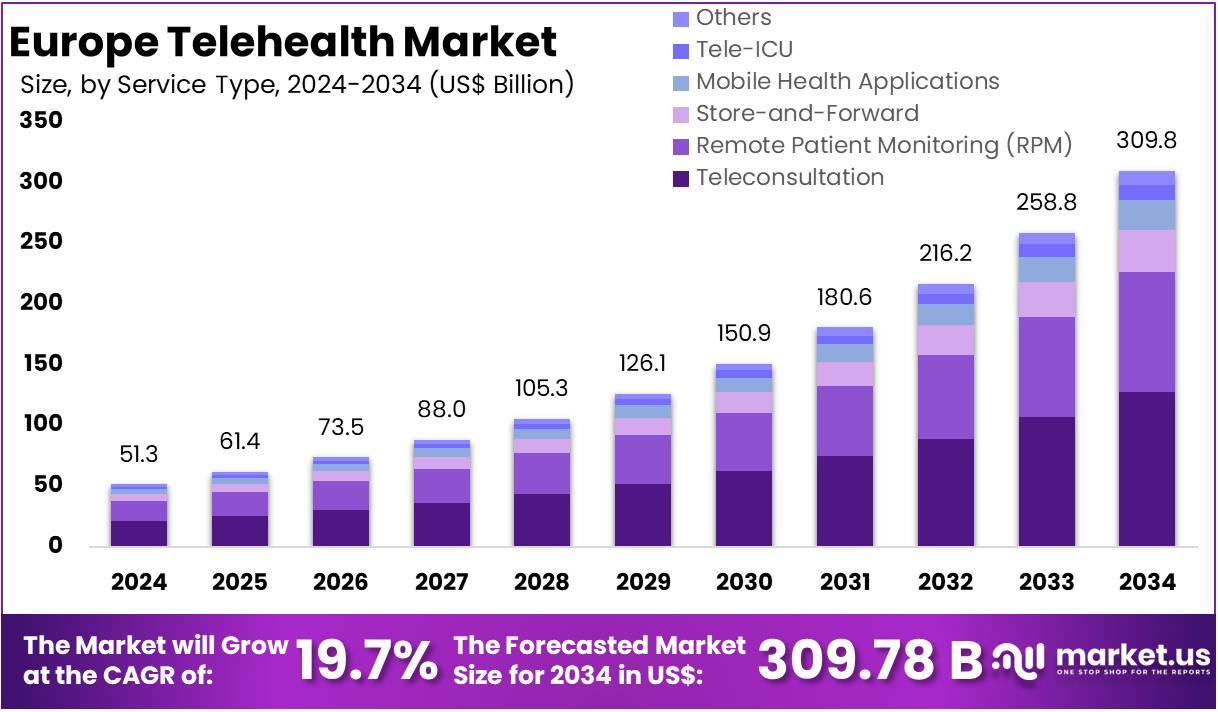
The Europe Telehealth Market size is expected to be worth around US$ 309.8 Billion by 2034, from US$ 51.3 Billion in 2024, growing at a CAGR of 19.7% during the forecast period from 2025 to 2034.
Europe’s telehealth ecosystem is moving from a pandemic-era solution toward a more integrated component of routine healthcare delivery. Telehealth can support virtual consultations, remote monitoring, digital diagnostics, follow-up care, and access to services for people who face geographic or mobility barriers. The World Health Organization (WHO) Regional Office for Europe notes that telemedicine can improve access, continuity of care, and cost-efficiency when it is integrated into health systems.
Digital infrastructure is strengthening the environment for remote care. The European Commission’s 2026 Digital Decade eHealth Indicator Study reported that the EU-27 achieved an average eHealth maturity score of 87% in 2025, up 4 percentage points from 2024. This progress reflects broader availability of electronic health information and increasing connectivity among healthcare providers.
Policy support is another important growth factor. WHO reported that 78% of Member States in the European Region directly addressed telehealth in policies or strategies in its 2023 assessment. However, adoption remains uneven, with differences in infrastructure, workforce readiness, regulatory frameworks, interoperability, and digital skills.
Going forward, telehealth development across Europe is expected to focus on secure data exchange, patient-centered virtual services, remote monitoring, and integration with electronic health records. WHO emphasizes cybersecurity and privacy as critical considerations as digital health services expand. These developments are creating a foundation for scalable, accessible, and digitally enabled healthcare delivery across European health systems.
Key Takeaways
- The Europe Telehealth Market is expected to reach US$ 309.8 Billion by 2034, rising from US$ 51.3 Billion in 2024 at a 19.7% CAGR during 2025–2034.
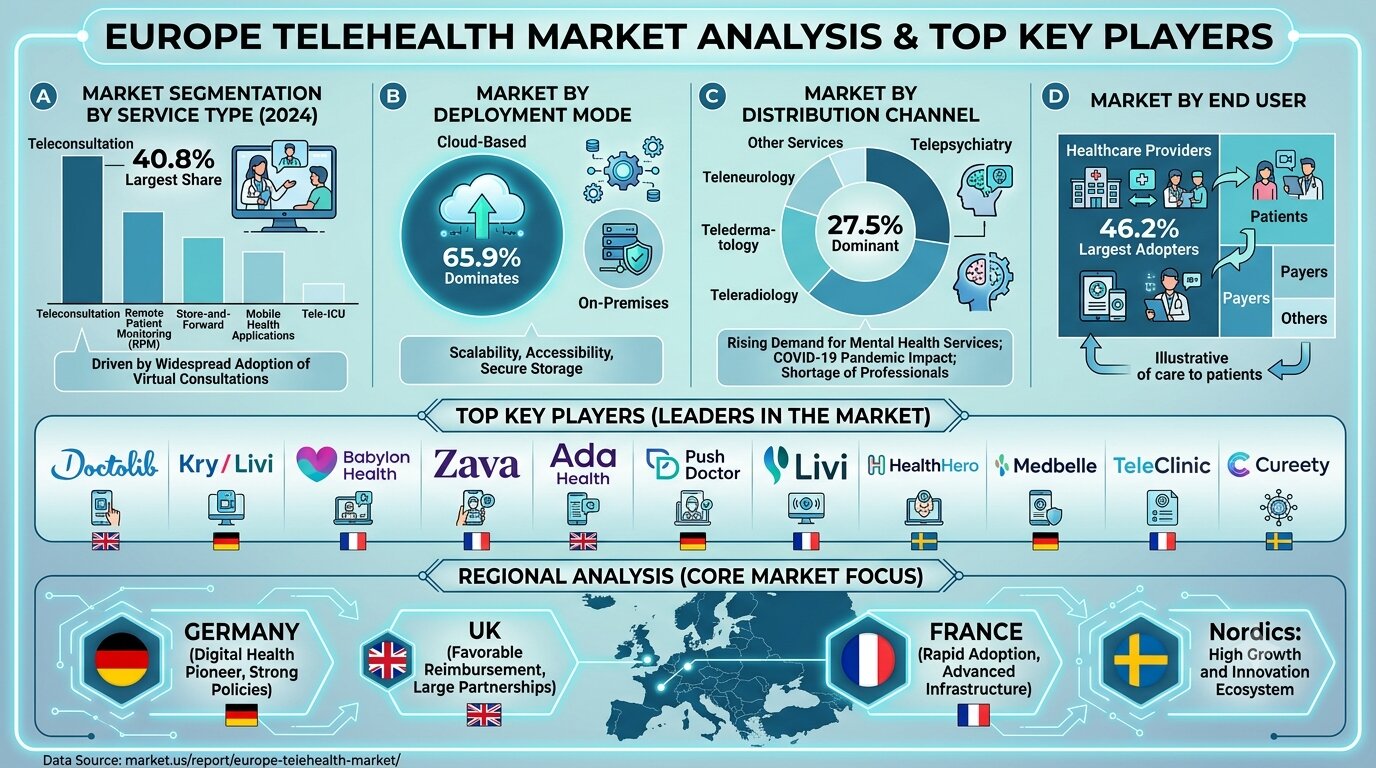
- By Service Type, Teleconsultation leads with a 40.8% market share, supported by widespread adoption of virtual doctor-patient consultations across general and specialized healthcare services.
- By Deployment Mode, Cloud-Based solutions dominate with a 65.9% market share, driven by scalability, accessibility, flexible deployment, and secure data storage capabilities.
- By Distribution Channel, Telepsychiatry holds the leading position with a 27.5% market share, fueled by increasing mental healthcare demand and shortages of mental health professionals.
- By End User, Healthcare Providers account for the largest share at 46.2%, as hospitals, clinics, and individual practitioners increasingly adopt telehealth to deliver accessible and efficient care.
Statistical Information
- 84% of countries in the WHO European Region reported using teleradiology, making it the most widely reported telehealth service in the region. This supports opportunities in remote imaging, cloud-based radiology, AI-assisted diagnostics, and specialist collaboration.
- 77% of countries reported providing telemedicine or remote patient monitoring services, indicating broad institutional adoption and opportunities for connected devices, chronic-disease monitoring, virtual care platforms, and hospital-at-home solutions.
- 51% of countries offered telepsychiatry, highlighting opportunities for virtual psychiatric consultations, online counseling, digital behavioral-health platforms, and remote mental-health monitoring.
- In 2022, 53% of WHO European Region Member States had an established teleradiology service, while established telepsychiatry services were reported by 42% of surveyed countries. This indicates room for further deployment and technology modernization.
- Only 37% of countries reported evaluating their telehealth services, creating opportunities for companies offering outcome measurement, quality-assurance tools, analytics, clinical dashboards, and telehealth performance monitoring.
- In 2024, 3.6% of EU residents aged 16 or older who needed medical care reported unmet needs because of financial constraints, waiting lists, or distance. Among people at risk of poverty, the figure increased to 6.0%, highlighting potential demand for accessible remote-care models.
- Among EU residents with severe disabilities, 50.9% used the internet to seek health-related information in 2024. The corresponding figure for people with moderate disabilities was 59.1%, demonstrating meaningful digital engagement among populations that could benefit from accessible telehealth services.
- In 2024, 78.2% of EU people aged 16–74 with severe disabilities used the internet regularly, compared with 86.0% of those with moderate disabilities. This indicates a substantial digitally connected population for accessible virtual-care and remote-health services.
- WHO research covering more than 20,000 patients across over 20,000 studies found evidence of telemedicine benefits across screening, diagnosis, treatment, disease management, and long-term follow-up for chronic conditions. This supports opportunities for specialized remote-care applications beyond basic virtual consultations.
- WHO notes that reimbursement mechanisms and clear pricing strategies are important for accelerating adoption of telemedicine, remote monitoring, and mobile-health applications. This creates opportunities for businesses developing reimbursement-ready platforms and solutions aligned with European healthcare payment systems.
Market Segmentation Analysis
Service Type Analysis
Teleconsultation dominates the European telehealth market, accounting for 40.8% of the market share. It enables patients to connect with doctors and healthcare professionals through video consultations, telephone calls, and digital messaging platforms without requiring physical visits. Its convenience, accessibility, and ability to support routine consultations have made it widely adopted across primary care, specialist services, mental health, and follow-up care.
Demand increased significantly following the COVID-19 pandemic as healthcare systems expanded virtual care capabilities. Continued improvements in digital health infrastructure, reimbursement policies, and patient acceptance are supporting adoption across Europe. The European Health Data Space is also expected to strengthen secure health-data access and exchange, supporting more connected digital healthcare services.
Deployment Mode Analysis
Cloud-Based deployment holds the leading position in the European telehealth market, representing 65.9% of the market share. Cloud platforms provide healthcare organizations with scalable and flexible infrastructure for delivering virtual consultations, remote patient monitoring, and digital healthcare services. They enable secure access to patient information from multiple locations while supporting integration with electronic health records and other healthcare systems.
Cloud deployment also reduces dependence on costly on-premises hardware and allows providers to scale services according to demand. Interoperability and centralized data management further strengthen its adoption. In February 2025, Philips expanded its cloud-based HealthSuite Imaging platform across several European countries, providing secure remote access to imaging studies and AI-enabled workflows through a software-as-a-service model.
Application Analysis
Telepsychiatry represents the leading application segment in the European telehealth market, holding a 27.5% market share. It enables patients to receive psychiatric consultations, therapy, counseling, and follow-up support through video calls, telephone services, and digital platforms. Growing awareness of mental health needs and limited availability of mental health professionals are increasing demand for remote psychiatric services, particularly in rural and underserved communities.
Telepsychiatry also provides greater privacy, convenience, and flexibility, helping patients overcome barriers associated with traditional in-person care. European healthcare systems are increasingly incorporating digital approaches into mental health delivery, while improved coverage and reimbursement can further support adoption. Digital assessment tools and emerging AI capabilities are also contributing to the evolution of remote mental healthcare.
End User Analysis
Healthcare Providers dominate the European telehealth market by end user, accounting for 46.2% of the market share. Hospitals, clinics, private practices, and specialist providers increasingly use telehealth platforms to deliver virtual consultations, remote monitoring, follow-up care, and other digital services. These solutions help providers extend healthcare access to patients in remote or underserved locations while improving continuity of care.
Telehealth can also reduce unnecessary physical visits and support more efficient management of growing patient volumes. Integration with electronic health records and other clinical systems further improves workflow efficiency and information accessibility. Government initiatives, reimbursement developments, digital infrastructure improvements, and the need to control healthcare costs are encouraging providers across Europe to expand their use of telehealth technologies.
Business Opportunities
The Europe telehealth market offers opportunities for companies developing virtual-care platforms, remote monitoring technologies, digital diagnostics, and interoperable healthcare systems. WHO reported that Member States in the European Region explicitly included telehealth in national digital health policies or strategies, demonstrating continued policy support for remote healthcare delivery. This creates opportunities for technology providers offering scalable teleconsultation, remote patient monitoring, and specialized telemedicine services.
The European Health Data Space (EHDS) is creating further opportunities for companies developing secure health-data exchange, interoperable EHR systems, analytics, and cross-border digital healthcare applications. The European Commission expects EHDS implementation to generate approximately €11 billion in savings over the next decade and support a 20–30% expansion of the digital health sector.
Additional opportunities exist in cybersecurity, AI-enabled telehealth, digital mental-health services, and workforce-focused technologies. WHO highlights infrastructure, training, interoperability, ethical considerations, and technical barriers as areas requiring further development, creating demand for specialized solutions that can support sustainable digital-health adoption across European healthcare systems.
Emerging Trends
- AI is moving into mainstream healthcare: WHO’s latest assessment covered 50 European Member States and found growing use of AI across health systems. For telehealth, this is creating opportunities for AI-supported diagnosis, clinical decision-making, patient triage, and automated healthcare workflows.
- Telehealth is becoming part of integrated care: WHO describes telemedicine as extending beyond video consultations to include remote diagnostic testing, remote patient monitoring, and digital therapy. This shift is encouraging providers to combine multiple digital services into connected care pathways instead of using standalone teleconsultation platforms.
- Connected devices are expanding remote monitoring: WHO specifically identifies wearable-device monitoring and chronic-disease management through mobile health applications as important telehealth applications. This is supporting use cases such as continuous monitoring, home-based care, medication management, and earlier identification of changes in patient conditions.
- AI-enabled imaging is gaining practical use: Norway has introduced AI into image analysis within teleradiology, with the aim of improving diagnostic accuracy and reducing radiology waiting times. This points toward increasing use of AI-supported imaging, remote specialist review, and automated diagnostic assistance in European telehealth.
- Telehealth is expanding into ageing and dementia care: A WHO review examined nearly 100 reviews and almost 3,000 records and found potential benefits from digital tools in dementia care, including improved safety, symptom management, social connection, and caregiver support. Remote care is therefore developing beyond conventional doctor consultations.
Use Cases
- Remote chronic-disease management: Telehealth is increasingly being used to support patients outside hospitals through remote monitoring and digital communication. WHO highlights chronic-disease management through mobile health applications as a practical use case, particularly for improving continuity of care and supporting patients in their homes.
- Remote radiology services: Teleradiology remains an important European use case, allowing medical images to be reviewed remotely by specialists. AI-supported image analysis is adding another layer by helping clinicians process examinations and potentially reduce diagnostic delays, particularly where specialist resources are limited.
- Virtual mental-health support: Digital platforms are increasingly being used for remote psychological and psychiatric services. WHO cites Norway’s eMeistring platform as an example of online therapy support, demonstrating how telehealth can extend mental-health services beyond conventional face-to-face appointments.
- Dementia and caregiver support: Telehealth can connect patients, caregivers, and healthcare professionals without requiring frequent travel. WHO reports that digital interventions can help reduce indoor falls by up to 63% in dementia-related applications while supporting safety, independence, and symptom management.
- Telehealth for rural and underserved populations: Remote healthcare can reduce geographical barriers by connecting patients with clinicians without requiring physical travel. WHO emphasizes that telemedicine can improve access for people living in remote locations and people with disabilities, making underserved populations an important use case for European digital-care providers.
Recent Developments
- In June 2026, Onera Health integrated its Onera hPSG home-polysomnography solution with Somnoware by ResMed, enabling clinicians to conduct sleep studies in patients’ homes while managing the workflow through Somnoware’s sleep-lab management software.
- In June 2026, Livi partnered with Klarna to provide UK members with same-day access to GP, physiotherapy and mental-health consultations. The agreement expands digital healthcare access through Klarna’s UK membership ecosystem and adds multiple healthcare services to Livi’s virtual-care offering.
- In May 2026, Doctolib acquired Medicus Health, bringing the UK-based GP technology company into Doctolib to build a next-generation primary-care platform for the UK market. Medicus Health’s clinical software had become the first new GP clinical system introduced into the NHS in more than 25 years.
- In April 2026, Ada Health reported clinical evidence from a study conducted with CUF in Portugal and published in NEJM AI, showing that its clinical AI can help patients make more appropriate care decisions. Ada reported a 38.5% reduction in planned emergency-department visits toward lower-acuity care after assessment.
- In March 2026, Livi UK partnered with Scan.com to integrate private diagnostic imaging into Livi’s healthcare platform. Patients can directly book MRI, CT, ultrasound, X-ray and other scans, expanding Livi’s digital-care proposition beyond virtual GP consultations.
- In January 2026, Onera Health published new clinical evidence validating its home-polysomnography system, showing that its patient-applied patch-based approach can provide respiratory measurements comparable with conventional laboratory testing. The development strengthens the use of home-based diagnostics within remote healthcare pathways.
- In May 2025, Accurx launched Accurx Scribe across the NHS in partnership with Tandem Health, making the AI-scribing tool available to more than 200,000 NHS staff. The technology automatically supports clinical documentation, aiming to reduce administrative work and give clinicians more time with patients.
Conclusion
The Europe Telehealth Market is evolving rapidly as healthcare providers, patients, governments, and technology companies increasingly adopt digitally enabled care. Strong demand for teleconsultation, cloud-based platforms, telepsychiatry, remote monitoring, and AI-supported healthcare is creating new opportunities across the region. Improvements in digital infrastructure, health-data interoperability, reimbursement frameworks, and connected technologies are supporting broader adoption.
At the same time, challenges related to cybersecurity, workforce readiness, regulation, and equitable access remain important considerations. Recent investments, partnerships, acquisitions, and technology launches demonstrate continued industry activity. Overall, Europe’s telehealth ecosystem is moving toward integrated, patient-centered, secure, and scalable healthcare models that can improve accessibility and strengthen long-term care delivery.




















