


Overview
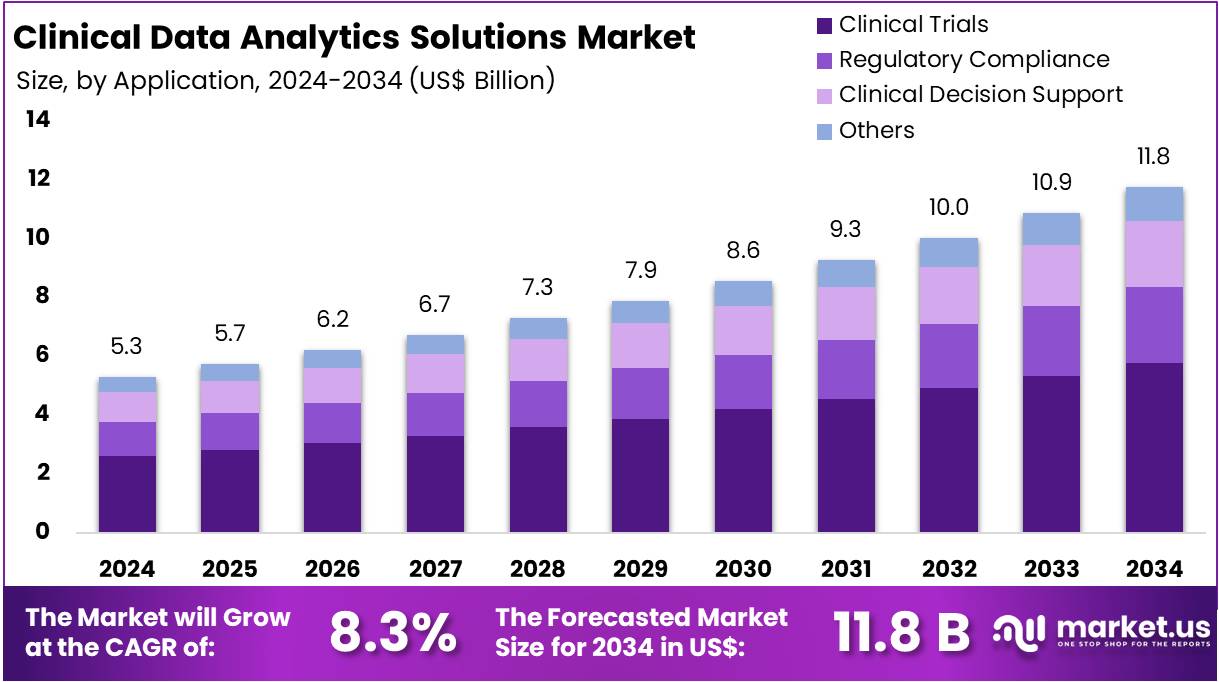
The Global Clinical Data Analytics Solutions Market Size is expected to be worth around US$ 11.8 Billion by 2034, from US$ 5.3 Billion in 2024, growing at a CAGR of 8.3% during the forecast period from 2025 to 2034. North America held a dominant market position, capturing more than a 43.6% share and holds US$ 2.3 Billion market value for the year.
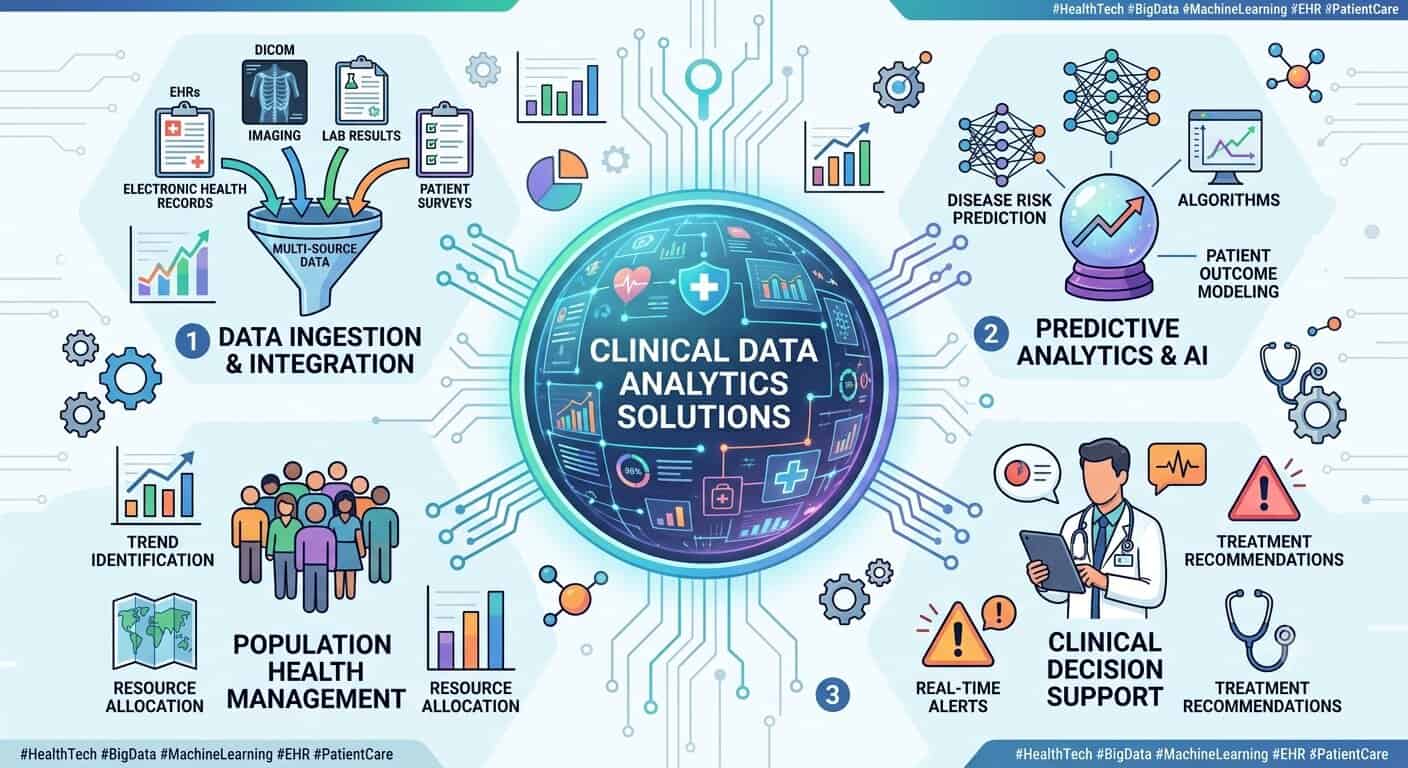
The growing adoption of interoperable health information, electronic health records (EHRs), and real-world data is strengthening demand for clinical data analytics solutions across healthcare systems. These technologies help providers transform complex clinical information into actionable insights that can support diagnosis, treatment planning, patient monitoring, operational efficiency, and population health management.
According to the U.S. Office of the National Coordinator for Health Information Technology (ONC), approximately 9 in 10 U.S. hospitals enabled patients to access their health information through an API in 2024, demonstrating the expanding digital infrastructure available for healthcare data exchange and analysis. In addition, 7 in 10 hospitals using API-based access reported using standards-based APIs, including HL7 FHIR, supporting more consistent and scalable data integration.
The U.S. Food and Drug Administration (FDA) is also emphasizing the analytical value of real-world data derived from sources such as EHRs, medical claims, registries, digital health technologies, and patient-generated information. The agency notes that advances in the availability and analysis of such data are expanding opportunities to generate real-world evidence for regulatory decision-making.
Meanwhile, ONC continues to advance interoperability standards through annual updates to the United States Core Data for Interoperability (USCDI), supporting improved access, exchange, and use of electronic health information. These developments are expected to encourage healthcare organizations to invest in advanced analytics platforms, predictive tools, data integration capabilities, and evidence-based clinical decision-support solutions.
Key Takeaways
- The global Clinical Data Analytics Solutions Market is projected to grow from US$ 5.3 Billion in 2024 to approximately US$ 11.8 Billion by 2034.
- This growth reflects a steady compound annual growth rate (CAGR) of 8.3% during the forecast period from 2025 to 2034.
- In 2024, cloud-based deployment dominated the market, accounting for over 55.6% of the Clinical Data Analytics Solutions Deployment Segment.
- The Clinical Trials segment led the Application Segment in 2024, securing more than a 43.6% share of the overall market.
- North America maintained a leading position in 2024, with over 43.6% market share and a valuation of approximately US$ 2.3 Billion.
Statistical Information
- 81% of U.S. physicians were using AI professionally in 2026, more than double the 38% recorded in 2023, demonstrating rapidly increasing demand for AI-enabled clinical analytics and decision-support tools.
- In 2024, 91% of U.S. hospitals integrated clinical data from third-party technology, while 83% provided clinical data to third-party technology, highlighting strong demand for data integration and analytics capabilities.
- 52% of U.S. hospitals used standards-based APIs to integrate clinical data in 2024, while 39% used them to provide clinical data, creating opportunities for interoperable analytics platforms.
- In 2024, 96% of medium and large U.S. hospitals integrated clinical data from third-party technology, compared with 85% of small hospitals, indicating particularly strong enterprise-level analytics demand.
- 77% of system-affiliated hospitals used standards-based APIs for patient access in 2024, compared with 57% of independent hospitals, showing a significant interoperability opportunity among independent providers.
- FDA records show that 11 real-world evidence submissions using electronic health records were reported in FY2025, compared with 4 in FY2024, indicating increasing use of clinical data for regulatory evidence generation.
- FDA data also show 25 non-interventional real-world evidence studies in FY2025, compared with 11 in FY2024, strengthening opportunities for analytics solutions supporting observational research and evidence generation.
- CMS requires impacted payers to report two Patient Access API usage metrics beginning in 2026, including unique patients whose data are transferred to health apps and patients whose data are transferred more than once, increasing demand for API monitoring and healthcare data analytics.
Market Segmentation Analysis
Deployment Analysis
In 2024, Cloud-based deployment dominated the Clinical Data Analytics Solutions Market, capturing more than 55.6% of the Deployment Segment. Its leadership is supported by rising demand for real-time data access, EHR integration, scalability, and flexible healthcare IT infrastructure. Cloud platforms enable healthcare organizations to deploy advanced analytics without significant upfront hardware investments or extensive internal IT resources. Remote accessibility also supports telehealth, collaborative care, and distributed clinical workflows.
Enhanced cybersecurity capabilities and growing compliance with healthcare data regulations are further strengthening adoption. Meanwhile, on-premise solutions remain relevant among institutions requiring greater internal control and supporting legacy systems, although higher maintenance costs and limited scalability are encouraging gradual migration toward cloud-based environments.
Application Analysis
In 2024, Clinical Trials led the Application Segment of the Clinical Data Analytics Solutions Market, capturing more than 43.6% share. The segment benefits from increasing clinical research activity and the growing volume and complexity of trial data. Analytics solutions help researchers improve patient recruitment, monitor outcomes, identify trends, and optimize trial timelines. Regulatory Compliance is another important application, enabling organizations to strengthen reporting, data quality, traceability, and privacy management.
Meanwhile, Clinical Decision Support solutions are gaining traction through predictive analytics and real-time patient information, helping healthcare professionals identify risks and support treatment decisions. Other applications, including billing, patient engagement, and operational management, are also expanding as digital healthcare adoption increases.
Regional Analysis
In 2024, North America held a dominant position in the Clinical Data Analytics Solutions Market, capturing more than 43.6% share and reaching approximately US$ 2.3 Billion in market value. The region’s leadership is supported by highly developed healthcare IT infrastructure, widespread EHR adoption, and continued investments in interoperability.
According to the U.S. Office of the National Coordinator for Health Information Technology (ONC), more than 99% of U.S. non-federal acute care hospitals had adopted certified EHRs by 2024, creating a strong digital foundation for clinical analytics.
The U.S. is also strengthening healthcare data exchange through standards such as USCDI and FHIR, enabling more efficient access and integration of clinical information.
Meanwhile, the FDA is advancing the use of real-world data from EHRs, medical claims, registries, and digital health technologies to support clinical research and regulatory decision-making. These developments, combined with demand for predictive analytics, patient-centered care, and evidence-based decisions, are expected to sustain North America’s leadership.
Business Opportunities
The Clinical Data Analytics Solutions Market presents strong business opportunities as healthcare organizations increasingly seek to convert large volumes of clinical data into actionable insights. Demand is growing for AI-powered predictive analytics, real-time dashboards, population health management, and clinical decision-support platforms that can improve care quality and operational efficiency.
The FDA recognizes EHRs, claims, registries, medical-device data, and digital health technologies as important sources of real-world data, creating opportunities for analytics providers serving pharmaceutical companies, medical-device manufacturers, and research organizations.
Interoperability is another major opportunity. CMS is advancing FHIR-based APIs for patient access, provider data exchange, payer-to-payer connectivity, and prior authorization, increasing demand for data integration and analytics solutions. Companies can also develop specialized platforms for clinical trials, regulatory compliance, real-world evidence, and automated prior authorization analytics. CMS’s 2026 proposals further expand opportunities around electronic data exchange and standardized healthcare APIs.
Emerging Trends
- TEFCA-driven health data exchange is accelerating: ONC reported that approximately 464 Million health documents had been exchanged through TEFCA by the end of 2025, creating a larger data environment for analytics, care coordination, and cross-organization insights.
- AI transparency is becoming a core analytics requirement: ONC’s HTI-1 rule introduces requirements designed to help clinical users evaluate AI algorithms for fairness, validity, effectiveness, and safety, increasing demand for explainable and trustworthy analytics tools.
- FHIR-based analytics is moving toward broader implementation: CMS is advancing standardized FHIR APIs across healthcare, while its 2026 interoperability framework calls for USCDI v3 or later and FHIR Bulk Data capabilities, supporting scalable clinical-data analysis.
- Real-world evidence analytics is gaining regulatory importance: Since 2016, more than 250 medical-device premarket authorizations have included real-world evidence, creating opportunities to analyze EHRs, registries, claims, device-generated data, and patient-generated information.
- Decentralized clinical trials are expanding the types of data available for analysis: FDA guidance supports remote trial activities such as telehealth visits, in-home visits, and local-provider interactions, creating new data streams for clinical analytics platforms.
Use Cases
- Care coordination across providers: Analytics platforms can combine information from different healthcare organizations to create a more complete patient record. TEFCA is designed to support secure exchange across providers, payers, patients, and public-health organizations.
- Value-based care monitoring: CMS’s BCDA v3 provides Medicare claims data earlier and strengthens FHIR alignment, enabling organizations to identify patient needs sooner, monitor quality measures, coordinate care, and evaluate outcomes.
- Electronic prior authorization: Clinical analytics can identify relevant patient information and support automated authorization workflows. CMS is working with providers, EHR vendors, networks, and payers to advance interoperable electronic prior authorization.
- Medical product evidence generation: Companies can analyze EHRs, claims, registries, device data, and patient-generated information to produce real-world evidence supporting medical-product evaluation and regulatory decisions.
- Clinical trial monitoring: Analytics can combine data from remote visits, local healthcare providers, and other decentralized trial activities to monitor participants and support more flexible clinical research models.
Recent Developments
- In July 2026, Dassault Systèmes signed a definitive agreement to acquire ArisGlobal for approximately US$ 1.8 billion in cash at closing, plus up to US$ 200 million linked to multi-year AI revenue milestones. The acquisition is intended to create a unified AI intelligence platform connecting molecule, patient, and real-world outcomes across life sciences.
- In March 2026, eClinical Solutions appointed Lauren Whitsell as Chief Operating Officer and Venu Mallarapu as Chief Transformation and AI Officer. The company said the leadership expansion supports its next growth phase and noted that its clinical data intelligence platform serves 18 of the world’s top 50 pharmaceutical companies.
- In January 2026, IQVIA and Boehringer Ingelheim announced a long-term global commercial data foundation transformation collaboration. The agreement is focused on scaling Boehringer Ingelheim’s commercial data products and analytics capabilities across therapeutic areas, supporting more consistent data-driven decision-making.
- In October 2025, eClinical Solutions and ZS announced a strategic partnership to combine ZS’s risk-based quality management expertise with eClinical’s elluminate Clinical Data Cloud. ZS already worked with 10 of the top global pharmaceutical sponsors, while the collaboration targets integrated risk assessment, monitoring, and oversight for clinical trials.
- In October 2025, BD launched the BD Incada Connected Care Platform, a scalable AI-enabled cloud platform designed to unify BD device data within one intelligent ecosystem. The platform was introduced alongside the next-generation BD Pyxis Pro Automated Medication Dispensing Solution to provide broader enterprise visibility and convert device data into actionable insights.
- In June 2025, SAS introduced SAS Health Cost of Care Analytics for healthcare payers and providers. The solution combines data sources and organizes claims into episodes of care, enabling organizations to evaluate treatment, patient, and population-level costs and identify opportunities to improve cost efficiency.
Conclusion
The Clinical Data Analytics Solutions Market is positioned for sustained expansion as healthcare organizations increasingly prioritize interoperable, data-driven, and AI-enabled decision-making. Growing adoption of cloud platforms, FHIR-based data exchange, real-world evidence, and predictive analytics is creating opportunities across clinical trials, care coordination, compliance, and clinical decision support.
North America remains a key regional hub due to its advanced digital healthcare infrastructure and strong interoperability initiatives. Meanwhile, partnerships, AI investments, platform launches, and acquisitions by leading technology and healthcare companies are accelerating innovation. Overall, the market is moving toward integrated analytics ecosystems that improve clinical outcomes, operational efficiency, research capabilities, and evidence-based healthcare delivery.




















