


Overview
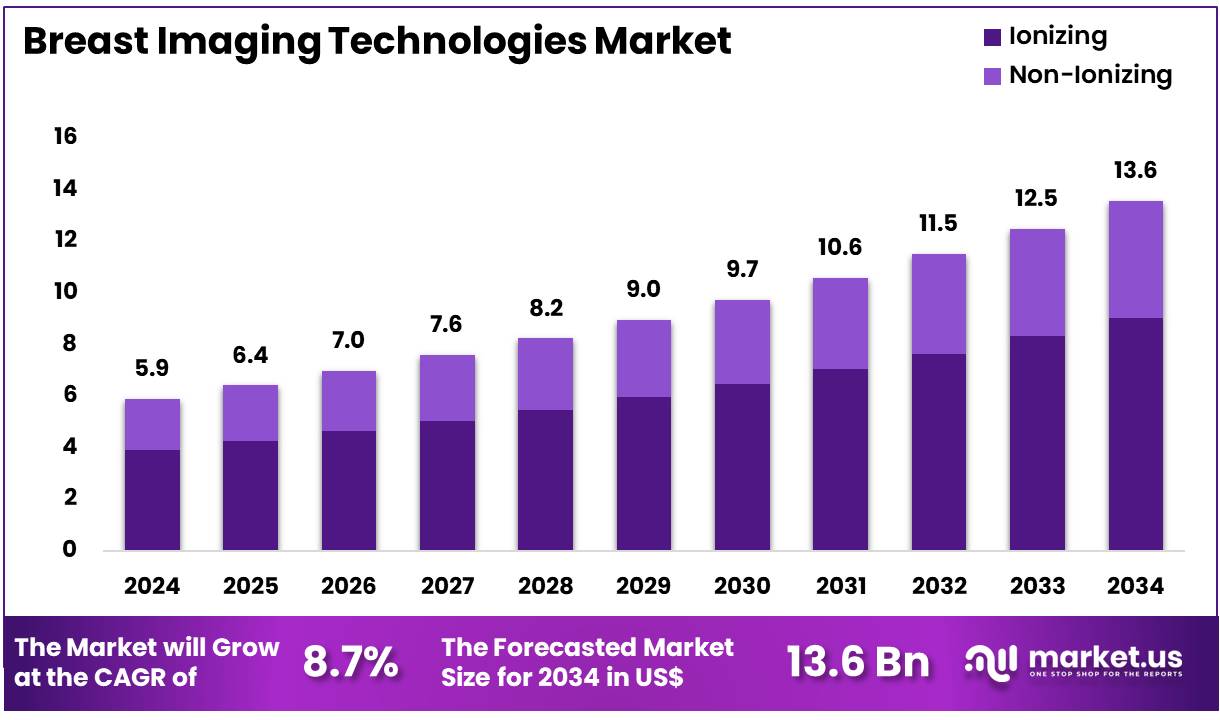
Global Breast Imaging Technologies Market size is expected to be worth around US$ 13.6 Billion by 2034 from US$ 5.9 Billion in 2024, growing at a CAGR of 8.7% during the forecast period 2025 to 2034. In 2024, North America led the market, achieving over 42.1% share with a revenue of US$ 2.5 Billion.
The global breast imaging technologies market is witnessing significant transformation due to rising breast cancer awareness programs, improvements in diagnostic accuracy, and the adoption of advanced imaging solutions. Governments and healthcare organizations worldwide are strengthening screening initiatives to support earlier diagnosis and improve patient outcomes.
According to the World Health Organization, breast cancer remains one of the most commonly diagnosed cancers worldwide, with approximately 2.3 million women diagnosed in 2022. The organization highlights early detection through screening and timely treatment as key strategies for reducing breast cancer mortality.
In the United States, the Centers for Disease Control and Prevention reported that breast cancer is the most common cancer among women, excluding some skin cancers. The agency continues to support screening awareness and recommends regular mammography-based screening programs to detect abnormalities before symptoms appear.
Technological innovation is reshaping breast imaging workflows, with digital mammography, breast ultrasound, magnetic resonance imaging (MRI), and artificial intelligence (AI)-assisted diagnostic tools gaining adoption. The U.S. Food and Drug Administration has cleared multiple AI-based medical imaging devices designed to assist radiologists in detecting breast abnormalities and improving diagnostic confidence.
Healthcare systems are also expanding access to screening services through mobile mammography units and population-based programs. According to the National Cancer Institute, mammography remains the primary screening method for detecting breast cancer at earlier stages, supporting improved treatment options and survival outcomes.
Increasing investments in healthcare infrastructure, growing demand for personalized diagnostics, and continued development of next-generation imaging technologies are expected to accelerate the adoption of breast imaging solutions globally.
Key Takeaways
- In 2024, the breast imaging technologies market generated revenue of US$ 5.9 billion and is projected to reach US$ 13.6 billion by 2033, expanding at a CAGR of 8.7% during the forecast period.
- Based on technology, the market is segmented into ionizing and non-ionizing technologies, with ionizing technologies dominating in 2024 by accounting for a 66.5% market share.
- By end-use, the breast imaging technologies market is categorized into hospitals, diagnostic imaging centers, and breast care centers. Among these, hospitals held the leading position with a 47.1% market share in 2024.
- Regionally, North America emerged as the leading market in 2024, capturing a 42.1% share of the global breast imaging technologies market.
Statistical Information
- According to the World Health Organization (WHO), approximately 2.4 million women were diagnosed with breast cancer globally in 2024, making it the most commonly diagnosed cancer among women worldwide and increasing the need for effective screening and diagnostic imaging solutions.
- The World Health Organization’s Global Breast Cancer Initiative aims to achieve a 2.5% annual reduction in breast cancer mortality over 20 years, which could prevent around 2.5 million breast cancer deaths globally through improvements in early detection, diagnosis, and treatment.
- The Centers for Disease Control and Prevention (CDC) states that breast cancer is the most common cancer among women in the United States, excluding some types of skin cancer, highlighting the importance of regular screening programs.
- The U.S. Preventive Services Task Force recommends that women aged 40 to 74 years receive mammography screening every two years, supporting continued adoption of mammography and advanced breast imaging technologies.
- The U.S. Food and Drug Administration (FDA) has authorized multiple artificial intelligence-enabled medical devices designed to assist healthcare professionals in analyzing medical images, improving diagnostic workflows, and supporting clinical decision-making.
- FDA-cleared AI-based breast imaging technologies are being developed to assist radiologists in applications such as breast lesion assessment, cancer detection support, and risk evaluation using advanced imaging data.
- According to WHO, breast cancer survival outcomes improve significantly with early detection, with five-year survival rates exceeding 90% in many high-income countries where timely diagnosis and treatment are widely available.
Regional Analysis
North America Leads the Breast Imaging Technologies Market
North America accounted for a leading position in the breast imaging technologies market, supported by advanced healthcare infrastructure, widespread screening programs, and strong adoption of digital diagnostic solutions. According to the Centers for Disease Control and Prevention, breast cancer remains one of the most common cancers among women in the United States, highlighting the continued need for effective screening and early detection methods.
The U.S. Preventive Services Task Force recommends that women begin biennial mammography screening at age 40, supporting increased demand for imaging technologies. The adoption of artificial intelligence (AI)-assisted imaging, 3D mammography, and advanced diagnostic tools is further improving detection accuracy and workflow efficiency.
Asia Pacific Expected to Witness Rapid Growth
Asia Pacific is projected to experience strong growth due to rising breast cancer incidence, improving healthcare infrastructure, and government-led screening initiatives. According to the World Health Organization, strengthening early detection and improving access to quality breast cancer care are key priorities under its Global Breast Cancer Initiative.
Expanding awareness programs, investments in diagnostic facilities, and increasing availability of advanced imaging technologies such as digital mammography and breast tomosynthesis are expected to support market expansion across the region.
Emerging Trends
- Expansion of 3D Mammography Technologies: Digital breast tomosynthesis (3D mammography) is gaining adoption as healthcare providers seek improved breast cancer detection accuracy. The FDA has approved multiple tomosynthesis systems, and this technology is increasingly used to overcome limitations of traditional 2D mammography, especially in women with dense breast tissue.
- Growth of Artificial Intelligence in Breast Imaging: AI-powered imaging solutions are becoming a major trend in breast diagnostics. FDA-authorized AI tools are helping radiologists analyze mammograms, detect suspicious patterns, and improve workflow efficiency. These technologies are supporting faster image interpretation and more consistent diagnostic decisions.
- Increasing Importance of Breast Density-Based Screening: Breast density assessment is influencing screening strategies as dense breast tissue can reduce mammography sensitivity. The FDA’s updated mammography reporting requirements encourage patients and providers to discuss additional screening options such as ultrasound or MRI when appropriate.
- Rising Adoption of Contrast-Enhanced Mammography: Contrast-enhanced mammography is emerging as an advanced imaging approach that provides additional information about abnormal breast tissue. FDA-cleared systems are enabling clinicians to evaluate suspicious findings with enhanced visualization, supporting improved diagnostic evaluation.
- Shift Toward Personalized Breast Cancer Screening: Healthcare systems are moving toward risk-based screening approaches that consider factors such as genetics, family history, age, and breast density. Research organizations, including the National Cancer Institute, are supporting personalized screening models to improve early detection strategies.
Use Cases
- Early Breast Cancer Detection Through Mammography Screening: Mammography remains the primary screening method for identifying breast abnormalities before symptoms appear. Government health programs continue promoting regular screening among eligible populations to improve early diagnosis and increase treatment success rates.
- AI-Assisted Breast Image Analysis: AI-based imaging tools are used by radiologists to analyze mammograms, highlight suspicious areas, and support clinical decision-making. These systems help manage increasing imaging workloads and assist healthcare professionals in improving diagnostic accuracy.
- Breast MRI for High-Risk Patient Screening: Breast MRI is used for individuals with elevated breast cancer risk, including those with strong family history or genetic risk factors. The American Cancer Society recommends annual MRI screening along with mammography for women with a lifetime risk of approximately 20% to 25% or greater.
- Mobile Mammography for Underserved Communities: Mobile mammography units are used to expand screening access in rural and underserved areas. These programs help reduce geographic barriers by bringing diagnostic imaging services closer to communities with limited healthcare infrastructure.
- Tele-Radiology for Remote Breast Imaging Interpretation: Tele-radiology enables specialists to review breast imaging studies remotely, helping healthcare facilities access expert radiologists regardless of location. This approach supports faster reporting, improves specialist availability, and enhances diagnostic services in areas facing workforce shortages.
Conclusion
The breast imaging technologies market is evolving rapidly due to increasing breast cancer awareness, expanding screening programs, and continuous advancements in diagnostic technologies. The integration of artificial intelligence, 3D mammography, MRI, ultrasound, and personalized screening approaches is improving early detection and clinical decision-making. Growing healthcare investments, government-supported screening initiatives, and rising demand for accurate diagnostic solutions are strengthening market adoption worldwide.
North America continues to lead through advanced healthcare infrastructure and technology adoption, while Asia Pacific is expected to experience significant growth due to improving access to breast cancer screening services. Future innovations will further enhance accuracy, accessibility, and patient outcomes.




















