


Overview
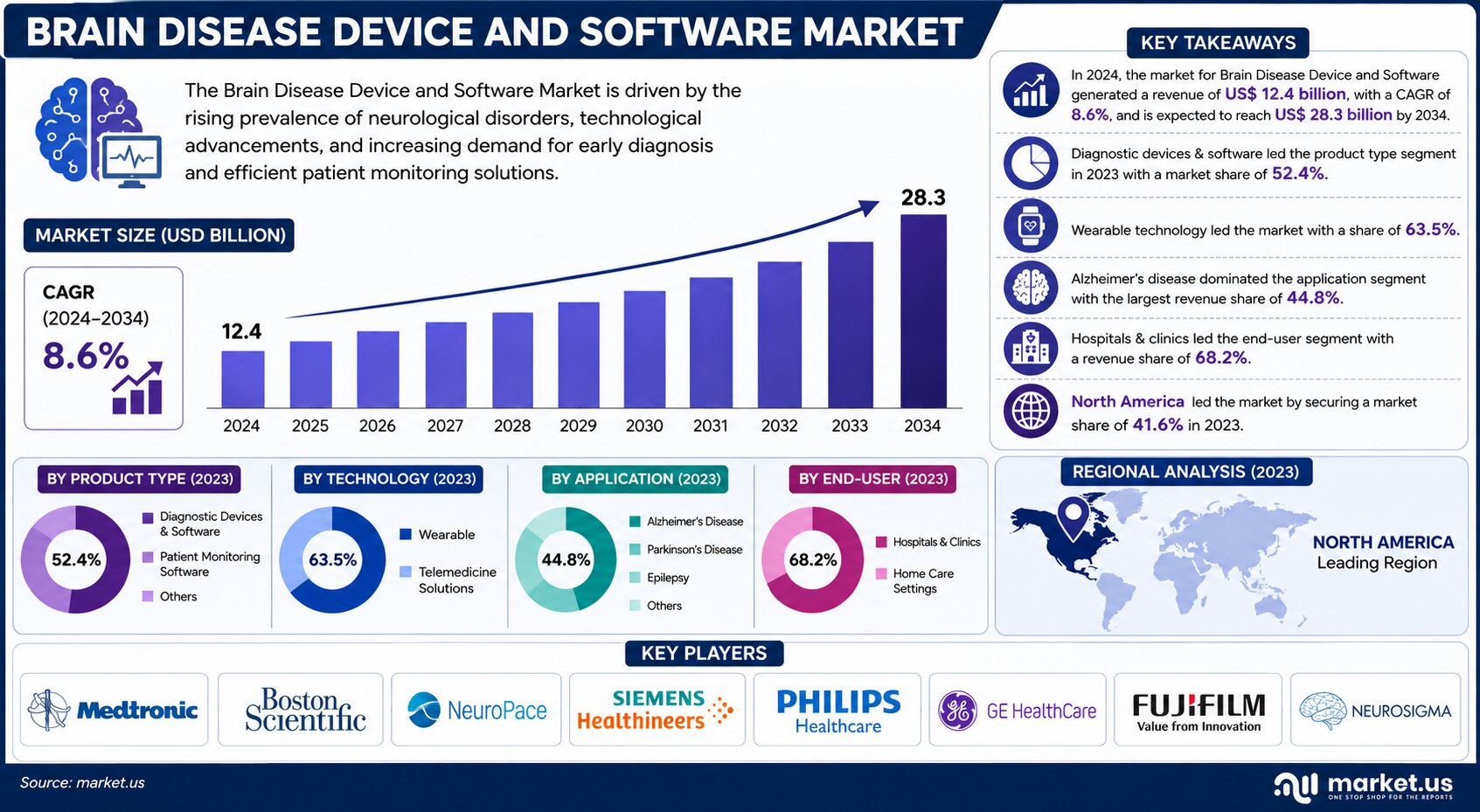
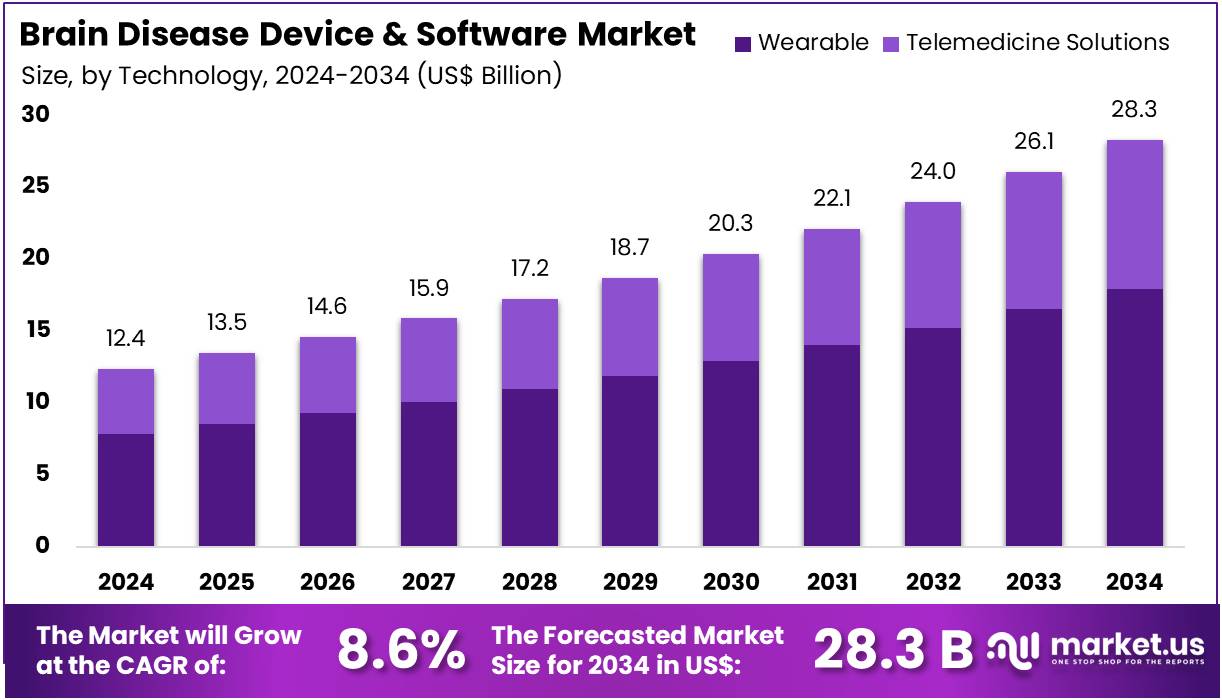
The Brain Disease Device and Software Market size is expected to be worth around US$ 28.3 billion by 2034 from US$ 12.4 billion in 2024, growing at a CAGR of 8.6% during the forecast period 2025 to 2034.
The growing burden of neurological conditions and advances in neurotechnology are creating opportunities for brain disease devices and software across diagnosis, treatment, and rehabilitation. The sector is supported by innovations spanning neurodiagnostic systems, neurostimulation technologies, brain-computer interfaces, digital monitoring platforms, and software-enabled clinical decision tools.
According to the World Health Organization (WHO), neurological conditions affect more than 3 billion people worldwide and represent the leading cause of illness and disability globally. WHO also reports that neurological conditions are responsible for more than 11 million deaths each year, highlighting the unmet need for earlier diagnosis, treatment, monitoring, and long-term disease management.
Technological development is expanding the capabilities of neurological care. The U.S. Food and Drug Administration (FDA) identifies neurodiagnostic, neurointerventional, and neurostimulation devices as categories used for conditions including epilepsy, Parkinson’s disease, Alzheimer’s disease, depression, traumatic brain injury, and spinal cord injury. Emerging technologies are also supporting personalized, data-driven approaches to neurological care.
WHO’s 2025 analysis of neurotechnology highlights neuroimaging, brain-computer interfaces, neuromodulation, and neurological devices as major areas of technological development. Meanwhile, FDA regulatory activity continues to include innovative brain stimulation and monitoring technologies, supporting progress in the field. These developments are expected to encourage healthcare providers, technology developers, and medical-device companies to pursue solutions that improve clinical precision, patient monitoring, accessibility, and treatment outcomes.
Key Takeaways
- In 2024, the Brain Disease Device and Software Market generated revenue of US$ 12.4 billion, growing at a CAGR of 8.6%, and is projected to reach US$ 28.3 billion by 2034.
- By product type, the market is segmented into diagnostic devices & software, patient monitoring software, and others. Among these, diagnostic devices & software dominated the market in 2023, accounting for a 52.4% market share.
- Based on technology, the market is categorized into wearable and telemedicine solutions. The wearable segment held the leading position in 2023, capturing a significant 63.5% market share.
- By application, the market is divided into Alzheimer’s disease, Parkinson’s disease, epilepsy, and others. Alzheimer’s disease emerged as the dominant application segment, representing the largest revenue share of 44.8% in 2023.
- Based on end users, the market is segmented into hospitals & clinics and home care settings. Hospitals & clinics accounted for the largest share, holding 68.2% of market revenue in 2023.
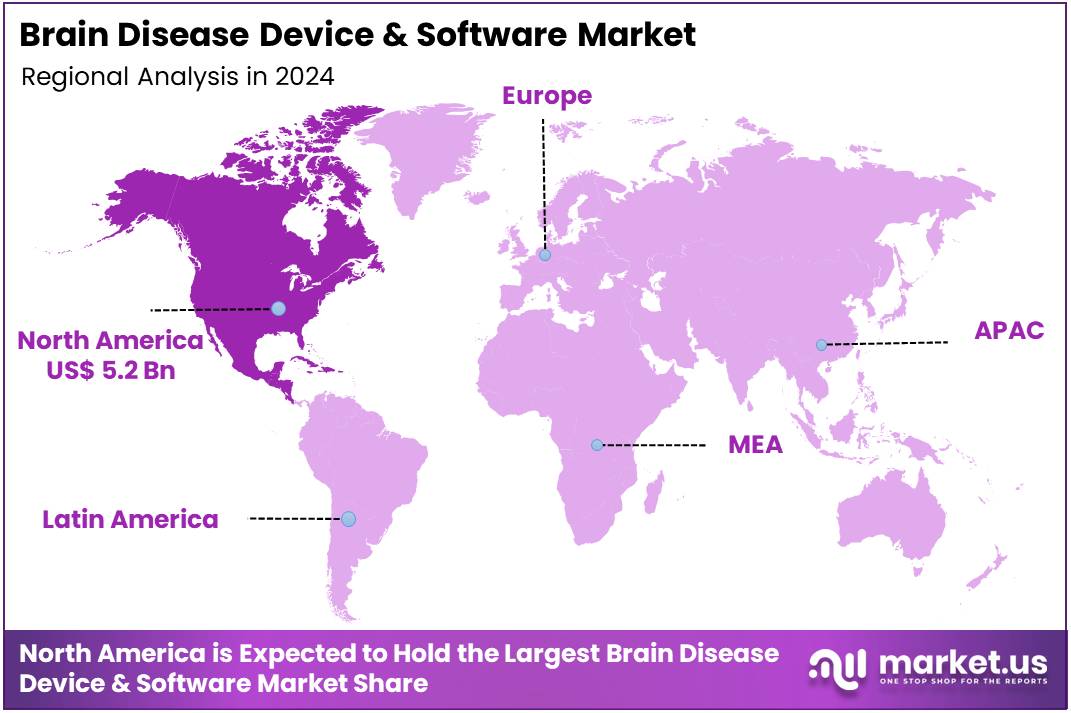
- Regionally, North America dominated the Brain Disease Device and Software Market in 2023, accounting for a substantial 41.6% market share.
Statistical Information
- 7.1 million Americans are currently living with Alzheimer’s disease, according to the 2025 NIH Alzheimer’s Disease and Related Dementias Research Progress Report. The number is projected to exceed 13.9 million by 2060, reinforcing the need for advanced diagnostic, monitoring, and disease-management technologies.
- Approximately 5.3 million Medicare beneficiaries, representing about 9% of beneficiaries, may have Alzheimer’s disease or a related dementia, based on an NIA-funded analysis of Medicare data. The study examined data from more than 60 million beneficiaries.
- In 2024, 5.0% of U.S. adults aged 45 and older had experienced a stroke. Among adults aged 65 and older, prevalence reached 9.3% in nonmetropolitan areas, highlighting demand for accessible neurological monitoring and diagnostic technologies.
- More than 795,000 people in the U.S. experience a stroke each year, including approximately 610,000 first or new strokes. About 185,000, or nearly one in four, occur among people who have previously experienced a stroke.
- In 2024, 166,852 deaths in the United States were attributed to stroke, making cerebrovascular disease the fourth-leading cause of death in the country.
- NIH-supported researchers developed a brain-computer interface that enabled a person with paralysis to communicate through synthesized speech after being unable to speak for 18 years, demonstrating the potential of BCI technologies for neurological rehabilitation and assistive communication.
- A 2025 systematic review and meta-analysis examining deep-brain stimulation included 5,488 patients across 33 studies. Parkinson’s disease was the most frequently represented neurological condition among patients receiving DBS.
- The FDA’s AI-enabled medical-device database now includes authorized AI-based devices across multiple clinical specialties, with new authorizations continuing into 2026. The agency states that listed devices have undergone applicable premarket review for safety and effectiveness, supporting the expanding role of AI in medical-device development.
Market Segmentation Analysis
Product Type Analysis
The diagnostic devices & software segment held a 52.4% market share, maintaining its leading position due to the growing need for accurate and timely identification of neurological disorders. Advances in medical imaging, artificial intelligence, and computer-assisted diagnostic technologies are improving the detection and assessment of brain-related conditions. The rising burden of neurological diseases is encouraging healthcare providers to adopt advanced diagnostic solutions that support clinical decision-making and improve patient management.
Integration with electronic health records and interoperable healthcare systems is further enhancing workflow efficiency. In addition, regulatory support, technological innovation, and increasing research and development investments by medical technology companies are contributing to the adoption of sophisticated diagnostic devices and software across healthcare settings.
Technology Analysis
The wearable segment accounted for a 63.5% market share, supported by increasing demand for portable technologies that enable continuous monitoring of neurological conditions. Wearable solutions can facilitate real-time collection of patient data, supporting healthcare professionals in tracking physiological activity, mobility, and other relevant indicators. Technological improvements in sensors, connectivity, and data analytics are strengthening the functionality of these devices.
The growing need for remote patient monitoring is also encouraging integration between wearable technologies and telemedicine platforms. In addition, the expanding elderly population and rising prevalence of chronic neurological disorders are creating greater demand for convenient monitoring solutions. Growing patient awareness and the preference for non-invasive technologies further support the adoption of wearable devices.
Application Analysis
The Alzheimer’s disease segment accounted for a 44.8% revenue share, driven by the growing global burden of cognitive disorders and increasing attention toward early detection and disease management. Healthcare providers are increasingly adopting technologies that support cognitive assessment, patient monitoring, and care coordination. Advances in diagnostic tools and biomarker-based technologies are creating new opportunities for solutions designed specifically for Alzheimer’s disease.
Rising research activities and funding are also encouraging the development of innovative neurological devices and software. Furthermore, the expanding elderly population is increasing the demand for effective monitoring and management solutions. Integration with digital cognitive health platforms and caregiver-support technologies can improve patient management while helping healthcare professionals and families monitor disease progression more effectively.
End-user Analysis
The hospitals & clinics segment held a 68.2% revenue share, reflecting the important role of healthcare facilities in the diagnosis and treatment of neurological disorders. Hospitals and specialized clinics typically have access to advanced diagnostic equipment, neurological specialists, monitoring infrastructure, and multidisciplinary care teams. Increasing patient volumes associated with brain disorders are supporting demand for sophisticated neurological devices and software within clinical environments.
Healthcare providers are also investing in advanced technologies to improve diagnostic accuracy, treatment planning, and patient monitoring. Partnerships between healthcare institutions and medical technology companies are facilitating the adoption and integration of innovative solutions. Additionally, growing demand for specialized neurological services and comprehensive facility-based care is expected to sustain the segment’s leading position.
Regional Analysis
North America is Leading the Brain Disease Device and Software Market
North America accounted for a 41.6% market share, supported by strong regulatory activity, advanced healthcare infrastructure, and increasing adoption of neurological technologies. The U.S. Food and Drug Administration (FDA) maintains dedicated regulatory pathways and research programs for neurological devices, covering technologies used for diagnosis, treatment, neurostimulation, and brain-computer interfaces.
The FDA’s AI-enabled medical device database also includes multiple products categorized under neurology, demonstrating continued development of software-driven neurological solutions.
Asia Pacific is Expected to Register the Fastest Growth
Asia Pacific is expected to record the fastest growth, supported by expanding healthcare infrastructure, rising digital-health adoption, and increasing attention to neurological disease management. The region’s growing need for accessible diagnostic and monitoring technologies is encouraging healthcare systems to explore software-enabled and remote-care solutions.
Increasing investment in advanced medical technologies, combined with an aging population and rising awareness of neurological disorders, is expected to create further opportunities for brain disease devices and software. FDA-recognized developments in AI-enabled and neurological technologies also demonstrate the broader global shift toward digitally supported neurological care.
Business Opportunities
The Brain Disease Device and Software Market presents significant business opportunities as healthcare systems increasingly adopt technologies for neurological diagnosis, monitoring, treatment, and rehabilitation. The World Health Organization identifies neuroimaging, brain-computer interfaces, neuromodulation, and neurological devices as key areas of emerging neurotechnology, creating opportunities for companies developing specialized hardware and software solutions.
AI-powered diagnostic software represents a promising opportunity, particularly for solutions that support neurological imaging, disease detection, clinical decision-making, and patient monitoring. The FDA continues to authorize AI-enabled medical devices, including products classified under neurology.
Another opportunity lies in wearable and remote-monitoring technologies. FDA-authorized sensor-based digital health devices include wearable technologies designed for continuous or spot-check monitoring, supporting the development of home-based neurological care solutions.
Brain-computer interfaces and neurorehabilitation technologies also offer substantial growth potential. Recent NIH research demonstrates progress toward using BCI systems as communication tools for people with paralysis. Additionally, interoperability, cloud-based platforms, cybersecurity, and personalized neurological care can create recurring software and service opportunities as healthcare providers seek connected digital solutions.
Emerging Trends
- Non-Invasive Neurotechnology: Non-invasive neurotechnology is gaining attention because it can collect brain signals without surgery. Recent research is focusing on lighter sensors, dry electrodes, and more comfortable wearable systems, helping move brain monitoring from specialized laboratories toward practical neurological care and rehabilitation.
- Closed-Loop Brain Systems: Brain devices are increasingly combining real-time sensing with automated responses. Closed-loop systems can monitor neural activity and adjust stimulation or therapy based on detected brain signals. This approach is creating opportunities for more personalized neurological treatment and rehabilitation.
- Lightweight EEG Wearables: EEG technology is moving toward smaller and more wearable formats. A 2026 study demonstrated a 20-channel EEG cap with graphene-based electrodes that maintained signal performance during a 36-day stability evaluation, supporting development of longer-term brain-monitoring solutions.
- Cognitive Brain-Computer Interfaces: BCI development is expanding beyond basic movement control toward cognitive applications. Recent research is examining systems that interpret neural activity associated with cognition and mental states, opening opportunities for communication support, neurological assessment, rehabilitation, and potentially personalized brain-health applications.
- Integrated Neurotechnology Platforms: The market is shifting toward integrated hardware-software systems rather than standalone devices. WHO identifies 4 major neurotechnology categories neuroimaging, brain-computer interfaces, neuromodulation, and neurological devices creating opportunities for companies combining sensing, analytics, software, and therapeutic functions.
Use Cases
- Seizure Monitoring at Home: Wearable devices are being used to monitor physiological signals associated with seizures outside hospitals. The FDA’s EpiMonitor authorization demonstrates a practical application for neurological monitoring, allowing technology to support patients and caregivers where continuous clinical observation is not feasible.
- Remote Neurological Monitoring: Connected medical devices can transmit patient-generated information to healthcare professionals for remote assessment and treatment management. CMS recognizes remote patient monitoring as an established healthcare service, creating opportunities to apply connected monitoring models to chronic neurological conditions.
- Stroke Rehabilitation: BCI systems are increasingly being tested for stroke rehabilitation by monitoring patient attention or neural activity and adapting therapy accordingly. Recent research demonstrated an attention-adaptive BCI-assisted therapy system designed to dynamically control rehabilitation activities based on real-time brain signals.
- Assistive Communication: BCI technology can provide communication pathways for people who cannot speak or control conventional input devices. Current systems combine neural-signal acquisition with decoding algorithms and external communication technologies, creating applications for patients with paralysis, severe motor impairment, or neurological injury.
- Brain Health and Cognitive Monitoring: Wearable EEG and BCI technologies are being investigated for monitoring cognitive and neurological states. One recent system combined EEG recording with acoustic-optical stimulation and reported 98.73% precision in its experimental assessment, indicating potential for future cognitive monitoring and non-invasive intervention applications.
Recent Developments
- In June 2026, Medtronic completed its acquisition of Scientia Vascular for $550 million, combining Scientia’s neurovascular access technologies with Medtronic’s therapeutic portfolio. The acquisition is intended to strengthen Medtronic’s neurovascular offering and provide physicians with complementary technologies for complex neurovascular procedures.
- In February 2026, Siemens Healthineers and Mayo Clinic expanded their strategic collaboration to improve care for neurodegenerative diseases. The agreement includes advancing and clinically translating AI-enabled MRI protocols to improve diagnostic accuracy and patient monitoring, alongside broader imaging and interventional-technology collaboration.
- In January 2026, Boston Scientific agreed to acquire Penumbra in a cash-and-stock transaction valued at approximately $14.5 billion enterprise value. The transaction combines Boston Scientific’s medical-device portfolio with Penumbra’s neurovascular technologies, including solutions used in stroke and other neurovascular procedures.
- In December 2025, NeuroSigma completed a $1 million investment in a high-volume manufacturing line for its second-generation Monarch eTNS device. The investment is intended to increase manufacturing capacity and support commercialization of its non-invasive neuromodulation technology.
- In November 2025, Philips and Cortechs.ai extended their partnership to integrate AI-enabled quantitative neuroimaging analytics directly into Philips MR systems. The collaboration is designed to provide clinicians with faster, more objective and reproducible brain-health insights for precision neurological diagnosis.
- In September 2025, GE HealthCare announced an agreement to acquire icometrix to strengthen its neurology portfolio with AI-powered brain-MRI assessment. The icobrain platform includes icobrain aria, an FDA-cleared solution designed to detect and quantify ARIA associated with amyloid-targeting Alzheimer’s therapies. Financial terms were not disclosed.
- In June 2025, NeuroPace secured a $75 million credit facility from MidCap Financial, consisting of a $60 million term loan and $15 million revolving facility. The company said the financing would support expansion of patient access to its RNS System, new indications, product development, and real-world evidence generation.
Conclusion
The Brain Disease Device and Software Market is advancing as healthcare systems seek more accurate, connected, and personalized solutions for neurological conditions. Growing disease burden, expanding neurotechnology applications, and progress in AI, wearable monitoring, neuroimaging, brain-computer interfaces, and neuromodulation are creating new opportunities across diagnosis, treatment, rehabilitation, and home-based care.
North America currently maintains a strong market position, while Asia Pacific offers significant future growth potential. Increasing regulatory activity, strategic investments, partnerships, and product development by leading medical technology companies are further strengthening the competitive landscape. Overall, integration of intelligent software with neurological devices is expected to remain a key driver of future market development.




















