


Introduction
The global development to operations market represents a foundational pillar of modern enterprise IT architecture, unifying software engineering and IT operations through continuous integration, continuous delivery, and automated infrastructure management. Valued at USD 11.5 billion in 2023 and projected to reach USD 66.0 billion by 2033, the sector is transitioning from siloed point tools toward unified DevSecOps platforms and internal developer platforms. Structural expansion is propelled by multi-cloud workload proliferation, embedded AI pipeline automation—integrated by 76% of DevOps teams—and strict software supply-chain compliance mandates across global enterprises.
Market Size & Statistics
- The global development and operations market was valued at USD 11.5 billion in the base year of 2023.
- Total global market revenue is projected to reach approximately USD 66.0 billion by 2033, expanding at a compound annual growth rate of 19.1% from 2024 to 2033.
- Within the component segmentation, the solution segment dominated the global market by capturing a 67.0% revenue share in 2023.
- By deployment mode, cloud-based DevOps deployments commanded a leading 65.2% market share in 2023 due to superior scalability, cost-effectiveness, and alignment with agile workflows.
- Across enterprise size categories, large enterprises accounted for 58.1% of total market revenue in 2023 as organizations invested heavily to manage distributed IT estates.
- Regionally, North America led the global DevOps landscape in 2023, capturing a 38.5% revenue share valued at USD 4.4 billion.
- Strategic cloud capital allocations continue to reshape vendor positioning, anchored by USD 12 billion from Microsoft, USD 11 billion from Google, and USD 6 billion from AWS to expand native DevOps ecosystems.
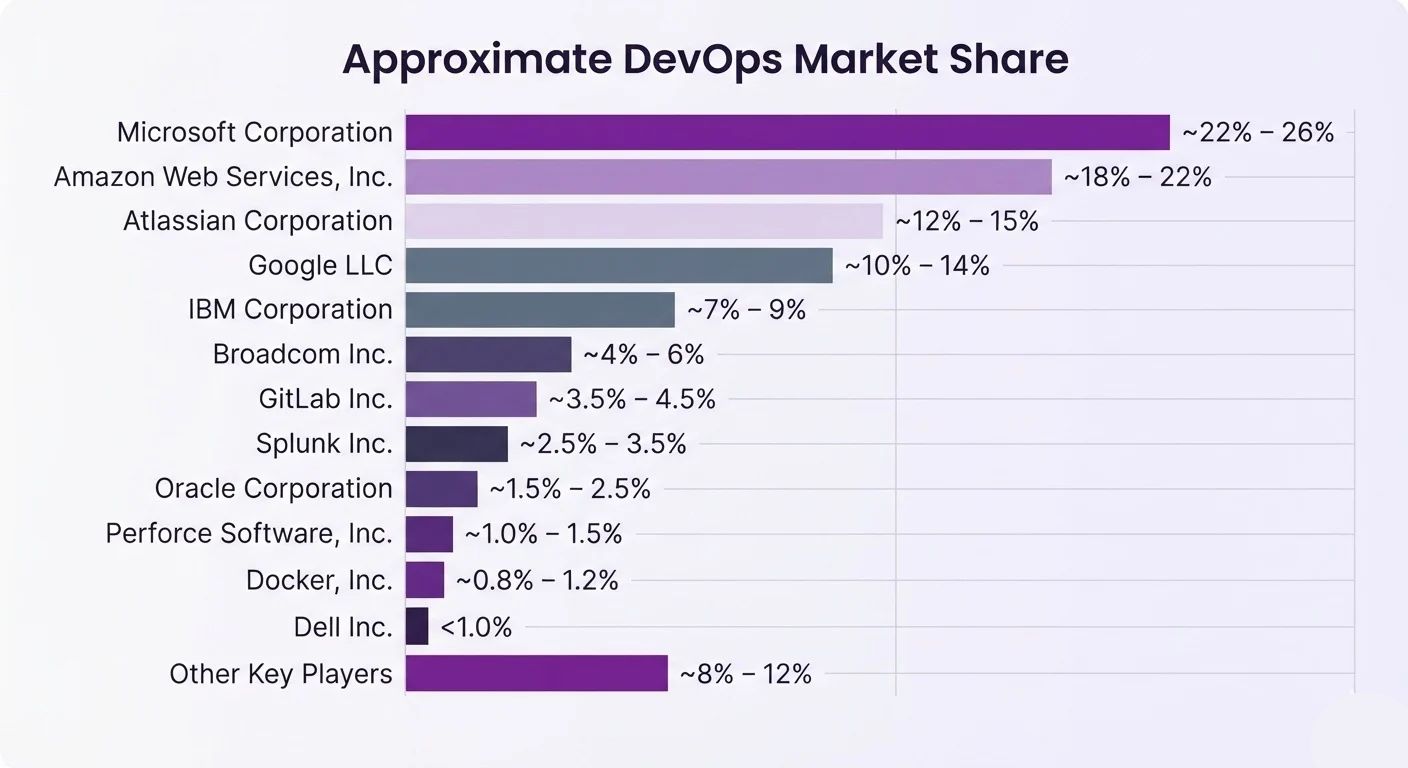
Enterprise DevOps market share is heavily concentrated among cloud hyperscalers that bundle native pipeline orchestration with cloud infrastructure, alongside pure-play DevSecOps and collaborative workflow leaders. Because diversified conglomerates do not audit standalone DevOps tool revenues separately from broader cloud or infrastructure software reporting, vendor shares reflect industry consensus across core DevOps software tools, CI/CD platforms, container orchestration, and AIOps observability.
| Company | Approximate DevOps Market Share | Primary DevOps Portfolio & Sector Positioning | Verifiable Sector Financial Metrics & Operational Benchmarks |
|---|---|---|---|
| Microsoft Corporation | ~22%–26% | Tier-1 Market Leader: GitHub, GitHub Actions, GitHub Copilot, Azure DevOps | Ranked a top worldwide DevOps tools leader by IDC; USD 12B DevOps allocation targeting >25% share; GitHub holds 82% enterprise adoption with 4.7M paid Copilot subscribers in Q2 FY26. |
| Amazon Web Services, Inc. | ~18%–22% | Tier-1 Cloud-Native Leader: AWS CodePipeline, CodeBuild, CodeDeploy, CloudFormation, CDK | Backed by a USD 6B DevOps ecosystem investment and ~30%–31% global cloud infrastructure share; total AWS segment hit USD 46.0B in Q3 2026 at +39% YoY, though standalone DevOps revenue is Data Unavailable. |
| Atlassian Corporation | ~12%–15% | Tier-1 Workflow & DevSecOps Leader: Jira, Bitbucket, Compass, Jira Service Management | Co-leader in IDC’s USD 25.2B worldwide DevOps tools tracker and 2026 Gartner DevSecOps Magic Quadrant Leader; total FY26 revenue reached USD 6,572M at +26% YoY with USD 6.61B subscription ARR. |
| Google LLC | ~10%–14% | Tier-1 Cloud & Kubernetes Challenger: Google Cloud Build, Artifact Registry, Anthos / GKE | Backed by a USD 11B investment targeting >15% DevOps market share; Google Cloud quarterly revenue surged 103% YoY to USD 30.7B in Q3 2026, while standalone DevOps revenue is Data Unavailable. |
| IBM Corporation | ~7%–9% | Hybrid Cloud & IaC Leader: Red Hat OpenShift, Ansible, HashiCorp Terraform & Vault, Concert AIOps | Red Hat OpenShift ARR surpassed USD 2.4B at +30% YoY in Q3 2026 within IBM’s USD 7.80B Software segment; completed USD 6.4B acquisition of HashiCorp in February 2025. |
| Broadcom Inc. | ~4%–6% | Enterprise Private Cloud & Mainframe DevOps: VMware Tanzu Platform, CA Automic, Release Automation | Infrastructure Software segment housing VMware Tanzu and CA DevOps generated USD 27.03B in FY25 at +26% YoY and USD 7.2B in Q2 FY26; standalone DevOps revenue is Data Unavailable. |
| GitLab Inc. | ~3.5%–4.5% | Pure-Play DevSecOps Orchestration Leader: GitLab Ultimate, GitLab Duo AI | 100% pure-play DevSecOps revenue reached USD 955.2M in FY26 at +26% YoY and USD 286.3M in Q2 FY27 at +21.3% YoY, serving over 50% of the Fortune 100. |
| Splunk Inc. | ~2.5%–3.5% | DevSecOps Observability & ITOps Specialist: Splunk Observability Cloud, AppDynamics integration | Operates within Cisco’s USD 1.10B FY26 Observability business; unified Splunk Platform and AppDynamics monitoring workflows for container and serverless DevOps teams in 2026. |
| Oracle Corporation | ~1.5%–2.5% | Enterprise CloudOps & OCI Pipeline Provider: OCI DevOps, Visual Builder Studio, Enterprise Manager | Named a Leader in Omdia CloudOps with a 93% observability score; consolidated corporate revenue reached USD 67.4B in FY26, while standalone DevOps revenue is Data Unavailable. |
| Perforce Software, Inc. | ~1.0%–1.5% | Infrastructure Automation & Version Control Specialist: Puppet, Helix Core, Delphix | Privately held pure-play DevOps vendor generating an estimated USD 100M–USD 500M in annual revenue across enterprise configuration management, compliance, and binary versioning. |
| Docker, Inc. | ~0.8%–1.2% | Container Toolchain Specialist: Docker Desktop, Docker Hub, Docker Scout | Generated USD 207M in ARR at +25% YoY across more than 1 million paid developer subscriber seats at a USD 2.1B private valuation. |
| Dell Inc. | <1.0% | Hardware-Integrated AIOps & Hybrid DevOps: Dell APEX AIOps, formerly Moogsoft | Acquired Moogsoft in September 2023 and rebranded it as Dell APEX AIOps Incident Management in May 2024 for alert correlation; standalone DevOps revenue is Data Unavailable. |
| Other Key Players | ~8%–12% | Fragmented Ecosystem Specialists: Datadog, JFrog, Harness, CircleCI, CloudBees, PagerDuty | Datadog co-leads IDC observability and DevOps rankings, while JFrog recorded USD 531.8M in 2025 revenue alongside specialized GitOps and CI/CD niche vendors. |
Top Companies List
- Microsoft Corporation
- Amazon Web Services, Inc.
- Atlassian Corporation
- Google LLC
- IBM Corporation
- Broadcom Inc.
- GitLab Inc.
- Splunk Inc.
- Oracle Corporation
- Perforce Software, Inc.
- Docker, Inc.
- Dell Inc.
- Other Key Players
Microsoft Corporation
Microsoft dominates the global DevOps tools landscape through the tight integration of GitHub, GitHub Actions, GitHub Copilot, and Azure DevOps. Its technological moat combines the world’s largest source-code repository ecosystem with multi-model AI coding agents and native Azure cloud deployment pipelines.
Company Overview
| Attribute | Company Data |
|---|---|
| Company Name | Microsoft Corporation |
| Ticker Symbol | NASDAQ: MSFT |
| Industry | Enterprise Software, Cloud Computing & DevOps Platforms |
| Headquarters | Redmond, Washington, U.S. |
| Founded | 1975 |
| Founders | Bill Gates, Paul Allen |
| Current CEO | Satya Nadella |
| Latest Quarterly Revenue | USD 92.3 billion Consolidated Q1 FY27 ended Sep 30, 2026; Agents & Infra segment: USD 76.8 billion; Standalone DevOps: Data Unavailable |
| YoY Revenue Growth | +19% Consolidated; +25% Agents & Infra; +48% Azure; >+50% GitHub Advanced Security |
| Primary Segments | DevOps Sector Focus: GitHub Actions, Copilot, Advanced Security, Azure DevOps, Visual Studio |
Financial Details
In Q1 FY27 ended September 30, 2026, Microsoft’s Agents and Infra segment—which houses Azure DevOps and GitHub—generated USD 76.8 billion in revenue at +25% YoY, while Azure revenues surged 48% YoY to USD 33.2 billion. Although standalone DevOps revenue is Data Unavailable in GAAP filings, management disclosed that Q1 FY27 results exceeded expectations due to surging GitHub Copilot usage and GitHub Advanced Security revenue growing over 50% YoY. Across its broader developer monetization engine, GitHub Copilot scaled past 4.7 million paid subscribers, and agent-generated pull requests on GitHub increased six-fold over the preceding six months.
Strategic Developments
- Committed a USD 12 billion strategic capital allocation toward cloud-integrated DevOps infrastructure and developer platform expansion to secure over 25% of global DevOps market share.
- Launched broad availability of GitHub Copilot Fusion at GitHub Universe in late 2026, introducing multi-model AI orchestration directly across enterprise CI/CD and pull-request workflows.
- Integrated GitHub Copilot coding agents with Microsoft Foundry and Agent 365 governance controls to automate code generation, security scanning, and deployment pipelines.
Amazon Web Services, Inc.
Amazon Web Services anchors cloud-native DevOps automation through AWS CodePipeline, CodeBuild, CodeDeploy, CloudFormation, and AWS CDK. Its core competitive moat stems from coupling automated infrastructure-as-code and agentic AI software lifecycle tooling directly into the world’s largest public cloud infrastructure footprint.
Company Overview
| Attribute | Company Data |
|---|---|
| Company Name | Amazon Web Services, Inc., Subsidiary of Amazon.com, Inc. |
| Ticker Symbol | NASDAQ: AMZN for Parent |
| Industry | Cloud Infrastructure & Cloud-Native DevOps Services |
| Headquarters | Seattle, Washington, U.S. |
| Founded | 2006 for AWS launch; Amazon.com founded 1994 |
| Founders | Jeff Bezos as Amazon.com Founder |
| Current CEO | Matt Garman as AWS CEO; Andy Jassy as Amazon.com President & CEO |
| Latest Quarterly Revenue | USD 46.0 billion for AWS Segment Q3 2026 ended Sep 30, 2026; Consolidated Amazon: USD 201.9 billion; Standalone DevOps: Data Unavailable |
| YoY Revenue Growth | +39.3% for AWS Segment; +12.0% for Consolidated Amazon |
| Primary Segments | DevOps Sector Focus: AWS CodePipeline, CodeBuild, CodeDeploy, CloudFormation, Amazon Q Developer, Kiro |
Financial Details
During Q3 2026 ended September 30, 2026, the AWS cloud segment accelerated for a sixth consecutive quarter, generating USD 46.0 billion in revenue at +39.3% YoY and USD 17.8 billion in operating income at a 38.7% operating margin. Standalone AWS DevOps toolchain revenue is Data Unavailable because native services such as CloudFormation and CodePipeline are bundled or metered via underlying compute and storage consumption. However, AWS’s USD 578 billion cloud backlog growing over 100% YoY reflects surging enterprise consumption of automated CI/CD, container orchestration across EKS and ECS, and AI-driven code modernization workloads.
Strategic Developments
- Deployed USD 6 billion in strategic DevOps and cloud developer ecosystem investments to reinforce continuous delivery automation across enterprise accounts.
- Expanded agentic DevOps automation via Amazon Q Developer to autonomously execute multi-step unit testing, .NET-to-Linux porting, Java upgrades, and CLI bash translations.
- Announced the strategic migration roadmap from legacy Amazon Q Developer IDE plugins retiring April 30, 2027 toward Kiro, AWS’s next-generation agentic coding and Model Context Protocol development environment.
Atlassian Corporation
Atlassian provides the central collaborative backbone for enterprise DevSecOps teams via Jira, Bitbucket, Bitbucket Pipelines, Jira Service Management, and DX. Its technological moat rests on its Teamwork Graph and Software Collection, linking agile issue tracking, CI/CD automation, and developer productivity intelligence.
Company Overview
| Attribute | Company Data |
|---|---|
| Company Name | Atlassian Corporation |
| Ticker Symbol | NASDAQ: TEAM |
| Industry | Collaborative DevSecOps, Agile Lifecycle & Developer Intelligence Software |
| Headquarters | Sydney, Australia / San Francisco, California, U.S. |
| Founded | 2002 |
| Founders | Mike Cannon-Brookes, Scott Farquhar |
| Current CEO | Mike Cannon-Brookes |
| Latest Quarterly Revenue | USD 1,772 million in Q1 FY27 ended Sep 30, 2026; Cloud revenue: USD 1,302 million |
| YoY Revenue Growth | +24% Total Revenue; +31% Cloud Revenue |
| Primary Segments | DevOps Sector Focus: Atlassian Software Collection including Jira, Bitbucket, Bitbucket Pipelines, Compass, DX, Rovo Dev, and Jira Service Management |
Financial Details
In Q1 FY27 ended September 30, 2026, Atlassian generated USD 1,772 million in total revenue at +24% YoY, driven by Cloud revenue climbing 31% YoY to USD 1,302 million and subscription ARR rising 23% YoY to USD 6.8 billion. Remaining performance obligations jumped 44% YoY to USD 4,746 million, while quarterly free cash flow surged 304% YoY to USD 463 million on an 11% GAAP operating margin. Growth was heavily catalyzed by enterprise standardization on the Atlassian Software Collection and multi-year DevSecOps cloud migrations across its 300,000+ customer base.
Strategic Developments
- Completed the acquisition of engineering-intelligence leader DX on November 10, 2025, in a transaction valued at approximately USD 1 billion in cash and restricted stock with a USD 720.4 million preliminary cash purchase price.
- Initiated the platform transition of internal developer portal capabilities from Atlassian Compass with support ending December 31, 2027 into DX Fabric within the unified Software Collection.
- Expanded its strategic partnership with OpenAI in Q1 FY27 to connect ChatGPT and Codex directly to the Atlassian Teamwork Graph for context-aware automated code review and workflow execution.
- Earned recognition as a Leader in the 2026 Gartner Magic Quadrant for DevSecOps Platforms for the fourth consecutive year.
Google LLC
Google LLC operates via Google Cloud to power cloud-native DevOps through Google Kubernetes Engine, Cloud Build, Artifact Registry, Cloud Deploy, and Gemini Code Assist. Having originated Kubernetes and site reliability engineering frameworks, Google’s moat centers on container orchestration scale and AI-native CI/CD pipelines.
Company Overview
| Attribute | Company Data |
|---|---|
| Company Name | Google LLC, Subsidiary of Alphabet Inc. |
| Ticker Symbol | NASDAQ: GOOGL / GOOG for Alphabet Inc. |
| Industry | Cloud Computing, Container Orchestration & AI DevOps Tooling |
| Headquarters | Mountain View, California, U.S. |
| Founded | 1998 |
| Founders | Larry Page, Sergey Brin |
| Current CEO | Sundar Pichai as Google & Alphabet CEO; Thomas Kurian as Google Cloud CEO |
| Latest Quarterly Revenue | USD 30.71 billion for Google Cloud Segment Q3 2026 ended Sep 30, 2026; Consolidated Alphabet: USD 127.58 billion; Standalone DevOps: Data Unavailable |
| YoY Revenue Growth | +103% for Google Cloud Segment; +25% for Consolidated Alphabet |
| Primary Segments | DevOps Sector Focus: Google Kubernetes Engine, Cloud Build, Artifact Registry, Gemini Code Assist, Antigravity |
Financial Details
In Q3 2026 ended September 30, 2026, Google Cloud revenues more than doubled, surging 103% YoY to USD 30.71 billion from USD 15.16 billion in the prior-year period. Segment operating income tripled at +209.4% YoY from USD 3.59 billion to USD 11.12 billion, demonstrating substantial operating leverage across Google Cloud Platform core services and AI developer solutions. While standalone DevOps revenue is Data Unavailable in Alphabet’s segment disclosures, Google Cloud Platform’s explosive expansion reflects heavy enterprise adoption of GKE container clusters and automated AI deployment pipelines.
Strategic Developments
- Allocated USD 11 billion toward cloud-native DevOps, AI developer infrastructure, and pipeline automation to target more than 15% of the global DevOps market.
- Restructured its AI developer tiering on June 18, 2026, migrating individual developers from Gemini Code Assist to Antigravity while concentrating Gemini Code Assist on enterprise-grade Google Cloud security, test generation, and IP-indemnified DevOps workflows.
- Launched the Argon and Carbon iterations of its Gemini foundation models in Q3 2026 to accelerate automated software engineering and agentic cloud deployments.
IBM Corporation
IBM Corporation anchors enterprise hybrid-cloud DevOps through Red Hat OpenShift, Ansible Automation Platform, HashiCorp Terraform, Vault, Apptio, and IBM Concert AIOps. Its moat lies in bridging mission-critical mainframe and on-premises environments with open-source multi-cloud container orchestration and automated infrastructure-as-code governance.
Company Overview
| Attribute | Company Data |
|---|---|
| Company Name | International Business Machines Corporation |
| Ticker Symbol | NYSE: IBM |
| Industry | Hybrid Cloud Software, DevOps Automation & IT Infrastructure |
| Headquarters | Armonk, New York, U.S. |
| Founded | 1911 |
| Founders | Charles Ranlett Flint |
| Current CEO | Arvind Krishna |
| Latest Quarterly Revenue | USD 17.10 billion Consolidated Q3 2026 ended Sep 30, 2026; Software Segment: USD 7.80 billion |
| YoY Revenue Growth | +5% Consolidated and +6% constant currency; +8% Software and +9% constant currency; +11% Red Hat Hybrid Cloud |
| Primary Segments | DevOps Sector Focus: Red Hat OpenShift and Ansible, HashiCorp Terraform and Vault, Apptio, watsonx Code Assistant, IBM Concert |
Financial Details
For Q3 2026 ended September 30, 2026, IBM’s Software segment—which houses its entire DevOps and hybrid cloud automation portfolio—delivered USD 7.80 billion in revenue, up 8% YoY and 9% in constant currency. Within Software, Red Hat hybrid cloud revenue rose 11% YoY on high-teens bookings growth, while Red Hat OpenShift annual recurring revenue accelerated over 30% YoY to reach USD 2.4 billion. Management also confirmed that newly integrated HashiCorp operations accelerated sequential revenue and bookings growth across all geographic regions, contributing to IBM’s USD 24.9 billion total software ARR at +8% YoY.
Strategic Developments
- Completed the USD 6.4 billion acquisition of multi-cloud infrastructure-as-code and secrets-management leader HashiCorp in February 2025, integrating Vault to register, authorize, and audit AI and DevOps agents.
- Integrated Confluent’s real-time data streaming alongside Red Hat OpenShift, watsonx including Bob and Orchestrate, and Apptio to form a unified four-pillar enterprise AI and application modernization stack.
- Expanded IBM Concert AIOps to correlate cross-domain application telemetry, container vulnerabilities, and automated remediation across hybrid OpenShift deployments.
Broadcom Inc.
Broadcom Inc. delivers enterprise-grade private-cloud DevOps, release automation, and value-stream management through VMware Tanzu Platform and its CA Technologies DevOps suite including Automic and Continuous Delivery Director. Its moat centers on deeply entrenched Fortune 500 private-cloud footprints and mainframe-to-cloud pipeline governance.
Company Overview
| Attribute | Company Data |
|---|---|
| Company Name | Broadcom Inc. |
| Ticker Symbol | NASDAQ: AVGO |
| Industry | Semiconductors & Enterprise Infrastructure/DevOps Software |
| Headquarters | Palo Alto, California, U.S. |
| Founded | 1961 as HP Semiconductor Division; Avago in 2005; Broadcom Inc. in 2016 |
| Founders | Henry Samueli, Henry Nicholas for Broadcom Corp. |
| Current CEO | Hock Tan |
| Latest Quarterly Revenue | USD 29.6 billion Consolidated Q3 FY26 ended Aug 2, 2026; Infrastructure Software Segment: USD 8.8 billion; Standalone DevOps: Data Unavailable |
| YoY Revenue Growth | +86% Consolidated; +29% Infrastructure Software with +15% segment ARR growth |
| Primary Segments | DevOps Sector Focus: VMware Tanzu Platform, VMware Cloud Foundation, CA Automic & Agile Central/Rally |
Financial Details
In Q3 FY26 ended August 2, 2026, Broadcom’s Infrastructure Software segment—which encompasses VMware Tanzu and legacy CA DevOps automation—generated USD 8.8 billion in revenue, climbing 29% YoY while sustaining 15% YoY ARR growth. Consolidated Q3 FY26 revenue surged 86% YoY to USD 29.6 billion, with Q4 FY26 consolidated revenue guided to approximately USD 34.8 billion at +93% YoY. While standalone DevOps tool revenue is Data Unavailable due to bundled VMware Cloud Foundation subscription licensing, software subscription transitions drove consolidated non-GAAP operating margins to 66%.
Strategic Developments
- Advanced VMware Tanzu into a Governed Enterprise Agent Platform in 2026, embedding policy-driven CI/CD, container buildpacks, and enterprise AI agent governance atop VMware Cloud Foundation.
- Unveiled the VMware Private AI Cloud Platform to streamline secure, automated MLOps and DevSecOps deployment pipelines for regulated on-premises workloads.
- Transitioned legacy perpetual VMware Tanzu and CA DevOps customers onto unified multi-year subscription bundles to expand recurring software cash flows.
GitLab Inc.
GitLab Inc. is the premier pure-play, single-application DevSecOps platform spanning source-code management, CI/CD execution, software composition analysis, and AI orchestration. Its technological moat eliminates toolchain sprawl by unifying developer, security, and operations workflows within a single cloud-agnostic data store.
Company Overview
| Attribute | Company Data |
|---|---|
| Company Name | GitLab Inc. |
| Ticker Symbol | NASDAQ: GTLB |
| Industry | Pure-Play DevSecOps & Software Delivery Orchestration Software |
| Headquarters | San Francisco, California, U.S., Operating All-Remote |
| Founded | 2011; Incorporated 2014 |
| Founders | Sid Sijbrandij, Dmitriy Zaporozhets |
| Current CEO | Bill Staples |
| Latest Quarterly Revenue | USD 286.3 million in Q2 FY27 ended Jul 31, 2026, 100% DevSecOps |
| YoY Revenue Growth | +21.3% YoY |
| Primary Segments | DevOps Sector Focus: GitLab DevSecOps Platform across Premium & Ultimate Tiers, GitLab Duo AI, GitLab Flex |
Financial Details
Because GitLab operates as a pure-play vendor, 100% of its Q2 FY27 revenue ended July 31, 2026 of USD 286.3 million at +21.3% YoY is directly attributable to the DevOps and DevSecOps sector, beating consensus estimates by USD 13.1 million. Record gross bookings pushed net ARR growth above 40% YoY, while GitLab’s newly introduced Flex consumption model secured over USD 20 million in commitments from 130+ enterprise customers within its first six weeks, lifting paid consumption run rate past USD 40 million. Management raised full-year FY27 revenue guidance to USD 1,129 million–USD 1,133 million and guided Q3 FY27 revenue to USD 281 million–USD 283 million.
Strategic Developments
- Launched GitLab Flex in FY27, coupling traditional seat-based DevSecOps subscriptions with usage-based consumption pricing tailored for autonomous AI coding and pipeline agents.
- Authorized a USD 400 million share repurchase program in March 2026 following full-year FY26 revenue reaching USD 955.2 million.
- Acquired cloud-native application security and risk management vendor Oxeye to embed automated Static Application Security Testing and software composition analysis directly into GitLab Ultimate CI/CD pipelines.
Splunk Inc.
Operating as a wholly owned subsidiary of Cisco Systems since March 2024, Splunk Inc. specializes in full-stack DevSecOps observability, log analytics, APM, and AIOps incident response. Its moat stems from ingesting massive, unstructured machine telemetry at scale across distributed Kubernetes, serverless, and hybrid CI/CD environments.
Company Overview
| Attribute | Company Data |
|---|---|
| Company Name | Splunk Inc., Subsidiary of Cisco Systems, Inc. |
| Ticker Symbol | NASDAQ: CSCO for Parent; formerly NASDAQ: SPLK prior to March 2024 acquisition |
| Industry | DevSecOps Observability, AIOps & Security Analytics |
| Headquarters | San Francisco, California, U.S.; Cisco HQ in San Jose, California, U.S. |
| Founded | 2003 |
| Founders | Michael Baum, Rob Das, Erik Swan |
| Current CEO | Chuck Robbins as Chair & CEO of Cisco Systems |
| Latest Quarterly Revenue | Cisco Observability Segment: USD 279 million; Cisco Security including Splunk: USD 2,120 million; Consolidated Cisco: USD 18.52 billion in Q1 FY27 ended Oct 24, 2026 |
| YoY Revenue Growth | +2% Cisco Observability; +7% Cisco Security; +24% Consolidated Cisco |
| Primary Segments | DevOps Sector Focus: Splunk Observability Cloud, Splunk IT Service Intelligence, Integrated AppDynamics APM |
Financial Details
Following Cisco’s USD 28 billion acquisition of Splunk, Splunk’s observability and DevSecOps telemetry revenues are partitioned across Cisco’s Observability and Security reporting lines. In Q1 FY27 ended October 24, 2026, Cisco reported standalone Observability segment revenue of USD 279 million at +2% YoY following a USD 1.10 billion full-year FY26 observability run rate, while Security revenue—heavily supported by Splunk’s log and SIEM platform—rose 7% YoY to USD 2,120 million. Consolidated Cisco Q1 FY27 revenue reached a record USD 18.52 billion at +24% YoY, with management projecting steady acceleration in Splunk recurring cloud conversions throughout FY27.
Strategic Developments
- Closed the acquisition of WideField Security Inc. in Q1 FY27 announced November 2026 to accelerate the Splunk Agentic SOC and automate machine-speed identity threat remediation across DevSecOps environments.
- Unified Splunk Observability Cloud with Cisco AppDynamics in 2026, enabling site reliability and DevOps engineers to trace distributed cloud-native microservices alongside traditional three-tier enterprise applications.
- Embedded AI-driven alert correlation and root-cause analysis across Splunk IT Service Intelligence to reduce mean time to resolution in continuous delivery pipelines.
Oracle Corporation
Oracle Corporation competes in the DevOps sector through Oracle Cloud Infrastructure DevOps, Visual Builder Studio, Oracle Enterprise Manager, and Oracle Container Engine for Kubernetes. Its competitive moat integrates automated database lifecycle management and CloudOps observability natively alongside mission-critical enterprise cloud workloads.
Company Overview
| Attribute | Company Data |
|---|---|
| Company Name | Oracle Corporation |
| Ticker Symbol | NYSE: ORCL |
| Industry | Enterprise Cloud Infrastructure, Database Software & CloudOps |
| Headquarters | Austin, Texas, U.S. |
| Founded | 1977 |
| Founders | Larry Ellison, Bob Miner, Ed Oates |
| Current CEO | Clay Magouyrk & Mike Sicilia serving as Co-CEOs |
| Latest Quarterly Revenue | USD 19.35 billion Consolidated Q1 FY27 ended Aug 31, 2026; Standalone DevOps: Data Unavailable |
| YoY Revenue Growth | +30% Consolidated and +30% constant currency; Triple-Digit OCI Growth |
| Primary Segments | DevOps Sector Focus: OCI DevOps Service, Oracle Container Engine for Kubernetes, Visual Builder Studio, Enterprise Manager CloudOps |
Financial Details
In Q1 FY27 ended August 31, 2026, Oracle’s total quarterly revenue rose 30% YoY to USD 19.35 billion, propelled by triple-digit revenue expansion in Oracle Cloud Infrastructure and 850 megawatts of newly delivered datacenter capacity. In the preceding Q4 FY26, total Cloud revenue reached USD 9.9 billion at +47% YoY, with IaaS surging 93% YoY to USD 5.8 billion. Standalone OCI DevOps revenue is Data Unavailable because Oracle provides OCI DevOps build and deploy pipelines as native consumption drivers for OCI compute and Kubernetes clusters, supporting management’s raised FY27 total revenue target of at least USD 90 billion at +34% YoY.
Strategic Developments
- Named a Leader in the Omdia Universe for CloudOps, achieving a 93% capability score in full-stack observability and automated hybrid IT operations via Oracle Enterprise Manager and OCI Logging Analytics.
- Scaled Oracle Container Engine for Kubernetes and automated GPU cluster provisioning in Q1 FY27, delivering over 300,000 GPUs for enterprise MLOps and AI continuous delivery workloads.
- Expanded native multi-cloud DevDataOps integrations pairing Oracle Autonomous Database schema pipelines directly with Microsoft Azure, AWS, and Google Cloud developer environments.
Perforce Software, Inc.
Perforce Software is a privately held enterprise DevOps portfolio specialist offering Helix Core version control, Puppet infrastructure automation, Delphix DevDataOps, Perfecto, and BlazeMeter continuous testing. Its moat lies in high-scale binary versioning, automated infrastructure compliance, and compliant test-data provisioning for regulated enterprises.
Company Overview
| Attribute | Company Data |
|---|---|
| Company Name | Perforce Software, Inc. |
| Ticker Symbol | Private, Backed by Francisco Partners & Clearlake Capital Group |
| Industry | Enterprise DevOps, Infrastructure Automation & Application Quality Software |
| Headquarters | Minneapolis, Minnesota, U.S. |
| Founded | 1995 |
| Founders | Christopher Seiwald |
| Current CEO | Jim Cassens |
| Latest Quarterly Revenue | Data Unavailable as Private Entity; Estimated Annual Revenue: USD 100M–USD 500M, 100% DevOps and SDLC focused |
| YoY Revenue Growth | Data Unavailable as Private Entity |
| Primary Segments | DevOps Sector Focus: P4 Platform including Helix Core and P4 One, Puppet Infrastructure as Code, Delphix Test Data Automation, BlazeMeter & Perfecto Continuous Testing |
Financial Details
As a privately held software company owned by private equity sponsors Francisco Partners and Clearlake Capital Group, Perforce’s audited quarterly financials and YoY growth rates are Data Unavailable. However, 100% of Perforce’s operations sit squarely within the DevOps and software development lifecycle sector, with industry intelligence benchmarking annual revenue in the USD 100 million to USD 500 million tier—widely estimated near USD 450M+ following consecutive roll-up acquisitions of Puppet and Delphix. Monetization is anchored by high-retention enterprise subscriptions across semiconductor design, game development, financial services, and federal DevSecOps pipelines.
Strategic Developments
- Acquired creative version-control startup Snowtrack on March 18, 2025, rebranding it as P4 One within the unified Perforce P4 Platform to bridge large-binary asset collaboration between digital designers and software engineers.
- Completed the acquisition of enterprise data-management leader Delphix in March 2024, embedding automated test-data masking, virtualization, and compliance directly into CI/CD pipelines.
- Published the 2026 State of DevOps Report via Puppet and Perforce in February 2026, introducing AI-governance capabilities across Puppet infrastructure automation and continuous testing suites.
Docker, Inc.
Docker, Inc. is the foundational containerization and cloud-native inner-loop developer toolchain provider, offering Docker Desktop, Docker Hub, Docker Build Cloud, Docker Scout, and Testcontainers. Its technological moat rests on ubiquity among millions of global developers standardizing containerized microservice packaging and supply-chain security.
Company Overview
| Attribute | Company Data |
|---|---|
| Company Name | Docker, Inc. |
| Ticker Symbol | Private |
| Industry | Containerization, Cloud-Native Developer Tools & DevSecOps Supply Chain |
| Headquarters | Palo Alto, California, U.S. |
| Founded | 2008 as dotCloud; pivoted to Docker in 2013 |
| Founders | Solomon Hykes, Kamel Founadi, Sebastien Pahl |
| Current CEO | Don Johnson, Appointed February 12, 2025 |
| Latest Quarterly Revenue | Data Unavailable as Private Entity; Latest Verified Annual Revenue and ARR: USD 207 million, equating to ~USD 51.8M quarterly run rate |
| YoY Revenue Growth | ~+25% ARR Growth per Industry Estimate |
| Primary Segments | DevOps Sector Focus: Docker Desktop, Docker Hub, Docker Scout, Docker Build Cloud, Testcontainers Cloud |
Financial Details
Because Docker, Inc. is privately held, GAAP quarterly disclosures are Data Unavailable; however, verified 2026 market telemetry places Docker’s pure-play DevOps revenue and annual recurring revenue at USD 207 million, equating to an approximate quarterly run rate of USD 51.8 million. Following its structural pivot away from legacy enterprise swarm orchestration toward developer-first SaaS subscriptions, Docker has scaled past 1 million paid commercial seats across tens of thousands of enterprise B2B accounts at a private valuation of USD 2.1 billion. Top-line expansion of roughly 25% YoY is propelled by enterprise seat upgrades to Docker Business and attachment of cloud-offloaded container builds and vulnerability scanning.
Strategic Developments
- Appointed former Oracle Cloud Infrastructure founding executive Don Johnson as Chief Executive Officer on February 12, 2025, succeeding Scott Johnston to scale enterprise cloud-native adoption.
- Integrated AtomicJar’s Testcontainers Desktop and Testcontainers Cloud acquired in December 2023 directly into the core Docker developer suite, automating ephemeral container-based integration testing in CI/CD pipelines.
- Expanded Docker Scout software supply-chain security and AI container runtime tooling to govern containerized LLM and microservice artifacts prior to production deployment.
Dell Inc.
Operating under Dell Technologies, Dell Inc. participates in the DevOps sector via Dell APEX AIOps built on Moogsoft, Dell NativeEdge orchestration, and validated Red Hat OpenShift and VMware Tanzu turnkey infrastructure stacks. Its moat pairs automated ITOps observability and incident correlation directly with enterprise server and hybrid-cloud hardware telemetry.
Company Overview
| Attribute | Company Data |
|---|---|
| Company Name | Dell Inc., Operating subsidiary of Dell Technologies Inc. |
| Ticker Symbol | NYSE: DELL |
| Industry | Enterprise IT Infrastructure, Hybrid Cloud & AIOps Software |
| Headquarters | Round Rock, Texas, U.S. |
| Founded | 1984 |
| Founders | Michael Dell |
| Current CEO | Michael Dell |
| Latest Quarterly Revenue | USD 54.94 billion Consolidated Q3 FY27 ended Oct 30, 2026; Standalone DevOps and AIOps: Data Unavailable |
| YoY Revenue Growth | +103% Consolidated YoY |
| Primary Segments | DevOps Sector Focus: Dell APEX AIOps across Incident Management, Infrastructure Observability, and Application Observability, plus Dell NativeEdge |
Financial Details
In Q3 FY27 ended October 30, 2026, Dell Technologies posted the strongest quarter in its corporate history, with consolidated revenue surging 103% YoY to USD 54.94 billion and AI server revenue reaching approximately USD 22.0 billion alongside a USD 132.3 billion AI server backlog. Standalone revenue for Dell APEX AIOps and DevOps software orchestration is Data Unavailable in SEC filings, as Dell bundles APEX AIOps SaaS subscriptions into broader Infrastructure Solutions Group support and managed hybrid-cloud contracts. Surging enterprise GPU and traditional server deployments—including USD 15.0 billion in Q3 traditional servers—directly expand the attach base for Dell’s automated infrastructure observability software.
Strategic Developments
- Acquired AI-driven incident management pioneer Moogsoft in September 2023 and relaunched the platform in May 2024 as Dell APEX AIOps, unifying Incident Management, Infrastructure Observability, and Application Observability for DevOps and SRE teams.
- Enhanced Dell APEX AIOps noise-reduction and alert-correlation engines in 2026 to monitor heterogeneous Kubernetes clusters, GPU compute fabrics, and hybrid CI/CD environments.
- Expanded validated Dell AI Factory and turnkey DevOps reference architectures with Red Hat OpenShift and Broadcom VMware Cloud Foundation to automate on-premises MLOps pipelines.
Other Key Players
Beyond diversified tech conglomerates, approximately 8% to 12% of the DevOps market is captured by high-growth pure-play specialists—spearheaded by Datadog in cloud-native observability and DevSecOps, and JFrog in binary artifact and software supply-chain management, alongside Harness, CircleCI, CloudBees, and PagerDuty. Their collective moat centers on vendor-neutral, multi-cloud toolchain interoperability.
Company Overview
| Attribute | Company Data |
|---|---|
| Company Name | Ecosystem Benchmark Leaders: Datadog, Inc. & JFrog Ltd., Alongside Harness, CircleCI, CloudBees, PagerDuty |
| Ticker Symbol | NASDAQ: DDOG for Datadog; NASDAQ: FROG for JFrog |
| Industry | Cloud-Native Observability, Binary Artifact Management & CI/CD Automation |
| Headquarters | Datadog: New York, NY, U.S.; JFrog: Sunnyvale, CA, U.S. |
| Founded | Datadog: 2010; JFrog: 2008 |
| Founders | Datadog: Olivier Pomel, Alexis Lê-Quôc; JFrog: Shlomi Ben Haim, Yoav Landman, Fred Simon |
| Current CEO | Olivier Pomel at Datadog; Shlomi Ben Haim at JFrog |
| Latest Quarterly Revenue | Datadog: USD 1,197 million in Q3 2026 ended Sep 30, 2026; JFrog: USD 179.2 million in Q3 2026 ended Sep 30, 2026 |
| YoY Revenue Growth | Datadog: +35.2% YoY; JFrog: +30.9% YoY |
| Primary Segments | DevOps Sector Focus: Datadog Infrastructure Monitoring, APM & Cloud Security; JFrog Artifactory, Xray & DevGovOps; Harness and CircleCI CI/CD |
Financial Details
Pure-play ecosystem specialists posted exceptional top-line acceleration in Q3 2026 ended September 30, 2026 as enterprises standardized governance around AI-generated code and multi-cloud containers. Datadog—ranked alongside Microsoft and Atlassian as a top-three worldwide DevOps tools leader by IDC—generated USD 1,197 million in Q3 2026 revenue at +35.2% YoY with USD 334.3 million in non-GAAP operating income at a 28% margin, crossing USD 2 billion in Infrastructure Monitoring ARR across 4,860 USD 100k+ ARR customers. Concurrently, JFrog reported Q3 2026 revenue of USD 179.2 million at +30.9% YoY and billings of USD 216.0 million at +31.9% YoY, guiding Q4 2026 revenue to USD 184 million at the midpoint.
Strategic Developments
- Datadog achieved FedRAMP High authorization traction in Q3 2026, landing major multi-product DevSecOps and monitoring consolidations with a U.S. federal defense agency and two top Japanese banks while expanding GPU fleet monitoring.
- JFrog expanded its Software Supply Chain Platform into DevGovOps and MLOps in 2026, establishing Artifactory as the system of record to scan, govern, and store AI-agent-generated code binaries and machine learning models.
- Private CI/CD and continuous delivery challengers including Harness, CircleCI, and CloudBees intensified investments in AI-automated pipeline failure recovery, feature flagging, and internal developer portals to compete against hyperscaler bundling.
Conclusion
Current Competitive Dynamics
Competitive power in the DevOps sector has bifurcated into two distinct strategic poles: cloud-infrastructure hyperscalers and cloud-agnostic platform consolidators. Microsoft via GitHub and Azure, AWS, and Google Cloud collectively command well over half of global DevOps expenditure by subsidizing native CI/CD, container registries, and AI coding agents as onboarding funnels for USD 677 billion+ cloud compute backlogs. Because hyperscalers control both the source repository and the deployment runtime, they exert severe pricing and bundling pressure on standalone single-stage point tools.
To defend and expand market share against hyperscaler native stacks, independent software leaders—led by Atlassian, IBM via Red Hat and HashiCorp, GitLab, Datadog, and JFrog—have executed aggressive horizontal M&A to control multi-cloud governance layers that enterprises refuse to lock into a single cloud provider. IBM’s USD 6.4 billion integration of HashiCorp alongside Red Hat OpenShift, Atlassian’s USD 1 billion acquisition of DX, and Cisco’s integration of Splunk with AppDynamics demonstrate that surviving outside the hyperscaler oligopoly requires owning end-to-end orchestration, security, or cross-cloud telemetry. Meanwhile, DORA research underscores a critical operational bottleneck shaping current vendor selection: individual AI coding speedups frequently create downstream disorder unless paired with automated testing, binary governance, and deployment guardrails.
Near-Term Structural Developments Over 12 to 24 Months
Over the 2027–2028 horizon, four structural shifts will redefine product architectures, enterprise procurement, and vendor unit economics across the DevOps landscape:
- Shift from User-Driven IDPs to Agentic Orchestration: With 90% of surveyed organizations already utilizing internal developer platforms and enterprise AI agent deployments projected to reach roughly 71% by late 2027, platforms are evolving from human self-service portals into machine-centric control planes. Gartner projects that by 2028, autonomous agent-driven workflows inside internal developer platforms will outnumber human user-driven workflows by a 5-to-1 ratio, forcing vendors to prioritize headless APIs and Model Context Protocol integrations.
- Structural Collapse of Pure Per-Seat Monetization: As autonomous coding, testing, and SRE agents execute multi-step pipeline tasks without human logins, classic seat-only SaaS licensing faces structural erosion. Following GitHub Copilot’s June 2026 transition toward token-metered usage billing and GitLab’s rollout of its hybrid Flex consumption model, 60% to 70% of enterprise software and DevOps vendors are projected to adopt hybrid platform-plus-consumption or outcome-based pricing by late 2027–2028.
- Mandatory Agent Identity and DevGovOps Harnesses: Autonomous agents acting across production CI/CD pipelines introduce acute machine-privilege risks, with Gartner forecasting that 25% of enterprise security breaches by 2028 will stem from unmanaged AI agent credentials. Consequently, capital budgets in 2027—carrying a 31.8% average increase for agentic AI—will heavily favor closed-loop Agent Coding Harnesses, secrets management such as HashiCorp Vault, and binary supply-chain verification such as JFrog DevGovOps and Docker Scout.
- Platform Engineering Standardization Over Custom Consulting: By 2027, over 75% of Fortune 1000 enterprises will operate formal infrastructure platform organizations, and 80% of large enterprises will rely on platform engineering to scale hybrid-cloud DevOps. Simultaneously, enterprises will reject bespoke, vendor-built custom agent services in favor of standardized, policy-as-code platform products to contain escalating token and maintenance costs.
Definitive Market Trajectory
The development to operations market is on an irreversible trajectory from a human-operated software delivery toolchain into an autonomous, consumption-metered DevSecOps and AIOps operating system. Sustained ~19% compound annual growth toward USD 66.0 billion by 2033 is structurally insulated from broader IT budget cyclicality because enterprises cannot monetize cloud infrastructure or scale production AI without automated testing, security governance, and observability guardrails. Ultimately, value capture will polarize between hyperscalers monetizing underlying compute consumption and unified multi-cloud platform leaders capable of governing machine-speed code generation, binary provenance, and zero-downtime remediation under one roof.



