Introduction
The Global AI Model Incident Response Services have moved from a niche specialty to a core security budget line. Enterprises now run generative AI, machine learning models, and autonomous agents in production, and these systems face prompt injection, data leakage, model drift, and agent manipulation.
The IEA estimates data centres used about 415 TWh of electricity in 2024, and it expects that to reach 945 TWh by 2030. Rules such as the EU AI Act, which requires serious AI incidents to be documented and reported, add to demand. The market is also consolidating quickly. Check Point closed its purchase of Lakera on October 22, 2025, and SentinelOne completed its purchase of Prompt Security for about USD 180 million.
Market Size & Statistics
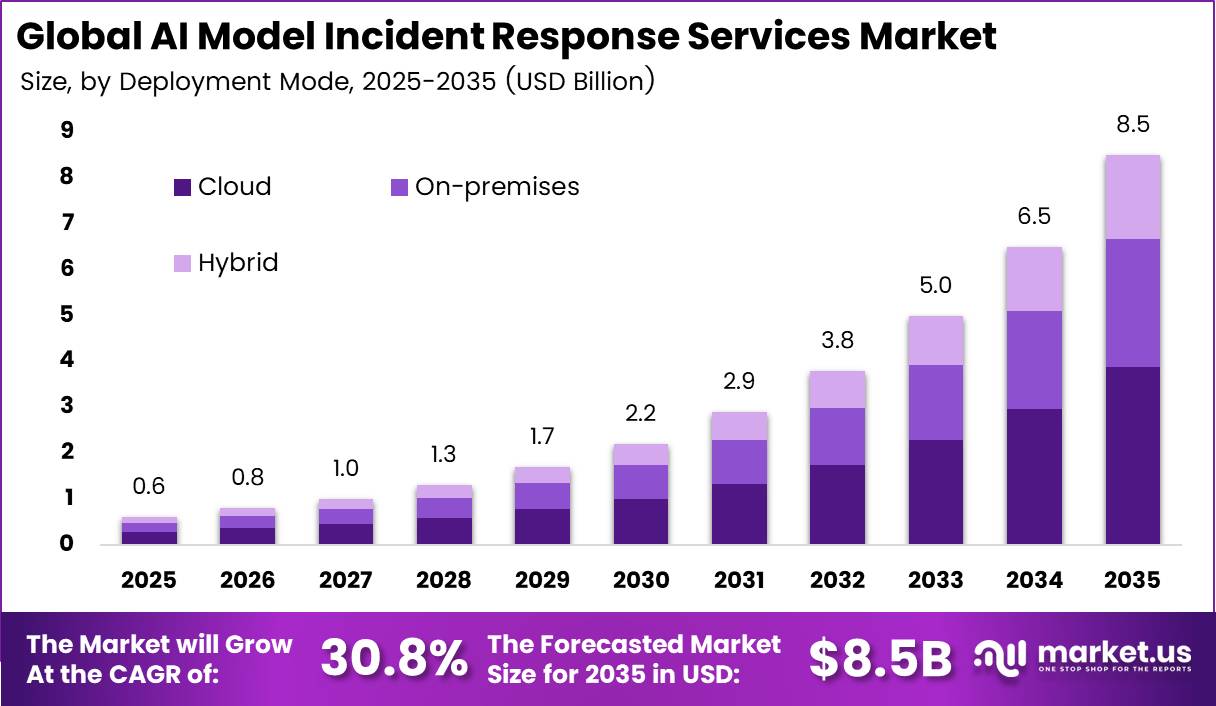
- The global AI Model Incident Response Services Market was valued at USD 0.6 billion in 2025.
- The market is projected to reach about USD 8.5 billion by 2035.
- The market is expected to grow at a compound annual growth rate (CAGR) of 30.8% from 2026 to 2035.
- North America held more than 40.0% of the market in 2025, worth about USD 0.2 billion in revenue.
- Incident Detection and Monitoring is the largest service type, with a 22.0% share.
- Cloud-based deployment leads the deployment segment with a 48.0% share.
- Large enterprises account for 68.0% of the market by organization size.
- Generative AI and large language models are the largest AI technology segment, with a 31.0% share.
- Information Technology and Telecommunications is the largest end-use industry, with a 24.0% share.
- Asia Pacific is the fastest-growing region, and Europe is the second-largest market.
- The report models a scenario in which all drivers and restraints play out at once, giving a CAGR of 32.8%; the report itself describes this as illustrative rather than a validated forecast.
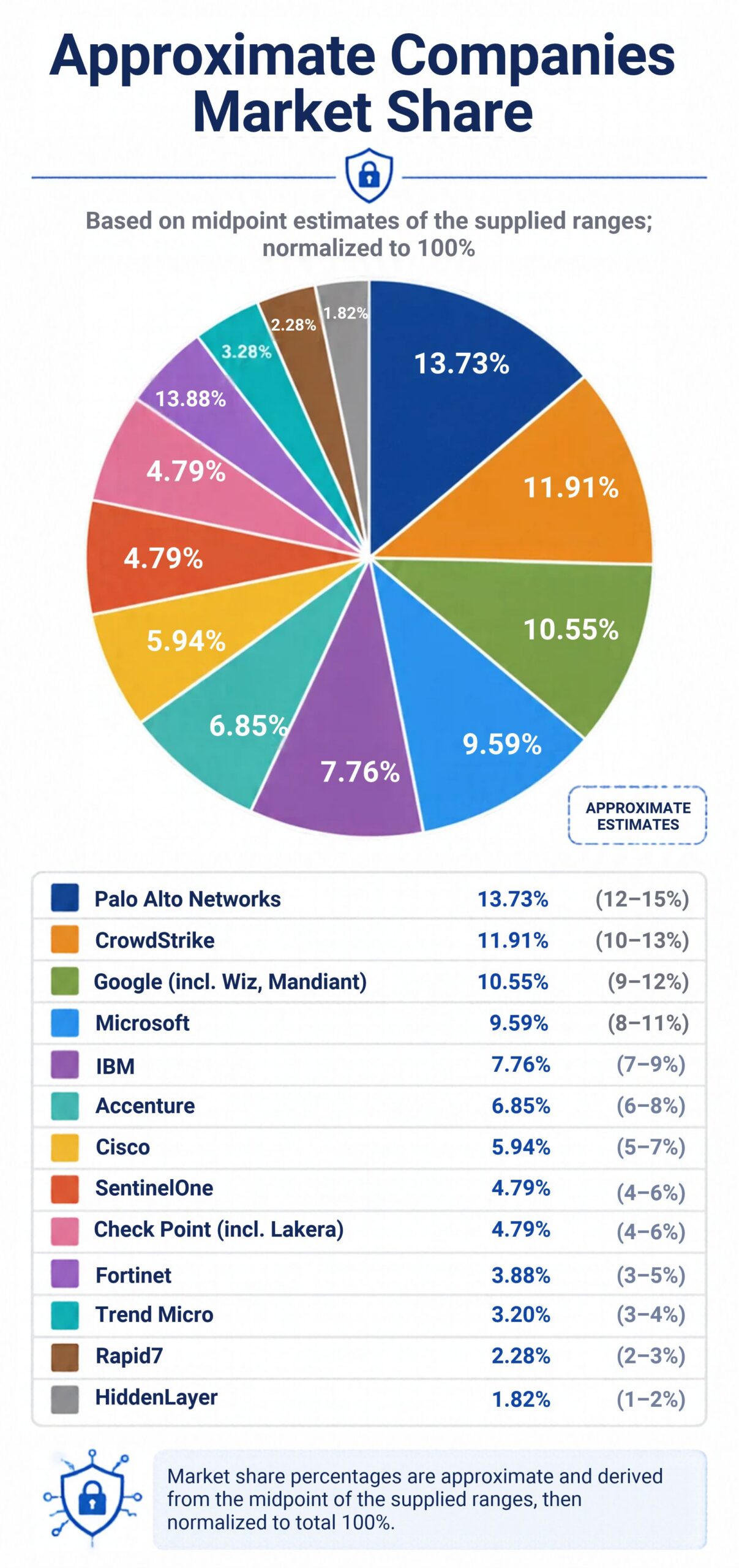
| Company | Est. Share Range | Basis for Positioning |
|---|---|---|
| Palo Alto Networks | ~12–15% | FY2025 revenue of USD 9.2B (up 15%); Next-Generation Security ARR of USD 5.6B; bought Protect AI for about USD 700M to build its Prisma AIRS platform |
| CrowdStrike | ~10–13% | FY2026 revenue of USD 4.81B (up 22%); ending ARR of USD 5.25B; Falcon Flex ARR of USD 1.69B |
| Google (incl. Wiz, Mandiant) | ~9–12% | Bought Wiz for USD 32B in cash, its largest deal ever, to build a unified AI-driven security platform |
| Microsoft | ~8–11% | Sells AI incident response bundled with its global cloud and wider security retainers |
| IBM | ~7–9% | Combines consulting and incident response; publishes the Cost of a Data Breach research |
| Accenture | ~6–8% | Uses its consulting reach to bundle AI incident response into security retainers |
| Cisco | ~5–7% | Bundles AI incident response through its network footprint |
| SentinelOne | ~4–6% | Bought Prompt Security (about USD 180M in cash and stock) for runtime and AI-agent security |
| Check Point (incl. Lakera) | ~4–6% | Bought Lakera; management said in November 2026 that Lakera is growing “phenomenally” from a small base |
| Fortinet | ~3–5% | Strong in mid-market detection and response |
| Trend Micro | ~3–4% | Strong in mid-market detection and response |
| Rapid7 | ~2–3% | Strong in mid-market detection and response |
| HiddenLayer | ~1–2% | Specialist in AI model protection; raised a USD 100M Series B in September 2026 |
| Lakera AI AG | Counted under Check Point | Now owned by Check Point; detection rates above 98% and latency below 50 ms |
These estimates add up to roughly 75–100%. The rest is held by fragmented specialist and regional providers.
Top Companies List
- Palo Alto Networks, Inc.
- CrowdStrike Holdings, Inc.
- Google LLC
- Microsoft Corporation
- IBM Corporation
- Accenture plc
- Cisco Systems, Inc.
- SentinelOne, Inc.
- Check Point Software Technologies Ltd.
- Fortinet, Inc.
- Trend Micro Incorporated
- Rapid7, Inc.
- HiddenLayer, Inc.
- Lakera AI AG
1. Accenture plc
About Accenture plc
Accenture is a global professional services company. It sells AI transformation and cybersecurity services together at very large scale, which is its main advantage. Its security business brings in about $10 billion a year, and it recently bought into industrial and operational technology (OT) security. That gives it the reach to detect, contain, and fix incidents involving enterprise AI models.
Company Overview Table
| Attribute | Company Data |
|---|---|
| Accenture plc | Global professional services, consulting and technology company |
| Ticker Symbol | NYSE: ACN |
| Industry | IT services and consulting |
| Headquarters | Dublin, Ireland |
| Founded | 1989 (as Andersen Consulting) |
| Founders | Formed from the consulting arm of Arthur Andersen |
| Current CEO | Julie Sweet, Chair and CEO (CEO since September 2019) |
| Latest Quarterly Revenue | $18.68 billion, Q4 FY2026, quarter ended August 31, 2026 |
| YoY Revenue Growth | Up 6% in U.S. dollars and 7% in local currency (Q4 FY2025: $17.60 billion) |
| Primary Segments | Geographic markets (Americas, EMEA, Asia Pacific); work types: Consulting and Managed Services |
Financial Details
Q4 FY2026 revenue was $18.68 billion, above Accenture’s guided range of $17.75 to $18.40 billion. Adjusted EPS was $3.29, up 8.6% from $3.03 a year earlier. For the full year, revenue was $74.18 billion, up 5% in local currency. That growth came despite a drag of about 1 percentage point from the federal business, which wound down at the end of Q3. Managed Services bookings hit a record $12.77 billion, a book-to-bill ratio of 1.4. Long multi-year contracts like these are how security operations and incident response are usually sold.
Accenture doesn’t break out revenue for AI incident response. The closest guide is its cybersecurity business, at roughly $10 billion a year. Accenture also had its own security incident in July 2026. A threat actor offered about 35 GB of allegedly stolen source code for sale. Accenture said it had fixed the source and that there was no operational impact.
Strategic Developments
- Accenture spent about $4.18 billion in total on Dragos (a majority stake), runZero and NetRise (both fully owned). The three are combined into a separate industrial security product unit. They were expected to bring about $208 million in annual recurring revenue as of June 2026.
- In February 2026, it bought an AI solution from Avanseus. The tool provides models for prediction, anomaly detection, and optimization, and is a building block for agentic AI in Accenture’s cognitive network platform.
- It is repositioning around AI. AI proficiency is now required for promotion, and it is restructuring at a cost of about $865 million.
- Its FY2027 revenue growth forecast is 3% to 6%, above analyst estimates.
2. CrowdStrike Holdings, Inc.
About CrowdStrike Holdings, Inc.
CrowdStrike runs the cloud-native Falcon platform, which uses one lightweight agent installed on each device. Its moat is the security data that agent collects across devices, identities, and cloud systems, plus the elite Falcon Complete team that does managed detection and response (MDR). In AI incident response, its main product is Falcon Guardian, its AI Detection and Response (AIDR) tool. Guardian detects attacks on AI agents, reconstructs the full chain of events, and contains threats in real time.
Company Overview Table
| Attribute | Company Data |
|---|---|
| CrowdStrike Holdings, Inc. | Cloud-native cybersecurity platform company |
| Ticker Symbol | NASDAQ: CRWD |
| Industry | Cybersecurity software (endpoint, cloud, identity, SIEM and AI security) |
| Headquarters | Austin, Texas, USA |
| Founded | 2011 |
| Founders | George Kurtz, Dmitri Alperovitch, Gregg Marston |
| Current CEO | George Kurtz |
| Latest Quarterly Revenue | $1.58 billion, Q3 FY2027, quarter ended October 31, 2026 |
| YoY Revenue Growth | Up 28%, from $1.23 billion in Q3 FY2026 |
| Primary Segments | Subscription (Falcon platform modules, including Falcon Flex) and professional services (incident response and advisory) |
Financial Details
Q3 FY2027 was CrowdStrike’s strongest quarter so far. Revenue was $1.58 billion, ahead of the $1.53 billion analysts expected, and adjusted EPS was $0.34, ahead of the $0.31 consensus. Subscription revenue grew 29% to $1.50 billion. Ending annual recurring revenue (ARR) grew 27% to $6.26 billion, the fifth straight quarter of faster ARR growth. Net new ARR reached a record $419 million, up 58% year over year.
AI incident response is the fastest-growing area. Falcon Guardian’s ARR more than doubled from the previous quarter. Shortly after the quarter ended, it passed $100 million in ARR, less than a year after the AIDR product launched. Falcon Flex customers, a flexible licensing model that makes it easier to add new modules like Guardian, generated more than $2.79 billion in ARR, double the year before.
For Q4, CrowdStrike expects revenue of $1.638 to $1.644 billion, above the $1.62 billion consensus. Even so, the stock fell 8.37% to $210.23 after the Zscaler announcement.
Strategic Developments
- Zscaler acquisition (announced November 23, 2026): CrowdStrike agreed to buy Zscaler in an all-stock deal worth about $43.9 billion, the largest cybersecurity deal on record. The combined company is expected to start with more than $10 billion in ARR, and CrowdStrike says the deal adds more than $185 billion to its addressable market. Closing is expected in the second half of FY2028.
- Dreadnode acquisition (announced November 3, 2026): Dreadnode continuously tests AI models, applications, and agents for security weaknesses before they are deployed. The product is due in Q4 FY2027, when the deal is also expected to close.
- AI Kill Switch launch: Lets security teams instantly cut AI agents off from the models that power them by directing connected AI gateways to block access. Response can be automated through Charlotte Agentic SOAR (security orchestration, automation, and response).
- Falcon Complete for Falcon Guardian: 24/7 expert-led MDR for AI coding assistants and agents. Analysts investigate malicious prompts and contain confirmed attacks.
- Agentic SOC (security operations center) features: New Agent Insider Threat Detection and AI Ecosystem Detections, which catch LLM API abuse, stolen API keys, and compromised MCP servers and coding assistants. Both arrive in Q4, alongside Multi-Agent Triage and Investigation, which is already generally available.
- Nvidia OpenShell integration (October 2026): Falcon Guardian now works with Nvidia’s OpenShell agent environment.
- AWS partnership: In Q2, CrowdStrike expanded AIDR, added identity protection for AI agents, and released new cloud and SIEM tools with AWS.
- Analyst recognition: Named a Leader in the 2026 Gartner Magic Quadrant for SIEM for Falcon Next-Gen SIEM
3. IBM Corporation
About IBM Corporation
IBM sells hybrid cloud and enterprise AI, with Red Hat, watsonx, HashiCorp Vault, and its X-Force security unit as the core pieces. That gives it control over AI governance, identity, and infrastructure. In AI incident response, X-Force teams provide incident response retainers and forensics. They also run autonomous detection and response and monitor how AI agents use credentials, an area IBM expanded with the AuthMind acquisition.
Company Overview Table
| Attribute | Company Data |
|---|---|
| IBM Corporation | International Business Machines Corporation: hybrid cloud, AI, consulting, and infrastructure company |
| Ticker Symbol | NYSE: IBM |
| Industry | Information technology: software, IT services, consulting and hardware |
| Headquarters | Armonk, New York, USA |
| Founded | 1911 (as Computing-Tabulating-Recording Company; renamed IBM in 1924) |
| Founders | Charles Ranlett Flint (consolidator); Thomas J. Watson Sr. led and renamed the company |
| Current CEO | Arvind Krishna, Chairman and CEO (CEO since April 2020) |
| Latest Quarterly Revenue | $17.10 billion, Q3 2026, reported October 21, 2026 |
| YoY Revenue Growth | Up 4.7% as reported and 6% at constant currency (Q3 2025: $16.33 billion) |
| Primary Segments | Software (including Red Hat, automation and security), Consulting, Infrastructure, Financing |
Financial Details
IBM’s Q3 2026 revenue was $17.10 billion, ahead of the $16.82 billion analysts expected. Operating EPS was $2.95, up 11% year over year. Software, the segment that includes IBM’s security, automation, and HashiCorp products, grew 8% to $7.80 billion (9% at constant currency), and Red Hat grew 11%. Consulting, home to X-Force incident response and managed security, was flat at $5.34 billion (up 2% at constant currency).
Infrastructure brought in $3.70 billion, and free cash flow rose by $700 million to $3.0 billion. IBM doesn’t report AI incident response revenue separately. Its own research shows why demand is rising: the Cost of a Data Breach Report 2026 found AI-driven attacks up 56%, and the X-Force Index logged more than 300,000 ChatGPT credentials exposed by infostealer malware in 2025. IBM still expects full-year 2026 constant-currency revenue growth of 4% to 5%.
Strategic Developments
- AuthMind acquisition (November 12, 2026): IBM bought AuthMind, an identity threat detection company, to monitor how AI agents use credentials after HashiCorp Vault issues them. It fits into IBM’s 5-part agent security model.
- Logiq Consulting acquisition (Q3 2026): A U.K. cybersecurity consultancy that adds Secure by Design expertise for regulated industries.
- OpenAI Daybreak Cyber Partner Program: IBM joined to bring frontier AI models into security operations, helping clients counter attacks that move at machine speed.
- Autonomous Threat Detection and Response: X-Force’s agentic AI security operations service covers the whole threat lifecycle, from hunting to remediation.
- X-Force Threat Intelligence Index 2026 (February 25, 2026): Found a 44% rise in attacks exploiting public-facing applications and a 49% rise in active ransomware groups. Vulnerability exploitation caused 40% of incidents.
- Sarvam partnership: IBM is working with India-based Sarvam on sovereign AI for government and regulated industries, with an emphasis on governance and data control.
4. Palo Alto Networks, Inc.
About Palo Alto Networks, Inc.
Palo Alto Networks sells one AI-driven security platform covering network, cloud, security operations, AI and identity security. Its moat is the large number of customers who have moved most of their security tools onto that platform (it calls this “platformization”), plus the incident response experience of its Unit 42 team. In AI incident response, its key products are Unit 42 IR, Prisma AIRS for runtime AI security, and Koi-based agentic endpoint security.
Company Overview Table
| Attribute | Company Data |
|---|---|
| Palo Alto Networks, Inc. | Global AI cybersecurity platform company |
| Ticker Symbol | NASDAQ: PANW |
| Industry | Cybersecurity: network, cloud, security operations, AI and identity security |
| Headquarters | Santa Clara, California, USA |
| Founded | 2005 |
| Founders | Nir Zuk |
| Current CEO | Nikesh Arora, Chairman and CEO |
| Latest Quarterly Revenue | $3.44 billion, Q1 FY2027, quarter ended October 31, 2026 |
| YoY Revenue Growth | Up 39% (Q1 FY2026: $2.47 billion) |
| Primary Segments | Revenue types: Product, Subscription and Support. Platforms: Network Security (Strata), Cloud Security (Prisma/Cortex Cloud), Security Operations (Cortex), AI Security (Prisma AIRS), Identity (Idira/CyberArk) |
Financial Details
Revenue for Q1 FY2027 grew 39% to $3.44 billion, ahead of the $3.31 billion analysts expected. Non-GAAP EPS was $1.05, 8 cents above estimates. GAAP net income was $482 million ($0.57 per share), up from $334 million a year earlier. Next-generation security ARR, the recurring revenue from Palo Alto’s newer platforms and its key growth metric, rose 66% to $9.73 billion. That was the third quarter in a row of faster growth, after 60% and then 63%.
Remaining performance obligations (contracted revenue not yet recognized) rose 35% to $21 billion. Prisma AIRS is the clearest sign of demand for AI security and response. Just 5 quarters after launch, it has more than 1,000 customers and nearly $170 million in ARR.
Revenue from Idira, the identity business built on CyberArk, grew 23%, helped by demand to secure AI agent identities. Palo Alto signed about 170 new platformization deals in the quarter. Customers on the full platform now make up two-thirds of next-generation security ARR. Palo Alto raised its FY2027 revenue guidance to $14.52 to $14.57 billion, from $14.10 to $14.20 billion, which is 26% to 27% growth.
Strategic Developments
- Applied Compute acquisition (announced November 18, 2026): An all-stock deal worth about $4.5 billion for a platform that customizes and runs open-weight AI models. Palo Alto expects it to add more than $1 billion in ARR by FY2029. Closing is expected in Q3 FY2027, and Applied Compute CEO Yash Patil will become co-chief AI officer.
- Terra Security talks (reported November 2026): Palo Alto is reportedly negotiating to buy this Israeli startup, which uses AI agents for penetration testing, for more than $500 million.
- CyberArk acquisition (February 2026): A $25 billion deal for identity security, now sold as Idira and used to protect AI agent identities and permissions.
- Koi acquisition (completed April 14, 2026): Created a new product category, Agentic Endpoint Security, to protect AI coding agents and other autonomous tools on employee devices. It is integrated with Prisma AIRS.
- Console acquisition (September 2026): An AI-native platform for building agentic workflows and automating operations tasks.
- Other 2026 deals: Palo Alto also bought Portkey and Chronosphere to round out its AI security and observability lineup.
- Unit 42 AI incident response services: These include the Unit 42 AI Security Assessment and Continuous Frontier AI Defense. In August and September 2026, Unit 42 tracked 25 autonomous attacks on at least 19 organizations that used the Cairn AI hacking framework.
- 2026 Unit 42 Global Incident Response Report: The fastest 25% of intrusions reached data exfiltration in 1.2 hours, down from 4.8 hours. Identity weaknesses played a role in nearly 90% of investigations.
5. Google LLC
About Google LLC
Google combines its own AI stack (TPU chips, Gemini models and agent platforms) with security assets it bought: Mandiant’s frontline incident response and threat intelligence, and Wiz’s multicloud protection. Its moat is threat data at a scale few can match. In AI incident response, it sells Mandiant IR and an “agentic SOC” (security operations center) built on Gemini in Security Operations.
Company Overview Table
| Attribute | Company Data |
|---|---|
| Google LLC | Wholly owned subsidiary of Alphabet Inc.: search, cloud, AI and security |
| Ticker Symbol | NASDAQ: GOOGL / GOOG (parent Alphabet Inc.) |
| Industry | Internet services, cloud computing, artificial intelligence and cybersecurity |
| Headquarters | Mountain View, California, USA |
| Founded | September 4, 1998 |
| Founders | Larry Page and Sergey Brin |
| Current CEO | Sundar Pichai (CEO of Google and Alphabet); Thomas Kurian (CEO of Google Cloud) |
| Latest Quarterly Revenue | $127.6 billion (Alphabet), Q3 2026, quarter ended September 30, 2026; Google Cloud: $30.71 billion |
| YoY Revenue Growth | Alphabet up 25%; Google Cloud up 103% (from $15.16 billion) |
| Primary Segments | Google Services, Google Cloud (including Mandiant, Wiz and Google Security Operations), Other Bets |
Financial Details
Alphabet’s Q3 2026 revenue rose 25% to $127.6 billion, its 13th straight quarter of double-digit growth. Google Cloud, the segment that holds Mandiant, Wiz, and Google Security Operations, more than doubled revenue to $30.71 billion, up 103%. Cloud operating income more than tripled to $11.12 billion from $3.59 billion, and operating margin rose from 23.7% to 36.2%.
Cloud CEO Thomas Kurian said the growing risk of cyber threats is driving strong demand for Google’s AI-powered security platform. He added that Gemini and Google Threat Intelligence analyze millions of outside events a day with 98% accuracy, and that Gemini Flash cyber models patch code 2.6 times more reliably than other models.
An IDC study found that teams using Gemini in Security Operations identify threats 98% faster and have 50% fewer serious incidents per month. They also earn a 319% three-year return and gain $5.4 million in average annual benefits. Investors were less impressed: Alphabet’s market value fell by $482 billion after the report, a 12.64% drop, on worries about the cost of its AI spending. Net income fell to $26.17 billion from $34.98 billion.
Strategic Developments
- Wiz acquisition (closed March 11, 2026): A $32 billion all-cash deal, the largest in Alphabet’s history. SEC filings record the purchase price as $29.467 billion. Wiz keeps its brand and secures AI applications and workloads while they run, across AWS, Azure, GCP and OCI.
- Security investment to date: Counting Mandiant ($5.4 billion, 2022) and Siemplify, Google has committed more than $37 billion to security acquisitions.
- Agentic SOC expansion: Gemini in Security Operations now includes specialized agents for triage and investigation, threat hunting, detection engineering and third-party context.
- Gartner Magic Quadrant for SIEM (November 23, 2026): Google was named a Leader.
- Anthropic Enterprise Frontier Safeguards: Built with Anthropic, this adds automated misuse detection for Claude models running in Google Cloud’s Model Garden.
- Project Chrysalis (October 22, 2026): A research design for AI agents that fix live incidents within strict security limits, using Model Armor, Cloud KMS and human approval. In simulations, outage mitigation fell from 15 to 45 minutes to 1.8 seconds. It is not yet a product.
- First fully autonomous cyberattack observed (November 2026): Google reported AI software that found bugs, wrote exploits and attacked targets with no human help. Zero-day exploits rose from 8 per month in 2025 to 11 per month in 2026, peaking at 22 in August.
6. Microsoft Corporation
About Microsoft Corporation
Microsoft combines Azure, Foundry, Copilot and its Entra identity platform with a full security stack: Defender, Sentinel, Purview and the new Perception agent layer. Its moat is control of the identity, endpoint and cloud systems most enterprise AI agents run on. In AI incident response, Defender’s integrated security operations center (ISOC) detects attacks on agents, contains them and helps teams recover.
Company Overview Table
| Attribute | Company Data |
|---|---|
| Microsoft Corporation | Global technology company: cloud, AI, productivity software, security and devices |
| Ticker Symbol | NASDAQ: MSFT |
| Industry | Software, cloud computing, artificial intelligence and cybersecurity |
| Headquarters | Redmond, Washington, USA |
| Founded | April 4, 1975 |
| Founders | Bill Gates and Paul Allen |
| Current CEO | Satya Nadella, Chairman and CEO |
| Latest Quarterly Revenue | $92.3 billion ($92,279 million), Q1 FY2027, quarter ended September 30, 2026 |
| YoY Revenue Growth | Up 19% (Q1 FY2026: $77,673 million) |
| Primary Segments | Agents and Infra; Devices and Consumer (new 2-segment structure from FY2027, replacing the earlier 3 segments) |
Financial Details
Revenue for Q1 FY2027 rose 19% to $92.3 billion, 1.88% above estimates. Operating income grew 21% to $45.9 billion, and diluted EPS rose 32% to $4.92. Microsoft Cloud revenue, which includes the Azure-based security services, grew 30% to $63.9 billion. Azure grew 48% to $33.2 billion, up from 42% the previous quarter, despite delays in capacity from third-party suppliers.
Revenue from Foundry, the platform where customers build AI agents, more than tripled. Those agents need posture management, runtime protection, and incident response. Microsoft doesn’t report security revenue separately. Adoption numbers show the demand: customers have registered more than 50 million agents in Agent 365 since it launched in May 2026. Spending is rising too. Capital spending reached $45.2 billion in the quarter, and free cash flow fell 27%.
Strategic Developments
- Microsoft Perception (GA, Ignite, November 17, 2026): A layer of specialized security agents, called red, blue and green teams, run through playbooks. They draw signals from Defender, Entra, Intune, Purview, Sentinel, Windows, the browser and Azure. New playbooks include the Posture Prioritization Agent (GA) and the Risk Reduction Agent (preview).
- Integrated SOC in Defender: Gives full SIEM features to eligible Defender Suite, Microsoft 365 E5 and E7 customers. It includes 90 days of built-in data retention and more than 500 Sentinel connectors, including OpenAI audit logs and CrowdStrike and Wiz feeds.
- Runtime protection for local AI agents (GA on Windows): Defender can block malicious instructions before agents like Claude Code, GitHub Copilot CLI, OpenClaw and ChatGPT Desktop act on them. Agent discovery grew by 35 local agent types, to 60 in total.
- Cross-platform agent posture (preview): Defender now assesses the security of agents built on Amazon Bedrock, Google Gemini, Vertex AI and Anthropic Claude, alongside Copilot Studio and Foundry agents.
- New threat detections: Defender now detects device-code phishing against developers’ GitHub accounts and can disable the account and revoke its sessions automatically. It also blocks ClickFix attacks (tricking users into pasting malicious commands), which made up 12.8% of intrusions Microsoft saw this year.
- MAI Cyber 2 Flash (preview, codename MDASH): Microsoft’s own security AI model, with 12 billion active parameters. It’s offered first to select customers.
- Agent 365 dynamic agent risk (preview): Combines identity, data, endpoint, cloud and network signals into a single risk level for each agent. Partners Check Point, Cyera, Darktrace and Zenity feed their runtime signals in through Sentinel.
- Vulnerability shielding (preview): An AI feature, on by default, that applies temporary controls to exposed systems before and during an attack while teams patch.
- Analyst recognition: Named a Leader in the 2026 Gartner Magic Quadrant for AI Agent Management Platforms.
7. Cisco Systems, Inc.
About Cisco Systems, Inc.
Cisco combines its dominant networking footprint with Splunk’s security monitoring (SIEM) and observability platform, which gives it visibility into network traffic that few rivals can match. In AI incident response, it offers AI Defense for red-teaming and protecting AI agents and models while they run. Talos Incident Response provides frontline breach response and forensics, and Splunk Enterprise Security supports AI-driven security operations.
Company Overview Table
| Attribute | Company Data |
|---|---|
| Cisco Systems, Inc. | Global networking, security, observability, and AI infrastructure company |
| Ticker Symbol | NASDAQ: CSCO |
| Industry | Networking hardware, cybersecurity, observability, and collaboration software |
| Headquarters | San Jose, California, USA |
| Founded | December 1984 |
| Founders | Leonard Bosack and Sandy Lerner |
| Current CEO | Chuck Robbins, Chair and CEO |
| Latest Quarterly Revenue | $18.517 billion, Q1 FY2027, quarter ended October 24, 2026 |
| YoY Revenue Growth | Up 24% (Q1 FY2026: $14.883 billion) |
| Primary Segments | Product categories: Networking, Security, Collaboration, Observability. Geographic segments: Americas, EMEA, APJC |
Financial Details
Q1 FY2027 was Cisco’s fastest-growing quarter in more than 15 years. Revenue hit a record $18.5 billion, up 24%, and non-GAAP EPS rose 40% to $1.40, beating the $1.33 consensus. Security, the category that holds AI Defense, Splunk, and identity and agentic security, grew 7% to $2.120 billion from $1.980 billion, slightly above Cisco’s own expectations. Security product orders excluding Splunk grew about 15%, the best rate in roughly 3 years.
Firewall orders grew more than 30% for the 3rd straight quarter, and AI Defense now protects more than 2 trillion tokens a month. Remaining performance obligations (contracted revenue not yet recognized) rose 8% to $46.2 billion, and operating cash flow rose 36% to $4.4 billion. Cisco raised its FY2027 revenue guidance to $74.8 to $75.8 billion.
Strategic Developments
- WideField Security acquisition (closed Q1 FY2027): Cisco bought this private security company to strengthen identity and agentic security.
- Claude Mythos in AI Defense (November 10, 2026): Cisco is adding Anthropic’s frontier cybersecurity model to its AI red-teaming framework, with audit trails for every test. AI Defense, launched in January 2025, has helped hundreds of customers find serious flaws in AI models and agents before they go live.
- Splunk Agent Observability and Cisco IQ: Give teams oversight of AI agents, including tracking how many tokens they use. The Cisco Data Fabric links live threat detections with network exposure data.
- Splunk advancements (September 15, 2026): These include Cisco AI POD for Splunk with NVIDIA for on-premises AI, a Tokenomics feature that tracks AI spending, and a multi-year agreement with AWS to co-develop defenses against AI-driven attacks.
- Secure AI Factory expansion (August 2026): Cisco added Supermicro rack-scale systems to its NVIDIA partnership.
- Talos IR AI threat findings (Q3 2026): Talos IR handled cases where AI tools were misused, including an insider who installed Claude Code and Copilot CLI and an attack that stole Claude Code credentials. Ransomware made up 27% of engagements, up from at most 20% in the previous 4 quarters.
- Security customer growth: More than 6,400 net new customers have bought Secure Access, XDR, Hypershield or AI Defense since those products launched.
8. SentinelOne, Inc.
About SentinelOne, Inc.
SentinelOne sells the AI-native Singularity Platform, which brings together endpoint, cloud, AI SIEM, and data security. Its moat is its sensors installed across customer devices, together with Purple AI’s autonomous reasoning. In AI incident response, its Autonomous SOC (security operations center) runs agentic investigations and responses. Prompt Security and AI security posture tools protect AI models, apps, and agents.
Company Overview Table
| Attribute | Company Data |
|---|---|
| SentinelOne, Inc. | AI-native cybersecurity platform company |
| Ticker Symbol | NYSE: S |
| Industry | Cybersecurity software: endpoint, cloud, AI SIEM, data and AI security |
| Headquarters | Mountain View, California, USA |
| Founded | 2013 |
| Founders | Tomer Weingarten, Almog Cohen and Ehud Shamir |
| Current CEO | Tomer Weingarten, Co-founder, Chairman and CEO |
| Latest Quarterly Revenue | $291.981 million (about $292 million), Q2 FY2027, quarter ended July 31, 2026 |
| YoY Revenue Growth | Up 21% (Q2 FY2026: $242.183 million) |
| Primary Segments | Single operating segment. Platform areas: Endpoint (EDR/XDR), Cloud Security, AI SIEM and Data (Observo AI), AI Security (Purple AI, Prompt Security), Services |
Financial Details
SentinelOne’s Q2 FY2027 revenue grew 21% to $292 million, above the top of its guidance range. ARR grew 22% to $1.218 billion, and net new ARR was $56 million, a record for a second quarter and up 4% year over year. On a non-GAAP basis, it set profitability records: operating and net margins both reached 10%, and EPS doubled to $0.08.
On a GAAP basis, it still lost money, with a net loss of $93.4 million ($0.27 per share). Gross margin was about 73%, and cash and investments totaled $813 million.
SentinelOne doesn’t report AI incident response revenue separately. The strongest signal is Purple AI, its agentic SOC product, which was included in more than 50% of licenses sold in Q4 FY2026. Management said adoption of its AI security, data, and cloud products is speeding up, and it raised full-year revenue and operating income guidance. Q3 FY2027 results come out December 3, 2026.
Strategic Developments
- OneCon 2026 launches: SentinelOne launched its Singularity Autonomous SOC and opened early access to Singularity Agentic Detection and Response. Analysts at Rosenblatt ($28 target), Susquehanna ($28) and Jefferies ($26) pointed to strong customer interest.
- Purple AI Agentic Investigation (June 17, 2026): Opened to all customers. It starts investigations on its own, with no setup needed, and records each step in a reviewable audit trail. SentinelOne also introduced Singularity Credits, a single unit of payment for AI work across the platform.
- RSAC 2026 AI security offerings (March 23, 2026): New agent security and agentic investigation features, plus Observo AI data pipelines built into Singularity AI SIEM.
- Anthropic Claude Mythos 5.1: SentinelOne is adding the frontier cybersecurity model to Wayfinder Frontier, its threat-hunting and response service.
- Strategic partnerships: SentinelOne signed a multi-year deal with Google Cloud to co-develop AI security and response. It also partnered with LevelBlue and with Moro Hub in the UAE, which offers its AI security platform as an in-country option or a managed service.
- DSPM expansion: New data security posture management (DSPM) features secure AI systems from data ingestion through runtime.
- $400 million credit facility: SentinelOne took out a secured revolving credit line, giving it more room for strategic moves.
- Recognition and M&A interest: Frost & Sullivan named SentinelOne a Visionary Leader in its 2026 AI SOC Radar (November 16, 2026). After CrowdStrike announced its $43.9 billion Zscaler deal, Citizens raised its price target to $28 and called SentinelOne an attractive acquisition target. The stock rose about 7.5%.
9. Fortinet, Inc.
About Fortinet, Inc.
Fortinet merges networking and security on one operating system, FortiOS, and its own FortiASIC chips. That combination gives it an edge in performance and cost of ownership. In AI incident response, it secures AI models and agents through FortiAIGate guardrails, Virtue AI’s runtime protection, and the FortiGuard Inline AI Security service. Agentic FortiAI powers its security operations (SOC) tools for incident investigation and response.
Company Overview Table
| Attribute | Company Data |
|---|---|
| Fortinet, Inc. | Global cybersecurity company combining networking and security |
| Ticker Symbol | NASDAQ: FTNT |
| Industry | Cybersecurity: network security, SASE, security operations and AI security |
| Headquarters | Sunnyvale, California, USA |
| Founded | 2000 |
| Founders | Ken Xie and Michael Xie |
| Current CEO | Ken Xie, Founder, Chairman and CEO |
| Latest Quarterly Revenue | $2.08 billion, Q3 2026, quarter ended September 30, 2026 |
| YoY Revenue Growth | Up 20% (20.5% unrounded) |
| Primary Segments | Revenue types: Product and Service. Solution areas: Secure Networking (FortiGate), Unified SASE, Security Operations (FortiSIEM, FortiSOAR, FortiSOC), AI Security (FortiAIGate, Virtue AI) |
Financial Details
Fortinet’s Q3 2026 revenue grew 20% to $2.08 billion, ahead of the $2.06 billion consensus. Non-GAAP EPS was $0.91, against $0.86 expected. Product revenue grew 37% to $765 million, even with longer lead times for some components. Billings grew 29% to $2.34 billion, and SASE firewall billings grew 31%. The value of deals over $1 million rose 51%, and free cash flow rose 52% to $864.8 million, a 41.6% margin.
Fortinet ended the quarter with $4.80 billion in cash and short-term investments. Fortinet doesn’t report AI security or incident response revenue separately. Its newest AI products, the FortiGuard Inline AI Security Service and FortiAIGate, came out around the end of the quarter, so their revenue impact hasn’t shown up yet.
Fortinet raised its 2026 guidance for the 3rd time this year: revenue of $8.125 to $8.215 billion (20% growth at the midpoint) and billings of $9.568 to $9.718 billion. It lowered service revenue guidance to $5.150 to $5.170 billion. Q4 guidance is revenue of $2.155 to $2.245 billion. Analysts were split: Stifel cut its price target to $140 from $175.
Strategic Developments
- Virtue AI acquisition (August 17, 2026): Adds runtime protection for AI, automated validation, agentic red-teaming, agent governance and real-time guardrails, all built around Virtue AI’s Guardian Agent. Terms weren’t disclosed, and Fortinet called the price immaterial.
- FortiGuard Inline AI Security Service (October 26, 2026): A cloud-delivered service that adds AI inspection and guardrails to existing FortiGate firewalls. It checks prompts, LLM traffic, and traffic to Model Context Protocol (MCP) tools in real time.
- FortiAIGate on the Equinix Distributed AI Hub (November 5, 2026): Brings low-latency guardrails for LLM and MCP traffic, per-token cost tracking, visibility into unapproved “shadow” AI tools, and inspection accelerated by NVIDIA GPUs.
- FortiSOC preview and agentic FortiAI (Accelerate 2026, March 10, 2026): A unified cloud SOC combining FortiAnalyzer, FortiSIEM, FortiSOAR and FortiTIP. It adds AI agents that handle alert triage, investigation and threat hunting, with MCP support.
- FortiSIEM 7.5 (January 22, 2026): Adds FortiAI-Assist agents that run full incident investigations, covering evidence, attack chain, impact assessment and recommended actions.
- Ecosystem partnerships: NVIDIA picked Fortinet as a top partner for its OpenShell AI security reference design. Fortinet is also working with Oracle on OCI Enterprise AI with FortiAIGate, and Microsoft added it to its Sovereign Partner Ecosystem for sovereign AI security.
- Stock reaction to the CrowdStrike–Zscaler deal: Fortinet shares rose 5.2% after CrowdStrike announced its $43.9 billion Zscaler acquisition, and analysts named Fortinet a possible acquirer of other security companies.
10. Check Point Software Technologies Ltd.
About Check Point Software Technologies Ltd.
Check Point builds its security on a prevention-first approach, using its Infinity Platform, ThreatCloud AI threat intelligence, and the research team Check Point Research (CPR). Its moat is the Lakera-built database of adversarial prompts behind its AI security products. In AI incident response, Check Point AI Security automatically blocks or shuts down misbehaving agents, steers agents back on task, and protects AI models while they run.
Company Overview Table
| Attribute | Company Data |
|---|---|
| Check Point Software Technologies Ltd. | Global cybersecurity company focused on preventing threats |
| Ticker Symbol | NASDAQ: CHKP |
| Industry | Cybersecurity: network, cloud, workspace, exposure management and AI security |
| Headquarters | Tel Aviv, Israel (U.S. headquarters in Redwood City, California) |
| Founded | 1993 |
| Founders | Gil Shwed, Marius Nacht and Shlomo Kramer |
| Current CEO | Nadav Zafrir (Gil Shwed is Executive Chairman) |
| Latest Quarterly Revenue | $669.8 million (about $670 million), Q3 2026, quarter ended September 30, 2026 |
| YoY Revenue Growth | Down 1% (1.1% unrounded); Q3 2025: $677.5 million |
| Primary Segments | Revenue types: Products and Licenses; Security Subscriptions; Software Updates, Maintenance and Services. Platform areas: Network (Quantum), Cloud (CloudGuard), Workspace (Harmony), Exposure Management (CTEM), AI Security (Lakera) |
Financial Details
Check Point’s Q3 2026 revenue was $669.8 million, down 1.1% and just below the $672.06 million consensus, though at the midpoint of its own $655 to $685 million guidance. Non-GAAP EPS was $2.49, $0.01 above estimates. Product and license revenue fell to $105.5 million from $130.4 million, because fewer customers replaced firewall appliances.
Security subscriptions, the line that includes AI security, grew 11% to $338.6 million and now make up 51% of total revenue. CEO Nadav Zafrir said the growth came from Email, CTEM (continuous threat exposure management) and AI Security. Remaining performance obligations (contracted revenue not yet recognized) rose 5% to $2.5 billion.
Management thinks this quarter is the low point. It guided Q4 revenue to $720 to $770 million and full-year 2026 revenue to $2,732 to $2,782 million. Check Point doesn’t report AI security revenue separately, but investor relations said Lakera products are growing “phenomenally” from a small base.
Strategic Developments
- Lakera acquisition (announced September 16, 2025; expected to close Q4 2025): Lakera provides runtime protection and red-teaming for LLMs, retrieval-augmented generation (RAG) and MCP data flows. It now anchors Check Point’s Global Center of Excellence for AI Security.
- Gauntlet adversarial prompt database: Lakera’s game, formerly called Gandalf, has 1.2 to 1.3 million regular users. Their attack prompts feed a large database that trains Check Point’s AI defenses.
- AI Network Firewall and AI Defense Plane: A new firewall with a matching AI Defense Plane subscription, now Check Point’s highest-priced tier.
- Agentic steering and AI kill switch (November 19, 2026): Check Point AI Security automatically blocks an agent’s actions or shuts it down. In tests, offering agents a safer alternative stopped attacks about as well as hard blocking, without disrupting their work.
- AI Agent Security lifecycle: Covers the full life of an agent, from discovery to runtime. It finds unknown agents, flags risky tools, permissions and MCP servers, and catches prompt injection, data exposure and unauthorized actions.
- Check Point Research AI findings (Oct–Nov 2026): CPR found a bypass of ChatGPT Lockdown Mode and “Haiou,” a persistent jailbreak bundle for OpenAI Codex. It also analyzed a test upload by Alibaba’s Qwen model to a server in Beijing and an infostealer called Aokigahara that targets AI developers.
- 2026 Cloud Security Report: 29% of organizations are moving AI workloads to their own data centers. Only 20% say their application security protects AI agents, and only 26% have the architecture to enforce their AI security strategy.
- M&A stance: Investor relations put the chance of a deal under $1 billion at 95% and a deal above $1 billion at 5%.
11. Trend Micro Incorporated
About Trend Micro Incorporated
Trend Micro sells enterprise security through TrendAI Vision One, a platform that combines cyber risk exposure management with security operations. Its moat is the Zero Day Initiative (ZDI), the world’s largest vendor-agnostic bug bounty program. In AI incident response, it offers AI red-teaming, agentic exploit remediation with its AESIR engine, investigation of AI agent activity, and managed detection and response (MDR) and incident response (IR) services.
Company Overview Table
| Attribute | Company Data |
|---|---|
| Trend Micro Incorporated | Global cybersecurity company; enterprise business branded TrendAI, consumer business branded TrendLife |
| Ticker Symbol | TSE: 4704 (OTC: TMICF / TMICY) |
| Industry | Cybersecurity software: enterprise platform, cloud, endpoint, network and AI security |
| Headquarters | Tokyo, Japan |
| Founded | 1988 (Los Angeles, California) |
| Founders | Steve Chang, Jenny Chang and Eva Chen |
| Current CEO | Eva Chen, Co-founder and CEO |
| Latest Quarterly Revenue | ¥75.3 billion (¥75,317 million; about $472.8 million non-GAAP), Q3 2026, quarter ended September 30, 2026 |
| YoY Revenue Growth | Up 9% in yen (Q3 2025: ¥68,844 million) |
| Primary Segments | TrendAI (enterprise: Vision One SaaS, Sovereign and Services) and TrendLife (consumer: Digital Life Protection). Regions: Japan, Americas, Europe, AMEA |
Financial Details
Trend Micro’s Q3 2026 net sales were a record ¥75.3 billion, up 9%. Its operating margin was 18%, and net income came to ¥8.6 billion. Company-wide ARR reached $1.76 billion. TrendAI, the enterprise business that sells AI security and incident response, grew net sales 12%, and enterprise ARR rose 8% to $1.292 billion.
Comparable net new enterprise ARR improved to $31 million from $21 million in Q2. Vision One SaaS ARR, the fastest-growing part, rose 46% to $564 million, and net revenue retention was 119%. Services ARR, which includes MDR and IR, grew 25% to $88 million, with 13% more services customers.
Sovereign ARR grew 15%. More than 420 strategic managed service providers (MSPs) now sell Vision One, and ARR from these MSPs grew 155%. Trend Micro kept its full-year 2026 forecast: net sales of ¥301.5 billion, operating income of ¥44.4 billion and net income of ¥30.7 billion.
Strategic Developments
- Autonomous Vulnerability Discovery and Remediation (private preview, September 29, 2026): Powered by Trend Micro’s AESIR engine, which runs on several AI models, mostly from Anthropic. It finds, validates and verifies fixes for vulnerabilities, including zero-days, and draws on ZDI research. AESIR ranked first on the CyberGym benchmark with a 97% success score.
- NVIDIA Agent Safety Platform support: Pairs threat detection on NVIDIA BlueField chips with Trend Micro’s network security and ZDI threat intelligence to protect enterprise AI agents.
- Anthropic Claude Code and Cowork integration: Security teams can now investigate prompts, responses and tool calls from Claude Code and Cowork sessions inside Vision One.
- Agentic red-teaming in AI Scanner (July 21, 2026): An AI model generates attack prompts and adapts them based on how the target AI application responds.
- AWS Marketplace milestone: TrendAI became the first AI security partner based in Asia-Pacific and Japan to pass $1 billion in AWS Marketplace sales.
- Shift to paid incident response (effective December 2, 2026): Specialist threat cases will no longer be handled for free by technical support. Customers will be directed to paid MDR and IR services or to Vision One’s self-service tools.
- Share buyback (November 13 to December 23, 2026): Up to 917,600 shares (0.70% of shares outstanding), for up to ¥5,000 million.
- Buyout background: In 2024, Trend Micro explored a sale after private equity firms showed interest, when its market value was about ¥950 billion ($6.5 billion). No deal was announced.
12. Rapid7, Inc.
About Rapid7, Inc.
Rapid7 sells AI-powered managed security operations through its Command Platform, which covers exposure management, next-gen SIEM and XDR. Its moat is the AI it has trained on years of detection and response data from its own 24/7 managed detection and response (MDR) operations. In AI incident response, it offers Incident Command, an agentic security operations center (SOC) built on its Kenzo acquisition, plus MDR and incident response retainers.
Company Overview Table
| Attribute | Company Data |
|---|---|
| Rapid7, Inc. | AI-powered managed cybersecurity operations company |
| Ticker Symbol | NASDAQ: RPD |
| Industry | Cybersecurity: detection and response (SIEM, XDR, MDR), exposure management and GRC |
| Headquarters | Boston, Massachusetts, USA |
| Founded | 2000 |
| Founders | Alan Matthews, Tas Giakouminakis and Chad Loder |
| Current CEO | Wael Mohamed (since June 1, 2026); Corey Thomas is Executive Chairman |
| Latest Quarterly Revenue | $212.4 million, Q3 2026, quarter ended September 30, 2026 |
| YoY Revenue Growth | Down 2.5% |
| Primary Segments | Single operating segment. Revenue types: Product Subscriptions ($206 million) and Professional Services. Solution areas: Detection and Response (Incident Command, MDR), Exposure Management, Cyber GRC |
Financial Details
Rapid7’s Q3 2026 revenue fell 2.5% to $212.4 million, though it beat the $209 million consensus by 1.6%. Product subscriptions brought in $206 million. ARR, its core recurring revenue metric, fell 2.2% to $819.7 million. More than 80% of that ARR comes from Detection and Response and Exposure Management, the businesses that sell MDR and incident response.
Profitability beat expectations: adjusted EBITDA was $52.64 million, a 24.8% margin and 25.7% above estimates. Non-GAAP operating income was $46.2 million, GAAP operating income $9.0 million and free cash flow $26.5 million. Net income fell 64% to $3.51 million ($0.052 per share). The stock still jumped 17% to $17.65 on the results.
Rapid7 guided Q4 revenue to $208 to $210 million, about 4% lower year over year, and full-year 2026 revenue to $841 to $843 million, about 2% lower. Whether it returns to growth depends on its AI-first SOC strategy and the Kenzo integration stabilizing ARR. It is targeting a non-GAAP operating margin of about 20%.
Strategic Developments
- Kenzo Security acquisition (March 26, 2026): An agentic AI security platform that runs investigations on its own across endpoint, identity, cloud, SaaS and third-party data. Rapid7 doesn’t expect a material impact on revenue, ARR or free cash flow.
- Leadership change (June 1, 2026): Wael Mohamed, co-founder of Third Brigade and former President and COO of Trend Micro, became CEO. Corey Thomas moved to Executive Chairman. Rafe Brown joined as CFO, Allan Peters as Chief Commercial Officer and Dan Deklich as Chief Product and Technology Officer.
- Black Hat USA 2026 launches (July 28, 2026): Cyber GRC became generally available, making Rapid7 the first major security operations platform to combine governance, risk and compliance with live security data. It also showed Preemptive MDR Alerts and an Agentic SOC.
- Rapid7 Intelligence (October 2, 2026): A unified threat intelligence engine built on Rapid7 Labs research. It notes that AI has shrunk the time to exploit a vulnerability to minutes, and that 8,539 critical vulnerabilities were tracked in Q2 alone.
- Incident Command and agentic MDR: Its next-gen SIEM uses agentic workflows based on Rapid7’s own SOC playbooks. The AI closes benign alerts with 99.93% accuracy and saves more than 200 SOC hours a week.
- MDR for Enterprise: A fully managed, customizable detection and response service for large, distributed organizations.
- Hiring and insider activity (November 2026): Rapid7 granted inducement awards (stock grants for new hires) on November 18, 2026. Director Julian Waits filed to sell 28,924 shares worth about $427,786.
13. HiddenLayer, Inc.
About HiddenLayer, Inc.
HiddenLayer is a specialist in securing AI itself, covering agentic, generative, and predictive AI systems. Its moat comes from adversarial machine learning research by a founding team that uncovered the first AI-specific malware. In AI incident response, it offers detection and response for AI systems while they run, threat hunting on agent activity, red-team attack simulation, and supply-chain scanning that catches backdoored models.
Company Overview Table
| Attribute | Company Data |
|---|---|
| HiddenLayer, Inc. | Private, venture-backed AI security company |
| Ticker Symbol | Not publicly traded (private) |
| Industry | Cybersecurity: AI and machine learning security, including agentic runtime protection and AI detection and response |
| Headquarters | Austin, Texas, USA |
| Founded | 2022 |
| Founders | Chris Sestito, Tanner Burns and James Ballard |
| Current CEO | Chris Sestito, Co-founder and CEO |
| Latest Quarterly Revenue | Not disclosed. ARR is in the “tens of millions” of dollars (as of September 2026). Third-party estimate: about $34.9 million a year |
| YoY Revenue Growth | ARR up more than 10x year over year, according to the company (September 2026) |
| Primary Segments | AI Security Platform with 4 modules: AI Discovery, AI Supply Chain Security, AI Attack Simulation, and AI Runtime Security (including Agentic Runtime Security and Agent Harness Security) |
Financial Details
HiddenLayer doesn’t publish quarterly results. The most reliable signal is its $100 million Series B, announced September 2, 2026. CEO Chris Sestito said ARR grew more than 10x over the past year to the “tens of millions” of dollars, and that more than 90% of that growth came from new customers signed during the year.
The company added more than 50 new platform customers. Third-party estimates vary widely: Growjo puts annual revenue at about $34.9 million, while other trackers say anywhere from about $10 million to $45 million. Total funding is now about $155 million, including a $50 million Series A in September 2023.
Headcount was reported at 128 to 164 employees in 2025. HiddenLayer’s own research points to strong demand: 96% of organizations consider AI critical to their core operations, but nearly one-third can’t say for sure whether they’ve had an AI-related breach. More than 1 in 8 reported AI breaches now involve autonomous agents.
Strategic Developments
- $100 million Series B (September 2, 2026): Led by Delta-v Capital, with Ten Eleven Ventures, Morgan Stanley, Microsoft’s M12 venture fund, and Booz Allen Ventures participating. The money will go mainly to sales and distribution, plus engineering and research on Agentic Runtime Security and Agent Harness Security.
- Erie Strategic Ventures investment (November 12, 2026): The venture arm of Erie Insurance invested in HiddenLayer to support security for enterprise AI infrastructure.
- Agent Harness Security (August 3, 2026): Runtime protection for AI coding agents. It plugs into each agent’s built-in hooks to stop prompt injection, leaked secrets and unsafe commands.
- Databricks Unity AI Gateway ecosystem (June 17, 2026): HiddenLayer is building on its Unity Catalog integration to bring model security, AI threat intelligence and detection and response into AI workflows on Databricks.
- Agentic Runtime Security (March 23, 2026): Adds 3 new capabilities: Agentic Runtime Visibility, Agentic Investigation and Threat Hunting, and Agentic Detection and Enforcement.
- 2026 AI Threat Landscape Report (March 18, 2026): Tracks the rise of agentic AI and the growing attack surface of autonomous systems.
- Industry presence (August 2026): HiddenLayer exhibited at Black Hat USA 2026 and sponsored the cybersecurity track at Ai4 2026. CTO Jacob Rideout gave a talk there on the 5 biggest risks of AI coding tools.
14. Lakera AI AG
About Lakera AI AG
Lakera is a Zurich-based company that builds AI-native security, real-time guardrails and red-teaming for LLMs, generative AI and agents. Its moat is the Gandalf/Gauntlet adversarial prompt database, built from millions of attack attempts. Since becoming Check Point’s AI security center of excellence, it powers runtime detection of prompt injection, data leakage, MCP threats, and incidents involving AI agents.
Company Overview Table
| Attribute | Company Data |
|---|---|
| Lakera AI AG | AI-native security company; wholly owned subsidiary of Check Point Software Technologies Ltd. since October 2025 |
| Ticker Symbol | Not separately listed; parent company trades as NASDAQ: CHKP |
| Industry | Cybersecurity: generative AI, LLM and agentic AI security (runtime guardrails, red-teaming) |
| Headquarters | Zurich, Switzerland (dual headquarters with San Francisco, California) |
| Founded | 2021 |
| Founders | David Haber, Dr. Mateo Rojas-Carulla, and Dr. Matthias Kraft |
| Current CEO | David Haber, Co-founder and CEO of Lakera at the time of the acquisition. Parent company CEO: Nadav Zafrir |
| Latest Quarterly Revenue | Not reported separately. Included in Check Point’s Security Subscriptions revenue of $338.6 million (Q3 2026) |
| YoY Revenue Growth | Not disclosed. Check Point describes Lakera’s growth as “phenomenal” from a small base; Security Subscriptions grew 11% year over year |
| Primary Segments | Products are now sold under the Check Point name: AI Guardrails (formerly Lakera Guard), AI Red Teaming (formerly Lakera Red), AI Agent Security, and Gandalf/Gauntlet threat research. All sit within Check Point’s AI Defense Plane |
Financial Details
Lakera no longer publishes standalone financials. Check Point bought it in a deal widely reported at about $300 million. The deal was announced September 16, 2025, and closed October 22, 2025; Check Point itself never disclosed the price. Before the acquisition, Lakera had raised about $30 million in total, including a $20 million Series A in July 2024, which puts the reported exit at about 10x its funding.
Its products now feed Check Point’s Security Subscriptions line, which grew 11% to $338.6 million in Q3 2026. Management named AI Security as one of the main growth drivers. One recent win was a 7-figure AI security contract covering more than 80,000 employees at a global electronics manufacturer. Check Point expects AI security revenue to build in 2026 and grow faster in 2027. It is also training a small language model on Lakera technology.
Strategic Developments
- Acquisition by Check Point (announced September 16, 2025; closed October 22, 2025): Reported value of about $300 million. Lakera became Check Point’s Global Center of Excellence for AI Security in Zurich, and Lakera Guard and Lakera Red were renamed Check Point AI Agent Security and Check Point AI Red Teaming.
- $20 million Series A (July 24, 2024): Led by Atomico, with Citi Ventures, Dropbox Ventures, and redalpine participating. Total funding reached $30 million, and Atomico partner Sasha Vidiborskiy joined the board.
- Seed funding and launch (October 2023): Lakera officially launched with $10 million in funding to protect companies from LLM risks such as data leakage and prompt injection.
- AI Defense Plane (March 23, 2026): Lakera’s runtime guardrails and red-teaming were combined with Check Point’s Workforce AI Security and technology from the Cyata acquisition.
- AI Agent Security early access (June 1, 2026): Discovers and rates the risk of AI agents built on Amazon Bedrock, Bedrock AgentCore, Google Cloud, Microsoft Copilot Studio, Salesforce Agentforce, n8n, and Relevance AI. Findings are mapped to the OWASP and MITRE ATLAS security frameworks.
- AI Network Firewall (R82.20, July 30, 2026): Brought prompt inspection, prompt injection blocking, and MCP policy enforcement to Check Point firewalls.
- Guard API updates (June–October 2026): Detectors now report how confident they are in each flag, and the dashboard shows how long requests take (25th, 50th, 75th, and 95th percentile latency).
- MCP threat research: Lakera found security weaknesses in 40% of 10,000 MCP servers it analyzed, a key finding in Check Point’s Cyber Security Report 2026.
- Ecosystem partnerships: Check Point continues to work with OpenAI, Anthropic and NVIDIA on AI security.
Conclusion
The AI Model Incident Response Services is moving from scattered point tools to a handful of large platforms. Platform vendors are winning share mainly through acquisitions. Palo Alto Networks paid about USD 700 million for Protect AI and USD 25 billion for CyberArk, and its Prisma AIRS product passed 1,000 customers and nearly USD 170 million in ARR within five quarters of launch.
CrowdStrike’s Falcon Guardian topped USD 100 million in ARR less than a year after launch. Its roughly USD 43.9 billion all-stock deal for Zscaler is the largest cybersecurity deal on record. With Google’s USD 32 billion purchase of Wiz added in, the competition is no longer about single AI security features. It is a contest between whole security architectures.