Introduction
The Global Deep Learning Market size is expected to be worth around USD 261.3 Billion by 2034, from USD 25.5 Billion in 2024, growing at a CAGR of 26.2% during the forecast period from 2025 to 2034. North America held a dominant market position, capturing more than a 33.9% share, holding USD 8.64 billion in revenue.
Deep learning is the branch of artificial intelligence that uses multilayer neural networks for tasks such as image recognition, speech processing and generative AI. Market.us covers hardware, software and services, with software its largest solution category in 2024. More recent evidence points to sustained infrastructure demand from both model training and inference: Stanford HAI estimates global AI compute capacity reached 17.1 million H100-equivalents by the end of 2025.
Meanwhile, the International Energy Agency reports that electricity use at AI-focused data centers rose 50% in 2025, making power availability and efficiency material constraints on deployment (IEA).
Market Size & Statistics
- The global deep learning market was valued at US$ 25.5 billion in 2024.
- The global market is forecast to reach US$ 261.3 billion by 2034.
- The projected global compound annual growth rate is 26.2% for 2025–2034.
- Software led the solution category with a 46.1% share in 2024.
- Image recognition led applications in 2024 with a 43.2% share.
- Automotive accounted for 39.6% of the 2024 market by end use.
- North America led globally in 2024 with a 33.9% share and US$ 8.64 billion in revenue.
- The publisher’s 2024 U.S. estimate of US$ 25.5 billion exceeds its North American total and is therefore excluded from geographic comparisons.
Global deep-learning revenue share: Market.us identifies participants but does not publish their individual shares on the public report page. Chip vendors, cloud platforms and application providers monetize different layers; dividing their reported revenues by a single market estimate would misstate share and could count the same underlying workload more than once.
The quantitative benchmark below is Epoch AI’s Q2 2026 estimate of the share of AI-chip compute capacity sold or shipped by tracked designers, measured in H100-equivalents of peak 8-bit compute. It is not revenue share, chip-unit share, installed-base share or measured workload throughput; Microsoft Maia and some other designs are excluded, so the tracked shares are slightly overstated versus a fully inclusive denominator.
1. Advanced Micro Devices, Inc.
AMD is a major challenger to NVIDIA in data-center accelerators. It combines Instinct GPUs, EPYC server CPUs, and ROCm software in its Helios rack-scale platform. This gives cloud providers a second source for large-model training and inference without having to integrate every hardware and software component independently.
Company Overview
| Attribute | Company Data |
|---|---|
| Company Name | Advanced Micro Devices, Inc. |
| Ticker Symbol | Nasdaq: AMD |
| Industry | Semiconductors and accelerated computing |
| Headquarters | Santa Clara, California, United States |
| Founded | May 1, 1969 (AMD corporate history) |
| Founders | Jerry Sanders III, Ed Turney, John Carey, Sven Simonsen, Jack Gifford, Frank Botte, Jim Giles, and Larry Stenger |
| Current CEO | Dr. Lisa Su |
| Latest Quarterly Revenue | Q3 2026 Data Center revenue: US$8.546 billion |
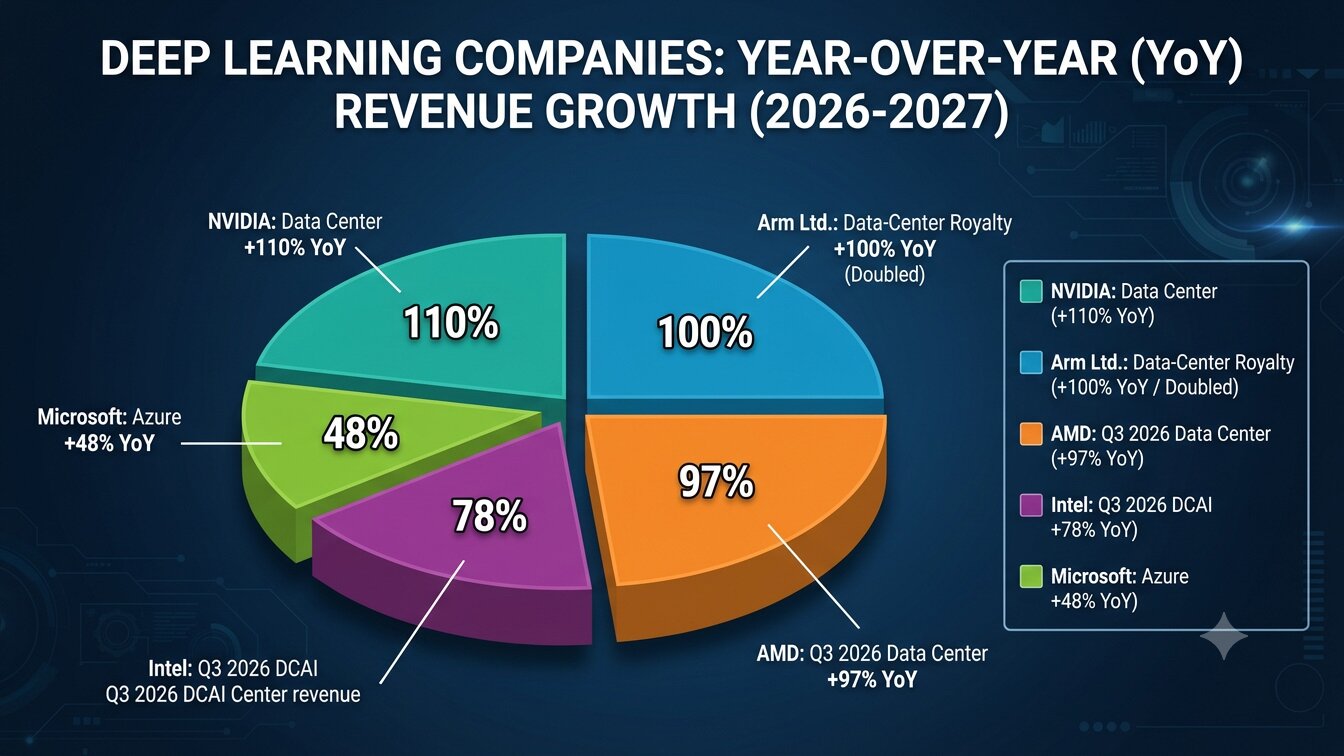
| YoY Revenue Growth | Q3 2026 Data Center revenue grew 97% YoY |
| Primary Segments | Data Center is the relevant reporting segment. Its deep-learning offerings include Instinct GPUs, EPYC host CPUs, Helios rack-scale systems, and ROCm software |
Financial Details and Market Position
- AMD attributed its record Data Center quarter, ended September 26, 2026, to strong EPYC demand and the launch of its Instinct MI450 Series GPUs. It did not disclose standalone Instinct sales, so the segment’s 97% growth cannot be attributed to deep learning alone.
- Epoch AI estimates that AMD accounted for approximately 4% of tracked AI-chip compute capacity sold or shipped in Q2 2026, compared with NVIDIA’s 63%. The benchmark measures peak computing power in H100-equivalents, not chip units, deployment, or revenue.
Strategic Developments
- Microsoft Azure, November 23, 2026: Microsoft powered up its first Helios system at an Azure lab and began validating inference workloads. This is a deployment milestone, not an announcement of general availability.
- Taalas acquisition, November 17, 2026: AMD completed its acquisition of the specialized inference-chip developer, adding a hardware design approach focused on running trained models efficiently.
- Meta deployment, October 27, 2026: AMD reported that Helios systems were already running at Meta. The partnership spans CPUs, GPUs, networking, systems, and software, showing adoption beyond standalone accelerator sales (AMD–Meta announcement).
2. Arm Ltd.
Arm supplies power-efficient CPU designs used in cloud and edge AI systems. Its licensing model gives it exposure to multiple chipmakers and cloud providers. With the Arm AGI CPU, it is also moving into direct chip sales, targeting the server processors that support AI inference rather than the GPUs that run most large-model training
Company Overview
| Attribute | Company Data |
|---|---|
| Company Name | Arm Limited; publicly listed parent: Arm Holdings plc |
| Ticker Symbol | Arm Limited has no standalone ticker. Arm Holdings plc American depositary shares trade on Nasdaq under ARM (Arm earnings filing). |
| Industry | Semiconductor intellectual property and processor design |
| Headquarters | Cambridge, England, United Kingdom |
| Founded | 1990 (Arm corporate history) |
| Founders | Acorn Computers, Apple Computer, and VLSI Technology founded Arm as a joint venture (Arm corporate history). |
| Current CEO | Rene Haas, CEO of Arm Holdings plc |
| YoY Revenue Growth | Data-center royalty revenue doubled YoY in fiscal Q2 2027. |
| Primary Segments | Sector-relevant businesses: Neoverse CPU IP and Compute Subsystems, data-center licensing and royalties, and direct Arm AGI CPU sales (Arm platform announcement; Arm quarterly results). |
Financial Details and Market PositionIn fiscal Q2 2027, ended September 30, 2026, Arm’s data-center royalties doubled year over year. Those royalties cover general-purpose cloud computing as well as AI infrastructure, so the figure does not isolate deep-learning growth. Arm reported purchase orders from multiple customers for the AGI CPU and targeted first commercial deliveries for fiscal Q4 2027. Those orders are not recognized quarterly revenue.
Deep-learning revenue share: Arm reported that Arm-based server market share at top hyperscalers rose from 15% in 2024 to more than 50% in 2025, but its release does not specify whether this measures shipments, new deployments, or installed systems. It is a company-reported measure of server CPU adoption, not a share of the deep-learning or AI accelerator market.
Strategic Developments
- Microsoft Azure, November 2026: Azure Cobalt 200 virtual machines powered by Arm Neoverse CSS V3 became generally available. This expands the commercial footprint of Arm-licensed technology for cloud and AI workloads; Cobalt 200 is distinct from the Arm AGI CPU.
- Oracle Cloud Infrastructure, October 2026: Oracle announced plans to offer Arm AGI CPU instances in fall 2027 for general-purpose cloud and agentic AI workloads. This is a planned offering, not current capacity (Arm–Oracle announcement).
- Meta, March 2026: Arm introduced the AGI CPU with Meta as lead development partner. The launch marks Arm’s move from licensing processor designs to also selling its own data-center silicon.
3. Clarifai, Inc.
Clarifai began in neural-network image recognition and expanded into model deployment, inference optimization, and compute orchestration. Its core engineering and research team joined Nebius in May 2026, and Nebius licensed its inference technology for Token Factory. That makes Clarifai’s historical platform reach a poor measure of its current standalone position.
Company Overview
| Attribute | Company Data |
|---|---|
| Company Name | Clarifai, Inc. |
| Ticker Symbol | None; Clarifai was privately held. Nasdaq: NBIS is Nebius’s ticker, not Clarifai’s (Forge Global; Nebius announcement). |
| Industry | Enterprise AI software, computer vision, and model inference (Clarifai company profile; Nebius announcement) |
| Founded | 2013 |
| Founders | Matthew Zeiler |
| Primary Segments | Historical product lines: computer vision, model training and deployment, and inference and compute orchestration. Nebius licensed the modern inference technology but excluded legacy computer-vision models from the license (Clarifai company profile; Nebius announcement). |
Financial Details and Market Position
Nebius’s Q3 2026 filing gives a figure not included in the earlier market report: US$97.4 million in accounting consideration for the Clarifai transaction, comprising US$75.0 million in cash and US$22.4 million in restricted stock units counted as consideration. Nebius accounted for the transaction as a business combination, but the filing does not say it bought Clarifai’s shares or disclose standalone Clarifai revenue. The consideration is a transaction value, not quarterly sales.
Deep-learning market share: Clarifai is best classified as a historical computer-vision and inference specialist whose core technical team moved to Nebius. Clarifai also posted that platform-credit purchases would be disabled after June 18, 2026, so historical usage is not a reliable proxy for current standalone sales.
Strategic Developments
- Nebius transaction, May 2026: Nebius brought over Clarifai’s core engineering and research team, agreed to acquire its patent portfolio, and obtained a perpetual, non-exclusive license to its modern inference and orchestration technology. The license excluded legacy computer-vision models and Clarifai’s U.S. government and defense programs.
- Arcee AI partnership, December 2025: Before the Nebius transaction, Clarifai announced that it would serve as the primary launch partner and hosting provider for Arcee AI’s Trinity family of open-weight models. The announcement establishes its historical role in commercial inference, not whether the hosting arrangement continued after the transaction.
4. Enlitic, Inc.
Market.us lists “Entilic,” which appears to refer to Enlitic, Inc. Its Ensight platform uses AI to standardize medical images and metadata, remove identifying information, and make imaging archives easier to use across radiology systems. Enlitic’s current commercial focus is imaging data and workflow, not standalone diagnostic models.
Company Overview
| Attribute | Company Data |
|---|---|
| Company Name | Enlitic, Inc. |
| Ticker Symbol | ASX: ENL |
| Industry | Healthcare technology, medical imaging software, and radiology AI |
| Headquarters | Loveland, Colorado, United States, listed as the principal place of business in its annual report |
| Founded | 2014 |
| Founders | Jeremy Howard, founding CEO |
| Current CEO | Michael Sistenich |
| Latest Quarterly Revenue | Unaudited Q3 2026 company revenue was approximately US$0.9 million |
| Primary Segments | Sector-relevant business lines: Ensight imaging-data standardization, de-identification, and workflow software; Laitek imaging-data migration integrated with Ensight |
Financial Details and Market Position
At September 30, 2026, Enlitic reported approximately US$760,000 in Ensight annualized recurring revenue, with a further US$360,000 awaiting go-live. Those figures indicate commercial traction but are not recognized quarterly revenue. The company’s approximately US$0.9 million of Q3 revenue was broadly flat versus Q2, and Enlitic did not disclose how much came from Ensight versus migration or other services.
Deep-learning market share: Enlitic is a specialist in radiology data rather than a broad AI platform. Its clearest sign of adoption is that Ensight went live at multiple radiology providers through Intelerad, while its first Sectra-based customer contract extended its reach to a second major imaging platform.
Strategic Developments
- Southwest Medical Imaging, October 2026: Enlitic signed a three-year US$144,000 contract for Ensight’s Hanging Protocols application, which helps radiologists display studies in their preferred layouts. The contract is subject to successful validation.
- University of Michigan Health–Sparrow, September 2026: Enlitic secured a US$806,000 contract to migrate approximately 10.6 million radiology and cardiology studies and standardize the historical archive with Ensight. It was Enlitic’s first customer contract to use its Sectra integration.
- Intelerad deployments, Q3 2026: Ensight went live at Radiology Imaging Associates and Radiology Consultants of Iowa, following an earlier deployment at RHCNZ Medical Imaging Group in New Zealand. These were production deployments, not just signed agreements.
5. Google, Inc. (Google LLC)
Google develops Gemini foundation models through Google DeepMind and sells model access and computing capacity through Google Cloud. Its advantage is that it can design its Tensor Processing Units (TPUs), models, and serving software together, then use the same infrastructure for its own products and for cloud customers.
Company Overview
| Attribute | Company Data |
|---|---|
| Company Name | Google LLC, formerly Google Inc.; a wholly owned subsidiary of Alphabet Inc. (Alphabet proxy statement; Google Inc. Form 10-K) |
| Ticker Symbol | Google LLC has no standalone ticker. Alphabet trades on Nasdaq as GOOGL (Class A) and GOOG (Class C) |
| Industry | Cloud computing, AI infrastructure, and foundation-model software (Google Cloud AI infrastructure; Google DeepMind) |
| Headquarters | Mountain View, California, United States (Google company history) |
| Founded | 1998 (Google Research) |
| Founders | Larry Page and Sergey Brin (Google company history) |
| Current CEO | Sundar Pichai, CEO of Google and Alphabet |
| Primary Segments | Sector-relevant operations: Google Cloud AI infrastructure and enterprise AI services; Gemini and Google DeepMind; TPU accelerator systems |
Financial Details and Market Position
For the quarter ended September 30, 2026, Alphabet attributed Google Cloud’s growth to enterprise AI infrastructure, enterprise AI solutions, and core Google Cloud Platform services. It described TPU system sales as a meaningful contributor but did not disclose separate revenue for TPUs or Gemini. Cloud’s 103% growth is therefore evidence of strong demand, not a deep-learning-only growth rate.
Epoch AI estimates that Google accounted for approximately 25% of tracked AI-chip compute capacity sold or shipped in Q2 2026, second to NVIDIA at 63%. The estimate measures peak computing power in H100-equivalents, not chip units, cloud revenue, or installed capacity.
Strategic Developments
- Oracle Cloud Infrastructure, October 2026: Google and Oracle announced plans to offer Google TPUs on OCI starting in calendar 2027. Google said OCI would be the first hyperscaler outside Google to offer its TPUs, giving Google a distribution channel beyond its own cloud.
- TPU portfolio expansion, November 2026: Google introduced TPU 8tx for confidential inference and TPU 8i Max for workloads with large context windows. The two designs target distinct model-serving requirements rather than treating inference as a single workload.
- Gemini 4 Neon, November 2026: Google introduced Neon for complex software engineering, analytical reasoning, and research workflows. Launch access included the paid Gemini API tier and eligible Gemini app plans, extending the model across developer, enterprise, and consumer channels.
6. HyperVerge
HyperVerge applies computer vision to identity verification, document checks, face matching, and fraud prevention. Its main differentiator is passive liveness detection from a single selfie, designed to work on lower-end devices and low-bandwidth connections. That makes it useful for financial institutions that need to verify customers without adding a video step to onboarding.
Company Overview
| Attribute | Company Data |
|---|---|
| Company Name | HyperVerge; its service privacy policy identifies HyperVerge Inc. and HyperVerge Technologies Private Limited |
| Industry | Computer vision, digital identity verification, and fraud prevention |
| Headquarters | Palo Alto, California, United States; Bengaluru, India, is also a listed operating location (Craft company profile; HyperVerge offices). |
| Founded | 2014, with origins in the Computer Vision Group at IIT Madras (Craft company profile; HyperVerge company history). |
| Founders | Kedar Kulkarni, Kishore Natarajan, Vignesh Krishnakumar, Praveen Kumar, and Saivenkatesh Ashokkumar |
| Current CEO | Kedar Kulkarni |
| Primary Segments | Sector-relevant product lines: identity and document verification, passive liveness and face matching, and onboarding fraud detection |
Financial Details and Market Position
HyperVerge says it scaled to more than US$19 million in annual recurring revenue (ARR). It does not give a measurement date or break out computer-vision revenue. The figure is therefore a company-reported indicator of commercial scale, not recognized quarterly revenue or a measure of deep-learning-only sales.
Deep-learning market share: HyperVerge is a specialist in identity verification for banks, lenders, fintechs, and insurers. Its website reports more than 2 billion identity verifications processed. That is a cumulative activity count, not a count of unique users or a market-share estimate.
Strategic Developments
- U.S. identity-verification patent, September 2026: The USPTO issued patent US 12,738,100 B2 to HyperVerge Technologies Private Limited for a method and system for video-based automatic identity verification. The patent documents proprietary technology in its verification business, but does not establish commercial adoption on its own.
- Business-loan underwriting, September 2026: HyperVerge launched three AI underwriting agents for business lending. The move extends its financial-services offering beyond identity checks into underwriting workflows, with final credit decisions remaining with people.
- Flip partnership, December 2024: Indonesian fintech Flip adopted HyperVerge’s liveness and fraud-detection tools for customer onboarding, targeting deepfakes and image-injection attempts. The announcement verifies a customer deployment but does not disclose contract value.
7. IBM Corporation
IBM focuses on deploying and governing deep-learning models in enterprises. Its watsonx platform supports IBM’s open-source Granite models and third-party models, while Red Hat OpenShift and IBM Consulting help customers run them across cloud and on-premises environments. IBM’s competitive strength is integrating models into existing systems where data control and governance matter.
Company Overview
| Attribute | Company Data |
|---|---|
| Company Name | International Business Machines Corporation |
| Ticker Symbol | NYSE: IBM (IBM earnings release) |
| Industry | Enterprise software, hybrid cloud, and AI consulting |
| Headquarters | Armonk, New York, United States |
| Founded | 1911 as the Computing-Tabulating-Recording Company, IBM’s predecessor (IBM corporate history) |
| Founders | Charles Ranlett Flint organized the founding merger (IBM corporate history). |
| Current CEO | Arvind Krishna |
| Latest Quarterly Revenue | IBM said AI represented about 30% of Q3 2026 Consulting revenue, a broader measure that does not isolate deep learning |
| Primary Segments | Sector-relevant operations: watsonx, Granite, and Red Hat OpenShift in Software; AI implementation and governance in Consulting; model-serving capacity on IBM Cloud |
8. Intel Corporation
Intel participates in deep learning through Xeon server CPUs, dedicated inference GPUs, and software that helps models run on Intel hardware. Its strongest position is in server CPUs that coordinate AI workloads or run inference directly. Its dedicated GPU business is less established: Intel reported that customer sampling of its GPU D-series was underway.
Company Overview
| Attribute | Company Data |
|---|---|
| Company Name | Intel Corporation |
| Ticker Symbol | Nasdaq: INTC |
| Industry | Semiconductors, server processors, and AI accelerators |
| Headquarters | Santa Clara, California, United States |
| Founded | 1968 (Intel corporate history) |
| Founders | Robert Noyce and Gordon Moore (Intel corporate history) |
| Current CEO | Lip-Bu Tan (Intel earnings release) |
| Latest Quarterly Revenue | Q3 2026 Data Center and AI (DCAI) revenue was US$7.318 billion |
| YoY Revenue Growth | Q3 2026 DCAI revenue grew 78% YoY |
| Primary Segments | DCAI is the relevant reporting segment. Sector offerings include Xeon processors, dedicated inference GPUs, and inference software |
Financial Details and Market Position
In Q3 2026, ended September 26, Intel’s DCAI server revenue increased US$2.5 billion YoY, driven by higher average selling prices and increased volume, with Intel citing stronger hyperscaler demand. Other DCAI revenue increased US$743 million, driven by demand for purpose-built silicon. Intel did not break out accelerator or deep-learning revenue, so these figures show strength in broader data-center infrastructure rather than growth in AI GPU sales.
Deep-learning market share: Intel has evidence of production AI workloads on Xeon, including Viettel Networks’ netMind platform. By contrast, Intel reported customer sampling for its dedicated GPU D-series and did not specify a general-availability date. Those are different stages of commercial adoption and should not be treated as equivalent.
Strategic Developments
- Microsoft Azure, November 2026: The companies expanded their long-term infrastructure agreement to include multiyear Xeon supply and planned Azure instances using next-generation Diamond Rapids processors. Microsoft also announced plans to use Intel Foundry’s EMIB packaging for first-party Azure silicon. The agreement covers broader cloud and AI infrastructure, not only inference.
- RadixArk, November 2026: Intel announced a collaboration to contribute optimizations for its CPUs, GPUs, and accelerators directly to SGLang, an open-source model-serving framework. The announcement did not specify a release date for those optimizations.
- Viettel Networks, November 2026: Intel documented a production deployment of Viettel’s Xeon 6-powered netMind platform. Intel reported that it serves more than 12,000 users and handles approximately 3,000 operational queries per day, a concrete example of CPU-based AI inference in use.
9. Microsoft Corporation
Microsoft spans deep-learning infrastructure, model deployment, and enterprise applications. Azure provides compute for training and inference, Microsoft Foundry gives developers access to Microsoft and third-party models, and Copilot brings those models into enterprise workflows. Its competitive advantage is the ability to serve customers across all three layers.
Company Overview
| Attribute | Company Data |
|---|---|
| Company Name | Microsoft Corporation |
| Ticker Symbol | Nasdaq: MSFT |
| Industry | Enterprise software, cloud computing, and AI infrastructure |
| Headquarters | Redmond, Washington, United States |
| Founded | 1975 |
| Founders | Bill Gates and Paul Allen |
| Current CEO | Satya Nadella |
| YoY Revenue Growth | Azure revenue grew 48% YoY, both as reported and in constant currency |
| Primary Segments | Agents and Infra is the relevant reporting segment. Its deep-learning offerings include Azure AI infrastructure, Microsoft Foundry, and Copilot |
Financial Details and Market Position
Microsoft said Foundry revenue more than tripled YoY in Q1 FY2027 and that the platform had more than 120,000 customers, but it did not disclose Foundry’s quarterly revenue in dollars. Its Form 10-Q separately disclosed US$10.0 billion in revenue from commercial arrangements with OpenAI, including revenue-sharing payments; that figure is not a standalone measure of Azure AI sales or Microsoft’s total deep-learning revenue. Management attributed Azure’s growth to both core cloud services and AI infrastructure and said customer demand continued to exceed available capacity.
Deep-learning market share: Microsoft is a leading cloud provider for AI workloads, with its position reinforced by model distribution through Foundry and end-user adoption through Copilot. Azure’s total revenue demonstrates the scale of its cloud platform, but it includes non-AI workloads and cannot be used to calculate a deep-learning market share.
Strategic Developments
- Foundry model expansion, November 2026: At Ignite, Microsoft announced plans to bring OpenAI’s GPT-6.2 and Meta’s latest models to Foundry, while introducing new models of its own for coding, image editing, and speech. The announcements broaden Foundry’s model lineup without making it dependent on a single provider.
- Maia inference infrastructure, October 2026: Microsoft confirmed that Maia 200 was already running production Copilot workloads. It plans to begin Maia 300 production deployments in 2027 as it scales its in-house inference capacity.
- OpenAI partnership amendment, April 2026: Microsoft remains OpenAI’s primary cloud partner, with Azure-first product releases subject to the agreement’s stated exception. OpenAI can serve customers through other clouds, and Microsoft retains a non-exclusive license to OpenAI model and product intellectual property through 2032.
10. NVIDIA Corporation
NVIDIA leads in tracked AI accelerator capacity and sells integrated systems for training and running deep-learning models. Its competitive advantage extends beyond Blackwell and Rubin GPUs: CUDA libraries support widely used frameworks such as PyTorch and JAX, while NVIDIA’s networking connects accelerators across large clusters.
Company Overview
| Attribute | Company Data |
|---|---|
| Company Name | NVIDIA Corporation |
| Ticker Symbol | Nasdaq: NVDA |
| Industry | Semiconductors and accelerated computing, including AI infrastructure |
| Headquarters | Santa Clara, California, United States |
| Founded | 1993 |
| Founders | Jensen Huang, Chris Malachowsky, and Curtis Priem |
| Current CEO | Jensen Huang, reinstated effective November 22, 2026 |
| Latest Quarterly Revenue | Data Center revenue was US$107.6 billion in Q3 FY2027, ended October 25, 2026 |
| YoY Revenue Growth | Data Center revenue grew 110% YoY |
| Primary Segments | Compute & Networking is the reportable segment most relevant to deep learning. Data Center is a separately disclosed market category, not a reportable segment |
Financial Details and Market Position
NVIDIA’s Q3 FY2027 Data Center revenue included US$60.1 billion from hyperscale customers, up 71% YoY, and US$47.5 billion from AI Clouds, Industrial & Enterprise, up 195% YoY. NVIDIA attributed growth across both groups to the rollout of Rubin infrastructure and standalone Vera CPUs, alongside continued growth in Blackwell Ultra. The figures show that growth extended beyond hyperscalers, but NVIDIA did not disclose revenue separately for deep learning, training, or inference.
Deep-learning revenue market share: As a hardware benchmark, Epoch AI estimated that NVIDIA accounted for 63% of the AI accelerator computing capacity sold or shipped by the designers it tracked in Q2 2026, ranking first. The estimate weights chips by peak 8-bit compute in H100-equivalents; it measures neither revenue nor chip units, and it excludes some custom accelerators, including Microsoft Maia and Meta MTIA.
Strategic Developments
- Microsoft Azure, November 2026: NVIDIA and Microsoft expanded access to Vera Rubin NVL72-powered Azure virtual machines in preview and broadened access to NVIDIA’s Nemotron models through Microsoft Foundry. Rubin systems were already running in Azure data centers, but the announcement did not establish general availability for the VMs.
- Oracle Cloud Infrastructure, October 2026: Oracle made Vera Rubin NVL72 systems and Vera CPUs generally available. The companies separately announced plans to expand Rubin-based OCI Superclusters to multi-gigawatt scale for AI training and inference; that larger buildout was not yet complete.
- Amazon Web Services, August 2026: AWS and NVIDIA announced plans to deploy 2 million additional Blackwell Ultra, Rubin, and Rubin Ultra GPUs across AWS infrastructure in 2027–2028. That figure represents a future deployment plan, not completed shipments or recognized revenue.
Conclusion
NVIDIA has the strongest measured position in AI compute, but its customers are neither aligned around a single silicon supplier nor confined to one distribution model. Oracle’s plans for both NVIDIA Rubin and Google TPUs illustrate how a single cloud provider can offer competing architectures, while Microsoft is putting its own inference silicon into production and AMD is demonstrating rack-scale adoption at Meta.
Over the next 12–24 months, the base case is continued expansion with more competition over inference costs. Large frontier training runs are likely to remain concentrated on platforms that can deliver well-integrated clusters, while recurring production workloads give buyers more incentive to use workload-specific chips and compare cost per token at a given latency.
Power availability could delay deployments even where hardware demand is strong. At the application layer, the stronger specialists will be those that can demonstrate repeatable production deployments and measurable workflow outcomes rather than model accuracy alone