



Introduction
The global Edge AI market is expanding as businesses increasingly integrate artificial intelligence into devices, industrial equipment, connected systems and local computing infrastructure. Edge AI enables data processing closer to its source, reducing response time, bandwidth requirements and dependence on centralized cloud infrastructure. Growing investments in artificial intelligence, Internet of Things (IoT), 5G connectivity, autonomous systems and industrial automation are supporting market expansion. Competition is increasingly shaped by semiconductor performance, energy efficiency, AI software ecosystems and the ability to deploy scalable edge computing solutions.
Market Size & Statistics
-
The global Edge AI market generated revenue of USD 23.3 billion in 2024.
-
The market is projected to reach USD 28.8 billion in 2025.
-
By 2034, the global Edge AI market is forecast to reach approximately USD 196.6 billion.
-
The market is expected to register a compound annual growth rate (CAGR) of 23.8% between 2025 and 2034.
-
Hardware accounted for the leading component share of 52.4% in 2024.
-
Software represented 18.7%, edge cloud infrastructure accounted for 19.5%, and services contributed 9.4% in 2024.
-
Consumer electronics dominated the end-use industry segment with a 28.0% share in 2024.
-
North America held the leading regional position with a 38.4% share, generating approximately USD 8.9 billion in revenue in 2024.
-
The United States Edge AI market was valued at approximately USD 7.615 billion, with a projected CAGR of 21.4%.
-
IT and telecommunications represented 20.9% of the global market in 2024, while automotive accounted for 9.7%.
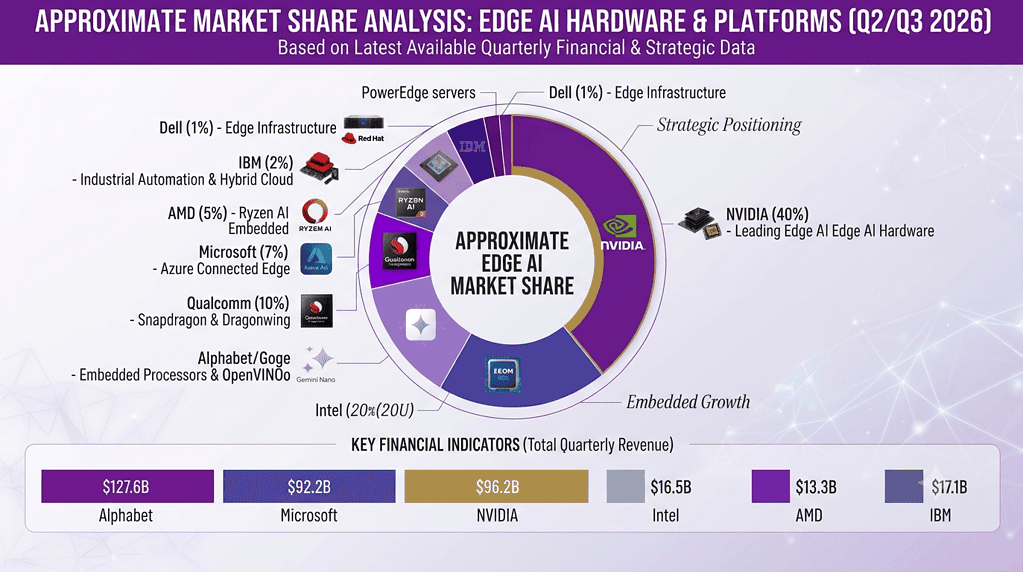
Important market-share qualification: The supplied Market.us report identifies the leading companies but does not disclose individual company revenue shares. The companies also operate across different Edge AI product categories. The following assessment uses relative competitive positioning rather than fabricated percentages.
1 NVIDIA Corporation
About NVIDIA Corporation: NVIDIA is a leading semiconductor and AI computing company with a strong position in Edge AI through its Jetson platform, GPU architecture and CUDA software ecosystem. Its technology supports robotics, autonomous machines, industrial automation, computer vision and real-time AI inference.
a) Company Overview Table
| Attribute | Company Data |
|---|---|
| Company Name | NVIDIA Corporation |
| Ticker Symbol | NASDAQ: NVDA |
| Industry | Semiconductors and AI Computing |
| Headquarters | Santa Clara, California, USA |
| Founded | 1993 |
| Founders | Jensen Huang, Chris Malachowsky and Curtis Priem |
| Current CEO | Jensen Huang |
| Latest Quarterly Revenue | USD 96.22 billion (Q2 FY2027) |
| YoY Revenue Growth | 106% |
| Primary Segments | Compute & Networking; Graphics |
b) Financial Details
NVIDIA reported revenue of USD 96.22 billion for the second quarter of fiscal 2027, ended July 26, 2026, representing 106% year-over-year growth. Data Center revenue reached USD 89.0 billion, increasing 117%. These results demonstrate the scale of investment in AI computing infrastructure, although the Data Center figure includes centralized AI infrastructure and cannot be treated as Edge AI revenue. NVIDIA does not separately disclose Jetson or Edge AI quarterly revenue. Its edge business benefits from demand for embedded GPUs, robotics computing and local AI inference.
c) Strategic Developments
-
Jetson ecosystem expansion: NVIDIA continues to expand its Jetson platform for robotics, industrial automation and physical AI applications.
-
Developer ecosystem: Its Jetson ecosystem has reported more than 2 million developers and over 150 ecosystem partners, supporting application development and commercial deployment.
-
Physical AI development: NVIDIA is expanding the integration of simulation, robotics software and accelerated computing to support intelligent machines.
-
Software ecosystem: CUDA, TensorRT and related development tools strengthen its competitive position by simplifying AI model optimization and deployment on edge hardware.
2 Qualcomm Incorporated
About Qualcomm Incorporated: Qualcomm develops semiconductor technologies, wireless connectivity solutions and energy-efficient processors. Its Edge AI presence is supported by Snapdragon and Dragonwing platforms, which enable on-device intelligence across smartphones, automotive systems, industrial equipment and connected infrastructure.
a) Company Overview Table
| Attribute | Company Data |
|---|---|
| Company Name | Qualcomm Incorporated |
| Ticker Symbol | NASDAQ: QCOM |
| Industry | Semiconductors and Wireless Technology |
| Headquarters | San Diego, California, USA |
| Founded | 1985 |
| Founders | Irwin Jacobs, Andrew Viterbi and co-founders |
| Current CEO | Cristiano Amon |
| Primary Segments | Qualcomm CDMA Technologies (QCT); Qualcomm Technology Licensing (QTL); Qualcomm Strategic Initiatives (QSI) |
b) Financial Details
Qualcomm’s Edge AI performance is driven by demand for processors that support local AI inference, wireless connectivity and low-power computing. Its Snapdragon platforms address consumer and mobile applications, while Dragonwing targets industrial IoT, networking and enterprise edge applications. Qualcomm does not separately disclose revenue from Edge AI processors or Dragonwing products. Its most relevant sector indicators include chip shipments, AI processing capabilities, industrial design wins and adoption of connected edge platforms.
c) Strategic Developments
-
March 2025 – Dragonwing platform: Qualcomm introduced the Dragonwing Fixed Wireless Access Gen 4 Elite platform with integrated Edge AI processing capabilities of up to 40 TOPS.
-
Industrial edge expansion: The Dragonwing portfolio extends Qualcomm’s addressable market into industrial automation, networking and connected infrastructure.
-
On-device AI: Qualcomm continues developing energy-efficient AI processing capabilities for devices that execute models locally rather than relying entirely on cloud infrastructure.
-
Automotive integration: Its Snapdragon Digital Chassis ecosystem supports intelligent vehicle computing, connectivity and driver-assistance applications.
3 Intel Corporation
About Intel Corporation: Intel is a major semiconductor manufacturer supplying processors, embedded computing products and AI acceleration technologies. Its Edge AI footprint includes Intel Core processors, Xeon platforms, OpenVINO software and industrial computing solutions designed for local inference and real-time processing.
a) Company Overview Table
| Attribute | Company Data |
|---|---|
| Company Name | Intel Corporation |
| Ticker Symbol | NASDAQ: INTC |
| Industry | Semiconductors and Computing |
| Headquarters | Santa Clara, California, USA |
| Founded | 1968 |
| Founders | Robert Noyce and Gordon Moore |
| Current CEO | Lip-Bu Tan |
| Latest Quarterly Revenue | USD 16.5 billion (Q3 2026) |
| YoY Revenue Growth | 21% |
| Primary Segments | Client Computing Group; Data Center and AI; Intel Foundry; other businesses |
b) Financial Details
Intel reported third-quarter 2026 revenue of USD 16.5 billion, an increase of 21% year over year. The company highlighted strong demand for its Xeon processor family and continued expansion of manufacturing capacity. Its Edge AI business benefits from embedded processors, industrial computing platforms and software optimization technologies. However, Intel does not provide a separate revenue figure for Edge AI or its OpenVINO-based deployments. Consequently, overall quarterly revenue should be treated as a corporate performance indicator rather than a direct measure of its Edge AI business.
c) Strategic Developments
-
OpenVINO ecosystem: Intel continues supporting AI model optimization and deployment across its processor and accelerator portfolio.
-
Industrial AI: Its edge computing technologies support machine vision, predictive maintenance, industrial automation and intelligent infrastructure.
-
Processor development: Intel’s Core and Xeon roadmaps support AI inference workloads requiring local processing and improved computing efficiency.
-
Enterprise integration: Intel continues working with technology partners and system integrators to expand edge computing deployments.
4 Advanced Micro Devices, Inc. (AMD)
About Advanced Micro Devices, Inc.: AMD develops high-performance processors, graphics technologies and adaptive computing products. Its Edge AI business focuses on Ryzen AI Embedded processors, EPYC Embedded processors and Versal adaptive SoCs for industrial automation, automotive computing, robotics and real-time AI applications.
a) Company Overview Table
| Attribute | Company Data |
|---|---|
| Company Name | Advanced Micro Devices, Inc. |
| Ticker Symbol | NASDAQ: AMD |
| Industry | Semiconductors and Computing |
| Headquarters | Santa Clara, California, USA |
| Founded | 1969 |
| Founders | Jerry Sanders and seven co-founders |
| Current CEO | Dr. Lisa Su |
| Latest Quarterly Revenue | USD 13.38 billion (Q3 2026) |
| YoY Revenue Growth | 45% |
| Primary Segments | Data Center; Client and Gaming; Embedded |
b) Financial Details
AMD reported third-quarter 2026 revenue of USD 13.38 billion, compared with USD 9.25 billion in the corresponding quarter of 2025. Its Embedded segment generated USD 1.11 billion, increasing approximately 29% year over year. This segment includes embedded CPUs, accelerated processing units, field-programmable gate arrays and adaptive system-on-chip products. These technologies provide the foundation for AMD’s Edge AI activities in industrial automation, networking, machine vision and automotive applications. The company does not separately report Edge AI revenue, so its Embedded segment is the closest relevant financial indicator, although it also includes non-AI products.
c) Strategic Developments
-
January 2026 – Ryzen AI Embedded launch: AMD introduced its Ryzen AI Embedded P100 and X100 processor families, combining Zen 5 CPU cores, RDNA 3.5 graphics and XDNA 2 neural processing technology.
-
AI processing capacity: The P100 series offers up to 50 AI TOPS, supporting low-latency AI processing in industrial and automotive systems.
-
March 2026 – Portfolio expansion: AMD expanded the Ryzen AI Embedded P100 portfolio to support industrial automation, robotics and medical imaging applications.
-
July 2026 – X100 development: AMD highlighted the Ryzen AI Embedded X100 platform, integrating CPU, graphics and neural processing capabilities for demanding edge workloads.
-
September 2026 – AMD Ross: AMD introduced its Ross agentic AI assistant to help embedded developers design, optimize, debug and deploy applications across its embedded portfolio.
5 Alphabet, Inc.
About Alphabet, Inc.: Alphabet operates through Google and other technology businesses, providing AI software, specialized computing infrastructure and intelligent device technologies. Its Edge AI presence is supported by Gemini Nano, Google AI Edge, Android AI capabilities and Tensor Processing Unit technologies.
a) Company Overview Table
| Attribute | Company Data |
|---|---|
| Company Name | Alphabet Inc. |
| Ticker Symbol | NASDAQ: GOOGL / GOOG |
| Industry | Technology and Digital Services |
| Headquarters | Mountain View, California, USA |
| Founded | 2015 |
| Founders | Larry Page and Sergey Brin |
| Current CEO | Sundar Pichai |
| Latest Quarterly Revenue | USD 127.6 billion (Q3 2026) |
| YoY Revenue Growth | 25% |
| Primary Segments | Google Services; Google Cloud; Other Bets |
b) Financial Details
Alphabet reported third-quarter 2026 revenue of USD 127.6 billion, representing 25% year-over-year growth. Google Cloud generated USD 30.7 billion, increasing 103%, supported by enterprise AI infrastructure, AI solutions and TPU system sales. Alphabet’s Edge AI opportunity is primarily associated with its on-device AI models, Android ecosystem and developer technologies. Gemini Nano enables generative AI workloads to operate directly on supported devices without requiring continuous cloud connectivity. However, Alphabet does not separately report revenue from Google AI Edge, Gemini Nano or other Edge AI products.
c) Strategic Developments
-
On-device AI expansion: Google continues expanding Gemini Nano for local AI execution on supported Android devices.
-
Google AI Edge SDK: Google provides developers with tools to experiment with and deploy AI capabilities directly on devices.
-
Privacy-focused processing: On-device AI supports applications requiring lower latency, reduced network dependence and improved control over personal data.
-
Google Cloud integration: Alphabet continues investing in AI infrastructure and specialized processors, creating opportunities to connect cloud-based model development with local AI execution.
6 Microsoft Corporation
About Microsoft Corporation: Microsoft provides enterprise software, cloud infrastructure and AI development platforms. Its Edge AI footprint is based on Azure IoT, Azure Local, Azure Arc and local AI deployment technologies, enabling enterprises to manage AI workloads across cloud, data center and edge environments.
a) Company Overview Table
| Attribute | Company Data |
|---|---|
| Company Name | Microsoft Corporation |
| Ticker Symbol | NASDAQ: MSFT |
| Industry | Software, Cloud Computing and AI |
| Headquarters | Redmond, Washington, USA |
| Founded | 1975 |
| Founders | Bill Gates and Paul Allen |
| Current CEO | Satya Nadella |
| Latest Quarterly Revenue | USD 92.28 billion (Q1 FY2027) |
| YoY Revenue Growth | 19% |
| Primary Segments | Agents and Infra; Devices and Consumer |
b) Financial Details
Microsoft reported first-quarter fiscal 2027 revenue of USD 92.28 billion, increasing 19% year over year for the quarter ended September 30, 2026. Microsoft Cloud revenue reached USD 63.9 billion, growing 30%, while Azure revenue increased 48%. These results reflect increasing enterprise investment in cloud and AI infrastructure. Microsoft’s Edge AI opportunity is linked to Azure-connected infrastructure, local computing and enterprise AI deployment. However, the company does not separately disclose revenue generated from edge AI software, Azure Local or edge inference workloads.
c) Strategic Developments
-
Azure Local: Microsoft continues expanding its infrastructure offering for organizations that need cloud-connected computing capabilities within their own facilities and edge locations.
-
Local AI execution: Microsoft’s Foundry Local platform supports AI inference on local devices, helping reduce dependence on centralized cloud processing.
-
Enterprise AI integration: Microsoft continues integrating AI capabilities into its enterprise software and infrastructure ecosystem.
-
Hybrid computing: Azure Arc supports management of distributed infrastructure across on-premises, cloud and edge environments.
7 IBM Corporation
About IBM Corporation: IBM provides enterprise technology, hybrid cloud infrastructure and artificial intelligence solutions. Its Edge AI activities focus on industrial automation, distributed computing, predictive maintenance and enterprise AI deployment through its software, consulting and infrastructure capabilities.
a) Company Overview Table
| Attribute | Company Data |
|---|---|
| Company Name | IBM Corporation |
| Ticker Symbol | NYSE: IBM |
| Industry | Information Technology and Enterprise Software |
| Headquarters | Armonk, New York, USA |
| Founded | 1911 |
| Founders | Charles Ranlett Flint; predecessor business founders |
| Current CEO | Arvind Krishna |
| Latest Quarterly Revenue | USD 17.1 billion (Q3 2026) |
| YoY Revenue Growth | 5% |
| Primary Segments | Software; Consulting; Infrastructure; Financing |
b) Financial Details
IBM reported third-quarter 2026 revenue of USD 17.1 billion, increasing 5% year over year. Software revenue reached USD 7.8 billion, growing 8%, while Infrastructure revenue increased 4% to approximately USD 3.7 billion. IBM’s Edge AI opportunities are associated with distributed enterprise computing, hybrid cloud deployment and AI-supported industrial applications. Its software and infrastructure businesses provide technologies for managing workloads across centralized and distributed environments. However, IBM does not disclose a separate Edge AI revenue figure, and its reported software and infrastructure results include substantial non-edge activities.
c) Strategic Developments
- Hybrid cloud expansion: IBM continues developing hybrid cloud technologies that support AI workloads across enterprise data centers and distributed computing environments.
- Red Hat integration: IBM’s Red Hat ecosystem provides container-based infrastructure and application deployment capabilities relevant to distributed edge environments.
- Industrial AI applications: IBM supports AI implementation in manufacturing, operational analytics, predictive maintenance and enterprise automation.
- Enterprise AI development: Its AI software portfolio supports the integration of machine learning and generative AI into enterprise workflows.
- Acquisitions and investment: IBM reported USD 11.4 billion in acquisition investments during the first nine months of 2026. However, this amount covers the broader business and cannot be attributed exclusively to Edge AI.
8 Dell Technologies Inc.
About Dell Technologies Inc.: Dell Technologies supplies enterprise computing infrastructure, servers, storage systems and integrated technology solutions. Its Edge AI footprint is supported by PowerEdge servers, NativeEdge infrastructure management and AI-optimized computing systems designed for distributed enterprise and industrial environments.
a) Company Overview Table
| Attribute | Company Data |
|---|---|
| Company Name | Dell Technologies Inc. |
| Ticker Symbol | NYSE: DELL |
| Industry | Information Technology and Computer Hardware |
| Headquarters | Round Rock, Texas, USA |
| Founded | 1984 |
| Founders | Michael Dell |
| Current CEO | Michael Dell |
| Latest Quarterly Revenue | USD 47.0 billion (Q2 FY2027) |
| YoY Revenue Growth | 58% |
| Primary Segments | Infrastructure Solutions Group; Client Solutions Group |
b) Financial Details
Dell Technologies reported second-quarter fiscal 2027 revenue of USD 47.0 billion, representing 58% year-over-year growth. The company increased its full-year fiscal 2027 revenue guidance to USD 192.0 billion and its AI-optimized server revenue guidance to USD 74.0 billion. These developments indicate strong demand for AI computing infrastructure. Dell’s Edge AI opportunity is supported by enterprise servers, distributed infrastructure and locally deployed AI systems.
However, AI-optimized server revenue includes both centralized and distributed AI infrastructure, so it cannot be considered Edge AI revenue. The company’s third-quarter fiscal 2027 results are scheduled for November 24, 2026, and are not included in this profile because they had not yet been released in the available financial results.
c) Strategic Developments
- AI-optimized server expansion: Dell increased its fiscal 2027 AI-optimized server revenue guidance to USD 74 billion, reflecting strong demand for AI computing systems.
- NativeEdge platform: Dell continues developing NativeEdge to support the deployment, management and operation of distributed edge infrastructure.
- Enterprise infrastructure: Its PowerEdge server portfolio supports local AI inference, data processing and enterprise computing applications.
- AI infrastructure integration: Dell’s hardware ecosystem enables organizations to deploy AI workloads across data centers, private infrastructure and edge environments.
Conclusion
The global Edge AI market is positioned for substantial expansion as artificial intelligence moves beyond centralized data centers into connected devices, industrial systems, autonomous equipment and enterprise infrastructure. According to the supplied Market.us report, the market is forecast to increase from USD 23.3 billion in 2024 to USD 196.6 billion by 2034, registering a CAGR of 23.8% during 2025–2034.
Over the next 12–24 months, competition is expected to intensify around energy-efficient AI processors, specialized neural processing units, embedded computing platforms and locally deployed generative AI applications. NVIDIA, Qualcomm, Intel and AMD are positioned to compete strongly in processing hardware, while Microsoft, IBM and Alphabet are expected to strengthen their roles in software and enterprise deployment. Dell will remain relevant through integrated infrastructure solutions.



