Introduction
The Global Blockchain Technology is shifting from experimental pilots to regulated financial infrastructure. Market.us sizes it at USD 123 billion in 2023 and projects USD 12,895 billion by 2033. Payments, stablecoins, and asset tokenization are now the strongest sources of demand. The US GENIUS Act, signed in July 2025, created a federal framework for payment stablecoins, and its final rules take effect on January 18, 2027. Visa’s adjusted figures put stablecoin transaction volume at USD 17.9 trillion by June 2026, up 125% year over year. Institutional capital is backing settlement networks such as Canton, though scalability, interoperability, and fragmented regulation still hold adoption back.
Market Size & Statistics
- The global blockchain technology market was valued at USD 123 billion in the 2023 base year.
- The market is projected to reach about USD 12,895 billion by 2033, a CAGR of 68%.
- The public cloud segment led by deployment type in 2022, with more than a 62% share.
- The infrastructure and protocols segment led by component in 2022, with more than a 65.4% share.
- Payments was the largest application segment in 2022, with more than a 44% share.
- Large enterprises held more than 68.5% of the market in 2022.
- Banking, financial services and insurance (BFSI) was the leading end-use sector in 2022, with more than 40% share.
- North America led the regional market in 2022 with more than a 39% share, and was valued at USD 28 billion in 2023.
- The United States accounts for 51% of global blockchain funding.
- Adoption of blockchain in supply chain and logistics grew 32% in 2023.
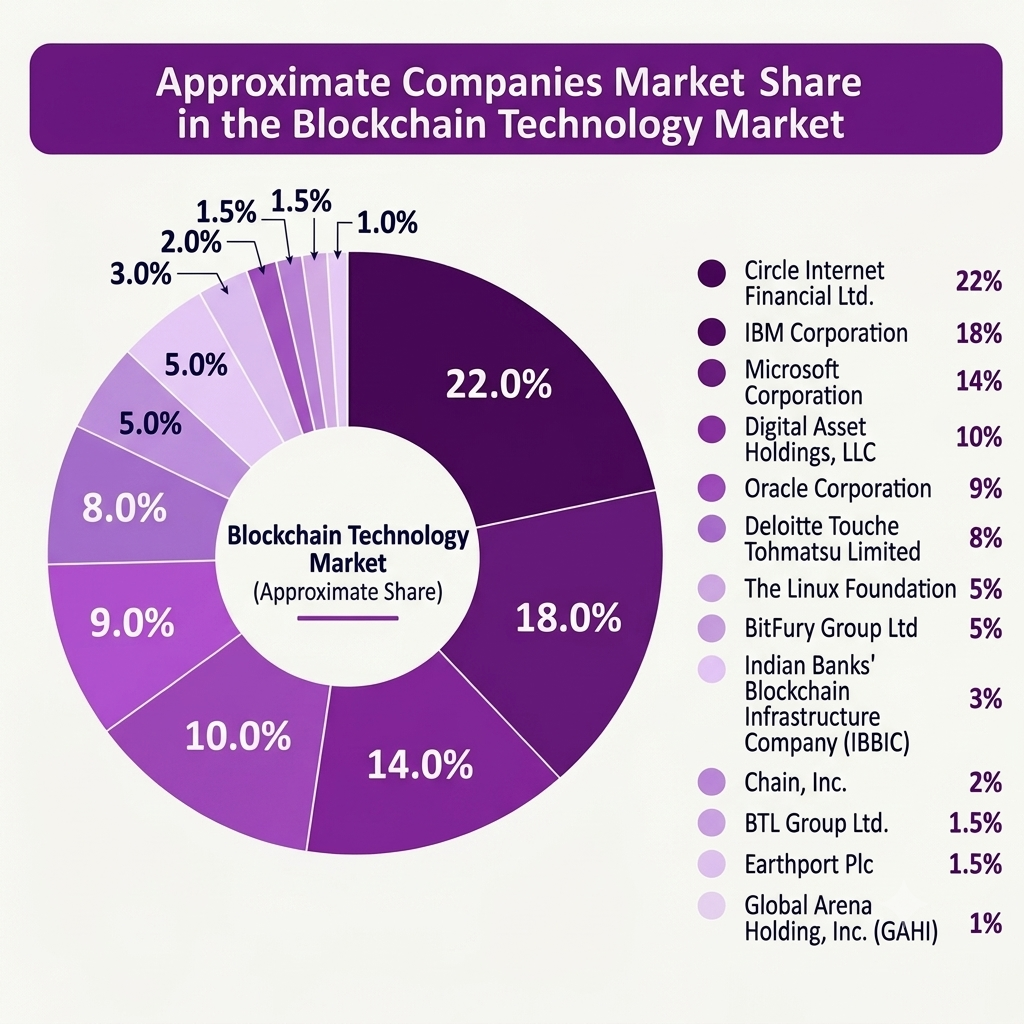
| Rank | Company | Estimated Share (%) | Basis for Estimate |
|---|---|---|---|
| 1 | Circle Internet Financial Ltd. | 22.0% | Q3 2026 revenue of USD 865 million, up 17% year over year; USDC volume of USD 13.9 trillion |
| 2 | IBM Corporation | 18.0% | Leading enterprise blockchain vendor through Hyperledger Fabric and its services business |
| 3 | Microsoft Corporation | 14.0% | Cloud infrastructure and the enterprise blockchain ecosystem around Azure |
| 4 | Digital Asset Holdings, LLC | 10.0% | Raised USD 355 million in 2026 to expand the Canton Network |
| 5 | Oracle Corporation | 9.0% | Oracle Blockchain Platform and its enterprise customers |
| 6 | Deloitte Touche Tohmatsu Limited | 8.0% | Blockchain consulting and integration |
| 7 | The Linux Foundation | 5.0% | Governs the Hyperledger open-source projects |
| 8 | BitFury Group Ltd | 5.0% | Mining hardware and blockchain infrastructure |
| 9 | Indian Banks’ Blockchain Infrastructure Company (IBBIC) | 3.0% | Blockchain consortium for Indian banks |
| 10 | Chain, Inc. | 2.0% | Legacy enterprise ledger technology |
| 11 | BTL Group Ltd. | 1.5% | Niche enterprise DLT (Interbit) |
| 12 | Earthport Plc | 1.5% | Legacy cross-border payment network |
| 13 | Global Arena Holding, Inc. (GAHI) | 1.0% | Micro-cap blockchain election and identity services |
Top Companies List
- Circle Internet Financial Ltd.
- IBM Corporation
- Microsoft Corporation
- Digital Asset Holdings, LLC
- Oracle Corporation
- Deloitte Touche Tohmatsu Limited
- The Linux Foundation
- BitFury Group Ltd
- Indian Banks’ Blockchain Infrastructure Company Private Limited (IBBIC)
- Chain, Inc.
- BTL Group Ltd.
- Earthport Plc
- Global Arena Holding, Inc. (GAHI)
Circle Internet Financial Ltd.
About Circle Internet Financial Ltd.
Circle issues USDC and EURC, regulated stablecoins backed by fully reserved dollar and euro assets. Its strength is regulatory trust combined with deep exchange and payment distribution. Its blockchain footprint includes a 27% share of the fiat-backed stablecoin market, a payments network (CPN) processing USD 41.3 billion a year, and Arc, its own blockchain network.
a) Company Overview Table
| Attribute | Company Data |
|---|---|
| Circle Internet Financial Ltd. | Operating subsidiary of Circle Internet Group, Inc.; issues the USDC and EURC stablecoins |
| Ticker Symbol | NYSE: CRCL (Circle Internet Group, Inc.) |
| Industry | Financial technology: stablecoins, blockchain payments and onchain financial infrastructure |
| Headquarters | New York, New York, USA |
| Founded | 2013 |
| Founders | Jeremy Allaire and Sean Neville |
| Current CEO | Jeremy Allaire (Co-founder, CEO and Chairman) |
| Latest Quarterly Revenue | USD 865 million total revenue and reserve income (Q3 2026) |
| YoY Revenue Growth | 17% (including USD 182 million of one-time ARC token presale revenue) |
| Primary Segments | Stablecoin reserve income (USDC, EURC), Circle Payments Network (CPN), Arc blockchain network and ARC token, developer and enterprise services |
b) Financial Details
Circle’s total revenue and reserve income were USD 865 million in Q3 2026, up 17% year over year. That growth relied on USD 182 million of one-time revenue from the ARC token presale, which lifted other revenue 627% to USD 207 million. Reserve income, the core of the business, fell 8% to USD 658 million because the yield on reserves dropped 61 basis points to 3.5%.
That decline more than offset 8% growth in average USDC circulation, which reached USD 73.3 billion. USDC on-chain transaction volume rose 49% to USD 13.9 trillion, and meaningful wallets (those holding more than USD 10) increased 16% to 7.3 million. Distribution costs fell 8% to USD 412 million, which widened the margin after those costs (RLDC) by 1,291 basis points to 52%.
Net income from continuing operations rose 5% to USD 226 million, and adjusted EBITDA rose 85% to USD 317 million. Circle’s market share slipped 183 basis points to 27%, and USDC circulation at the end of the quarter was flat year over year at USD 73.9 billion. Circle also cut about 5% of its workforce.
c) Strategic Developments
- Tazapay acquisition (agreement signed Q3 2026): Circle agreed to buy Tazapay, a Singapore-based B2B cross-border payments platform with more than USD 25 billion in annualised volume and payout rails in over 100 markets. About 60% of Tazapay’s volume already uses stablecoins. The deal is expected to close in 2027, pending regulatory approvals.
- Arc public mainnet (September 16, 2026): Arc, Circle’s own layer-one blockchain, went live with more than 100 institutional builders and native USDC. Circle minted the full 10 billion ARC token supply and plans to move the network to proof of stake in 2027.
- Binance strategic investment: A USD 100 million equity investment, plus an expanded and renewed partnership to promote USDC worldwide, with an emphasis on emerging markets.
- Visa Direct: Visa moved its USDC prefunding for cross-border payouts out of pilots and into commercial use across more than 180 countries, through Inyo Global.
- Tereina and SAP ecosystem: USDC and EURC are being integrated into Tereina’s enterprise payment infrastructure, starting within the SAP ecosystem.
- Samsung Wallet: Eligible Galaxy users in the US can now send USDC to bank accounts in more than 60 countries, with payouts in local currency.
- Allaria (Argentina) and Volante Technologies: Partnerships to deepen USDC liquidity in Argentina and to integrate stablecoin settlement into banks’ payment operations.
- Chelsea FC principal partnership: Circle and USDC branding appear on the front of Chelsea’s shirts from the 2026/27 season.
IBM Corporation
About IBM Corporation
IBM gives regulated institutions the infrastructure to run blockchain and digital assets securely. Its flagship is Digital Asset Haven, a wallet, custody, and transaction platform built with Dfns, running on IBM Z and LinuxONE mainframes. IBM’s main advantages are its security and compliance credentials and its existing relationships with banks. It also contributed early code to Hyperledger Fabric and now connects clients to SWIFT’s shared ledger.
a) Company Overview Table
| Attribute | Company Data |
|---|---|
| IBM Corporation | International Business Machines Corporation, a publicly listed hybrid cloud, AI, consulting, and infrastructure company |
| Ticker Symbol | NYSE: IBM |
| Industry | Information technology: enterprise software, hybrid cloud, consulting and infrastructure, including blockchain and digital asset platforms |
| Headquarters | Armonk, New York, USA |
| Founded | 1911 (as Computing-Tabulating-Recording Company; renamed IBM in 1924) |
| Founders | Charles Ranlett Flint |
| Current CEO | Arvind Krishna (Chairman and CEO) |
| Latest Quarterly Revenue | USD 17.1 billion company-wide (Q3 2026); blockchain revenue not reported separately |
| YoY Revenue Growth | 5% (6% at constant currency); software up 8% |
| Primary Segments | Software (including Red Hat and Digital Asset Haven), Consulting (including blockchain services), Infrastructure (IBM Z and LinuxONE for digital asset workloads), Financing |
b) Financial Details
IBM doesn’t report revenue from blockchain or digital assets separately; that work is included in its Software, Consulting and Infrastructure results. In Q3 2026, IBM’s revenue was USD 17.1 billion, up 5% (6% at constant currency), with operating earnings of USD 2.95 per share, up 11%, and free cash flow of USD 3.0 billion, up USD 700 million. Software, which includes Digital Asset Haven, grew 8% to USD 7.8 billion, and Red Hat grew 11%.
Infrastructure grew 4%, even though IBM Z revenue fell against a strong prior-year quarter. That matters because Digital Asset Haven offers a hybrid version running on IBM Z and LinuxONE mainframes. Consulting revenue, where blockchain services sit, was flat (up 2% at constant currency).
IBM has been moving its blockchain business away from owning the underlying technology and toward selling platforms and infrastructure. In July 2026, it sold most of its blockchain patents to Circle, while continuing to grow Digital Asset Haven with institutions.
c) Strategic Developments
- Swift shared ledger integration (September 24, 2026): In beta, Digital Asset Haven clients can connect to Swift’s blockchain-based shared ledger for tokenized deposit transactions 24/7, using an ISO 20022 messaging adapter.
- Digital Asset Haven on-premises (September 24, 2026): An on-premises beta lets institutions manage stablecoins and tokenized deposits entirely in their own data centres.
- Sale of blockchain patents to Circle (July 27, 2026): Circle bought most of IBM’s blockchain patent portfolio, more than 680 patent families and nearly 1,000 issued patents covering banking, financial services, insurance, supply chain and secure cloud. Circle became the largest holder of blockchain patents in the US.
- Digital Asset Haven launch (October 27, 2025): Built with Dfns, the platform covers wallets, custody and transaction orchestration across public and private blockchains, with built-in identity checks (KYC), anti-money-laundering (AML) controls and yield services. It is available as SaaS or as a hybrid on IBM Z and LinuxONE.
- Hyperledger legacy: IBM was a founding code contributor to Hyperledger Fabric, the permissioned blockchain framework hosted by the Linux Foundation.
Microsoft Corporation
About Microsoft Corporation
Microsoft offers blockchain mainly through cloud infrastructure rather than its own blockchain network. Its key product is Azure Confidential Ledger, a tamper-proof record store backed by blockchain technology that runs in hardware-protected secure enclaves. Its advantage is Azure’s scale and its security certifications. Customers use the ledger for audit trails, regulatory compliance, and verified records, rather than for cryptocurrency or tokens.
a) Company Overview Table
| Attribute | Company Data |
|---|---|
| Microsoft Corporation | Publicly listed cloud, AI, software and devices company |
| Ticker Symbol | NASDAQ: MSFT |
| Industry | Information technology: cloud computing, enterprise software and AI infrastructure, including blockchain-backed ledger services |
| Headquarters | Redmond, Washington, USA |
| Founded | 1975 |
| Founders | Bill Gates and Paul Allen |
| Current CEO | Satya Nadella (Chairman and CEO) |
| Latest Quarterly Revenue | USD 92.3 billion company-wide (Q1 FY2027, quarter ended September 30, 2026); blockchain revenue not reported separately |
| YoY Revenue Growth | 19%; Azure up 48% to USD 33.2 billion |
| Primary Segments | Agents and Infra (including Azure, which hosts Azure Confidential Ledger), Devices and Consumer, Microsoft Cloud (Azure and Microsoft 365 commercial cloud) |
b) Financial Details
Microsoft doesn’t report revenue from blockchain or distributed ledgers separately. Azure Confidential Ledger is priced by usage and counted within Azure, part of the new Agents and Infra segment. In Q1 FY2027, total revenue was USD 92.3 billion, up 19%, ahead of the consensus estimate of about USD 90.6 billion. Agents and Infra grew almost 25% to USD 76.8 billion. Microsoft Cloud grew 30% to USD 63.9 billion, and Azure, disclosed in dollars for the first time, grew 48% to USD 33.2 billion. Devices and Consumer fell 3% to USD 15.5 billion.
Microsoft guided FY2027 Q2 revenue to USD 96 billion to USD 97.1 billion, growth of 18% to 19%. For blockchain, the relevant point is that Microsoft now sells blockchain-backed tools for trust and audit within Azure security services. It has moved away from managed blockchain networks: the 2019 Azure Blockchain Service built with J.P. Morgan’s Quorum has been discontinued, and the current focus is Confidential Ledger.
c) Strategic Developments
- Azure Confidential Ledger documentation updated (October 2026): The ledger is now one workload of the Confidential Computing Ledger platform, alongside Microsoft’s Signing Transparency Ledger. It is a customer-managed, append-only ledger running in secure hardware enclaves.
- Ignite 2026 (November 17–20, 2026): Microsoft published security guidance for Confidential Computing Ledger workloads, covering network security, identity and access controls, and data integrity.
- Verified records for industry (November 2026): A Microsoft reference design uses Azure Confidential Ledger to seal hourly production records for certifying green hydrogen exports, an example of the ledger being used to prove compliance.
- Azure Blockchain Service (legacy): Launched in 2019 with J.P. Morgan’s Quorum as its first ledger, with planned support for R3 Corda. Microsoft had worked with the Ethereum, Corda and Hyperledger communities since 2015. The service has since been retired.
- Blockchain-specific deals: I found no blockchain-specific acquisitions, funding rounds or partnerships announced in 2026.
Digital Asset Holdings, LLC
About Digital Asset Holdings, LLC
Digital Asset created the Canton Network, which it describes as the only public layer-one blockchain with institutional-grade privacy. Canton is built for regulated capital markets. Its advantage is the Daml smart-contract language, privacy controls that meet regulatory requirements, and backing from major institutions such as DTCC, Goldman Sachs and Tradeweb. More than 700 organisations participate in its ecosystem, using it for tokenized Treasuries, collateral and settlement.
a) Company Overview Table
| Attribute | Company Data |
|---|---|
| Digital Asset Holdings, LLC | Privately held blockchain infrastructure company; creator of the Canton Network and a founding member of the Canton Foundation |
| Ticker Symbol | Not publicly listed (private company) |
| Industry | Blockchain technology: privacy-enabled layer-one infrastructure for regulated financial markets |
| Headquarters | New York, New York, USA |
| Founded | 2014 |
| Founders | Yuval Rooz, Shaul Kfir, Eric Saraniecki and Sunil Hirani |
| Current CEO | Yuval Rooz (Co-founder and CEO) |
| Latest Quarterly Revenue | Not disclosed (private); raised USD 355 million in June 2026, later expanded |
| YoY Revenue Growth | Not disclosed; pre-round reports cited a target valuation of about USD 2 billion |
| Primary Segments | Canton Network (public layer one with Global Synchronizer and Canton Coin), Daml smart-contract platform, tokenization and collateral mobility, settlement and payment applications |
b) Financial Details
Digital Asset doesn’t publish financial results, and the size of its revenue is unknown. The best guide to its momentum is its funding. On June 11, 2026, it announced a USD 355 million round led by a16z crypto. Investors included Apollo, BNP Paribas, Broadridge, Citadel Securities, CME Ventures, Coinbase Ventures, HSBC, S&P Global, SoFi, Tradeweb and a subsidiary of the Abu Dhabi Investment Authority. On July 21, 2026, it added Shinhan Financial Group and Standard Chartered as strategic investors.
This round follows a USD 135 million raise in June 2025 and strategic investments from BNY, iCapital, Nasdaq and S&P Global in December 2025. The money will go toward expanding Canton’s tokenization, collateral mobility, settlement and payment uses. Canton is now in commercial use, not just pilots. Tradeweb facilitated an on-chain US Treasuries transaction in July 2026, and DTCC is tokenizing US Treasury securities it holds in custody on Canton.
c) Strategic Developments
- USD 355 million funding round (June 11, 2026): Led by a16z crypto, with Citadel Securities, HSBC, BNP Paribas, Apollo, CME Ventures, Coinbase Ventures and others. The deal also starts a strategic partnership with a16z crypto.
- Round expanded (July 21, 2026): Shinhan Financial Group and Standard Chartered joined as strategic investors in the oversubscribed round.
- Real-world asset collaboration (November 10, 2026): A strategic collaboration to speed up moving real-world asset transactions onto blockchain.
- OpenAssets partnership (November 5, 2026): A partnership to modernise capital markets infrastructure on Canton.
- American Idea Foundation RISE pilot (August 21, 2026): A first-of-its-kind pilot distributing benefit payments on Canton.
- Japanese market expansion (2026): A proof of concept for repo transactions in Japanese government bonds on-chain with Mitsubishi UFJ Trust and Banking (August 13). A multi-chain wallet partnership with BOOSTRY (August 3). A memorandum of understanding with Hanwha Securities (April 22). A trial of digital collateral management using Japanese government bonds (April 20).
- Tradeweb on-chain Treasuries (July 1, 2026): Tradeweb facilitated a landmark on-chain US Treasuries transaction on Canton.
- HQLAX strategic investment (April 21, 2026): Digital Asset and Broadridge invested in HQLAX, a collateral mobility platform, to support its growth on Canton.
- DTCC partnership (December 17, 2025): To tokenize US Treasury securities held in custody at DTC on Canton.
- Earlier backers and partners: USD 135 million raised (June 2025). Strategic investments from BNY, iCapital, Nasdaq and S&P Global (December 2025). Franklin Templeton’s Benji platform and Chainlink partnerships (2025).
Oracle Corporation
About Oracle Corporation
Oracle sells enterprise blockchain infrastructure built on Hyperledger Fabric and Besu, through Oracle Blockchain Platform and Digital Assets Data Nexus. Banks can use them to issue and run stablecoins, tokenized deposits, CBDCs, and real-world assets. Oracle’s advantage is that these tools plug into its existing banking software, including Oracle Banking Payments, and support ISO 20022 messaging. It also connects to Swift’s ledger.
a) Company Overview Table
| Attribute | Company Data |
|---|---|
| Oracle Corporation | Publicly listed database, cloud infrastructure and enterprise applications company |
| Ticker Symbol | NYSE: ORCL |
| Industry | Information technology: cloud infrastructure, enterprise software and databases, including blockchain and digital asset platforms |
| Headquarters | Austin, Texas, USA |
| Founded | 1977 |
| Founders | Larry Ellison, Bob Miner and Ed Oates |
| Current CEO | Mike Sicilia (CEO) |
| Latest Quarterly Revenue | USD 19.35 billion company-wide (Q1 FY2027, quarter ended August 31, 2026); blockchain revenue not reported separately |
| YoY Revenue Growth | 30% (cloud up 62%; cloud infrastructure up 121%) |
| Primary Segments | Cloud (OCI infrastructure and SaaS, including OCI Blockchain Platform), Software (license and support, including Oracle Blockchain Platform Enterprise Edition), Hardware, Services; industry applications such as Oracle Banking Payments and Digital Assets Data Nexus |
b) Financial Details
Oracle doesn’t report revenue from blockchain or digital assets separately. OCI Blockchain Platform is counted in cloud revenue, and the Enterprise Edition and Digital Assets edition in software and industry applications. In Q1 FY2027, total revenue rose 30% to USD 19.35 billion, ahead of the consensus estimate of USD 19.13 billion. Cloud revenue rose 62% to USD 11.6 billion.
Cloud infrastructure (OCI) grew 121% to USD 7.4 billion, and cloud applications grew 10% to USD 4.2 billion. Software revenue fell 3% to USD 5.55 billion, with licence revenue down 15%, as customers moved to the cloud. Remaining performance obligations, Oracle’s backlog of contracted revenue, reached a record USD 664 billion. Capital spending of USD 28.5 billion pushed free cash flow negative, to about minus USD 5 billion to minus USD 5.4 billion.
Non-GAAP EPS rose 30% to USD 1.92. Oracle expects FY2027 revenue of at least USD 90 billion. In blockchain, the most relevant development is Digital Assets Data Nexus, planned for availability in FY2027. It is aimed at banks moving stablecoins and tokenized deposits from pilots into production as the GENIUS Act and MiCA take effect, which gives Oracle a new source of revenue linked to its banking software.
c) Strategic Developments
- Digital Assets Data Nexus expansion (September 23, 2026): Adds payment integrations using ISO 20022 messaging, a prebuilt connection to Oracle Banking Payments, a Swift Ledger integration, controls for wallets and smart contracts, and AI-assisted risk and transaction oversight.
- Interoperability between banks: Data Nexus supports emerging models in which multiple banks exchange tokens, including Commercial Bank Money Token (CBMT) and Swift Ledger, covering tokenized deposits, stablecoins, CBDCs, digital bonds and real-world assets.
- Stablecoin payment at the till with SVRN (July 2026): Oracle Simphony POS and the Digital Assets Data Nexus teams completed a proof of concept with SVRN, adding stablecoin payments to Oracle’s retail checkout without slowing transactions or raising costs.
- Hyperledger Besu support: Oracle Blockchain Platform Enterprise Edition now supports governed digital asset applications on Hyperledger Besu, an Ethereum-compatible ledger, alongside Hyperledger Fabric.
- Blockchain Platform Digital Assets edition (February 11, 2025): Adds tokenization features, support for confidential payments, and prebuilt smart contracts for CBDCs, deposit tokens, stablecoins, securities and real-world assets.
- Bank tokenization strategy (September 2026): Oracle published guidance on tokenized deposits and stablecoins ahead of Sibos, describing banks as possible facilitators of x402 payments, a protocol for paying over the web with stablecoins.
- Blockchain-specific deals: I found no blockchain-specific acquisitions or funding rounds announced in 2026.
Deloitte Touche Tohmatsu Limited
About Deloitte Touche Tohmatsu Limited
Deloitte is the world’s largest professional services network. In blockchain and digital assets, it advises clients on strategy, builds and integrates systems, and handles audit, tax, risk and regulatory work. Its strength is pairing trusted assurance work with technology alliances: Digital Asset (Canton and Daml), Ava Labs (Avalanche) and Bitwave (accounting for digital assets).
a) Company Overview Table
| Attribute | Company Data |
|---|---|
| Deloitte Touche Tohmatsu Limited | UK private company limited by guarantee that coordinates the global Deloitte network of independent member firms |
| Ticker Symbol | Not publicly listed (owned by its partners) |
| Industry | Professional services: audit and assurance, consulting, tax and legal, risk and financial advisory, including blockchain and digital asset services |
| Headquarters | London, United Kingdom |
| Founded | 1845 |
| Founders | William Welch Deloitte |
| Current CEO | Joe Ucuzoglu (Deloitte Global CEO since December 2022) |
| Latest Quarterly Revenue | Not reported quarterly; FY2026 global revenue of USD 74.5 billion (year ended May 31, 2026); blockchain revenue not reported separately |
| YoY Revenue Growth | 5.7% in USD (3.8% in local currency) for FY2026 |
| Primary Segments | Audit & Assurance, Consulting, Tax & Legal, Strategy, Risk & Transactions; Blockchain & Digital Assets practice (advisory, tokenization, digital asset accounting and tax) |
b) Financial Details
Deloitte reports only annual revenue for the whole network and doesn’t break out blockchain or digital asset revenue. For FY2026, aggregate global revenue was USD 74.5 billion, up from USD 70.5 billion in FY2025. That was growth of 5.7% in US dollars, but only 3.8% in local currency, down from 4.8% the year before. Deloitte has about 470,000 people across more than 150 countries and territories, and remains the largest of the Big Four firms by revenue, ahead of PwC at USD 60.2 billion and EY at USD 57 billion.
Its blockchain work earns money across its businesses: advisory on token strategy and regulation, implementation through technology alliances, and specialist services in accounting, tax, and governance, risk and controls for digital assets. The new GENIUS Act and MiCA rules should increase demand for audits and reserve attestations from stablecoin issuers and banks.
c) Strategic Developments
- Digital Asset alliance (March 30, 2023): A strategic alliance to develop, build and launch smart-contract and blockchain solutions. It combines Deloitte’s strategy, implementation, risk, regulatory, cyber and tax work with Digital Asset’s DAML and Canton technology.
- Ava Labs alliance: Deloitte uses the open-source Avalanche blockchain for transparency, data auditing, checks on data health, tamper-evident logging and passwordless authentication.
- Bitwave alliance: Combines Bitwave’s software, which pulls data from more than 80 blockchains and DeFi ecosystems into ERP systems, with Deloitte’s accounting, tax and governance advisory.
- Global blockchain leadership: Deloitte has a global and US Tax Blockchain & Digital Assets practice, led by Rob Massey.
- Blockchain-specific deals: I found no blockchain acquisitions or strategic investments announced in 2026.
The Linux Foundation
About The Linux Foundation
The Linux Foundation is a neutral nonprofit that hosts open-source projects. In blockchain, it works through LF Decentralized Trust (LFDT), home to Hyperledger Fabric, Besu and Cacti, plus newer projects such as Chaguar and IBC. Its strength is neutral governance trusted by central banks and large financial institutions. According to LFDT, nearly 30% of institutional blockchain platforms that disclose their technology run on its projects.
a) Company Overview Table
| Attribute | Company Data |
|---|---|
| The Linux Foundation | Nonprofit technology consortium (a US 501(c)(6) trade association) hosting open-source projects, including LF Decentralized Trust |
| Ticker Symbol | Not applicable (nonprofit organisation) |
| Industry | Open-source software foundation: governance of blockchain, distributed ledger, digital identity and cryptography technologies |
| Headquarters | San Francisco, California, USA |
| Founded | 2000 (Open Source Development Labs, which merged with the Free Standards Group in 2007 to form the Linux Foundation); LF Decentralized Trust formed in 2024 |
| Founders | Formed through the merger of Open Source Development Labs and the Free Standards Group |
| Current CEO | Jim Zemlin (Executive Director); Daniela Barbosa (Executive Director, LF Decentralized Trust) |
| Latest Quarterly Revenue | Not reported quarterly (nonprofit); funded by membership dues, events, training and certification |
| YoY Revenue Growth | Not reported; LFDT added at least 29 members in 2026 announcements, including the Bank of Korea, the 10th central bank member |
| Primary Segments | LF Decentralized Trust (Hyperledger Fabric, Besu, Cacti, Chaguar, IBC, Panurus, Paladin, Lineth), digital identity and wallets (OpenWallet from January 2027), x402 agent payments initiative, LF Research |
b) Financial Details
The Linux Foundation doesn’t publish quarterly results, and LFDT’s income isn’t disclosed separately. The foundation is funded mainly by membership dues, events, training and certification. Its blockchain influence is better measured by how widely its projects are used and how many institutions join. LFDT’s 2026 Institutional Adoption Report, written by Ledger Insights and published on September 29, 2026, mapped 80 institutional platforms using LFDT technologies, all either in production or on a documented path to it.
Those platforms are linked to institutions such as DTCC, Euroclear, Clearstream, SWIFT, Citi, HSBC and BNP Paribas. LFDT says nearly 30% of institutional blockchain platforms that disclose their technology now run on its projects. Membership grew too: 10 new members in April, 15 in September, including SWIFT and Wells Fargo, and a Linea premier membership in May. Separately, the Linux Foundation’s 2026 State of Open Source in Financial Services report found a 63% year-over-year increase in GitHub commits from financial institutions.
c) Strategic Developments
- Four new projects (November 18, 2026): Chaguar, a high-performance ledger for digital assets contributed by IBM Research. IBC, contributed by Cosmos and used by more than 200 ledgers. Also ThunderID from WSO2 and espuni, the first project to move over from OpenWallet.
- Open Financial Trust Alliance (November 2026): The Linux Foundation launched an alliance against fraud with Cifas, The Knoble, MEF and the Stop Scams Alliance, using its Tazama project.
- Swift, Wells Fargo and 13 new members (September 24, 2026): Also launched Panurus, a token project already used in CBDC deployments, the CLPR cross-ledger protocol lab from Hedera, and Hyperledger Cacti 3.0.
- OpenWallet Foundation consolidation (announced September 1, 2026): OpenWallet’s wallet and credential projects become part of LFDT on January 1, 2027.
- x402 AI-payment initiative (July 2026): Ripple joined the Linux Foundation’s x402 effort, bringing XRP and RLUSD into open-source infrastructure for payments made by AI agents.
- Linea premier membership (May 5, 2026): Linea became the first major Ethereum layer-two network to put its core technology under neutral governance, contributing the Linea Stack as the Lineth project.
- Ten new members and OTAS lab (April 21, 2026): New members included Matter Labs, Espresso Systems and Horizen. The Open Tokenized Asset Standard became an LFDT lab.
- Bank of Korea and Paladin (January 27, 2026): The Bank of Korea became the 10th central bank member, and LFDT launched Paladin, a programmable privacy framework. OpenAssets also joined as a premier member with a seat on the governing board.
BitFury Group Ltd
About BitFury Group Ltd
BitFury started in Bitcoin mining in 2011 and developed eight generations of mining chips and data-centre designs. It is now a technology investment firm and incubator with a USD 1 billion initiative. Its strength is a portfolio built on that hardware background, spanning web3, AI and sustainable computing. In blockchain, it holds stakes in Cipher Mining, Hut 8, Crystal blockchain analytics and Shyft Network.
a) Company Overview Table
| Attribute | Company Data |
|---|---|
| BitFury Group Ltd | Privately held technology incubator and investment firm, formerly a Bitcoin mining and blockchain infrastructure company |
| Ticker Symbol | Not publicly listed (private company) |
| Industry | Blockchain technology and emerging-technology investment: web3 and digital assets, AI, sustainable high-performance computing |
| Headquarters | Amsterdam, Netherlands (historical base; CEO based in Abu Dhabi, UAE) |
| Founded | 2011 |
| Founders | Valery Vavilov and Valery Nebesny |
| Current CEO | Val Vavilov (Co-founder, CEO and Chairman) |
| Latest Quarterly Revenue | Not disclosed (private); USD 1 billion investment initiative launched November 2025 |
| YoY Revenue Growth | Not disclosed; last disclosed valuation about USD 1 billion (Series C, November 2018) |
| Primary Segments | Web3 and digital asset investments (Cipher Mining, Hut 8, Crystal, Shyft Network), decentralised AI compute (Gonka), sustainable HPC (LiquidStack immersion cooling), AI hardware (Axelera AI) |
b) Financial Details
BitFury doesn’t publish financial results, and there is no recent quarter to analyse. Its last disclosed fundraising was an USD 80 million Series C in November 2018, led by Bryan, Garnier & Co, which valued it at about USD 1 billion. Investors included Galaxy Digital, Macquarie Capital, Dentsu, and Korelya Capital. The more important recent event is its change of business model. On November 18, 2025, BitFury announced it had become an investment firm, with a USD 1 billion initiative that it said was already fully funded from past operations, successful investments and its network of investors.
Two weeks later, on December 2, 2025, it committed USD 50 million to Gonka, its first major investment in decentralised AI compute. Its blockchain value now comes mainly from its stakes in listed mining and infrastructure companies, Cipher Mining (NASDAQ: CIFR) and Hut 8, and in the analytics firm Crystal. That shifts its exposure from running mining operations to the value of its investment portfolio.
c) Strategic Developments
- USD 1 billion initiative (November 18, 2025): BitFury turned into an investment firm and technology incubator backing companies in web3, AI and sustainable computing. It said the money was already fully secured.
- Gonka investment (December 2, 2025): Committed USD 50 million to Gonka, a decentralised network for high-efficiency AI compute.
- Web3 and digital asset portfolio: Stakes in Cipher Mining (data centres for HPC and Bitcoin mining), Hut 8 (mining and blockchain infrastructure, set up through an exclusive partnership with BitFury), Crystal (analytics for crypto compliance and investigating crypto crime) and Shyft Network.
- Infrastructure for computing: Incubated LiquidStack, which makes two-phase immersion cooling for data centres, and co-founded Axelera AI, a maker of AI chips.
- Mining legacy: Opened a 28 MW digital-asset mining data centre in Sarnia, Ontario, and launched Exonum, an open-source enterprise blockchain framework.
- Industry groups: Founding member of the Global Blockchain Business Council and the Blockchain Alliance, and co-founder of the Blockchain Trust Accelerator in 2016.
Indian Banks’ Blockchain Infrastructure Company Private Limited (IBBIC)
About Indian Banks’ Blockchain Infrastructure Company Private Limited (IBBIC)
IBBIC, now renamed IBDIC, builds shared infrastructure on blockchain for India’s banks, insurers and financial companies. It focuses on trade and supply-chain finance. Its strength is joint ownership by 18 leading banks, which gives its network an advantage that standalone vendors lack. Its products include letters of credit (LCs) on blockchain and tokenized invoice financing that passed the RBI’s regulatory sandbox.
a) Company Overview Table
| Attribute | Company Data |
|---|---|
| Indian Banks’ Blockchain Infrastructure Company Private Limited (IBBIC) | Now Indian Banks’ Digital Infrastructure Company (IBDIC) Private Limited; a digital public infrastructure company owned by a consortium of banks |
| Ticker Symbol | Not publicly listed (private company; CIN U72900MH2021PTC361017) |
| Industry | Blockchain and digital public infrastructure for financial services: trade finance, supply-chain finance and lending |
| Headquarters | Mumbai, Maharashtra, India |
| Founded | 2021 (incorporated May 2021 as IBBIC; later renamed IBDIC) |
| Founders | 15 founding banks, expanded to 18 equity shareholders: Axis Bank, Bank of Baroda, Canara Bank, Federal Bank, HDFC Bank, ICICI Bank, IDBI Bank, IDFC Bank, Indian Bank, IndusInd Bank, Kotak Bank, PNB, RBL Bank, SBI, Standard Chartered Bank, South Indian Bank, Union Bank of India and Yes Bank |
| Current CEO | Ashish Singhal (Chief Executive Officer) |
| Latest Quarterly Revenue | Not disclosed (private; not reported quarterly); paid-up capital ₹23.4 crore |
| YoY Revenue Growth | -6.49% total revenue change in FY2025 (Tofler, year ended March 2025); amount not disclosed |
| Primary Segments | Inland letters of credit on blockchain and document verification for trade finance, tokenized deep-tier supply-chain financing for MSMEs, digital trust infrastructure, utilities for exporters (EDF generation) |
b) Financial Details
IBDIC doesn’t publish quarterly results, and full figures are only available from paid company-data services. Tofler’s most recent data, for the year ended March 2025, shows paid-up capital of ₹23.4 crore and a 6.49% fall in total revenue, but doesn’t disclose the revenue amount. The company is small, with 11 to 50 employees according to LinkedIn. It works as a shared utility for its owner banks rather than as a profit-focused company.
The best measure of its progress is regulatory: in August 2025, the RBI found its blockchain platform for deep-tier MSME financing viable at the end of the sandbox’s fifth cohort. On that platform, a supplier’s invoice accepted by a large buyer is turned into a token and passed down the supply chain instead of cash, and lenders fund smaller suppliers against those tokens. ICICI Bank, HDFC Bank, Yes Bank and Aditya Birla Capital were the partners in the test. Regulated lenders may now adopt the product. In the earlier pilot for LCs on blockchain, processing time fell about 75%, from 8–9 days to 2–3 days.
c) Strategic Developments
- Exit from the RBI sandbox (August 14, 2025): The RBI found IBDIC’s tokenized deep-tier MSME financing viable, with ICICI Bank, HDFC Bank, Yes Bank and Aditya Birla Capital as partners. It is now cleared for adoption by regulated lenders.
- Selected for the RBI sandbox test (July 26, 2024): IBDIC was one of five entities chosen from 22 applicants for the fifth cohort of the RBI’s regulatory sandbox.
- Letters of credit on blockchain (December 2023): The Indian Banks’ Association told Parliament that IBDIC was scoping domestic LC issuance on blockchain as a core use case.
- Rename and expansion: The company was renamed from IBBIC to IBDIC and grew from 15 to 18 owner banks. Its scope widened from blockchain-based LCs to payments, lending, compliance and digital trust infrastructure.
- Infosys Finacle partnership (founding): Its first platform for inland LCs was built on Infosys Finacle Connect.
- Exporter utility (2026): Launched a tool that generates exporters’ EDF forms from their invoice details.
- Competing RBI pilot: The RBI separately ran a pilot for digital LCs on blockchain with banks including SBI, HDFC and ICICI. One industry official suggested it could become an alternative to IBDIC’s platform.
Chain, Inc.
About Chain, Inc.
Chain was an early enterprise blockchain pioneer in San Francisco, backed by Visa, Nasdaq and Citi. It built Chain Core, an open-source distributed ledger for issuing and transferring financial assets. Its strength was partnerships with major financial institutions. Lightyear acquired it in 2018 to form Interstellar. The current Chain business offers stablecoin infrastructure built on the Onyx blockchain.
a) Company Overview Table
| Attribute | Company Data |
|---|---|
| Chain, Inc. | Former enterprise blockchain company, acquired by Lightyear Corporation in September 2018 to form Interstellar; the Chain brand is now used by a separate stablecoin infrastructure business (chain.com) |
| Ticker Symbol | Not publicly listed (former private company); associated Onyx Protocol token: XCN (crypto token, not equity) |
| Industry | Blockchain technology: enterprise distributed ledgers (historical); stablecoin payment infrastructure (current chain.com) |
| Headquarters | San Francisco, California, USA (historical) |
| Founded | 2014 |
| Founders | Adam Ludwin and Devon Gundry |
| Current CEO | Not applicable after the 2018 acquisition; Adam Ludwin was co-founder and CEO until then |
| Latest Quarterly Revenue | Not applicable (acquired 2018; revenue never disclosed); about USD 200 million deal value reported by Fortune |
| YoY Revenue Growth | Not applicable (acquired 2018); more than USD 40 million in venture capital raised before acquisition |
| Primary Segments | Historical: Chain Core (open-source enterprise ledger), Sequence (ledger as a service). Current chain.com: stablecoin infrastructure for payments, cards and wallets, Chain for Banks, Onyx blockchain ledger |
b) Financial Details
There are no recent quarterly results for the original Chain, Inc., and it never disclosed revenue. On September 10, 2018, Chain announced it had been acquired by Lightyear Corporation, the Stellar-focused company backed by the Stellar Development Foundation. Terms weren’t disclosed, but Fortune reported a value of about USD 200 million. The Chain and Lightyear brands were retired, the combined company became Interstellar, and Chain’s enterprise customers and products moved to Stellar’s public ledger.
Before the deal, Chain had raised more than USD 40 million, including a USD 30 million Series B in September 2015 from Visa, Nasdaq, Citi Ventures, Capital One, Fiserv and Orange. The current Chain.com business sells stablecoin infrastructure for payments, cards and wallets, recording transactions on the Onyx blockchain. Under its Chain for Banks model, client banks stay at the centre of transactions and Chain doesn’t hold client funds. That business doesn’t disclose any financial results.
c) Strategic Developments
- Acquisition by Lightyear (September 10, 2018): Lightyear Corporation acquired Chain, the brands were retired and the combined company became Interstellar on the Stellar network. Fortune reported a value of about USD 200 million.
- StellarX launch: After the merger, Interstellar launched StellarX, a marketplace for trading assets on Stellar. The Stellar Development Foundation remained independent.
- Chain Core goes open source (October 24, 2016): Chain released its enterprise blockchain platform for anyone to download and run, instead of limiting it to partner institutions.
- USD 30 million Series B (September 2015): From Visa, Nasdaq, Citi Ventures, Capital One, Fiserv and Orange, alongside a Blockchain Working Group formed with those investors to work on interoperability.
- Onyx and the current chain.com business: A stablecoin infrastructure business now operates under the Chain brand, recording transactions on the Onyx blockchain. Some sources say Chain later evolved into the Onyx Protocol and its XCN token.
BTL Group Ltd.
About BTL Group Ltd.
BTL Group was a Canadian-British enterprise blockchain company and Canada’s first publicly listed blockchain company. It developed Interbit, a private, Java-based platform for settling trades in assets across multiple chains. Its standout achievement was a successful energy trading pilot with BP, Eni and Wien Energie. It left the blockchain business in 2020 and is now North Peak Resources.
a) Company Overview Table
| Attribute | Company Data |
|---|---|
| BTL Group Ltd. | Former enterprise blockchain company; renamed Interbit Ltd. (January 2019), then North Peak Resources Ltd. (June 2020); blockchain patents sold in 2021 |
| Ticker Symbol | Formerly TSXV: BTL and OTC: BTLLF; then TSXV: IBIT (from January 10, 2019); now trades as North Peak Resources Ltd. |
| Industry | Blockchain technology: enterprise private blockchain platform (historical); now mineral exploration (North Peak Resources) |
| Headquarters | Vancouver, British Columbia, Canada (historical offices in Vancouver, Calgary and London) |
| Founded | 2015 (listed on the TSX Venture Exchange on November 10, 2015) |
| Founders | Guy Halford-Thompson and Hugh Halford-Thompson |
| Current CEO | Not applicable (blockchain business exited); last disclosed BTL CEO was Dominic McCann (2018), with Brian Hinchcliffe as Executive Chairman |
| Latest Quarterly Revenue | Not applicable (blockchain operations ended in 2020) |
| YoY Revenue Growth | Not applicable (blockchain operations ended in 2020); peak market capitalisation about CAD 250 million (2017) |
| Primary Segments | Historical: Interbit platform (multi-chain asset settlement, APIs and smart contracts), energy trading confirmation solutions, prototypes for interbank payments and settlement |
b) Financial Details
BTL has no recent blockchain financial results, because the company left the sector in 2020. At its peak, BTL billed itself as the world’s first publicly listed blockchain company. It listed on the TSX Venture Exchange in November 2015 and reached a market capitalisation of about CAD 250 million within three years. But Interbit never moved from trials into large-scale commercial use.
The 12-week energy trading pilot with BP, Eni Trading & Shipping and Wien Energie passed all eight test scenarios in June 2017, but BTL’s later plan to put it into production never produced meaningful revenue. Co-founder Guy Halford-Thompson stepped down as CEO in October 2017 and left the board in July 2018. The company renamed itself Interbit Ltd. in January 2019, became North Peak Resources Ltd. in June 2020 and sold its remaining blockchain patents in 2021, ending its presence in blockchain.
c) Strategic Developments
- Blockchain patents sold (2021): BTL’s remaining blockchain intellectual property was sold after it left the sector.
- Change to North Peak Resources (June 2020): The company left blockchain and became a mineral exploration company.
- Renamed Interbit Ltd. (January 10, 2019): The new name matched its main product. Shares began trading on the TSX Venture Exchange as IBIT.
- Co-founder departs (July 30, 2018): Guy Halford-Thompson left the board, having stepped down as CEO in October 2017.
- Energy pilot completed (June 5, 2017): BP, Eni Trading & Shipping and Wien Energie completed a 12-week Interbit pilot for confirming energy trades, and more participants were invited into a production phase.
- Energy pilot launched (February 14, 2017): Started an Interbit blockchain pilot with Wien Energie, Austria’s largest regional energy company, and other major energy firms.
- Interbit launch (January 18, 2016): BTL launched its enterprise blockchain platform.
Earthport Plc
About Earthport Plc
Earthport ran one of the world’s largest independent cross-border payment networks, built on local bank-transfer (ACH) systems and reaching more than 60 countries. Its strength was a hub model: banks and money-transfer operators needed only one relationship with Earthport. In blockchain, it launched what it called the world’s first Distributed Ledger Hub, connecting clients to Ripple. Visa acquired it in 2019.
a) Company Overview Table
| Attribute | Company Data |
|---|---|
| Earthport Plc | Former UK cross-border payments network; acquired by Visa Inc. (completed May 8, 2019) and now part of Visa |
| Ticker Symbol | Formerly AIM: EPO (delisted after the acquisition); now part of Visa Inc. (NYSE: V) |
| Industry | Payments infrastructure: cross-border payments over local bank-transfer networks, with access to distributed ledgers (Ripple) |
| Headquarters | London, United Kingdom |
| Founded | 1997 |
| Founders | Not publicly documented in available sources |
| Current CEO | Not applicable (Visa subsidiary); last disclosed CEO before the acquisition was Hank Uberoi |
| Latest Quarterly Revenue | Not applicable (acquired 2019); last reported full-year revenue £31.9 million (FY2018, year ended June 30, 2018) |
| YoY Revenue Growth | 5.3% (FY2018 vs FY2017 revenue of £30.3 million) |
| Primary Segments | Historical: cross-border payments network over local ACH systems, Distributed Ledger Gateway and Hub (Ripple connectivity), payout services for banks, money-transfer operators and businesses |
b) Financial Details
Earthport has no recent quarterly results because it has been part of Visa since 2019 and Visa doesn’t report it separately. In its final trading update as an independent company, for the year ended June 30, 2018, revenue grew 5.3% to £31.9 million. Its business was shrinking, though: transactions fell to 10.5 million from 11.0 million, and the value of payments fell to USD 16.9 billion from USD 17.5 billion. Administrative expenses rose 9.1% to £28.8 million, equal to 90% of revenue, and the adjusted operating loss was £8.4 million.
Those losses made Earthport a takeover target. Visa made a recommended cash offer in December 2018, Mastercard made a competing offer in January 2019, and Visa’s deal of about USD 250.6 million completed on May 8, 2019. Its blockchain business was the Distributed Ledger Hub, which gave clients access to Ripple’s network for real-time settlement through a single API. It never produced revenue that Earthport reported separately.
c) Strategic Developments
- Visa acquisition (completed May 8, 2019): Visa acquired control of Earthport for about USD 250.6 million, adding its bank-transfer payment network to Visa’s cross-border and B2B services.
- Competing Mastercard offer (January 25, 2019): Mastercard UK Holdco made an all-cash offer, but Visa’s higher offer won.
- Visa’s recommended offer (December 27, 2018): Visa announced a cash offer structured as a scheme of arrangement under English company law.
- Distributed Ledger Hub launch (January 12, 2016): Earthport presented it as the world’s first distributed ledger hub, giving clients full access to the Ripple ecosystem, including private Ripple setups and market makers, through a single API.
- Distributed Ledger Gateway (August 2015): Earthport’s first distributed ledger service, combining Ripple’s near-real-time settlement with Earthport’s network of local bank-transfer systems.
- Exploration with R3 and Ripple: CEO Hank Uberoi said Earthport was exploring blockchain for trade finance and cash management through both R3 and Ripple.
Global Arena Holding, Inc. (GAHI)
About Global Arena Holding, Inc. (GAHI)
Global Arena Holding is a micro-cap US holding company traded on the OTC market. Its blockchain exposure came from a 2015 investment in Blockchain Technologies Corp. and a 30% stake in TrueVote, which was developing blockchain-based digital voting. It had no lasting technical advantage: its blockchain subsidiary is dormant, and it is selling Global Election Services, its only operating business.
a) Company Overview Table
| Attribute | Company Data |
|---|---|
| Global Arena Holding, Inc. (GAHI) | Publicly quoted micro-cap holding company (formerly financial services); owner of Global Election Services, Inc. (GES), whose assets are being sold |
| Ticker Symbol | OTC Pink: GAHC (“GAHI” is the company’s abbreviation, not its trading symbol) |
| Industry | Election services technology, with dormant blockchain investments |
| Headquarters | New York, New York, USA |
| Founded | February 2009 (incorporated in Delaware); quoted since May 16, 2002 under a predecessor entity |
| Founders | Not publicly documented in available sources |
| Current CEO | John S. Matthews (Chairman, CEO and CFO) |
| Latest Quarterly Revenue | USD 308,833 (Q1 2026, quarter ended March 31, 2026; all from discontinued election services); no blockchain revenue |
| YoY Revenue Growth | -23% (fewer elections held; most clients vote on a three-year cycle) |
| Primary Segments | Global Election Services (absentee, mail and online election services, held for sale), GAHI Acquisition Corp. (blockchain investment vehicle, dormant since 2024), Fortis Industria LLC (dormant since 2025) |
b) Financial Details
Global Arena earned no blockchain revenue in its latest filed quarter. All of its Q1 2026 revenue, USD 308,833 and down 23% year over year, came from Global Election Services. Because the company agreed to sell that business, it is now reported as discontinued operations. The net loss widened to USD 397,069 from USD 288,123, because other expenses rose and discontinued operations lost more.
The balance sheet is under severe strain. The company says there is substantial doubt about its ability to continue as a going concern; some of its debt was in default as of March 31, 2026, and it keeps borrowing through convertible notes and loans. In FY2025, it reported revenue of USD 1.3 million, a net loss of USD 1.0 million, total assets of USD 770,913, and shareholders’ equity of minus USD 9.9 million.
It has 1,695,351,226 common shares outstanding. Its blockchain investments are worth little: the initial investment in Blockchain Technologies Corp. was written off, and GAHI Acquisition Corp. has been dormant since 2024.
c) Strategic Developments
- Sale of the election business (amended agreement, October 2, 2026): The company agreed to sell Global Election Services’ assets to GES Acquisition Corp. for USD 1.42 million in cash paid by Easterly CV VI LLC, 1,841,761 GES Acquisition shares and the buyer taking on certain liabilities. John Matthews will become CEO of GES Acquisition. The original agreement was signed on February 26, 2026.
- Accounting change (from October 1, 2026): Global Election Services is no longer included in the company’s consolidated results, which the company calls a strategic shift with a major effect on its operations.
- Legal settlement (July 1, 2026): The company settled a lawsuit by agreeing to pay USD 176,641 each to Christian and Brett Pezzuto, plus attorneys’ fees, and to issue 2,500 Series A Preferred shares to each.
- Restructuring (2024–2026): GAHI Acquisition Corp. has been dormant since 2024 and Fortis Industria since 2025. Tidewater Energy Group, previously 51% owned, was dissolved by March 31, 2026.
- TrueVote stake (2019): Global Arena owns 30% of TrueVote, Inc., with which Global Election Services was developing a decentralised, fully digital voting system.
- Blockchain Technologies Corp. investment (2015): It acquired a 10% stake in Blockchain Technologies Corp., which held six blockchain start-ups and patent applications, with the right to buy up to 30% more. The investment was later written off.
Conclusion
Blockchain is moving out of the experimental stage and becoming regulated financial infrastructure. Payments, stablecoins, and asset tokenization now drive most of the demand. Clearer stablecoin rules in the United States and the shift of large payment networks from pilots to commercial use have given institutions more confidence to build on blockchain rails. The leading companies are taking different routes.
Circle is building a full stablecoin and payments ecosystem around USDC and its own blockchain network. IBM and Microsoft offer secure enterprise infrastructure, custody, and tamper-proof ledger services. Digital Asset is gaining support from major financial institutions for privacy-focused settlement on the Canton Network. The next stage of growth will depend on how well the industry handles scalability, interoperability, and regulation that still differs from country to country.
Some businesses remain exposed to outside pressures, such as changes in interest rates that affect stablecoin reserve income and competition that eats into market share. Older enterprise blockchain products have also been retired or repositioned, which shows that not every early model has lasted. The companies most likely to lead are the ones that combine regulatory trust, strong institutional partnerships, real-world payment use cases, and infrastructure that connects smoothly with traditional finance.