


Market Introduction
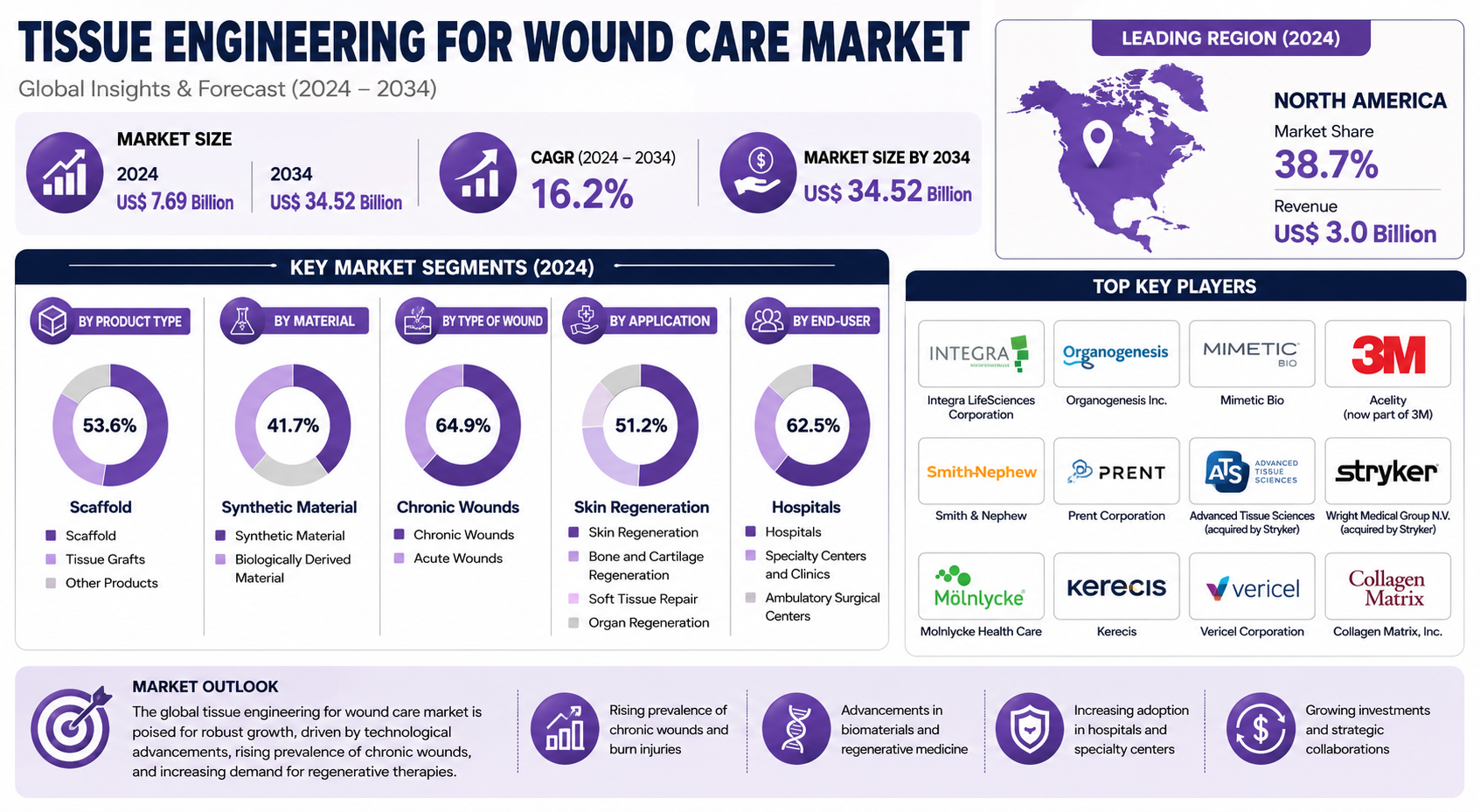
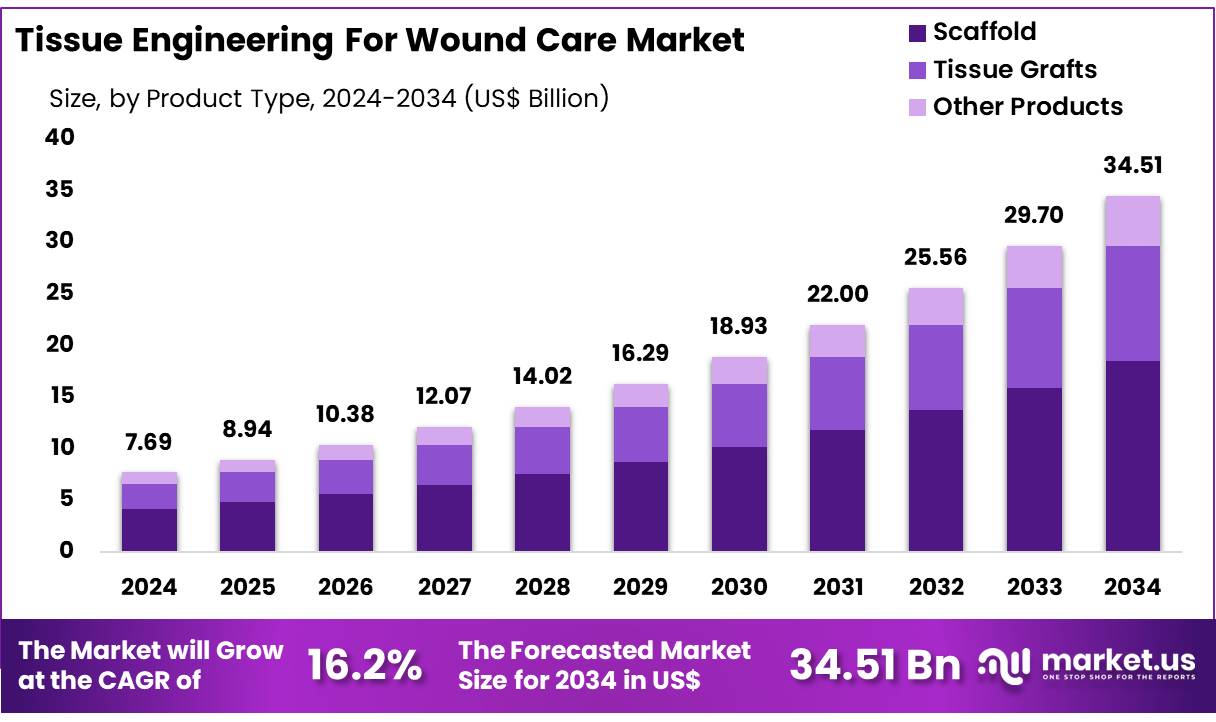
Global Tissue Engineering for Wound Care Market size is expected to be worth around US$ 34.52 billion by 2034 from US$ 7.69 billion in 2024, growing at a CAGR of 16.2% during the forecast period 2024 to 2034. In 2024, North America led the market, achieving over 38.7% share with a revenue of US$ 3.0 Billion.
The global Tissue Engineering for Wound Care Market is gaining momentum as healthcare systems increasingly adopt regenerative therapies to address the growing burden of chronic and acute wounds. Rising cases of diabetic foot ulcers, pressure ulcers, venous leg ulcers, burns, and traumatic injuries are driving demand for advanced tissue-engineered products that support faster and more effective healing. Unlike traditional wound dressings, tissue engineering solutions combine biomaterials, living cells, growth factors, and bioactive scaffolds to stimulate natural tissue regeneration and improve wound closure.
Continuous advancements in regenerative medicine, biomaterials, stem cell research, and 3D bioprinting are expanding the development of innovative skin substitutes and engineered tissue products. These technologies are designed to restore damaged tissue, reduce infection risk, minimize scarring, and improve overall patient outcomes. Healthcare providers are increasingly integrating advanced wound care products into clinical practice for patients with complex or slow-healing wounds.
The market is also benefiting from increased research investments by biotechnology companies, academic institutions, and healthcare organizations focused on developing next-generation regenerative therapies. Growing awareness of personalized medicine and the need to reduce long-term treatment costs associated with chronic wounds are further supporting product adoption.
Despite strong growth potential, challenges such as high treatment costs, reimbursement limitations, and regulatory requirements remain. However, ongoing technological innovation, expanding clinical evidence, and increasing acceptance of regenerative medicine are expected to strengthen the adoption of tissue engineering solutions for wound care over the coming years.
Key Takeaways
- In 2024, the Global Tissue Engineering for Wound Care Market was valued at US$ 7.69 billion and is projected to reach US$ 34.52 billion by 2034, expanding at a CAGR of 16.2% during the forecast period.
- By Product Type, the market is segmented into Scaffold, Tissue Grafts, and Other Products. Among these, the Scaffold segment dominated in 2024, accounting for 53.6% of the market share.
- Based on Material, the market is categorized into Synthetic Material and Biologically Derived Material. The Synthetic Material segment held the leading position with a 41.7% market share in 2024.
- By Type of Wound, the market is divided into Chronic Wounds and Acute Wounds. The Chronic Wounds segment emerged as the largest contributor, capturing 64.9% of the total market share.
- Based on Application, the market is segmented into Skin Regeneration, Bone and Cartilage Regeneration, Soft Tissue Repair, and Organ Regeneration. Skin Regeneration led the market with a 51.2% share in 2024.
- By End User, the market is classified into Hospitals, Specialty Centers and Clinics, and Ambulatory Surgical Centers. The Hospitals segment accounted for the largest share, representing 62.5% of the market in 2024.
- North America dominated the global market in 2024, securing a 38.7% market share.
Statistical Information
- A 2025 randomized clinical trial in venous leg ulcers reported 70.0% complete wound closure (21 of 30 patients) using a collagen-based tissue-engineered skin substitute, compared with 43.3% (13 of 30 patients) using dehydrated human amnion/chorion membrane.
- The same 2025 study found the collagen-based skin substitute reduced the average healing time to 42.6 ± 9.8 days, compared with 46.2 ± 8.7 days for the comparator treatment.
- Histological analysis from the same trial showed a 65% increase in capillary density, demonstrating significantly improved angiogenesis within regenerated tissue.
- The study also reported a 49% increase in collagen deposition, indicating stronger extracellular matrix formation and tissue remodeling.
- A 2026 multicenter randomized trial reported 83.3% complete wound closure (50 patients) using the collagen-based tissue-engineered skin substitute versus 51.7%(31 patients) with dehydrated human amnion/chorion membrane.
- The same study measured an average 81.5% ± 12.3% wound area reduction after five weeks, compared with 64.2% ± 14.1% in the control group.
- 88.3% (53 patients) treated with the tissue-engineered skin substitute achieved at least 50% wound reduction, compared with 55.0% (33 patients) in the comparator arm.
- Histological evaluation demonstrated 45.6 ± 7.9 vessels/mm² capillary density after treatment versus 29.4 ± 9.2 vessels/mm², confirming enhanced vascular regeneration.
- A 2026 multicenter randomized controlled trial evaluating the biosynthetic wound matrix PermeaDerm enrolled 184 patients, randomized 1:1 across four clinical centers, with wound healing assessed through Day 14 for superficial burns and Day 21 for deep partial-thickness burns.
Market Segmentation Analysis
- Product Analysis: Scaffolds accounted for 53.6% of the tissue engineering for wound care market due to their ability to provide structural support for cell attachment and tissue regeneration. Demand is increasing for advanced wound management. Other products, including growth factors, stem cell therapies, and bioactive molecules, are expanding regenerative treatment options for complex wounds.
- Material Analysis: Biologically derived materials held a 58.3% market share because of their excellent biocompatibility and ability to promote cellular growth and tissue repair. These materials closely resemble the extracellular matrix, supporting regeneration in chronic wounds. Acellular dermal matrices such as AlloDerm® are widely used for reconstructive procedures and complex wound healing.
- Type of Wound Analysis: Chronic wounds represented 64.9% of the market due to increasing cases of diabetic ulcers, pressure injuries, and vascular wounds requiring advanced therapies. Tissue-engineered products accelerate healing by supporting tissue regeneration and angiogenesis. Bioengineered skin substitutes are extensively utilized to improve outcomes in difficult-to-heal chronic wound conditions.
- Application Analysis: Skin regeneration captured 51.2% of the market owing to rising incidences of burns, diabetic ulcers, and chronic wounds. Tissue-engineered skin substitutes, scaffolds, and biomaterials create an environment that supports cell growth and tissue repair. Products such as bilayered skin substitutes are widely adopted to enhance healing and restore damaged skin.
- End-User Analysis: Hospitals dominated the market with a 62.5% share because they provide specialized care for acute and chronic wounds requiring advanced tissue-engineered therapies. Their multidisciplinary teams and access to sophisticated infrastructure enable the effective use of scaffolds, skin substitutes, and regenerative biomaterials for managing complex wound healing cases.
Driver
The increasing prevalence of chronic wounds, including diabetic foot ulcers, pressure ulcers, and venous leg ulcers, is driving the demand for tissue engineering solutions in wound care. The growing global burden of diabetes, obesity, and aging populations has significantly increased the number of patients requiring effective wound management.
Tissue-engineered products accelerate healing, reduce infection risks, and improve tissue regeneration, making them a preferred option over conventional dressings. Continuous advancements in regenerative medicine further strengthen market expansion.
Trend
A significant trend in the tissue engineering for wound care market is the integration of advanced biomaterials with regenerative technologies to enhance healing outcomes. Manufacturers are developing bioengineered skin substitutes, scaffold-based therapies, and stem cell-supported products that closely mimic natural tissue structures.
The incorporation of growth factors, extracellular matrix components, and 3D bioprinting technologies is improving product effectiveness and patient recovery. Growing investments in regenerative medicine research and commercialization continue to support innovation and broaden clinical adoption worldwide.
Business Opportunities
The Tissue Engineering for Wound Care Market presents substantial business opportunities due to the increasing prevalence of chronic wounds, diabetic foot ulcers, pressure ulcers, and burn injuries across the global population. Rising demand for advanced regenerative therapies has encouraged healthcare providers to adopt bioengineered skin substitutes, tissue scaffolds, and stem cell-based wound care solutions that accelerate healing and reduce treatment duration.
Continuous investments in research and development, combined with advancements in biomaterials, 3D bioprinting, and cell engineering technologies, are creating opportunities for innovative product development and commercialization. Expanding healthcare infrastructure in emerging economies, along with improving reimbursement frameworks in developed countries, is further supporting market expansion.
Strategic collaborations between biotechnology companies, research institutions, and healthcare organizations are enabling the introduction of next-generation tissue-engineered products with enhanced clinical outcomes. In addition, the growing emphasis on personalized medicine and regenerative healthcare is expected to create long-term revenue opportunities for manufacturers, technology developers, contract research organizations, and healthcare service providers operating in this market.
Regional Analysis
North America dominated the Tissue Engineering for Wound Care Market, accounting for 38.7% of the global market share. The region’s leadership is supported by a well-developed healthcare system, extensive research in regenerative medicine, and the growing clinical adoption of tissue-engineered products for managing chronic and complex wounds. The United States is at the forefront due to the high burden of chronic wounds, which affect approximately 10.5 million Medicare beneficiaries, increasing the demand for advanced wound healing technologies.
Regulatory support from the U.S. Food and Drug Administration (FDA) has accelerated the development and review of tissue-engineered products, cell therapies, and regenerative medicine technologies, encouraging innovation and commercialization. Healthcare providers across hospitals and specialized wound care centers are increasingly utilizing bioengineered skin substitutes, cellular and acellular matrix-like products (CAMPs), and growth factor-based therapies to improve healing outcomes.
In addition, strong collaboration between biotechnology companies, academic research institutions, and healthcare organizations continues to strengthen product development, clinical research, and the adoption of advanced tissue engineering solutions, reinforcing North America’s leadership in this market.
Emerging Trends
- Growing adoption of bioengineered skin substitutes: Healthcare providers are increasingly using bioengineered skin substitutes for chronic wounds such as diabetic foot ulcers and venous leg ulcers. These products contain cellular or acellular matrix-like components that support tissue regeneration, although their use is balanced against higher costs and storage requirements.
- Rising use of cellular and acellular matrix-like products (CAMPs): Advanced wound care is shifting toward cellular and acellular matrix-like products (CAMPs), including epidermal, dermal, and composite skin replacements. These technologies are selected based on wound size, depth, location, and surrounding tissue condition to improve healing outcomes.
- Expansion of 3D-printed tissue engineering solutions: Researchers are developing 3D-printed wound dressings and tissue-engineered scaffolds that can be customized for individual patients. These biomaterials provide better structural support, maintain a moist healing environment, and promote faster tissue regeneration than many conventional dressings.
- Increased research into regenerative biologics: Current research is expanding the use of growth factors, stem cells, microRNA-based therapies, and bioengineered cellular therapies to stimulate cell migration and tissue repair. These regenerative approaches are designed to overcome delayed healing commonly seen in chronic wounds.
- Focus on improving product accessibility and clinical evidence: Healthcare organizations continue to emphasize stronger clinical evidence for tissue-engineered products. The U.S. Agency for Healthcare Research and Quality identified 76 commercially available skin substitute products, while noting that only 22 randomized controlled trials had evaluated 16 products, highlighting the need for broader clinical validation.
Use Cases
- Treatment of diabetic foot ulcers: Tissue-engineered skin substitutes are widely used to treat diabetic foot ulcers by promoting tissue regeneration and reducing healing time. Clinical studies have reported 83.3% complete wound closure in treated patients, demonstrating their value for managing chronic diabetic wounds.
- Management of venous leg ulcers: Bioengineered tissue products are increasingly applied to venous leg ulcers where standard wound care is insufficient. Clinical evidence reported 70.0% complete wound closure, supporting their use for difficult-to-heal chronic ulcers.
- Burn wound reconstruction: Engineered skin tissues are being used for burn treatment to replace damaged skin, reduce infection risk, and improve healing. Current clinical programs are evaluating laboratory-grown skin capable of forming protective tissue within about four weeks after cell collection.
- Regeneration of complex chronic wounds: Advanced tissue-engineered matrices are increasingly used for pressure ulcers, traumatic wounds, and surgical wounds that fail to heal with conventional dressings. These products provide structural support while encouraging cell migration, angiogenesis, and collagen formation during healing.
- Personalized regenerative wound care: Patient-specific tissue engineering approaches are becoming more common, using autologous cells and customized biomaterials to improve wound repair. These personalized therapies are designed to better match wound characteristics and support long-term tissue regeneration in complex cases.
Conclusion
The Tissue Engineering for Wound Care Market is advancing rapidly as regenerative medicine transforms the treatment of chronic and complex wounds. Growing adoption of bioengineered skin substitutes, scaffolds, cellular therapies, and advanced biomaterials is improving wound healing outcomes while reducing complications in patients with diabetic foot ulcers, venous leg ulcers, burns, and other difficult-to-heal wounds.
Recent clinical studies have demonstrated higher wound closure rates and enhanced tissue regeneration, reinforcing confidence in these technologies. Although high treatment costs and regulatory requirements remain challenges, continued research, FDA support for regenerative medicine, and innovations in stem cells, 3D bioprinting, and personalized therapies are expected to accelerate clinical adoption and strengthen the market’s long-term growth potential.




















