


Overview
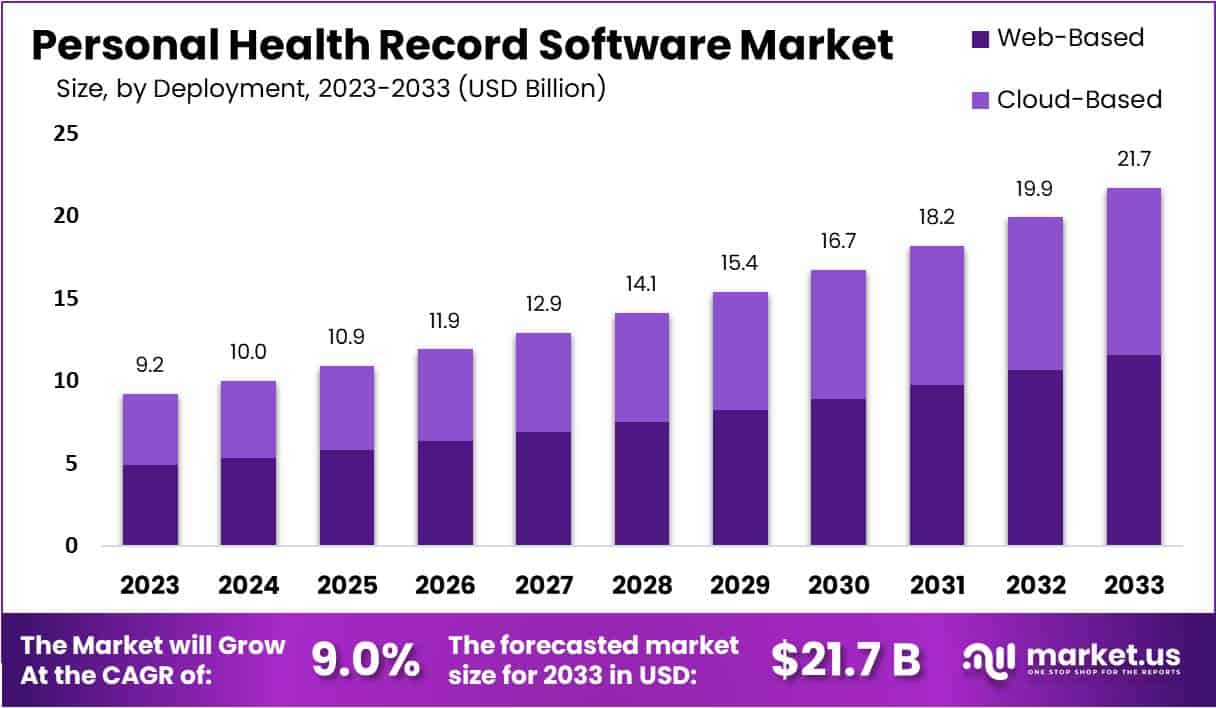
The Global Personal Health Record Software Market size is expected to be worth around US$ 9.2 Billion by 2033, from US$ 21.7 Billion in 2023, growing at a CAGR of 9% during the forecast period from 2024 to 2033.
The global Personal Health Record (PHR) software market is gaining momentum as healthcare providers, governments, and technology companies work to give individuals greater control over their medical information. Rising demand for secure digital access to health records, laboratory reports, prescriptions, vaccination histories, and chronic disease management tools is encouraging the adoption of patient-centered health platforms.
The increasing focus on interoperability and secure health data exchange is further supporting the expansion of PHR software across hospitals, clinics, and home healthcare settings.
Government-led digital health initiatives are playing an important role in strengthening this market. In India, the Ayushman Bharat Digital Mission (ABDM) surpassed 100 crore linked health records connected to Ayushman Bharat Health Accounts (ABHA), demonstrating rapid progress toward an integrated digital healthcare ecosystem.
In the United States, the Office of the National Coordinator for Health Information Technology (ONC) reported that 65% of individuals accessed their online medical records or patient portals in 2024, while the use of smartphone applications to access health records increased from 38% in 2020 to 57% in 2024, reflecting growing consumer acceptance of digital health management tools.
Growing awareness of preventive healthcare, expansion of telehealth services, and increasing integration of wearable devices with digital health platforms are expected to create new opportunities for software developers. Continued investments in cybersecurity, cloud infrastructure, and standardized health data exchange are likely to strengthen patient trust and support the long-term adoption of personal health record software worldwide.
Key Takeaways
- The Personal Health Record Software Market is projected to reach US$ 21.7 Billion by 2033, expanding at a 9% CAGR from 2024 to 2033, supported by rising adoption of digital health platforms and increasing demand for convenient access to medical information.
- The Cloud-Based Deployment segment accounted for a 53.4% market share in 2023, driven by growing user preference for secure, flexible, and real-time access to health records across multiple devices.
- The Software & Mobile Applications segment dominated in 2023 with a 52.7% market share, highlighting the increasing importance of user-friendly applications that enable efficient health data tracking and management.
- The Standalone PHR Software segment captured a 40.1% market share in 2023, as individuals increasingly seek independent control and personalized management of their healthcare records.
- North America held the leading position in 2023 with a 50.2% market share, valued at USD 4.6 Billion, supported by advanced healthcare infrastructure, high digital health adoption, strong technology integration, and favorable government initiatives.
Statistical Information
- In 2024, 65% of individuals in the United States accessed their online medical records or patient portals, showing increased consumer engagement with digital health record platforms and growing demand for personal health information management solutions.
- The percentage of individuals accessing online medical records has increased from 25% in 2014 to 65% in 2024, demonstrating significant growth in patient adoption of digital healthcare access tools over the past decade.
- 57% of individuals used smartphone applications to access their medical records in 2024, compared with 38% in 2020, indicating a shift toward mobile-based personal health record management and app-driven healthcare interactions.
- In 2024, 51% of individuals used proxy or caregiver access features to view or manage another person’s health records, increasing from 24% in 2020 and highlighting rising demand for family and caregiver-supported health management.
- 87% of individuals encouraged by healthcare providers to use patient portals accessed their online records in 2024, compared with 57% of individuals who were not encouraged, showing the important role of provider recommendations in digital health adoption.
- In 2024, 59% of individuals reported having multiple online medical records or patient portals, while only 7% used portal-organizing applications to combine information from different healthcare sources into a single view.
- In 2025, the European Union’s digital health monitoring showed an average 87% eHealth maturity score across EU-27 countries, reflecting continued progress in electronic health record accessibility, interoperability, and digital healthcare infrastructure.
- The European Union is working toward the goal of 100% of EU citizens having access to electronic health records by 2030, supporting wider adoption of patient-controlled digital health information systems.
Regional Analysis
In 2023, North America dominated the Personal Health Record (PHR) Software Market, accounting for a 50.2% market share valued at USD 4.6 Billion. The region’s leadership is supported by advanced healthcare IT infrastructure, widespread adoption of digital health technologies, and strong initiatives promoting secure access to electronic health information. The U.S. government continues to strengthen nationwide health information exchange through initiatives such as TEFCA, which supports secure sharing of electronic health records among patients and healthcare providers.
Europe is expected to witness steady growth due to increasing focus on patient-centered healthcare and digital health policies. The European Health Data Space (EHDS) aims to improve access, control, and exchange of electronic health data across the region, supporting greater adoption of digital health solutions.
The Asia-Pacific region is projected to experience significant expansion, driven by rising healthcare investments, growing digital transformation programs, and increasing awareness of electronic health management solutions. Countries across the region are developing digital health ecosystems to improve healthcare accessibility and efficiency. Overall, regional advancements in interoperability, data security, and patient empowerment will continue shaping the global PHR software market.
Emerging Trends
- Artificial Intelligence Integration in Personal Health Records: AI is becoming an important trend in PHR software by helping users analyze health information, identify risks, and receive personalized health recommendations. WHO has highlighted AI governance and digital health innovation as major priorities, with more than 1,600 government officials from over 100 countries trained in digital health and AI initiatives.
- Greater Focus on Interoperable Health Data Exchange: PHR platforms are increasingly adopting interoperability standards to connect hospitals, laboratories, pharmacies, and wearable devices. WHO reported that 129 countries have established national digital health strategies, showing strong global movement toward connected healthcare ecosystems and standardized health information exchange.
- Expansion of Digital Health Ecosystems: Personal Health Record software is evolving from simple record storage platforms into complete digital health ecosystems combining telehealth, remote monitoring, medication management, and healthcare communication tools. WHO’s Global Digital Health Strategy emphasizes improving health information systems and scaling digital solutions worldwide.
- Improved Data Privacy and Patient-Controlled Information: Security and patient ownership of health data are becoming major priorities in PHR development. New platforms are focusing on encryption, consent management, and controlled data sharing as healthcare organizations increase efforts to protect sensitive medical information and maintain user trust.
- Growth of Cross-Border Digital Health Records: Governments are developing frameworks that allow patients to access and share medical information across different healthcare systems. WHO reported that the Global Digital Health Certification Network initiative has supported digital health collaboration benefiting 1.8 billion people across 80 countries, encouraging wider adoption of connected health records.
Use Cases
- Chronic Disease Management and Long-Term Monitoring: PHR software is increasingly used for managing diabetes, cardiovascular diseases, and other chronic conditions by allowing patients to track medications, laboratory results, symptoms, and treatment progress. Healthcare providers use these platforms to improve follow-up care and support continuous patient monitoring.
- Telehealth and Remote Consultation Support: PHR platforms are becoming essential tools for virtual healthcare by providing physicians with patient history, previous reports, and medication information during online consultations. This improves decision-making and enables more personalized remote care delivery, especially for patients requiring frequent healthcare interactions.
- Medication Management and Treatment Adherence: Healthcare providers are using PHR applications to help patients manage prescriptions, refill schedules, vaccination records, and treatment reminders. These features reduce medication errors and support better adherence, particularly among elderly patients and individuals managing multiple therapies.
- Preventive Healthcare and Wellness Tracking: PHR software is increasingly used for preventive care by combining medical records with lifestyle information, wearable device data, and health assessments. These solutions help individuals monitor health trends, identify potential risks early, and encourage proactive healthcare decisions.
- Caregiver and Family Health Management: PHR platforms are expanding caregiver-focused features that allow authorized family members to support elderly patients, children, and individuals requiring assistance. These systems enable secure sharing of medical information, appointment details, and treatment updates while maintaining patient control over health data access.
Frequently Asked Questions About Health Record (PHR) Software
- How does Personal Health Record Software benefit patients?
PHR Software helps patients access their medical information easily, monitor health conditions, review treatment history, and communicate better with healthcare providers. These platforms improve patient involvement by allowing individuals to understand their health information and make informed healthcare decisions. - What information can be stored in Personal Health Record Software?
Personal Health Record Software can store details such as doctor visits, medications, laboratory reports, immunizations, allergies, diagnoses, and treatment records. By organizing healthcare information digitally, PHR platforms help patients and caregivers maintain complete and updated health histories. - Is Personal Health Record Software secure for managing health data?
PHR Software uses privacy controls, authentication methods, and secure sharing features to protect sensitive medical information. Healthcare authorities emphasize that patients should have convenient access to their records while maintaining security and control over who can view their information. - What factors are driving the growth of the Personal Health Record Software Market?
The PHR Software Market is expanding due to increasing demand for digital healthcare access, patient-centered care models, interoperability solutions, and mobile health platforms. Healthcare organizations are adopting these systems to improve information sharing and strengthen communication between patients and providers. - How is Personal Health Record Software different from Electronic Health Records (EHR)?
PHR Software is mainly designed around patient access and personal control of health information, while Electronic Health Records are maintained by healthcare providers for clinical operations. PHR platforms allow individuals to collect, manage, and share their healthcare data more independently. - How does interoperability support the Personal Health Record Software Market?
Interoperability allows PHR platforms to connect with healthcare systems, applications, and digital health tools. This enables smoother exchange of medical information between patients and providers, helping improve care coordination, reduce information gaps, and support more efficient healthcare delivery. - What are the major applications of Personal Health Record Software?
PHR Software is used for chronic disease management, medication tracking, appointment management, telehealth support, preventive healthcare monitoring, and caregiver assistance. These applications help individuals maintain continuous records of their health conditions and support better coordination throughout their healthcare journey. - What is the future outlook of the Personal Health Record Software Market?
The future of the PHR Software Market is expected to be influenced by digital health transformation, cloud-based platforms, artificial intelligence integration, wearable device connectivity, and increased patient demand for healthcare data ownership. These developments will support more personalized and connected healthcare experiences.
Conclusion
The Personal Health Record (PHR) Software Market is evolving rapidly as healthcare systems worldwide prioritize digital access, patient empowerment, and secure health information exchange. Increasing adoption of cloud platforms, mobile health applications, interoperability standards, and AI-driven healthcare solutions is transforming PHR software from a simple record-keeping tool into a comprehensive health management platform.
Government initiatives and healthcare digitization efforts are further strengthening market growth by improving patient access and data connectivity. As demand for personalized care, remote monitoring, and preventive healthcare increases, PHR software will play a crucial role in creating more connected, efficient, and patient-focused healthcare ecosystems globally.




















