


Introduction
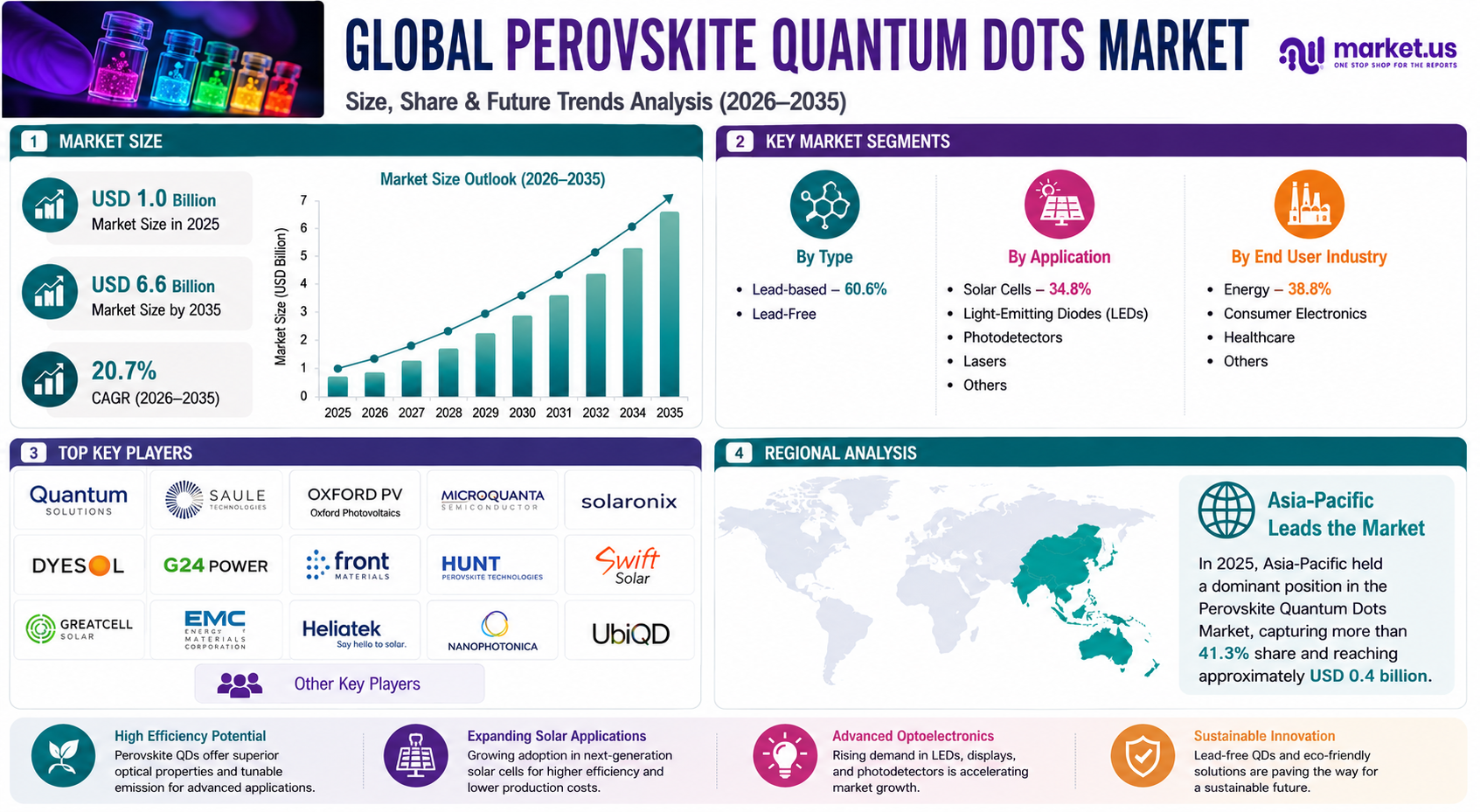
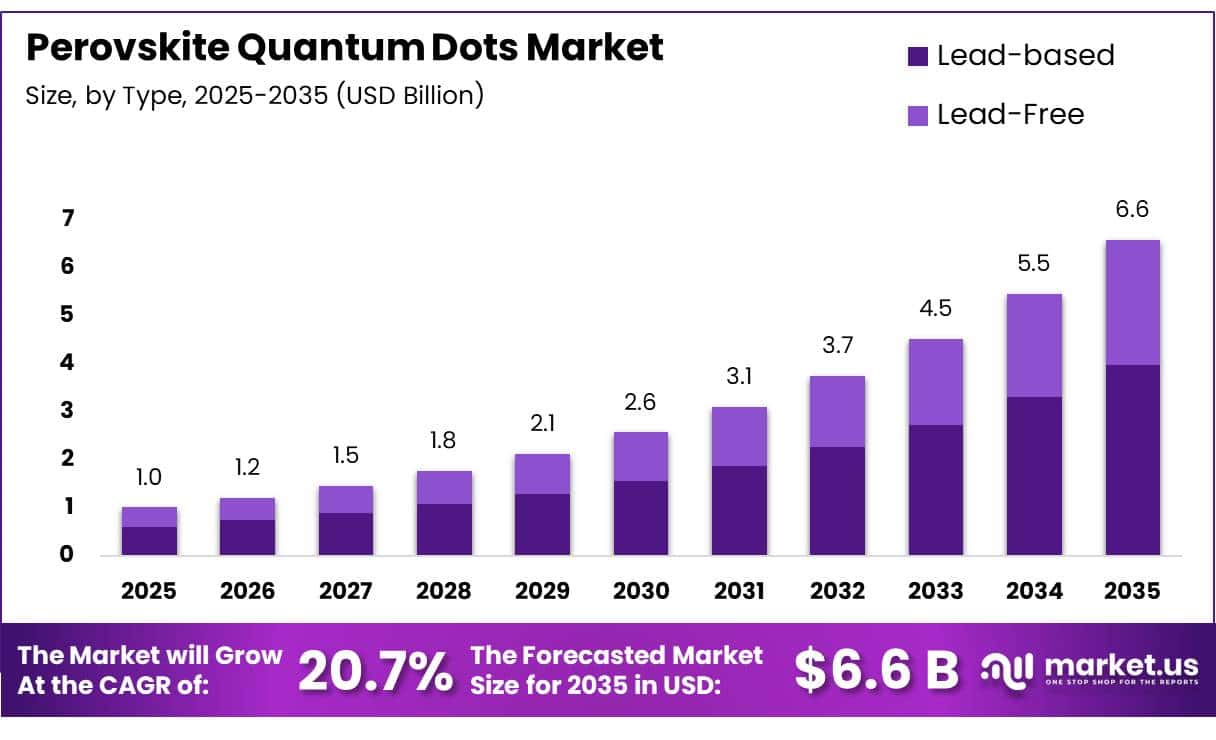
In 2025, the Global Perovskite Quantum Dots Market was valued at USD 1.0 billion. The market is expected to grow at a 20.7% CAGR from 2026 to 2035 and reach nearly USD 6.6 billion by 2035. Asia-Pacific led the market with more than 41.3% share, generating around USD 0.4 billion in revenue.
Perovskite quantum dots are advanced semiconductor nanomaterials used in solar cells, LEDs, photodetectors, sensors, and other optoelectronic devices. Their key benefits include adjustable optical properties, strong light absorption, low-temperature processing, and compatibility with solution-based manufacturing.
Research has shown strong progress in perovskite-based technologies. Perovskite quantum dot solar cells have achieved efficiencies of around 16.6%, while broader perovskite technologies reached nearly 27% for single-junction cells and more than 34.5% for perovskite-silicon tandem cells.
The rapid expansion of solar energy is creating new opportunities for these materials. Global renewable capacity additions reached about 800 GW, while solar PV installations exceeded 600 GW, taking cumulative global solar PV capacity to nearly 2,800 GW. Solar PV generation also increased by around 600 TWh, while renewables supplied about 34% of global electricity.
Durability and large-scale production remain important challenges. An NREL-led study demonstrated around 26% laboratory efficiency with only about 2% degradation after 2,100 hours of continuous operation under elevated temperatures. Further improvements in encapsulation, manufacturing consistency, lead management, and scalable processing will be important for commercialization.
Key Takeaways
- The Global Perovskite Quantum Dots Market was valued at USD 1.0 billion in 2025.
- The market is projected to grow at a CAGR of 20.7% and is estimated to reach USD 6.6 billion by 2035.
- On the basis of Type, Lead-based dominated the market, constituting 60.6% of the total market share.
- Based on the Application, Solar Cells dominated the market, with a substantial market share of around 34.8%.
- Based on the End User Industry, Energy led the market, comprising 38.8% of the total market.
- In 2025, Asia-Pacific was the most dominant region in the market, accounting for 41.3% of the total global consumption.
Market Segmentation Overview
Type Analysis
Lead-Based Leads with 60.6% Share Due to Strong Optoelectronic Performance
In 2025, Lead-based perovskite quantum dots held a dominant position, accounting for more than 60.6% of the market. Materials such as CsPbBr₃, CsPbI₃, and FAPbI₃ remain widely used because of their strong light absorption, efficient charge movement, tunable emission, and suitability for solution-based manufacturing. These properties support their use across solar cells, LEDs, displays, and other optoelectronic applications. In June 2025, a study indexed by the U.S. National Institutes of Health reported that cesium-formamidinium lead triiodide quantum-dot solar cells achieved 18.17% power-conversion efficiency. Another 2025 study reported a photoluminescence quantum yield of up to 78.64% for CsPbBr₃ quantum-dot films, while the associated QLED achieved 9.67% external quantum efficiency.
Application Analysis
Solar Cells Dominate with 34.8% Share as Photovoltaic Deployment Expands
In 2025, Solar Cells captured more than 34.8% of the Perovskite Quantum Dots Market by application. Demand is supported by the ability of perovskite quantum dots to improve light absorption, wavelength management, and energy-conversion performance in advanced photovoltaic devices. Their lightweight nature and compatibility with flexible designs also support future solar applications. According to the U.S. Energy Information Administration, total U.S. solar photovoltaic capacity reached 209,304.0 MW in 2025 and increased to 222,690.5 MW by May 2026, creating a wider technology base for the development of advanced photovoltaic materials.
End User Industry Analysis
Energy Dominates with 38.8% Share Supported by Rising Solar Generation
In 2025, the Energy industry held a dominant position, accounting for more than 38.8% of the Perovskite Quantum Dots Market. The segment benefits from growing research into quantum-dot-enabled photovoltaic systems, where tunable optical properties and solution-based processing can support more efficient solar technologies. The U.S. Energy Information Administration reported that utility-scale solar generation reached 296,000 GWh in 2025, while small-scale solar systems generated another 93,000 GWh. This expanding solar generation base supports continued research into perovskite quantum dots for future energy-conversion applications.
Drivers
Solar Expansion Accelerates Demand for Perovskite Quantum Dots
Rapid expansion of solar power is a major growth driver for perovskite quantum dots, as these materials offer strong light absorption, adjustable optical properties, and potential for lightweight photovoltaic devices. According to the International Energy Agency, global renewable capacity additions reached a record 800 GW in 2025, while solar PV additions exceeded 600 GW for the first time. This expansion lifted global installed solar PV capacity to around 2,800 GW.
Technical improvements in the wider perovskite field are also strengthening this driver. In 2025, an NREL-led study demonstrated an initial laboratory efficiency of 26.1%. Another device maintained about 26% efficiency with only around 2% degradation after 2,100 hours of operation at 65°C. These results show that researchers are making progress on efficiency and durability, two important barriers to commercial perovskite photovoltaics.
Government-supported research is further encouraging commercialization. The U.S. Department of Energy FY2025-27 program includes dedicated work on Perovskite Enabled Tandems and scalable manufacturing of metal-halide perovskites. Meanwhile, the IEA expects almost 4,600 GW of renewable capacity additions during 2025–2030, with solar PV contributing nearly 80% of the expansion and distributed solar representing 42% of overall PV growth.
Business Opportunities
High-Efficiency Tandem Solar Commercialization Creates Major Growth Opportunity
The International Energy Agency reported that global solar PV additions exceeded 600 GW in 2025, pushing cumulative installed solar capacity to around 2,800 GW. Solar PV generation also recorded an increase of about 600 TWh during the year.
Commercial-scale tandem performance is also improving. In 2026, Fraunhofer ISE and Oxford PV demonstrated perovskite-silicon tandem modules rated at 491 W and 546 W, with both achieving 25.6% efficiency across the complete module area. The achievement shows that tandem technology is moving from small laboratory cells toward practical rooftop and large-area photovoltaic modules.
At the same time, the IEA expects almost 4,600 GW of renewable capacity additions through 2030, with solar PV representing nearly 80% of expansion and distributed solar contributing 42% of overall PV growth. This creates strong commercial space for lightweight, flexible, and higher-efficiency perovskite quantum-dot products.
Emerging Trends
Perovskite Quantum Dots Expand Into Advanced Detection Applications
A major emerging trend for perovskite quantum dots is their growing use in high-performance X-ray, gamma-ray, and optical sensing systems. These applications are expanding the technology beyond solar cells and displays into medical imaging, industrial inspection, security scanning, and scientific instrumentation. In January 2025, Quantum Solutions and AY Sensors reported that QDot™ CsPbBr₃ perovskite detectors achieved sensitivity above 2,000 μC Gyair⁻¹ cm⁻², maintained detector linearity of R² = 0.9995, and reached a detection limit of only 11 nGy air s⁻¹ at 10 V.
Research is also improving how perovskite materials perform in gamma-ray spectroscopy. A 2025 peer-reviewed study indexed by the U.S. National Institutes of Health reported that device engineering improved gamma-ray energy resolution from 7% to around 5%, while the best measured resolution reached 1.9%. The detector also recorded sensitivity of approximately 10⁵ μC Gyair⁻¹ cm⁻².
Government-supported research is strengthening this trend. A 2025 study listed by the U.S. Department of Energy’s Office of Scientific and Technical Information examined CsPbBr₃ detectors for 662 keV gamma radiation and was sponsored by the U.S. National Nuclear Security Administration. Separately, a 2025 NIH-indexed study produced CsPbBr₃ quantum dots with sizes of 3.0–12.0 nm and achieved a sensing detection limit of 0.16 μM.
Use Cases
1. High-Efficiency Solar Cells and Photovoltaic Systems: A 2025 peer-reviewed study reported that FAPbI₃ perovskite quantum-dot solar cells achieved 19.01% power-conversion efficiency, while a larger 1 cm² device reached 17.19% efficiency. Another study achieved 18.21% efficiency and retained more than 80% of its original performance after over 1,400 hours of ambient aging. These results show growing potential for PQDs in rooftop solar, flexible PV, tandem cells, and portable power applications.
2. High-Color-Purity Displays and Advanced LED Products: A 2026 study on CsPbI₃ quantum-dot LEDs achieved an external quantum efficiency of 30.8% with red emission at 634 nm. The device covered 98.5% of the Rec. 2020 color standard and recorded an operating half-life exceeding 140 hours at an initial brightness of 100 cd/m². Separately, 2025 research on blue PQD LEDs achieved 16.28% efficiency and maximum luminance of 8,423.35 cd/m². These properties create potential for high-definition televisions, smartphones, microdisplays, augmented-reality devices, and advanced LED lighting.
3. Photodetectors for Sensing and Optical Communications: A 2025 study developed an InSrO/CsPbBr₃ quantum-dot photodetector capable of detecting wavelengths from 230 to 500 nm while operating at only 0.05 V. The device achieved responsivity of 6.88 A/W and specific detectivity of 6.39 × 10¹⁴ Jones. It also maintained 95% of its original photocurrent after 15 days. Another PQD-enhanced silicon device produced a response time of approximately 6 milliseconds at infrared wavelengths around 1,100 nm, showing possible use in autonomous vehicles and low-light sensing systems.
4. Chemical and Heavy-Metal Detection Sensors: A 2025 scientific assessment reported photoluminescence quantum yields of around 50–90% and narrow emission widths of approximately 12–40 nm for PQD sensing materials. Lead-based CsPbX₃ quantum-dot sensors have demonstrated detection limits as low as 0.1 nM with response times below 10 seconds. Research has examined their use for detecting ions including Hg²⁺, Cu²⁺, Cd²⁺, Fe³⁺, Cr⁶⁺, and Pb²⁺. These characteristics could support wastewater monitoring, industrial process control, lubricant testing, environmental compliance, and rapid contamination screening.
Regional Analysis
In 2025, Asia-Pacific dominated the Perovskite Quantum Dots Market with more than 41.3% share, valued at around USD 0.4 billion. The region benefits from a large solar manufacturing industry, expanding optoelectronics research, and rising investment in advanced photovoltaic materials.
China added nearly 317 GW of new solar PV capacity in 2025, taking its total installed capacity to about 1.2 TW. Solar power generation reached approximately 1.17 trillion kWh, increasing by around 40% during the year. This strong renewable energy base supports future use of perovskite quantum dots in solar cells, LEDs, displays, and sensors.
North America is the fastest-growing regional market, supported by advanced research and development in perovskite and quantum-dot technologies. In April 2025, NREL researchers demonstrated perovskite cells with 26.1% initial efficiency, while another device maintained around 26% efficiency with only 2% degradation after 2,100 hours of operation.
The expanding U.S. solar industry also creates strong opportunities for advanced photovoltaic materials. Developers installed around 12 GW of utility-scale solar capacity during the first half of 2025 and planned an additional 21 GW during the second half.
Recent Developments
In June 2026, Oxford PV collaborated with Fraunhofer ISE to showcase tandem solar modules rated at 491 watts and 546 watts, with both achieving 25.6% efficiency. By early 2026, Oxford PV had also secured more than 400 granted patents, strengthening its position in tandem photovoltaic technology and licensing.
In January 2025, Quantum Solutions partnered with AY Sensors to develop QDot™ CsPbBr₃ perovskite single crystals for advanced X-ray and gamma-ray detection. Testing showed a detector linearity of R² = 0.9995 across a dose range of 0.08–33.60 μGy air s⁻¹, sensitivity above 2,000 μC Gy air⁻¹ cm⁻², and a detection limit of 11 nGy air s⁻¹ at 10 V.
Conclusion
Perovskite quantum dots are moving toward wider commercial use as their efficiency, stability, and processing performance continue to improve. A 2025 peer-reviewed study reported that FAPbI₃ perovskite quantum-dot solar cells achieved 19.01% power-conversion efficiency, while a larger 1 cm² device reached 17.19%, showing progress toward more practical device sizes. Another study achieved 18.21% efficiency and maintained more than 80% of its initial performance after over 1,400 hours, indicating that durability is also improving.
The wider perovskite sector is advancing quickly, with NREL reporting 26.1% initial laboratory efficiency and only about 2% degradation after 2,100 hours of operation at 65°C for an advanced perovskite device. Demand conditions are also favorable, as the IEA reported more than 600 GW of new solar PV capacity in 2025, taking worldwide installed solar capacity to around 2,800 GW.
Looking for data tailored to your specific market, region, or business need? Request a custom report or consultation — write to us at [email protected]




















