


Overview
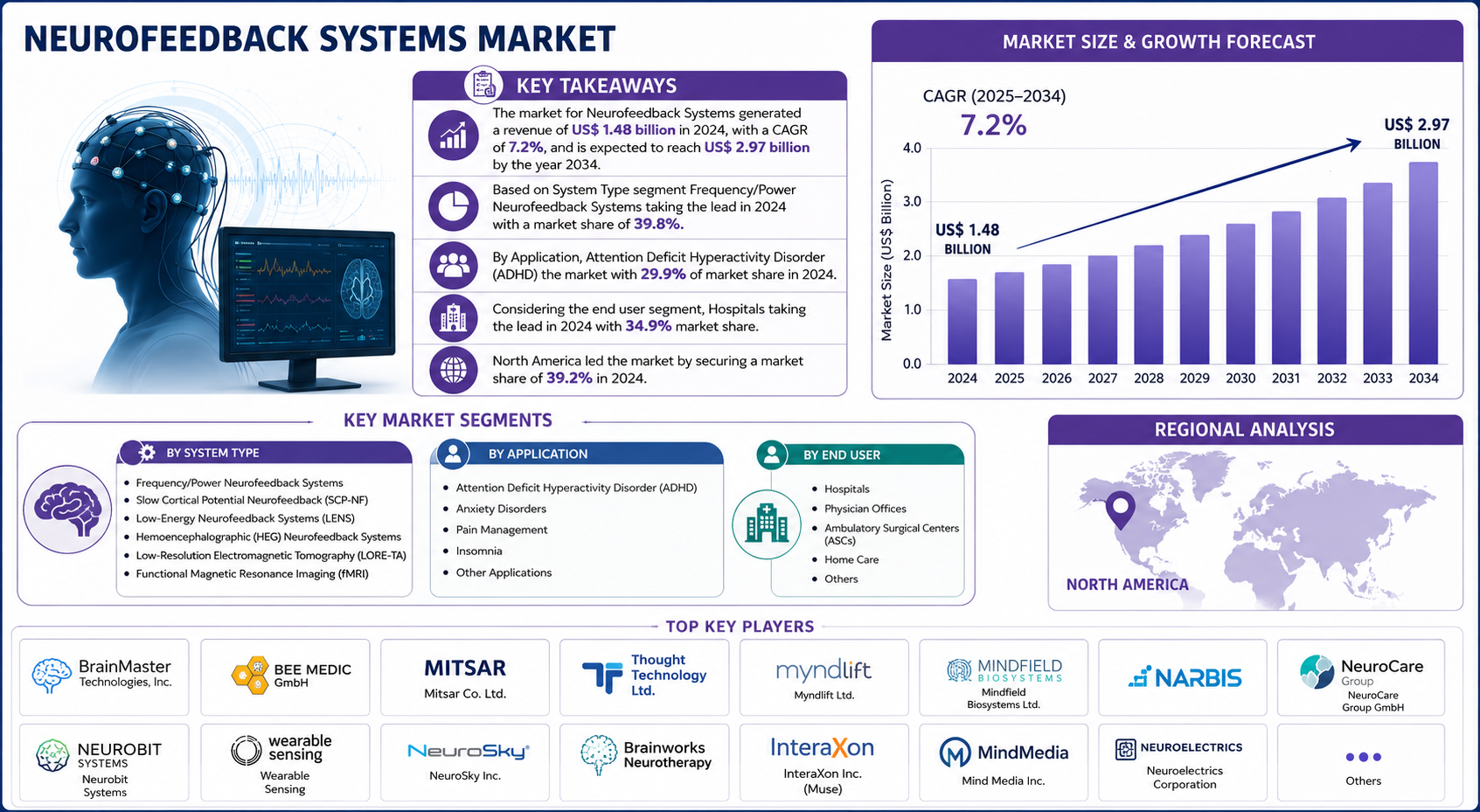
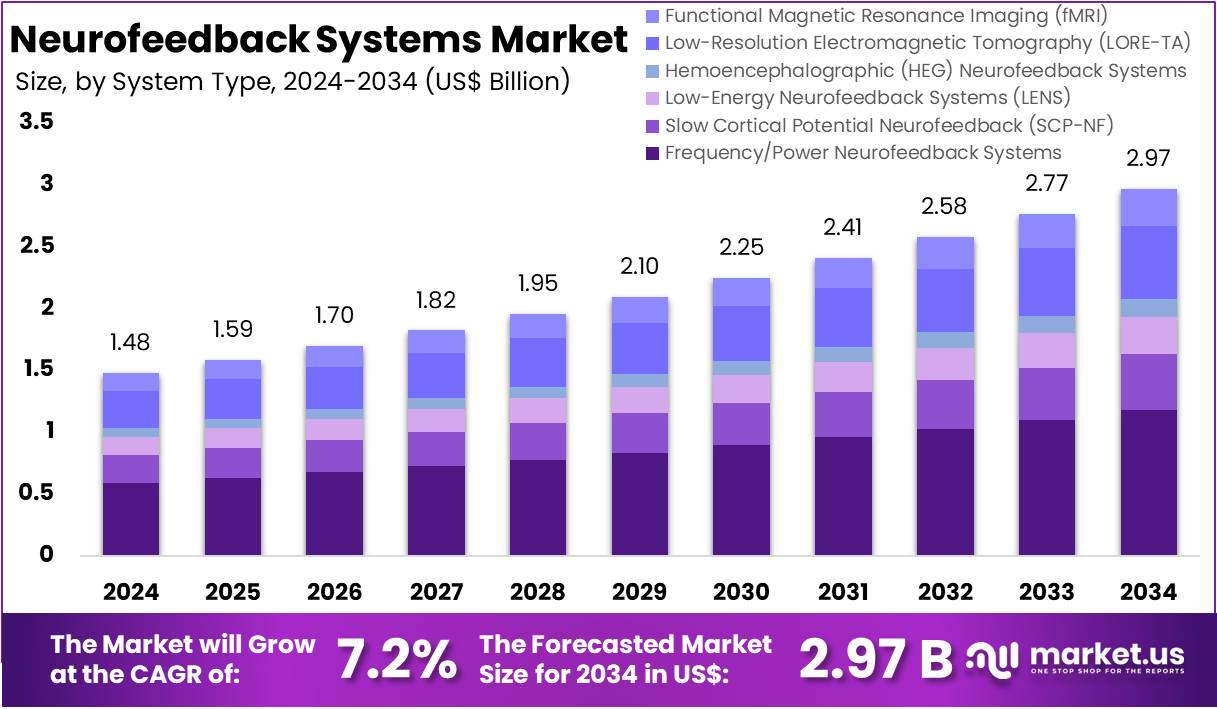
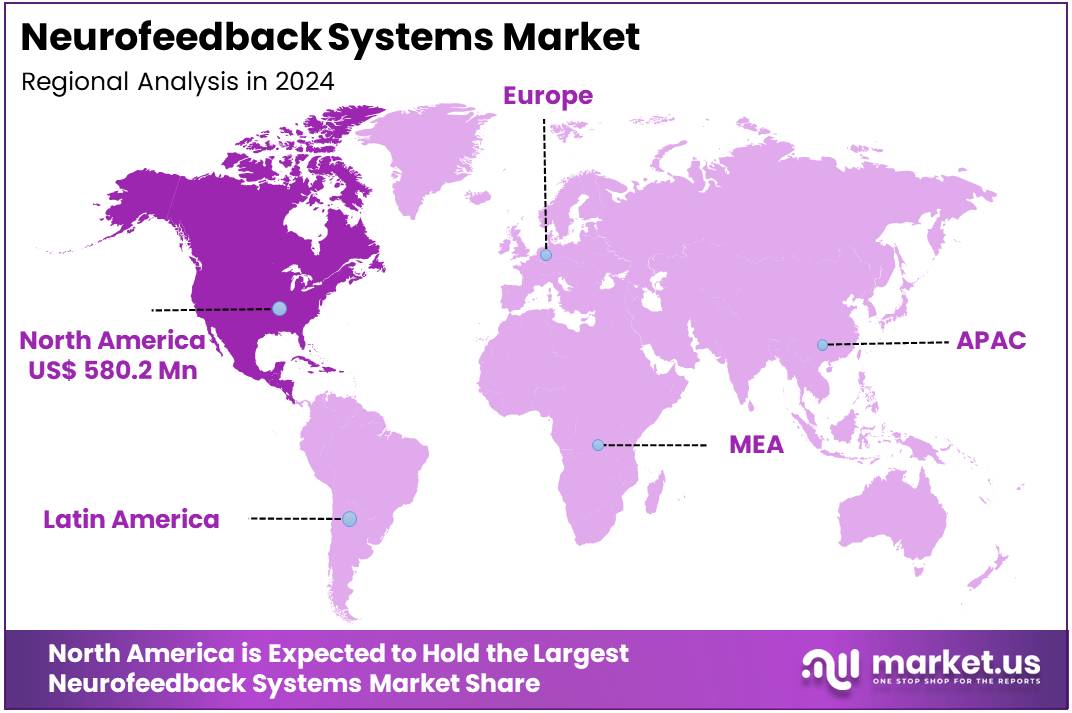
The Neurofeedback Systems Market size is expected to be worth around US$ 2.97 Billion by 2034 from US$ 1.48 Billion in 2024, growing at a CAGR of 7.2% during the forecast period 2025 to 2034. North America held a dominant market position, capturing more than a 39.2% share and holds US$ 580.2 Million market value for the year.
Neurofeedback systems are gaining attention as healthcare providers seek non-invasive approaches to support neurological and mental health care. These systems monitor brain activity, typically through electroencephalography (EEG), and provide real-time feedback that helps individuals learn to regulate specific brainwave patterns. Their adoption is expanding across research institutions, rehabilitation centers, and specialized mental health clinics for conditions such as attention-deficit/hyperactivity disorder (ADHD), anxiety, epilepsy, sleep disorders, and cognitive rehabilitation.
Increasing awareness of personalized brain health, combined with advances in artificial intelligence and digital neuroscience, is encouraging innovation in neurofeedback technologies. Improvements in wearable sensors, software analytics, and remote monitoring capabilities are also making these systems more accessible for clinical and research applications. However, healthcare professionals continue to emphasize the need for strong clinical evidence and standardized treatment protocols before broader routine adoption across all neurological conditions.
Growing demand for neurofeedback systems is also supported by the increasing prevalence of neurological and behavioral disorders worldwide. According to the U.S. Centers for Disease Control and Prevention (CDC), approximately 7 million U.S. children (11.4%) aged 3–17 years had ever been diagnosed with ADHD in 2022, highlighting the need for expanded assessment and treatment options.
Additionally, nearly 78% of children with ADHD had at least one co-occurring condition, including anxiety, learning disabilities, or behavioral disorders, underscoring the complexity of neurological care. These trends are driving continued investment in technologies that support objective brain monitoring, personalized therapy, and long-term neurocognitive management across healthcare settings.
Key Takeaways
- In 2024, the global Neurofeedback Systems Market was valued at US$ 1.48 billion and is projected to reach US$ 2.97 billion by 2034, expanding at a CAGR of 7.2% during the forecast period.
- The Frequency/Power Neurofeedback Systems segment emerged as the leading system type in 2024, accounting for 39.8% of the global market share.
- Among applications, Attention Deficit Hyperactivity Disorder (ADHD) dominated the market in 2024, capturing 29.9% of the total revenue due to the increasing adoption of neurofeedback therapies for attention-related disorders.
- Based on end users, Hospitals held the largest share of the Neurofeedback Systems market in 2024, representing 34.9% of the overall market, supported by the growing integration of neurofeedback technologies into clinical care.
- North America maintained its leadership position in the global Neurofeedback Systems market in 2024, accounting for 39.2% of the total market share.
Statistical Information
- More than 3 billion people worldwide are living with a neurological condition, making neurological disorders the leading cause of illness and disability globally.
- A 2025 horizon scan identified 81 unique neurotechnology innovations, including 23 focused on mental health, 31 on healthy ageing, and 42 targeting physical disabilities.
- Of those 81 neurotechnologies, 79% had not yet received FDA approval, indicating a substantial commercialization pipeline for emerging brain-health technologies.
- 77.4% of neurotechnology products identified globally were still in pilot or feasibility stages, while only 22.6% had reached pivotal or post-market phases.
- Among neurotechnologies incorporating digital features, 86.2% (50 of 58 technologies) were classified as digital therapeutics, highlighting the growing role of software-enabled brain health solutions.
- The U.S. FDA recognizes IEEE Std 2010-2023 as the consensus standard for EEG Neurofeedback Systems, supporting standardized development and regulatory evaluation of these devices.
- The WHO Global Status Report on Neurology collected data from 102 Member States, representing 71% of the world’s population, demonstrating increasing global focus on neurological care and brain health.
- According to the WHO Global Digital Health Monitor, 58 countries reported digital health maturity data, with the global average reaching Phase 3, reflecting broader adoption of digital healthcare infrastructure that supports neurotechnology deployment.
- The WHO Foresight Programme has evaluated more than 100 emerging health innovations through global horizon scanning, with neurotechnology identified as one of the key areas expected to shape future healthcare delivery.
Market Segmentation Analysis
System Type Analysis
The Frequency/Power Neurofeedback Systems segment accounted for 39.8% of the global Neurofeedback Systems market in 2024, making it the leading system type. These systems measure and train brainwave frequency and amplitude in real time, supporting applications in attention, stress management, and cognitive performance.
Their widespread adoption is driven by ease of use, compatibility with clinical and home settings, and continuous software improvements. Growing demand for non-invasive neurological monitoring and personalized brain training is expected to further strengthen this segment’s market position.
Application Analysis
The Attention Deficit Hyperactivity Disorder (ADHD) segment led the Neurofeedback Systems market with a 29.9% share in 2024, reflecting increasing demand for supportive neurocognitive therapies. According to the U.S. CDC, millions of children aged 3–17 years had ever been diagnosed with ADHD in 2022, while nearly 2 million children with ADHD did not receive ADHD-specific treatment. These statistics continue to drive interest in technologies that support behavioral management and cognitive training alongside conventional care.
End User Analysis
Hospitals emerged as the leading end-user segment in 2024, capturing 34.9% of the Neurofeedback Systems market. Hospitals benefit from specialized neurology and psychiatry departments, trained healthcare professionals, and advanced diagnostic infrastructure, enabling the integration of neurofeedback into multidisciplinary care.
Rising demand for non-invasive neurological assessment and personalized treatment approaches has further supported hospital adoption. As healthcare institutions continue investing in digital neuroscience and brain health technologies, hospitals are expected to remain the primary setting for neurofeedback-based clinical services.
Regional Analysis
North America accounted for 39.2% of the global Neurofeedback Systems market in 2024, supported by advanced healthcare infrastructure, growing awareness of neurological disorders, and increased adoption of non-invasive brain monitoring technologies. The region benefits from strong investments in neuroscience research, digital health, and AI-enabled medical devices across the United States and Canada.
According to the National Institute of Mental Health (NIMH), neurofeedback is being investigated as a complementary intervention for attention-deficit/hyperactivity disorder (ADHD), reflecting continued federal research interest in brain-based therapies. In addition, NASA’s Langley Research Center developed neurofeedback-based attention monitoring technology that translates brainwave activity into real-time measures of focus, demonstrating broader applications of neurofeedback beyond healthcare.
Canada is also witnessing increasing integration of neurofeedback systems into rehabilitation clinics and wellness centers, supported by advances in wearable sensors and personalized digital health solutions. These technological developments and expanding clinical applications continue to reinforce North America’s leadership in the global neurofeedback systems market.
Business Opportunities
The Neurofeedback Systems market presents strong business opportunities as healthcare providers increasingly adopt digital, non-invasive technologies for neurological and behavioral care. Growing investment in wearable electroencephalography (EEG) devices, artificial intelligence, and remote patient monitoring is creating opportunities for manufacturers to develop portable, cloud-connected neurofeedback platforms for hospitals, rehabilitation centers, and home-based care. The U.S. Food and Drug Administration (FDA) continues to support the advancement of digital health technologies that enable remote monitoring and personalized healthcare, encouraging innovation across connected medical devices.
Additionally, the FDA recognizes EEG neurofeedback systems under established medical device standards, providing a clearer regulatory framework for developers. Research initiatives supported by the National Institute of Mental Health (NIMH) are also accelerating innovation by exploring neurofeedback interventions for mental health disorders and expanding clinical evidence.
These developments create opportunities for companies to collaborate with healthcare providers, research institutions, and digital therapeutics developers to deliver AI-enabled neurofeedback solutions, data analytics platforms, and integrated brain-health services. Expansion into telehealth ecosystems, pediatric neurology, cognitive rehabilitation, and preventive mental wellness programs is expected to unlock new commercial opportunities in the coming years.
Emerging Trends
- AI-powered neurofeedback platforms are becoming more common. The World Health Organization (WHO) identifies artificial intelligence, brain-computer interfaces (BCIs), neuromodulation, and neuroimaging as the four major emerging neurotechnology areas that are shaping future neurological care. These innovations are improving personalized brain training and clinical decision-making.
- Wearable EEG devices are expanding access to neurofeedback. The U.S. FDA recognizes both full-montage EEG systems with 16 or more electrodes and reduced-montage EEG devices with fewer than 16 electrodes, supporting the development of portable and home-based neurofeedback technologies.
- Digital therapeutics are integrating neurofeedback into remote care. The FDA has established a Class II regulatory pathway for prescription digital therapy devices that reduce sleep disturbances in psychiatric conditions using consumer smartphones, watches, sensors, and software, expanding opportunities for home-based neurological care.
- Connectivity-based neurofeedback is replacing single-signal training. Recent scientific reviews analyzing 65 clinical studies show increasing use of multimodal and connectivity-based EEG neurofeedback, allowing clinicians to evaluate broader brain networks rather than isolated brainwave activity for improved therapy outcomes.
- Global health organizations are prioritizing neurotechnology. In its 2025 landscape analysis, the WHO highlights neurotechnology as a strategic area for future healthcare, with increasing focus on affordable neurological devices that can improve diagnosis, rehabilitation, and long-term brain health worldwide.
Use Cases
- PTSD management is becoming a key application. A 2025 meta-analysis reviewed five randomized EEG neurofeedback trials and found meaningful improvements in PTSD symptoms compared with passive control groups, supporting broader evaluation of neurofeedback in behavioral healthcare.
- Home-based prescription therapy is expanding. Researchers are developing prescription digital therapeutics that combine heart-rate variability biofeedback with remote monitoring, allowing patients with PTSD to receive guided therapy outside hospitals while maintaining clinician oversight.
- Sleep health is emerging as a major opportunity. A 2025 umbrella review evaluated 28 systematic reviews and meta-analyses involving 118,970 participants, demonstrating growing clinical interest in digital technologies for improving insomnia and sleep-related neurological conditions.
- Mental wellness and emotional regulation are expanding use cases. Modern neurofeedback systems are increasingly used to improve attention, emotional regulation, anxiety management, and cognitive performance by providing real-time feedback from brain activity using advanced EEG technologies.
- Stroke rehabilitation is becoming an important use case for neurofeedback systems. One recruiting trial plans to enroll 40 participants to assess upper-limb rehabilitation, while another study is enrolling patients to personalize EEG neurofeedback protocols for improving motor function after stroke. These efforts highlight the growing role of neurofeedback in neurological rehabilitation.
Recent Developments
- In January 2026, Precision Neuroscience entered a strategic partnership with Medtronic to integrate its Layer 7 Cortical Interface with Medtronic’s StealthStation surgical navigation platform, aiming to improve precision in neurosurgical procedures and brain-computer interface deployment.
- In November 2025, Precision Neuroscience secured a strategic investment from SCI Ventures, a venture fund backed by the Christopher & Dana Reeve Foundation, Wings for Life, and Spinal Research, to accelerate development of brain-computer interface technologies for paralysis and spinal cord injury.
- In June 2025, Myndlift Ltd. announced that its platform had surpassed 1 million neurofeedback sessions delivered through clinical partners worldwide. The company also introduced a visual brainwave guide developed from anonymized session data to help clinicians better understand neural activity and optimize treatment outcomes.
- In March 2025, InteraXon Inc. (Muse) launched Muse S Athena, the company’s first consumer brain-sensing headband combining EEG and functional near-infrared spectroscopy (fNIRS). The new device provides simultaneous brain activity and blood-flow monitoring to enhance cognitive fitness and sleep tracking.
Conclusion
The global Neurofeedback Systems market is poised for steady growth, supported by rising prevalence of neurological and behavioral disorders, increasing adoption of non-invasive brain monitoring technologies, and continuous advancements in artificial intelligence, wearable EEG devices, and digital therapeutics.
Expanding applications across ADHD, cognitive rehabilitation, mental health, and stroke recovery are strengthening market demand in clinical and research settings. North America continues to lead due to strong healthcare infrastructure and innovation, while regulatory support and ongoing clinical research are fostering technology development. As evidence-based protocols advance, neurofeedback systems are expected to play an increasingly important role in personalized neurological care and digital brain health.




















