



Overview
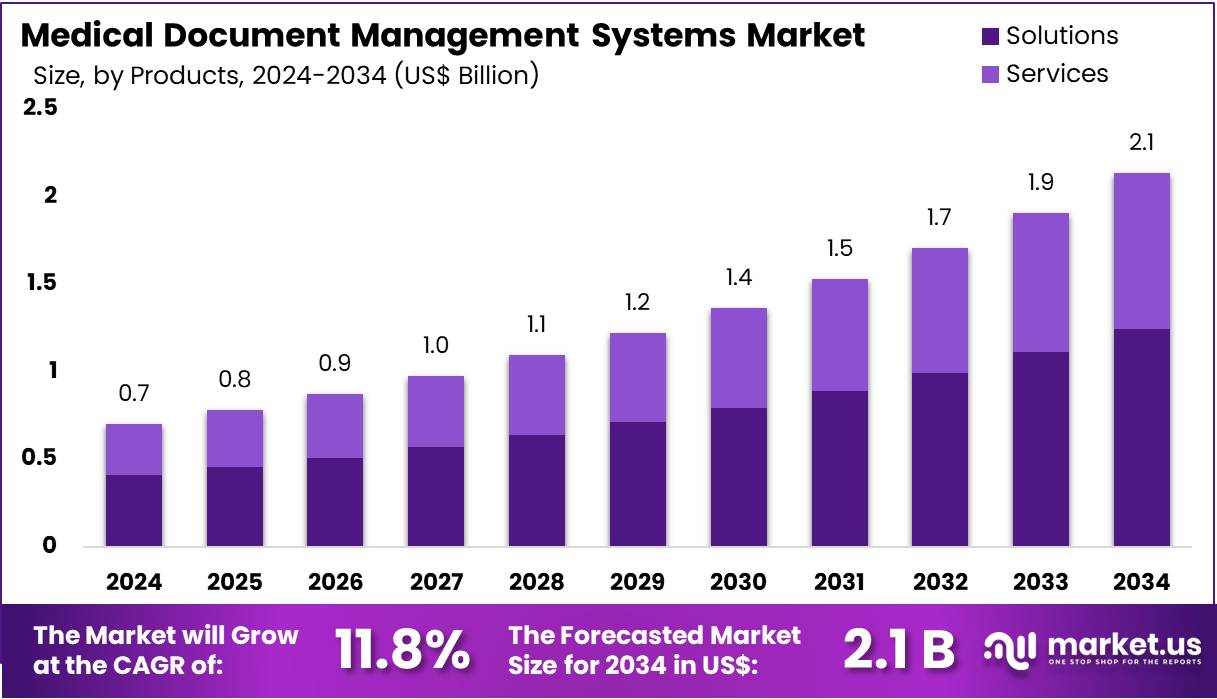
The Global Medical Document Management Systems Market size is expected to be worth around US$ 2.1 Billion by 2034, from US$ 0.7 Billion in 2024, growing at a CAGR of 11.8% during the forecast period from 2025 to 2034.
The growing digitization of healthcare records is strengthening demand for medical document management systems that can organize, store, retrieve, secure, and exchange clinical information efficiently. These platforms support hospitals, clinics, diagnostic centers, and other healthcare organizations in managing electronic documents, clinical notes, scanned records, imaging reports, administrative files, and patient information within increasingly connected digital environments.
Government data highlights the scale of healthcare digitization. According to the U.S. Centers for Disease Control and Prevention (CDC), 95.0% of U.S. office-based physicians had adopted EHR systems in 2024, while 83.6% used certified EHR systems. The Office of the National Coordinator for Health Information Technology (ONC) also reported that more than 99% of U.S. non-federal acute care hospitals had adopted certified EHRs by 2024.
Interoperability is becoming another important factor influencing document management requirements. ONC reported that approximately 90% hospitals enabled patient electronic access to health information through APIs in 2024, supporting greater connectivity between EHR platforms, applications, and healthcare services.
Healthcare organizations are increasingly prioritizing centralized document repositories, secure access controls, automated workflows, search capabilities, audit trails, and integration with EHR and health information exchange systems. The expansion of trusted data-sharing infrastructure is also creating opportunities for solutions capable of handling larger volumes of electronic health information while maintaining privacy, security, and regulatory compliance.
Key Takeaways
- In 2024, the Medical Document Management Systems Market generated revenue of US$ 0.7 billion and is projected to reach US$ 2.1 billion by 2034, expanding at a CAGR of 11.8% during the forecast period.
- The products segment comprises solutions and services, with solutions emerging as the leading segment in 2024. It accounted for a dominant 58.2% market share during the year.
- By application, the market includes patient medical records management, patient billing documents management, and admission & registration document management. Patient medical records management dominated with a 53.3% share in 2024.
- Based on mode of delivery, the market is categorized into on-premise, web-based, and cloud-based solutions. Cloud-based systems led the segment, capturing the largest revenue share of 63.5% in 2024.
- The end-user segment includes hospitals & clinics, nursing homes/assisted living facilities/long-term care, healthcare payers, and others. Hospitals & clinics held the leading position, accounting for 52.8% of the market in 2024.
- Regionally, North America maintained its leadership in the Medical Document Management Systems Market in 2024. The region accounted for a significant 44.4% market share, supported by strong healthcare digitization and technology adoption.
Statistical Information
- 65% of U.S. individuals accessed their online medical records or patient portal in 2024, up from 57% in 2022. This indicates sustained consumer demand for convenient digital access to medical information.
- Proxy or caregiver access to patient portals increased from 24% in 2020 to 51% in 2024, more than doubling in four years. This creates demand for document systems supporting authorized multi-user access to patient information.
- 59% of U.S. individuals had multiple online medical records or patient portals in 2024, while only 7% used a portal-organizing application to combine information from different portals. This highlights an opportunity for document-management platforms that consolidate fragmented records.
- About 1 in 5 U.S. individuals who visited a doctor in 2024 reported waiting for test results longer than they considered reasonable. The finding points to continued opportunities for faster document retrieval, information exchange, and workflow automation.
- In 2024, 43.2% of U.S. physicians reported at least one symptom of burnout, while physicians reported an average 7.3 hours per week on administrative tasks. Document automation and workflow tools can therefore address a measurable operational burden.
- 22.5% of U.S. physicians spent more than eight hours per week on EHR activities outside normal working hours in 2024. This provides a strong use case for intelligent document processing, automated organization, and streamlined clinical documentation.
- 26.5% of physicians identified inadequate doctors and support staff as a key stressor in 2024, while 13.8% cited excessive administrative tasks. Automated document workflows could help healthcare teams handle documentation and administrative workloads more efficiently.
- In 2024, 81% of U.S. hospitals enabled patient access through apps configured to meet API specifications, while 70% enabled FHIR-based app access. The growing use of standardized digital interfaces creates opportunities for document-management providers offering interoperable, API-connected solutions.
Market Segmentation Analysis
Products Analysis
The solutions segment dominated the Medical Document Management Systems Market in 2024, accounting for 58.2% of the market. This leadership reflects the growing need among healthcare organizations for efficient, secure, and organized document management. Solutions combine software capabilities and supporting services to streamline workflows, minimize documentation errors, and strengthen regulatory compliance.
Increasing demand for secure and easily retrievable patient information is expected to support segment expansion. Moreover, the integration of artificial intelligence into document processing is improving automation, classification, and information retrieval. As healthcare providers continue investing in digital transformation initiatives, comprehensive document management solutions are expected to gain wider adoption, supporting sustained growth across hospitals, clinics, and other healthcare facilities.
Applications Analysis
The patient medical records management segment held the largest share of the applications segment in 2024, accounting for 53.3% of the market. Its strong position is driven by the growing requirement for accurate, accessible, and securely managed patient information. Effective medical record management enables healthcare providers to improve clinical decision-making, coordinate treatment, and enhance operational efficiency. The continued transition from paper-based documentation to digital healthcare systems is further increasing demand for integrated record management solutions.
Rising adoption of electronic health records (EHRs) also supports segment growth by enabling healthcare professionals to access and share patient information more efficiently. As healthcare organizations prioritize data accuracy, interoperability, and privacy, patient medical records management is expected to remain a major application area.
Mode of Delivery Analysis
The cloud-based segment dominated the mode of delivery category in 2024, capturing a substantial 63.5% revenue share. Its leading position is supported by the increasing preference of healthcare organizations for flexible and scalable digital infrastructure. Cloud-based medical document management systems enable remote access, centralized data storage, streamlined collaboration, and lower dependence on physical IT infrastructure. These capabilities are particularly valuable for healthcare providers managing large volumes of patient and administrative documents.
Growing requirements for secure information exchange and compliance with data privacy standards are also encouraging organizations to adopt cloud platforms. Furthermore, the cost-effectiveness and scalability of cloud-based solutions allow healthcare facilities to expand document management capabilities according to operational requirements, supporting continued adoption.
End-Users Analysis
The hospitals & clinics segment led the end-user category in 2024, accounting for 52.8% of the market. Its dominant position reflects the substantial volume of clinical, administrative, billing, and patient-related documents generated and managed by healthcare facilities. Hospitals and clinics increasingly rely on digital document management systems to improve record accessibility, streamline workflows, and enhance operational efficiency. The ongoing digitization of healthcare operations is further encouraging investments in secure document storage and retrieval technologies.
Additionally, growing regulatory requirements for maintaining accurate and protected patient records are strengthening demand. As healthcare providers focus on improving care delivery, reducing administrative burdens, and supporting data-driven workflows, hospitals and clinics are expected to remain key end users of medical document management systems.
Regional Analysis
North America is leading the Medical Document Management Systems Market
North America led the Medical Document Management Systems Market in 2024, accounting for 44.4% of revenue. Strong EHR adoption, healthcare digitization, interoperability initiatives, and regulatory requirements for secure information management are supporting regional demand.
The U.S. healthcare system has established digital infrastructure, while Canada continues advancing connected electronic health information. These developments are encouraging healthcare providers to adopt technologies for secure document storage, retrieval, sharing, and workflow management.
Asia Pacific is expected to experience the highest CAGR
Asia Pacific is expected to record the highest CAGR during the forecast period, supported by rapid healthcare digitization, expanding digital infrastructure, and government-led initiatives.
WHO notes that countries across South-East Asia are advancing electronic health records, digital health strategies, interoperability, and data governance. Eight of the region’s 10 Member States have developed national digital health blueprints, creating a foundation for medical document management adoption.
Business Opportunities
The Medical Document Management Systems Market presents significant opportunities as healthcare organizations accelerate the transition from paper-based processes to digital information environments. Vendors can capitalize on demand for cloud-based document management, particularly solutions that provide scalable storage, remote access, automated workflows, and integration with existing healthcare IT systems. HHS confirms that cloud services can be used to store and process electronic protected health information when appropriate HIPAA requirements and business associate agreements are met.
Another opportunity lies in AI-powered document processing, including automated classification, indexing, extraction, and retrieval of clinical information. Vendors can also develop interoperability-focused platforms that connect document repositories with EHRs and other healthcare applications. Strong opportunities exist in cybersecurity and compliance, as HHS requires appropriate administrative, physical, and technical safeguards for electronic protected health information.
Healthcare providers, payers, long-term care facilities, and diagnostic organizations represent expanding customer segments. Companies offering secure, interoperable, customizable, and subscription-based solutions can differentiate themselves through workflow automation, analytics, audit capabilities, and advanced data protection.
Emerging Trends
- AI-powered document creation is becoming a major trend. In 2026, 30% of physicians reported using AI to create discharge instructions, care plans, or progress notes. This is pushing document management beyond storage toward automated drafting, summarization, and workflow support.
- AI-assisted chart summarization is gaining attention. The AMA found that 28% of physicians used AI to generate chart summaries in 2026. Medical document platforms are therefore increasingly expected to extract important information from lengthy records and present it in simpler, usable formats.
- FHIR-based interoperability is emerging as a key direction. HHS proposed strengthening FHIR-based APIs to support AI-enabled interoperability and easier health-information exchange. This trend favors document systems that can connect smoothly with EHRs and other healthcare applications.
- AI governance and documentation controls are becoming more important. FDA guidance issued in 2025 recommends attention to AI product design, development, maintenance, and documentation throughout the technology lifecycle. This is increasing demand for traceable and well-controlled digital records.
- Large-scale health-data exchange is accelerating. HHS reported in February 2026 that TEFCA had reached nearly 500 million health records exchanged. This trend supports document platforms capable of handling information from multiple organizations while maintaining standardized and secure data flows.
Use Cases
- AI adoption is moving toward integrated EHR workflows. In 2024, 84% of physicians identified EHR integration as an important requirement for advancing AI adoption. This is encouraging medical document systems to connect AI capabilities directly with existing clinical workflows rather than operate as standalone tools.
- Discharge documentation management offers another practical application. Medical document systems can help organize discharge instructions, care plans, and progress notes, allowing providers to create, review, store, and retrieve these documents within connected workflows.
- Patient communication documentation is an expanding use case. In 2026, 19% of physicians reported using AI to generate draft responses to patient portal messages. Document platforms can help retain these communications alongside relevant patient records.
- Administrative document automation can support billing and revenue-cycle workflows. The AMA found that 80% of physicians considered AI assistance for billing codes, medical charts, or visit notes relevant to their practices, highlighting strong potential for automated document processing.
- Cross-system health information management is another important use case. HHS is advancing standardized health-data exchange through FHIR and USCDI, including 29 proposed new data elements in USCDI v7. This supports systems that organize and exchange standardized information across healthcare environments.
Recent Developments
- In April 2026, Southwest General reported that its Oracle Health Clinical AI Agent generated approximately 81,800 notes across 18 specialties, while reducing average EHR time per patient by 18.6% and after-hours work by 14.15%. The solution converts patient-clinician conversations into structured draft notes.
- In March 2026, GE HealthCare completed its US$ 2.3 Billion acquisition of Intelerad, adding cloud-enabled medical imaging software and expanding its enterprise imaging capabilities across hospitals, specialized clinics, and ambulatory settings in the U.S., Canada, the UK, and Oceania.
- In February 2026, Epic published more than 50 APIs and accompanying integration playbooks supporting CMS interoperability and prior-authorization requirements. Epic also released 12 new FHIR APIs for exchanging radiation-treatment summaries, expanding structured clinical-data exchange capabilities.
- In February 2026, Oracle Health made Clinical AI Agent, Clinical Note available in the UK following pilots at NHS organizations including Barts Health, Imperial College Healthcare, and Milton Keynes University Hospital. Oracle reported use across more than 300 organizations and approximately 40% lower average documentation time per patient.
- In January 2026, Veradigm and Meperia launched an 8-Way Match EDI platform for healthcare supply chains. The cloud-based system supports more than 16 million transactions and US$ 5 Billion in purchase volume, automatically validating transactions against contracts, receipts, invoices, item masters, and rebate terms.
Conclusion
The Medical Document Management Systems Market is positioned for strong expansion as healthcare organizations accelerate digital transformation, interoperability, cloud adoption, and AI-enabled documentation. Growing demand for secure, accessible, and efficiently managed medical information is creating opportunities across hospitals, clinics, payers, and other healthcare providers. Cloud-based platforms, automated workflows, intelligent document processing, and standardized data exchange are becoming important areas of innovation.
North America currently maintains a leading position, while Asia Pacific offers significant growth potential through expanding healthcare digitization. Recent investments, partnerships, acquisitions, and product launches from major technology and healthcare companies further demonstrate increasing industry focus on integrated, secure, and intelligent document management solutions.




















