


Introduction
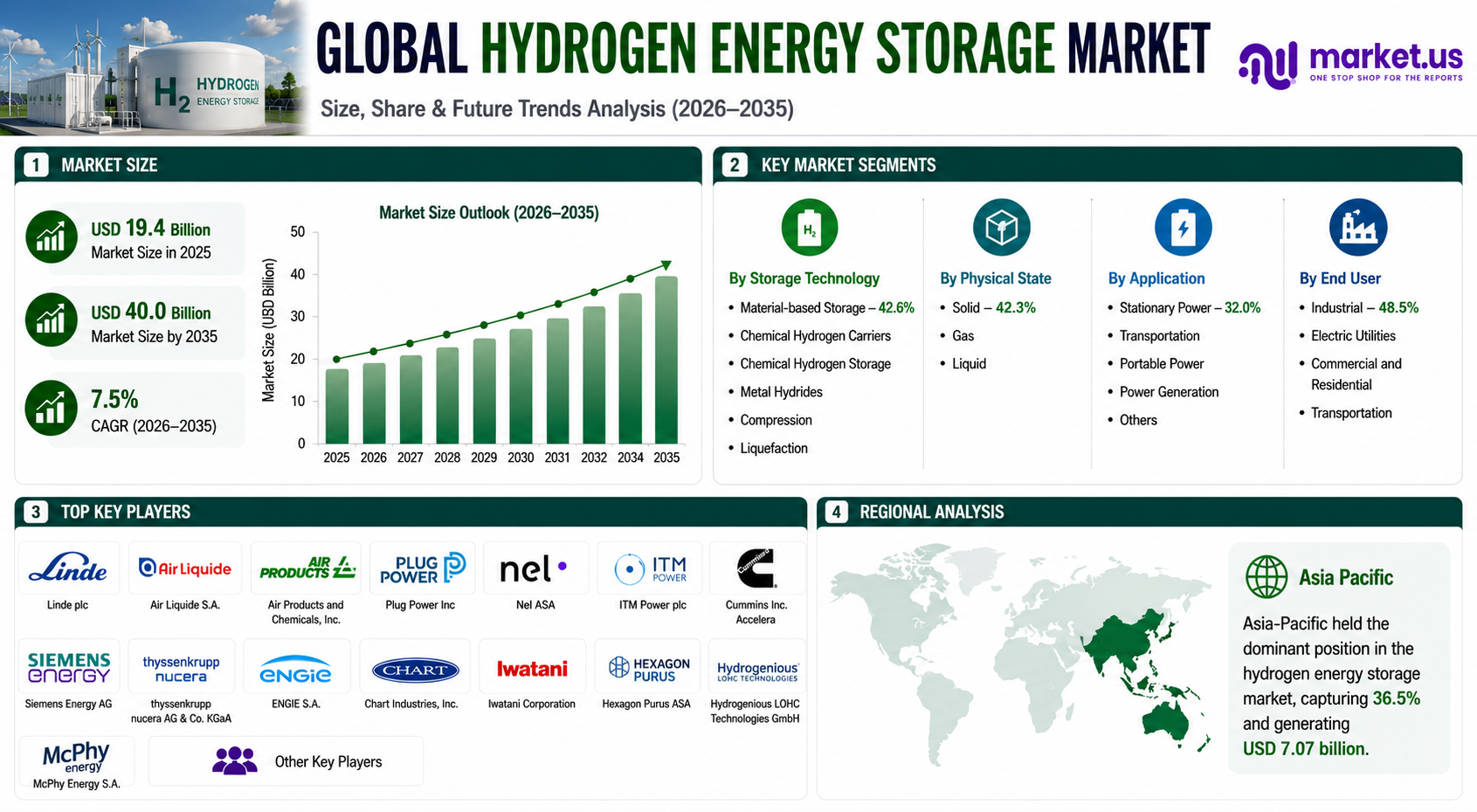
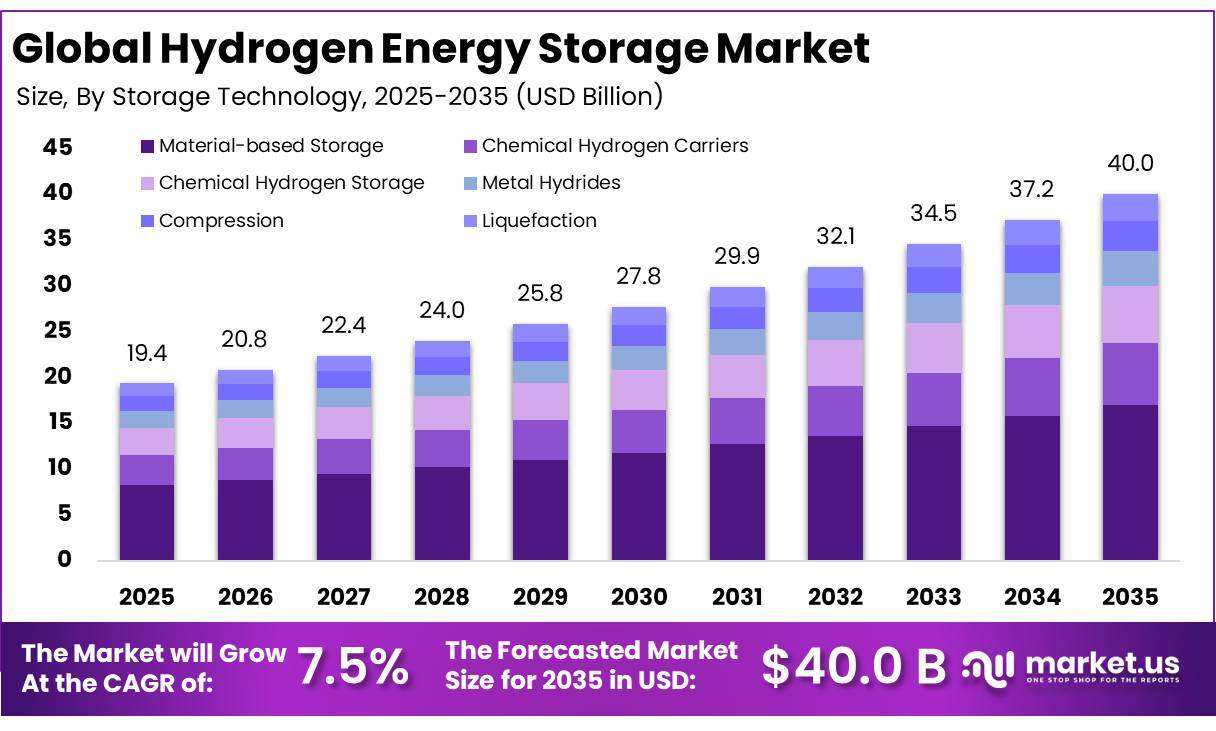
In 2025, the Global Hydrogen Energy Storage Market was valued at USD 19.4 billion and is projected to grow at a CAGR of 7.5% during 2026–2035, reaching approximately USD 40.0 billion by 2035. Asia Pacific dominated the market in 2025, accounting for more than 36.5% of the global share, with revenue totaling USD 7.07 billion.
Hydrogen energy storage is gaining importance as a reliable long-duration energy storage solution, enabling excess renewable electricity to be converted into hydrogen through electrolysis and stored for future use. The stored hydrogen can later be utilized for power generation, industrial applications, or transportation. Storage methods include compressed gas, cryogenic liquid, chemical carriers, and underground geological formations, providing flexibility across multiple end-use sectors.
According to the U.S. Department of Energy, liquid hydrogen is stored at approximately -253°C, typically at pressures of up to 5 bar. The department also notes that four operational salt caverns are currently used for hydrogen storage in the United States, highlighting hydrogen’s capability to support large-scale and seasonal energy storage requirements.
Key Takeaways
- The Global Hydrogen Energy Storage Market was valued at US$19.4 billion in 2025.
- The market is projected to grow at a CAGR of 7.5% and is estimated to reach US$40.0 billion by 2035.
- On the basis of storage technology, material-based storage dominated the market, constituting 42.6% of the total market share.
- Based on the physical state, solid dominated the market, with a substantial market share of around 42.3%.
- Based on the application, stationary power led the market, comprising 32.0% of the total market.
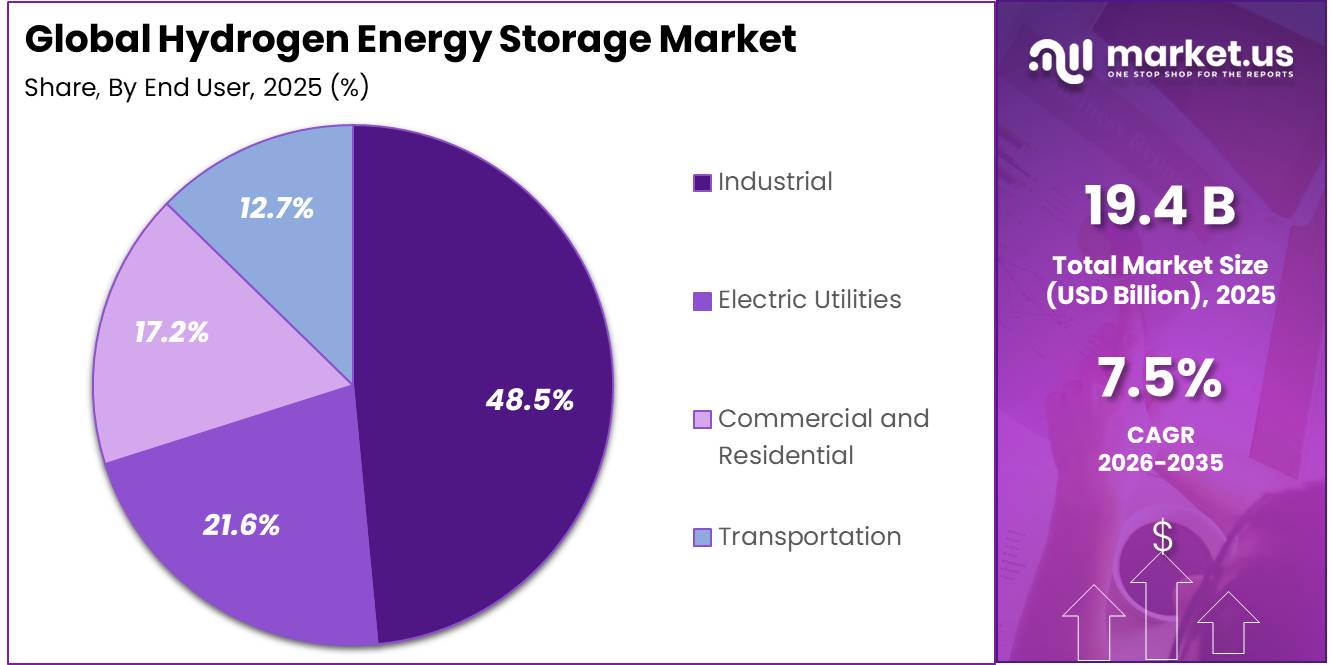
- On the basis of end user, industrial dominated the market, constituting 48.5% of the total market share.
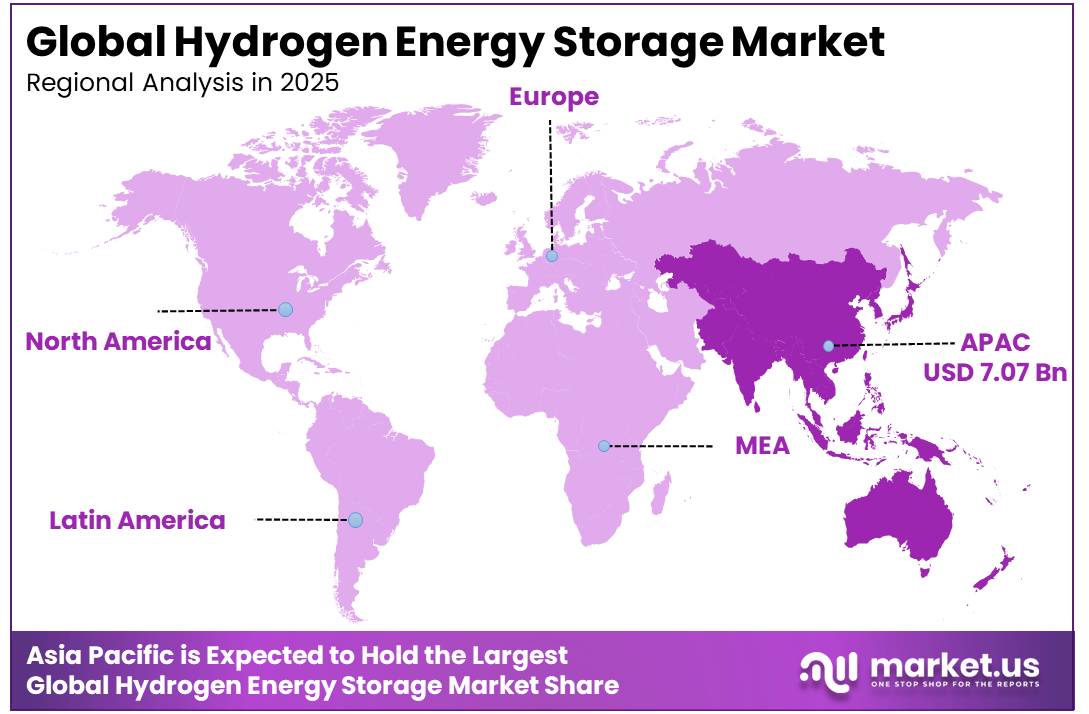
- In 2025, Asia Pacific was the most dominant region in the market, accounting for 36.5% of the total global consumption.
Market Segmentation Overview
Storage Technology Analysis
Material-based Storage accounted for the largest share of 42.6% in 2025, supported by its high storage efficiency and improved operational safety.
In 2025, Material-based Storage dominated the Hydrogen Energy Storage Market with a 42.6% share. The segment is driven by its capability to store hydrogen within solid or liquid materials instead of depending solely on high-pressure storage vessels. Technologies including metal hydrides, porous sorbents, and chemical storage materials are advancing to enhance hydrogen storage density, improve safety, and enable controlled hydrogen release. According to the U.S. Department of Energy, material-based storage remains a key long-term solution for stationary, portable, and transportation applications because it can operate at lower pressures while enabling more compact and efficient storage systems.
Physical State Analysis
Solid held the leading position with a 42.3% market share in 2025 due to its high storage density and enhanced safety advantages.
In 2025, the Solid segment captured more than 42.3% of the Hydrogen Energy Storage Market by physical state. Solid-state storage technologies retain hydrogen within metal hydrides, chemical compounds, and porous materials, providing high volumetric storage capacity while reducing dependence on extremely high-pressure tanks. These systems are well suited for stationary energy storage, industrial backup power, and applications where space efficiency and operational safety are critical. During 2025, the European Union’s REMEDHYS project advanced the development of a solid-state metal-hydride storage system capable of storing 100 kg of hydrogen at pressures below 50 bar alongside a 2 MW electrolyser. In parallel, the U.S. Department of Energy continued supporting research on metal hydrides, sorbents, and chemical hydrogen storage materials to improve storage performance and long-term durability.
Application Analysis
Stationary Power led the market with a 32.0% share in 2025, driven by its role in supporting reliable and flexible electricity systems.
In 2025, Stationary Power represented more than 32.0% of the Hydrogen Energy Storage Market. The segment benefits from hydrogen’s ability to convert excess renewable electricity into stored energy that can be used when renewable generation declines or electricity demand increases. This capability strengthens grid stability, supports industrial power requirements, and provides dependable backup electricity. According to the European Commission’s June 2025 update, the HYFLEXPOWER demonstration project was designed to generate 12 MW of electricity using fuel mixtures containing up to 100% hydrogen, highlighting the growing deployment of hydrogen-based stationary power solutions.
End User Analysis
Industrial emerged as the largest end-user segment with a 48.5% share in 2025, supported by consistent hydrogen demand across major process industries.
In 2025, the Industrial segment accounted for more than 48.5% of the Hydrogen Energy Storage Market. The segment’s leadership is supported by extensive hydrogen consumption in petroleum refining, ammonia production, chemical manufacturing, and other high-temperature industrial processes that require continuous and reliable hydrogen supply. According to the UK government, national hydrogen demand reached 12 TWh during the year, with petroleum refineries representing approximately 75% of total consumption. These established industrial applications continue to drive investment in hydrogen production, storage, and onsite distribution infrastructure.
Drivers
Growing Renewable Power Capacity Drives Hydrogen Storage Demand
The rapid expansion of renewable electricity generation is creating a greater need for long-duration energy storage, making hydrogen an increasingly important solution for balancing power systems. As more wind and solar projects are connected to national grids, excess electricity produced during periods of high generation can be converted into hydrogen through electrolysis and stored for later use when renewable output declines. This helps improve grid reliability while reducing energy waste.
According to the International Energy Agency (IEA), global renewable electricity capacity increased by almost 700 GW in 2024, marking the largest annual capacity addition ever recorded. The International Renewable Energy Agency (IRENA) also reported that global renewable power capacity reached 4,448 GW (4.45 TW) at the end of 2024. Governments are supporting this transition through hydrogen strategies, funding for electrolyser deployment, and clean energy programs that encourage large-scale hydrogen storage. As renewable electricity continues to expand worldwide, hydrogen storage is becoming an essential part of building reliable and flexible low-carbon energy systems.
Major Challenges
Business Opportunities
Expansion Of Green Hydrogen Projects Creates Significant Storage Opportunities
The rapid development of green hydrogen projects is creating strong business opportunities for the Hydrogen Energy Storage Market. As countries invest in renewable hydrogen production, demand is increasing for reliable storage systems that can balance supply, support industrial consumption, and provide long-duration energy reserves. Hydrogen storage facilities are becoming an essential part of integrated hydrogen value chains, enabling energy produced from wind and solar resources to be used whenever needed.
According to the International Energy Agency (IEA), the global pipeline of announced low-emissions hydrogen projects reached more than 1,500 projects by 2025, covering production, transport, storage, and end-use applications. To accelerate commercialization, the European Commission launched the European Hydrogen Bank, allocating €2.2 billion to support renewable hydrogen production and encourage private investment across the hydrogen ecosystem. Similar government-backed initiatives in several countries are strengthening demand for advanced storage technologies, including underground storage, compressed gas systems, and material-based solutions. As hydrogen production capacity expands, investment in efficient and scalable storage infrastructure is expected to become one of the strongest business opportunities across the clean energy sector.
Use Cases
Grid Balancing and Renewable Energy Integration
Hydrogen energy storage is increasingly used to absorb surplus electricity generated from wind and solar power and supply it back to the grid when renewable generation falls. Through electrolysis, excess electricity is converted into hydrogen, stored for weeks or even months, and later reconverted into electricity using fuel cells or hydrogen turbines. This provides seasonal and long-duration energy storage that batteries cannot economically deliver at large scale. According to the International Energy Agency (IEA), renewable electricity capacity additions reached almost 700 GW in 2024, creating a growing need for long-duration storage solutions. Hydrogen storage is becoming an important tool for maintaining grid stability as renewable energy penetration increases.
Regional Analysis
Asia-Pacific Dominates the Hydrogen Energy Storage Market
In 2025, Asia-Pacific held the leading position in the Hydrogen Energy Storage Market, accounting for 36.5% of the global market and generating USD 7.07 billion in revenue. The region’s strong market position is supported by China’s well-established electrolyser manufacturing industry, Japan’s hydrogen-based power generation initiatives, South Korea’s clean energy transition policies, and expanding hydrogen production projects across Australia and Southeast Asia.
Rapid growth in solar and wind power capacity has increased the need for long-duration energy storage solutions that can capture excess renewable electricity and deliver power during periods of lower generation. Demand is also driven by industries such as petroleum refining, chemicals, steel manufacturing, shipping, and power generation, where hydrogen is becoming an important energy carrier. Ongoing investments in underground storage caverns, compressed and liquid hydrogen tanks, ammonia-based transport systems, and hydrogen pipeline infrastructure continue to strengthen the region’s hydrogen storage capabilities and support its long-term market leadership.
Recent Developments
- In September 2025, Linde plc, as part of its New Product Development strategy, introduced a next-generation liquid hydrogen trailer with a carrying capacity of 3.9 metric tons. The trailer offers 50% higher payload capacity than conventional European liquid hydrogen containers while reducing heat transfer to less than 100 watts, enhancing hydrogen storage performance and transportation efficiency.
- In August 2025, Air Products and Chemicals successfully completed the first liquid hydrogen filling of the world’s largest hydrogen storage sphere at NASA’s Kennedy Space Center. The project involved the delivery of more than 50 trailer loads and over 730,000 gallons of liquid hydrogen. The storage sphere has a total capacity of 1.25 million gallons, making it approximately 50% larger than the facility’s previous hydrogen storage tanks.
Conclusion
The Hydrogen Energy Storage Market is expected to play a vital role in supporting the global transition toward low-carbon and renewable energy systems. Rising investments in wind and solar power are increasing the need for long-duration energy storage, where hydrogen offers advantages for seasonal storage, industrial energy supply, and grid balancing.
According to the International Energy Agency (IEA), global renewable electricity capacity additions reached almost 700 GW in 2024, while governments across Europe, Asia-Pacific, and North America continue to expand hydrogen production, storage, and transport infrastructure through dedicated funding programs and national hydrogen strategies.
Advances in electrolysers, underground storage, material-based storage technologies, and hydrogen transport networks are further strengthening commercial adoption. Although infrastructure costs and storage challenges remain, continued policy support and technological innovation are expected to improve project viability. As clean hydrogen becomes more integrated into power generation, transportation, and industrial applications, hydrogen energy storage is likely to become an essential component of future resilient and flexible energy systems.




















