


Overview
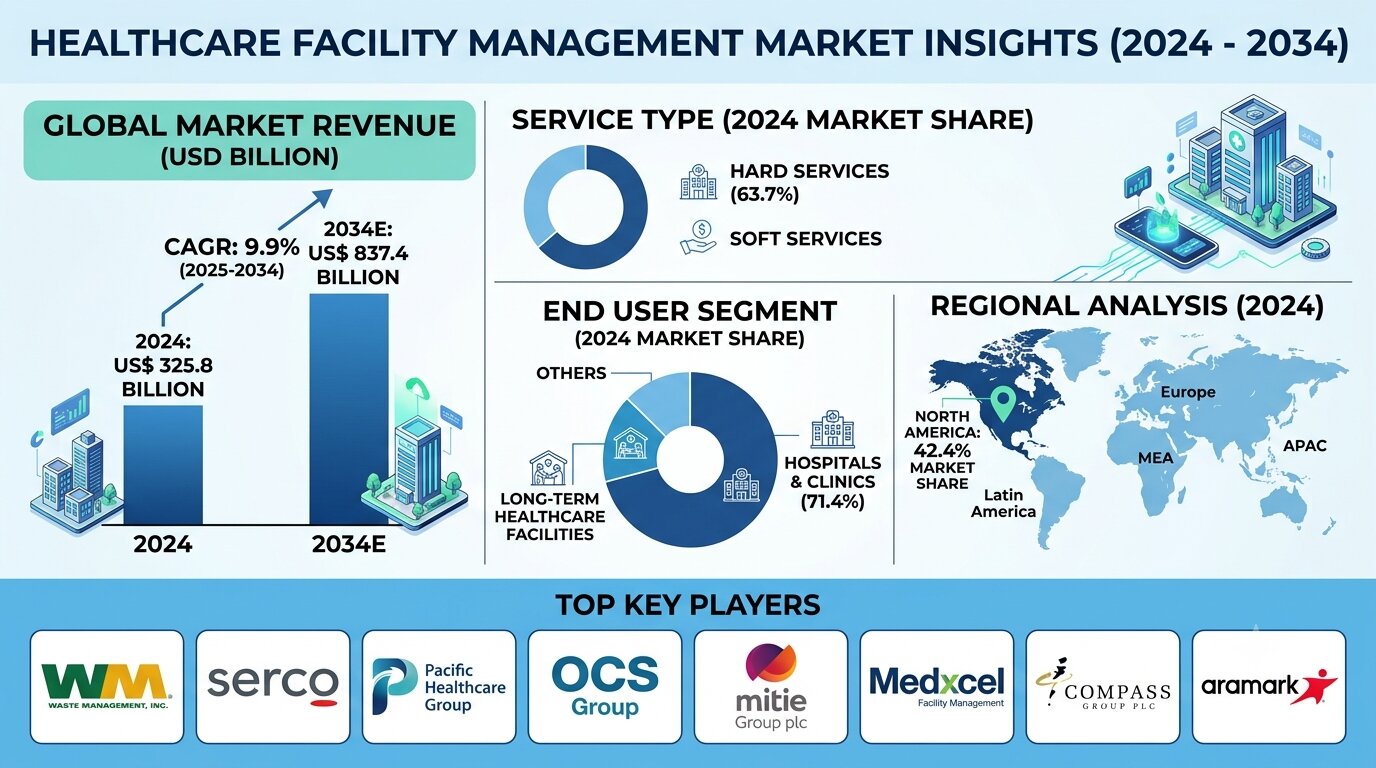
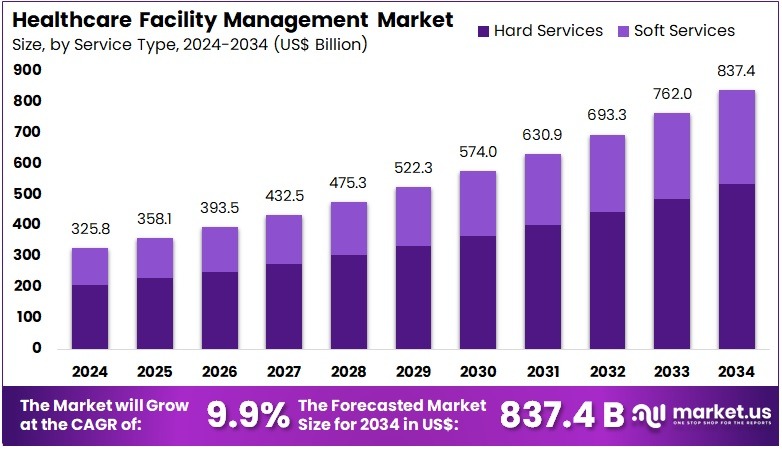
The Healthcare Facility Management Market Size is expected to be worth around US$ 837.4 Billion by 2034 from US$ 325.8 Billion in 2024, growing at a CAGR of 9.9% during the forecast period 2025 to 2034.
The global healthcare facility management landscape is gaining importance as healthcare providers increasingly focus on maintaining safe, reliable, hygienic, and resilient environments for patients and healthcare workers. Facility management encompasses critical functions such as building maintenance, utilities, energy management, sanitation, waste handling, environmental services, and infrastructure operations.
The growing emphasis on healthcare infrastructure is reinforced by recent evidence from the World Health Organization (WHO) and UNICEF. Their 2025 global progress report found that 101 countries had provided validated data on water, sanitation, hygiene, waste, and electricity services in healthcare facilities, compared with 47 countries in 2020.
Infrastructure gaps continue to create substantial operational challenges. WHO and UNICEF reported that in 2023, approximately 1.1 billion people were served by healthcare facilities lacking basic water services, while 3 billion lacked basic sanitation services. In addition, nearly 1 billion people in low- and lower-middle-income countries relied on facilities without reliable electricity or with no electricity access.
Energy efficiency is also becoming an important facility-management priority. The U.S. Department of Energy has conducted hospital energy monitoring covering heating, cooling, lighting, pumps, fans, and other major energy-consuming systems, highlighting opportunities for better operational management and efficiency. These developments are encouraging healthcare organizations to strengthen preventive maintenance, digital facility monitoring, energy optimization, infection-control infrastructure, and climate-resilient facility planning.
Key Takeaways
- In 2024, the global healthcare facility management market generated US$ 325.8 billion in revenue and is projected to reach US$ 837.4 billion by 2034, expanding at a CAGR of 9.9% during the forecast period.
- By service type, the market is segmented into hard services and soft services, with hard services accounting for the leading share of 63.7% in 2024.
- Based on end user, the healthcare facility management market is categorized into hospitals & clinics, long-term healthcare facilities, and others. Hospitals & clinics dominated the segment with a 71.4% market share in 2024.
- Regionally, North America held the largest share of the global healthcare facility management market at 42.4% in 2024.
Statistical Information
- NHS England reported that running the NHS estate cost £14.0 billion in 2024/25, highlighting the scale of expenditure associated with healthcare buildings, infrastructure, utilities, and facility operations.
- NHS trusts consumed 11.3 billion kWh of energy in 2024/25, demonstrating the importance of energy monitoring, efficiency programs, HVAC optimization, and building-management solutions across healthcare facilities.
- The estimated NHS maintenance backlog reached £15.9 billion in 2024/25, indicating substantial opportunities for infrastructure renewal, preventive maintenance, asset management, and modernization services.
- NHS cleaning services cost £1.6 billion in 2024/25, underscoring the significant operational role of environmental and soft facility-management services in healthcare.
- 70% of respondents in the 2024 NHS Adult Inpatient Survey said their hospital room or ward was “very clean.” Patient feedback also identified areas such as bed linen, toilets, and spaces beneath beds as areas where cleanliness could be improved.
- U.S. Department of Energy monitoring found annual fan energy use of 51.0 kBtu/ft²-year at Massachusetts General Hospital’s Gray Building, highlighting the importance of HVAC and ventilation efficiency in hospital facilities.
- DOE measured annual lighting and other electric-load energy use of 86.2 kBtu/ft²-year at Massachusetts General Hospital’s Gray Building, supporting opportunities for lighting controls, electrical optimization, and energy-management technologies.
- DOE identified opportunities to improve idle-mode energy consumption from medical equipment, including using controls that reduce unnecessary power consumption while maintaining rapid response and emergency readiness.
- The CDC recommends more frequent cleaning and disinfection of high-touch surfaces, including door handles, bed rails, light switches, and surfaces around patient-room toilets, creating an ongoing need for structured environmental-services programs.
Market Segmentation Analysis
Service Type Analysis
The hard services segment accounted for 63.7% of the healthcare facility management market, supported by growing demand for reliable infrastructure maintenance and operational efficiency. These services cover critical systems such as HVAC, electrical installations, plumbing, and building maintenance, which help healthcare facilities maintain safe, functional, and compliant environments. Rising investments in hospital construction, renovation, and modernization are expected to further strengthen demand for hard services.
Healthcare providers are increasingly focusing on preventive maintenance to minimize equipment downtime, improve facility performance, and ensure uninterrupted operations. As healthcare infrastructure becomes more complex, the need for specialized technical maintenance is expected to support steady growth of the hard services segment.
End User Analysis
The hospitals & clinics segment held a 71.4% market share, representing the dominant end-user category in healthcare facility management. Hospitals and clinics require comprehensive facility management due to high patient volumes, complex medical operations, and continuous infrastructure requirements. Increasing investments in healthcare infrastructure are encouraging providers to improve asset management, utilities, maintenance, and operational efficiency.
The expansion of hospital networks and modernization of healthcare facilities is expected to further increase demand. In addition, growing emphasis on regulatory compliance, cost optimization, patient safety, and uninterrupted healthcare delivery is prompting hospitals and clinics to strengthen facility management capabilities, supporting continued expansion of this segment.
Regional Analysis
North America is Leading the Healthcare Facility Management Market
North America accounted for the largest share of the healthcare facility management market at 42.4% in 2024, supported by strong regulatory oversight and the need for safe, efficient healthcare infrastructure. In the U.S., the Centers for Medicare & Medicaid Services (CMS) oversees compliance with Medicare and Medicaid health and safety standards across hospitals and other healthcare facilities. CMS also conducts certification and oversight activities focused on quality, safety, and facility compliance.
Asia Pacific to Register the Fastest Growth
Asia Pacific is expected to record the highest CAGR, driven by healthcare infrastructure development and changing demographic needs. WHO reports that India’s government health spending represented 1.8% of GDP in 2021–22, while initiatives such as the Ayushman Bharat Health Infrastructure Mission are supporting infrastructure development. Population ageing is another important factor, with WHO indicating that the older population in Southeast Asia is expected to double by 2050, increasing demand for stronger, accessible, and well-managed healthcare systems.
Business Opportunities
The healthcare facility management market offers broad opportunities for companies providing integrated infrastructure, maintenance, and operational services. Demand is increasing for solutions that help healthcare organizations maintain safe, reliable, and resilient facilities while improving the coordination of buildings, assets, utilities, and support services. WHO emphasizes the importance of well-planned infrastructure, water, energy, telecommunications, and facility management in maintaining effective hospital operations.
Digital facility management is an important opportunity, particularly through predictive maintenance, remote monitoring, computerized maintenance management systems, asset tracking, and smart-building technologies. Energy-management services also offer scope for growth as hospitals seek better control of heating, cooling, lighting, ventilation, pumps, and other building systems.
Additional opportunities exist in HVAC maintenance, electrical and plumbing services, environmental cleaning, healthcare waste management, water and sanitation management, and infection-prevention infrastructure. WHO’s WASH FIT framework specifically integrates water, sanitation, hygiene, environmental cleaning, healthcare waste, energy, building, and facility management, creating opportunities for specialized service providers.
Climate-resilient infrastructure, renewable-energy systems, backup power, and sustainable facility solutions can further create opportunities as healthcare providers seek facilities capable of maintaining essential services during disruptions.
Emerging Trends
- Climate-resilient infrastructure: Healthcare operators are increasingly planning facilities around climate risks such as flooding, extreme heat, water shortages, and power disruptions. WHO recommends integrating resilience into infrastructure, energy, water, sanitation, waste management, and technology planning so facilities can continue delivering care during climate-related emergencies.
- Smart water-management systems: Water management is becoming a stronger facility-management priority as hospitals focus on preventing waterborne infections. CDC guidance published in 2026 recommends formal water-management programs and infection-control risk assessments covering water sources, plumbing systems, patient exposure, and vulnerable populations.
- Energy-efficient operating theatres: Hospitals are adopting more controlled ventilation strategies to reduce unnecessary energy consumption while maintaining clinical requirements. NHS England issued new guidance in July 2026 specifically addressing theatre-ventilation controls, showing that intelligent building-system management is becoming part of healthcare energy planning.
- Integrated WASH management: Water, sanitation, hygiene, healthcare waste, and environmental cleaning are increasingly managed as connected facility functions rather than separate services. WHO and UNICEF reported that 107 countries were included in their 2025 WASH progress tracker, reflecting growing adoption of coordinated facility-improvement programs.
- Clean-energy infrastructure: Healthcare facilities are increasingly exploring solar power and other clean-energy solutions to improve reliability and reduce environmental impact. WHO identifies clean and cost-effective energy technologies as important tools for sustainable healthcare electrification and climate resilience, particularly where conventional power supplies are unreliable.
Use Cases
- Predictive building maintenance: Facility teams can use monitoring systems to identify abnormal equipment conditions before failures occur. Applications include tracking HVAC, pumps, electrical systems, plumbing, and other critical infrastructure, helping maintenance teams schedule interventions earlier and reduce disruption to healthcare operations.
- Waterborne infection prevention: Hospitals can use water-management programs to identify hazardous plumbing conditions and establish corrective actions. CDC recommends assessing water sources, transmission routes, patient susceptibility, and exposure risks, making plumbing monitoring an important use case for healthcare facility-management teams.
- Post-disaster facility recovery: Facility managers and engineering teams can use structured assessment processes following floods, storms, or water damage. CDC guidance recommends evaluating building structures, utilities, ventilation, medical equipment, and contaminated materials before healthcare facilities are repaired and reopened.
- Environmental cleaning optimization: Digital scheduling, monitoring, and quality-control systems can support cleaning teams across patient rooms, treatment areas, toilets, and other high-risk environments. CDC guidance connects effective environmental cleaning with adequate water, wastewater, sanitation, and facility infrastructure.
- Healthcare waste management: Facility managers can integrate waste segregation, collection, treatment, storage, and disposal into broader environmental-management programs. WHO identifies healthcare waste as a core component of safe facility operations, while its 2025 guidance encourages stronger integration of WASH, waste, energy, and quality-of-care improvement activities.
Recent Developments
- In July 2026, OCS announced a recommended acquisition of Mitie, subject to shareholder and regulatory approvals, to combine two major facilities-management businesses and strengthen capabilities across healthcare, life sciences, government, defence, and other mission-critical environments.
- In May 2026, Mitie secured a £27 million, three-year facilities-management contract with Kingston and Richmond NHS Foundation Trust, covering intelligence-led cleaning, portering, and waste management. The agreement includes AI-driven task management, smartphone tracking, electric portering vehicles, and measures targeting a 5% annual reduction in the Trust’s carbon emissions.
- In October 2025, Aramark Healthcare+ signed a multi-year agreement with the University of Pennsylvania Health System, beginning in early 2026, to provide patient and retail food, environmental services, patient transportation, and an integrated call center across UPHS’s nearly 4,000-bed, seven-hospital system.
- In October 2025, Mitie won an £11.8 million facilities-management contract with Barking, Havering and Redbridge University Hospitals NHS Trust, covering five healthcare sites. Services include cleaning, security, waste management, patient catering, reception, pest control, and smart portering using AI-driven task management and smartphone tracking.
- In July 2025, Compass Group agreed to acquire Vermaat Groep B.V. for an enterprise value of approximately €1.5 billion. The transaction expands Compass Group’s premium food-services operations in Europe and strengthens its capabilities in complex client environments, including healthcare and other institutional settings.
- In January 2025, YY Group entered into an agreement to acquire approximately 99.99% of Singapore-based Property Facility Services Pte. Ltd. The consideration included $816,000 in cash, $784,000 in deferred cash subject to adjustment, and 143,516 YY Group shares, expanding its integrated facilities-management operations in Singapore.
Conclusion
The healthcare facility management market is evolving as healthcare providers place greater emphasis on operational efficiency, patient safety, infrastructure resilience, and sustainable facility operations. Demand for hard services, particularly among hospitals and clinics, remains strong as healthcare organizations modernize buildings, utilities, and critical systems.
Digital monitoring, predictive maintenance, smart energy management, water safety, environmental cleaning, and climate-resilient infrastructure are creating new opportunities for service providers and technology companies. Regional demand is also supported by healthcare infrastructure development and rising operational complexity. Strategic partnerships, technology adoption, acquisitions, and integrated service models are expected to further strengthen competition and innovation across the healthcare facility management sector.




















